Archive for the ‘Saintly People’ Category

What We Should Do Now

March 25, 2020

The Solemnity of the Annunciation

The angel Gabriel was sent from God to a town of Galilee called Nazareth, to a virgin betrothed to a man named Joseph, of the house of David, and the virgin’s name was Mary. And coming to her, he said, “Hail, full of grace! The Lord is with you.” But she was greatly troubled at what was said and pondered what sort of greeting this might be. Then the angel said to her, “Do not be afraid, Mary, for you have found favor with God. Behold, you will conceive in your womb and bear a son, and you shall name him Jesus. He will be great and will be called Son of the Most High, and the Lord God will give him the throne of David his father, and he will rule over the house of Jacob forever, and of his Kingdom there will be no end.”

But Mary said to the angel, “How can this be, since I have no relations with a man?” And the angel said to her in reply, “The Holy Spirit will come upon you, and the power of the Most High will overshadow you. Therefore the child to be born will be called holy, the Son of God. And behold, Elizabeth, your relative, has also conceived a son in her old age, and this is the sixth month for her who was called barren; for nothing will be impossible for God.” Mary said, “Behold, I am the handmaid of the Lord. May it be done to me according to your word.” Then the angel departed from her.


What would it be like to be visited by an angel? Scripture tells us “some [people] have unknowingly entertained angels,” like Gideon or Tobiah, because angels can appear on earth in human disguise. But if you ever saw an angel in unveiled glory this spiritual creature would not be a winged Precious Moments character like some people imagine. As C.S. Lewis writes in the preface of his book The Screwtape Letters:

In the plastic arts [the symbolic representations of angels] have steadily degenerated. Fra Angelico’s angels carry in their face and gesture the peace and authority of Heaven. Later come the chubby infantile nudes of Raphael; finally the soft, slim, girlish and consolatory angels of nineteenth-century art… They are a pernicious symbol. In Scripture the visitation of an angel is always alarming; it has to begin by saying “Fear not.” The Victorian angel looks as if it were going to say “There, there.

When the Archangel Gabriel came and greeted the Virgin Mary in Nazareth, “she was greatly troubled.” He must calm and reassure her, “Do not be afraid, Mary, for you have found favor with God.” His message from Heaven is a weighty and mysterious one: you shall conceive and bear the Messiah, the Christ, who is both the heir to David’s kingdom and the Son of Almighty God. Mary has apparently made a prior vow to remain a virgin within her current marriage to Joseph, for she questions how she would ever conceive apart from relations with a man. Gabriel explains this will be through the power of God, for whom all things are possible. Even this answer leaves a great deal unrevealed.

It’s natural for Mary to feel anxious. She has heard God’s promises but much remains uncertain for her near and distant future: Will Joseph believe her? How should she parent such a Holy Child? How will Jesus become king? What will happen to her? How long or difficult will her life be? God’s full plan is unknown to Mary, but she knows what to do for that moment. She says, “Behold, I am the handmaid of the Lord. May it be done to me according to your word.” Through this faithful, trusting response, Jesus Christ saves his Church, the Virgin Mary becomes the Most Blessed, and every generation is blessed.

It’s natural to feel anxious now. We have received God’s promises but much remains uncertain about our near and distant future. Follow Mary’s example and entrust your life to God’s will, so that you may be the most blessed and a great multitude may be blessed through you.

Finding Jesus in the Temple

March 19, 2020

The Solemnity of St. Joseph

Each year Jesus’ parents went to Jerusalem for the feast of Passover, and when he was twelve years old, they went up according to festival custom. After they had completed its days, as they were returning, the boy Jesus remained behind in Jerusalem, but his parents did not know it. Thinking that he was in the caravan, they journeyed for a day and looked for him among their relatives and acquaintances, but not finding him, they returned to Jerusalem to look for him.

After three days they found him in the temple, sitting in the midst of the teachers, listening to them and asking them questions, and all who heard him were astounded at his understanding and his answers. When his parents saw him, they were astonished, and his mother said to him, “Son, why have you done this to us? Your father and I have been looking for you with great anxiety.” And he said to them, “Why were you looking for me? Did you not know that I must be in my Father’s house?” But they did not understand what he said to them.


Joseph and Mary feel great anxiety in these days. Jesus is missing and Jerusalem could be dangerous. Yet the young Lord Jesus is not lost. Retracing their steps they find him in the Temple. He’s dialoguing with the Jewish teachers, perhaps answering their replies with more probing questions of his own in the tradition of the rabbis.

Mary asks her Son, “Why have you done this to us?” Her anxiety, perhaps even touched by anger, is natural. Jesus has purposes in these events that his parents do not fully grasp, but they still love him and he loves them too. “Why were you looking for me? Did you not know that I must be in my Father’s house?” Jesus could have been found by his parents sooner; he was in the Temple the whole time.

You may feel great anxiety in these days. With the suspension of public Masses you could feel like Jesus is missing. Given the serious reports of disease the city could be dangerous. Yet we have not lost Jesus. Retracing your steps you can find him in the church.

What questions are you asking Jesus in prayer? What question does he pose you in reply? Perhaps you ask, “Why have you allowed this to happen to us?” Our feelings of anxiety or anger are natural. Jesus has purposes in these events that we do not fully grasp, but we still love him and he loves us too.

And Jesus can still be found nearby; he has been present in the tabernacle of the church this whole time. You can find Jesus in his Temple by visiting the Real Presence of our Eucharistic Lord. St. Paul’s Church is open daily, 7 AM to 7 PM and St. John the Baptist’s Church is open 8 AM to 7 PM on Saturdays, Sundays, Tuesdays, & Thursdays. These churches will be spray-disinfected for each day they are open, but use the cleaning materials located in the back of church to clean your seating area before and after use.

Follow these important safety tips as they might save your life or the lives of others’:

  • Realize that possibly 80% of confirmed cases of Coronavirus are contracted from people who did not realize they were sick and that symptoms typically take five days to manifest. Therefore, we must guard against this disease before we know it is among us. Practice social distancing.
  • If you have a cough or a fever, you might not be sick with the Coronavirus but please stay home; this virus can linger in the air and upon surfaces and infect others.
  • Remember that the virus can survive on surfaces (such as door handles, pews, and clothing) for one, two, or three days; so avoid touching your eyes, nose, or mouth. Treat unwashed hands as if they were infected and clean them often with soap and water.
  • Maintain at least a six-foot distance from other people.
  • No more than nine persons can be at the church at once (under emergency Wisconsin state law and by our bishop’s decree).
  • The most common place visitors sit in church is the back pews; so I suggest sitting in other, less-frequented, possibly-safer rows.


St. Joseph,
Patron of the Universal Church
and Protector of the Holy Family,
pray for us in our time of need


A Future Pope on Fasting from the Eucharist

March 18, 2020

In the Latin Rite of the Catholic Church (of which 98.6% of the world’s Catholics are members) there is only one day each year when no Masses are to be celebrated – that is, Good Friday. That day’s liturgy contains a Communion service in which presanctified (previously consecrated) Hosts are received and eaten by the faithful. However, in the early Church, there was no consumption of Holy Communion on Good Fridays by the faithful at all. This tradition was noted by the esteemed theologian Joseph Cardinal Ratzinger (the future Pope Benedict XVI) in his 1986 book “Behold the Pierced One” and again (reprinted) in the 2002 book “Pilgrim Fellowship of Faith: The Church as Communion.”

In passages relevant to our present-day, Lenten reality, Cardinal Ratzinger reflects upon the spiritual value that could be found in the practice of Catholics in full communion with the Church abstaining for a time from consuming Jesus Christ in the Holy Eucharist:

“When Augustine felt his death approaching, he ‘excommunicated’ himself and took upon himself ecclesiastical penitence. In his last days, he set himself alongside, in solidarity, with the public sinners who seek forgiveness and grace through the pain of not receiving the Communion. He wanted to meet his Lord in humility of those who hunger and thirst for righteousness, for Him, the righteous and gracious One. Against the background of his sermons and writings, which describe the mystery of the Church as a communion with the Body of Christ and as the Body of Christ, on the basis of the Eucharist, in a really marvelous way, this gesture is quite shocking. It seems to me more profound and fitting, the more often I ponder it. Do we not often take things too lightly today when we receive the most Holy Sacrament? Could such a spiritual fasting not sometimes be useful, or even necessary, to renew and establish more deeply our relation to the Body of Christ?

In the early Church there was a most expressive exercise of this kind: probably since the time of the apostles, Eucharistic fasting on Good Friday was part of the Church’s spirituality of Communion. Not receiving Communion on one of the most holy days of the Church’s year, which was celebrated with no Mass and without any Communion of the faithful, was a particularly profound way of sharing in the Passion of the Lord: the sorrowing of the bride from whom the bridegroom has been taken away (see Mark 2:20). I think that a Eucharistic fast of this kind, if it were deliberate and experienced as a deprivation, could even today be properly significant, on certain occasions that would have to be carefully considered—such as days of penitence (and why not, for instance, on Good Friday once more?), or also perhaps especially at great public Masses when there are so many people that a dignified distribution of the Sacrament is often not possible, so that by not receiving the Sacrament people could truly show more reverence and love than by doing so in a way that contradicts the sublime nature of this event.

Such fasting—which could not be allowed to become arbitrary, of course, but would have to be consonant with the spiritual guidance of the Church—could help people toward a deepening of their personal relation to the Lord in the Sacrament; it could be an act of solidarity with all those who have a yearning for the Sacrament but cannot receive it. It seems to me that the problem of people who have been divorced and remarried, yet equally the problem of intercommunion (in mixed marriages, for example), would be less of a burden if voluntary spiritual fasting was at the same time undertaken in visible recognition and expression of the fact that we are all dependent upon that ‘healing of love’ which the Lord effected in the ultimate solitude of the Cross. I would not of course wish to suggest by this a return to some kind of Jansenism: in biological life, as in spiritual life, fasting presumes that eating is the normal thing to do. Yet from time to time we need a cure for falling into mere habit and its dullness. Sometimes we need to be hungry—need bodily and spiritual hunger—so as once more to comprehend the Lord’s gifts and to understand the suffering of our brethren who are hungry. Spiritual hunger, like bodily hunger, can be a vehicle of love.”

Saint Patrick’s Growth

March 17, 2020

Did you know that St. Patrick wasn’t born Irish? He was born in Scotland to Roman parents in the late 300’s AD. When he was 16 years old, Patrick was captured by raiders and sold into slavery in Ireland. For six years he shepherded sheep for a cruel master. But this unexpected, unchosen, difficult separation from his family and previous life was the occasion for a religious awakening in Patrick. He recalls in his autobiography:

“The love of God and His fear increased in me more and more, and the faith grew in me, and the spirit was roused, so that, in a single day, I have said as many as a hundred prayers, and in the night nearly the same, so that while in the woods and on the mountain, even before the dawn, I was roused to prayer and felt no hurt from it, whether there was snow or ice or rain; nor was there any slothfulness in me, such as I see now, because the spirit was then fervent within me.”

After these six hard but fruitful years, Patrick heard a voice tell him that he would soon go home and that his ship was ready. He walked two hundred miles to the coast, found a ship, and eventually persuaded the crew to take him along. He left Ireland a better man. Later, in an inspired dream, he heard people of Ireland call out to him, “We appeal to you, holy servant boy, to come and walk among us.” Patrick returned to his former land of slavery as a missionary priest, won converts to Christianity, and is called today the “Apostle of Ireland.” How can you make the most of the recent unexpected, unchosen, disruptions in your life to be changed for the better?

Here is a famous and inspiring prayer attributed to him, “Saint Patrick’s Breastplate” also known as “The Deer Cry”:

I bind to myself today
The strong virtue of the Invocation of the Trinity:
I believe the Trinity in the Unity
The Creator of the Universe.

I bind to myself today
The virtue of the Incarnation of Christ with His Baptism,
The virtue of His crucifixion with His burial,
The virtue of His Resurrection with His Ascension,
The virtue of His coming on the Judgement Day.

I bind to myself today
The virtue of the love of seraphim,
In the obedience of angels,
In the hope of resurrection unto reward,
In prayers of Patriarchs,
In predictions of Prophets,
In preaching of Apostles,
In faith of Confessors,
In purity of holy Virgins,
In deeds of righteous men.

I bind to myself today
The power of Heaven,
The light of the sun,
The brightness of the moon,
The splendour of fire,
The flashing of lightning,
The swiftness of wind,
The depth of sea,
The stability of earth,
The compactness of rocks.

I bind to myself today
God’s Power to guide me,
God’s Might to uphold me,
God’s Wisdom to teach me,
God’s Eye to watch over me,
God’s Ear to hear me,
God’s Word to give me speech,
God’s Hand to guide me,
God’s Way to lie before me,
God’s Shield to shelter me,
God’s Host to secure me,
Against the snares of demons,
Against the seductions of vices,
Against the lusts of nature,
Against everyone who meditates injury to me,
Whether far or near,
Whether few or with many.
I invoke today all these virtues
Against every hostile merciless power
Which may assail my body and my soul,
Against the incantations of false prophets,
Against the black laws of heathenism,
Against the false laws of heresy,
Against the deceits of idolatry,
Against the spells of women, and smiths, and druids,
Against every knowledge that binds the soul of man.

Christ, protect me today
Against every poison, against burning,
Against drowning, against death-wound,
That I may receive abundant reward.
Christ with me, Christ before me,
Christ behind me, Christ within me,
Christ beneath me, Christ above me,
Christ at my right, Christ at my left,
Christ in the fort,
Christ in the chariot seat,
Christ in the poop deck,
Christ in the heart of everyone who thinks of me,
Christ in the mouth of everyone who speaks to me,
Christ in every eye that sees me,
Christ in every ear that hears me.

I bind to myself today
The strong virtue of an invocation of the Trinity,
I believe the Trinity in the Unity
The Creator of the Universe.

We can always call upon Jesus, who is near at hand for us. As he told his disciples at The Great Commission, “Behold, I am with you always, until the end of the age.

Finding Jesus in our Isolation — 3rd Sunday of Lent—Year A

March 16, 2020

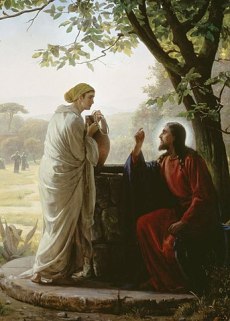
Today’s Gospel story contains a valuable lesson for us in our present situation.

Jesus, tired from his journey, sat down there
at [Jacob’s] well. It was about noon.
A woman of Samaria came to draw water.
Jesus said to her, “Give me a drink.”

There is a weird detail contained in these passages: the woman is going to the well to draw water at noon. It’s hot at noon in the Middle East, so Jesus and the woman are the only ones there. Why didn’t she come in the morning or the evening when the heavy job of hauling water would not have the added burden of the midday sun and heat? It’s because she didn’t want to be there when the other women would be around. Jesus reveals that the woman has no true husband and that she has had five different mates through the years. Jesus knows this supernaturally but her neighbors know something of these facts naturally, through local gossip. This woman has a reputation and if she were to go to that well at the same time as the other women they would make her feel unwelcome, through their words or their silence, with their eyes and their body language. They have quarantined themselves from her and she has socially distanced her heart from them.

In the middle of her day,
in the uncertainties of her life,
amid the stress of her tasks,
in her personal isolation,
she is surprised to encounter Jesus there.

He says to her:

“If you knew the gift of God and who is saying to you, ‘Give me a drink,’ you would have asked him and he would have given you living water. … Whoever drinks the water I shall give will never thirst; the water I shall give will become in him a spring of water welling up to eternal life.”

Jesus wins over the woman’s soul, she leaves her water jar behind and joyfully proclaims her great discovery. Meanwhile, the returned disciples urge Jesus, ‘Rabbi, Teacher, eat something!’ But he says to them, “I have food to eat of which you do not know. … My food is to do the will of the one who sent me and to finish his work.” Of course Jesus is hungry—physical realities are real—but he has nourishment in his soul, from his relationship with God his Father and his deepening relationship with those he has come to save, like this woman at the well.

Now in likening the woman at the well to one quarantined from others, I am not advising you to take unnecessary or imprudent risks amidst this current Coronavirus pandemic. In these months ahead, some of us will be called to acts of particular courage; nurses and doctors come first to mind. But we should not blithely, unnecessarily place ourselves in foreseeable natural dangers expecting God to perform miracles to protect us. Recall how Satan tempted, “If you are the Son of God, throw yourself down from here. For it is written: ‘He will command his angels concerning you’ and ‘with their hands they will support you, lest you dash your foot against a stone.” Jesus answers, “You shall not put the Lord, your God, to the test.” We must not act presumptuously.

The reason I mention the woman finding Jesus in her isolation is because, whatever our health may be, we need to encounter him there as well. Public Masses continue in our diocese, but it is very probable that these will be suspended in the future, just as Catholic Churches suspended public Masses a century ago during the Spanish Flu pandemic. I will personally be very surprised if we are having Mass here together two weeks from today. [Post-Script: On the evening of March 17th, Bishop William Callahan directed his priests to abide by Wisconsin’s statewide ban on all gatherings of more than 10 people announced earlier in the day. As a result, we are cancelling all remaining public Masses at my parishes.] Yet even in times when public Masses are readily available, most hours of our week and not spent inside of a church.

In the middle of your day,
in the uncertainties of your life,
amid the stress of your tasks,
in your personal isolation,
you can encounter Jesus there.

He is with you and within you, so you are never really alone.
Jesus says:

“Let anyone who thirsts come to me and drink.
Whoever believes in me, as scripture says:
‘Rivers of living water will flow from within him.’”

Wherever you are, find him there, and draw on his graces.

I seem to recall a story about St. Faustina Kowaska, the Polish nun and visionary most closely associated with the Divine Mercy devotion. When she was confined to her convent infirmary, suffering from the tuberculosis which would eventually take her life, she lamented that for one or more days in a row she had been unable to receive Holy Communion. In a vision, Jesus reassured her, saying, ‘Whenever you receive me in the Eucharist, I remain within you until you receive me again, unless you cast me out through mortal sin.’ Similarly, in the sixth chapter of John, Jesus famously declares:

“I am the bread of life; whoever comes to me will never hunger, and whoever believes in me will never thirst. … Whoever eats my flesh and drinks my blood remains in me and I in him.”

Christ’s Church encourages frequent, even daily, reception of Holy Communion as a helpful devotion toward holiness, but whether your next communion is one week or three months from now, know that Jesus is with you to provide his sufficient graces for your life. If public Masses are suspended in our diocese, realize that I and other Catholic priests, even if standing alone in our churches, will still be offering the Holy Mass daily for you and the whole world. And we will be bringing Confession, Holy Anointing, and Viaticum to the sick, as is our calling and duty, for as long as we are able. This Wuhan Coronavirus pandemic is rightfully concerning. (I urge you to read my bulletin article this weekend.) But whatever comes we need not fear, for “we know that all things work for good for those who love God,” and “whether we live or die, we are the Lord’s.” As Jesus would very often say, “Be not afraid.

Concerning Coronavirus

March 12, 2020

Coronavirus is a Serious Concern

The Wuhan Coronavirus is very contagious and estimated by Dr. Anthony S. Fauci, head of the National Institute of Allergy and Infectious Diseases, to be ten times deadlier than the seasonal flu. This new pandemic poses some small danger to the young but puts the elderly and those with underlying health issues at much graver risk. In Italy, where 6% of those confirmed to be infected with Coronavirus have died thus far, the Italian Catholic bishops have suspended all public Masses in their churches until at least April 3rd. And in Washington State, where 31 people have died, the Catholic Archdiocese of Seattle has suspended all public Masses indefinitely.

Due to current limitations in the United States’ ability to test for the Coronavius, it is unclear how pervasively the illness is spreading in this country. For some idea of how bad things could become, according to the Centers for Disease Control and Prevention’s (CDC) figures the less contagious and less lethal Influenza virus has infected between 3% to 14% of Americans per year since 2010, resulting in 12,000 to 61,000 deaths annually. If, hypothetically, 14% of Americans go on to catch this new Coronavirus and its mortality rate proves to be 1% (as Dr. Fauci predicted this Wednesday in his testimony before Congress) it will result in 458,000 U.S. deaths. The Wuhan Coronavirus is clearly a matter for our serious attention.

Signs of Illness & Means of Prevention

What are the symptoms of the Wuhan Caronavirus? The World Health Organization (WHO) reports that among confirmed cases about 90% of patients manifest a high fever and about 70% have a dry cough. Shortness of breath is another noted symptom. If someone believes they are infected, the CDC recommends calling ahead to their personal doctor or hospital for instructions rather than just walking into their local E.R. and possibly infecting others. The sick are urged to stay home and to wear a mask to prevent spreading the disease. There is currently no vaccine to protect against this Coronavirus and a safe vaccine is not expected for at least another year.

The CDC says the virus is thought to spread mainly person-to-person, between people in close contact with one another (6 feet or less,) especially from the coughs or sneezes of an infected person. They recommend frequently washing your entire hands with soap and water for at least 20 seconds or (if soap and water are not available) to use hand sanitizer with at least 60% alcohol content. They also urge no touching of your eyes, nose, or mouth with unwashed hands, disinfecting commonly touched surfaces, avoiding contact with those who are sick, and distancing yourself from other people in general.

Missing Mass & Spiritual Communion

Common, good, and prudent reasons for missing Sunday Mass include being ill, dangerous conditions, or needing to care for another person. Therefore, when someone is sick, or believes that venturing out would be dangerous, or believes that the risk of bringing a sickness back home to someone in their care is too great, they are excused from attending Sunday Mass. However, if someone is avoiding Sunday Mass as a too-risky activity then it seems that person also should not be attending parties, going to the movies, out shopping for non-essential items, and the like, but rather social distancing in a way consistent with one’s concern. And if you will be missing Mass for an extended time, to help ensure the continued health of your parish consider registering for automatic withdrawal (ACH) giving from your checking account. Additionally, even if one has a legitimate reason to skip Mass, our duty to worship God and rest on the Lord’s Day remains.

Jesus Christ’s Catholic Church encourages frequent (even daily) Holy Communion, but if we cannot attend Mass we can still unite ourselves to Our Lord by making a Spiritual Communion. St. Teresa of Ávila wrote, “When you do not receive Communion and you do not attend Mass, you can make a Spiritual Communion, which is a most beneficial practice; by it the love of God will be greatly impressed on you.” Once, in a vision, Jesus showed St. Catherine of Siena two chalices, one gold and one silver. He said her Sacramental Communions were preserved in the gold chalice and her Spiritual Communions in the silver one. A Spiritual Communion with Jesus is the next best thing to physically receiving Him in the Eucharist.

If public Masses are suspended in your diocese, remember that the Holy Mass can be seen on TV or online as a next best alternative. Know that the daily Mass readings can be found at the U.S. Conference of Catholic Bishops (USCCB) website. And realize that Catholic priests, even if standing alone in their churches, will still be offering the Holy Mass daily for the whole world and bringing Confession, Holy Anointing, and Viaticum to the sick for as long as they are able. The Wuhan Coronavirus pandemic is rightfully concerning, but whatever comes we need not fear, for “we know that all things work for good for those who love God,” and “whether we live or die, we are the Lord’s.” (Romans 8:28,14:8) As Jesus often said, “Be not afraid.

Shepherds & Fishermen — 3rd Sunday in Ordinary Time—Year A

March 3, 2020

What did the twelve apostles do for a living before Jesus called them to follow him? For six of the first apostles, that is half of the original twelve, we have no words from Scripture concerning their previous jobs. We are told that St. Matthew was a tax collector for the Roman government. We also hear of St. Simon the Zealot, who was either especially zealous in his personal religious devotion, or had ties to the Jewish Zealot movement is Israel. The Zealot movement sought, through politics and insurrection, to overthrow the Roman government in the Promised Land. If Matthew and Simon did indeed come from opposite sides of that era’s political spectrum, it suggests that every political party or faction has important things to learn from Jesus Christ.

In today’s Gospel, we learn the shared profession of four other apostles: Simon Peter, Andrew, James, and John; they were commercial fishermen. Now the Lord choosing men from the fishing industry was something new in salvation history. In the Old Testament, God often employs shepherds in his holy service. Among the patriarchs there is Abraham, Jacob-Israel, and his twelve sons – shepherds all. Later there’s the prophet Moses, King David, and Amos the prophet, each of whom tended flocks for some time before receiving their higher calling from God. As far as I can tell, there are no fishermen of particular note in the Bible before these four to whom Jesus says, “Come after me, and I will make you fishers of men.” Jesus, in calling fishermen, is doing something new. Now if the fishing background of these four apostles were irrelevant, I doubt the Holy Spirit would have inspired the inclusion of this fact into the Gospels. So what is the significance of this detail?

The work of a shepherd is different from that of fisherman. A shepherd tends his flock. He knows his sheep and his sheep know him. Some new lambs are born while other, older sheep go off to market or return to the earth, but the size of the sheepfold tends to remain rather stable. A fisherman, on the other hand, through his practiced skills and God’s providence, seeks and finds new fish every day. The fish are living in their own dark, watery world until the fisherman gathers them to himself. A shepherd maintains his numbers, but a fisherman goes out to seek more and more. Jesus chose his apostles not only to shepherd his people Israel, but to go forth to fish for people from all nations. Jesus made Peter not only a “fisher of men” but commanded him to ‘”feed my lambs… tend my sheep… feed my sheep.

Today we primarily think of water as a symbol of life, because nothing lives without water. Yet in the ancient world, water was often seen as a symbol of death. It’s possible even on a calm day to drown in a river, lake, or sea, but the volatile, deadly nature of large bodies of water is the subject of stories, poems, and songs even up to our day. For example:

The legend lives on from the Chippewa on down
Of the big lake they called Gitche Gumee
Superior, they said, never gives up her dead
When the gales of November come early

Fish live with this realm of death, a dark, watery world. The fisherman brings fish into the light, to a higher realm, a world they had previously ignored or never imagined. In our semi-post-Christian world today, is Jesus calling you and I to be shepherds or fishermen? Are we meant to maintain our flock, or to endeavor for more unnetted souls? There is need for both missions. In fact, we are called to do both. Many around us are baptized and still identify as Christians, yet how deep does their faithful devotion really go? Peter and Andrew left their careers for Jesus. James and John left their family for Jesus. Yet how few people today even come to church for him. True devotion and divine relationship is ignored or never imagined. Jesus calls you to be a missionary; not on the far side of the earth so much as in our own community. Be able to give witness to him. When I was a kid, when we were driving home from Sunday Mass, my family would often talk about what we heard in the homily. Today you your drive home from church I encourage you to ask each other: Why did you come to church today? What difference does it make for your life? We need to practice sharing why our faith is a gift with one another so that we can invite others to share this treasure.

In our first reading from St. Paul’s first letter to the Corinthians, we learn that the Christians in Corinth were choosing favorites and forming factions: ‘I belong to Paul. I belong to Apollos. I belong to Cephas.‘ St. Paul writes to remind them, you belong to Christ! Do not allow another person to get in way of Jesus for you. Pastors are important and Jesus has ordained it so, since without clear leadership how could St. Paul’s prayer and Christ’s desire, ‘that all of us agree in what we say, that there be no divisions among us, that we be united in the same mind and in the same purpose‘ ever be achieved? The need for human leadership of Jesus’ Church in this broken world, however, makes grave sin and scandal possible. This is a terrible thing, wherever and whenever it occurs. But please, please, do not separate from Peter on account of another apostle’s sin. You need Jesus, I need Jesus, and everyone else needs Jesus, too. Let us be good shepherds and fishers of men, caring for and seeking out everyone in our midst, as Jesus calls us to do.

Be Well-Prepared for Disaster

February 20, 2020

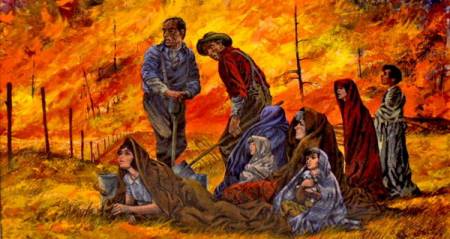
On October 9th, 1859, the first Marian apparition in the United States (since approved by the Catholic Church as “worthy of belief – although not obligatory”) occurred near Green Bay, Wisconsin. Adele Brise, a 28-year-old Belgian immigrant, was walking eleven miles home from Sunday Mass when she saw a beautiful lady with long, wavy, golden hair wearing a crown of stars and clothed in a dazzling white dress with a yellow sash around her waist.

Adele fell to her knees and asked, “In God’s name, who are you and what do you want of me?” The Blessed Virgin Mary replied, “I am the Queen of Heaven, who prays for the conversion of sinners, and I wish you to do the same. You received Holy Communion this morning, and that is well. But you must do more. Make a general confession, and offer Communion for the conversion of sinners. If they do not convert and do penance, my Son will be obliged to punish them. … Gather the children in this wild country and teach them what they should know for salvation…

Adele was faithful to her mission, teaching the Catholic Faith to the young and praying for sinners’ souls. However, almost exactly twelve years to the day after Mary’s message, Eastern Wisconsin experienced the one of the largest and the most deadly forest fire in our nation’s history. Flames of the vast Pestigo Fire surrounded the shrine built upon the apparition site, but all who fled to this ground dedicated to Mary survived. Consider: is our present time and culture somehow less deserving of divine punishment than theirs?

Another disaster afflicted our land a century ago. From 1918 to 1920, a deadly flu plagued Europe and the U.S. but wartime censors suppressed news reports from many nations besides the World War One neutral country of Spain. The Spanish Flu, as it came to be called, would go on to kill an estimated 675,000 Americans and at least 50 million people worldwide. This largely-forgotten history has been on my mind as the Coronavirus pneumonia outbreak has spread forth from Wuhan, China. There are strong indications that the dictatorial Chinese government is under-reporting how many of their people are infected or have died from this highly-infectious disease, and new cases are being reported day-by-day around the world. Earlier this month, in a effort to contain the spread of the disease, the Hong Kong government asked its citizens to stay at home and the cardinal of their Catholic diocese has suspended public Masses. Could we experience a deadly pandemic here? The U.S. Centers for Disease Control saysthe potential public health threat posed by [Coronavirus] is high.” Therefore, it is wise to be prepared.

I urge prudent preparation on two fronts. First, materially speaking, if an emergency were declared and schools and businesses sent everyone home, could your family be able to shelter at your house away from others for two or three weeks until the crisis passed? What food and water would you have if your electric power went out? Building non-perishable food reserves is easy now while store shelves remain fully stocked. And if no disaster ever comes (as may well be the case) you can simply cycle through these pantry supplies over time; so nothing is lost. The second, more important front in your disaster preparedness is: are you spiritually ready?

If you knew this Lent might possibly be your last, how would that change your spiritual focus? What vices would you cut and which virtues would you grow? How would you commit to prayer and prepare your soul? For many, times of great crisis or the end of their lives arrive unexpectedly and people face them unprepared. As Jesus once observed, “In [the days of Noah] before the flood, people were eating and drinking, marrying and giving in marriage, up to the day that Noah entered the ark. They did not know until the flood came and carried them all away.” Mark’s Gospel recalls one occasion when the Pharisees came forward and began to argue with Jesus, seeking from him a sign from Heaven to test him. Jesus sighed from the depth of his spirit and said, “Why does this generation seek a sign?” The Pharisees had heard Jesus’ teachings and known his mighty works but they still obstinately refused to change. Why do we put off the Lord, refusing to listen and respond, postponing our conversion until it might be too late?

Once, after a tower collapse in Jerusalem ended eighteen lives, Jesus asked, “Do you think they were more guilty than everyone else who lived in Jerusalem? By no means! But I tell you, if you do not repent, you will all perish as they did!” Will the Coronavirus become a devastating American disaster like the Pestigo Fire or the Spanish Flu? Hopefully not. I pray to God it will not be so and ask that you do the same. Yet even if this crisis never comes to your community, why not prepare? Stocking-up your pantry, regularly washing your hands, instilling our Faith into your children, and deepening your own relationship with Jesus Christ are wise decisions you won’t regret.

The Holy Stream — Baptism of the Lord—Year A

January 13, 2020

When you think of the River Jordan, maybe you imagine something broad, vast, and impressive, like the mighty Mississippi or even the Chippewa River. But the Jordan River is a lot more like Duncan Creek. Ever heard of Duncan Creek? It’s not far from here. Duncan Creek flows out of the south end of Lake Como in Bloomer. You know the bridge between Dairy Queen and the post office? That bridge crosses over Duncan Creek. In terms of size and color, the Jordan River is much like Duncan Creek; small and muddy with shrubs and trees growing along its banks. But unlike the rivers around here in Wisconsin, which are numerous and flow though green and lush countryside, the Jordan is among the few rivers passing through its region’s mostly arid lands. This is the body of water Jesus chose to be baptized in. A humble river of life flowing through a desert. Joshua led God’s Old Covenant people into the earthly Promised Land through this river. And Jesus, the new Joshua, leads God’s New Covenant people to the true Promised Land through holy baptism.

Jesus did not need John’s baptism for himself. John the Baptist sensed this and tried to prevent him, saying, “I need to be baptized by you, and yet you are coming to me?” Jesus insists, so John relents, but what is the purpose of his baptism? Jesus is baptized not to be made holy by the water, but to make the water holy, so that this most plentiful substance on the face of the earth could serve as the material for Christ’s gateway sacrament all throughout the world.

Jesus is baptized to allow us, through baptism, to be united to himself. His baptism foreshadows what comes in Christian baptism, what happened for you and me when we were baptized. The water, the decent of the Spirit, and the voice of the Father all signify effects of our first sacrament. Through baptism our souls were cleansed, the grace of the Holy Spirit was imparted to us, and we were acknowledged as a beloved children of God. We might take these things for granted: that sins can be forgiven, that the divine can dwell with us, that we can be more than mere servants, or slaves, or distant acquaintances to the transcendent God of the universe. That we can be treasured sons and daughters of God our Father. We need to remember and appreciate these things, for what goes unappreciated can be neglected to our loss.

The Jordan River flows about one hundred and fifty miles on the eastern border of Israel, south from the Sea of Galilee into the Dead Sea. These physical bodies of water contain a spiritual allegory. The Sea of Galilee is a large lake. Its fresh water, full of fish, pours out as the Jordan River. And this river, flowing through the arid desert, blesses its shores with life. But once these waters descent seven hundred vertical feet down into the Dead Sea, to the lowest place on earth, the water has no place else to go. So there the water sits, evaporating away in the heat, leaving its trace amounts of salt behind, causing the Dead Sea today to be an intensely salty sea in which no plants, nor fish, nor any other visible life lives.

The pure waters from above, received from the holy stream, bear no life in this recipient. Likewise, the sacraments offer grace from Heaven above, through Jesus Christ the stream of living water, but in the unrepentant soul they bear no life. Even a priest, baptized, confirmed, and ordained, saying the Mass every day, can be spiritually dead, causing spiritual harm to many, if he does not turn away from mortal sin. If you are in mortal sin, for God’s sake, for your sake, and for the sake of those around you, repent and be reconciled to God through his Sacrament of Confession. Jesus desires us to flow with his graces as a great blessing to others in this spiritually-arid world.

The words of Isaiah in our first reading point to Jesus, but because of your baptism you are in Christ. So Isaiah’s inspired words are spoken to every soul in a state of grace:

Thus says the Lord:
“You are my servant whom I uphold, my chosen one with whom I am pleased, upon whom I have put my spirit;
I, the LORD, have called you for the victory of justice, I have grasped you by the hand; I formed you… a light for the nations, to open the eyes of the blind, to bring out prisoners from confinement [and darkness.]”

You might not be called to cry out or shout, making your voice heard in the streets, breaking this and crushing that. But Jesus wants to use you as his powerful instrument to do transforming good in this world. Jesus is still quietly saving souls through his faithful ones, who receive his graces and pour them forth for others. Let this be you, for Him, and for many.

The Magi Sought Jesus — Epiphany of the Lord

January 7, 2020


The Magi from the east arrived in Jerusalem, saying, “Where is the newborn king of the Jews? We saw his star at its rising and have come to do him homage.” When King Herod heard this, he was greatly troubled, and all Jerusalem with him.

Why was King Herod greatly troubled? Because he saw this rumored, newborn king as a threat to his power and rule. No one ever mistook King Herod himself for being the Messiah or the Christ. Herod was not descended from David (as it was prophesied the great king of the Jews would be) and King Herod was not a godly ruler. The Roman Senate had installed him as king of Jerusalem and Judea, and he ruled as a brutal tyrant. Herod imposed harsh taxes, killed large numbers of his political opponents, and executed members of his family as well, including several of his wives and sons. The Magi, these wise astronomers from the east, had rightly interpreted the signs of heaven, but they badly misjudged Herod’s intentions. They had come, naturally enough, to Jerusalem to find the newborn King, but King Herod had no such son, so Herod hatched a wicked plan to murder any innocent child reputed to be the Christ.

Assembling all the chief priests and the scribes of the people, He inquired of them where the Christ was to be born. They said to him, “In Bethlehem of Judea, for thus it has been written through the prophet  [Micah]: And you, Bethlehem, land of Judah, are by no means least among the rulers of Judah; since from you shall come a ruler, who is to shepherd my people Israel.”

When King Herod was greatly troubled, all of Jerusalem was troubled with him because, knowing Herod, they knew the Magis’ message would likely lead to death and violence. Why did the Jewish religious leaders plainly-reveal to Herod where the Messiah might be born? They had reason to fear Herod, yet they could have demurred in Herod’s presence at responding to his inquiry. We must never tell lies, but we need not tell everything we know to everyone who asks us; for example, you don’t tell a killer where to find his next victim. The religious leaders could have replied to Herod, “Well, there are various disagreeing opinions about where the Christ will be born,” and that would have been true. The Jewish rabbis enjoyed theological debates about every question – and there was no need to let Herod know their best and most-accepted answer. Or, they could have replied, “Moses does not clearly tell us where the Christ will be born,” and that also could have been true – the prophet Micah provides that particular answer. Instead, the religious leaders tell Herod exactly where to look: “In Bethlehem of Judea,” they said to him. Without even realizing it, this was the Jewish religious leaders’ first betrayal, first denial, first rejection of Jesus Christ on earth.

Then King Herod called the magi secretly and ascertained from them the time of the star’s appearance. He sent them to Bethlehem and said, “Go and search diligently for the child. When you have found him, bring me word, that I too may go and do him homage.” After their audience with the king they set out [and found the fulfillment of their hearts’ hopes.]

If the Magi were “overjoyed at seeing the star,” imagine how they felt upon entering the house and finding Jesus with his mother. The Magi had traveled hundreds of miles to seek out the newborn king, to give him their precious gifts, and to show him their homage. But did any of Jerusalem’s priests or scribes travel the five miles to Bethlehem to do the same? Did any of them seek out the Magi or the Holy Family to privately warm them that they were in grave danger? Apparently not, for it required dreams from Heaven to warn the Holy Family and the Magi to flee from Herod. It is as if the religious leaders didn’t believe the Messiah, their Christ, would or could be born for them; like they did not believe that God was alive and active in their present day. Despite their vast religious knowledge, these men lacked faith. You and I profess to be Catholic Christians, and that is important. We have come to Mass today, and that is very well. But the Jewish leaders show us the danger of our faith being just a theory, an idea we hold without it prompting our full response to God.

The Magi sought out Jesus. Are we seeking a daily encounter with Christ? The Magi gave Jesus their precious gifts. Are we offering our Lord our time, talents, and treasures generously? The Magi prostrated themselves before Jesus and showed him their homage. Are we loving Jesus as merely an idea, or as the most important person in our lives? The beginning of this new year is a good time to take stock of ourselves and make resolutions to follow Christ better. Do not be afraid, for it will be the fulfillment of your heart’s hopes. If you are willing, he will lead and guide you on your journey.

Lord of wonder, Lord of light,
Lord with royal beauty bright,
Heaven leading, still proceeding,
guide us to thy perfect light.

Naming Jesus — January 1 — Mary the Mother of God

January 7, 2020

“When eight days were completed for his circumcision, he was named Jesus, the name given him by the angel before he was conceived in the womb.”

Who named Jesus? In one sense, it was his parents; Mary his mother and Joseph his adoptive-father. Yet this name was not their own idea. At the Annunciation, the Archangel Gabriel told Mary: “you will conceive in your womb and bear a son, and you shall name him Jesus.” And later on, an angel of God, likely Gabriel but perhaps another, told Joseph in a dream: “[Mary, your wife,] will bear a son and you are to name him Jesus, because he will save his people from their sins.” So this name was communicated to Jesus’ parents, and both parents were instructed to name him so, but the idea of this name and the commands to bestow it did not originate with the angels.

The word “angel” comes from the Greek and Latin words for “messenger,” and the angel spirits are messengers of God. The Archangel Gabriel was sent from God to Nazareth to announce to Mary the plan and will of God. So who named Jesus? First and foremost, God. The Letter of St. Paul to the Philippians declares, “[God] bestowed on him the name that is above every name, that at the name of Jesus every knee should bend, of those in heaven and on earth and under the earth”.

And what does the name of Jesus mean? The name “Jesus” (or “Iēsous” in Greek) is “Yeshua” in Hebrew, which means “Yahweh helps,” or “God saves.” The name of Jesus, given him by his Heavenly Father, denotes the message and the mission of the Son, And this message and mission was given him by the Father. Jesus declares, “I did not speak on my own, but the Father who sent me commanded me what to say and speak,” and “I came down from heaven not to do my own will but the will of the one who sent me.” The Father names his Son, and the Son is obedient to his Father’s authority.

Naming someone or something is to author its name, and authorship denotes authority over that person or thing. In the story of Creation, God creates and names the Day and the Night; the Sky, the Earth, and the Sea. Then the Lord forms man from the ground and settles him in the garden, with a mission to cultivate, protect, and care for it. Then God forms the animals from the ground, bringing each to the man to see what he would call them; and whatever the man called each living creature was then its name. Since none of these would be a suitable partner for the man the Lord formed another from the man’s rib, perhaps the bone closest to the core of man’s being, God’s last and ultimate creature. When the Lord brought her to the man, he rejoiced: “This one shall be called ‘woman,’ for out of man this one has been taken,” and the man gave his wife the name “Eve.” God blessed them and said to them: “Be fertile and multiply; fill the earth and subdue it. Have dominion over the fish of the sea, the birds of the air, and all the living things that crawl on the earth.

The man has sovereignty and dominion over the creatures he named. Parents, likewise, have authority over their children. As we heard last Sunday from the Book of Sirach, on the Feast of the Holy Family, “God sets a father in honor over his children; [and] a mother’s authority he confirms over her sons.” Both Joseph and Mary name Jesus on this eighth day after his birth and they exercise authority over the Child-God. “[Jesus] went down with them and came to Nazareth, and was obedient to them.” All legitimate authority (in a family, a workplace, a government, or the Church) is to be exercised in accord with God’s will. And when authority is exercised in this way, we can expect the household, business, nation, or Church to thrive—provided that legitimate, godly authority is likewise obeyed in accord with God’s will. ‘Jesus went down with Joseph and Mary, and was obedient to them; and his mother kept all these things in her heart. And Jesus advanced in wisdom and age and favor before God and man.’

Who have you been entrusted with authority over? For whom has God given you a mission to cultivate, protect, and care for as their Christ-like servant-leader? Recognize your mission, and exercise your authority in accord with God’s will as a blessing for others. And realize that those with spiritual authority over others (as you may have in your household) can literally bless them. Usually when we say “God bless you,” (that is, when we say this to a peer) we are not really blessing them ourselves but desiring, hoping, wishing, praying that God might bless them. As the Letter to the Hebrews says, “Unquestionably, a lesser person is blessed by a greater.” When we have spiritual authority for someone we can personally speak blessings upon them.

Words can not only encourage, but they also seem to have metaphysical power. Our first reading recounts how Aaron and his sons as priests of Israel were given authority to bless God’s people. The Old Testament patriarchs blessed their children and we see their words fulfilled. God creates and Jesus works miracles through spoken words; God said “let there be light” and there was light. Jesus said to the paralytic your sins are forgiven; stand up, pick up your mat, and go home, and the man was healed inside and out. Your words of blessing, in accord with God’s authority, can have great power, too.

[After preaching this homily last night, a parishioner shared with me that she and her husband learned about blessing and claiming dominion your household from friends a decade ago. They notice a difference in their family in their years of marriage before and after. For example, when she begins to fell minor health issues coming on, she asks for her husband’s blessing, and reports that she can “feel the power of his prayers.”]

So husbands, bless your wives and children, mothers bless your children, and bless your grandchildren, too. And on this first day of the year, ask God our Father and Holy Mary, the Mother of God and our spiritual mother too, to bless you and yours in this new year ahead.

A Life for Christ — 2nd Sunday of Advent—Year C

December 8, 2019


This weekend the Catholic Church Jesus Christ established joyfully celebrates and remembers one of her martyrs. Moved by the Holy Spirit, he answered God’s calling. He renounced his possessions, left his home and family behind, and lived in a different land. He lived differently, he dressed differently, and lived a celibate life for the love of God and the service of God’s people. His life was a prophetic sign for others, pointing them to Christ and his Kingdom. He was humble but brave in doing what was right. And for this faithfulness, the wicked had him killed. Today we celebrate him as one of those blessed in the Kingdom of Heaven. This description sounds a lot like St. John the Baptist, featured in today’s Gospel, but I speak of another: Brother James Miller, born in our diocese, a native son of Stevens Point, who became a Christian Brother and a missionary. He was martyred in Guatemala and, in a Mass celebrated there yesterday (December 7, 2019) was beatified by the Catholic Church, that is, declared one of the blessed in Heaven.

James Miller was born in Stevens Point in 1944, grew up on a dairy farm, and graduated from Pacelli High School. Discerning his religious vocation, he entered the novitiate of the Christian Brothers in 1962, and taught for them in St. Paul, Minnesota. In addition to teaching religion, Brother James taught English and Spanish, coached football, and worked in the maintenance of the school building. In fact, his skill and pleasure in doing such repairs would win him the nickname “Brother Fix-it.” After taking final vows in 1969, Brother James was sent abroad. He worked as a teacher, an administrator, and even a builder of schools in both Nicaragua and Guatemala, serving the poor with Christ’s love.

It was a time of great violence in Latin America, of war and terrorism between the region’s dictatorial governments and communist rebels. In these conflicts, Catholic priests and religious could be marked for death by either side. The Sandinista rebels put Brother James on a list of people to be “dealt with,” viewing him as an ally of the Nicaraguan government, but it may have been his religious community’s resistance to the Guatemalan government’s wrongdoing which led to his martyrdom.

Despite the students at Brother James’ school in Guatemala being exempt from being drafted, four men abducted a local youth from the city marketplace and forced him into military service. The Christian Brothers went to the authorities objecting to this breach and demanding their young man’s release. Soon after, on February 13, 1982, the 37-years-old Brother James Miller was up on a ladder outside, repairing a wall of the school building. There, he was shot, point-blank, multiple times, by three still-unknown gunmen. It is suggested that Brother James died before his body hit the ground.

When I read the story of St. John the Baptist’s martyrdom — of how his objection to the king’s sin landed him in a prison, of how the dancing of Herod’s daughter, the rash vows of the king, and the scheming of his vengeful queen, resulted in an executioner being dispatched to the dungeon with orders to bring back John’s head on a platter — I wonder if John the Baptist knew what was coming. Did he have any awareness of the events at the party leading to his death? I think quite likely not. I can easily imagine the sword-bearing henchman entering John’s dark cell, giving a curt command for him to bend down, and ending his holy life without any warning or explanation.

This reflection comes to mind because when Brother James was getting into the car to depart for dangerous Guatemala and, though they did not know it, he would never return, his biological brother Ralph told him to “be careful.” Brother James replied, “I’m no martyr.” And yet Brother James Miller and John the Baptist did become martyrs. They may not have expected the day or hour, but they had already made the decision to live for Christ and even die for Christ years before. Whether to love and serve Christ the King is a decision, a resolution, we each have to make and constantly renew. There is no hedging – not making the choice is making a choice; and everything follows from the choice we make.

St. Ignatius of Loyola, in his Spiritual Exercises, has a famous prayer reflection: “The Meditation on Two Standards.” (The word “Standard” in this case means a military or ceremonial flag carried on a pole.) St. Ignatius asks us to imagine a great field near Jerusalem, the holy city, where the supreme commander-in-chief of the good is Christ our Lord; and another field in the region of Babylon, the city of sin, where the chief of the enemy is Lucifer.

Imagine that chief of all the enemy seated in that field of Babylon in a great throne of fire and smoke, horrible and terrifying in shape. Consider how he issues a summons to innumerable demons and how he scatters them, some to one city and others to another, and so through all the world not one province, place, state, nor particular person is omitted. Consider how he instructs them to cast out nets and chains; to tempt human beings to a longing for riches, to a desire for the vain honor of this world, and to vast pride, thereby leading them to all other sins besides.

And then, on the contrary, imagine the supreme and true captain, who is Christ our Lord. Consider how Christ our Lord puts himself in a great field near Jerusalem, in a humble place, beautiful and welcoming. Consider how the Lord of all the world chooses so many persons – apostles, disciples, and others – and sends them through all the world spreading his holy teaching to people of all conditions and states of life. Consider the discourse which Christ our Lord gives to all His servants and friends whom He sends on this expedition, counseling them to poverty rather than riches; to contempt for worldly honor, and to humility against pride, leading them to all other virtues besides.

Whose side, whose standard will you rally to today? John the Baptist appears in our Gospel crying out to us: “Repent, for the Kingdom of Heaven is at hand!” Blessed James Miller and St. John the Baptist gloriously rejoice today with their Lord, Jesus Christ the King. Now, which side do you choose? With whom and for whom will you live and die?

Obstacles to Jesus — 31st Sunday of Ordinary Time—Year C

November 6, 2019

Last week, Jesus told us a parable about a penitential tax collector. This Sunday, St. Luke recounts for us a true story about real one. Jesus came to Jericho and a man there named Zacchaeus, a chief tax collector and a wealthy man, was seeking to see him. You just heard the ending of that story; Zacchaeus joyfully succeeds in to beholding and encountering Jesus, and Jesus happily succeeds in finding and saving Zacchaeus. But Zacchaeus’ story would have ended differently if he had allowed any earthly obstacle or any human excuse to stop him. What sort of things could have gotten in Zacchaeus’s way of seeing and encountering Jesus? Many of the same things that can get in our way.

For starters, Zacchaeus could have believed or claimed that he was too busy to devote time for Jesus. Zacchaeus was a chief tax collector, a busy man, and this appears to have been a working business day. Faithful Jews did not walk long distances on the Sabbath day of rest. The rabbinic tradition set the limit for Saturday travel at 2,000 cubits or about ¾ of a mile. (That’s not very far.) But Jesus walked to Jericho and had intended to pass through the town, suggesting that tolls and taxes from toilers and traders and travelers were there for the tax man’s taking. But Zacchaeus made time for Jesus in his busy day.

Are we busy? I’d bet that most people would say that they are, but busy with what? Last year, the average American adult spent 3 hours and 44 minutes a day watching television; that’s more than 28 hours per week, that’s a full 56 days in a year! Maybe you don’t watch TV at home (I don’t) but how much time do we expend with games and social media and entertainments online? Whether we have time or not for something is really a question of priorities.

We just celebrated All Saints’ Day’s. Have you ever considered, if you get canonized as a saint someday, what you would like to become the patron saint of? If I get canonized I’d like to be the patron saint of packing. I have a number of reasons for desiring this niche but needed patronage, but it all goes back to a lesson from my father. One time, for an Illinois trip, he taught me how to pack a car trunk. He said, “Put the big things in first, and then fit the smaller things in around them.” So it is with life; put the big things in first. Make time for weekly Mass, daily prayer, spiritual study, and spiritual growth. Make them your priority.

Another reality that could have made Zacchaeus give up on Jesus when they got in his way was other people. “Zacchaeus was seeking to see who Jesus was; but he could not see him because of the crowd, for he was short in stature.” (In other words, Zacchaeus wasn’t tall.) The crowd was not only an imposing physical barrier, but a hostile obstacle as well. They all knew him by sight and despised him as a sinner. Because of Zacchaeus’s small size, they could easily and effectively block him out or even push him away from Jesus.

On this occasion, the short of statue Zacchaeus was one of the “little ones” whom Jesus warns us not to despise: “It is not the will of your heavenly Father that one of these little ones be lost.” And Jesus warns of great woe for anyone who causes his little ones spiritual harm: “Whoever causes one of these little ones who believe in me to sin, it would be better for him to have a great millstone hung around his neck and to be drowned in the depths of the sea.” It is gravely wrong to push people away from Jesus through sin, but it is also a great error for us to allow others to push us away from Jesus. Jesus’ Church is holy but it’s the home of sinners, too. Do not let Judas’s betrayals or Peter’s denials, as horrible as these scandals are, keep you away from meeting Jesus here.

Zacchaeus did not let the obstacle of other people thwart him. When he was unable to penetrate the crowd, “he ran ahead and climbed a sycamore tree in order to see Jesus, who was about to pass that way.” It is debated within scripture commentaries whether is was considered undignified for a first century Jewish man to run apart from an emergency. But another embarrassing aspect of this story remains recognizable for us today. When was the last time you saw a grown man climb a tree for any reason other than to cut down a branch? Climbing trees is something kids do. When people saw Zacchaeus, the rich man, sitting in a tree on Main Street they probably pointed and laughed at him. But Zacchaeus ignored their gossip and mockery to do this for Jesus, and that made the difference for his soul.

Jesus expects us to be different from the world sometimes, both in the things we do and the things we don’t or refuse to do. And people will not always respect us or like us because of it. There are various reasons for this hostility, but a major one was noted in the second century by a Christian who wrote: “the world hates the Christians not because they have done it any wrong, but because they are opposed to its enjoyments.” Jesus tells his disciples at the Last Supper before his death: “If the world hates you, realize that it hated me first. If you belonged to the world, the world would love its own; but because you do not belong to the world, and I have chosen you out of the world, the world hates you.”

Do you sometimes avoid doing good things because you’re afraid of looking too pious or of being thought of as a goody-two-shoes? Do pray before meals to give thanks to God and ask him to bless your food at home but never at restaurants? Do you avoid receiving Jesus’ absolution in sacramental confession because you’re afraid of what the priest or others might think? When and where was the last time you mentioned the name of Jesus outside of church or apart from prayer? We need to be unashamed to be Christians, unashamed to be Catholics, not cowed by peer pressure but bold in doing what Jesus desires of us.

Let’s make a quick review of the things that might have prevented Zacchaeus, or might prevent us, from seeking and encountering Jesus: believing or saying we’re too busy; obstacles from other people, their sinfulness or peer pressure; and finally, our own resistance to full or true conversion.

When Jesus reached the tree he saw a fruit hanging in it for his harvest. Jesus looked up and said, “Zacchaeus, come down quickly, for today I must stay at your house.” And Zacchaeus came down quickly and received him with joy. Jesus was not content to simply exchange pleasantries and then go their separate ways. Jesus says, “I must stay at your house.” This more than merely a historical detail–this is a profound utterance; the Lord desires to dwell with Zacchaeus for all his days.

In encountering Jesus Christ, Zacchaeus realizes he must change the way he lives. He can’t play host to Jesus one day and then behave like it never happened. Well, he could, that’s the temptation. He can keep clinging to his sins, but his sins haven’t made him happy. If Zacchaeus had been content with his life he would not have been trying so hard to see Jesus. Now, Zacchaeus is free to change his life with Christ, and he’s excited by the new hope set before him. Zacchaeus declares: “Behold, half of my possessions, Lord, I shall give to the poor, and if I have extorted anything from anyone I shall repay it four times over.” The focus of Zacchaeus’ life has changed. No more defrauding. No more hoarding. Now, the Lord dwells in Zacchaeus’ house as his honored guest. And giving away one-half of all his wealth suggests his heart’s intention to love his neighbor as himself. And Jesus says to him, “Today salvation has come to this house.

The name Zacchaeus is a Hebrew name. It means “clean” or “pure.” While Zacchaeus was still imperfect, still unclean, still impure, Jesus called out to him by name and said “today I must stay at your house.” And Zacchaeus, by finding and knowing Jesus, became true to his name, realized his true identity, became his true self. The Lord desires the same for each of us. So allow nothing to get in your way of seeing and encountering Jesus.

Humility, Truth, & Love — 30th Sunday of Ordinary Time—Year C

October 28, 2019

Today’s second reading from the Second Letter to Timothy has St. Paul declaring near the end of his earthly life: “I have competed well, I have finished the race, I have kept the faith. From now on the crown of righteousness awaits me, which the Lord, the just judge, will award to me…” Recall how at the Visitation, after encountering her cousin Elizabeth, St. Mary declares about herself: “[God] has looked with favor on his lowly servant; from this day all generations will call me blessed.” Are these humble things for Mary and Paul to say about themselves?

Well, they’re both true statements, inspired by the Holy Spirit. Paul, having finished his race, is now a triumphant saint in Heaven, and the Church calls Mary the Blessed Virgin in every generation even to our day. True humility is not thinking that you’re dirt, it is being down-to-earth, well-grounded, and rooted in reality. Jesus says, “Let your light shine before others,” and the Blessed Virgin Mary pleases and honors God when she states, “The Almighty has done great things for me and holy is his name.” God has done good things for you as well, so thank and praise and glorify him for it!

But wait a minute, someone might object, wasn’t the Pharisee who went up to pray at the Temple in Jesus’ parable today also thanking God and declaring true statements about himself? What if this Pharisee did fast twice a week; what if he did pay tithes on his entire income; and was neither greedy, dishonest, nor adulterous? That is what’s implied by the parable, and those are all very good things! So why then does he incur our Lord and God’s displeasure?

Today’s gospel says “Jesus addressed this parable to those who were convinced of their own righteousness and despised everyone else.” Jesus says the Pharisee took up his position at the Temple and spoke this prayer to himself, “O God, I thank you that I am not like the rest of humanity – greedy, dishonest, adulterous – or even like this tax collector.” Imagine the Pharisee praying these words out loud, within earshot of this tax collector in front of everybody. Yet, even if the Pharisee prayed silently, or quietly to himself, and his neighbor did not hear him; the Pharisee despised the tax collector and the rest of humanity, and did not gain God’s pleasure. Like St. Paul once wrote, “If I give away everything I own, and if I hand over my body so that I may boast but do not have love, I gain nothing.” In order to gain Heaven; truth, love, and sacrifice all need to go together within us.

We see the truth, authentic love, and self-sacrifice combined in the inspiring life of the twentieth century saint, Edith Stein. She was born into a Orthodox Jewish family but renounced her faith by the age of thirteen and embraced atheism. She went on to become a respected PhD in philosophy. Then, one night while staying with friends on a vacation, she read the entire autobiography of St. Teresa of Avila. The following morning she put the book down and declared, “That is the truth,” and responded accordingly. She was baptized a Catholic at the age of thirty, became a Carmelite nun and took the name Teresa Benedicta of the Cross, like the Carmelite St. Teresa of Avila before her. During World War II, because of her Jewish ancestry, the Nazis came to arrest her along with her biological sister Rosa, who worked at the convent. Teresa Benedicta reportedly said to Rosa, “Come. Let us go and die for our people.” They were taken to Auschwitz where survivors of the death camp testified that the nun helped other sufferers with great compassion. A week after their arrest, she and her sister were killed in the gas chamber. St. Teresa Benedicta comes to my mind this Sunday because of one of her most famous quotes: “Do not accept anything as truth that lacks love and do not accept anything as love that lacks truth. One without the other is a destructive lie.

It could be said that the proud Pharisee in our parable had the truth without love, while our culture today has many (so called) loves apart from the truth. Through our friendship, our prayers, and our perseverance, the tax collectors we know today need to encounter love and the truth, that they might turn to Jesus and say “O God, be merciful to me a sinner,” and be saved. If you think you see someone seriously sinning; perhaps in your circles or our community, on TV or in the news; be sure—at very least—to pray for them. Maybe you’re right, which means that they are greatly in need of your prayer. Or perhaps you’re judging rashly or too harshly, in which case you are in need more prayer. In any case, you cannot both hate someone and pray for someone at the same time, because praying for someone is an act of love.

As Jesus tells us, “the one who humbles himself will be exalted.” Praying for and loving sinners makes you their servant in the likeness of Christ. Jesus came to us, he told us the truth, he prayed and interceded for us, and he even died for us – you and me and everyone. Jesus wants all of us to be like him, loving in truth and sharing the truth in love.

Jesus and His Wounded Church

October 27, 2019

On October 15th, her feast day, I heard a story told of St. Teresa of Avila I had never heard before. It may be a pious legend (as I have not found any primary sources for the tale) but it contains a truth all the same. The story goes that Satan once appeared to the 16th century Spanish nun in the glorious guise of Jesus. Satan intended to lead Teresa astray, but she quickly saw he was not Christ. Before departing from her the Devil asked how she was so certain. She replied, “Because you have no wounds.”

In the Book of Acts we read that on the road to Damascus Saul heard a voice say, “Saul, Saul, why are you persecuting me?” “Who are you, sir,” asked the afflictor of the Early Church. “I am Jesus, whom you are persecuting.” Jesus had already, some months or years before, bodily ascended into Heaven, but Our Lord felt all the afflictions of the Church on earth as his own. Saul repented, converted, and became St. Paul.

Jesus hates the grave mistreatment and harming of his members but his Body suffers and bears wounds still; wounds inflicted both from outside and within his Church. Jesus told his disciples, “Things that cause sin [literally “skandala,” scandals or stumbling-blocks] will inevitably occur, but woe to the person through whom they occur.” Yet even as Jesus heals and avenges his innocent, injured sheep he desires the salvation of wrongdoers too – that, justly-chastised, the sinner would ultimately appear before God as a saint.

Pray for our whole Church without despairing, for the victory of our Faithful Bridegroom is assured. St. Teresa of Avila said, “I do not fear Satan half so much as I fear those who fear him,” and she urged her sisters to unshakable confidence in Jesus Christ:

“Let nothing disturb thee; Let nothing dismay thee:
All thing pass; God never changes.
Patience attains all that it strives for.
He who has God finds he lacks nothing:
God alone suffices.”