19th Sunday & 20th Sunday in Ordinary Time
By Fr. Victor Feltes
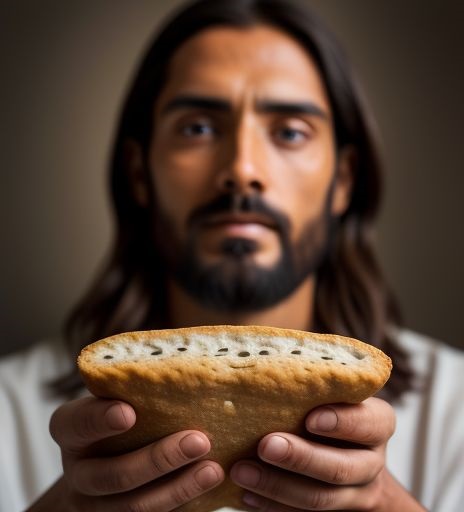
All four Gospels recall the miracle of Jesus using five loaves and two fish to feed five thousand people. But only John’s Gospel records what Jesus taught the following day in Capernaum. The Gospels of Matthew, Mark, and Luke all quote Jesus’ Last Supper declaration “This is my Body.” But John’s Gospel, written after them all, clarifies what these words mean.
Today we hear from the sixth chapter of John, where Jesus says, “I am the bread that came down from heaven.” Some in the synagogue congregation murmur, “Is this not Jesus, the son of Joseph? Do we not know his father and mother? Then how can he say, ‘I have come down from heaven’?” Jesus of Nazareth was the son of Mary and the adopted son of Joseph, but Jesus also truly came down from God his Father in heaven. The people did not yet understand how what Jesus said was real.
Jesus then goes on to say, “I am the living bread … whoever eats this bread will live forever and the bread that I will give is my flesh….” The people quarrel among themselves about this, “How can this man give us [his] flesh to eat?” They envision something grotesque, but once again what Jesus said was real in a way his hearers did not yet understand.
In retelling Jesus’ response to this objection from the crowd, John’s Gospel repeatedly employs a Greek verb for eating which is more intense than before — a word which does not mean merely “to eat” but “to chew, or gnaw.” In other words, Jesus preaches:
“Whoever [gnaws] my flesh and drinks my blood has eternal life, and I will raise him on the last day. … Whoever [chews] my flesh and drinks my blood remains in me and I in him. Just as the living Father sent me and I have life because of the Father, so also the one who [gnaws] on me will have life because of me. … Unlike your ancestors (during the Exodus) who ate (bread from heaven) and still died, whoever [chews] this bread will live forever.”
Jesus does not intend to make his followers cannibals by feeding them a portion of his dead or detached flesh. Jesus would offer them his entire living self as food: his body and blood, soul and divinity. “Take this, all of you, and of eat it, for this is my body.” His Church has kept his commandment to do this in memory of him every Sunday throughout the centuries since.
Today, some Christians say, “This meal is only symbolic.” There is some symbolism present in the Eucharist: to separate a body from its blood and then reunite them is a symbol of death and resurrection. Jesus’ coming to us as food speaks to how essential receiving him in this sacrament is for our spiritual life. (“Amen, amen, I say to you, unless you eat the flesh of the Son of Man and drink his blood, you do not have life within you.”) And Jesus taking on the appearances of bread and wine reflects his wish to be one with us in both the ordinary and the exceptional. (“Whoever eats my flesh and drinks my blood remains in me and I in him.”) The Eucharist contains symbolism but the Eucharist is not just a symbol.
We are not idolaters. We do not worship bread. We worship Jesus Christ in the Eucharist. This is the teaching of the Sacred Scriptures. This is the faith of the early Church. This is a wonder confirmed by miracles. This is our Most Blessed Sacrament. This is Jesus, the joy of the saints.
At Capernaum, when Jesus’ disciples first hear him preach about this “Bread of Life” which is his flesh, many of them murmur, “This saying is hard; who can accept it?” Jesus replies, “Does this shock you?” They doubted if he really came down from heaven, so he asks, “What if you were to see the Son of Man ascending to where he was before? (Which is something Jesus went on to literally do.) … The words I have spoken to you are Spirit and life.” Jesus does not retract his teaching, and verse John 6:66 records that “as a result of this, many of his disciples returned to their former way of life and no longer accompanied him.” Jesus turns to his apostles and asks, “Do you also want to leave?” And St. Peter responds with trusting faith, “Master, to whom shall we go? You have the words of eternal life.”
Notice how Christ did not immediately chase down those departing disciples. Like the father of the Prodigal Son who ran from home, Jesus’ great love was unable to keep them close to him that day. But Jesus hoped that time, God’s grace, and the welcoming witness of his disciples would bring them back to his Holy Communion someday. Does the disunity of Christians and waywardness of the world trouble you too? Jesus wants us to be his welcoming witnesses today.
Having encountered the goodness and love of Jesus, having received him in the Eucharist, invite others to his Church. Pray for souls and tell them the difference being a Catholic Christian makes in your life. Share good homilies, articles, videos, talks, your favorite prayer devotions and saintly heroes. Pray for and invite your family, friends, coworkers, neighbors to come to Mass with you, and when you see new faces here help to make them feel welcome. Our parish classes for becoming Catholic (for those above the age of reason who want to be baptized or confirmed and be received into the Church) begin next month. Now is the time to encourage people to consider registering, even if only to come, see, and learn more. You possess a great treasure it costs you nothing to share. So invite others, as our psalmist says, to “taste and see the goodness of the Lord.”
 Parishable Items
Leave a comment