3rd Sunday of Easter
By Fr. Victor Feltes
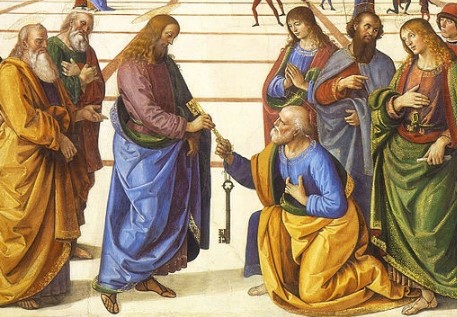
Jesus changed Simon the Apostle’s name to Peter or “Rock” and said, “Upon this rock I will build my Church, and the gates of the netherworld shall not prevail against it.” Jesus told him, “I will give you the keys to the Kingdom of Heaven,” and declared “Whatever you bind on earth shall be bound in heaven; and whatever you loose on earth shall be loosed in heaven.” This promise assures us that Peter would not bind the Church to error, for binding the Church on earth to lies would bind heaven to the same. What is the purpose of this awesome authority to teach and lead? Jesus tells him and us in today’s Gospel: it is to ‘Feed his lambs, tend his sheep, and feed his sheep.’
Jesus had specifically told Simon at the Last Supper, “Behold, Satan has demanded to sift all of you like wheat, but I have prayed that your own faith may not fail; and once you have turned back, you must strengthen your brothers.” In the Gospels, Simon Peter’s name is always first among his fellow apostles in any listing where he appears, while Judas Iscariot’s name is always placed last. All of this reflects the God-given preeminence of St. Peter as the servant-leader of Christ’s Church on earth. Jesus remains the invisible Head of his One, Holy, Catholic Church, but he knew that without providing clear and visible apostolic shepherds to give us clarity and unity his flock would surely scatter.
This was true in the 1st century with St. Peter as 1st bishop of Rome, and Peter’s office has continued in his successors, the popes, as recognized by Christians throughout the first millennium. Jesus had told the apostles “whoever hears you hears me” and promised the Holy Spirit would guide them “into all the truth.” The New Testament also proclaims the Church to be “the pillar and foundation of truth.” Was only the first century to be graced with such divine gifts and assurances? No. Jesus is the wise man who built his house on Rock so that even when the rains fell, the floods came, and winds blew and buffeted his Church it would not collapse into heresy.
Indeed, when a pope (or a Church council together with him) definitively defines a doctrine of faith or morals to be held by the whole Church, the Holy Spirit protects their teaching from error. This is called infallibility. Through divine inspiration, the Holy Spirit previously utilized imperfect men to pen precisely what he wished to be written as Holy Scripture; so simply protecting Holy Church from officially teaching errors is an important but lesser miracle. Though popes can teach infallibly and possess full authority as chief shepherds, they are not flawless people. Simon Peter, even after denying, repenting, and returning to Christ, sometimes still slipped up.
Through St. Paul’s Letter to the Galatians we learn that St. Peter was accustomed to eating with Gentile Christians who did not keep the Old Covenant’s rules about ritually clean and unclean foods, as Christ’s New Covenant allowed. That was all well and good, but once when some Jewish Christians arrived in town who cared about keeping all those dietary laws, Peter began to withdraw from his previous table companions. Peter probably wished to avoid causing offense and division, but this action caused confusing scandal by implying that keeping all the Old Laws of Moses was necessary for salvation.
St. Paul writes, “I opposed him to his face because he clearly was wrong.” Paul corrected Peter in front everyone, saying, “If you, though a Jew, are living like a Gentile and not like a Jew, how can you compel the Gentiles to live like Jews?” St. Peter had not denied the Gospel but his personal example in this case caused harm and he received a fraternal correction from St. Paul. In the Church’s two-millennium-long history there have been some very bad and scandalous popes, but by God’s grace none of them bound the Church to heresy, and that’s a priceless blessing.
Having mourned and prayed for Pope Francis, the cardinals will gather this Wednesday inside the Sistine Chapel at the Vatican for the important task of electing a new pope. Some 133 cardinals, appointed by previous popes from places around the world, will sequester themselves away until they elect a Holy Father. After any failed rounds of voting, they will burn the ballots to make black smoke. But once a pope has been elected by a two-thirds of the vote they will burn the ballots to make white smoke accompanied by the ringing of St. Peter’s Basilica’s bells. Then our new pope will be introduced to the world and impart his papal blessing. All the conclaves in recent decades have been short, concluding within three days, but do not be alarmed even if this conclave takes more than a week. We will have a pope again soon.
People sometimes wonder, “Does the Holy Spirit choose who will be the pope?” Before he became Pope Benedict XVI in 2005, Cardinal Joseph Ratzinger was asked about this in a 1997 interview. He replied, “I would not say so, in the sense that the Holy Spirit picks out the Pope…. [“There are too many contrary instances of popes the Holy Spirit obviously would not have picked!”] I would say that the Spirit does not exactly take control of the affair but rather like a good educator, as it were, leaves us much space, much freedom, without entirely abandoning us. Thus the Spirit’s role should be understood in a much more elastic sense, not that he dictates the candidate for whom one must vote. Probably the only assurance He offers is that the thing cannot be totally ruined….”
When I was younger, I would have imagined there was just one cardinal in any conclave who could be the right pope; but now I suspect the Holy Spirit perhaps beholds dozens of cardinals with whom he could accomplish comparable good fruits. God works with what we give him. So pray that the cardinals will be receptive to the Holy Spirit’s guidance, but do not be anxious or afraid. Whatever happens, we already know that Christ and his Church will endure and triumph in the end, for “the gates of the netherworld shall not prevail against it.” Pray this week that the Church of Christ on earth may soon be led by another great pope who will feed his lambs, tend his sheep, and feed his sheep.
 Parishable Items
Leave a comment