29th Sunday in Ordinary Time
By Fr. Victor Feltes
Once upon a time, the pope summoned his Vatican chauffeur. When his driver had brought the car around, the Holy Father confided, “Ever since I got elected pope, I have sorely missed not driving anymore. Please, sit in the backseat and let me take the wheel.” The chauffeur reluctantly agreed and the pope was beaming with joy. But soon the Holy Father accidentally went the wrong way down an empty one-way street and got pulled over by City of Rome police. An officer approached their vehicle intending to write them a ticket, but after a brief chat he soon returned to his partner waiting in the squad car. His partner asked, “What, no ticket? Who’s riding in that limo?” “I don’t know, but whoever it is he must be really important—the pope is his chauffeur!”
Jesus (although in a much sounder, wiser way than this) also speaks from the lesser to the greater. This classic mode of rhetoric argues that something true in a smaller case is surely true for the larger case as well. For example, Jesus says a “person who is trustworthy in very small matters is also trustworthy in great ones; and the person who is dishonest in very small matters is also dishonest in great ones.” Elsewhere, he points out: “Are not two sparrows sold for a small coin? Yet not one of them falls to the ground without your Father’s knowledge. … So do not be afraid, [for] you are worth more than many sparrows!” And on another occasion, Jesus tells us: “If you, who are wicked, know how to give good gifts to your children, how much more will your heavenly Father give good things to those who ask him!”
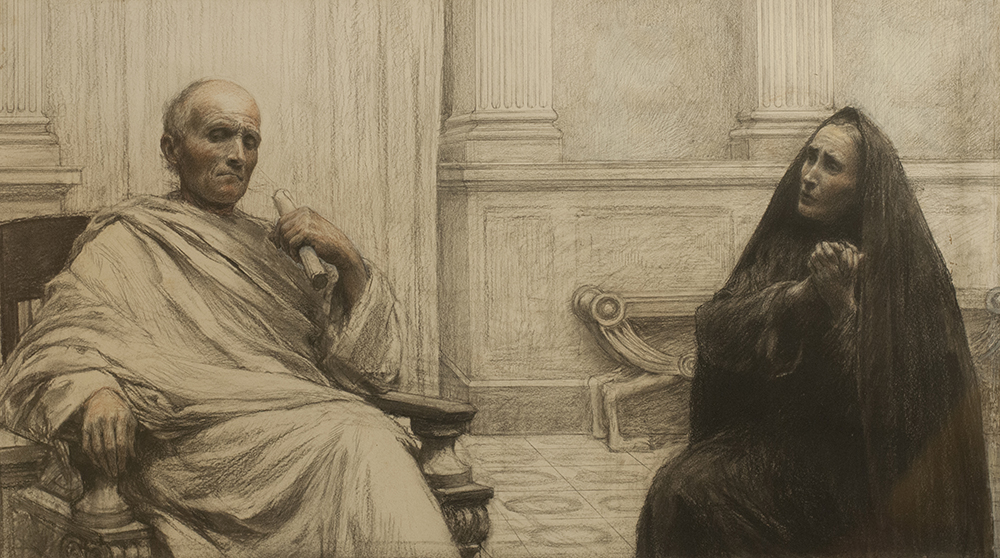
Jesus argues from the lesser to the greater in today’s Parable of the Unjust Judge. This bad judge does not care about justice. He neither fears God nor respects any human being. However, we see a widow wear him down to give her what she rightfully asks for through her dogged persistence. Jesus says, “Pay attention to what the dishonest judge says.” If a wicked judge with a heart of stone will eventually give in to a poor, weak widow, then, as Jesus argues, “will not God secure the rights of his chosen ones who call out to him day and night? Will he be slow to answer them? I tell you, he will see to it that justice is done for them speedily.” Unlike that unjust and indifferent judge, God is just and cares about us deeply, so we ought to ask God for good things and keep asking without becoming weary.
Our Sunday lectionary reinforces this lesson in today’s first reading. During the Exodus, when the Israelites entered a battle against the Amalekites, Moses climbed a hill overlooking the battlefield carrying the staff of God that had split the Red Sea. As long as Moses held that wooden staff raised above his head, Israel had the better of the fight. But whenever Moses let his tired arms rest, their enemy had the better of the fight. This scene prefigures Jesus’ crucifixion upon the hill of Calvary, where Christ’s arms upraised on the wooden Cross bring victory over our enemies. Just as Jesus had support from John the Apostle and the Virgin Mary and others at the Cross, so Moses had Aaron and Hur supporting his arms until the day was done and the battle was won. So who can support you in the battle of prayer? I can recommend spiritual allies divine, angelic, and human.
How often do we lack motivation to pray or, once beginning to praying, lack enthusiasm, inspiration, or insight? “We do not know how to pray as we ought,” but if we ask the Holy Spirit himself to help us to pray he will come to the aid of our weakness. Each of us is also accompanied by at least one sinless, loving, brilliant, and powerful guardian angel tasked by God to help us be saints. Ask your guardian angel to help you pray more faithfully and fervently. And finally, we have fellow Christians to help us. There are saints in heaven to intercede for us and people around us to pray with us, encourage us, and help keep us accountable. Ask the Holy Spirit, your guardian angels, other Christians to help you pray better.
Jesus expresses the necessity for us to pray always without becoming weary. St. Alphonsus Liguori, a doctor (or great teacher) of the Church, believed enduring in prayer is key to our salvation. St. Alphonsus said: “He who prays is certainly saved; he who does not pray is certainly damned. All the saints in heaven, except infants, were saved because they prayed; and all the damned in hell were damned because they did not pray, and this is their greatest torment to see how easily they could have been saved, had they prayed, and that now the time for prayer is over.” Jesus asked whether when he comes again he find faith on earth? If we keep on praying, he at least will find us faithful.
 Parishable Items
Leave a comment