30th Sunday in Ordinary Time
By Fr. Victor Feltes
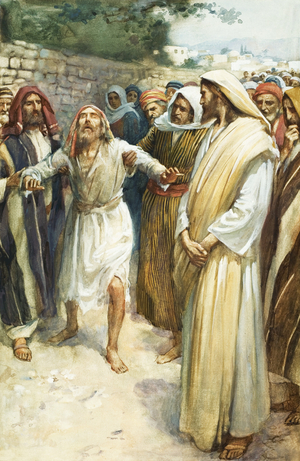 Jesus cured many people during his public ministry but very few of their names are recorded in the Gospels. Jesus raised Lazarus of Bethany from the tomb, cast out seven demons from Mary Magdalene, and restored the ear of Malchus in the Garden of Gethsemane. But beyond that, no recipients of Christ’s healings are named except for the blind man Bartimaeus, the son of Timaeus. The first three Gospels all recount this event, but the name of Bartimaeus the son of Timaeus appears only in today’s Gospel.
St. Mark wrote, “As Jesus was leaving Jericho with his disciples and a sizable crowd, Bartimaeus, a blind man, the son of Timaeus, sat by the roadside begging.” In Aramaic, the prefix Bar- means “Son of,” so Bartimaeus means “Son of Timaeus.” Why do St. Mark and the Holy Spirit doubly-emphasize the name of Bartimaeus the son of Timaeus, and what does Timaeus mean?
An Aramaic interpretation of the name Timaeus suggests “uncleanness,” but in Greek the name means “highly prized” or “honored.” This Bartimaeus sat begging on the ground alongside a road near Jericho—an extremely ancient city which symbolized the sinful world. He was blind, impoverished, ignored, despised, called a son of uncleanness, and he was unclean, yet our Lord considered him precious.
Bartimaeus had heard about Jesus’ healings and had faith in him. He shouts, “Jesus, son of David, have pity on me,” because he believes Jesus is the Christ (or the Messiah), the prophesized descendant of King David, and he believes Jesus possesses the power to heal him.
At first, many disciples rebuked the beggar, telling him to be silent, while he kept calling out all the more. Then Jesus stopped and said, “Call him.” So people in the crowd told the blind man, “Take courage; get up, Jesus is calling you!” The man sprang up from the dust and came closer to Christ, guided by Jesus’ disciples.
We are also journeying in a large crowd of Jesus’ disciples today, walking with him in his Church. Are we ignoring people who are not here with us, as the crowd at first ignored Bartimaeus? Jesus commands us to call them and help lead them to himself.
Before Bartimaeus could see, he had heard what other people were saying about Jesus. Are we sharing our stories, our cause for hope, with others? Are we mentioning the miracles that we have witnessed? Are we telling them the difference our Catholic Faith makes? Are we encouraging them to join us here?
Bartimaeus had faith due to what he heard and from God’s grace already active within him, for God is calling everyone. Bartimaeus called out to Jesus and, being called, threw aside his dirty, smelly cloak, lest it restrict his movement or cause offense. We, likewise, must cast off our sinful habits, lest they offend the Lord and impede our progress toward him.
When Bartimaeus reached Jesus, our Lord asked him: “What do you want me to do for you?” Christ could read the hearts of men, so why did he ask the blind man what he wanted? St. Augustine wrote that God wills us to ask him for things not because he doesn’t know (for he cannot fail to know) but “to exercise our desire through our prayers so that we may be able to receive what he is preparing to give us.” For “the deeper our faith, the stronger our hope, the greater our desire, the larger our capacity to receive will be…” Praying for our requests also helps us remember how much we need God and deepens our relationship. St. Teresa of Avila said, “You pay God a great compliment by asking great things of him.”
Jesus asks, “What do you want me to do for you?” How will we answer him? The blind man answered boldly, “Master, I want to see.” And Jesus told him, “Go your way; your faith has saved you.” Bartimaeus immediately received his sight and followed Jesus on the way. May this famous story of Blind Bartimaeus help us to see in new ways too.
 Parishable Items
Leave a comment