30th Sunday in Ordinary Time
By Fr. Victor Feltes
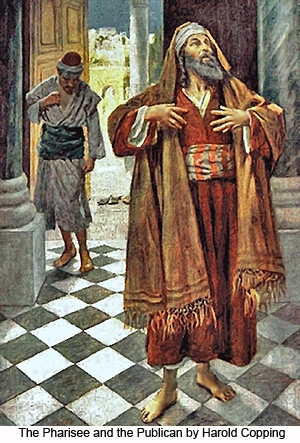 When the Pharisee in Jesus’ parable went up to the temple, he stood and spoke this prayer to himself: “O God, I thank you that I am not like the rest of humanity — greedy, dishonest, adulterous — or even like this tax collector.” And yet, Jesus tells us that this Pharisee did not go home justified, or righteous in God’s sight. Why is that?
When the Pharisee said ‘I am not like the rest of humanity — I am not greedy, dishonest, or adulterous…’ was it true that he had conquered sin? Very likely not. Psalm 130 rhetorically asks, “If you, O Lord, should mark our iniquities, who could stand?” And the Gospels record Jesus criticizing the Pharisees repeatedly, saying things like “Oh you Pharisees! Although you cleanse the outside of the cup and the dish, inside you are filled with plunder and evil.” But assuming this Pharisee quietly spoke his prayer to himself in a way which no one else could hear, why would he lie? Maybe he believed everything he said.
When we compare ourselves to others, like this Pharisee compared himself to the tax collector, we can imagine the great faults of others make our own faults unimportant. But just because somebody else is ten billion dollars in debt doesn’t mean that I am solvent. My own debts still remain. Some people accuse and make much of others’ sins because they are projecting at others what they dislike in themselves. It is much easier to condemn the faults in others than to change the faults in me.
Another phenomenon common to people and cultures is to condemn a person or group for the problems of the day. Sometimes, these are merely scapegoats for shifting blame. At other times, particular persons really are at fault and should be corrected or stopped. But we should not imagine that we can banish, purge, and kill our way to earthly paradise. Even after the Great Flood in Genesis, sinners disembarked from Noah’s ark. As the Christian Russian dissident and winner of the 1970 Nobel Peace Prize winner, Aleksandr Solzhenitsyn, famously wrote: “If only it were all so simple! If only there were evil people somewhere insidiously committing evil deeds, and it were necessary only to separate them from the rest of us and destroy them. But the line dividing good and evil cuts through the heart of every human being. And who is willing to destroy a piece of his own heart?”
The Pharisee’s heart was probably not so pure of sin as he thought. He needed Jesus Christ to cleanse and heal and change it. But imagine if it really were true that the Pharisee was unlike the rest of humanity; not greedy, not dishonest, and not adulterous. Why then did this Pharisee not go home justified before God? What more did he lack?
Our Gospel tells us Jesus addressed today’s parable “to those who were convinced of their own righteousness and despised everyone else.” The Pharisee looked down on that tax collector and despised him with contempt. Greed, dishonesty, and adultery are hateful things, but Jesus forbids us from hating anyone. Jesus says you will be hated, you will have enemies, but he commands you to “love your enemies, and pray for those who persecute you, that you may be children of your heavenly Father.” If there is ever people you may be hating, be sure to pray for them (since you cannot pray for someone — willing their good — and hate them at the same time). Otherwise, when you die and you see someone whom you hate on the other side of the pearly gates, you might refuse to enter into Heaven.
Without ever denying right and wrong, without ceasing to share the truth, we must remain humble as sinners living among sinners. ‘For whoever exalts himself amongst others will be humbled, and the one who humbles himself will be exalted.’ That’s some food for prayerful thought today as we stand to pray in this temple and go back to our homes in the world.
 Parishable Items
Leave a comment