3rd Sunday of Lent
By Fr. Victor Feltes
When the Samaritan woman in John’s Gospel meets Jesus at the well, he says to her, “Give me a drink.” She replies with surprise that he, a Jew, would ask her, a Samaritan woman, for a drink (since Jews used nothing in common with Samaritans). And then Jesus says to her, “If you knew the gift of God and who is saying to you, ‘Give me a drink,’ you would have asked him and he would have given you living water.” So Jesus thirsts, and yet at the same time he says he has water to offer her. Jesus in his human nature experienced natural thirst for natural drink, noting “everyone who drinks this water will be thirsty again.” But Jesus adds “the water I shall give… will become in [a person] a spring of water welling up to eternal life.” Later in John’s Gospel, in Jerusalem during a Jewish feast, Jesus stands up and exclaims, “Let anyone who thirsts come to me and drink.” But then, on Good Friday as he hangs upon his Cross, Jesus says, “I thirst.” And when he died and was pierced in the side, “immediately blood and water flowed out.” Thus, Jesus may be called the “Thirsty Fountain.”
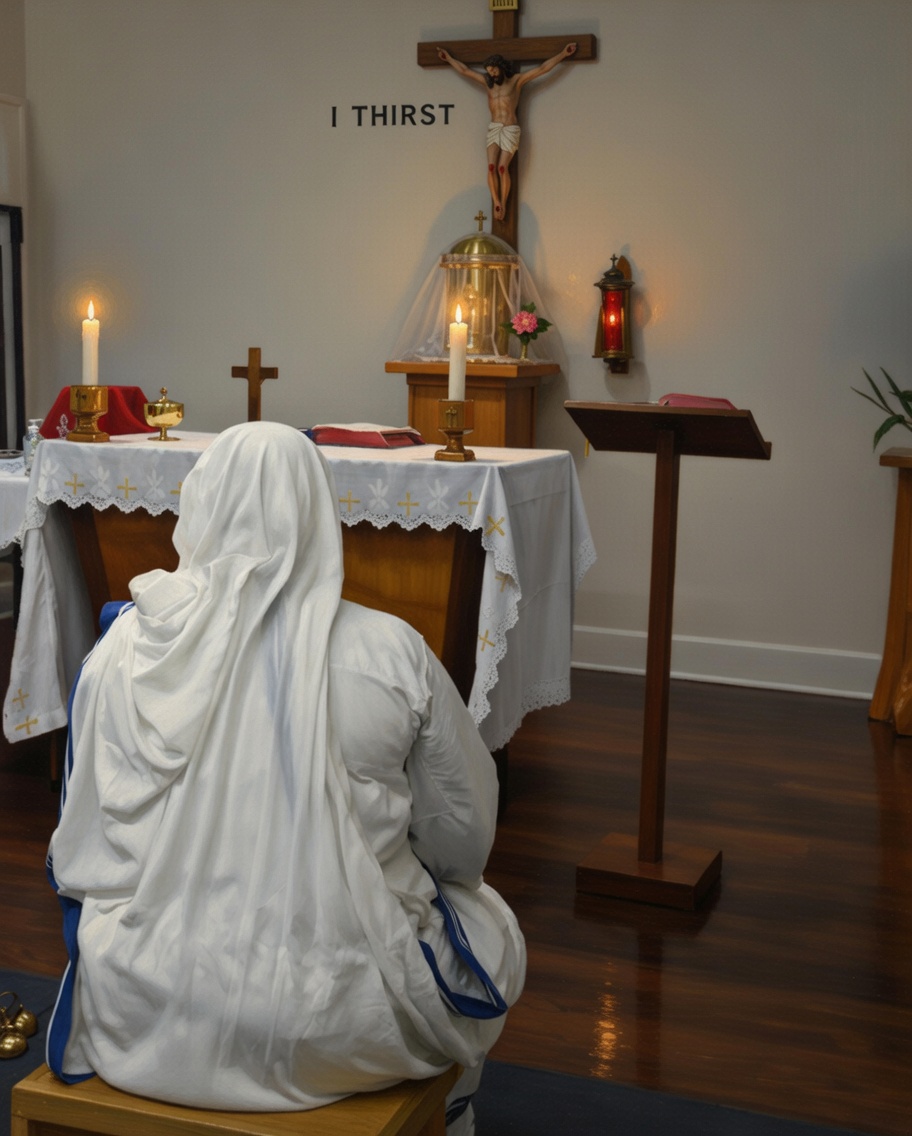 St. Teresa of Calcutta, foundress of the Missionaries of Charity, had Jesus’ words “I Thirst” placed beside the crucifix inside of every one of their chapels. Psalm 22 prophesied about Christ’s sufferings when it said, “As dry as a potsherd is my throat; my tongue cleaves to my palate… They have pierced my hands and my feet.” But Mother Teresa recognized that when Jesus said “I Thirst” on the Cross, he spoke of something more profound than merely his physical dehydration. As Jesus pours himself out for us, he thirsts to love us and to be loved by us. In a letter to her religious community in March of 1993, Mother Teresa wrote: “‘I thirst’ is something much deeper than Jesus just saying ‘I love you.’ Until you know deep inside that Jesus thirsts for you – you can’t begin to know who He wants to be for you. Or who He wants you to be for Him.” And such reflections did not only originate with Mother Teresa. For instance, St. Gregory Nazianzen wrote in the 4th century, “God is thirsting to be my thirst.”
The Samaritan woman at the wall balked at Jesus’ first words to her (“Give me a drink”) for she thought, ‘How could a Jew want anything from me?’ We, likewise, might resist the idea that God would want us. He is infinite while we are finite. He is perfect while we are flawed. How could God, complete and happy in himself, ever desire us? It is not from any necessity or lack within God. It was not necessary for God create us. And God was not morally obliged to redeem us from sin and death. But “God is love,” and we see that Infinite Divine Love likes to overflow for others. St. Paul wrote to the Romans that “God proves his love for us in that while we were still sinners Christ died for us.”
Other people may resist the idea of Christ thirsting for their souls, not due to philosophical or theological objections, but because they find the idea hard to personally connect with, as happens with other inspired Christian metaphors. For instance, the Church is Christ the Bridegroom’s the beloved Bride whom he cherishes and protects that she might be holy and beautiful. That imagery may feel more relatable to women than men. At the same time, men may more readily relate to the call for all Christians to be priests, prophets, and kings in Christ; sanctifying, teaching, servant-leading as other Christs. If Jesus longing for your soul feels too romantic in connotation, remember how our Lord eagerly longs to lead heroes and heroines. The saints are his friends who are willing to sacrifice in his service. “Only with difficulty does one die for a just person, though perhaps for a good person one might even find courage to die.” Jesus longs for souls who, with the courage and grace he outpours, are willing to lay down their lives for him as he laid down his life for us.
In conclusion, increase your thirst for Christ who thirsts for you, and drink deeply of the peace, virtue, wisdom, and love which flow out from him. You will never exhaust that Divine Fountain.
 Parishable Items
Leave a comment