26th Sunday in Ordinary Time
By Fr. Victor Feltes
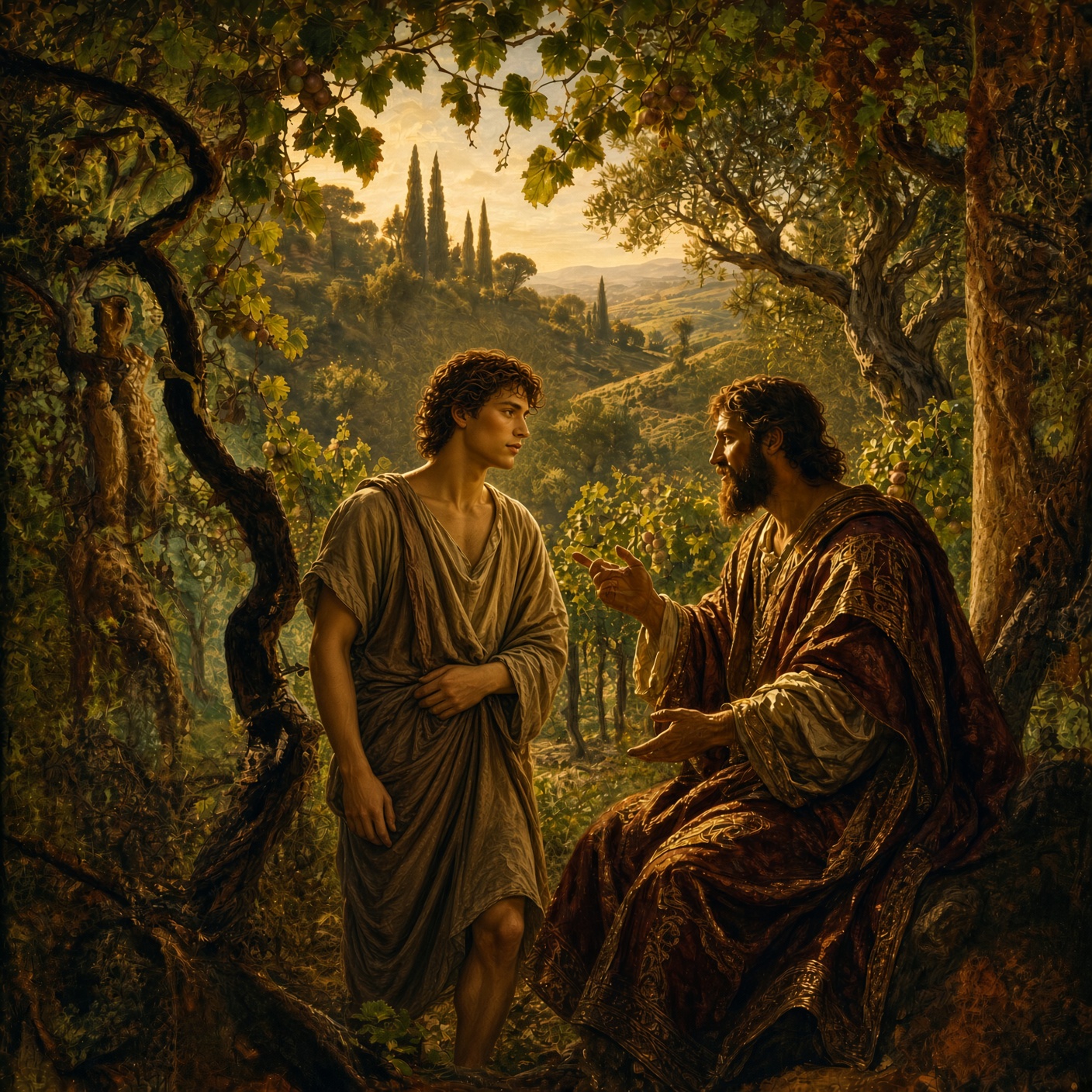
Today Jesus tells us a parable about a father and two sons. The father comes to each one and says, “Son, go out and work in the vineyard today.” One son says “Yes, sir,” but does not go. The other son initially refuses, saying “I will not [go].” But then afterwards he changes his mind and goes. So what is this parable about?
In its original context, Jesus is contrasting the Jewish leaders who had rejected St. John the Baptist with the tax collectors and prostitutes who had accepted him. The Jewish leaders, while speaking faithful words, failed to respond to God’s word through John. Meanwhile, sinners who had been disobedient before began to act rightly in response to God’s word. Jesus criticized the chief priests and elders for their stubborn disbelief despite seeing those good fruits. Since we have seen Christ’s good fruits in others, Jesus expects us to faithfully respond to him too.
Another fulfillment of this parable is seen between the Jews and the Gentiles. The Jewish people had followed God in the past, but many balked at accepting Jesus. The non-Jewish Gentiles had not followed the true God in the past, but many went on to become Christians. A third interpretation of this parable applies to us today: God is our Father and we are his sons. Like the Lord says in our first reading through the Prophet Ezekiel, it is important for us who profess faith in God to follow through in action. For “when someone virtuous turns away from virtue to commit iniquity and dies, it is because of the iniquity he committed that he must die.” However, if we have done wickedness and sincerely repent, turning to do what is right and just, permitting Christ to save our souls, then we shall surely live.
We are called to go and serve our Heavenly Father. If we have refused him in the past, then we should change our minds and begin doing his will. The tax collectors and prostitutes turned away from their greed and lust. Why did those sinners change? Why would we? One might ask why that one son changed his mind and went to work in his father’s vineyard? I can think of three possible motivations: first, the fear of punishment and desire for reward; second, the force of conscience to do what is right; and third, for love of the father.
The first motive avoids punishments and seeks rewards. St. Thomas Aquinas notes that even under the New Covenant “the fear of punishment and certain temporal promises have been necessary… to incite [some] to virtuous works.” (Catechism of the Catholic Church, paragraph #1964) Christian hope confidently looks forward to divine blessings and the beatific vision of God while piously fearing to offend God’s love and incur just punishments. (CCC #2090) Such punishments in this life or the next are not “vengeance inflicted by God from without,” but consequences which flow from the nature of sin itself. (CCC #1472).
A second motive for conversion is the influence of moral conscience. As the Second Vatican Council taught, “Deep within his conscience, man discovers a law which he has not laid upon himself but which he must obey. Its voice, ever calling him to love and to do what is good and to avoid evil, sounds in his heart…. For man has in his heart a law inscribed by God. There he is alone with God whose voice echoes in his depths.” (CCC #1776) Our consciences, which command us to serve Truth and Goodness, also insist that we form our consciences and enlighten our moral judgements using reliable teachers and sources. So while teachings of Christ’s Church on private conscience are important, we must also heed what she teaches about what is right and wrong.
The ultimate and final motive is love. St. Basil writes that “if we turn away from evil out of fear of punishment, we are in the position of slaves. If we pursue the enticement of wages… we resemble mercenaries. Finally if we obey for the sake of the good itself and out of love for him who commands… we are in the position of children.” (CCC #1828) “The New [Covenant] Law is called a law of love because it makes us act out of the love infused by the Holy Spirit, rather than from fear; a law of grace… a law of freedom… [that] lets us pass from the condition of a servant… to that of a friend of Christ… even to the status of son and heir.” (CCC #1972)
How can we develop a greater love for God? One way is to consider what Christ did for you. For “though he was in the form of God… he emptied himself, taking the form of a slave, coming in human likeness… he humbled himself, becoming obedient to the point of death, even death on a cross.” Our Savior did what was right, for love of God and love of us, enduring great suffering to receive supreme rewards. Now his name is above every name. Jesus Christ is Lord. Contemplate Jesus Christ on the Cross for you and ask him to deepen your love for God.


Leave a Reply