Archive for March, 2010

A Premature Passion? — Palm Sunday—Year C

March 28, 2010

So why did we just proclaim the Passion?  Isn’t the Passion a bit premature? It’s Palm Sunday, not Holy Thursday or Good Friday. Aren’t we jumping the gun? No, like the two disciples Jesus instructed in our opening Gospel, we’re being told what we are going to see. The Church has us recount the Passion on Palm Sunday to prepare us; to prepare us for encountering Christ’s Passover through the special ceremonies and symbols of this Holy Week.

Now the celebration of the Eucharist actually makes the events of the Pascal mystery present for us every time we come to Mass. Jesus’ Last Supper, His Passion and Death, His Resurrection and Ascension into glory, are all truly presented to us at each and every Mass; but during Holy Week, we unpack and encounter these events in unique and special ways.

Today you have waved palms, an ancient symbol of victory, to Christ, welcoming Him into our city. On Holy Thursday, you can go where the Blessed Sacrament is reserved and give company to Christ in his lonely solitude, with Him in His agony before His arrest and with Him as He spends the night awaiting His trial. On Good Friday, you can reverence the crucifix; you can kiss the wood of Jesus’ cross and kiss His body hanging upon it, as He dies for us. And at the Easter Vigil, you can see the sign of the light of Jesus Christ resurrecting out of darkness and death.

And so I invite you to encounter Jesus’ Pascal mystery, at this Mass, at every Mass, and through the special signs and ceremonies of this Holy Week.

11 Absent Students — March 25 — Annunciation

March 28, 2010

You have probably wondered why our school chapel’s icon, statues, and crucifixes are veiled with purple cloth. Covering of religious images is a tradition for the last two weeks of Lent, a period we call Passiontide. So why do we have this tradition?

One explanation recalls that Jesus’, when His enemies sought to kill Him, hid Himself prior to His final days: “Jesus left and hid from them.” (John 12:36) Others see in this veiling a symbol for how Jesus’ divinity was veiled within His humble and vulnerable humanity. He was God incarnate, but none of the rulers of His age knew, “for if they had known it, they would not have crucified the Lord of glory.” (1 Corinthians 2:8) But behind all of this I think there is a very human reason for why we veil the holy images of Jesus and the saints at Passiontide. “Absence makes the heart grow fonder.”

During Lent we deprive ourselves of luxuries and pleasures for our personal conversion and growth in holiness, but we also do this so that we can celebrate the Christ’ Easter triumph with an even greater feeling of joy. This is why we normally don’t sing as much (or say the Gloria or the “A”-word before the Gospel) during Lent—so that we can enjoy pulling out all the stops at Easter.

Veiling our statues of Mary and Joseph, our wall icon of Elizabeth Ann Seton, and our crucifixes causes a little pain of separation within us. But what if this chapel had never been furnished? What if our chapel had always been bare of religious art? Then their absence would not affect us at all because we would not know that we were missing them.

There are not as many students here today as there should be. Now I’m not saying that this should have been a whole school Mass, and I’m not begrudging anyone who may have stayed in study hall this hour to work on homework.  This is a great turn out and every seat is filled. But still, there are not as many students here as should be here today.

In the early nineties, when most of you were born, for every three live births in our country there was one boy or girl who was intentionally killed. (CDC) I counted roughly 33 students here today. That means we are missing 11 of your classmates who were not allowed to be born.

Today we recall the Annunciation, which some people call “Pro-Life Christmas,” for even though Jesus will be born nine months from now, today is the day of the Incarnation, when God became a human being like us in the womb of the Virgin Mary. After the angel Gabriel departed, Mary went in haste to see her relative. Elizabeth exclaimed, “Who am I that the mother of my Lord should come to me,” and John the Baptist leapt for joy in his mother’s womb in the presence of our microscopic Savior, Jesus Christ. (Luke 1:43-44)

Imagine if 11 of your classmates were to die in a bus accident. You would you feel terrible from the loss, and our whole school would be in mourning. But we have never known the 11 who are missing here today, so we do not feel our loss.

At this Mass and henceforth, let us keep the following things in mind regarding the past, present, and future. As to the past, remember these absent classmates and pray for them. They never received a name, they never had a funeral, and few people have ever prayed for them. Pray for their parents, too. 

In the present, perhaps you honestly find yourself not feeling much emotion one way or the other towards the reality of one million innocents being murdered in our country every year. If so, then ask God to give us His heart and His sight to love what He loves and to hate what He hates. God loves us all, but He hates our sins. He hates our sins because they are bad for us, and the worse they are for us the more He hates them. His love for us and His hatred for our sins are two sides of the same coin. Blessed Mother Teresa of Calcutta said “the greatest destroyer of peace today is abortion.” The Lord’s heart is certainly not indifferent to this evil, and neither should ours be.

And finally, for the future, keep hope that this evil of abortion will come to an end in our time. We can have this hope, for as the angel Gabriel said to Mary, “nothing will be impossible for God.”

Sin Means Death — 5th Sunday in Lent—Year C

March 21, 2010

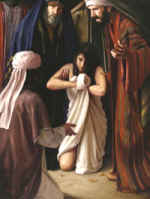
The scribes and the Pharisees were jealous of Jesus. When He came to the temple all the people gathered round Him to listen to Him teach. His words were compelling; the truths of God taught with gentle mercy. All the people were flocking to Jesus and this made the scribes and the Pharisees deeply jealous. We ourselves must beware of jealousy, for it can lead us to hate the good and condemn the innocent.

The scribes and the Pharisees bring before Jesus an adulterous woman and say to him, “Teacher, this woman was caught in the very act of committing adultery. Now in the law, Moses commanded us to stone such women. So what do you say?”

This scene raises some questions. For instance, how did Jesus’ enemies know where to find an adulteress when they needed one? It’s unlikely this affair was discovered just that morning. It must have been known from days, weeks, months, or even years before.

This prompts another question: if this affair had occurred much earlier, then why had the Jews not executed judgment on this woman before now. There seems to be two reasons for this. First of all, under Roman rule, the Jews had no authority to impose the death penalty on anyone. We will see this come into play in the Passion, where the Jewish leaders must convince Pilate that Jesus is an enemy of the state if they are going to do away with this “blasphemer.”

But there is another reason, too. Even though the Law of Moses had commanded death for certain sins, based upon what I’ve read the actual use of capital punishment for sins was very, very rare among the people of Israel, even before the Romans came along. And, as we can see in this scene, not even the scribes and the Pharisees are really serious about applying the law in strict and absolute terms. If they had been, they would have brought along the adulterous man for judgment too. Where is he? He was just as guilty as her, if not more (considering their culture.)

So the penalty of death was very rarely employed for punishing sinners, but then why were these severe punishments in the Old Covenant at all?  It seems that the point of those rarely applied laws was to teach an important lesson, a lesson repeated over and over again in countless ways throughout the Old Testament, a lesson for the Jews and a lesson for us today:

Sin is serious stuff, because sin leads to death.
Sin brings us death in our bodies and our souls.
Sin means death.

The scribes and the Pharisees round up a known adulteress and set their trap against Jesus (which is the only thing this is really about for them.) Jesus’ enemies will try pitting justice against Jesus’ mercy. They’re thinking to themselves, “Surely he’s not going to tell us to stone her, that’s not his way. He says he ‘has come not to destroy, but to seek and to save what is lost.’ So when he tells us not to stone her, then we’ve got him. He’ll be telling us to disobey the Law of Moses, and then we’ll have a charge to bring against him.”

“So Jesus… what do you say?” Jesus says nothing. He stoops down and writes with His finger on the ground the only thing we have record of Him writing in the entire Gospels. What did Jesus write? We don’t know. The Greek verb used indicates that Jesus was writing letters or words, and not drawing disinterested doodles or drawing a line between the accused and her accusers.

A common explanation is that Jesus’ finger was writing on the ground the names of sins, sins which those in the crowd had committed, sins which the finger of God had written of long before, on the stones of the commandments atop Mount Sinai. Perhaps Jesus wrote the words: “Sacrilege, Rebellion, Adultery, Theft, Deception, Coveting.”

The accusers continue harassing Jesus, but He rises again, and gives his well-known reply. The crowd of evil doers slowly scatters, and Jesus is left there alone with the woman. The threatening mob is gone, and you think that the woman would flee, but the woman does not run away. She knows she has sinned. She knows that she cannot run away from her sins or from God. She stays there before Jesus.

Jesus rises again and says to her, “Woman, where are they? Has no one condemned you?”
She replies, “No one, sir.”
Jesus says, “Neither do I condemn you. Go, and from now on do not sin any more.”

Jesus condemns the sin, but not the sinner. Jesus is merciful, but He is not indifferent to the prospect of her continuing in sin, nor is he indifferent to us continuing in our old sins. He does not say, “Go, and live as you will: presume on my deliverance: for however great your sins may be, it doesn’t really matter one way or the other.”

Jesus does not say this, for sin means death, and Jesus died to free us from sin and death. So let us come before Jesus to receive His pardon, but then let us go forth seriously and, from now on, sin no more.

The Prodigal Son — 4th Sunday in Lent—Year C

March 14, 2010

If today happens to be your first time coming back to church in a long time, then take today’s gospel as a sign. God our Father is incredibly merciful and He welcomes you home with a loving embrace.

But most of us here, I suspect, came to Mass last week, and the week before that, because you always come every week. If so, then you probably hear this familiar parable of the Prodigal (that is, squandering) Son and wonder where you fit into the story. When you look at yourself I bet you can honestly say that you’re not living a life of great dissipation like the younger son, and the idea of a sinner being reconciled with God makes you genuinely happy, not bitter, like the older son or the Pharisees. So what does this story have to teach those of us who are doing a lot more right than we’re doing wrong?

First, let’s look at the younger, prodigal son. He goes to his father and says, “Father, give me the share of your estate that should come to me.” Here, he is asking for his inheritance while his father is still alive. He is basically saying, “I don’t want to share my life with you,” and then he demonstrates it a few days later by setting off to a distant country. There he squanders his inheritance on a life of dissipation, but after he has freely spent everything, he finds himself in dire need. What he thought would make him happy left him disappointed in the end.

Sure, we’re not professional, all-star sinners like the prodigal son, but we act like him in many little ways in our daily lives. The prodigal son asked his father for something which was not his and which he had no right to take (while his father is still alive.) Whenever we live as if our lives were our own, as if our lives did not come from God and do not belong to God, our Father, we say to Him, “I don’t want to share my life with you.”

Though our small and venial sins only hinder or wound our relationship with God, in every sin we turn our backs and set off for awhile to a distant country. Whenever we insist upon it, God permits us to freely spend our lives in squandering ways, in ways which we think will make us happy but which disappointing us in the end. When we return to our Father, He forgives our sins and welcomes us back, but you and I must learn to stop trying to live our lives without sharing them completely with God.

Why are we afraid of the idea of doing what God wants us to do every moment of our day? I think we are afraid that doing God’s will won’t really make us happy. Maybe we imagine that doing God’s will means we will have to pray ten hours a day at church or walk around wearing a burlap outfit. Of course that’s crazy. God probably wants you to live the same life you are living now, but with some minor adjustments, and more closely to Him.

Maybe we are afraid to give ourselves completely to God because we are a lot like the other, older, more faithful son in the parable. We have served our Father for years without ever asking or expecting much for ourselves. But working hard for God without ever experiencing His good gifts and joys does not make us holy; over time it makes us angry and embittered, like the older son who never asked for anything. We start to think of our Father, not as our father, but as a slave master. But our Father says to us today, “My child, you are here with me always; everything I have is yours.”

“Taste and see the goodness of the Lord,” as our psalm said. Do not let your face blush with shame at asking for good things for you and your friends to enjoy. When we are poor and call out the Lord hears us, and He will save us from all our distress. So look to God, and be radiant with joy.

We’ve learned important lessons from both of the sons in this parable, and I hope we will put them into practice.

From the faithful but disgruntled son, we learned the importance of asking for good things from God. So today, at this Mass, ask our Father to surprise you today with some good gift that you’ll enjoy. Then watch to see what He does for you.

From the prodigal son we learned the importance of living with and for God every day of our lives. So tomorrow morning, when you wake up and you’re lying in bed, make the sign of the cross and entrust yourself to God for that day, that you may live your life that day always with Him and for Him. Ask you guardian angel to remind you and I bet you will remember.  Try it, and I think you’ll be pleasantly surprised by the difference it makes in your day.

One Catholic Church — Tuesday, 3rd Week of Lent

March 9, 2010

In the first reading we hear the ardent prayer of an Old Testament Jew named Azariah who finds himself in a pretty hot spot. He fervently prays, “… O Lord, do not deliver us up forever, or make void your covenant. [Save us for] the sake of Abraham, your beloved… to whom you promised to multiply … offspring like the stars of heaven, or the sand on the shore of the sea.”

This was God’s covenant promise to Abraham, and God has indeed made Abraham’s spiritual offspring vast and numerous. Today, half of the people on earth claim Abraham as their father in faith—these are Christians, Muslims and Jews who all seek to worship the God of Abraham.

Yet Jesus prayed that all people would be one in Him, as one holy family of God—a diversity of persons sharing one perfect unity. To achieve this goal Jesus established one, holy, catholic, and apostolic Church, so that all may be one, as He and the Father are one. Our Church was established by Jesus, Himself, who said to Peter, our first pope, “You are rock, and upon this rock I will build My Church.”

Our Catholic family is made up of every race and reaches to every nation. To illustrate this, I would ask all high school students; freshmen, sophomores, juniors, and seniors, to stand up now. Imagine that these 146, or so, young men and women represent the world’s nearly 1.2 billion Catholics. Each one represents about eight million of our  Catholic brothers and sisters.

In the United States we have 68 million Catholics, but this is only 5.7% of all the Catholics in the world. I would now ask the male freshmen to remain standing and for everyone else to sit down. These guys represent the Catholics of the United States, plus the rest of North America and the Caribbean—just 9% of Catholics worldwide.

The freshmen can sit down and I would ask the male sophmores to stand up. This is Asia, Australia, and the Pacific Islands, totaling 11% of all Catholics.

You can sit and I’ll ask the senior males to stand. This is Africa’s Catholics, 12% of the Catholics in the world.

You can sit and we’ll have the male juniors and the female seniors rise. This is Europe, 27% of all Catholics.  (The pope is in there somewhere.)

You can sit and we’ll have our largest region of all, represented by the female juniors and the full sophomore class, please stand. This is Central and South America, where 39% of all Catholics live.

So, as you can see our Catholic family is far more diverse than you might have imagined. We are young and old, men and women, rich and poor, sinners and saints.

Our Catholic family not only spans the globe, it also spans the centuries. This is reflected in the ancient prayers we sing today, such as the Latin Sanctus and Agnus Dei, the Kyrie which is ancient Greek, and the Amen which is Hebrew.

Let me put this another way: Could I have one high school student please stand up. This one person represents about 13½ years, which is about how long you have had to explore and get to know about your faith. Now could all of the high schoolers please stand up. You represents all the years that the Church has been on earth, since 33 AD. Our Church has been around a lot longer than we have. You may be seated.

Roman Catholics make up the largest religious denomination in the United States.  However, it is said that the second largest denomination in our country would be former Catholics. Tragically, many Catholics leave the Church. Oftentimes, they experience one or two parishes and a couple of priests, in one region, of one country, over a handful of years, and they imagine that they have exhausted the riches of the 2,000 year-old worldwide Church and Faith of Jesus Christ. But in reality, you can explore the mysteries of Catholic beauty and truth for a lifetime and never exhaust them.

My message for you, with all passionate the urging of Jesus Christ, is this: always remain in the Church that Jesus Christ founded. Never walk away from the fullness of God’s family, but dwell in the household of God.

Sources:
Distribution of Catholic Population, by Region: 2000
USCCB: The Catholic Church in the United States At A Glance

When Towers Fall — 3rd Sunday in Lent—Year C

March 7, 2010

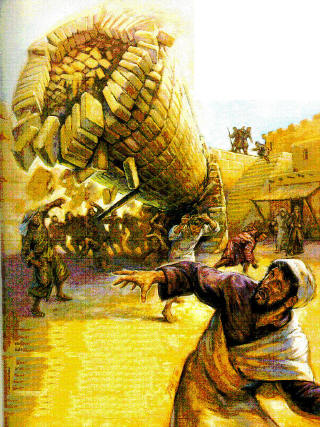
When disasters happen, like the recent earthquakes in Haiti and Chile, some Christian observers respond according to two opposite extremes. One reaction says that a truly just God would never let the innocent die along side the guilty; therefore, all of the victims must have been punished for their sins and got what they had coming to them. The opposite reaction says that a truly loving God would never punish our sins; therefore, all of the victims must have been innocent.

The truth is more complicated than either of these simple and pat explanations. Our God is both perfectly loving and perfectly just. In this world the wheat grows side by side with the weeds. At harvest time, the two are uprooted together, but their eternal fates are not the same. We see that the truth is more complex than some assume by looking at the gospels.

One day Jesus and His disciples observed a man blind from birth. The disciples asked Jesus, “Rabbi, who sinned, this man or his parents, that he was born blind?” Jesus answered, “Neither he nor his parents sinned; it is so that the works of God might be made visible through him.” Jesus smeared clay in man’s eyes and told him to wash in the Pool of Siloam. The innocent man washed and returned able to see.

Yet, on another occasion (in the same Gospel of John) Jesus saw a man lying on the ground who had been ill for thirty-eight years. Jesus miraculously cured this man too, but finding him later Jesus said to the man, “Look, you are well; do not sin any more, so that nothing worse may happen to you.” In this case, it appears that the man’s sin was connected to the cause of his sufferings.

We need to remember that people who suffer and die are not always guilty. On the other hand, people are not always innocent either. Discerning the truth behind why this or that evil befell this or that person or place usually lies well beyond our own limited vision.

For instance, the friends of Job insisted with all confidence that Job’s sufferings must be due to some great sin he had committed.  However, Job stood firm on his innocence, and he truly was as righteousness he claimed. Great sufferings and even violent death are no certain indication of a person’s sinfulness, that “they had it coming.” Just look at our holy and beloved saints:

  • St. John the Baptist was murdered in his 30’s, and St. Paul in his 60’s—they were both beheaded.
  • St. Peter was murdered too, crucified upside down, and of all the apostles, only St. John died of old age.
  • St. Joan of Arc, age 19, was murdered with fire.
  • St. Therese of Lisieux and St. Faustina Kowalska both died of tuberculosis, at ages 24 and 33.
  • St. Maximilian Kolbe and St. Edith Stein were murdered by the Nazi’s in the Auschwitz concentration camp.
  • More recently, before our eyes, John Paul the Great suffered greatly and died of Parkinson’s disease.
  • Even the Blessed Virgin Mary, as perfectly innocent as she was, shared as a mystic and a mother in suffering the passion and death of her Son.

The innocent who suffer live and die in the likeness of Jesus Christ are promised a heavenly reward like His.

So from where do earthquakes and other natural disasters come? In the beginning of time, some of the angels and all of humanity rebelled against God and we rejected our proper places within His creation. This Fall introduced disharmony into our (now) mortal bodies and into the entire natural world. Since that time, Christ has come and in perfect obedience to our Father, died, rose, and has enabled us to be reconciled with God. However, the disharmony of nature remains and we remain free to choose to rebel against our God.

If rebel in sin, we should not be surprised if bad things happen as a result. Usually in this world, we are punished through our sins, more so than for them. For example, someone who neglects prayer and Sunday worship should expect that they will feel disconnected from God. Someone who abuses drugs or alcohol, will see the harmful consequences it brings to their relationships and at school or at work. Someone who covets their neighbors’ spouse and possessions will become sickly green with lust and envy. Add up the sum total of an entire peoples’ sins and you can easily see how an empire or a great nation can decline and decay over time.

God hates our sins, but not merely because they “break His rules.” God hates our sins in proportion to how harmful they are to us. If sins were not bad for us, then God would not command us not to do these things. God hates our sins because He loves us; these are two sides of the same coin.

So what should we do when we witness disaster strike half a world away or in our own community? We should pray for the dead and give our aid to those who live on. Christ calls us to give our compassion, love, spiritual support, and material aid to those who need it. And as for ourselves, such disasters should lead us to convert and reform our lives. Death can come suddenly to any of us. A car crash or a heart attack could take any of us tomorrow placing us unexpected before the judgment seat of God. Let us take such opportunities to prepare ourselves for that day which will come to us all.

What if is not instant death, but a more prolonged evil that comes to me? For instance, what if I go to the doctor and receive a terrible diagnosis?  When such a day comes for me, I hope that I may remember the tree from today’s Gospel, which the gardener worked and fertilized in hopes that it would bear much fruit. If I, like that tree, will humbly accept the manure that comes to me, then it will be a source of great fruitfulness to me.

Could an evil such as this be a correction or a chastisement from God on account of my sins? Possibly, but if I’m not aware of any serious unconfessed sins on my conscience, then probably not. More likely, Jesus is giving me the opportunity to following in His footsteps, to have a share in His cross like the holy saints who came before me. If we accept our crosses with humility, then they can become the means of our sanctification in the likeness of Christ and a source for spiritual fruitfulness for ourselves and the entire world.

Alive in Christ — Funeral for Lila O’Brien, 94

March 3, 2010

On behalf of Christ the King parish I wish to offer to you, Lila’s family and friends, the sympathies and prayers of this community. I also want to give special recognition, praise and thanks to Lila’s children, who provided her with around the clock companionship and care, allowing her the blessing of dying at her home with her loved ones.

In these last months, I had the privilege to visit Lila at home on two occasions. The first time I came, I anointed her with holy oil, to strengthen her for the share in Christ’s passion which laid before her. The second time some of her family and I gathered and pray with her the prayers of commendation for the dying.

When I ask people about Lila they tell me that she was friendly and feisty. That she was ever active and always on the go. That she was funny, a bit goofy, and unpredictable. They tell me that she was very independent, yet also very personable. Lila was a neat lady. Let us not forget that she remains a neat lady.

It is the habit in our culture to refer to people who have died using the past tense. For instance people say, “So and so was such a loving person,” and they say the person “would have really enjoyed being with us today.” Even if unintentionally, these words implies that the dead love no longer and that they are no longer aware of us.

Yet after death, a person who is loving in this life becomes still more loving. It seems quite likely that each of us will be aware of our own funerals, just as I believe that Lila is aware of our gathering today.

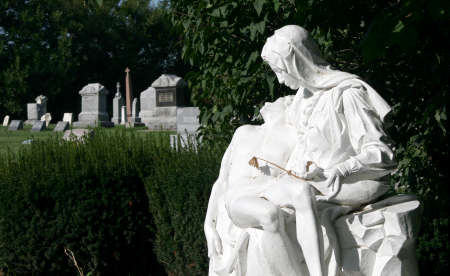
Though we fall into speaking of the departed in the past tense, we do not really believe that death is the end. Dying does not annihilate those we love. As Jesus said, ‘The God of Abraham, the God of Isaac, and the God of Jacob is not the God of the dead, but of the living, for to Him all are alive.’

Nor does dying make a person less fully themselves than what they were before. “Whether we live or die, we are the Lord’s.” And as Jesus said in the gospel, to the good thief crucified with Him, “Amen, I say to you, today you will be with me in Paradise.”

Lila has passed on, but if you would like to talk to her, just go ahead and pray. She will hear you and she will appreciate it. And be sure to pray for her too.

In her years on earth, Lila did not like to travel far from home and she didn’t take long trips, unless the promise of a casino jackpot awaited her. But now Lila is making the human soul’s furthest trip, the journey to full and heavenly presence of God. She has an incredible jackpot to motivate her, the promise of supreme and perfect happiness, however receiving this reward is not a matter of luck. It requires the purification of her soul and the help of our prayers, so offer this morning’s mass and your continued prayers to God for her.

Lila has died, but Lila is not dead. If the woman we remember has changed it is only to become more perfectly who she really is, in all her unrepeatable uniqueness. Lila was, and she remains, a friendly, funny and feisty lady.

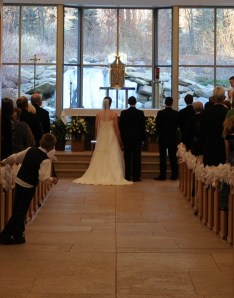
For an Extraordinary Marriage — Wedding of Andrew and Laura Foreki

March 3, 2010

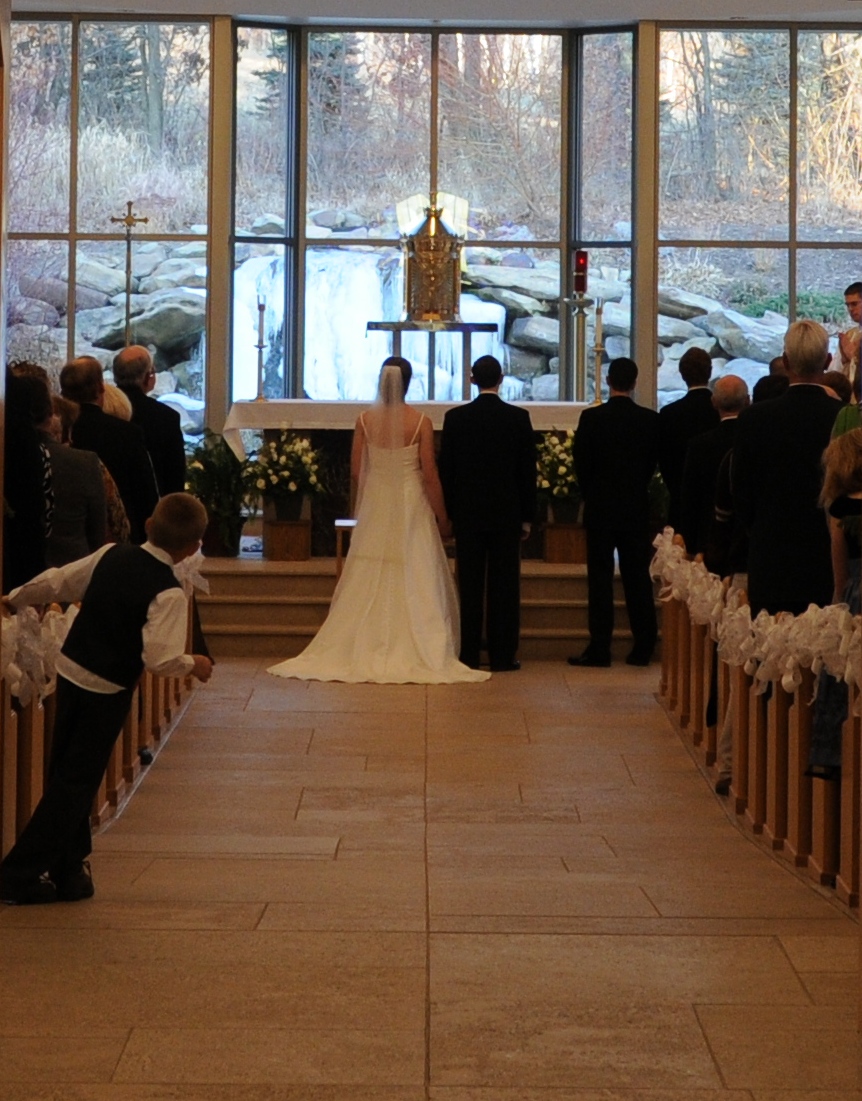
I would like to begin this homily today by sharing with you the extraordinary story of how this boy, Andrew, met this girl, Laura. Picture Andrew, walking one morning across the University of Wisconsin campus in the deep cold of winter. He is on his way to Chadborn Hall where a prayer group is meeting for their twice-weekly 7:30 rosary. 

He walks into the room where the group is meeting and casts his eyes, for the very first time, upon a drowsy-eyed coed named Laura. And can you guess what Andrew said to himself when his eyes saw Laura for the very first time? That’s right. He said to himself, “Oh, I don’t know who that is.” This reaction, of course, is to be expected, since Andrew and Laura didn’t know each other prior to being introduced a few moments later.

Now Andrew’s first impression is not what makes this an extraordinary story. Did you notice what was the extra-ordinary part? Here it is: Here we have two college students, getting up, out of warm beds, on a cold day, to pray a rosary, at 7:30 in the morning! Now, you have to understand, in College Student Time, this is like getting up at 4:30 AM. Your typical college student doesn’t get up any earlier than he has to, but these two got up… to pray. For this and a thousand other reasons, I think you will all agree with me, that we have here two extra-ordinary people, from whom we good reason to expect an extraordinary marriage.

Do you two want to ensure you share an extraordinary marriage together? Then there are three things that I, as an ordained servant of Jesus Christ, believe that you should do.

First, like Tobit and his wife Sarah in our first reading, you should pray together. Of course you must pray individually. And of course you must pray with your children once they come. But you also need to pray together. It doesn’t need to be anything complicated.  Just hold each others’ hands a few moments before you part for work, or stand, or kneel, at your bedside, like Tobit and Sarah did, and speak aloud from your hearts to God. Ask blessings for each other, and give thanks for all the blessing you have received, and close you prayer by saying, “Amen, amen.”

Some couples find this kind of prayer too intimidating, or too personal, to be attempted; for our prayers express our most intimate selves, our fears, our hopes, our pains, our joys, our deepest longings. If you pray honestly in this way, nothing will be hidden between you. Today you will vow to give yourselves completely to each other. Do you want to be truly and totally one? Then pray together. Through marriage you will share of one flesh, if but pray together and you will also share of one spirit. Pray together and you will share an extraordinary marriage as one flesh with one soul. So please, pray together.

The second thing you should do for an extraordinary marriage is to come to Mass. Come to Mass every Sunday and every holy day of obligation. Come, and be moved by the beauty of architecture and songs. Come, and be strengthened by the experience of Christian fellowship. Come, and be inspired by the eloquence of Gospel preaching.

No doubt some people hear this and think to themselves, “That sounds great… But our church is ugly and the songs are dumb and hard to sing. And our community is little more than a gathering of strangers. And our priest always gives the same boring homilies.” Which all boils down to saying, I just don’t get anything out of going to Mass. Then hear this, even if everything else is lacking at Mass, Jesus Christ is always here for us, Body, Blood, Soul, and Divinity in the Eucharist. At Mass, the one sacrifice of Calvary and the Last Supper are made truly present to us for us to receive their power.

At Mass Jesus Christ shows us the perfect spousal love that He calls each of us to imitate. Jesus never called himself “the bachelor.” No, He joyfully called himself “the bridegroom” and eagerly seeks to unite himself to His bride. On the cross, naked without shame, He consummates this union with her, giving himself freely, fully, fruitfully, and forever… freely, fully, fruitfully, and forever. Do you want your union with each other to be free, fully, fruitful, and forever? Then come to Mass to learn the pattern of how Christ loves us and draw from the power He offers us through communion with Him. His is the pattern and the power for an extraordinary marriage. So please, come to Mass.

The third and final thing you should do for an extraordinary marriage is to be salt and light in the world. What does this mean? Being salt and light means that your Christianity should show. As Jesus says, “Your light must shine before others, that they may see your good deeds and glorify your heavenly Father.”

Your good deeds should stand out in the world. As St. Paul says in the second reading, “Do not conform yourselves to this age, but be transformed by the renewal of your mind” If the world never judges you to be radical in any aspect of your Christian life, then you’re not doing it right. Then you’re not yet living as salt and light–you’re not yet living like the saints. For example, everyone loves their friends, but who loves their enemies and prayers for them? Most people pray, but who spends a long time to be with God every day. Many people can give when times are prosperous, but who gives generously when times are tight? Such things as this are what it means to be the light and the salt of the world. Light is different than the darkness, and salt makes the ordinary flavorful.

Clearly, you two are salt and light already, for who goes on weekend retreats to know God better? Or who drives to Washington D.C. to march for life? Or who goes down to Louisiana to volunteer for Hurricane relief? Or who get up at 7:30 in the morning to pray the Rosary? So, please keep on being salt and light, and your marriage will be extraordinary.

Years from now, I don’t expect that you will remember much from this homily, but I hope you remember these three things: Pray together, come to Mass, and be salt and light and you will have an extraordinary marriage.

[Preached as a deacon for my sister’s wedding,  November 22, 2008]