By Fr. Victor Feltes
In 1952, a TV network let an unlikely gentleman host a show during a timeslot nicknamed “The Obituary Slot.” 8 P.M. on Tuesday nights put him head-to-head against NBC’s “Mr. Television” Milton Berle and Frank Sinatra on CBS. The broadcaster, the DuMont Network, had such low expectations for this new show that they classified it as a public service and paid its host no salary. The show only had a simple set, no band, no guests, just a chalkboard and a Catholic auxiliary bishop giving a talk. But then, like a mustard seed growing in a garden, the show became huge, attracting up to 30 million viewers a week, frequently ranking number one in the ratings. His engaging presentation of Christian insights won the host a 1953 Emmy Award as the “Most Outstanding Television Personality.” He said in his acceptance speech, “I feel it is time I pay tribute to my four writers—Matthew, Mark, Luke, and John.” His show was called “Life Is Worth Living” and its host was Blessed Fulton J. Sheen. He was born in El Paso, Illinois in 1895. He passed away as an archbishop in 1979. And last Thursday, September 24th, he was beatified in St. Louis, Missouri; that is, the Catholic Church declared him to be a Blessed now in Heaven. Watch him on YouTube and read his books. He is a remarkable teacher. If he were preaching at this wedding, what might he say?
 Blessed Fulton Sheen wrote 66 books, including one in 1951 about spousal love entitled, “Three to Get Married.” This intriguing title’s meaning is that a successful marriage requires three participants — a husband, a wife, and God. Sheen wrote that “Love of self without love of God is selfishness; love of neighbor without love of God embraces only those who are pleasing to us, not those who are hateful. … How can one love self without being selfish? How can one love others without losing self? The answer is: By loving both self and neighbor in God. It is His Love that makes us love both self and neighbor rightly. … The closer we live to God, the closer we are bound to our neighbor; the farther we are from God, the farther we are from one another. Christian love, which loves everyone either as a potential or actual child of God, redeemed by Christ, … loves the other, not because of attractiveness, or talents, or sympathy, but because of God. To the Christian, a person is one for whom I must sacrifice myself, not one who must exist for my sake.”
Sheen would later write that in marriage “every man promises a woman, and every woman promises a man that which only God alone can give, namely, perfect happiness. One of the reasons why so many marriages are shipwrecked is because as the young couple leave the altar, they fail to realize that human feelings tire and the enthusiasm of the honeymoon is not the same as the more solid happiness of enduring human love… In the first moments of human love, one does not see the little hidden deformities which later on appear. … The passing of time wears out bodies, but nothing can make a soul vanish or can diminish its eternal value. Nothing on earth is stronger than the fidelity of a heart fortified by the Sacrament. … Pleasure is the play of the now-moment. Fidelity is an engagement with the future. When the future is eternity, and when the soul knows that it cannot be saved unless it is faithful to the spouse, it remains faithful even when faced with infidelity.”
We heard Jesus declare in the Beatitudes, “Blessed are the pure in heart, for they shall see God.” Sheen teaches that “the pure in heart shall see God, because they always do His will. Purity does not begin in the body but in the will. From there it flows outward, cleansing thought, imagination, and, finally, the body. … Life is impure only when the will is impure.” Sheen notes that “Love is primarily in the will, not in the emotions or the glands. The will is like the voice; the emotions are like the echo. The pleasure associated with love… is the frosting on the cake; its purpose is to make us love the cake, not ignore it. … What some people love is not a person but the experience of being in love. The first is irreplaceable; the second is not. One of the greatest mistakes the human heart can make is to seek pleasure as a goal of life. Pleasure is a by-product of the fulfillment of duty; it is a bridesmaid, not a bride. … A good husband wants to love and to have a happy life; a wicked husband wants to be loved and to enjoy himself. The good man seeks a woman to complement his imperfection and to work toward mutual enrichment. The evil man wants to immolate a woman in order to enjoy himself.” And the same things could well be said about a good or bad wife.
Bishop Sheen taught that if romantic love does not climb with God to God it falls. “If, like the flame, it does not burn upward to the sun, it burns downward to destroy. … As life goes on, [the couple] become not two compatible beings who have learned to live together through self-suppression and patience, but one new and richer being, fused in the fires of God’s love and tempered of the best of both.” Matthew and Sofia and all couples here, please heed these words: It takes three to be married well. You need Christ as your companion and model in daily prayer, weekly Mass, and regular Confession, growing in love and goodness as you serve your loved ones’ sanctity. Remember: The self-sacrifice of Calvary and ecstatic joy of the wedding feast of Cana are meant to be joined in you in Jesus Christ.


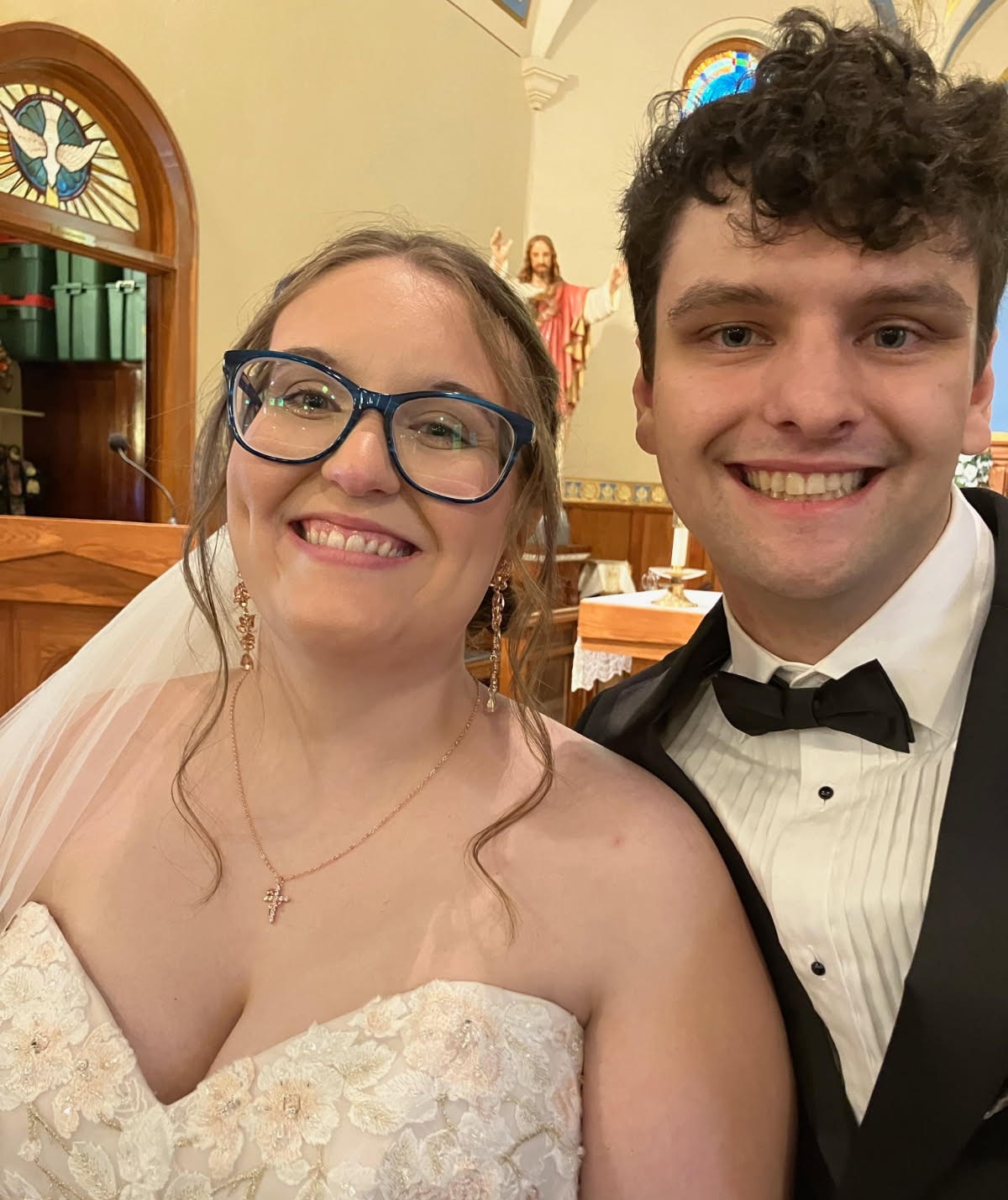



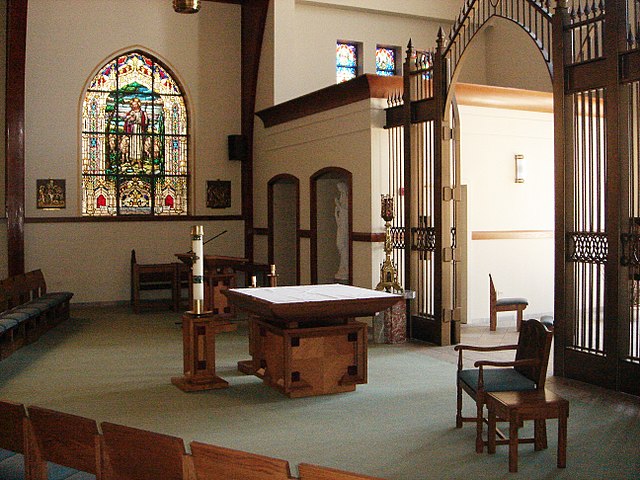
 Nathan and Cassie’s wedding day lands upon this, the third Friday after the Feast of Pentecost, the eleventh day of June. God’s providence has arranged it that they be married on this special day – a feast day, the Solemnity of the Sacred Heart of Jesus, during a month especially dedicated to Jesus’ Sacred Heart. You can see depictions of the Sacred Heart inside this church. There is the statue of Jesus behind me, here in the sanctuary, and presently another statue in our devotional corner in the back. In artistic depictions, you may see Jesus’ Sacred Heart resting upon his chest, or maybe he holds it in his hand offering it to you, and sometimes his heart is depicted by all itself. In every depiction it is a human heart, crowned with thorns, pierced on the side, with flames and a cross emerging from the top. What is the meaning of these things? What do they reveal about Jesus? And what do they mean for Nathan and Cassie and us?


