Archive for March, 2011

3 Mountains / 3 Montañas — 2nd Sunday in Lent—Year A

March 20, 2011
In the life of Jesus, he climbs three significant mountains; The mountain of the sermon on the mount, the mountain of Transfiguration (in today’s reading) and the mountain of the crucifixion. In the Christian life, we must also visit these three mountains. 
 
The three mountains are united. The wisdom of the sermon on the mount, on the first mountain, brings the pleasures and pains of the other mountains. The life of the Gospel brings the joys of the light and the suffering of the cross. Wisdom, glory and sacrifice; the three are a trio here on this earth. Our glories without sacrifice pass quickly. Our sacrifices without wisdom we regret quickly. And our wisdom will be without glory forever if we do not follow Christ in sacrifice. Which mountain should visit more this season of Lent?
 
Do you lack wisdom? Do you not know well that Jesus and his Church teaches? Go to the first mountain to learn, like the disciples at the Sermon on the Mount, with the Bible, or the Catechism or many popular resources available in audio or visual forms.
 
Do you need consolation? Do you not feel well that Jesus is your beloved friend? Go to the second mountain, to feel like Jesus and his disciples at the Transfiguration, through time in a quiet place with God.
 
Do you need perfection in your love? Do you not carry the cross well? Go to the last mountain to practice it, like Jesus at the crucifixion, through good works for others.
 
Jesus climbed the mountains of wisdom, glory and sacrifice. To be with him, we must climb these also.
 

En la vida de Jesús, él sube tres montañas notables. La montaña del sermón del monte, la montaña de la transfiguración (en la lectura de hoy) y la montaña de la crucifixión. En la vida cristiana, debemos visitar estas tres montañas también.

Las tres montañas están unidas. La sabiduría del sermón del monte, de la primera montaña, trae los placeres y dolores de las otras montañas. La vida del Evangelio trae las alegrías de la luz y los sufrimientos de la cruz.  Sabiduría, gloria y sacrificio; los tres son un trío unido en esta tierra.

Nuestras glorias sin sacrificio pasan rápidamente. Nuestros sacrificios sin sabiduría lamentamos rápidamente. Y nuestra sabiduría será sin gloria para siempre si no nos siga a Cristo en sacrificio. ¿Qué montaña deben visitar más esta temporada de Cuaresma?

¿Faltas de sabiduría? ¿No sabes bien lo que Jesús y su Iglesia enseñan? Vaya a la primera montaña para aprender como los discípulos al sermón del monte, con la Biblia, o el catecismo o muchos recursos populares disponibles en formularios visuales o de audio.

¿Necesitas consuelo? ¿No te sientes bien que Jesús es tu amigo amado? Vaya a la segunda montaña para sentirlo como Jesús y sus discípulos a la transfiguración, con tiempo con Dios en un lugar tranquilo.

¿Necesitas perfección en tu amor? ¿No llevas bien la cruz? Vaya a la última montaña para practicarlo como Jesús a la crucifixión, con buenas obras para otros.

Jesús subió las montañas de sabiduría, de gloria y de sacrificio. Para estar con él, debemos subir estas también.

The Dons That Would Have Been

March 18, 2011

The first meeting of the Columbus Pro-Life Society produced this poster, which was hung and well-received in the school cafeteria today.

The Passion of Lent — 1st Sunday in Lent—Year A

March 14, 2011


Today Satan approaches Jesus in the desert at the end of His forty days of prayer and fasting and attempts to divert Him from the Father’s plan.   The ancient serpent employs the same tactics he used on Eve in the garden, twisting God’s words and playing on human desires. So how much did Satan know about what Jesus intended to do in the years ahead? St. Matthew suggests the Devil knew something of this, because the three temptations Satan puts to Jesus foreshadow His future Passion.

First, Satan comes and says to Jesus, “If you are the Son of God, command that these stones become loaves of bread.” Is it a coincidence that at the Last Supper Jesus will command bread to transformation into His very Self? It is as if the Devil were saying, “Why not simply give everyone bread. Why give yourself into their hands?” Jesus answers, “Man does not live on bread alone, but on every word that comes forth from the mouth of God.”

Jesus knows that a lifetime supply of bread would not save us. To live forever the Bread of Life must nourish us. Jesus is the Bread of Life. We do not live by bread alone, with whatever this world can offer, but by the Word that comes forth from the mouth of God. The Word of God is Jesus Christ.

This first temptation and Jesus’ answer point to the importance of prayer and the Eucharist. Prayer lifts our minds above having worldly thoughts alone. The Eucharist empowers our hearts to live for God. Do you pray every day? Prayer must be a top priority in Lent. Do you frequently receive Jesus in the Eucharist? In Lent, try coming to weekday Masses. Those who do so find it so powerful and precious that they often wonder how they ever used to make it a full seven days without receiving Jesus in between.

For his next temptation, Satan takes Jesus to the very top of the temple in Jerusalem. About three years later, not far from that place, the hostile Sanhedrin will gather and put Jesus on trial, questioning Him, demanding to know, ‘Are you the Son of God?’ and they’re not going to like His answer. The Devil says, “If you are the Son of God, throw yourself down.  [God’s angels will protect you.]” It is as if the Devil were saying, “Since you are a child of God He will be with you to save you no matter what, so why not do your own will and decline to give difficult witness?” But Jesus answers, “You shall not put the Lord, your God, to the test.”

You and I are also children of God and He is always with us,  but this must not lead us to presumption. We need to seek His will and give witness in the world by our words and deeds. If we sin, God always offers forgiveness, but we must take Him up on the offer. God always welcomes sinners, but we must turn to Him. To keep sinning without any words or actions of repentance is to put God to the test.

This second temptation and Jesus’ response point to the importance of confession and conversion. This Lent, turn from sin, come to confession at least once, and put some serious thought into planning how you will “sin no more and to avoid the near occasions of sin.”

For the third temptation, the Devil takes Jesus up to a very high mountain and shows him all the kingdoms of the world in their magnificence. He says, “All these I shall give to you, if you will prostrate yourself and worship me.” Jesus plans to claim His universal kingdom by climbing another mountain by Himself, Mount Calvary, and by taking his throne on the cross. (This is why Jesus tells James and John that they do not know that they are asking when they request to sit ‘one at His right hand and one at His left when He enters His kingdom and glory.’) Here it is as if the Devil were saying, “If you simply give up you won’t have to sacrifice, you won’t have to suffer. Lay down your cross and lay down before me.” But Jesus rebukes the devil, (much like he will later rebuke St. Peter for saying, ‘God forbid such a thing should ever happen to you): “Get away, Satan! The Lord, your God, shall you worship and him alone shall you serve.”

This third temptation and Jesus’ answer point to the importance spiritual sacrifices and patiently bearing our burdens. We have taken on Lenten penances, let us not give them up; and when unforeseen trials come to us, let us trust that Jesus knows what He’s doing; for it is through crosses like these that God makes us holy.

Prayer and the Eucharist, confession and conversion, spiritual sacrifices and patiently bearing our burdens. Let these things be in your response as you are tested these forty days.

3 Myths / 3 Mitos — 9th Sunday in Ordinary Time—Year A

March 6, 2011

Many today assume three modern myths: One, that we get into Heaven based on whether our good works out-weigh our sins. Two, that as long as we claim Jesus Christ as our personal Lord and Savior we are assured Heaven. And three, that one Christian church is just as good as another. Let us consider these common myths one by one, and come to understand the truth about Christianity.

If you ask people whether they think they’ll go to Heaven, many say something like this, “I’m a pretty good person. I mean I’ve never robbed any banks or killed anybody. I’ve done good things, so yeah, I think I’ll go to Heaven.” In their minds, such people seem to envision the Last Judgment as a giant scale, with their good deeds on one side and their sins on the other.

The truth is, we cannot earn our own salvation. God is all good and deserving of all our love. When we do good we are just giving Him what He deserves. But when we sin, we disfigure ourselves and our relationship with God in ways that only He can repair. “…All have sinned and are deprived of the glory of God.” But thanks be to God, we “are justified freely by his grace through the redemption in Christ Jesus…. What occasion is there then for boasting?” asks St. Paul. “It is ruled out.” We do not save ourselves. We are saved only through Jesus Christ.

Many Christians like to ask, “Have you accepted Jesus Christ as your personal lord and savior?” Do not hesitate to answer “Yes,” for every time you receive Him worthily in the Eucharist you are accepting Him as your Savior and Lord. Evangelical Christians also like to ask, “Are you saved?” They say this because they think whoever professes faith in Christ is assured of their salvation. However, according to Jesus, “Not everyone who says to me, ‘Lord, Lord,’ will enter the kingdom of heaven, but only the one who does the will of my Father in heaven.”

Think of it this way: the demons recognize that Christ is Christ, but that does not save them. They are not saved because they do not love Him, and love is about more than just words. As Jesus told His Apostles, “If you love me, you will keep my commandments. … This is my commandment: love one another as I love you.” (Jn 14:15, 15:12)

Consider the New Testament words of St. James, “What good is it, my brothers, if someone says he has faith but does not have works? Can that faith save him? If a brother or sister has nothing to wear and has no food for the day, and one of you says to them, ‘Go in peace, keep warm, and eat well,’ but you do not give them the necessities of the body, what good is it? So also faith of itself, if it does not have works, is dead.” (James 2:14) As St. Paul observes, “If I have all faith so as to move mountains but do not have love, I am nothing.” Our salvation in Christ requires faith and love in action.

We know that more than a few Catholics have wandered away from the Church. Some have been drawn away, after being told the Catholic Church does not know the Bible. Others have simply left, thinking that one Christian church is just as good as another. Do not be misled by myths.

In truth, Jesus Christ has built only one house, one Church. And, being a wise man, he built the house on a rock, St. Peter, our first Pope. However, men have built other houses. These Christian denominations have many good characteristics from the one Church of Christ: like Scripture, prayer, the Apostles’ Creed, baptism, marriage, and Christian morals. However, in time, the rains fall, the floods come, and the winds blow and buffet their houses and they collapse ruined. Those houses separate from the truth and separate from within into new houses. Therefore, never abandon the beliefs and the sacraments of the Catholic Church. There is one true house of Jesus Christ. Do not be misled by myths.

Muchos hoy aceptan tres mitos modernos: Uno, que entramos en el cielo si nuestras buenas obras son más que de nuestros pecados. Dos, si nos declararía Jesucristo como nuestro Señor personal y Salvador estamos seguros de entrar en el cielo. Y tres, que una iglesia Cristiana es tan buena como la otra. Consideremos estos mitos populares uno por uno y comprender la verdad acerca del cristianismo.

Si se pregunta a las personas si piensan que van a ir al cielo, muchos dicen algo como esto, “Soy una persona buena bastante. Yo nunca he robado al banco ni matado a nadie. He hecho cosas buenas, entonces sí, creo que voy a ir al cielo.” Estas personas imaginan el juicio final para ser una escala gigante, con sus buenas acciones en un lado y sus pecados en el otro.

La verdad es que no podemos ganar nuestra propia salvación personal. Dios es el sumo bien y digno de ser amado sobre todas las cosas. Cuando hacemos bueno sólo damos lo que se merece Dios. Pero cuando pecamos, nos hacemos daño a nosotros mismos sino a nuestra relación con Dios in maneras que solo Dios puede reparar. “Como todos pecaron, todos están privados de la presencia salvadora de Dios; pero todos son justificados gratuitamente por su gracia, en virtud de la redención llevada a cabo por medio de Cristo Jesús… por medio de la fe.” “¿Dónde, pues, quede el orgullo del hombre ante Dios,” pregunta de San Paulo. “Queda eliminado!” Nosotros no ganamos nuestra salvación por nosotros mismos. Somos salvados sólo a través de Jesucristo.

A veces otros cristianos nos preguntan, “Has aceptado a Jesucristo como tu Señor personal y Salvador?” No duden en responder “Sí”, porque cada vez que le reciban dignamente en la Eucaristía  lo aceptan como su Salvador y Señor.  Nuestros amigos cristianos evangélicos también quieren preguntar, “¿Eres salvado?” Dicen porque piensan que la person que profesa la fe en Cristo se asegura su salvación. Sin embargo, según Jesús, “No todo el que me diga ‘Señor, Señor!’, entrará en el Reino de los cielos, sino el que cumpla la voluntad de mi Padre, que está en los cielos.”

Consideren esto: los demonios reconocen que Cristo es Cristo, pero no los salva. No se salva porque ellos no lo aman, y amor es más que decir palabras. Como Jesús les dijo a sus apóstoles, “Si ustedes me aman, obedecerán mis mandamientos. … Mi mandamiento es este: Que se amen unos a otros como yo los he amado a ustedes.”

Consideren las palabras del Nuevo Testamento de San Santiago, “Hermanos míos, ¿de qué le sirve a uno decir que tiene fe, si sus hechos no lo demuestran? ¿Podrá acaso salvarlo esa fe? Supongamos que a un hermano o a una hermana les falta la ropa y la comida necesarias para el día; si uno de ustedes les dice: ‘Que les vaya bien; abríguense y coman todo lo que quieran’, pero no les da lo que su cuerpo necesita, ¿de qué les sirve? Así pasa con la fe: por sí sola, es decir, si no se demuestra con hechos, es una cosa muerta.” Como San Pablo observa, “Si tengo la fe necesaria para mover montañas, pero no tengo amor, no soy nada.” Nuestra salvación en Cristo requiere fe y amor en acción.

Sabemos que más que unos católicos pocos han vagado de la Iglesia Católica. Algunos son atraídos, oyen falsamente que la Iglesia Católica no conoce la Biblia. Otros simplemente dejaron, piensan falsamente que una iglesia cristiana es tan buena como la otra. No se engañen por mitos.

En verdad, Jesucristo ha construido sólo una casa, una iglesia. Y, siendo un hombre sabio, construyó la casa sobre una roca, San Pedro, nuestro primer Papa. Pero, hombres han construido otras casas. Estas denominaciones cristianas tienen muchas características buenas de la única casa de Cristo: como escritura, oración, el credo de los apóstoles, bautismo, matrimonio, las morales cristianas. Pero, en tiempo, viene la lluvia, bajan las crecientes, se desatan los vientos, contra esas casas y las arras an.  Esas casas sparan de las verdad y sparan desde los interiors en las casas nuevas. Por lo tanto, nunca abandonen las creencias y los sacramentos de la Iglesia Católica. Es la única casa de Jesucristo. No se engañen por mitos.

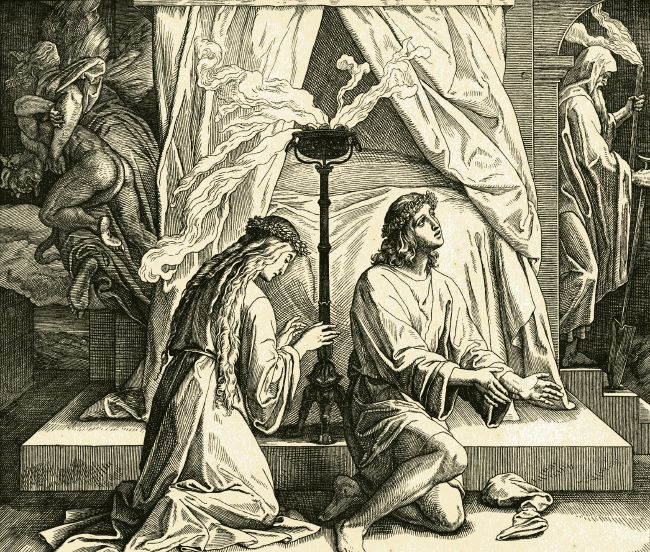
Tobiah Prefigures Jesus

March 3, 2011

In the Gospels of Matthew, Mark, and Luke, Jesus declares to his disciples at the Last Supper, ‘I shall not drink again the fruit of the vine until the day when I drink it new in the kingdom of God.’ (Mt 26:26, Mk 14:25, Lk 22:18) This is as Tobiah says to the father of Sarah—his rightful and would-be bride: “I will eat or drink nothing until you set aside what belongs to me.” (Tobit 7:11)

In Matthew, Mark, and John, almost the final thing Jesus does on His cross before He dies is to consume some wine from a sponge. (Mt 27:48, Mk 15:36, Jn 19:29) Jesus drinks because the kingdom has come and His marriage to His bride, the Church, is sealed. He loves us as Tobiah loved Sarah, not out of lust (to control and exploit) but “for a noble purpose” (out of love.)  Like Tobiah, Jesus is willing to face death to gain His beautiful bride.

The Giving Tree — Tuesday, 8th Week in Ordinary Time—Year I

March 1, 2011

Do you remember The Giving Tree, that very green childrens book by Shel Silverstein? It’s a story about a boy and the tree that loved him. When he is a boy, the tree gives him her leaves to play with and her apples to eat. However, when the boy becomes a young man he comes asking for money, so that he can buy things and have fun. Since money doesn’t grow on trees, she gives him her apples for him to sell. Time passes, and he comes back, this time asking for a house. The tree lets him cut off her branches so that he may build one. Later, much later, the boy returns again, but he is now a much older and sadder man.”I want a boat that will take me far away from here,” he says. “Can you give me a boat?” The tree offers her trunk and he takes it. He fashions a boat, and sails far away. After a long time, the boy returns, now a very tried and very old man. The tree is now just an old stump. He has taken everything, but she still gives. The story closes with these words: “‘Come, Boy, sit down. Sit down and rest.’ And the boy did. And the tree was happy.”

Now if The Giving Tree has always been one of your favorite books, that’s ok. If it has a special place in your heart, don’t let me or anybody take that from you. But, as for me, this book has always bothered the heck out of me. Even when I was a kid, the story filled me with indignation. Do you know what I’m taking about?

It’s the boy! The selfish, ungrateful boy, who never gives anything back. He receives everything the tree has to give and he never says, “Thank you.” He takes everything she has to give, uses all of it up on himself, and he never says, “I’m sorry.” This book would have been so much better if he just said “thank you” at the end. Does this kid’s behavior in the story of The Giving Tree bother you like it bothers me? If so, then you and I should make sure that we’re not doing the same in our own lives.

So who would be the “giving tree” we take for granted in our lives? Our moms and dads come first to mind. They’ve given us life, food, shelter, clothing, and love our entire lives. What have we given back to them? They probably don’t need your material support right now, but they would appreciate signs of your love. (It’s probably no coincidence that Shel Silverstein dedicated The Giving Tree to his own mom.) But there is another “Giving Tree” we can take for granted, who is even greater and more generous than our parents. I speak of God, and of Jesus Christ, “from whom all good things come.” What should we do for our parents and for God? We should honor them with our words. We should obey them in our actions. We should be grateful for everything and show it.

For God, we do this by way of sacrifices. (This Eucharist is a thanksgiving sacrifice. The name itself means thanksgiving in Greek.) Yet our sacrifice is not merely what happens here at church, but the offering of our whole lives. Those who make no sacrifices for God in their daily lives bring nothing to His altar. What do we have to offer Him today? What will we have to offer him tomorrow?

Jesus Christ is The Giving Tree. At this sacrifice, let us say to Him, “I’m sorry, for misusing your gifts.” Let us say, “Thank you, for your generosity to us.” And let us say, “I love you,” because that will make Him happy.