Archive for May, 2011

Sending Another Advocate — 6th Sunday in Easter—Year A

May 29, 2011

At the Last Supper, Jesus told His apostles that He would soon be departing from them. His disciples found this news distressful. Jesus had been their spiritual leader and intimate friend. For the better of three years, they spent almost all day, every day, with Him; sharing breakfasts in the morning, walking down the roads and conversing with Him, watching Him preach and heal n villages, spending evenings with Him around the fire. Not only had he taught them about God, he had also made them more godly men. And so, understandably, word of their Good Shepherd’s departure saddened them.

But Jesus told them, “Do not let your hearts be troubled. You have faith in God, have faith also in me.” In obedience to His Father, Jesus was going away, but He told the disciples that they would not be left orphans. God would send them another person to lead and sanctify them. Jesus told them God the Father would send them another Advocate, another Helper, another Guide, to be with them always. Jesus spoke of the Holy Spirit, who would continue the same work which Jesus had begun in them. The Father had blessed them before by sending them Jesus. Now, at Jesus’ departure, the Lord wanted them to trust and remember this: that they would be blessed again.

Today, this Gospel is fulfilled in our hearing. Father Stoetzel has asked me to read you this letter from him:

Dear parishioners,

Bishop Callahan has asked me to take a new parish assignment beginning July 1st. I will be the next rector of St. Joseph the Workman Cathedral in La Crosse. Also, I am very happy to announce your new pastor here and St. John the Baptist in Marshfield. He is Fr. Samuel Martin who is presently the director of the Holy Cross House of Formation and teacher at Aquinas High School in La Crosse. Please welcome him graciously as he is being sent by the bishop to be your pastor.

I want to thank you very much for the privilege of being your pastor for the past 15 years. My gratitude goes to you for the prayers and many acts of kindness you have shown. Let us continue to pray for one another. Be assured that you will be in my fondest thoughts.

Sincerely,
Fr. Stoetzel

The fact that our bishop has appointed Fr. Stoetzel to be the rector of the cathedral (the bishop’s own parish) says much about Father’s quality as a pastor. We will miss him in many ways. I don’t know Fr. Martin too well, but every encounter I have had with Him has been a positive one. I predict that we will all be very pleased with him when he comes in July and will be blessed by getting to know him better. In the meantime, let’s remember pray for Fr. Stoetzel, as he prepares for his new assignment in La Crosse. Let us also pray for our pastor-to-be, Fr. Sam Martin, as he prepares for us.

Jesus says, “Do not let your hearts be troubled. You have faith in God, have faith also in me.” The Lord wants us to trust and remember this: that He has blessed us before and that He we will be blessed again.

The Way, Truth, & Life — 5th Sunday in Easter—Year A

May 22, 2011

Jesus said, “I am the way and the truth and the life. No one comes to the Father except through me.”

The Mass is an encounter with Jesus Christ, leading us to God the Father. Like Jesus Himself, the Mass contains the Way, the Truth, and the Life of Jesus. First, we journey on the Way to Jesus, then we come to the Truth of Jesus, finally we join in the Life of Jesus.

The Mass begins with the sign of the cross, for God is the beginning and end of everything. Next, we confess our unworthiness to approach the Lord, asking mercy for our sins, so that we may dare to take this journey to God. The, from the Holy Scriptures, we hear of God’s words and deeds among the Old Testament peoples and within the New Testament Church. In this, we learn of the providential way that God has prepared throughout time for us to encounter Jesus Christ today. Just as the journey on this Way through history leads to Jesus Christ, so the liturgy of the Word leads to the Gospel. Certainly, Jesus Christ the Word of God is present throughout the entire Word of God which is Sacred Scripture, but for the reading of the Gospel, we all stand up for Him and sing “Alleluia,” “Praise the Lord,” because we have come to Jesus Christ and He is more fully present among us in the proclamation of the Gospel.

The Gospel reading proclaims Jesus, who is the Truth. The homily that follows proclaims that the Truth matters for us here and now and demands our personal response. To this call, we answer with the Creed, proclaiming our faith in who God is and what He has done for us. In the Creed, we proclaim our acceptance of Jesus, the Truth. In the prayers of the faithful, we petition the Lord for our needs and concerns, saying in so many words, “Lord, let your kingdom come, on earth as it is in Heaven! Let us share you life! Give us your life!” At Mass, the Way leads to the Truth, and from the Truth we long for God’s Life. At Mass, the Liturgy of the Word leads to the Liturgy of the Eucharist.

The presentation of the gifts is not merely about moving around cash and bread and water and wine. The presentation of the gifts is about the presentation of everything that we have, and everything that we are, to God. We lift up our hearts to be one with our sacrifice. Amidst praises to the Father, the one life-giving sacrifice of the Last Supper, of the cross, and of Heaven becomes present here to us. We join in offering this sacrifice through Jesus, with Jesus, and in Jesus, in union with the Holy Spirit, to God the Father in Heaven.

Through this offered sacrifice, we join in God’s Life. We pray “Our Father,” because uniting with the paschal mystery, the great Easter deeds of Jesus, gives us life as the Father’s sons and daughters. Then we share with one another the sign of peace, the loving peace that is possessed by God’s holy ones. Finally, at the climax, we partake of Jesus Christ, Life Himself, most truly present in the Holy Eucharist.

Sometimes people say, “I just don’t get anything out of going to Mass. Father, I know that you say all this important and wonderful stuff is going on, but I don’t see it and I don’t feel it. The Mass is boring for me.” I understand. When I was a boy, I made a point of going to the bathroom (sometimes twice) during every Mass, just to break up the monotony. When I would see the priest cleaning the dishes at the altar—that was a good sign, because it meant that the Mass was almost done. I didn’t really know what was happening at Mass, so I really didn’t believe in what was happening at Mass. But as I grew older I began to learn what was happening, and as I grew in faith I began to believe in what was happening, and my experience of the Mass was transformed.

People who say that the Mass is boring resemble St. Phillip in something he said to Jesus at the first Eucharist, the Last Supper: “Master, (we don’t see or feel the presence of God the Father,) show us the Father, and that will be enough for us.” And Jesus said to him, “Have I been with you for so long a time and you still do not know me, Philip? Whoever has seen me has seen the Father. (Whoever has been to Mass has encountered my mysteries.) How can you say, ‘Show us the Father’? (How can you say, ‘The Mass is boring?’)” The awesome mystical realities of the Mass are true, and real, and present and active at every Mass we attend, whether we see them, or feel them, or believe in them, or not.

Jesus Christ and the Holy Mass contain the Way, the Truth, and the Life, and we shall receive from them according to our faith. Let us pray, that at this Mass and every Mass, we may be as fully present to Jesus Christ and His mysteries as they are to us at every Mass.

“Are You Saved?”

May 13, 2011

Catholics take a modest approach to the question, “Are you saved?” We hope to be saved in Jesus Christ, and we can have some measure of confidence that we will be, but Catholics consider it presumptuous to say that our salvation is assured. The Catholic attitude is like that expressed by Paul:

“It does not concern me in the least that I be judged by you or any human tribunal; I do not even pass judgment on myself; I am not conscious of anything against me, but I do not thereby stand acquitted; the one who judges me is the Lord. Therefore, do not make any judgment before the appointed time, until the Lord comes, for he will bring to light what is hidden in darkness and will manifest the motives of our hearts, and then everyone will receive praise from God.” (1st Corinthians 4:3-5)

After seeing the light on the road to Damascus, if anyone could be certain of their salvation one would imagine it would be Paul. However, in 1st Corinthians 9, Paul doesn’t speak as if he had Heaven already in the bag. He says:

“All this (becoming all things for all people) I do for the sake of the gospel, so that I too may have a share in it. … I drive my body and train it, for fear that, after having preached to others, I myself should be disqualified.” (1 Cor 9:23, 27)

Immediately following this, Paul warns the Corinthians about the necessity of remaining faithful lest they be condemned like God’s people during the Exodus:

“They were all under the cloud (like the Holy Spirit) and all passed through the sea (like baptism) and all of them were baptized into Moses (who imaged Christ) in the cloud and in the sea. All ate the same spiritual food, and all drank the same spiritual drink (like the Eucharist)… Yet God was not pleased with most of them, for they were struck down in the desert. These things happened as examples for us, so that we might not desire evil things, as they did. … Therefore, whoever thinks he is standing secure should take care not to fall.” (1 Cor 10:1-6, 12)

In Matthew’s Gospel, Jesus warns us that if we are to be saved, we must not be among those who acknowledge Him as “Lord, Lord” but fail to do God’s will:

“Not everyone who says to me, ‘Lord, Lord,’ will enter the kingdom of heaven, but only the one who does the will of my Father in heaven. Many will say to me on that day, ‘Lord, Lord, did we not prophesy in your name? Did we not drive out demons in your name? Did we not do mighty deeds in your name?’ Then I will declare to them solemnly, ‘I never knew you. Depart from me, you evildoers.'” (Matthew 7:21-23)

Those condemned seemed surprised that they are refused entry into Heaven. This is why Catholics do not rest in a self-assurance of Heaven (that judgment belongs to the Lord.) Our part is to ceaselessly strive to cooperate with the saving grace of Jesus Christ as we “work out [our] salvation with fear and trembling” as God does His work in us. (Philippians 2:12)

The Significance of Standing — Tuesday, 3rd Week of Easter

May 10, 2011

There’s a curious detail about Stephen’s vision of Heaven in our first reading today:

“Stephen, filled with the Holy Spirit, looked up intently to heaven and saw the glory of God and Jesus standing at the right hand of God, and Stephen said, ‘Behold, I see the heavens opened and the Son of Man standing at the right hand of God.’”

Stephen looks up to Heaven and sees Jesus standing at the Father’s right hand, but both the Apostles’ Creed and Nicene Creed (which we say each Sunday) describe Jesus as “seated at the right hand of the Father.” What are we to make of this?

In the ancient world, to be seated at someone’s right hand gave you the place of higher honor. At a meal, this favored seat granted a special closeness to the host. In a kingdom, the one seated at the right hand of the throne would share in the king’s authority and rule. Of course, describing Jesus as “seated at the right hand of the Father” is only an image (God the Father is unlimited, pure spirit and doesn’t have a right hand.) But this phrase from our creeds does describe a reality: that Jesus is now in the intimate presence of God the Father, sharing supremely in His glory and rule. In his vision, Stephen beholds Jesus in the place of honor, at the Father’s “right hand,” but Stephen sees Jesus standing. So why is Jesus standing?

Did you know that whenever the President of the United States enters a room, everybody stands up? It doesn’t matter if it is a room full of Democrats or Republicans, members of the press, or ordinary citizens, everyone stands up for the President. The same goes for a judge in his courtroom: “All rise, the Honorable Judge So-and-so presiding.” And a gentleman knows that he ought to stand up whenever he greets a lady. Why do they stand? Because it is a sign of respect. If you think about it, whenever we’re offering prayers in the Mass, provided we’re not kneeling, we’re standing up to pray. We stand to pray as a sign of respect to God.

Sometimes, people stand as a sign of respect not so much for the individual but for the greatness of the office they possess. Even a U.S. President’s most hostile critics in Congress, political opponents who couldn’t say one good thing about him, will stand up when he arrives to give his State of the Union address out of respect for the office he holds. It wasn’t for this reason that Jesus stood. No one on earth could have demanded Jesus’ respect by holding an office higher than his.

Jesus stood up because he wanted to show Stephen a sign of His respect. Jesus stood up because he was proud of Stephen. I think that we forget that Jesus is a real human being, with human feelings and emotions about the human events he sees. At the same time, He is also God; and therefore, He sees us all.

When you’re alone, and overcome temptation to do what you know is good, Jesus sees you and He’s proud of you. When you give an anonymous contribution or do a secret kindness, Jesus sees it and He’s proud of you. When you are opposed like Stephen, by people who hate you, or that just don’t understand you, when all the while you’re trying act with love, you do not stand alone. Remember that when you do what’s hard for Jesus, He sees it, and He sees you and He’s proud of you for it.

The Emmaus Travelers — 3rd Sunday in Easter—Year A

May 7, 2011

Let’s start off with a riddle… Once, a father and his son were driving along in the country together when they got into a terrible car crash. They were both seriously injured and ambulances rushed them to two different hospitals. But when the boy was brought into the Emergency Room, the surgeon on duty saw him and declared, “I can’t operate on him. He’s my son.” How can this be…? The trick of the riddle is that we tend to assume that surgeons will be male. The answer is that the surgeon is the boy’s mother.

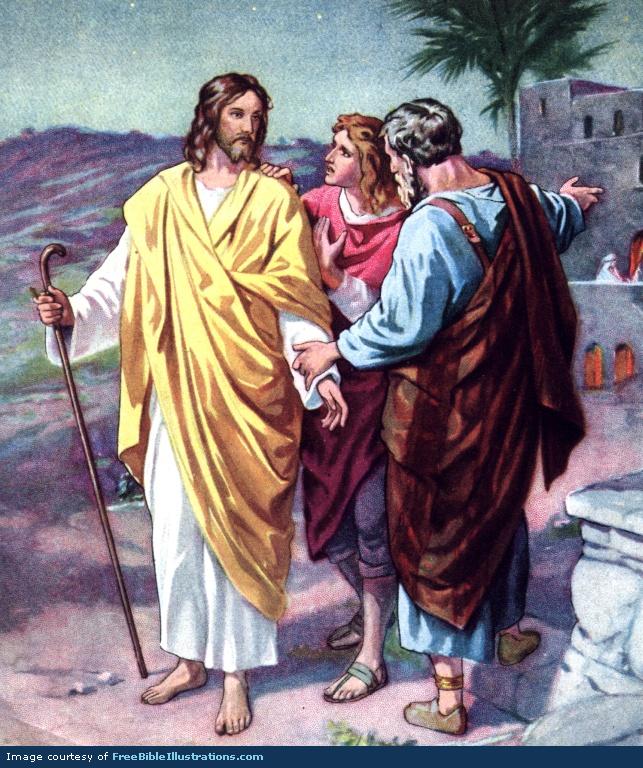
There is a similar trick of the mind at work when we hear the story of the two travelers on the road to Emmaus; we always assume that they were two men. It’s not wonder, since virtually every painting of the encounter on the road to Emmaus will show Jesus with two men. For example, look at the relief on the front of our altar. Many people assume that this is a depiction of the Last Supper (but that there are only two apostles shown because we had to crop it down to size.) Actually, this scene is from after His Passion—you can see crosses on the hill in the distance and there are wound marks in Jesus’ hands. What we have here is to two men at the house in Emmaus, shocked to recognize Jesus in the breaking of the bread.

The artistic depictions always show two men [the picture on the right being the only possible exception I could find], however the original Greek does not call them “two men,” or even “two disciples.” It only says there were “two of them” and that one of them was a man named Cleopas. As to the name and gender of the other traveler, the gospel text is silent. Perhaps the second person’s identity is left as a mystery so as to invite any of us to imagine ourselves in their place in this story. This may be the extent of what we can know for certain, but there is an interesting clue from another Gospel that suggests more detail.

In Gospel of John, it says that “standing by the cross of Jesus were his mother and his mother’s sister, Mary the wife of Clopas….” (John 19:25) So we have a Clopas and Cleopas both associated with Jesus. Perhaps these similar names are merely a coincidence, but perhaps Clopas and Cleopas are variations of the same person’s name. If Clopas and Cleopas are one in the same person, then the other traveler on the road was probably his wife, Mary. This Mary was most likely either Jesus’ aunt and the sister of St. Joseph, or one of the cousins of the Blessed Virgin Mary. What we do know for certain is that this Mary stood with Jesus’ mother at the foot of the cross.

Admittedly, it is speculation to say the other traveler was Cleopas’ wife, but if it was, then this Resurrection episode has a much greater poetry. In the Garden of Eden, a husband and wife ate from a tree. “Then the eyes of both of them were opened, and they realized that they were naked.” They felt ashamed and afraid. But in the house at Emmaus, a husband and wife ate the Eucharist, the fruit of the tree of the cross. “With that their eyes were opened and they recognized Him.” They felt joyful and unafraid. In Eden, God moved about the garden with the man and the woman. After the resurrection, Jesus walks with us, both men and women, along our road.

But whether that second traveler on the road was a woman or not, it would be a remain mistake to think that only men were important in the early Church. That would be at least as mistaken as thinking that every surgeon is a male. Jesus Christ chose some men to be the Church’s leaders, and much is said about them in the Scriptures, but He chose to spread the good news about Himself through the witness of women as well.

Though we sing of the “Faith of Our Fathers,” the faith of our mothers has been just as important, if not more, through time. Today,  it is oftentimes mom who takes the forefront in fostering faith in the family, in leading her children to Christ and His Church; through bedtime prayers and Bible stories, by bringing them to Mass and to CCD, in seeing to it that they receive the graces of the sacraments. If you feel like you’re alone in witnessing to the faith in your family, I commend you, and Jesus is proud of you.

There is another trick of the mind when it comes to celebrating Mother’s Day. On Mother’s Day we remember our mothers, who gave us birth and nurtured us, who raised us and put up with us, but we tend to forget about the greatest gift, the gift of our faith. At the Easter vigil the Exultet asks: “What good would life have been to us, had Christ not come as our redeemer?” Indeed, what good would life be to us if after our births we had not also been brought to Christ through the witness of holy women. Who were these holy women in your life? At this Mother’s Day Mass, let us remember and pray not only for our mothers in the natural order, but for each of our spiritual mothers as well.

The Death of Bin Laden — May 3 — Sts. Philip and James

May 3, 2011

Osama Bin Laden has caused the deaths of countless people worldwide, he has spread hatred and division among peoples, and he has exploited religion for these purposes. He has done evil things, and now he is dead. How should we take this news? On Sunday night, some people celebrated in the streets of New York City and Washington, DC. Many people said with unrestrained delight that not a man, but a vermin, or a thing of pure evil, had been exterminated. But what is God’s opinion? What are His feelings on these events? God speaks to us in his words from Ezekiel 33:11: “Answer them: As I live, says the Lord God, I swear I take no pleasure in the death of the wicked man, but rather in the wicked man’s conversion, that he may live.” If God does not rejoice in the death of the wicked, then neither should we.

Our U.S. Special Forces’ successful mission in Abbottabad, Pakistan rightly pleases us in many ways, like in how this achievement may prevent future terrorist attacks or the fact that al-Qaeda is now deprived of their most charismatic leader, but a Christian should not rejoice in the death of a sinner. It should be noted here, that Jesus the Prince of Peace loves peace, but He is not a pacifist. (A pacifist is someone who condemns the use of force in all situations.) Recall that Jesus did not drive out the money-changers and animal-sellers from the temple solely by endlessly asking them nicely. “He made a whip out of cords and drove them all out of the temple area…” Force, even deadly force, is sometimes just and necessary, as I believe it was in Abbattabad this Sunday. And yet, even in wartime, we must not hate those who hate us, nor rejoice in the death of wrongdoers, not even when it’s Osama Bin Laden. The death of a sinner is a tragedy to the heart of Jesus, whose Divine Mercy and Love we celebrated on that same Sunday.

Perhaps someone might hear this and ask, “What difference does it make whether or not I hate Bin Laden or other people I’ve never met? Or what difference does it make whether or not I hate some of the people I actually know?” This is why it matters. You heard Jesus say to Thomas, “I am the way and the truth and the life. No one comes to the Father except through me.” No one comes to the Father, except through Him. Jesus is the way. He is our way to Heaven not just by our saying that He’s our Lord and Savior. Jesus is the way because He is the way we must become. No one comes to the Father in Heaven except they who conform themselves to the person of Jesus Christ. Therefore, if you die hating anyone in your heart, when you come to the gates of Heaven, whether the persons you hate are inside or not, you will not enter in; either you will be prevented from entering until your heart is cleaned to be like Christ’s, or you will never enter in, because you will have decided that you do not want Heaven’s ways, Heaven’s truths, or Heaven’s life.

You’re unlikely to hear the message of this homily said anywhere on TV. Imagine how the world would react if someone went on FOX News or CNN and suggested we shouldn’t hate Bin Laden. If you’ve heard anything like this homily since Sunday’s events, it was probably here at Columbus, through one of your teachers. What makes them different from the world is that they have been formed by the Gospel and a Catholic Christian worldview. Our Catholic Faith is the only thing that frees from the slavery of merely being a child of one’s time. It allows us to see the world more through Jesus’ eyes and to conform our hearts to His. This is important, because if you and I want to enter into Heaven someday, we must be converted into Him.

A Man In Jesus’ Image — Divine Mercy Sunday—Year A

May 1, 2011

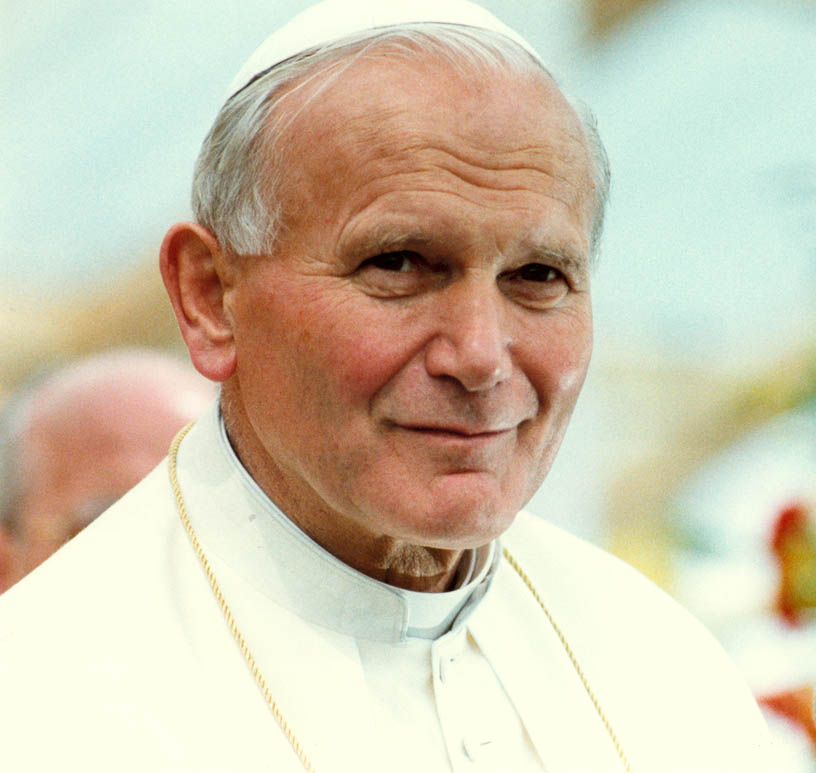
This Divine Mercy Sunday, our Catholic Church throughout the world celebrates and glorifies two men together in a special way. The first is our Savior, our Lord and our God, Jesus Christ; and the second is the great pope John Paul the Second, who is being beatified today in Rome. John Paul the Great, born Karol Wojtyla, is a man who lived in the image and likeness of Jesus Christ.

Both chose the Blessed Virgin Mary to be their mother. One chose her after the loss of his earthly mother as a boy. The other chose her from all eternity. Growing up, both of their beloved homelands were occupied and oppressed by foreign empires. For one it was the Romans. For the other it was the Nazis and then the Soviet Union. As young men, they both worked as manual laborers, in lives hidden from the world. When people encountered their ministries for the first time, many said, “Who is this man, and where does he come from?”

Both men transformed this world, not by leading violent revolutions, not by amassing incredible fortunes, but by speaking the truth, and living the truth, and leading others in doing the same for God. They preached God’s message, and their words gave hope and courage to many, but their words were not accepted by all. Both men had enemies who sought to destroy them, but they forgave, face to face, those who sought their lives.

At the end of their lives, both men were afflicted with great physical sufferings, but neither laid down their crosses. Some onlookers mocked or dismissed them in their afflictions, but those with spiritual insight beheld them to be offering a sacrifice to the Father for the salvation of the world.

St. John tells us that Jesus has done many other signs in the presence of his disciples that are not written in his Gospel. As St. John writes elsewhere, “There are many other things that Jesus did, but if these were to be described individually, I do not think the whole world would contain the books that would be written.”

Among these signs are the lives of the saints throughout the centuries, saints like Pope John Paul the Great. His life was a sign worked by Jesus Christ in our midst so that we would come to believe more deeply that Jesus is the Christ, the Son of God, and that through this belief we may have life in his name.

Why did people love Pope John Paul II so much? Catholics of every country and of all ages loved and flocked to him. Even non-Catholics and non-Christians were drawn to him. What explains this phenomenon? I think the answer is simple. People saw in him a reflection of Jesus Christ’s love for them. John Paul the Second was an icon of Christ and his love.

Every time you saw Pope John Paul, he was smiling. He traveled the nations, and embraced everyone warmly. When you encountered him, you felt loved, even if you were one person in a crowd of thousands. This was the Holy Spirit at work. Although you did not see Jesus you loved him in Pope John Paul; even though you did not see Jesus you believed in him all the more because of him, and rejoiced with an indescribable and glorious joy.

This morning we celebrate a feast day which Pope John Paul II established, Divine Mercy Sunday. What is divine mercy like? What does Jesus’ unfathomable love, which enfolds every one of us here and every person God has made, look like? Through the life of Pope John the Great we saw a partial glimpse of the divine mercy and love of Jesus Christ.