How does the Eternal Father love Jesus Christ his Son?
The Scriptures provide us insights into their relationship.
The Father gives his Son instruction and example
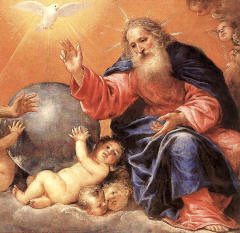 As Jesus once said, “Amen, amen, I say to you, a son cannot do anything on his own, but only what he sees his father doing; for what he does, his son will also do,” adding, “I cannot do anything on my own.” The Father loves his Son and shows him everything that he does. Sometimes believers find it harder to relate to God the Father than Christ the Son. But what is the Father really like? He is just like his Son. Jesus “is the image of the invisible God.” As Jesus said, “Whoever has seen me has seen the Father.” The Father offers his Son the perfect example, and his Son perfectly follows him.
The Father listens to his Son
Outside the tomb of Lazarus, Jesus said, “Father, I thank you for hearing me. I know that you always hear me…” Jesus shares his own attitude toward prayer when he tells us, “In praying, do not babble like the pagans, who think that they will be heard because of their many words. Do not be like them. Your Father knows what you need before you ask him. This is how you are to pray: Our Father…” Jesus knows that wordy, poetic prayers are not necessary because his Father is always listening.
The Father encourages his Son
At Jesus’ baptism in the Jordan River, the Father declared from heaven, “You are my beloved Son, in whom I am well pleased.” And on the summit of Mt. Tabor, at Jesus’ Transfiguration, the Father spoke from the cloud, “This is my beloved Son, listen to him.” The Father encourages his Son with reminders of his love.
The Father provides for his Son
Jesus said, “Everything that the Father has is mine.” Jesus’ Father is like the father in the parable of the Prodigal Son who told his first-born, “My son, you are here with me always; everything I have is yours.” Confident in his Father’s providence, Jesus tells us to be likewise unafraid concerning our basic needs, what we are to eat and drink, or what we are to wear: “Seek first the kingdom of God and his righteousness, and all these things will be given you besides.” The Father also provides his Son with gifts greater than material things. At the Last Supper, Jesus said of disciples, “Father, they are your gift to me.”
The Father welcomes closeness with his Son
It was a big deal when Jesus prayed, “Abba, Father.” As St. John Paul the Great observed, “An Israelite would not have used [“Abba” to address God] even in prayer. Only one who regarded himself as Son of God in the proper sense of the word could have spoken thus of him and to him as Father–Abba, or my Father, Daddy, Papa!” Because the Father welcomes intimate closeness with his Son, Jesus can say, “I and the Father are one.”
The Father loves his Son’s mother
At the Visitation, filled with the Holy Spirit, Elizabeth declared to Mary, “Most blessed are you among women,” and Mary rejoiced, “From this day all generations will call me blessed. The Almighty has done great things for me, and holy is his name.” By pouring his love and blessings into Mary, God the Father gave his Son a loving mother full of grace.
The Father fosters growth in his Son and sends him on mission
The Letter to the Hebrews says, “Son though he was, [Jesus] learned obedience from what he suffered; and when he was made perfect, he became the source of eternal salvation for all who obey him, declared by God high priest according to the order of Melchizedek.” But this raises a question: how can the divine Son grow in any way? Though perfect in heaven, the Son of God had no firsthand experience of weakness, suffering, or the trials of obedience, until his Incarnation. Through these things he was made complete so that he could be the savior of humanity. The Father prepares his Son and sends him on a mission to transform the world. “God did not send his Son into the world to condemn the world, but that the world might be saved through him.”
The Father as our model for Fatherhood
Whether we are biological or spiritual fathers, Jesus’ heavenly Father gives men a model for our fatherhood. We are to give our children instruction and good example. We should listen to them and encourage them, letting them know that they are well-beloved. We should provide for our children, according to our abilities, supplying their basic needs without neglecting the greater gifts. We are to welcome closeness with our children. We are to love our children by loving their mother, whether she be our spouse or the Church. We are to foster maturity and virtue in them so that they may go forth in mission to transform the world. Which aspect of your fatherhood are you resolved to grow in with God the Father?
 Our Perfect Father
Some of us have had very good fathers, while some of our fathers were very far from perfect. But regardless of the quality of our earthly fathers, we all have a heavenly Father who loves us perfectly. As Jesus tells us, “the Father himself loves you, because you have loved me…” Our Father instructs us and shows us his example through his Word. He always listens, and we should not be surprised when he encourages us, speaking to us, in prayer. Our Father provides for our material needs and gives us the greater gifts. “For everyone who asks, receives…” Our Father welcomes intimacy with us, giving his children the spirit of his Son so that we too may cry, “Abba, Father!” And he gives us Mary, the same perfectly loving mother he provided for his Son. Our Father would grow and mature us into greatness, into saints, into the likeness of his Son, and send us on mission for the transformation of the world.
 Parishable Items