Archive for September, 2015

Taking Jesus Too Literally

September 30, 2015

Jesus Facepalm

We do well to closely heed all that our Lord Jesus says, but we must also carefully understand what the Word of God Incarnate is really telling us. Using Scripture to interpret Scripture, let us consider two examples where some modern-day Christians misinterpret Jesus’ teaching by taking him too literally.


“Do not swear at all”

Jesus declares, “You have heard that it was said to your ancestors, ‘Do not take a false oath, but make good to the Lord all that you vow.’ But I say to you, do not swear at all; not by heaven, for it is God’s throne; nor by the earth, for it is his footstool; nor by Jerusalem, for it is the city of the great King. Do not swear by your head, for you cannot make a single hair white or black. Let your ‘Yes’ mean ‘Yes,’ and your ‘No’ mean ‘No.’ Anything more is from the evil one.” (Matthew 5:33-37)

Swearing an oath or vow invokes God as one’s witness to a claim or a promise and invites God’s just punishments if his name is taken in vain. It seems that people in Jesus’ day were trying to steal credibility without fearing divine retribution by swearing by lesser holy things. But Jesus warns that all good things belong to God, and condemns clever manipulations of the truth as coming from the devil. Instead, Jesus says, “do not swear at all,” but “let your ‘Yes’ mean ‘Yes.’”

So do any appropriate times and places remain for swearing oaths or vows in the New Covenant? God reveals that such exist through St. Paul. In Galatians 1:20 and 2nd Corinthians 1:23, God himself inspires St. Paul to swear oaths (for example, “I call upon God as witness, on my life, that it is to spare you that I have not yet gone to Corinth.“) And in Acts 18:18, we read that St. Paul “had taken a vow.” Thus, in rare, righteous, and serious situations a Christian may solemnly swear to things before God.


“Call no one on earth your father”

Jesus tells us, “Call no one on earth your father; you have but one Father in heaven.” (Matthew 23:9) Does this mean that we should not call priests (or our even own dads) “Father?” This is not how the first Christians understood Jesus’ words.

St. Stephen calls the Jewish leaders “fathers” in Acts 7:2, and St. Paul does similarly in Acts 22:1. God prompted St. John to address Christian community elders as “fathers.” (1st John 2:13-14) God also willed St. Paul to write of “our father Isaac” and to call Abraham “the father of us all.” (Romans 9:10, 4:16-17) God inspired St. Paul to regard and describe himself as a father to his spiritual children. (1st Corinthians 4:14-15, 1st Timothy 1:2, Titus 1:4, Philemon 10) Therefore, the true concern of our Lord is not with the label of “father,” but that our greatest devotion and love always be directed toward “our Father who art in Heaven.”

Pope Francis’ Great Americans

September 25, 2015

Pope Francis, during his visit to our country this week, elevated one figure from American history to sainthood, and spotlighted two other Catholics in his speech to the U.S. Congress. Who are they and what do they have to show and teach us?


St. Juniperro SerraSt. Junípero Serra
 (1713–1784)

This missionary was a Spanish Franciscan friar who founded nine missions for evangelizing the native people from San Diego to San Francisco in what is today California. In his homily for St. Junípero’s canonization on Wednesday, Pope Francis said of him:

“He was the embodiment of ‘a Church which goes forth,’ a Church which sets out to bring everywhere the reconciling tenderness of God. Junípero Serra left his native land and its way of life. He was excited about blazing trails, going forth to meet many people, learning and valuing their particular customs and ways of life. He learned how to bring to birth and nurture God’s life in the faces of everyone he met; he made them his brothers and sisters. Junípero sought to defend the dignity of the native community, to protect it from those who had mistreated and abused it. Mistreatment and wrongs which today still trouble us, especially because of the hurt which they cause in the lives of many people.

Father Serra had a motto which inspired his life and work, a saying he lived his life by: ‘Siempre adelante! Keep moving forward!’ For him, this was the way to continue experiencing the joy of the Gospel, to keep his heart from growing numb, from being anesthetized. He kept moving forward, because the Lord was waiting. He kept going, because his brothers and sisters were waiting. He kept going forward to the end of his life. Today, like him, may we be able to say: Forward! Let’s keep moving forward!”

© Copyright 2010 CorbisCorporationServant of God Dorothy Day
(1897–1980)

This Catholic social activist was an agnostic American journalist who converted and established the Catholic Worker Movement, Houses, and Newspaper. These advanced Catholic social teachings and provided direct aid for the poor and homeless. As a young woman, prior to her conversion, Day had an abortion and later gave birth to her daughter, though she never married. (A patron for repentance from sins like these seems much needed in our time.) The cause for her canonization has been opened by the New York Archdiocese since 2000, bestowing her the title “Servant of God.” In his (first of its kind) speech before Congress on Thursday, Pope Francis said, “Her social activism, her passion for justice and for the cause of the oppressed, were inspired by the Gospel, her faith, and the example of the saints.

Dorothy Day’s own famous quotes include, “The greatest challenge of the day is: how to bring about a revolution of the heart, a revolution which has to start with each one of us?” Of herself, in life she said, “Don’t call me a saint. I don’t want to be dismissed so easily.” And of Catholicism she said, “Our faith is stronger than death, our philosophy is firmer than flesh, and the spread of the Kingdom of God upon the earth is more sublime and more compelling.”

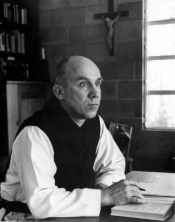
Thomas MertonThomas Merton  (1915–1968)

This monk lived a life as checked as Day’s prior his conversion to Catholicism during college in his mid-twenties. In December 1941, he joined the Trappist monetary in Gethsemani, Kentucky. Seven years later, he published an autobiography about his converion and spiritual journey called “The Seven Storey Mountain.” Though Merton wrote more than 70 books, this work spoke to his generation more than any other, inspiring many monastic vocations.

In his speech before Congress, Pope Francis said of Merton:

“He remains a source of spiritual inspiration and a guide for many people. In his autobiography he wrote: ‘I came into the world. Free by nature, in the image of God, I was nevertheless the prisoner of my own violence and my own selfishness, in the image of the world into which I was born. That world was the picture of Hell, full of men like myself, loving God, and yet hating him; born to love him, living instead in fear of hopeless self-contradictory hungers.’ Merton was above all a man of prayer, a thinker who challenged the certitudes of his time and opened new horizons for souls and for the Church. He was also a man of dialogue, a promoter of peace between peoples and religions.”

Thomas Merton own quotes include: “Pride makes us artificial and humility makes us real.” “We are not at peace with others because we are not at peace with ourselves, and we are not at peace with ourselves because we are not at peace with God.” “The beginning of love is to let those we love be perfectly themselves, and not to twist them to fit our own image.” And, “Faith is the total surrender to Christ, which places all our hope in Him and expects all strength and sanctity from his merciful love.”

The Catholic Catechism on Immigration

September 21, 2015

Paragraph 2241:

Catholic AmericanThe more prosperous nations are obliged, to the extent they are able, to welcome the foreigner in search of the security and the means of livelihood which he cannot find in his country of origin.  Public authorities should see to it that the natural right is respected that places a guest under the protection of those who receive him.
Political authorities, for the sake of the common good for which they are responsible, may make the exercise of the right to immigrate subject to various juridical conditions, especially with regard to the immigrants’ duties toward their country of adoption.  Immigrants are obliged to respect with gratitude the material and spiritual heritage of the country that receives them, to obey its laws and to assist in carrying civic burdens.

Preventable Tragedies

September 12, 2015

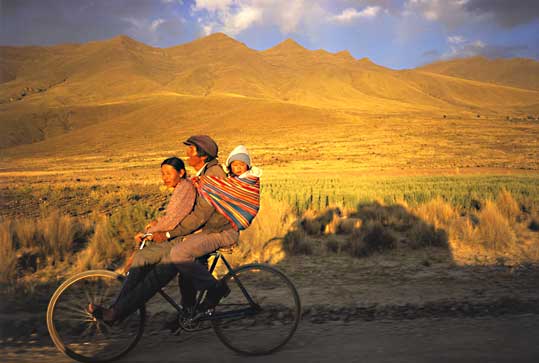
A Bolivian Family Riding a Bicycle, 1991

While studying for the priesthood, I spent a summer at our diocese’s mission in Bolivia. There I learned that South America’s poorest country has a death rate from tuberculosis 222-times higher than here. I was told the Bolivian government offers free TB medicine, but that many who take the pills start to feel better and quit before they’ve finished the prescription. Tragically, this allows the disease to resurge, and the patients are lost. Their half-measured approach to what would save them invites their death.

As our children soon return to CCD, I wish to emphasize the obvious truth that CCD alone is not enough to form a child into a mature Christian adult. Religious education must be paired with daily family prayer (beyond simply before meals) and family Mass attendance each week. Without these, children learn from their parents’ silent instruction that their Catholic faith may be carelessly discarded once their “last hoop” of Confirmation is cleared. This must not be so!

If you are already attending Mass and sharing family prayers, please keep it up. If not, please follow this powerful prescription of prayer and Sunday worship. Embrace it for your children’s sake and for your own. Our Catholic faith is not mere “fire insurance.” It is the path to abundant life for this life and the next. As Jesus says, “I came so that they might have life and have it more abundantly.” (John 10:10)