The U.S. Constitution establishes that the president, “Before he enter on the Execution of his Office, he shall take the following Oath or Affirmation: —“I do solemnly swear (or affirm) that I will faithfully execute the Office of President of the United States, and will to the best of my Ability, preserve, protect and defend the Constitution of the United States.”
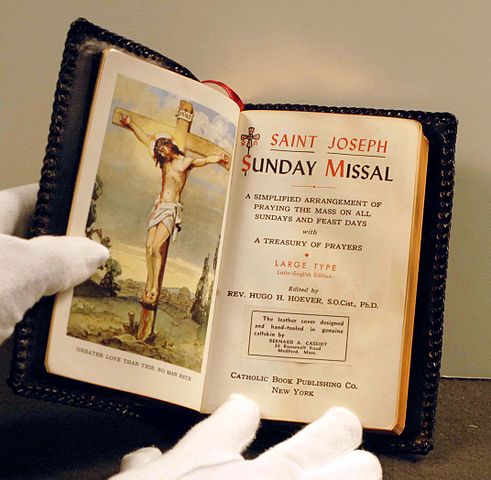
The Kennedy Catholic missal used for Johnson’s inauguration on November 22, 1963.
Typically, presidents-elect take their oaths upon open or closed Bibles — sometimes two or three stacked one atop another under the oath-taker’s hand — but there have been exceptions to this custom. John Quincy Adams (1825) and Franklin Pierce (1853) used law books, while John F. Kennedy’s Catholic missal was found on a side table in Air Force One’s presidential bedroom for the mid-flight swearing-in of Lyndon Johnson in 1963.
History has often recorded the verses to which the presidents’ Bibles were opened. In 1789, George Washington’s Bible was opened “at random, due to haste” to Genesis 49:13. (“Zebulun shall dwell at the haven of the sea; and he shall be for an haven of ships; and his border shall be unto Zidon.”) However, most presidents have intentionally selected their passages.
William McKinley (1897) and William Taft (1909) chose separate accounts of one Old Testament quote. Young King Solomon, invited by the Lord to request a wish, asks for wisdom to lead God’s vast people and it is abundantly granted him. (2nd Chronicles 1:10, 1st Kings 3:9-11)
Hebert Hoover’s (1929) verse, Proverbs 29:18, notes the importance of right purpose: “Where there is no vision, the people perish: but he that keepeth the law, happy is he.”
Franklin Delano Roosevelt selected 1st Corinthians 13’s teaching on love for all four of his inaugurals (1933, ’37, ’41, ‘45): “And now abideth faith, hope, charity, these three; but the greatest of these is charity.”
Dwight Eisenhower’s (1957) verse, Psalm 33:12, acknowledges our shared dependence on God for our blessedness, “Blessed is the nation whose God is the Lord; and the people whom he hath chosen for his own inheritance.”
Jimmy Carter (1977) and Warren Harding (1921) chose Micah 6:8: “…What doth the Lord require of thee, but to do justly, and to love mercy, and to walk humbly with thy God?”
Ronald Reagan (1981 & 1985) twice-chose 2nd Chronicles 7:14, where the Lord invites conversion to gain His blessings: “If my people… shall humble themselves, and pray, and seek my face, and turn from their wicked ways then will I hear from heaven, and will forgive their sin, and will heal their land.”
We, like all people, must beware of idolizing our presidents and other earthly leaders. (Even among popes only around 30% have been canonized and none of them have been sinless.) But we do well always to ask God’s grace for our leaders and for his blessings on the times in which we live.
For other presidential inaugural oaths’ Scripture passages, check out this list.


 Parishable Items