Archive for August 31st, 2018

The Time St. Paul Corrected St. Peter

August 31, 2018

Jesus gave Simon the fisherman the keys to his kingdom and changed his name to “Rock” (that is, “Petros” in Greek, or Peter):

I say to you, you are Peter, and upon this rock I will build my church, and the gates of the netherworld shall not prevail against it. I will give you the keys to the kingdom of heaven.” (Matthew 16:18-19a)

The significance of these things is found in the Old Testament. The Lord changed the names of Abram, Sarai, and Jacob to Abraham, Sarah, and Israel to declare what God would achieve through their lives. (Abraham, for example, means “father of a multitude.”) In the old Davidic dynasty, the king’s chief steward and master of the royal household would carry a key symbolizing his authority. Thus, for Jesus’ Kingdom – the Church – Peter is given the great power and office of prime minister:

Whatever you bind on earth shall be bound in heaven; and whatever you loose on earth shall be loosed in heaven.” (Matthew 16:19b)

Yet, despite his divine calling, St. Peter was not always perfect in his personal example. The New Testament records that on one occasion he had to be fraternally corrected by St. Paul.

In the early years of the Church, as belief in the Gospel began to spread from Jerusalem into pagan lands, the question arose of how much of what God commanded through Moses needed to be observed by the Gentile (that is, non-Jewish) converts to the New Covenent. God gave not only the Ten Commandments in the Old Covenant but some 613 religious rules, touching on many areas of daily life, including food and clothing. These precepts were called the Mosaic law.

St. Peter’s vision at Joppa and his subsequent visit to Cornelius the centurion’s house in Caesarea (recounted in Acts 10) revealed to him God’s will that Gentile converts to Christianity need not be obliged to observe the full Mosaic law. Yet others were teaching, “Unless you are circumcised according to the Mosaic practice, you cannot be saved.” Around the year 50 A.D., the Apostles and other Church leaders gathered for the Council of Jerusalem to settle this question.

There, some from the party of the Pharisees who had become believers in Christ stood up and said to the assembly, “It is necessary to circumcise them and direct them to observe the Mosaic law.” But St. Peter replied, “[Why] are you now putting God to the test by placing on the shoulders of the disciples a yoke that neither our ancestors nor we have been able to bear? On the contrary, we believe that we are saved through the grace of the Lord Jesus, in the same way as they.” (Acts 15:10-11) And the Council decreed that Gentile Christians were free from observing the bulk of Jewish religious rules and customs.
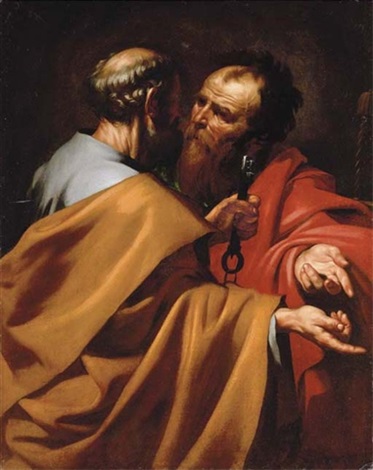
The Dispute at Antioch: Saints Peter & Paul by Jusepe de Ribera

But there was a later episode at Antioch where Peter’s personal example did not match his professed beliefs, and St. Paul was moved to correct him:

[W]hen Cephas (the Aramaic word for “Rock” or “Peter”) came to Antioch, I opposed him to his face because he clearly was wrong. For, until some people came from James, he used to eat with the Gentiles; but when they came, he began to draw back and separated himself, because he was afraid of the circumcised. And the rest of the Jews also acted hypocritically along with him, with the result that even Barnabas was carried away by their hypocrisy. But when I saw that they were not on the right road in line with the truth of the gospel, I said to Cephas in front of all, “If you, though a Jew, are living like a Gentile and not like a Jew, how can you compel the Gentiles to live like Jews?” (Galatians 2:11-14)

Apparently, the “people from James” were Jewish Christians who were disapproving of Peter eating non-kosher meals with the Gentile Christians, leading Peter to withdraw from table fellowship with those non-Jewish converts. St. Peter, the first Pope, was preserved by God from teaching error, but he was not immune to personal faults. Paul publicly corrected Peter because his failure in leadership was leading to scandal within the Church. Spirit-led fraternal correction is a spiritual work of mercy and a duty of Christian love.

The Catholic Church’s Code of Canon Law says:

[The Christian faithful] have the right, indeed at times the duty, in keeping with their knowledge, competence and position, to manifest to the sacred Pastors their views on matters which concern the good of the Church. They have the right also to make their views known to others of Christ’s faithful, but in doing so they must always respect the integrity of faith and morals, show due reverence to the Pastors and take into account both the common good and the dignity of individuals.” (Canon 212, Section 3)

In this present, painful season in the Church, let us remain faithful but not silent. Let us insist of our shepherds that these scandals may lead to cleansing through true leadership and effective reform.

Things You Probably Don’t Know About Contraception & Natural Family Planning

August 31, 2018

We Just Passed a Historic Milestone
July 25, 2018 marked the 50th anniversary of Blessed Pope Paul VI’s encyclical Humanae Vitae (“Of Human Life”) on the moral and immoral regulation of human births. In that document, Pope Paul reaffirmed the Church’s teachings on marriage, the marital embrace, and the prohibition of artificial birth control.

Artificial Contraception Existed in Ancient Times
Egyptian scrolls dating to 1850 B.C. describe various barrier and sperm-killing methods. Pagans practiced contraception techniques in the Roman Empire at the time of Jesus Christ and the Early Church.

God Smote a Man in the Bible for Contracepting
Genesis 38 relates how a man named Onan repeatedly “wasted his seed on the ground” during intercourse to avoid conceiving children. “What he did greatly offended the Lord, and the Lord took his life…”

The Church Fathers Condemned Artificial Birth Control
For example, St. Clement of Alexandria, St. Augustine, St. John Chrysostom all condemned acts of contraception and/or sterilization.

Famous Protestants Also Denounced Contraception
Martin Luther the founder of Lutheranism, John Calvin the founder of Calvinism, and John Wesley the co-founder of Methodism all wrote against it.

All Christian Groups Agreed About This a Century Ago
In 1930, the Anglicans were the very first Protestant denomination to officially approve the use of artificial contraception methods for hard cases. (As recently as 1917, that the same group had declared contraception “demoralizing to character and hostile to national welfare.”)

Protestant Denominations Changed Their Teachings
By 1961, the National Council of Churches could pronounce that “Most of the Protestant churches hold contraception… to be morally right when the motives are right,” adding, “Protestant Christians are agreed in condemning abortion or any method which destroys human life, except when the health or life of the mother is at stake.”

The Catholic Church has Stood Firm
At the end of 1930 and again in 1968, popes issued encyclical letters reaffirming the constant teaching of Christ’s Church. Pope Pius XI’s Casti Connubii and Pope Paul VI’s Humanae Vitae taught truths about the nature, purpose, and goodness of marriage and the marital act. Both repeated our consistent and ancient rejection of all directly-willed acts of contraception, sterilization, and abortion.

Good Intentions are not Enough
As The Catechism of the Catholic Church teaches, “Legitimate intentions on the part of the spouses do not justify recourse to morally unacceptable means… for example, direct sterilization or contraception.” (#2399)

Humanae Vitae Foretold Great Harms
Paul VI predicted that the widespread use of contraception would broadly lower morality, increase marital infidelity, lessen respect towards women, be coercively imposed by governments, and promote the self-harming belief that we have unlimited dominion over our bodies and human life in general.

Contraception has Broken its Promises
According to its advocates, contraception was supposed to strengthen marriages, prevent unplanned pregnancies, reduce abortions, and increase women’s happiness. Today, even after decades of cheap and common contraceptive use, half of all pregnancies are unplanned and half of all marriages end in divorce, about one-in-five U.S. pregnancies are aborted (with more than 60 million killed since Roe vs. Wade in 1973), and women have reported lower and lower levels of happiness throughout the decades since the 1970’s.

The Lord is Pro-Family and Pro-Children
The first commandment in the Garden of Eden was “be fruitful and multiply,” and the the Bible always speaks of having many children and descendants as a blessing rather than a curse. Jesus presents marriage as a holy union of life and love saying “what God has joined together, no human being must separate” and adds “whoever receives one child such as this in my name receives me.”

NFP Regulates Births Both Virtuously and Effectively
Natural Family Planning (also known as NFP) uses signs from a woman’s body to identify the days in her cycle when she can conceive. Equipped with this knowledge, a couple may abstain from marital embrace to avoid a pregnancy or engage in order to achieve one.

There can be Holy Reasons not to Have More Babies
As Pope Paul VI wrote in his famous 1968 encyclical Humanae Vitae, “With regard to physical, economic, psychological, and social conditions, responsible parenthood is exercised by those who prudently and generously decide to have more children, and by those who, for serious reasons and with due respect to moral precepts, decide not to have additional children for either a certain or an indefinite period of time.”

NFP is not the Rhythm Method
The old Rhythm Method simply counted how many days had passed since the woman’s last cycle and was a moral but ineffective approach to avoiding conception. For comparison, faithfully-followed NFP techniques have a 99% effectiveness rate (meaning that up to one in one hundred woman will become pregnant in a year, a rate comparable to widespread methods of artificial contraception.)

NFP Causes None of Contraception’s Harms
Unlike chemical contraceptives, NFP never causes:
– Spontaneous abortions (by preventing implantation
of newly conceived embryos into the uterine wall)
– Increased risks of breast, liver, and cervical cancer
– Nausea, vomiting, stomach problems, or diarrhea
– Depression or mood swings
– Decreased libido
– Or other published side-effects

NFP Strengthens Married Life
Couples who practice Natural Family Planning grow in communication, self-control, and intimacy. They are more open to discerning and embracing God’s plan for their families and are statistically less likely to divorce. Not only is NFP completely natural, the information it tracks about a woman’s body commonly leads to the diagnosis, treatment, and cure of health disorders, from infertility to life-threatening illnesses.

You can Learn NFP From Home
Visit the Diocese of La Crosse’s website (at diolc.org) and search for “NFP”. There you can investigate more about various NFP techniques, its science and benefits, and register for on-line courses.

* * * * * * * * * * * * *

“In destroying the power of giving life through contraception a husband or wife is doing something to self. This turns the attention to self and so it destroys the gift of love in him or her. In loving, the husband and wife must turn the attention to each other as happens in natural family planning, and not to self, as happens in contraception. Once that living love is destroyed by contraception, abortion follows very easily.”  – St. Mother Teresa of Calcutta

“In the conjugal act, husband and wife are called to confirm in a responsible way the mutual gift of self which they have made to each other in the marriage covenant. The logic of the total gift of self to the other involves a potential openness to procreation: in this way the marriage is called to even greater fulfillment as a family. Certainly the mutual gift of husband and wife does not have the begetting of children as its only end, but is in itself a mutual communion of love and of life. The intimate truth of this gift must always be safeguarded. … The two dimensions of conjugal union, the unitive and the procreative, cannot be artificially separated without damaging the deepest truth of the conjugal act itself.”  —Pope St. John Paul II, Letter to Families, 1994

“Marriage must include openness to the gift of children. Generous openness to accept children from God as the gift to their love is the mark of the Christian couple. Respect the God-given cycle of life, for this respect is part of our respect for God himself, who created male and female, who created them in his own image, reflecting his own life-giving love in the patterns of their sexual being.”  —Pope St. John Paul II, 1979