Archive for November, 2018

Mary in History: The Miraculous Medal

November 29, 2018

November 27, 1830 – France
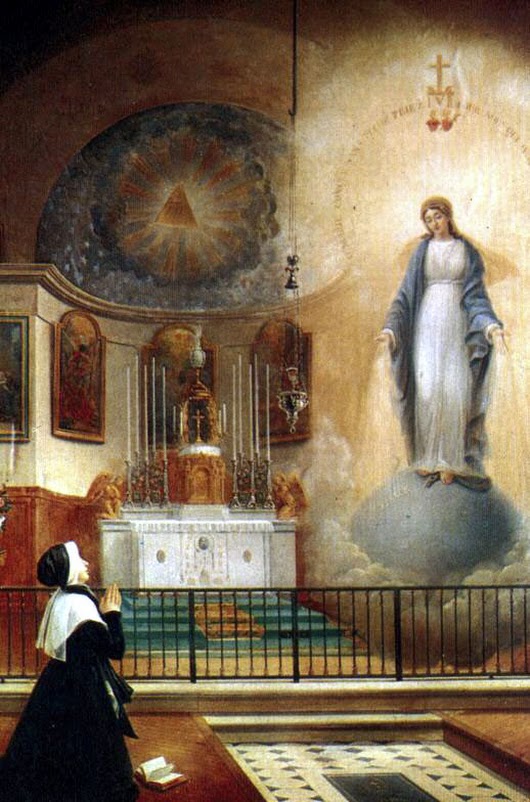
Our Lady appeared to St. Catherine Labouré, a 24-year-old novice (training to become a vowed religious sister,) in the Daughters of Charity’s convent chapel in Paris, France. In this, Mary’s second of three appearances to her, Catherine saw something like two living paintings, one fading into the other, in which the Blessed Virgin stood in a white silk dress upon a half-globe, her feet crushing a serpent. Mary held a small golden globe topped with a cross which she lifted up towards Heaven. Catherine heard a voice say, “This globe represents the entire world, including France, and every person.”

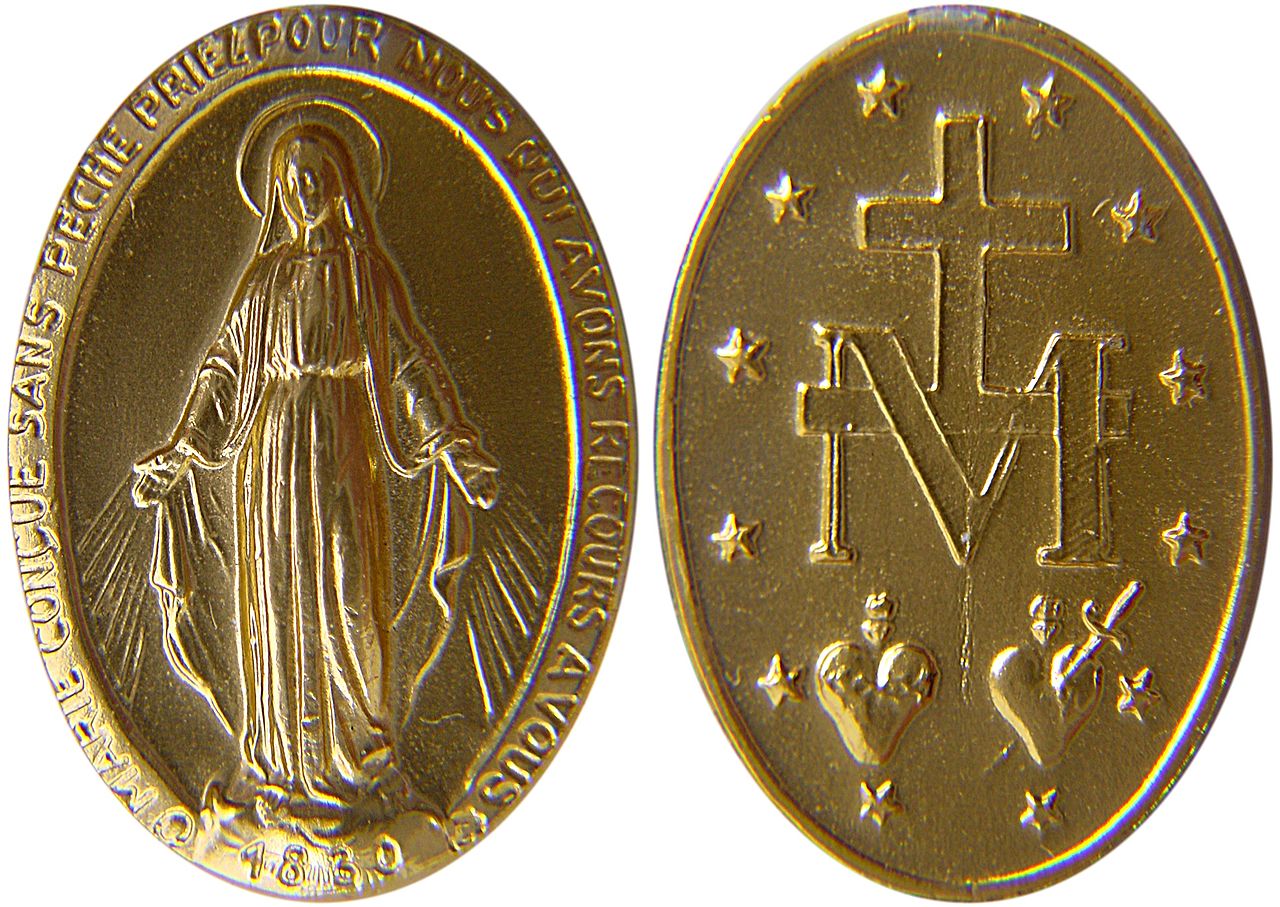
In the second image, beautiful rays of light streamed from Mary’s open hands, her fingers covered with jeweled rings. Catherine heard, “These rays are a symbol of the graces that I pour out on those who ask them of me. The gems from which rays do not fall are the graces for which souls forget to ask.” Then an oval formed around the apparition and Catherine saw in a semi-circle these words in gold letters: “O Mary, conceived without sin, pray for us who have recourse to you.”

Then a voice commanded Catherine, “Have a medal made according to this model. For those who wear it with confidence, there will be abundant graces.” The image turned and Catherine saw the reverse side of the medal: an “M” topped with a little cross and two hearts, one crowned with thorns and the other pierced by a sword. With approval by the Archbishop of Paris, the medal was minted and shared, leading to such gifts of grace that it came to be called “The Miraculous Medal.”
Christ the King & His Kingdom Among Us

November 27, 2018

We tend to think of Mexico as one of the most Catholic countries on earth, but for a time in 1920’s it was illegal to publicly celebrate Mass there. Following a revolution, the new, socialist, Mexican government effectively sought to outlaw the Catholic Church. They seized church property, expelled all foreign priests, and closed the monasteries, convents and religious schools.

But this did not stop priests like Blessed Miguel Pro from secretly ministering to the faithful; celebrating the Eucharist, distributing Holy Communion, hearing confessions, and anointing the sick clandestinely. He would often sneak from place to place in disguise, sometimes as a mechanic, or an office worker, or as a beggar. After many close calls, Fr. Pro was arrested by the government and, without trial, condemned to death on false charges that he was connected to a bombing assassination plot.

On November 23, 1927, Fr. Pro was led out for his execution by firing squad. He blessed the soldiers, knelt and quietly prayed for a time. He declined the blindfold and faced his executioners with a crucifix in one hand and a rosary in the other. He held out his arms like the crucified Christ and shouted, “May God have mercy on you! May God bless you! Lord, you know that I am innocent! With all my heart I forgive my enemies!”

Just before the order was given to fire, he proclaimed, “Viva Cristo Rey!” (which means “Long live Christ the King!”) When the initial bullets failed to kill him, a soldier shot him point-blank. The anti-Catholic government had a photographer on hand to capture these moments for propaganda purposes, but soon after these images were published in all the newspapers the possession of these pictures was outlawed. Seeing this Catholic priest dying innocently, bravely, and faithfully was an inspiration to the oppressed people of Mexico, who eventually won back their freedom of religion and freedom for Christ’s Catholic Church.

Today we celebrate “Christ the King,” but where is his Kingdom? During his ministry, Jesus said, “If I cast out devils by the finger of God, [and he did] then the kingdom of God has come upon you.” On another occasion he said, “Behold, the Kingdom of God is among you.” And at the Last Supper he declared, “Amen, I say to you, I shall not drink again the fruit of the vine until the day when I drink it new in the kingdom of God.” The next time he drank the fruit of the vine (that is to say, wine) was the next day, Good Friday, when he drank it from a sponge held to his lips as he hung upon the Cross. So when Jesus tells Pilate, “My kingdom does not belong to this world,” and, “My kingdom is not here,” he is not saying it is entirely absent from this world, that we will only begin to see it in Heaven or at his Second Coming when his Kingdom will come in its fullness. His Kingdom is not here because it is not yet here fully, and his Kingdom does not belong to this world because it is not from this world but from Heaven.

So where is Jesus’ Kingdom on earth? Jesus was called the “Son of David,” that is, the descendant of King David and heir to his throne. It was believed that the Christ would become the new King of Israel. And in fact, when Jesus was put to death on the Cross, the written charge declared above his head was: “This is Jesus the Nazarene, King of the Jews.” The Kingdom of David and his successors (the old, Davidic dynasty) was imperfect but it prefigured Jesus’ Kingdom. As St. Augustine taught, the Old Testament is the New Testament concealed, and the New Testament is the Old Testament revealed. The old foreshadows and points to the new. So, we can draw clues from the old Davidic Kingdom to identify Jesus’ new Kingdom in our midst.

The kings in the Davidic dynasty had many, many wives. From the beginning, God intended marriage to be between one man and one woman, but the kings of Israel – thinking blood is thicker than water – used marriages to seal their peace treaties and alliances with other nations. But this presented a problem: when the king has many wives, who is the queen? You can imagine the rivalry and discord this question could generate. The solution in the Davidic dynasty was to have the mother of the king fulfill that role, as Queen Mother. She had a throne of honor at the king’s right hand and served as an intercessor for the people of the kingdom. If someone had a request, one might bring it to her to present to the king. If the request were pleasing to the king and good for the kingdom he would happily grant it to please his well-loved mother.

The king of Israel had many ministers, but there was one prime minister among them: the king’s chief steward, the master of the royal household. As a sign of that man’s office and authority, the chief steward carried a large wooden key on his shoulders. When he would retire, or die, or be removed from office, another would take his place. His power was that of the king, on whose and with whose authority he acted. But a chief steward acting contrary to the king’s will would soon find himself replaced.

In the courts of ancient kingdoms, including Israel’s, you would find eunuchs. A eunuch is a man born or rendered physically incapable of marrying or having children. Eunuchs were preferred for practical reasons. First, they were safe to be around the king’s wives and harem. Secondly, since they had no wife or children of their own, eunuchs were entirely focused on the king and the kingdom. Their mission, personal success, and legacy were entirely wedded to that of the king’s.

Now we can see how the old conceals the new, and how the new reveals what the old prefigured. Jesus called all those willing and able to be “eunuchs for the sake of the Kingdom of Heaven.” Today, many ministers serve him devotedly in his celibate Priesthood. Jesus told Peter, “I give you the Keys to the Kingdom of Heaven. Whatever you bind on earth shall be bound in Heaven, and whatever you loose on earth shall be loosed in Heaven.” Jesus made Peter the first Pope, the first prime minister, chief steward, and master of his royal household on earth. Jesus has sealed his peace treaty and alliance with peoples of all nations through a single marriage: his marriage to his bride, the Church. But among the Church’s many members, is anyone the queen? As before, she is the mother of the King. The Lord has called Mary to a throne at his right hand where she intercedes for his people. If we have a request, we can ask her to present it to her Son, and if the request is pleasing to the King and good for his Kingdom he will happily grant it because he loves his mother so.

We are called to be good citizens of this country, but we are first and foremost citizens of Christ’s Kingdom. We are to vote and participate in the political process (for good polices and laws do good, while bad laws and policies do great harm) but we are not to put our trust in princes or politicians. We are to obey the law, but we know there is a higher law that supersedes unjust laws, and we know that above every earthly leader there is a higher King. That is why Blessed Miguel Pro was willing to defy the laws and president of Mexico to celebrate the Church’s sacraments and was not too terrified to face death before a firing squad. Let us remain loyal to Christ our King, and remain loyal to his Kingdom, a Kingdom which is among you, in His Holy Catholic Church.

A Prayer Litany for the Souls in Purgatory

November 2, 2018

O Jesus, Thou suffered and died that all mankind might be saved and brought to eternal happiness. Hear our pleas for further mercy on the souls of:

My dear parents & grandparents,

     [Response: “My Jesus, Have Mercy”]

My brothers & sisters & other near relatives,

My godparents & sponsors of Confirmation,

My spiritual & temporal benefactors,

My friends & neighbors,

All for whom love or duty bids me pray,

Those who have suffered disadvantage or harm through me,

Those who have offended me,

Those whose release is near at hand,

Those who desire most to be united to Thee,

Those who endure the greatest sufferings,

Those whose release is most remote,

Those who are least remembered.

Those who are most deserving on account of their services to the Church,

The rich, who are now the most destitute,

The mighty, who are now powerless,

The once spiritually blind, who now see their folly,

The frivolous, who spent their time in idleness,

The poor who did not seek the treasures of heaven, The tepid who devoted little time to prayer,

The indolent who neglected to perform good works, Those of little faith, who neglected the frequent reception of the Sacraments,

The habitual sinners, who owe their salvation to a miracle of grace,

Parents who failed to watch over their children, Superiors who were not solicitous for the salvation of those entrusted to them,

Those who strove for worldly riches & pleasures, The worldly minded, who failed to use their wealth & talent for the service of God,

Those who witnessed the death of others, but would not think of their own,

Those who did not provide for the life hereafter,

Those whose sentence is severe because of the great things entrusted to them,

The popes, kings, & rulers,

The bishops & their counselors,

My teachers & spiritual advisors,

The priests & religious of the Catholic Church,

The defenders of the Holy Faith,

Those who died on the battlefield,

Those who fought for their country,

Those who were buried in the sea,

Those who died of strokes,

Those who died of heart attacks,

Those who suffered & died of cancer,

Those who died suddenly in accidents,

Those who died without the last rites of the Church,

Those who shall die within the next 24 hours,

My own poor soul when I shall have to appear before Thy judgment seat,

Eternal rest grant unto them, O Lord, and let perpetual light shine upon them: For evermore with Thy Saints, because Thou art gracious. May the prayer of Thy suppliant people, we beseech Thee, O Lord, benefit the souls of Thy departed servants and handmaids: that Thou mayest both deliver them from all their sins, and make them to be partakers of Thy redemption. Amen. Eternal rest grant unto them, O Lord. And let perpetual light shine on them. Amen. May their souls & the souls of all the faithful departed through the mercy of God, rest in peace. Amen.