Archive for December, 2018

Mary in History: Our Lady of the Flowers

December 29, 2018

December 29, 1336 – Italy

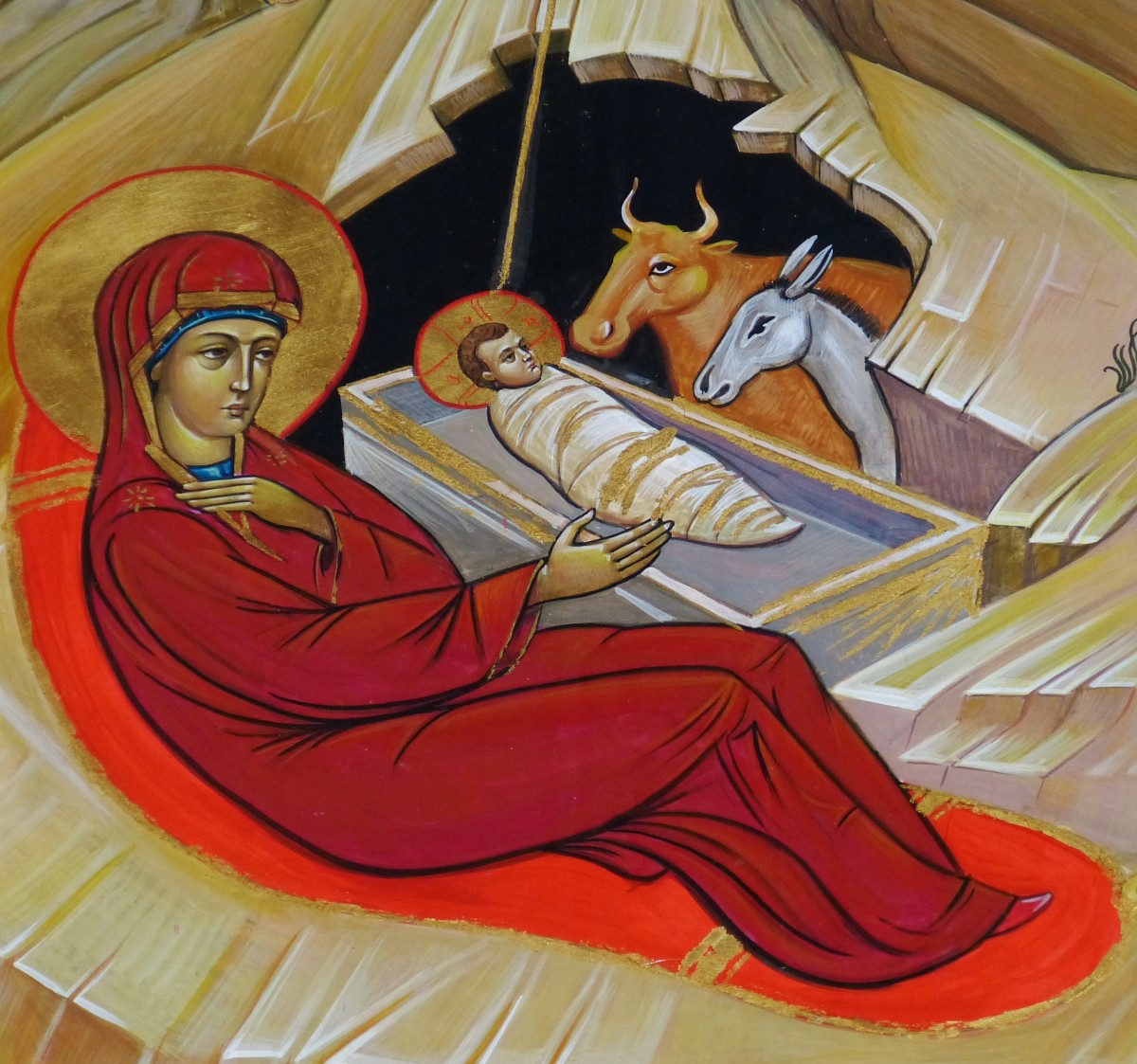
Egidia Mathis, a pregnant, young wife, was walking alone at the edge of nightfall near Bra, Italy. Near a pillar bearing a coarsely painted image of the Virgin Mary with Child, she crossed paths with two foreign soldiers-for-hire (that is, mercenaries) whom she sensed wished to do her harm. Incapable of defense or escape, Egidia flung herself towards the pillar, begging Mary’s help. A great light came forth from the image. Mary scared off the wicked men with a commanding gesture and smiled at Egidia with maternal empathy. The stress of the moment caused Egidia to go into labor and she delivered her baby there. As she held her newborn closely in the winter cold, the blackthorn thicket surrounding the pillar was now in full bloom with thousands of white flowers. Upon reaching home, she told her husband of the whole episode and he with their relatives and neighbors all beheld the miraculous, out-of season flowering.

Some might dismiss this tale as merely pious legend. But virtually every winter since 1336, this blackthorn thicket, contrary to its species and scientific explanation, has flowered between December 25th and January 15th. Two rare exceptions were 1914 and 1939, the years the two World Wars began. Furthermore, on three occasions, this winter flowering has extended for months, corresponding each time with rare public expositions of the Shroud of Turin (the possible burial cloth of Christ) housed twenty-seven miles away.

A Christmas Funeral

December 29, 2018

Funeral Homily for Marie Clark
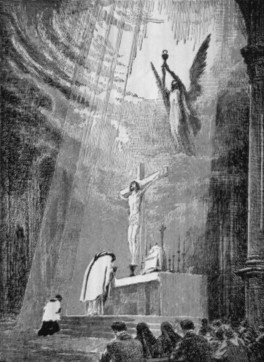
There is an understandable and natural sadness felt in the passing of a well-loved mother, sister, aunt, grandma, and  great-grandmother like Marie in any season of the year. But a funeral like this, so close to Christmas, can feel strange as well. Perhaps I have forgotten but I can’t remember — in almost a decade of priesthood — ever offering a funeral Mass so close to the celebration of Jesus’ birth, with Christmas trees still in the sanctuary. And yet, this is not so strange as it may seem, for the birth of Jesus the Christ bears many connections with and foreshadowings of his death:

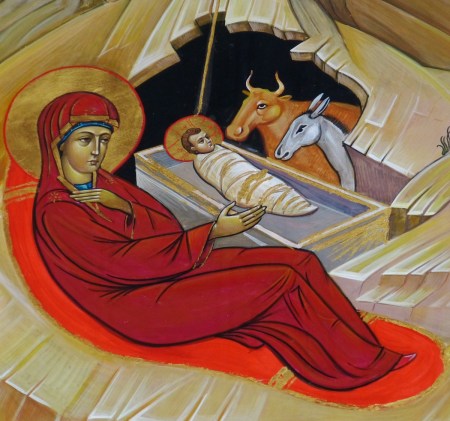
Jesus’ birthplace, a stable, was actually a cave. His burial-place, his tomb, was a cave as well.

The first cave was prepared by Joseph, the poor carpenter from Nazareth. The second cave was also prepared by a Joseph, a rich man from Arimathea.

At his birth, Mary wrapped Jesus’ body tightly in cloths for swaddling clothes. At his death, Mary also wrapped Jesus’ body, in linen cloth, for a burial shroud.

She placed his body in a manger, a feed-box for grain. He would give his own body as food, feeding his flock with his flesh and blood.

Who first heard the news of Jesus’ birth? It was shepherds in the fields outside Bethlehem. From Bethlehem’s flocks the lambs were provided for sacrifice at the Temple in Jerusalem about 5½ miles away. Jesus is the Lamb of God who was born to die as a sacrifice to take away our sins.

The Christmas trees in our sanctuary are evergreen and gloriously-lighted. Contrast that to the wood of the Cross, stark and dead, where we see the starkness of death in Christ crucified. Yet the cross bears the Light of the World, for Jesus says, “I am the Light of the World.” Life flows from this tree.

The Church, in these days following Christmas, celebrates a series of martyrs. The day after Christmas is the feast of St. Stephen, the first martyr after Jesus’ Ascension. Tomorrow, it’s St. Thomas Becket, a bishop martyred more than a millennium later. Today, it’s the Holy Infants of Bethlehem, who died unknowingly for Christ, but who the Church has long-celebrated as martyrs. We can fittingly celebrate the martyrs or even a funeral so close to Christmas because the birth of Jesus Christ has great and vast implications for life and death.

As we heard in our first reading, “If before men, indeed they be punished, yet is their hope full of immortality. … They seemed, in the view of the foolish, to be dead; and their passing away was thought an affliction, and their going forth from us, utter destruction. But they are in peace.” So, even in the dark valleys of life, we are courageous (as St. Paul twice declares in the second reading) for the Lord who died and rose is our shepherd. “Even though I walk in the dark valley I fear no evil; for you are at my side.” And this is our Gospel: ‘this is the will of the Father, that everyone who sees the Son and believes in him may have eternal life, and Jesus shall raise them on the last day.’

Pray for Marie’s soul, as is fitting and right, but be courageous and even joyful through the sadness; for at Christmas we see:

Christ, by highest heaven adored,
Christ, the everlasting Lord.
Late in time behold he comes,
offspring of the Virgin’s womb.

Mild he lays his glory by,
born that we no more may die,
born to raise us from the earth,
born to give us second birth.

With the herald angels sing,
“Glory to the newborn King.”

Christ, the Peace Light, is Born

December 27, 2018

In the city of Israel that is called Bethlehem, the ancient Church of the Nativity marks the site of the first Christmas. There one can actually stoop and bend down beneath the central altar & touch the celebrated spot where Jesus Christ was born. It is fitting that the pilgrims bend low to do this, because the miracle of God becoming a human being — to live and die and rise for us — surely deserves humble reverence with everything that we are.

Earlier this year, as has happened for a number of years now, an Austrian child and their family was selected to travel to Bethlehem. Candles and lamps are always burning within the Church of the Nativity, and there this chosen child transferred their fire into two blast-proof lanterns. Then they all flew back to Austria, where this flame (called “The Peace Light”) has spread from lamp to lamp, light to light, candle to candle, into more than thirty European countries and to places around the world. On December 1st of this year, the Peace Light arrived at J.F.K. Airport in New York City and it has traveled from there across our country. This week, it providentially came to our parish.

Last Friday, a Hudson couple traveling with the Peace Light approached me after morning Mass at St. Paul’s. I had never heard of the Peace Light before, but I happily received it and kept it for this Christmas celebration. All the flames you see burning our sanctuary this Christmas were originally lit from Bethlehem’s flame. Now I carefully carried, protected, and preserved this light; especially when I only had one vigil candle. I realized that one error, one jostling of the liquid wax, could extinguish the fire; and then what would become of this, my Christmas homily? I’d be lost. But, thanks be to God, these candles are lit here today.

So why do we have candles at Mass? Since the early days of Christianity, when Catholic Mass was celebrated in hiding, underground in the catacombs, lamps have provided useful illumination. But these lights are not merely practical. In the late 300’s A.D., a heretic named Vigilantius criticized Christians in the East about many of their practices, including their lighting of great piles of candles while the sun was still shining in the sky. St. Jerome declared in answer to him that candles are lighted where the Gospel is proclaimed not merely to put darkness to flight, but as a sign of joy. As an added symbol, these candles on the altar (and the Easter Candle) are, by tradition, mostly made of beeswax. Because beeswax, which is the product of the virginal female bee, is like the flesh of Our Lord supplied by the Blessed Virgin Mary.

Of course, the celebrated Peace Light is not merely a symbol of some abstract notion or idea of peace; it’s a symbol of the very real person of Jesus Christ. The “Light of the World” entered our world from his mother’s womb in Bethlehem. And his light has spread across the world and throughout time to this place and our day. Today, our candles burn and shine for him.

Within you there is also candle, but it is a very vulnerable light. Through error or neglect its light can go out. And without this light we are in darkness without true joy. So Jesus commands us to regularly gather all our candles together here, to be re-lit from the Source, the Light of Christ. In conclusion, in case my symbolism has been too subtle: Have a very joyful Christmas, and know that Jesus Christ (who loves you) wishes you to return here again for his Holy Mass next Sunday.

Mary in History: Our Lady of Guadalupe

December 11, 2018

December 12, 1531 – Mexico

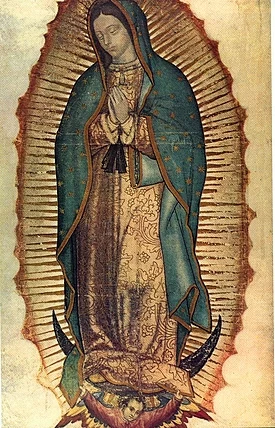
The Blessed Virgin had previously appeared to St. Juan Diego, a Native American, Catholic convert, twice sending him to the local bishop to ask that a church be built near Tepeyac Hill in what is today Mexico City, Mexico. The bishop was not persuaded by the native’s story but asked him for some kind of sign from Mary. On this date, Mary directed Juan to pick some non-native roses miraculously in bloom out of season on that hill and to bring them to the bishop. Juan gathered these in the front of his poncho-like garment (called a tilma) and set off.

When Juan opened the front of his tilma before the bishop to reveal the roses, Our Lady of Guadalupe’s image was found on the humble fabric of his garment. Her appearance was that of an Aztec princess, clothed in the Sun with the Moon under her feet, bearing a Divine Child in her womb. The image’s rich symbolism spoke compellingly to the native people and Mexico was converted to Christ.

That tilma, made of rough cactus fibers, should have deteriorated centuries ago, but this garment and its brushstroke-less image remain on display in Mexico’s greatest shrine to this day. Like many things, it’s a miracle existing in plain sight. Our diocese also has a beautiful shrine dedicated to Our Lady of Guadalupe, Patroness of the Americas, located just south of La Crosse. If you’ve never visited, it’s worth the pilgrimage.

Good Reasons for Missing Mass

December 11, 2018

Attending and participating at Mass every Sunday (or Saturday evening) and holy day of obligation is one of the precepts of the Church. This flows from the Third Commandment: “Remember to keep holy the Sabbath day.” Yet there can be good and holy reasons for missing Mass.

Are you ill? If you are nauseous, for example, definitely do not come to church. Are the weather or road conditions dangerous for you? Then stay safe indoors. Do you have to care for another person, perhaps someone newborn or elderly? Then you can be away for them. For good reasons like these, one may watch the Mass on TV or online or prayerful meditate on the Scriptures at home to spiritually commune with the Lord.

Jesus once asked, “Is it lawful to do good on the Sabbath rather than to do evil, to save life rather than to destroy it?” So he prefers that you not get accidentally killed or injured or spread diseases by coming to Mass. On another occasion, Jesus asked, “Who among you, if your son or ox falls into a cistern, would not immediately pull him out on the Sabbath day?” Thus, the necessity to care for others supersedes the normal rules.

On the other hand, willfully, deliberately skipping Mass (such as on a family vacation or for hunting season) is a serious sin. With the internet and cellphones and so many Mass times available, anyone can plan ahead to find and celebrate our Lord’s Sacrifice. I tell children in Confession who are not taken to Mass that “what’s not your choice is not your sin,” but I encourage them to ask their parents to bring them to church, since this is what Jesus desires for everyone as far as they are able.

Mary in History: The Immaculate Conception

December 8, 2018

December 8, 1854

On this date, to the delight of the Church in Heaven and earth, Pope Pius IX employed the gift of papal infallibility to dogmatically affirm our ancient belief in the sinlessness of the Mother of God: “We declare, pronounce, and define that the doctrine which holds that the most Blessed Virgin Mary, in the first instance of her conception, by a singular grace and privilege granted by Almighty God, in view of the merits of Jesus Christ, the Savior of the human race, was preserved free from all stain of original sin, is a doctrine revealed by God and therefore to be believed firmly and constantly by all the faithful.

In her apparitions at Lourdes, France three years after, Mary affirmed, “I am the Immaculate Conception.” The Church celebrates Mary’s Immaculate Conception on December 8th and her birthday nine months later, on September 8th. Every one of us, from the greatest to the least, begins very, very small. But God loves to make great things of the small.