Funeral Homily for Marie Clark
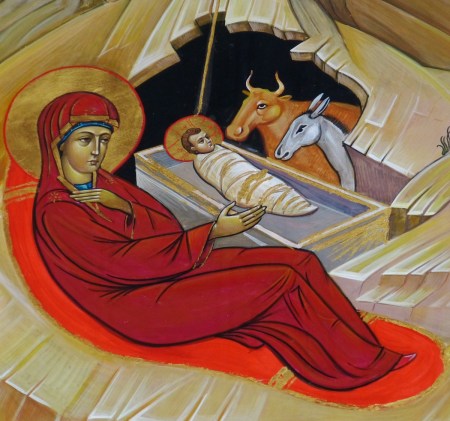
There is an understandable and natural sadness felt in the passing of a well-loved mother, sister, aunt, grandma, and great-grandmother like Marie in any season of the year. But a funeral like this, so close to Christmas, can feel strange as well. Perhaps I have forgotten but I can’t remember — in almost a decade of priesthood — ever offering a funeral Mass so close to the celebration of Jesus’ birth, with Christmas trees still in the sanctuary. And yet, this is not so strange as it may seem, for the birth of Jesus the Christ bears many connections with and foreshadowings of his death:
Jesus’ birthplace, a stable, was actually a cave. His burial-place, his tomb, was a cave as well.
The first cave was prepared by Joseph, the poor carpenter from Nazareth. The second cave was also prepared by a Joseph, a rich man from Arimathea.
At his birth, Mary wrapped Jesus’ body tightly in cloths for swaddling clothes. At his death, Mary also wrapped Jesus’ body, in linen cloth, for a burial shroud.
She placed his body in a manger, a feed-box for grain. He would give his own body as food, feeding his flock with his flesh and blood.
Who first heard the news of Jesus’ birth? It was shepherds in the fields outside Bethlehem. From Bethlehem’s flocks the lambs were provided for sacrifice at the Temple in Jerusalem about 5½ miles away. Jesus is the Lamb of God who was born to die as a sacrifice to take away our sins.
The Christmas trees in our sanctuary are evergreen and gloriously-lighted. Contrast that to the wood of the Cross, stark and dead, where we see the starkness of death in Christ crucified. Yet the cross bears the Light of the World, for Jesus says, “I am the Light of the World.” Life flows from this tree.
The Church, in these days following Christmas, celebrates a series of martyrs. The day after Christmas is the feast of St. Stephen, the first martyr after Jesus’ Ascension. Tomorrow, it’s St. Thomas Becket, a bishop martyred more than a millennium later. Today, it’s the Holy Infants of Bethlehem, who died unknowingly for Christ, but who the Church has long-celebrated as martyrs. We can fittingly celebrate the martyrs or even a funeral so close to Christmas because the birth of Jesus Christ has great and vast implications for life and death.
As we heard in our first reading, “If before men, indeed they be punished, yet is their hope full of immortality. … They seemed, in the view of the foolish, to be dead; and their passing away was thought an affliction, and their going forth from us, utter destruction. But they are in peace.” So, even in the dark valleys of life, we are courageous (as St. Paul twice declares in the second reading) for the Lord who died and rose is our shepherd. “Even though I walk in the dark valley I fear no evil; for you are at my side.” And this is our Gospel: ‘this is the will of the Father, that everyone who sees the Son and believes in him may have eternal life, and Jesus shall raise them on the last day.’
Pray for Marie’s soul, as is fitting and right, but be courageous and even joyful through the sadness; for at Christmas we see:
Christ, by highest heaven adored,
Christ, the everlasting Lord.
Late in time behold he comes,
offspring of the Virgin’s womb.
Mild he lays his glory by,
born that we no more may die,
born to raise us from the earth,
born to give us second birth.
With the herald angels sing,
“Glory to the newborn King.”
 Egidia Mathis, a pregnant, young wife, was walking alone at the edge of nightfall near Bra, Italy. Near a pillar bearing a coarsely painted image of the Virgin Mary with Child, she crossed paths with two foreign soldiers-for-hire (that is, mercenaries) whom she sensed wished to do her harm. Incapable of defense or escape, Egidia flung herself towards the pillar, begging Mary’s help. A great light came forth from the image. Mary scared off the wicked men with a commanding gesture and smiled at Egidia with maternal empathy. The stress of the moment caused Egidia to go into labor and she delivered her baby there. As she held her newborn closely in the winter cold, the blackthorn thicket surrounding the pillar was now in full bloom with thousands of white flowers. Upon reaching home, she told her husband of the whole episode and he with their relatives and neighbors all beheld the miraculous, out-of season flowering.
 Parishable Items