Archive for January, 2019

The Seventh Jar

January 22, 2019

Anyone who has done the chore of carrying milk gallons from the store to the car, and from the car into the house, knows they are not feather light. “Now there were six stone water jars (at Cana) for Jewish ceremonial washings, each holding 20 to 30 gallons.” Perhaps the servants did not have to lug those stone jars around, but they had to move the water from the local well or cistern to where the party was held. Have you ever considered how much those 120 to 180 gallons of water weighed? One gallon of water weights a little more than eight pounds. So six stone jars holding 20 to 30 gallons each is a weight of water somewhere between 1,000 and 1,500 pounds.

Mary said to the servers, “Do whatever he tells you.”
Jesus told them, ‘Fill the jars with water.’
So they filled them to the brim.”

It wasn’t easy work. At the time it did not seem that important or glorious. But those servants obediently and generously served Christ at that marriage, filling the jars to the very brim, and what they did will be remembered and celebrated forever.

In various times and places, different numbers can carry symbolic meanings. For example, if I asked you for a lucky number, you would probably say “seven.” And if I asked you for an unlucky number, you would probably quote me “thirteen.” The Jewish culture of the Bible has its own symbolic associations with numbers. For instance, for Jews the number six meant imperfection. (This is partly why, in the Book of Revelation, the number of the Beast is “666,” because great evil is profoundly imperfect.) And for Jews the number seven meant completeness. (In the beginning, when God had finished Creation, he rested on the seventh day because his work was complete.)

“Now there were six stone water jars there for Jewish ceremonial washings.” These six jars of water which Jesus turns into wine point to how his New Covenant fulfills and improves upon the imperfect Old Covenant. The water for the purification rites was good, but the wine for the wedding is best. Along with those six stone jars, John’s Gospel goes on to notice one more jar:

“[On the Cross,] aware that everything was now finished, in order that the scripture might be fulfilled, Jesus said, ‘I thirst.’ There was a jar filled with sour wine. So they put a sponge soaked in wine on a sprig of hyssop and put it up to his mouth. When Jesus had taken the wine, he said, ‘It is finished (fulfilled / complete / consummated)’ And bowing his head, he handed over the spirit.”

All four gospels mention this sour wine Jesus received on the Cross, fulfilling the Psalm which said, “for my thirst they gave me vinegar to drink.” Vinegar is made from wine which grows old and sour. This jar of sour vinegar wine at the Cross is the seventh jar which completes the six jars from Cana. The public ministry of Our Lord began with the joy of a wedding. And public ministry led him to sacrificing himself for his spouse, the Church. Every marriage should have its share of joy and sacrifice.

Marriages are often said to go through a “honeymoon” period. When the relationship is fresh and new, life feels like water changed into wine and joy flows easily. But as the relationship continues and grows older, the wine sometimes turns into vinegar. And then people ask themselves, “Did I make a mistake? Did I marry the wrong person? Did I choose the wrong vocation?” And many people give up too hastily. But these challenging times are a call to purifying love.

When someone says, “I love coffee” or “I love pizza,” they’re really saying “I love how these foods make me feel. I love what they do for me.” But this is not how we are called to love God and one another. We are to love others for their own sake. And in this the Cross of Christ is unavoidable. If mere personal happiness were the meaning of life, then suffering would be meaningless. That’s not what we believe. The Cross grows us into Christ. God does not want us to be endlessly miserable, but if we think the journey of our lives will always be on mountain tops, and never in dark valleys, then we will not journey well through the highs and lows and plains of life.

What if I’m saying to myself, “I have no wine.” What should I do? As Jesus’ Mother said to the servers, “Do whatever he tells you.” This means obedience to Jesus Christ. What if I think I lack the strength to do what Christ asks, or despair that things can really change? The Virgin Mary may not have known it at the time, but in saying “Do whatever he tells you” she was echoing this passage from Genesis:

“When the seven years of abundance enjoyed by the land of Egypt came to an end, the seven years of famine set in, just as Joseph had foretold. Although there was famine in all the other countries, food was available throughout the land of Egypt. When all the land of Egypt became hungry and the people cried to Pharaoh for food, Pharaoh said to all the Egyptians: ‘Go to Joseph and do whatever he tells you.’”

Joseph had been storing up surplus grain for seven years before and he proceeded to provide sufficient food for the entire Kingdom of Egypt and all the world who came to him and asked. When there is no wine where there ought to be (in your marriage, in your household, in your life) do your small part like the servants did at Cana, and invite, ask, and rely on Jesus to provide the rest.

The Christian life has highs and lows, but most of our days are lived in between, on the flat plains. Our lives matter greatly to God, so he has told us so and shown us so through Jesus Christ, but for the most part our lives feel ordinary. As our second reading from 1st Corinthians says, the Church of Christ has many members, with various gifts and roles for the Kingdom of God. Yet nobody feels they are particularly extraordinary because our lives are full of the ordinary.

Say you’re raising children, forming saints for Heaven, who produce piles of laundry and dirty dishes. So say you’re working outside of home, doing a regular job, which provides a service so beneficial and valuable that people pay you money to do it, money you then use to help others. Say you’re praying daily (as we’re called to do,) blessing others, near and far, the living and deceased, by your worship and intercessions before Almighty God, and repeatedly checking your watch. Even if you’re ordained priest, you can be celebrating the Holy Sacrifice of the Mass… fourteen times a week. So much of our lives filled with the ordinary that these ordinary things must matter much more than we might think.

Nothing is recorded in the gospels about most of the years of Jesus’ life. We hear about his early years and his later, few-year ministry, but not what happened in between. The span of time from the finding of twelve-year-old Jesus in the Temple to the start of his public ministry at about thirty years of age is called his “hidden years.” Jesus may not have worked any miracles in those years, but in Heaven we will see how he lived and worked and loved then in ordinary and yet far from insignificant ways.

A full Christian life is not easy work. At times what we do may not feel that important or glorious. But if we serve Jesus Christ, obediently and generously, then what we do here will be remembered and celebrated, by us and by all, with joy forever.

Mary in History: The Conversion of Marie-Alphonse Ratisbonne

January 20, 2019

January 20, 1842 – Italy

Alphonse, a French, upper-class, secular Jew, was no fan of religion. He particularly opposed Catholicism after his brother converted and became a priest. Yet providential circumstances brought Alphonse to Rome where Baron Theodore de Bussières, a family friend and fervent Catholic, challenged the 27-year-old skeptic to wear the Miraculous Medal and say the Memorare prayer each day. Alphonse obliged and, on the morning of January 20th, he felt drawn to walk into a church.

I was scarcely in the church when a total confusion came over me,” he later wrote. “When I looked up, it seemed to me that the entire church had been swallowed up in shadow, except one chapel. It was as though all the light was concentrated in that single place. I looked over towards this chapel whence so much light shone, and above the altar was a living figure, tall, majestic, beautiful and full of mercy. It was the most holy Virgin Mary, resembling her figure on the Miraculous Medal. At this sight I fell on my knees right where I stood. Unable to look up because of the blinding light, I fixed my glance on her hands, and in them I could read the expression of mercy and pardon. In the presence of the Most Blessed Virgin, even though she did not speak a word to me, I understood the frightful situation I was in, my sins and the beauty of the Catholic Faith.

That day, he went to meet a Catholic priest. Eleven days after, Alphonse was baptized, confirmed, received Holy Communion, and added “Marie” (that is, “Mary”) to his name. That same year a formal Vatican investigation into his instant conversion judged it a divine miracle operated through the intercession of the Blessed Virgin Mary. Marie-Alphonse was ordained a priest five years later and alongside his priest-brother labored twenty-nine years establishing religious houses and evangelizing Jews in Palestine, or present-day Israel. At the first Pentecost, 3,000 people in Jerusalem were converted to Christ through the Apostles. The Lord Jesus would have us also use our personal testimonies, invitations, and prayers to win souls for him today.

Christ Calls in Ordinary Time

January 16, 2019

As [Jesus] passed by the Sea of Galilee, he saw Simon and his brother Andrew casting their nets into the sea; they were fishermen. Jesus said to them, “Come after me, and I will make you fishers of men.” Then they left their nets and followed him.

— Mark 1:16-18

A remarkable thing about this calling of Simon Peter and Andrew is its ordinariness. The pair are not called through a vision or by angels. Mark mentions no miracles performed there on the shore. We know from John’s Gospel that they have met this rabbi before. Jesus simply tells them to follow him.

This call does not happen on a Jewish holy day, in the Temple, or in a palace, nor at Jerusalem or Rome. (The region of Galilee was an unesteemed place for the Jews and doubly so for the Romans.) Simon and Andrew are not clergy nor scholars, neither governors nor generals. They’re fishermen who work nights doing manual labor. They’re not on spiritual retreat or pilgrimage, they haven’t journeyed for days to a holy mountain of God. Yet Christ walks up to them and calls these two brothers during an ordinary day at their place of work.

Jesus Christ the God-Man does extraordinary things through the ordinary. He makes use of water for his baptism, bread for his Eucharist, and human pairing to reveal his loving union with the Church. He uses our human words to communicate God’s Word in the most published book on earth. He dwells (and waits) for us in every Catholic tabernacle. He makes himself so accessible that, if we are unattentive to him, we can disregard his presence and graces amidst familiar things.

Ordinary Time has returned in the Church. Though not a “special” season like Advent, Lent, Christmas, or Easter, its name does not derive from a lack of value but from the ordinal numbers which count its weeks (1st, 2nd, 3rd, etc.) The color of this time is green because it is a season for our ongoing growth. So let us follow the Christ who greets and calls us like Simon Peter and Andrew even in Ordinary Time.

Mary in History: Help of Christians

January 12, 2019

January 12-13, 1866 – Czech Republic

For more than a decade, Magdalena Kade suffered from very poor health. At age 30, her condition took a turn for the worse such that her two physicians thought she would soon die and her priest gave her the Sacrament of the Anointing of the Sick with Last Rites. One Friday night, while Magdalena lay in bed attended to by Veronika Kindermannová, her friend from next door, “All of a sudden the room became luminous, full of more light than daytime.” As Magdalena would later testify in the bishop’s investigation, “I was frightened. I elbowed Veronika, saying to her: ‘Veronika, wake up, do you not see this glow?’ Veronika said: ‘But I do not see anything.’ In front of my bed was a figure that emanated a very white light, with a golden crown on its head. I quickly thought it was the Mother of God. I united my hands in prayer and began to pray: ‘My soul magnifies the Lord, and my spirit exults in God, my Savior.‘ [Mary spoke these words at the Visitation.] Having said this, I heard a voice – but an unusual voice, different from that of people: ‘My child, from this moment on you will be healed.’ And in that moment the person disappeared and I no longer felt any pain.

That night, Magdalena rose from her bed to the great joy of her family and on Saturday morning she walked to the local bakery to buy bread. When the townspeople of Filipov saw her and asked how she was well, she replied, “Last night I saw the Virgin Mary and she told me I would be healed. And I am healed. Nothing more and nothing less happened.” Magdalena would go on to retell her story many times to inquirers and the room where she was healed became a place of pilgrimage. After her bishop’s investigation affirmed the supernatural character of Magdalena’s cure, a church was built on the site. In 1885, Pope Leo XIII elevated it to a minor basilica and officially consecrated and dedicated it to “Mary, Help of Christians.” Like Mary before her, Magdalena could rejoice that “the Almighty has done great things for me” and, by plainly sharing her firsthand experience, she led others to deeper faith in Christ. Let us likewise share the stories our own miraculous, God-touched moments with family, friends, and neighbors as well.

Mary in History: Our Lady of Prompt Succor

January 8, 2019

January 8, 1815 – Louisiana

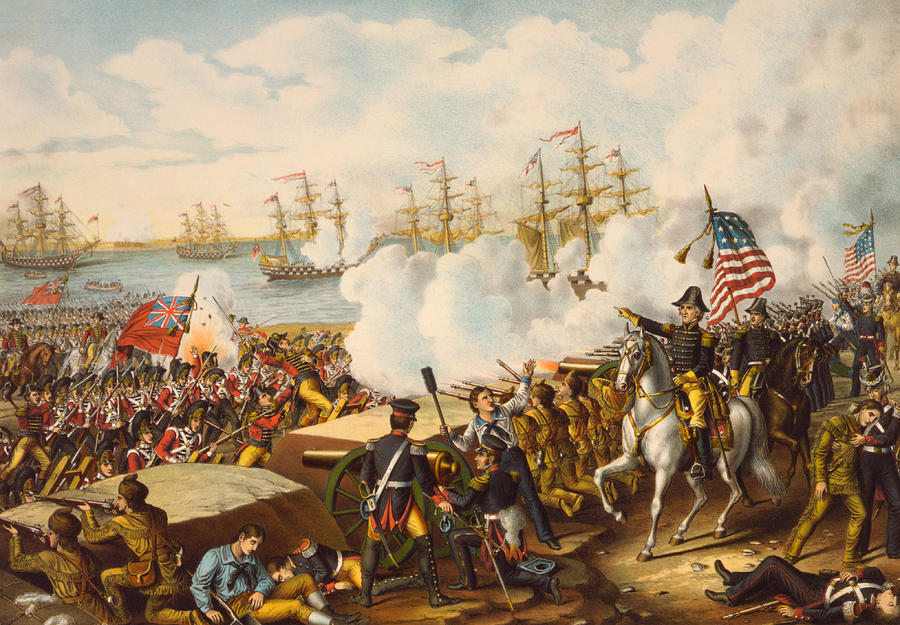
Mary as Our Lady of Prompt Succor (which means, “rapid aid”) has been celebrated in New Orleans, Louisiana on this date for more than 200 years since a famous military victory. The Ursuline Sisters in New Orleans had honored a statue of Mary by this title for several years in their chapel, but when the British army threatened to capture their city during the War of 1812 these nuns and many townsfolk spent the night beseeching her help. The convent’s prioress made a vow to have a Mass of Thanksgiving sung annually should the American forces prevail. During Mass the next morning, as Holy Communion was being distributed, a messenger rushed into the chapel with the news that the British had been defeated.

Though the British army had outnumbered the American troops (about 8,000 to 5,700) the invaders were repulsed and swiftly defeated in just over a half hour of fighting. The commanding general of the American side, the future president Andrew Jackson, went to nuns’ convent afterwards to thank them for their prayers: “By the blessing of heaven, directing the valor of the troops under my command, one of the most brilliant victories in the annals of war was obtained.” For each American soldier lost or wounded in that battle, the British had experienced roughly thirty casualties. This victory was commemorated by Johnny Horton’s 1959 #1 hit song “The Battle of New Orleans.” Since 1928, Our Lady of Prompt Succor has been honored as the principal patroness of the City of New Orleans and the State of Louisiana.