Archive for June, 2019

Mass Apparitions of Our Lord

June 26, 2019

So there’s Our Lady of Guadalupe, Our Lady of Lourdes, Our Lady of Knock, Our Lady of Fatima, and Our Lady of lots of places. Our Lady of the Rosary, Our Lady of the Miraculous Medal, Our Lady of Good Counsel, Our Lady of Good Help, Our Lady of Sorrows, Our Lady of Victory, Our Lady of Grace, Our Lady of Peace, and Our Lady of lots of other good things, too. When I was a kid, I didn’t realize that all these ladies were the same lady. But eventually I figured out that these were all titles of the Blessed Virgin Mary. With that confusion cleared up, I went on to wonder why there seems to be so many apparitions of Mother Mary throughout Church history and so few of her Son, Jesus Christ.

Sure, there are famous exceptions. In the 18th century, Jesus appeared to St. Margaret Mary Alacoque to invite devotion to his Sacred Heart. The month of June is now dedicated to the Sacred Heart of Jesus. And in the 20th century, St. Faustina Kowalska had visions of Jesus encouraging devotion to his Divine Mercy. As a result, the first Sunday after Easter is celebrated as Divine Mercy Sunday. But it’s usually Mary who we hear about appearing here or there around the world, encouraging people to repent, to listen to her Son’s words, and be saved.

So I wondered, “Why aren’t there more apparitions of Jesus in the world?” Eventually I figured out the reason: there’s an apparition of Jesus Christ at every Holy Mass. At every Mass, Jesus’ words are proclaimed. At every Mass, he works a miracle for us. At every Mass, his Real Presence come to us by the Eucharist. Compared to how frequently Jesus appears before us at Mass, Marian apparitions are the rarity.

In today’s Gospel, Jesus multiplies five loaves and two fish to feed more than five thousand people (and that’s just counting the men.) He has them sit in groups of about fifty, blesses and breaks the food, and hands it to his disciples to serve the people. They all eat and are satisfied, and the leftovers are more than Jesus had started with. The day after this amazing event (a miracle recounted by all four Gospels) St. John tells us that Jesus was in Capernaum, teaching in the synagogue about the Bread of Life:

I am the bread of life,” he said, “whoever eats this bread will live forever; and the bread that I will give is my flesh for the life of the world.” At this the Jews quarreled among themselves, saying, “How can this man give us his flesh to eat?” And Jesus replied, “Amen, amen, I say to you, unless you eat the flesh of the Son of Man and drink his blood, you do not have life within you. Whoever eats my flesh and drinks my blood has eternal life, and I will raise him on the last day. …My flesh is true food, and my blood is true drink. Whoever eats my flesh and drinks my blood remains in me and I in him. …The one who feeds on me will have life because of me. …Whoever eats this bread will live forever.

The crowds were perplexed by this teaching and St. John notes that after this many of Jesus disciples left and no longer followed him. But Jesus doesn’t chase them down saying, “Come back, you misunderstood, I was only using a figure of speech.” Instead, he turns to his apostles and asks, “Do you also want to leave?” St. Peter, not understanding but trusting, replies, “Master, to whom shall we go? You have the words of eternal life.” After the Last Supper, recounted by St. Paul in today’s second reading, the Early Church understood Jesus’ teaching. Multiplying five loaves into enough bread to feed thousands is a miracle, but Jesus’ far greater miracle is feeding the world with bread transformed into himself.

If someone asked you, “Are you an object? Are you a thing?” how would you answer? If someone asked me if I was an object, I’d say that I do have many qualities and traits of an object; I have size, and shape, and color, and weight. But an object or a thing can be bought or sold, used and discarded, held cheaply and treated cheaply. You and I are not merely objects or things, but persons; persons meant to be loved and to recognized as worthy of love. So much about our devotion is set right when we recognize that the Holy Eucharist is not merely an object but a person.

When we dress up for Sunday Mass, we dress up for him. When we sing as Mass, we’re singing for him. Unlike Judas, who took the morsel and left the Last Supper before it was over, we remain until the end of Mass because he is here. Sunday Mass in not merely an obligation, but an opportunity for encounter with him. And when we visit him (on Sundays, or at a weekday Mass, or just stopping by the church) he is please that we are here. In love, Jesus offers us a communion with himself through the Eucharist more intimate and profound than that shared by spouses. Our Eucharistic Lord wants us to behold him, recognize him, and rejoice to receive him. So, if a Christian ever asks you, “Have you personally received Jesus?” you can answer, “Yes, in my hand, on my tongue, into my body and blood, in my soul and in my heart, through the Most Holy Eucharist, which is his very self.

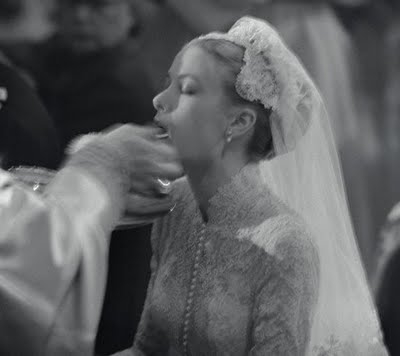
Princess Grace (née Kelly) of Monaco receives
the Holy Eucharist at her 1956 nuptial Mass


The Good Father

June 26, 2019

How do we know about the Most Holy Trinity? Humanity learned of the it late in history, but the Trinity existed before the universe began. In retrospect, Christians can read the Old Testament and see the truth of the one true God being one God in three Divine Persons hinted at, but this eternal reality was only clearly revealed to us through Jesus Christ.

Some people, past and present, have claimed that Jesus was not divine – that he was just a man, or an angel, or something else more exulted than us but less than God. But this is not what the Early Church believed. Prologue of St. John’s Gospel proclaims: “the Word was with God, and the Word was God… And the Word became flesh.” (That’s Jesus Christ.) And when St. Thomas sees Jesus resurrected and exclaims: “My Lord and my God!” Jesus does not correct him for idolatry, because Jesus is truly God.

Others, past and present, have held that the Father, Son, and Holy Spirit are just one person, God, who manifests himself in different modes, like an actor who puts on masks to play different parts. But in the Garden of Gethsemane, Jesus prays: “My Father, if it is possible, let this cup pass from me; yet, not as I will, but as you will.” If Jesus and the Father are the same person, then who is Jesus talking to? The Father and the Son are distinct persons who know and love each other.

Others people have said, simplifying the mystery, that the three persons of the Trinity are three Gods. But God had instilled Monotheism, the belief that there is only one God, deeply into his Jewish people: “Hear, O Israel! The Lord is our God, the Lord is one!” And the earliest Christians, all of them Jews, believed this as well. For example, in his New Testament letter, St. James writes, “You believe that God is one. You do well. Even the demons believe that and tremble.” The oneness of God is treated as a given, while at the same time the Church confessed that “Jesus Christ (the Son of God) is Lord.” Jesus said, “I and the Father are one,” and “whoever has seen me has seen the Father.”

This year, Holy Trinity Sunday lands upon Father’s Day weekend. God the Father is the origin and paragon of fatherhood. So let’s explore what Jesus reveals to us about God the Father and what fathers are called to be.

The Good Father has Authority, but is he not Unapproachable
In the Garden, Jesus prayed, “Abba, Father, all things are possible to you. Take this cup away from me, but not what I will but what you will.” Jesus submits to his “Abba, Father’s” plan. And his use of the word “Abba” is a big deal. As St. John Paul the Great observed, “An Israelite would not have used [“Abba” to address God] even in prayer. Only one who regarded himself as Son of God in the proper sense of the word could have spoken thus of him and to him as Father – Abba, or my Father, Daddy, Papa!” We are encouraged by Scripture and the Holy Spirit to be this familiar with the Father as well, calling God our “Abba” too.

The Good Father Listens
Outside the tomb of Lazarus, Jesus said, “Father, I thank you for hearing me. I know that you always hear me…” God always hears our words to him; be they words of Adoration, Contrition, Thanksgiving, or Supplication, or just our telling him about our day.

The Good Father Cares and Provides
Jesus said, “The Father loves the Son and has given everything over to him.” “Ask and it will be given to you; seek and you will find; knock and the door will be opened to you.” Though when we ask for something he may answer with a “not yet,” or by fulfilling our longing in a better way than we had thought of, the Father always cares, listens, and provides.

The Good Father Encourages
At Jesus’ baptism in the Jordan River, the Father declared from Heaven, “You are my beloved Son, in whom I am well pleased.” And on Mt. Tabor, at Jesus’ Transfiguration, the Father spoke from the cloud, “This is my beloved Son, listen to him.” Imagine how it must have felt for Jesus to hear his Father profess his love for him and pleasure in him. Our words are powerful for one another. Let us strive, with the Holy Spirit’s help, to make our compliments and praises outnumber our criticisms and complaints.

The Good Father Teaches through his Word and Example
Jesus said, “the word you hear is not mine but that of the Father who sent me.” “Amen, amen, I say to you, a son cannot do anything on his own, but only what he sees his father doing; for what he does, his son will also do.” The influence a father can have is reflected by a large, 1990’s Swiss study which found that the religious practice of a father is what most determines the future attendance of his children at church. It found that if a father is non-practicing and the mother is a regular churchgoer, only 2% of their children will go on to become regular worshipers while over 60% of such children will be lost completely to the church. However, if the father is a regular churchgoer while the mother is non-practicing, 44% of these children grow up to become regular churchgoers too – more than twenty-fold impact! Such is the importance and influence of a father’s example.

And finally, the Good Father Loves his Child’s Mother
At the Visitation, filled with the Holy Spirit, Elizabeth declared to Mary, “Most blessed are you among women,” and Mary rejoiced, “From this day all generations will call me blessed. The Almighty has done great things for me, and holy is his name.” It has been rightly said that the best way for a father to love his children is to dearly love their mother.

Some of us have had very good dad, while for some of us our fathers were very far from perfect. There is a cultural crisis with fatherhood today; we see its effects in our country’s schools and in our country’s prisons. Gentlemen, take our heavenly Father as your model. And if you’re ever unsure of how to resemble our Father, look at His son, for St. Paul calls him “the image of the invisible God.” May God bless all our fathers, living or passed on, and may God help all of us here who are fathers to become better ones.

The Gift of the Holy Spirit

June 11, 2019

If you ask people what the Solemnity of Pentecost is about, most will say “the sending of the Holy Spirit.” But Pentecost was not the first time the Holy Spirit had been active in human history.

On Easter Sunday evening, Jesus appeared the Apostles in the Upper Room – although the doors were locked. He said, “Peace be with you,” and showed them his hands and his side. Then Jesus breathed on them and said, “Receive the Holy Spirit…” Earlier in the Gospels, at the Annunciation, Mary asked the archangel how the Messiah, the Christ, would be conceived in her; and Gabriel replied it would be a miraculous work of the Holy Spirit. And then soon after, at the Visitation, her relative Elizabeth, with the little John the Baptist within her, was “filled with the Holy Spirit,” moving Elizabeth to joyfully exclaim the hidden knowledge: “Most blessed are you among women, and blessed is the fruit of your womb!” And the Holy Spirit worked in more than just the time of the Gospels. The Nicene Creed says the Holy Spirit “has spoken through the prophets.” He inspired all the books of both the Old and New Testaments.

So what was different about Pentecost? Before answering that, let’s review what happened. On that day, the Holy Spirit descended to the sound of strong, driving wind and in the appearance of flames, which separated and came to rest upon each of the gathered disciples without doing them any harm.

They were moved to voice ecstatic praises glorifying God and the Holy Spirit gave them the power to speak in different languages they did not naturally know to address Jews visiting from many lands of the then-known world. These devout Jews were gathered in Jerusalem to celebrate the annual Jewish feast of Pentecost, their feast of first fruits celebrating the new harvest from the earth. Similarly, the first Christian Pentecost was the disciples’ first abundant harvest of souls into Christ’s Kingdom.

The Holy Spirit not only gave the disciples the capacity to speak but embed them with courage to bear witness to Christ. Previously, they had hidden behind locked doors. Now they spoke openly in the streets. Peter, who during the Passion had denied Jesus three times out of fear, is inspired this day to begin preaching the Gospel to total strangers. “Those who accepted his message were baptized, and about 3,000 persons were added that day.”

On Pentecost, the curse of Babel is reversed. In the Genesis story of Babel, people tried to reach Heaven by building a towering city apart from God. God confused their language as a kindness, to limit the evil they could do. But at Pentecost, the Holy Spirit is building and populating the city of God, the Church, gathering them to God with this miracle of all languages united as one. Indeed his Church is catholic, that is universal, for every land and people, tribe and tongue.

So, returning to the previous question, what is different about Pentecost? Notice that these gifts of the Holy Spirit were given to each of the disciples gathered in the house; not only the Blessed Virgin full of grace, not just the Apostles—the first leaders of the Church, but each and every one of the roughly one hundred and twenty Christians gathered together there. The Holy Spirit was not acting in the world for the first time at Pentecost; nor was his presence and gifts meant for only for the most famous saints in the Early Church. The Holy Spirit’s activity continues in the Church today, not only within a favored few but in all of us in Christ.

As St. Augustine preached: “What the soul is to the human body, the Holy Spirit is to the Body of Christ, which is the Church.” In a living human body, all the parts of the body are joined to each other and joined to their supremely important head. Without the head, the body dies. Without the soul, the body is lifeless. We are the Body of Christ, Jesus is our exalted Head, and the Holy Spirit—the Soul of the Church—animates the body and every living part of it.

You and I first received the Holy Spirit at our baptisms, probably at an age earlier than we can remember. (I wish I had the time and opportunity to ask people baptized as adults to describe the difference having the Holy Spirit in their life has had.) We were more deeply configured to the Holy Spirit at our confirmations. (After my confirmation at Zorn Arena in Eau Claire, as my family and I were driving to a restaurant, I remember feeling particularly happy and wondering why. Then I remembered, “Oh yeah, the Holy Spirit.” Joy is one of his fruits.) The Holy Spirit was not new at Pentecost but he outpoured amazing gifts into all the Christians. Likewise, the Holy Spirit is not new in you, but he desires to outpour himself to you with his gifts anew.

How can this happen for us? Simply by asking and inviting him. Jesus tells us, “Everyone who asks, receives; and the one who seeks, finds; and to the one who knocks, the door will be opened.” In those days, a round, baked, loaf of bread could resemble a brown stone, so Jesus adds, “Which one of you would hand his son a stone when he asks for a loaf of bread? If you, who are wicked (who are sinful), know how to give good gifts to your children, how much more will the Father in Heaven give the Holy Spirit to those who ask him?” Ask for the Holy Spirit to empower you.

Try some experiments with the Holy Spirit. For instance, invite him into your prayer times. Anyone committed to regular prayer will have times of dryness, listlessness, lack of direction. St. Paul writes to the Romans that the Holy Spirit “comes to the aid of our weakness; for we do not know how to pray as we ought, but the Spirit intercedes…” At dry times in prayer, when I remember to ask the Holy Spirit for help, my prayer immediately becomes easier.

Invite the Holy Spirit to inspire your work. Though I care a great deal about writing good homilies, most Friday nights I don’t know what I will be preaching on Saturday afternoon. I think the Lord does this to improve my trust. After ten years of priesthood, he has never left me high and dry without anything to preach for Sunday.

And ask for the Holy Spirit’s aid in your interactions with others. I ask for his help in confessions or before challenging conversations. Now I share these examples because they are examples from my life, but don’t think that the Holy Spirit only comes to our air with church-y things. He wants to be present, to share his gifts in your everyday life, because this is where souls are lost and won for the Kingdom of God.

About a dozen years ago, I was lying on my bed one afternoon praying to the Holy Spirit rather apologetically. I said, ‘Holy Spirit, you are like the forgotten and ignored third Person of the Trinity. You’re just as much God as the Father and the Son, but we address many more prayers to them than you; and when we do pray to you it’s because we want something, but you’re more than just some divine vending machine.” Then I heard in my mind these words: “I am gift.”

Now whenever you receive a word in prayer it’s good to verify it against the truths that you know. So I thought, “Let’s see if this checks out.” From all eternity, God the Father gives all that he is to God the Son, and the Son gives himself back as a total gift to the Father. From this exchange of self-gift and love, God the Holy Spirit eternally proceeds. The Father and the Son send the Holy Spirit to earth as a gift to sanctify and transform us so we can join the life of the Trinity. The Holy Spirit rejoices to be gift. It is who he is. And when we ask for his gifts we are implicitly welcoming for his presence; for how could his gifts be manifested where he is not?

So conduct some experiments with the Holy Spirit. Invite him, and ask that his gifts be manifested in you. He is happy to give.