Archive for March, 2020

Tips to be Better Prepared

March 31, 2020

Since February 20th, I have encouraged parishioners to be well-prepared for disaster in both body and soul. This post offers some advice on how to be better materially-ready to face this pandemic.

Statistical models from The University of Washington predict U.S. Coronavirus hospitalizations and deaths to peak nationally around April 15th and to peak in Wisconsin around April 27th. Our home state looks like it will fare better than most, but the worst of this crisis still remains ahead of us.

To prepare for this pandemic, the Department of Homeland Security recommends:

  • Storing-up additional supplies of food and water.
  • Periodically checking your prescription drugs to ensure a continuous supply in your home.
  • Having nonprescription drugs and other health supplies on hand (including pain relievers, stomach remedies, cough and cold medicines, fluids with electrolytes, and vitamins).
  • Obtaining copies and maintaining electronic versions of your health records from doctors, hospitals, pharmacies, and other sources and storing them for personal reference.
  • Talking with family members and loved ones about how they would be cared for if they get sick, or what will be needed to care for them in your home.

DHS also urges social distancing; washing your hands with soap or sanitizer; covering your coughs and sneezes; not touching your eyes, nose, or mouth; avoiding people who are sick; and practicing healthy habits.

I also personally recommend these steps (for the unlikely possibility of power or water outages):

  • Storing-up nonperishable food items.
  • Filling spare bathtubs or containers with water, or at least remembering that your water heater and toilet tops contain fresh water.
  • Keeping some extra cash money on hand.
  • And, if running low, filling-up your car’s gas tank. (Though be careful with your hands in touching the pump and nozzle.)

If you need to visit the pharmacy to fill a prescription, call ahead and they may be willing and able to bring out your order to your car and drop it through your passenger side window.

Since, according to the World Health Organization, temperatures of 140° to 150° Fahrenheit are enough to kill most viruses, your oven may be used to sanitize things like mail, documents, or money. (Note however, while paper famously burns at 451°F, some plastics melt at temperatures as low as 165°F.)

God bless and be well.

The Latest Updates

March 30, 2020

For more news, articles, & resources
visit our parish Facebook pages:

○ St. Paul’s Parish       ○ St. John the Baptist Parish

Why Jesus Wept

March 28, 2020

5th Sunday of Lent—Year A

When Mary came to where Jesus was and saw him, she fell at his feet and said to him, “Lord, if you had been here, my brother would not have died!” When Jesus saw her weeping and the Jews who had come with her weeping, he became perturbed and deeply troubled, and said, “Where have you laid him?” They said to him, “Sir, come and see.” And Jesus wept.

Why did Jesus weep on his way to Lazarus’ tomb? Was it because he had only just learned of his dear friend Lazarus’ death? No, for Jesus had known long before he reached the village. He had already told his disciples, “Lazarus has died. And I am glad for you that I was not there, that you may believe.” Did Jesus weep because he had not planned to immediately resurrect Lazarus until sorrow changed his mind? No, for when the news of Lazarus’ sickness first arrived he told his disciples, “This illness is not to end in death,” and two days later he added, “Our friend Lazarus is asleep, but I am going to awaken him.” Were Jesus’ tears in fact not shed for Lazarus at all?

Here’s a thought experiment. Imagine if I informed you of two facts (about which, let’s suppose, you would have zero doubts): first, that someone you love had recently died — but also, that twenty minutes from now, this same person would be completely alive and healthy, living among us again. How long and profoundly would you mourn for this person? I do not weep over my friends and family going to sleep at night because I believe they will be fully awake again in the morning. Why would Jesus cry for someone he was about to resurrect? But if Jesus was not grieving over the very-soon-to-be-resurrected Lazarus, then why did Jesus weep?

When Mary ran to Jesus and fell at his feet crying, was there a hurt reproach in her voice when she said, “Lord, if you had been here, my brother would not have died”? (‘We sent you a message days ago that our brother was very ill. Why didn’t you save him?‘) Some of the Jews who came to comfort Martha and Mary seemed to doubt Jesus’ care or power. “Could not the one who opened the eyes of the blind man have done something so that this man would not have died?” When Jesus saw Mary weeping and the Jews who had come with her weeping, he became perturbed and deeply troubled. Jesus beholds grave anguish, doubt, and despair amidst the faith-testing scandal of death. And because of this, Jesus wept.

On Friday, in the midst of our worldwide pandemic, Pope Francis preached a message of hope in a rainy, dark, and empty St. Peter’s Square. He reflected on another gospel story where facing death challenged peoples’ faith in the love and power of the Lord: Jesus is asleep in the boat during a storm on the Sea of Galilee and his disciples wake him up and ask him, “Teacher, do you not care that we are perishing?!” In the words of Pope Francis:

It is easy to recognize ourselves in this story. What is harder to understand is Jesus’ attitude. While his disciples are quite naturally alarmed and desperate, he [is] in the stern, in the part of the boat that sinks first. And what does he do? In spite of the tempest, he sleeps on soundly, trusting in the Father; this is the only time in the Gospels we see Jesus sleeping. When he wakes up, after calming the wind and the waters, he turns to the disciples in a reproaching voice: “Why are you afraid? Have you no faith?

Let us try to understand. In what does the lack of the disciples’ faith consist, as contrasted with Jesus’ trust? They had not stopped believing in him; in fact, they called on him. But we see how they call on him: “Teacher, do you not care if we perish?” Do you not care: they think that Jesus is not interested in them, does not care about them. One of the things that hurts us and our families most when we hear it said is: “Do you not care about me?” It is a phrase that wounds and unleashes storms in our hearts. It would have shaken Jesus too. Because he, more than anyone, cares about us. (…)

Why are you afraid? Have you no faith?” Faith begins when we realize we are in need of salvation. We are not self-sufficient; by ourselves we founder: we need the Lord, like ancient navigators needed the stars. Let us invite Jesus into the boats of our lives. Let us hand over our fears to him so that he can conquer them. Like the disciples, we will experience that with him on board there will be no shipwreck. Because this is God’s strength: turning to the good everything that happens to us, even the bad things. He brings serenity into our storms, because with God life never dies.

Screwtape on Pandemics

March 25, 2020

I was introduced to the Christian writing of C.S. Lewis years ago during a time of temptation. Alone at my uncle and aunt’s home, I prayed to God for some kind of diversion. “Lord, give me something (to change where I see things are headed).” The next moment, scanning the living room shelves, I saw a book cover with the image you see here. That paperback preserved me that evening and would go one to become one of my all-time favorite books: The Screwtape Letters.

In these letters, a senior demon named Screwtape instructs a junior demon, his “nephew” Wormwood, in the tactics of misleading humans. Screwtape describes how to draw the soul of one’s “patient” away from God (“the Enemy“) toward the devil (“Our Father Below“). The book is not only often seasoned with ironic, dry humor, but also contains great insights into human nature and spiritual realities.

At the time of Screwtape’s fifth letter to Wormwood, Britain had just recently entered the Second World War. However, as Lewis observes in his preface, “The history of the European War, except in so far as it happens now and then to impinge upon the spiritual condition of one human being, is obviously of no interest to Screwtape.” What the demon has to say about the influence of war in the greater battle for souls contains spiritual reflections that apply to our current time of pandemic as well.

Below is the text of that letter refashioned with pandemic being substituted for war.


My dear Wormwood,

It is a little bit disappointing to expect a detailed report on your work and to receive instead such a vague rhapsody as your last letter. You say you arc “delirious with joy” because [of this new pandemic.](1) I see very well what has happened to you. You are not delirious; you are only drunk. Reading between the lines in your very unbalanced account of the patient’s sleepless night, I can reconstruct your state of mind fairly accurately. For the first time in your career you have tasted that wine which is the reward of all our labours — the anguish and bewilderment of a human soul — and it has gone to your head. I can hardly blame you. I do not expect old heads on young shoulders. Did the patient respond to some of your terror-pictures of the future? Did you work in some good self-pitying glances at the happy past? — some fine thrills in the pit of his stomach, were there? You played your violin prettily did you? Well, well, it’s all very natural. But do remember. Wormwood, that duty comes before pleasure. If any present self-indulgence on your part leads to the ultimate loss of the prey, you will be left eternally thirsting for that draught of which you are now so much enjoying your first sip. If, on the other hand, by steady and cool-headed application here and now you can finally secure his soul, he will then be yours forever — a brim-full living chalice of despair and horror and astonishment which you can raise to your lips as often as you please. So do not allow any temporary excitement to distract you from the real business of undermining faith and preventing the formation of virtues. Give me without fail in your next letter a full account of the patient’s reactions to the war, so that we can consider whether you are likely to do more good by making him [a reactionary extremist of one kind or the other.](2) There are all sorts of possibilities. In the meantime, I must warn you not to hope too much from a [pandemic.](3)

Of course a [plague](3) is entertaining. The immediate fear and suffering of the humans is a legitimate and pleasing refreshment for our myriads of toiling workers. But what permanent good does it do us unless we make use of it for bringing souls to Our Father Below? When I see the temporal suffering of humans who finally escape us, I feel as if I had been allowed to taste the first course of a rich banquet and then denied the rest. It is worse than not to have tasted it at all. The Enemy; true to His barbarous methods of warfare, allows us to see the short misery of His favourites only to tantalise and torment us — to mock the incessant hunger which, during this present phase of the great conflict, His blockade is admittedly imposing. Let us therefore think rather how to use, than how to enjoy, this [worldwide pandemic.](4) For it has certain tendencies inherent in it which are, in themselves, by no means in our favour. We may hope for a good deal of cruelty and [greed.](5) But, if we are not careful, we shall see thousands turning in this tribulation to the Enemy, while tens of thousands who do not go so far as that will nevertheless have their attention diverted from themselves to values and causes which they believe to be higher than the self. I know that the Enemy disapproves many of these causes. But that is where He is so unfair. He often makes prizes of humans who have given their lives for causes He thinks bad on the monstrously sophistical ground that the humans thought them good and were following the best they knew. Consider too what undesirable deaths occur [in plagues.](6) Men [die](7) in places where they knew they might [die](8) and to which they go, if they are at all of the Enemy’s party, prepared. How much better for us if all humans died [of old age](9) in costly nursing homes amid doctors who lie, nurses who lie, friends who lie, as we have trained them, promising life to the dying, encouraging the belief that sickness excuses every indulgence, and even, if our workers know their job, withholding all suggestion of a priest lest it should betray to the sick man his true condition! And how disastrous for us is the continual remembrance of death which [pandemic](3) enforces. One of our best weapons, contented worldliness, is rendered useless. [During a plague](6) not even a human can believe that he is going to live forever.

I know that Scabtree and others have seen in [plagues](10) a great opportunity for attacks on faith, but I think that view was exaggerated. The Enemy’s human partisans have all been plainly told by Him that suffering is an essential part of what He calls Redemption; so that a faith which is destroyed by a war or a pestilence cannot really have been worth the trouble of destroying. I am speaking now of diffused suffering over a long period such as the [pandemic](3) will produce. Of course, at the precise moment of terror, bereavement, or physical pain, you may catch your man when his reason is temporarily suspended. But even then, if he applies to Enemy headquarters, I have found that the post is nearly always defended.

Your affectionate uncle
SCREWTAPE


Endnotes:

(1) – Originally, “the European humans have started another of their wars.”

(2) – “an extreme patriot or an ardent pacifist.”

(3) – “war”

(4) – “European war”

(5) – The original word here was “unchastity,” but the levels of that sin during this pandemic appear either decreased or the same as before. An intense and selfish attachment to material goods and wealth seems the more tempting vice at this time.

(6) – “in wartime”

(7) – “are killed”

(8) – “be killed”

(9) – These words are my insertion as a contrast to those dying in nursing homes from the Coronavirus.

(10) – “wars”


For more of The Screwtape Letters, I highly-recommend this excellent illustrated series on YouTube.

What We Should Do Now

March 25, 2020

The Solemnity of the Annunciation

The angel Gabriel was sent from God to a town of Galilee called Nazareth, to a virgin betrothed to a man named Joseph, of the house of David, and the virgin’s name was Mary. And coming to her, he said, “Hail, full of grace! The Lord is with you.” But she was greatly troubled at what was said and pondered what sort of greeting this might be. Then the angel said to her, “Do not be afraid, Mary, for you have found favor with God. Behold, you will conceive in your womb and bear a son, and you shall name him Jesus. He will be great and will be called Son of the Most High, and the Lord God will give him the throne of David his father, and he will rule over the house of Jacob forever, and of his Kingdom there will be no end.”

But Mary said to the angel, “How can this be, since I have no relations with a man?” And the angel said to her in reply, “The Holy Spirit will come upon you, and the power of the Most High will overshadow you. Therefore the child to be born will be called holy, the Son of God. And behold, Elizabeth, your relative, has also conceived a son in her old age, and this is the sixth month for her who was called barren; for nothing will be impossible for God.” Mary said, “Behold, I am the handmaid of the Lord. May it be done to me according to your word.” Then the angel departed from her.


What would it be like to be visited by an angel? Scripture tells us “some [people] have unknowingly entertained angels,” like Gideon or Tobiah, because angels can appear on earth in human disguise. But if you ever saw an angel in unveiled glory this spiritual creature would not be a winged Precious Moments character like some people imagine. As C.S. Lewis writes in the preface of his book The Screwtape Letters:

In the plastic arts [the symbolic representations of angels] have steadily degenerated. Fra Angelico’s angels carry in their face and gesture the peace and authority of Heaven. Later come the chubby infantile nudes of Raphael; finally the soft, slim, girlish and consolatory angels of nineteenth-century art… They are a pernicious symbol. In Scripture the visitation of an angel is always alarming; it has to begin by saying “Fear not.” The Victorian angel looks as if it were going to say “There, there.

When the Archangel Gabriel came and greeted the Virgin Mary in Nazareth, “she was greatly troubled.” He must calm and reassure her, “Do not be afraid, Mary, for you have found favor with God.” His message from Heaven is a weighty and mysterious one: you shall conceive and bear the Messiah, the Christ, who is both the heir to David’s kingdom and the Son of Almighty God. Mary has apparently made a prior vow to remain a virgin within her current marriage to Joseph, for she questions how she would ever conceive apart from relations with a man. Gabriel explains this will be through the power of God, for whom all things are possible. Even this answer leaves a great deal unrevealed.

It’s natural for Mary to feel anxious. She has heard God’s promises but much remains uncertain for her near and distant future: Will Joseph believe her? How should she parent such a Holy Child? How will Jesus become king? What will happen to her? How long or difficult will her life be? God’s full plan is unknown to Mary, but she knows what to do for that moment. She says, “Behold, I am the handmaid of the Lord. May it be done to me according to your word.” Through this faithful, trusting response, Jesus Christ saves his Church, the Virgin Mary becomes the Most Blessed, and every generation is blessed.

It’s natural to feel anxious now. We have received God’s promises but much remains uncertain about our near and distant future. Follow Mary’s example and entrust your life to God’s will, so that you may be the most blessed and a great multitude may be blessed through you.

Beware of False Dilemmas

March 24, 2020

Tuesday, 4th Week of Lent

Now there is in Jerusalem at the Sheep Gate a pool called in Hebrew Bethesda, with five porticoes. In these lay a large number of ill, blind, lame, and crippled. One man was there who had been ill for thirty-eight years. When Jesus saw him lying there and knew that he had been ill for a long time, he said to him, “Do you want to be well?” The sick man answered him, “Sir, I have no one to put me into the pool when the water is stirred up; while I am on my way, someone else gets down there before me.” Jesus said to him, “Rise, take up your mat, and walk.” Immediately the man became well, took up his mat, and walked.


Jesus asks the infirm man lying near the pool, “Do you want to be well?” He answers, “Sir, I have no one to put me into the pool when the water is stirred up; while I am on my way, someone else gets down there before me.” The best early Greek manuscripts of John’s Gospel do not contain the verse (John 5:4) and many modern Bibles omit it, but this ancient passage explains what the surrounding verses imply: “From time to time an angel of the Lord would come down and stir up the waters. The first one into the pool after each such disturbance would be cured of whatever disease they had.

The afflicted man perceives only two possibilities, a dilemma; either be healed by being the fastest into the water or continue in his infirmity. The first path is impossible and the second leaves him miserable. The man is tempted toward despair yet he remains patiently near the pool. And there he encounters Jesus who reveals a new, third way he had not imagined, a better option he had not seen. Jesus says to him, “Rise, take up your mat, and walk,” and immediately the man arises cured.

Beware of accepting false dilemmas in life. They can take many forms. Should I keep on being late into the water or give up on ever being cured? Should I ignore the Church’s teaching or be unhappy for the rest of my life? Should I keep on sinning and confessing or give up on my fight against habitual temptation? Should we allow this pandemic to totally destroy our economy or just let everybody die? Realize that the Lord can deliver us through ways we are not perceiving. When facing a painful “either-or”, an intolerable Trolley Problem, ask Jesus to reveal a third track. What if Jesus can heal my legs? What if following the Church’s teaching will lead to both my holiness and my joyful peace? What if my necessary resolutions and humble appeals for Christ’s saving grace can lift me up from my struggle? What if, in the near future, more treatments, testing, and technologies will allow us to save both lives and livelihoods?

Do not despair of your deliverance. “Do not conform yourselves to this age but be transformed by the renewal of your mind, that you may discern what is the will of God, what is good and pleasing and perfect. … Now to him who is able to accomplish far more than all we ask or imagine, by the power at work within us, to him be glory in the Church and in Christ Jesus to all generations, forever and ever. Amen.” (Romans 12:2, Ephesians 3:20)

This is His Body Given up to Save Many

March 21, 2020

Laetare Sunday — 4th Sunday of Lent—Year A

This past Wednesday evening, I saw this image online with the caption: “Darkness has fallen: every single U.S. diocese has suspended public celebrations of the Mass.”

Our Laetare Sunday rejoicing is more subdued this Lent. The sad but necessary suspension of public Masses by our nation’s bishops is a painful loss. And for many of the faithful, the greater their love for the Lord the greater the pain they feel. They are like the woman at Simon the Pharisee’s house who could bathe Jesus’ feet with dripping tears ‘because she loved much.’ (Luke 7:47) However, darkness has not overcome us.

Brothers and sisters,” today’s second reading tells us, “you were once darkness, but now you are light in the Lord.” God is still God, Christ is still Lord, and we are still His. Though public liturgies have ended the Holy Mass continues to be privately offered in most every Catholic church. The graces of Jesus’ sacrifice pour forth from these altars into Christian souls throughout the world, for our good and the good of all his holy Church. Priests are celebrating these Masses in obedience to the command of Christ recalled at every Consecration, “Do this in memory of me.” Yet each of us, ordained and lay people alike, is called to keep this commandment of Christ in a deeper way; by personally imitating Jesus in his loving self-sacrifice for others.

Today, and in the critical weeks and months ahead, all of us are called to sacrifice in ways that will seriously limit our activities and impact our finances. Why are we doing this? To stop the spread of a deadly disease not merely to ourselves but to our many neighbors around us. From my research into this grave topic, it appears that hundreds of thousands—potentially millions—of American lives depend upon the extent of our collective and individual actions now. So please respond with a firm resolve from a Christian love for others.

When you ache today because you can neither gather for Mass nor physically receive our Lord, take heart in the reason for your sacrifice. This is his Body given up to save many; we do this in memory of Him. And soon, when you are asked to help people in the community meet their material needs, sacrifice for them knowing whom you are also serving. For whatever you do for the least of your brethren, you do it for Him. Invite Jesus now to enter into your heart and be with you, to console and strengthen you, today and in the trials ahead of us.

Finding Jesus in the Temple

March 19, 2020

The Solemnity of St. Joseph

Each year Jesus’ parents went to Jerusalem for the feast of Passover, and when he was twelve years old, they went up according to festival custom. After they had completed its days, as they were returning, the boy Jesus remained behind in Jerusalem, but his parents did not know it. Thinking that he was in the caravan, they journeyed for a day and looked for him among their relatives and acquaintances, but not finding him, they returned to Jerusalem to look for him.

After three days they found him in the temple, sitting in the midst of the teachers, listening to them and asking them questions, and all who heard him were astounded at his understanding and his answers. When his parents saw him, they were astonished, and his mother said to him, “Son, why have you done this to us? Your father and I have been looking for you with great anxiety.” And he said to them, “Why were you looking for me? Did you not know that I must be in my Father’s house?” But they did not understand what he said to them.


Joseph and Mary feel great anxiety in these days. Jesus is missing and Jerusalem could be dangerous. Yet the young Lord Jesus is not lost. Retracing their steps they find him in the Temple. He’s dialoguing with the Jewish teachers, perhaps answering their replies with more probing questions of his own in the tradition of the rabbis.

Mary asks her Son, “Why have you done this to us?” Her anxiety, perhaps even touched by anger, is natural. Jesus has purposes in these events that his parents do not fully grasp, but they still love him and he loves them too. “Why were you looking for me? Did you not know that I must be in my Father’s house?” Jesus could have been found by his parents sooner; he was in the Temple the whole time.

You may feel great anxiety in these days. With the suspension of public Masses you could feel like Jesus is missing. Given the serious reports of disease the city could be dangerous. Yet we have not lost Jesus. Retracing your steps you can find him in the church.

What questions are you asking Jesus in prayer? What question does he pose you in reply? Perhaps you ask, “Why have you allowed this to happen to us?” Our feelings of anxiety or anger are natural. Jesus has purposes in these events that we do not fully grasp, but we still love him and he loves us too.

And Jesus can still be found nearby; he has been present in the tabernacle of the church this whole time. You can find Jesus in his Temple by visiting the Real Presence of our Eucharistic Lord. St. Paul’s Church is open daily, 7 AM to 7 PM and St. John the Baptist’s Church is open 8 AM to 7 PM on Saturdays, Sundays, Tuesdays, & Thursdays. These churches will be spray-disinfected for each day they are open, but use the cleaning materials located in the back of church to clean your seating area before and after use.

Follow these important safety tips as they might save your life or the lives of others’:

  • Realize that possibly 80% of confirmed cases of Coronavirus are contracted from people who did not realize they were sick and that symptoms typically take five days to manifest. Therefore, we must guard against this disease before we know it is among us. Practice social distancing.
  • If you have a cough or a fever, you might not be sick with the Coronavirus but please stay home; this virus can linger in the air and upon surfaces and infect others.
  • Remember that the virus can survive on surfaces (such as door handles, pews, and clothing) for one, two, or three days; so avoid touching your eyes, nose, or mouth. Treat unwashed hands as if they were infected and clean them often with soap and water.
  • Maintain at least a six-foot distance from other people.
  • No more than nine persons can be at the church at once (under emergency Wisconsin state law and by our bishop’s decree).
  • The most common place visitors sit in church is the back pews; so I suggest sitting in other, less-frequented, possibly-safer rows.


St. Joseph,
Patron of the Universal Church
and Protector of the Holy Family,
pray for us in our time of need


A Future Pope on Fasting from the Eucharist

March 18, 2020

In the Latin Rite of the Catholic Church (of which 98.6% of the world’s Catholics are members) there is only one day each year when no Masses are to be celebrated – that is, Good Friday. That day’s liturgy contains a Communion service in which presanctified (previously consecrated) Hosts are received and eaten by the faithful. However, in the early Church, there was no consumption of Holy Communion on Good Fridays by the faithful at all. This tradition was noted by the esteemed theologian Joseph Cardinal Ratzinger (the future Pope Benedict XVI) in his 1986 book “Behold the Pierced One” and again (reprinted) in the 2002 book “Pilgrim Fellowship of Faith: The Church as Communion.”

In passages relevant to our present-day, Lenten reality, Cardinal Ratzinger reflects upon the spiritual value that could be found in the practice of Catholics in full communion with the Church abstaining for a time from consuming Jesus Christ in the Holy Eucharist:

“When Augustine felt his death approaching, he ‘excommunicated’ himself and took upon himself ecclesiastical penitence. In his last days, he set himself alongside, in solidarity, with the public sinners who seek forgiveness and grace through the pain of not receiving the Communion. He wanted to meet his Lord in humility of those who hunger and thirst for righteousness, for Him, the righteous and gracious One. Against the background of his sermons and writings, which describe the mystery of the Church as a communion with the Body of Christ and as the Body of Christ, on the basis of the Eucharist, in a really marvelous way, this gesture is quite shocking. It seems to me more profound and fitting, the more often I ponder it. Do we not often take things too lightly today when we receive the most Holy Sacrament? Could such a spiritual fasting not sometimes be useful, or even necessary, to renew and establish more deeply our relation to the Body of Christ?

In the early Church there was a most expressive exercise of this kind: probably since the time of the apostles, Eucharistic fasting on Good Friday was part of the Church’s spirituality of Communion. Not receiving Communion on one of the most holy days of the Church’s year, which was celebrated with no Mass and without any Communion of the faithful, was a particularly profound way of sharing in the Passion of the Lord: the sorrowing of the bride from whom the bridegroom has been taken away (see Mark 2:20). I think that a Eucharistic fast of this kind, if it were deliberate and experienced as a deprivation, could even today be properly significant, on certain occasions that would have to be carefully considered—such as days of penitence (and why not, for instance, on Good Friday once more?), or also perhaps especially at great public Masses when there are so many people that a dignified distribution of the Sacrament is often not possible, so that by not receiving the Sacrament people could truly show more reverence and love than by doing so in a way that contradicts the sublime nature of this event.

Such fasting—which could not be allowed to become arbitrary, of course, but would have to be consonant with the spiritual guidance of the Church—could help people toward a deepening of their personal relation to the Lord in the Sacrament; it could be an act of solidarity with all those who have a yearning for the Sacrament but cannot receive it. It seems to me that the problem of people who have been divorced and remarried, yet equally the problem of intercommunion (in mixed marriages, for example), would be less of a burden if voluntary spiritual fasting was at the same time undertaken in visible recognition and expression of the fact that we are all dependent upon that ‘healing of love’ which the Lord effected in the ultimate solitude of the Cross. I would not of course wish to suggest by this a return to some kind of Jansenism: in biological life, as in spiritual life, fasting presumes that eating is the normal thing to do. Yet from time to time we need a cure for falling into mere habit and its dullness. Sometimes we need to be hungry—need bodily and spiritual hunger—so as once more to comprehend the Lord’s gifts and to understand the suffering of our brethren who are hungry. Spiritual hunger, like bodily hunger, can be a vehicle of love.”

Prepared for this Time

March 18, 2020

Wednesday, 3rd Week of Lent

Moses spoke to the people and said:

“I teach you the statutes and decrees as the Lord, my God, has commanded me… Observe them carefully, for thus will you give evidence of your wisdom and intelligence to the nations, who will hear of all these statutes and say, ‘This great nation is truly a wise and intelligent people.’ … However, take care and be earnestly on your guard not to forget the things which your own eyes have seen, nor let them slip from your memory as long as you live, but teach them to your children and to your children’s children.”

We may not have expected circumstances to be as they are now, but these things come as no surprise to God from his vantage point outside of time. He permits such trials for the salvation of souls and for his saints to more greatly share in his likeness and glory. The Lord, in his providence, has been preparing you for this season.

In difficult times like these, virtue is tested, character is proven, and many souls will rise or fall. So take care and be earnestly on your guard. Do not to forget the things of faith your ears have heard and eyes have seen. Teach and practice what you have learned. For as Jesus said to his disciples, “whoever obeys and teaches these commandments will be called greatest in the Kingdom of Heaven.

Saint Patrick’s Growth

March 17, 2020

Did you know that St. Patrick wasn’t born Irish? He was born in Scotland to Roman parents in the late 300’s AD. When he was 16 years old, Patrick was captured by raiders and sold into slavery in Ireland. For six years he shepherded sheep for a cruel master. But this unexpected, unchosen, difficult separation from his family and previous life was the occasion for a religious awakening in Patrick. He recalls in his autobiography:

“The love of God and His fear increased in me more and more, and the faith grew in me, and the spirit was roused, so that, in a single day, I have said as many as a hundred prayers, and in the night nearly the same, so that while in the woods and on the mountain, even before the dawn, I was roused to prayer and felt no hurt from it, whether there was snow or ice or rain; nor was there any slothfulness in me, such as I see now, because the spirit was then fervent within me.”

After these six hard but fruitful years, Patrick heard a voice tell him that he would soon go home and that his ship was ready. He walked two hundred miles to the coast, found a ship, and eventually persuaded the crew to take him along. He left Ireland a better man. Later, in an inspired dream, he heard people of Ireland call out to him, “We appeal to you, holy servant boy, to come and walk among us.” Patrick returned to his former land of slavery as a missionary priest, won converts to Christianity, and is called today the “Apostle of Ireland.” How can you make the most of the recent unexpected, unchosen, disruptions in your life to be changed for the better?

Here is a famous and inspiring prayer attributed to him, “Saint Patrick’s Breastplate” also known as “The Deer Cry”:

I bind to myself today
The strong virtue of the Invocation of the Trinity:
I believe the Trinity in the Unity
The Creator of the Universe.

I bind to myself today
The virtue of the Incarnation of Christ with His Baptism,
The virtue of His crucifixion with His burial,
The virtue of His Resurrection with His Ascension,
The virtue of His coming on the Judgement Day.

I bind to myself today
The virtue of the love of seraphim,
In the obedience of angels,
In the hope of resurrection unto reward,
In prayers of Patriarchs,
In predictions of Prophets,
In preaching of Apostles,
In faith of Confessors,
In purity of holy Virgins,
In deeds of righteous men.

I bind to myself today
The power of Heaven,
The light of the sun,
The brightness of the moon,
The splendour of fire,
The flashing of lightning,
The swiftness of wind,
The depth of sea,
The stability of earth,
The compactness of rocks.

I bind to myself today
God’s Power to guide me,
God’s Might to uphold me,
God’s Wisdom to teach me,
God’s Eye to watch over me,
God’s Ear to hear me,
God’s Word to give me speech,
God’s Hand to guide me,
God’s Way to lie before me,
God’s Shield to shelter me,
God’s Host to secure me,
Against the snares of demons,
Against the seductions of vices,
Against the lusts of nature,
Against everyone who meditates injury to me,
Whether far or near,
Whether few or with many.
I invoke today all these virtues
Against every hostile merciless power
Which may assail my body and my soul,
Against the incantations of false prophets,
Against the black laws of heathenism,
Against the false laws of heresy,
Against the deceits of idolatry,
Against the spells of women, and smiths, and druids,
Against every knowledge that binds the soul of man.

Christ, protect me today
Against every poison, against burning,
Against drowning, against death-wound,
That I may receive abundant reward.
Christ with me, Christ before me,
Christ behind me, Christ within me,
Christ beneath me, Christ above me,
Christ at my right, Christ at my left,
Christ in the fort,
Christ in the chariot seat,
Christ in the poop deck,
Christ in the heart of everyone who thinks of me,
Christ in the mouth of everyone who speaks to me,
Christ in every eye that sees me,
Christ in every ear that hears me.

I bind to myself today
The strong virtue of an invocation of the Trinity,
I believe the Trinity in the Unity
The Creator of the Universe.

We can always call upon Jesus, who is near at hand for us. As he told his disciples at The Great Commission, “Behold, I am with you always, until the end of the age.

News of a Sad but Necessary Measure

March 17, 2020

By Fr. Victor Feltes

Monday evening, our Bishop William Callahan announced the suspension of public Masses in the Diocese of La Crosse starting this Friday. “In light of the continued concern surrounding the coronavirus, and the advice of medical experts, across the country, and especially in our State, all Masses in the Diocese of La Crosse will be canceled beginning 20 March 2020 until further notice.” This means that there will be no Sunday or weekday parish Masses open to the general public. Earlier on Monday, Wisconsin Governor Tony Evers had announced his decision to ban public gatherings greater than fifty people in hopes of mitigating the deadly spread of COVID-19.

[Post-Script: Tuesday evening, Bishop Callahan directed his priests to abide by Wisconsin’s statewide ban on all gatherings of 10 or more people announced earlier in the day and cancelled all public Masses.

What does this mean for Holy Week and Easter?
Bishop Callahan predicts that this suspension of public Masses will need to continue until the beginning of May. If so, the rites of this year’s Easter Triduum at St. Paul’s will be celebrated without public participation.

Will Confession still be available?
Yes. Bishop Callahan has asked his brother priests to offer even more and varied times for hearing confessions.

What about Funerals and Weddings?
Funerals and weddings will continue to be celebrated for the faithful but with strictly-limited attendance.

Will our Churches be open?
Bishop Callahan asks that the churches in our diocese remain accessible for private prayer. St. Paul’s and St. John the Baptist’s churches are not kept unlocked 24-7, but they will continue to be as open as they were before this epidemic arose.

Will Anointing of the Sick and Viaticum be available?
Priests will make every effort to reach the sick or dying to share these precious sacraments. Please contact us if you are aware of someone in need. Fr. Feltes can be reached at 715-568-3255.

Will any Masses be offered?
Many priests of our diocese will be privately offering Mass each day for you, the Church, and the whole world. Fr. Feltes’ daily Masses will be celebrated unannounced, at irregular times, so as to limit dangerous contact amongst God’s people.

What can we do?
Amidst these events, unprecedented in our lifetimes, Bishop Callahan calls us to charity, faithful prayer, and patience. He asks us to pray for all of our brothers and sisters whose personal lives and the lives of their families have been affected by this disease. He also invites healthy volunteers to clean our churches at various times during the day for those who may wish to make a private visit or come for Confession. If interested in joining such a cleaning effort, please call or email the parish office. Our bishop also urges us to “Please stay well and take every precaution to do so.” Stay tuned, as Fr. Feltes will provide helpful updates and edifying reflections in these days and weeks ahead. “And behold,” Jesus tells us, “I am with you always, until the end of the age.” (Matthew 28:20)

Finding Jesus in our Isolation — 3rd Sunday of Lent—Year A

March 16, 2020

Today’s Gospel story contains a valuable lesson for us in our present situation.

Jesus, tired from his journey, sat down there
at [Jacob’s] well. It was about noon.
A woman of Samaria came to draw water.
Jesus said to her, “Give me a drink.”

There is a weird detail contained in these passages: the woman is going to the well to draw water at noon. It’s hot at noon in the Middle East, so Jesus and the woman are the only ones there. Why didn’t she come in the morning or the evening when the heavy job of hauling water would not have the added burden of the midday sun and heat? It’s because she didn’t want to be there when the other women would be around. Jesus reveals that the woman has no true husband and that she has had five different mates through the years. Jesus knows this supernaturally but her neighbors know something of these facts naturally, through local gossip. This woman has a reputation and if she were to go to that well at the same time as the other women they would make her feel unwelcome, through their words or their silence, with their eyes and their body language. They have quarantined themselves from her and she has socially distanced her heart from them.

In the middle of her day,
in the uncertainties of her life,
amid the stress of her tasks,
in her personal isolation,
she is surprised to encounter Jesus there.

He says to her:

“If you knew the gift of God and who is saying to you, ‘Give me a drink,’ you would have asked him and he would have given you living water. … Whoever drinks the water I shall give will never thirst; the water I shall give will become in him a spring of water welling up to eternal life.”

Jesus wins over the woman’s soul, she leaves her water jar behind and joyfully proclaims her great discovery. Meanwhile, the returned disciples urge Jesus, ‘Rabbi, Teacher, eat something!’ But he says to them, “I have food to eat of which you do not know. … My food is to do the will of the one who sent me and to finish his work.” Of course Jesus is hungry—physical realities are real—but he has nourishment in his soul, from his relationship with God his Father and his deepening relationship with those he has come to save, like this woman at the well.

Now in likening the woman at the well to one quarantined from others, I am not advising you to take unnecessary or imprudent risks amidst this current Coronavirus pandemic. In these months ahead, some of us will be called to acts of particular courage; nurses and doctors come first to mind. But we should not blithely, unnecessarily place ourselves in foreseeable natural dangers expecting God to perform miracles to protect us. Recall how Satan tempted, “If you are the Son of God, throw yourself down from here. For it is written: ‘He will command his angels concerning you’ and ‘with their hands they will support you, lest you dash your foot against a stone.” Jesus answers, “You shall not put the Lord, your God, to the test.” We must not act presumptuously.

The reason I mention the woman finding Jesus in her isolation is because, whatever our health may be, we need to encounter him there as well. Public Masses continue in our diocese, but it is very probable that these will be suspended in the future, just as Catholic Churches suspended public Masses a century ago during the Spanish Flu pandemic. I will personally be very surprised if we are having Mass here together two weeks from today. [Post-Script: On the evening of March 17th, Bishop William Callahan directed his priests to abide by Wisconsin’s statewide ban on all gatherings of more than 10 people announced earlier in the day. As a result, we are cancelling all remaining public Masses at my parishes.] Yet even in times when public Masses are readily available, most hours of our week and not spent inside of a church.

In the middle of your day,
in the uncertainties of your life,
amid the stress of your tasks,
in your personal isolation,
you can encounter Jesus there.

He is with you and within you, so you are never really alone.
Jesus says:

“Let anyone who thirsts come to me and drink.
Whoever believes in me, as scripture says:
‘Rivers of living water will flow from within him.’”

Wherever you are, find him there, and draw on his graces.

I seem to recall a story about St. Faustina Kowaska, the Polish nun and visionary most closely associated with the Divine Mercy devotion. When she was confined to her convent infirmary, suffering from the tuberculosis which would eventually take her life, she lamented that for one or more days in a row she had been unable to receive Holy Communion. In a vision, Jesus reassured her, saying, ‘Whenever you receive me in the Eucharist, I remain within you until you receive me again, unless you cast me out through mortal sin.’ Similarly, in the sixth chapter of John, Jesus famously declares:

“I am the bread of life; whoever comes to me will never hunger, and whoever believes in me will never thirst. … Whoever eats my flesh and drinks my blood remains in me and I in him.”

Christ’s Church encourages frequent, even daily, reception of Holy Communion as a helpful devotion toward holiness, but whether your next communion is one week or three months from now, know that Jesus is with you to provide his sufficient graces for your life. If public Masses are suspended in our diocese, realize that I and other Catholic priests, even if standing alone in our churches, will still be offering the Holy Mass daily for you and the whole world. And we will be bringing Confession, Holy Anointing, and Viaticum to the sick, as is our calling and duty, for as long as we are able. This Wuhan Coronavirus pandemic is rightfully concerning. (I urge you to read my bulletin article this weekend.) But whatever comes we need not fear, for “we know that all things work for good for those who love God,” and “whether we live or die, we are the Lord’s.” As Jesus would very often say, “Be not afraid.

Concerning Coronavirus

March 12, 2020

Coronavirus is a Serious Concern

The Wuhan Coronavirus is very contagious and estimated by Dr. Anthony S. Fauci, head of the National Institute of Allergy and Infectious Diseases, to be ten times deadlier than the seasonal flu. This new pandemic poses some small danger to the young but puts the elderly and those with underlying health issues at much graver risk. In Italy, where 6% of those confirmed to be infected with Coronavirus have died thus far, the Italian Catholic bishops have suspended all public Masses in their churches until at least April 3rd. And in Washington State, where 31 people have died, the Catholic Archdiocese of Seattle has suspended all public Masses indefinitely.

Due to current limitations in the United States’ ability to test for the Coronavius, it is unclear how pervasively the illness is spreading in this country. For some idea of how bad things could become, according to the Centers for Disease Control and Prevention’s (CDC) figures the less contagious and less lethal Influenza virus has infected between 3% to 14% of Americans per year since 2010, resulting in 12,000 to 61,000 deaths annually. If, hypothetically, 14% of Americans go on to catch this new Coronavirus and its mortality rate proves to be 1% (as Dr. Fauci predicted this Wednesday in his testimony before Congress) it will result in 458,000 U.S. deaths. The Wuhan Coronavirus is clearly a matter for our serious attention.

Signs of Illness & Means of Prevention

What are the symptoms of the Wuhan Caronavirus? The World Health Organization (WHO) reports that among confirmed cases about 90% of patients manifest a high fever and about 70% have a dry cough. Shortness of breath is another noted symptom. If someone believes they are infected, the CDC recommends calling ahead to their personal doctor or hospital for instructions rather than just walking into their local E.R. and possibly infecting others. The sick are urged to stay home and to wear a mask to prevent spreading the disease. There is currently no vaccine to protect against this Coronavirus and a safe vaccine is not expected for at least another year.

The CDC says the virus is thought to spread mainly person-to-person, between people in close contact with one another (6 feet or less,) especially from the coughs or sneezes of an infected person. They recommend frequently washing your entire hands with soap and water for at least 20 seconds or (if soap and water are not available) to use hand sanitizer with at least 60% alcohol content. They also urge no touching of your eyes, nose, or mouth with unwashed hands, disinfecting commonly touched surfaces, avoiding contact with those who are sick, and distancing yourself from other people in general.

Missing Mass & Spiritual Communion

Common, good, and prudent reasons for missing Sunday Mass include being ill, dangerous conditions, or needing to care for another person. Therefore, when someone is sick, or believes that venturing out would be dangerous, or believes that the risk of bringing a sickness back home to someone in their care is too great, they are excused from attending Sunday Mass. However, if someone is avoiding Sunday Mass as a too-risky activity then it seems that person also should not be attending parties, going to the movies, out shopping for non-essential items, and the like, but rather social distancing in a way consistent with one’s concern. And if you will be missing Mass for an extended time, to help ensure the continued health of your parish consider registering for automatic withdrawal (ACH) giving from your checking account. Additionally, even if one has a legitimate reason to skip Mass, our duty to worship God and rest on the Lord’s Day remains.

Jesus Christ’s Catholic Church encourages frequent (even daily) Holy Communion, but if we cannot attend Mass we can still unite ourselves to Our Lord by making a Spiritual Communion. St. Teresa of Ávila wrote, “When you do not receive Communion and you do not attend Mass, you can make a Spiritual Communion, which is a most beneficial practice; by it the love of God will be greatly impressed on you.” Once, in a vision, Jesus showed St. Catherine of Siena two chalices, one gold and one silver. He said her Sacramental Communions were preserved in the gold chalice and her Spiritual Communions in the silver one. A Spiritual Communion with Jesus is the next best thing to physically receiving Him in the Eucharist.

If public Masses are suspended in your diocese, remember that the Holy Mass can be seen on TV or online as a next best alternative. Know that the daily Mass readings can be found at the U.S. Conference of Catholic Bishops (USCCB) website. And realize that Catholic priests, even if standing alone in their churches, will still be offering the Holy Mass daily for the whole world and bringing Confession, Holy Anointing, and Viaticum to the sick for as long as they are able. The Wuhan Coronavirus pandemic is rightfully concerning, but whatever comes we need not fear, for “we know that all things work for good for those who love God,” and “whether we live or die, we are the Lord’s.” (Romans 8:28,14:8) As Jesus often said, “Be not afraid.

Moses & the Rock — 2nd Sunday of Lent—Year A

March 8, 2020

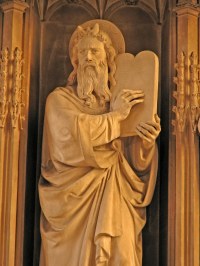
You’re familiar with the story of Moses: his being saved from the waters of the Nile as a baby, his growing up in the household of Pharaoh, his flight as a fugitive after killing an Egyptian taskmaster, his years shepherding in the Sinai Desert until God called him from the Burning Bush, how God used Moses to free the Hebrews from Egyptian slavery with great plagues and awesome miracles, how God through Moses gave his people the Law of the Old Covenant. Moses shared an incredible intimacy with God.

In the Book of Numbers, God said:

“If there are prophets among you,
in visions I reveal myself to them,
in dreams I speak to them;
Not so with my servant Moses!
Throughout my house he is worthy of trust:
face to face I speak to him,
plainly and not in riddles.
The likeness of the Lord he beholds.”

The Book of Deuteronomy declares: “Since [that time] no prophet has arisen in Israel like Moses, whom the Lord knew face to face.” So one would imagine, one would think, that Moses saw God’s face. The Book of Exodus says: “The Lord used to speak to Moses face to face, as a person speaks to a friend.” However, following soon after in that same chapter from Exodus, Moses asks the Lord, “Please let me see your glory!” And the Lord answers: “I will make all my goodness pass before you, and I will proclaim my name, ‘Lord,’ before you … But you cannot see my face, for no one can see me and live. Here is a place near me where you shall station yourself on the rock. When my glory passes I will set you in the cleft of the rock and will cover you with my hand until I have passed by. Then I will remove my hand, so that you may see my back; but my face may not be seen.” So Moses met with God in intimate conversation as one friend speaks to another, in his holy presence, yet it is not clear that Moses, during his lifetime, ever beheld God’s face. Similarly, God gave Moses the mission of leading his people from Egypt to the Promised Land, the land promised to Abraham and his descendants, yet Moses during his lifetime never entered the Promised Land himself.

Why was that the case? Early in their desert wanderings, the Hebrews complained against Moses because of their lack of water. Moses cried out to the Lord, “What shall I do with this people? A little more and they will stone me!” And the Lord answered Moses: “Go on ahead of the people, and take along with you some of the elders of Israel, holding in your hand, as you go, the staff with which you struck the Nile. I will be standing there in front of you on the rock in Horeb. Strike the rock, and the water will flow from it for the people to drink.” Moses did this in the sight of the elders of Israel and the crisis was adverted.

However, on a later occasion, when the community again lacked water, they held an assembly against Moses and Aaron. The people quarreled with Moses, exclaiming, “Why have you brought us out of Egypt, only to bring us to this wretched place [to die]? It is not a place for grain nor figs nor vines nor pomegranates! And there is no water to drink!” The Lord said to Moses: “Take the staff and assemble the community, you and Aaron your brother, and in their presence command the rock to yield its waters. Thereby you will bring forth water from the rock for them, and supply the community and their livestock with water.

So Moses took the staff from its place before the Lord, as he was commanded. Then Moses and Aaron gathered the assembly in front of the rock, where he said to them, “Just listen, you rebels! Are we to produce water for you out of this rock?” Then, raising his hand, Moses struck the rock twice with his staff, and water came out in abundance, and the community and their livestock drank. But the Lord said to Moses and Aaron: “Because you did not have confidence in me, to acknowledge my holiness before the Israelites, therefore you shall not lead this assembly into the land I have given them.

Years later, at the edge of the Promised Land, the Lord told Moses: “Ascend this mountain [Mount Nebo] and view the land … which I am giving to the Israelites as a possession. Then you shall die on the mountain you are about to ascend, and shall be gathered to your people, [because] you broke faith with me among the Israelites at the waters of Meribath-kadesh in the wilderness of Zin: you did not manifest my holiness among the Israelites. You may indeed see the land from a distance, but you shall not enter that land which I am giving to the Israelites.” And there, Moses the servant of the Lord died as the Lord had foretold. Moses was one hundred and twenty years old when he died, yet his eyes were undimmed and his vigor unabated.

What was behind this punishment from God? Moses had been disobedient to the Lord, striking the rock twice instead of speaking to the rock as instructed; and this was more than just some desert rock—the rock carried spiritual, symbolic, prophetic significance. In his First Letter to the Corinthians, St. Paul saw the Church and her sacraments prefigured in the story of the Hebrews and the Exodus. St. Paul writes: “Our ancestors were all under the cloud and all passed through the sea, and all of them were baptized into Moses in the cloud and in the sea. All ate the same spiritual food, and all drank the same spiritual drink, for they drank from a spiritual rock that followed them, and the rock was the Christ.

So the rock in the desert symbolized Jesus Christ. The first time, God told Moses to strike the rock, and it poured forth from its side saving water for God’s people. But the second time, when God told Moses to speak to the rock, Moses disobeyed and struck it twice. Jesus Christ has already been struck, beaten, and suffered violence once, for you and me in his Passion. We are no longer to keep striking him, again and again, through our sinful disobedience. Rather than choosing sin, we are to speak to Christ, asking him to pour forth his saving gifts. Jesus says, “Let anyone who thirsts come to me and drink. … To the thirsty I will give a gift from the spring of life-giving water.

I fear that sometimes we might think, “I can keep on sinning, it’s no big deal, because if I keep on going to Confession and have my sins forgiven it’s like they never happened—they don’t really matter.” Yet every sin is a lost opportunity to do God’s will. Every sin refuses God’s “Plan A.” And sins, even after they are forgiven, can bear earthly consequences which remain for the rest of our lives. Moses sinned, and repented, and remained God’s friend, but he was refused entry into the earthly Holy Land to his own great disappointment. Even convicted murderers can be forgiven by God, but they still remain behind prison bars and their victims bodies remain buried underground. Let’s not be complacent about our sins, for every sin is a lost opportunity to follow God’s better plan and, even if forgiven, sins can have irreparable consequences in this world for the rest of our lives. But, thanks be to God, our Christian hopes are not for this lifetime alone. Moses died and was buried, but that is not the end of his story.

Jesus took Peter, James, and John his brother, and led them up a high mountain by themselves. And he was transfigured before them; his face shone like the sun and his clothes became white as light. And behold, Moses and Elijah appeared to them, conversing with him.” St. Luke’s telling of today’s Gospel story notes Moses and Elijah “appeared in glory and spoke of [Jesus’] exodus that he was going to accomplish in Jerusalem.

Sometimes people ask how the apostles knew it was Moses and Elijah. Most likely they either introduced themselves, or Jesus introduced them. Some people have the notion that the dead forget who they were, forget all their memories, and care nothing about the events on earth. But Moses can only introduce himself if he knows who he is. And if Jesus said, “This is the prophet Moses,” there’s no indication that Moses replied, “I am? Where am I? What is happening?” Moses and Elijah can converse with Jesus about the exodus he is going to accomplish in Jerusalem (that is, about his coming Passion, death, and resurrection) because they know who they are, remember their lives, and are concerned about events among the living.

At the Transfiguration, we see the not quite fully-satisfied aspects of Moses’ life reaching their fulfillment. Moses never entered the Promised Land in his lifetime, but here he stands in Israel upon Mount Tabor with Jesus. Moses seems to have never seen God’s face, but now he speaks face to face with Christ. Consider how privileged we are to stand in this holy place and have such intimacy with Jesus Christ in his Holy Eucharist. It is good that we are here.

God greatly desires that we not sin. And if we have sinned, the Lord desires that we promptly repent and sin no more. Now, this season of Lent is an excellent time for repentance—especially while we’re still healthy. This world is scarred by sins, some forgiven and many not; and these painful wounds grieve us and prevent our full satisfaction in life. Yet the full story of Moses shows that our hopes are not merely limited to this life. Our hope extends beyond death, and St. Paul says, “God works all things for the good of those who love him.” And in the end, as St. Julian of Norwich says, “all shall be well, and all shall be well, and all manner of thing shall be well.