Archive for March, 2020

Satan’s Old Tricks — 1st Sunday of Lent—Year A

March 3, 2020

After his baptism in the Jordan, but before the start of his public ministry, Jesus was led by the Holy Spirit into the desert to be tempted by the devil. Did Satan realize at that time that Jesus was God? He says, “If you are the son of God… If you are the son of God.” But if Satan knew, it’s strange that he would attempt the impossible: to try tempting the all-holy God into sinning and doing evil. Old Testament prophesies allude to the promised Messiah, the awaited Anointed One, as being “Son of God.” God says in the 2nd Psalm:

“I myself have installed my king
on Zion, my holy mountain….
You are my son;
today I have begotten you.”

And in Psalm 89, God says:

“He shall cry to me, ‘You are my father,
my God, the Rock of my salvation!’
I myself make him the firstborn,
Most High over the kings of the earth.”

Old Testament Jews had been told their Messiah would at least figuratively be the Son of God; so, whether or not Satan knew Jesus was divine, he at very least suspected that this man from Nazareth was the Christ.

Jesus evidently went on to tell his apostles of the devil’s temptations in the desert—for how else would anyone know to write about them in the Gospels? There may have been additional temptations, but three are retold in Matthew and Luke’s Gospels. Jesus is on the verge of beginning his public ministry. What kind of Messiah will he be? The devil’s three temptations seek to corrupt his mission from the start. Satan seeks to lead the Christ off track so as to derail the plan of God. He did this first in the lush Garden of Eden, and here he seeks to do it again in the desert.

If you are the Son of God,” Satan says, “command that these stones become loaves of bread.” Jesus was hungry, but if he does this miracle the next question may be, “So you feed yourself, do you? How now can you refuse to give bread to everyone?” Satan wants Jesus to be a materialistic Messiah who must focus on nourishing bodies to the neglect of their souls. Jesus calls his disciples to practice material charity; today the Catholic Church is the largest charitable organization in the world; teaching, healing, clothing, housing, feeding, but this is all of secondary importance to its spiritual work. For what would it profit us to have all of our material needs fulfilled if our spiritual needs went unaddressed and we ultimately died separated from God? How do these things personally apply to us? Well, did the recent stock market drops ruin your week? Or are you too afraid or possessive to share, to tithe, to give to good causes? Or are you too busy working to pray? Jesus answers, “One does not live on bread alone, but on every word that comes forth from the mouth of God.

Next we hear how the devil takes Jesus to the roof edge atop the temple in Jerusalem and challenges him: “If you are the Son of God, throw yourself down. For it is written: ‘He will command his angels concerning you’ and ‘with their hands they will support you, lest you dash your foot against a stone.’” Satan is quoting Psalm 91. This goes to show—and serves as a warning—that not every Bible quote teaches what some people claim it does. True Scripture interpretation must be in union with the mind of Christ, and one with the Body of Christ, that is his Church.

God does not want Jesus to jump off buildings, but the devil wants the Messiah to demand that God protect him from all harm or hardship. Satan wants Jesus to be a Christ who is unwilling to suffer, who will refuse to drink any bitter chalice. The devil knows doing God’s will in this broken world will necessarily entail some sufferings for his faithful ones. If Jesus is unwilling to sacrifice then God’s people will never be saved. Are you trying to force your plans upon God? Are you pleased to serve God only so long as you experience no pain? Are you demanding that your salvation come without embracing your cross? Jesus answers, “You shall not put the Lord, your God, to the test.

Lastly, we hear the devil takes him up to a very high mountain, and shows him all the kingdoms of the world in their magnificence, and says, “All these I shall give to you, if you will prostrate yourself and worship me.” Satan wants Jesus to be a compromised Messiah who will pursue good things by doing, by serving, evil. The tempter says, “It’s only a little thing, just lay down, just say the words, just take a small bite, everything will be so much easier and better if you do.” Or else the tempter lies in the opposite extreme direction, “You have no choice – it’s a sin but there’s no other way – this must be done!” What sins do you still commit in hopes that good will result? Where do you bow down and side with Satan against the will of God? Jesus answers, “The Lord, your God, shall you worship and him alone shall you serve.

By God’s providence, the temptations of Jesus in the desert foreshadow Christ’s Passion to come. Jesus is not a materialist Messiah, changing stones to loaves of bread. But, beginning at the Last Supper, he feeds the world by changing bread into himself “for the life of the world.” Jesus is not a Christ who refuses to sacrifice. At the Temple he endures trail and condemnation by the Sanhedrin and accepts the bitter chalice of his Passion according to his Father’s saving will. And Jesus is not a compromised Messiah, committing sins for false and illusory gains. Christ becomes the magnificent, sinless king of all nations, atop Mount Calvary enthroned upon the Cross.

In this season of Lent, in these forty days of penance, we are in the desert with Jesus, learning from him, and being strengthened by him, so that we can stand straight and strong and not fall for the temptations and traps of the enemy, the same tricks he used against of Adam and Eve, that he attempted with Jesus Christ, and that he still uses in our day. This Lent, instead of falling for Satan’s same old tricks, let us grow closer to Jesus Christ in relationship and resemblance, closer in his friendship and closer to his holy likeness.
Conversion Within — 6th Sunday in Ordinary Time—Year A

March 3, 2020

Ash Wednesday, the beginning of our Lenten journey to Easter, is only a week and a half away. The season of Lent is for penance, conversion, and growing closer to our Lord. Jesus comes not only to forgive sinners but to transform us into saints. This year, would you like to become the best person in Christ that you have ever been? If so, then let’s begin to form a plan.

Lots of people give up something during Lent. Some people give up a particular food, like cookies, chocolate, ice cream, candy, potato chips, or pizza. Some people give up something they drink, like coffee, soda pop, or alcoholic beverages. Some people give up a habit, a thing small like spitting, chewing Gum, or biting their nails, or something grave, like smoking, chewing, or vaping. While other people give up desserts, snacks, junk food, fast food, or meals at restaurants. What do all these popular penances have in common? One’s mouth.

Fasting from a particular food or beverage is a fine Christian penance. Unless you’re exempted by age or health, abstaining from meat on Ash Wednesday and Lenten Fridays is already a part of our hared Church disciplines. But far more important than the things eat or drink with our mouths are the things that go on within our souls. Jesus once summoned the crowd and said to them, “Hear and understand. It is not what enters one’s mouth that defiles that person; but what comes out of the mouth is what defiles one.” When Peter and the disciples asked what he meant by this, Jesus explained: “The things that come out of the mouth come from the heart, and they defile. For from the heart come evil thoughts, murder, adultery, unchastity, theft, false witness, blasphemy. These are what defile a person.” The small and secret choices we make inside us lead to manifest effects around us.

First, an important point about the things that go on inside us. Thoughts, feelings, imaginings, and memories will often arise in our minds unexpectedly, unsought, and unreflectively. A temptation can be like this; an ugly thought or feeling, an idea or inclination to do something wrong, can come our way without our having willed it. Some people think they’re sinning when this happens. Not so. Remember that a saint is not someone who never experiences temptation, but someone who chooses what’s right and good and loving even when faced with temptation. We only do good or evil when we make a choice of the will; a choice to act or not act, to keep thinking about something or to try to think about something else. I mention all this because people commonly confess unwilled temptations they never consented to as if they we sins. Mere temptations are not sins or failures; they are a crossroads where we can choose the holy path, they are an occasion for us to do Christian battle, they are an opportunity for us to deepen our relationship with Christ.

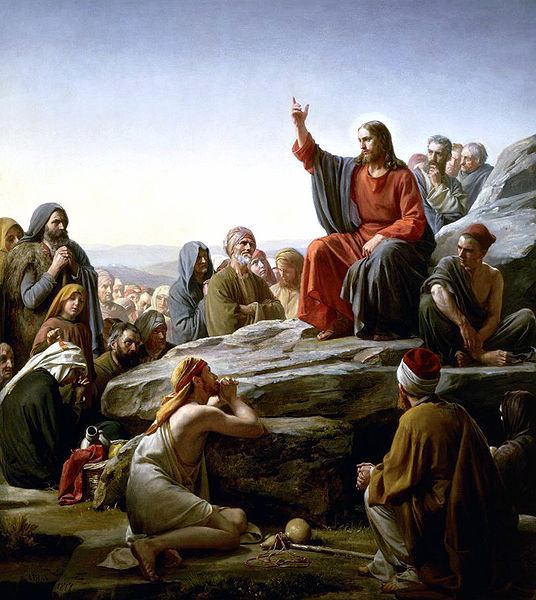
In today’s Gospel from the Sermon on the Mount, Jesus calls us beyond merely external holiness that other people can see to holiness through and through: “Unless your righteousness surpasses that of the scribes and Pharisees, you will not enter the Kingdom of Heaven.” Jesus reminds his disciples, “You have heard that it was said to your ancestors, You shall not kill. You shall not commit adultery. Do not take a false oath.” But then Jesus goes even further, for instance: “I say to you, whoever is angry with his brother will be liable to judgment; and whoever says to his brother, ‘Raqa, [blockhead]’ will be answerable to the Sanhedrin; and whoever says, ‘You fool,’ will be liable to fiery Gehenna.” Murder doesn’t come out of nowhere. It comes from contempt and hatred of others. As a Christian, you are not allowed to hate people. Scripture insists: “If anyone says, ‘I love God,’ but hates his brother, he is a liar; for whoever does not love a brother whom he has seen cannot love God whom he has not seen. This is the commandment we have from him: whoever loves God must also love his brother.” True, you might enjoy some people more than others. The nose might not find it pleasant to be around the armpits in the Body of Christ even as each member serves the others’ good. If there is anyone you dislike, remember that likes and dislikes are natural, but love—to will the good of another—is a decision, a choice you can always make. If there is anyone you hate or strongly dislike, I urge you to pray for them, since it is impossible to pray for someone and hate them at the same time. Perhaps for this Lent, focus on giving up your criticism of others and choose to focus on the best in everyone.

Jesus continues, “You have heard that it was said, ‘You shall not commit adultery. But I say to you, everyone who looks at a woman with lust has already committed adultery with her in his heart.’” Why did Adam and Eve put on clothes after they ate of the Tree of Knowledge of Good and evil? It’s not because their bodies were shameful, but because each of them realized for the first time that they could be manipulated and exploited by the other, used as a thing rather than loved as a person. This is what lust is, using another person as a thing for my own pleasure without care, concern, or love for them. And to think that lusts entertained in secret have no impact on how we behave or treat others in public is naive. Sexual sins can cost you your soul. For this Lent, perhaps focus on giving up using others for your pleasure and choose to see and love each person, even strangers, as God-loved person they are.

And finally, Jesus observes: “You have heard that it was said to your ancestors, Do not take a false oath, but make good to the Lord all that you vow. But I say to you, do not swear at all; not by heaven, for it is God’s throne; nor by the earth, for it is his footstool; nor by Jerusalem, for it is the city of the great King.” Apparently, some of Jesus’ Jewish contemporaries tried to gain the credibility associated with solemn oaths while avoiding divine punishments for speaking falsely. Jesus corrects them noting that all things are God’s, so to swear falsely by Heaven, Earth, Jerusalem, or your own head is no less sinful. Instead, Jesus teaches: “Do not swear at all (in everyday life.) Let your ‘Yes’ mean ‘Yes,’ and your ‘No’ mean ‘No.’ Anything more is from the evil one.” Your reputation for speaking the truth should be such that no oaths are necessary. Now being honest doesn’t mean you have to share every your thought or answer every question. But Jesus never lies, and he wants you to be like him. And once you no longer have dishonesty to evade responsibility, your other behaviors will improve as well. Maybe for this Lent, focus on giving up lying. Let your ‘Yes’ mean ‘Yes,’ and your ‘No’ mean ‘No,’ to be closer to the Holy One.

Lent, a season for penance, conversion, and growing closer to our Lord is just around the corner. This year, would you like to become the best person in Christ that you have ever been? Then form a plan to welcome the grace of Jesus Christ to transform you from the inside out.

Strong Reactions — 5th Sunday in Ordinary Time—Year A

March 3, 2020

My childhood memories of summer include the Osseo City Pool. I remember having fun in the water with friends, the 80’s songs playing from the lifeguards’ boombox, and the big brown door with red letters, warning something like: “Danger, Deadly Chlorine Gas, Staff Only!” As you might imagine, I never ventured into that room. Another memorable experience from my youth involving chemicals happened some years later. My science teacher, Mr. Hall, placed a bucket of water into the snow outside of our high school. Then, using tongs, he carefully dropped into it a chunk of pure sodium, and quickly backed away. The water steamed and bubbled and exploded a couple of times. It was intimidating and awesome. Two potent chemicals: chlorine and sodium. What happens when you combine them? You get sodium chloride. Today, this compound is present in the environment and inside of our homes. It’s in the oceans, on our streets, and even in the food we eat. Sodium Chloride may sound dangerous, but you know this common compound by another name: it’s salt.

Sodium Chloride (a.k.a. Salt)

Salt preserves, salt disinfects, and salt also adds flavor. Salt can preserve food from spoiling. In the days of sailing ships, unrefridgerated salted-pork could safely feed a crew for three months at sea. Salt has been used as a disinfectant and cleaning product since ancient times. The Egyptians, Greeks, and Romans employed salt water to treat cuts, wounds, and mouth sores. Even in 2010, a study from the Mayo Clinic found that gargling warm salt water reduces cold symptoms, including sore throat pain and mucus. And you know firsthand from a lifetime of eating that the addition of salt can make an otherwise bland dish taste much better.

Today, Jesus tells his disciples: “You are the salt of the earth.” Like salt, Christianity is found all over the world, preserving its good, purifying its evil, and adding flavor to what would otherwise be bland, meaningless life. And yet, like Sodium Chloride, Christianity is irrationally feared. This is nothing new. Listen to this second century Letter to Diognetus describing how Christians are present throughout the world, both helpful and good, and yet feared and opposed:

“Christians are indistinguishable from other men either by nationality, language or customs. They do not inhabit separate cities of their own, or speak a strange dialect, or follow some outlandish way of life. … With regard to dress, food and manner of life in general, they follow the customs of whatever city they happen to be living in, whether it is Greek or foreign. And yet there is something extraordinary about their lives. They live in their own countries as though they were only passing through. They play their full role as citizens, but labor under all the disabilities of aliens. Any country can be their homeland, but for them their homeland, wherever it may be, is a foreign country. Like others, they marry and have children, but they do not expose [their children to death]. They share their meals, but not their wives. They live in the flesh, but they are not governed by the desires of the flesh.”

“They pass their days upon earth, but they are citizens of Heaven. Obedient to the laws, they yet live on a level that transcends the law. Christians love all men, but all men persecute them. Condemned because they are not understood, they are put to death, but raised to life again. They live in poverty, but enrich many; they are totally destitute, but possess an abundance of everything. They suffer dishonor, but that is their glory. They are defamed, but vindicated. A blessing is their answer to abuse, deference their response to insult. For the good they do they receive the punishment of malefactors, but even then they rejoice, as though receiving the gift of life. They are attacked by the Jews as aliens, they are persecuted by the Greeks, yet no one can explain the reason for this hatred.”

Why does the world oppose devout Christianity? One reason is they imagine believing Christians behave like sodium in water, boiling hot with hatred and intolerance and violent in their reactions. Yet Christians’ allegiance to Jesus and his teachings on mercy, love, and the value of every human person are the best antidotes to mankind’s natural hatred and indifference toward others. Who is more responsible for sharing bread with the hungry, sheltering the oppressed and the homeless, and clothing the naked in world history than Christians in general and the Catholic Church in particular?

Another reason why worldly people oppose Christianity is that they think our faith is lethal to life’s pleasures; they fear that embracing Christianity would asphyxiate their happiness, like breathing chlorine gas. This too is nothing new. In Roman times, Christians were charged with “hatred of humanity” because the Romans believed ‘a lover of man should love what men love.’ The Early Christians would not partake of common sins for passing pleasures while, at the same time, living joyful lives. Joyful even at their martyrdom. As Diognetus’ pen-pal observed in the second century: “The world hates the Christians, not because they have done it any wrong, but because [Christians] are opposed to its enjoyments.” And so it is today. When we tell the world some things it loves are false roads to happiness the world hates us for it.

Jesus said, “If the world hates you, realize that it hated me first. If you belonged to the world, the world would love its own; but because you do not belong to the world, and I have chosen you out of the world, the world hates you. If they persecuted me, they will also persecute you. … In the world you will have trouble, but take courage, I have conquered the world.” So what are we to do? First, realize that the modern animosity to Christianity is nothing new. Don’t wait for that cultural hostility to pass; it won’t pass in our lifetimes. Next, never accept or act like your faith is a shameful thing. Jesus declares: “You are the light of the world. Your light must shine before others, that they may see your good deeds and glorify your heavenly Father.” If you are a Christian, Jesus wants the people around you to see something different in you and wonder, “What’s your secret.” Be unafraid to tell them the truth, “It’s my personal relationship to Jesus Christ and his Holy Church.” Cooperating with Christ to live like this saves souls and transforms our world.

There is another, more literal translation of Jesus’ words in our gospel: “You are the salt of the earth… You are the light of the world”: “You are the salt of the ground… You are the light of the cosmos.” Through your life, and every Christian life however humble, Jesus would reveal his divine light to the world, the glory and love that sustain the cosmos.

Shepherds & Fishermen — 3rd Sunday in Ordinary Time—Year A

March 3, 2020

What did the twelve apostles do for a living before Jesus called them to follow him? For six of the first apostles, that is half of the original twelve, we have no words from Scripture concerning their previous jobs. We are told that St. Matthew was a tax collector for the Roman government. We also hear of St. Simon the Zealot, who was either especially zealous in his personal religious devotion, or had ties to the Jewish Zealot movement is Israel. The Zealot movement sought, through politics and insurrection, to overthrow the Roman government in the Promised Land. If Matthew and Simon did indeed come from opposite sides of that era’s political spectrum, it suggests that every political party or faction has important things to learn from Jesus Christ.

In today’s Gospel, we learn the shared profession of four other apostles: Simon Peter, Andrew, James, and John; they were commercial fishermen. Now the Lord choosing men from the fishing industry was something new in salvation history. In the Old Testament, God often employs shepherds in his holy service. Among the patriarchs there is Abraham, Jacob-Israel, and his twelve sons – shepherds all. Later there’s the prophet Moses, King David, and Amos the prophet, each of whom tended flocks for some time before receiving their higher calling from God. As far as I can tell, there are no fishermen of particular note in the Bible before these four to whom Jesus says, “Come after me, and I will make you fishers of men.” Jesus, in calling fishermen, is doing something new. Now if the fishing background of these four apostles were irrelevant, I doubt the Holy Spirit would have inspired the inclusion of this fact into the Gospels. So what is the significance of this detail?

The work of a shepherd is different from that of fisherman. A shepherd tends his flock. He knows his sheep and his sheep know him. Some new lambs are born while other, older sheep go off to market or return to the earth, but the size of the sheepfold tends to remain rather stable. A fisherman, on the other hand, through his practiced skills and God’s providence, seeks and finds new fish every day. The fish are living in their own dark, watery world until the fisherman gathers them to himself. A shepherd maintains his numbers, but a fisherman goes out to seek more and more. Jesus chose his apostles not only to shepherd his people Israel, but to go forth to fish for people from all nations. Jesus made Peter not only a “fisher of men” but commanded him to ‘”feed my lambs… tend my sheep… feed my sheep.

Today we primarily think of water as a symbol of life, because nothing lives without water. Yet in the ancient world, water was often seen as a symbol of death. It’s possible even on a calm day to drown in a river, lake, or sea, but the volatile, deadly nature of large bodies of water is the subject of stories, poems, and songs even up to our day. For example:

The legend lives on from the Chippewa on down
Of the big lake they called Gitche Gumee
Superior, they said, never gives up her dead
When the gales of November come early

Fish live with this realm of death, a dark, watery world. The fisherman brings fish into the light, to a higher realm, a world they had previously ignored or never imagined. In our semi-post-Christian world today, is Jesus calling you and I to be shepherds or fishermen? Are we meant to maintain our flock, or to endeavor for more unnetted souls? There is need for both missions. In fact, we are called to do both. Many around us are baptized and still identify as Christians, yet how deep does their faithful devotion really go? Peter and Andrew left their careers for Jesus. James and John left their family for Jesus. Yet how few people today even come to church for him. True devotion and divine relationship is ignored or never imagined. Jesus calls you to be a missionary; not on the far side of the earth so much as in our own community. Be able to give witness to him. When I was a kid, when we were driving home from Sunday Mass, my family would often talk about what we heard in the homily. Today you your drive home from church I encourage you to ask each other: Why did you come to church today? What difference does it make for your life? We need to practice sharing why our faith is a gift with one another so that we can invite others to share this treasure.

In our first reading from St. Paul’s first letter to the Corinthians, we learn that the Christians in Corinth were choosing favorites and forming factions: ‘I belong to Paul. I belong to Apollos. I belong to Cephas.‘ St. Paul writes to remind them, you belong to Christ! Do not allow another person to get in way of Jesus for you. Pastors are important and Jesus has ordained it so, since without clear leadership how could St. Paul’s prayer and Christ’s desire, ‘that all of us agree in what we say, that there be no divisions among us, that we be united in the same mind and in the same purpose‘ ever be achieved? The need for human leadership of Jesus’ Church in this broken world, however, makes grave sin and scandal possible. This is a terrible thing, wherever and whenever it occurs. But please, please, do not separate from Peter on account of another apostle’s sin. You need Jesus, I need Jesus, and everyone else needs Jesus, too. Let us be good shepherds and fishers of men, caring for and seeking out everyone in our midst, as Jesus calls us to do.