Archive for April, 2020

The Christian Commentary of the Ferengi Fathers

April 28, 2020

Though thoroughly pagan, Ferengi culture is very rich. While the love of money and of what tickles the ears leads to many sins and errors, the brilliance of hidden treasure may still be glimpsed shining forth through dirt. Like St. Justin Martyr wrote, God has planted “seeds of truth”, seeds of the Logos, within all pre-Christian peoples in preparation for the fullness of the Gospel.

Let us examine how aphorisms found within Ferengi society’s most influential text (Grand Nagus Gint’sThe Rules of Acquisition”) sometimes point, even despite themselves, to revealed Christian truths. I doubt many Ferengi will forgive me if my interpretations here are too generous, but I hope that many may gain some profit from them.


Jesus called them. So they left their father Zebedee in the boat along with the hired men and followed him.

Rule #6: Never allow family to stand in the way of opportunity.


“Everyone who belongs to the truth listens to my voice.”

Rule #7: Keep your ears open.


“You have drunk, but have not been exhilarated;
have clothed yourselves, but not been warmed;
and he who earned wages earned them
for a bag with holes in it.”

Rule #19: Satisfaction is not guaranteed.


“I give them eternal life, and they shall never perish.   No one can take them out of my hand.”

Rule #42: What’s mine is mine.


“I do not pray for the world but for the ones you have given me, because they are yours, and everything of mine is yours and everything of yours is mine, and I have been glorified in them.”

Rule #43: What’s yours can be mine.


Jesus said, “Father, glorify your name!” Then a voice came from heaven, “I have glorified it and will glorify it again.” The crowd there heard it and said it was thunder, but others said, “An angel has spoken to him.”

Rule #44: Never confuse wisdom with luck.


On that day, there broke out a severe persecution of the church in Jerusalem, and all were scattered throughout the countryside of Judea and Samaria, except the apostles.

Rule #45: Expand or Die.


As Jesus passed on from there, he saw a man named Matthew sitting at the customs post. He said to him, “Follow me.” And he got up and followed him.

Rule #46: Make your shop easy to find.


“God so loved the world that he gave his only Son, so that everyone who believes in him might not perish but might have eternal life.”

Rule #49: Everything is worth something to somebody.


The angel said to the women at the tomb, “I know that you are seeking Jesus the crucified. He is not here, for he has been raised… Go quickly and tell his disciples he has been raised from the dead… Behold, I have told you.”

Rule #55: Advertise.


“Are you the only visitor to Jerusalem who does not know of the things that have taken place there in these days?!”
And Jesus replied to them, “What sort of things?”

Rule #56: Be discreet.


“You must not distort justice: you shall not show partiality; you shall not take a bribe, for a bribe blinds the eyes even of the wise and twists the words even of the just.”

Rule #61: Never underestimate the power of bribery.


“We speak God’s wisdom, mysterious, hidden, which God predetermined before the ages for our glory, and which none of the rulers of this age knew; for if they had known it, they would not have crucified the Lord of glory.”

Rule #85: Never let the competition know what you’re thinking.


“Do not store up for yourselves treasures on earth, where moth and decay destroy, and thieves break in and steal. But store up treasures in heaven, where neither moth nor decay destroys, nor thieves break in and steal.”

Rule #90: The Divine Treasury awaits.


In those days John the Baptist appeared, preaching in the desert of Judea saying, “Repent, for the kingdom of heaven is at hand! … Even now the ax lies at the root of the trees.”

Rule #93: Act without delay! The sharp knife cuts quickly.


“Love your enemies, do good to those who hate you, bless those who curse you, pray for those who mistreat you… Then your reward will be great and you will be children of the Most High, for he himself is kind to the ungrateful and the wicked.”

Rule #118: There is no profit in revenge.


“[Jesus Christ] emptied himself… he humbled himself, becoming obedient to death, even death on a cross. Because of this, God greatly exalted him and bestowed on him the name that is above every name…”

Rule #154: Pain passes, but profits remain.


After they had crucified him, they divided his garments by casting lots…

Rule #162: Even in the worst of times, someone turns a profit.


Behold, the angel of the Lord appeared to Joseph in a dream and said, “Rise, take the child and his mother, flee to Egypt, and stay there until I tell you. Herod is going to search for the child to destroy him.”
Joseph rose and took the child and his mother by night and departed for Egypt.

Rule #173: Dream, plan, believe, act.


“Which of you wishing to construct a tower does not first sit down and calculate the cost to see if there is enough for its completion? Otherwise, after laying the foundation and finding himself unable to finish the work the onlookers should laugh at him… In the same way, everyone of you who does not renounce all his possessions cannot be my disciple.”

Rule #195: You can’t jump a twenty foot gorge in two ten foot jumps.


“I give praise to you, Father, Lord of heaven and earth, for although you have hidden these things from the wise and the learned you have revealed them to the childlike.”

Rule #207: Sense without education is better than education without sense.


The high priest asked him and said to him, “Are you the Messiah, the son of the Blessed One?”
Then Jesus answered, “I am;
and ‘you will see the Son of Man
seated at the right hand of the Power
and coming with the clouds of heaven.”

Rule #208: Sometimes the only thing more dangerous than a question, is an answer.


When the wine ran short, the mother of Jesus said to him, “They have no wine.”
Jesus said to her, “Woman, how does your concern affect me? My hour has not yet come.”
His mother said to the servers, “Do whatever he tells you.”

Rule #225: Always follow one step ahead.


(On the pride of Goliath and Absalom)

Rule #235: Duck; death is tall.


“Do not give what is holy to dogs, or throw your pearls before swine, lest they trample them underfoot, and turn and tear you to pieces.”

Rule #250: Precious things are for those that can prize them.


“Put to death, then, the parts of you that are earthly: immorality, impurity, passion, evil desire, and the greed that is idolatry. Because of these the wrath of God is coming upon the disobedient.”

Rule #257: Despise the things you cannot have.


“After this I had a vision of a great multitude, which no one could count, from every nation, race, people, and tongue. They stood before the throne and before the Lamb, wearing white robes and holding palm branches in their hands.”

Rule #276: Overbooking is standard practice.


The Face of a Friend

April 25, 2020

3rd Sunday of Easter—Year A
By Deacon Dick Kostner

Our world tells us that death is the end of life. Jesus has parabled us into a new direction. Death is but the birth of a new and perfected life. I believe that our readings this Third Sunday of Easter tell us two important lessons to be learned. The first is that we are living at this moment in trying times, and that is anxiety, fear and confusion not only causes us to be disoriented but it also distracts us from seeing the cure for our affliction. The second lesson is that Jesus has, through our baptism, commissioned us to be the body of Christ in this very confused world. We no longer bear the face we were born with, but rather we are no longer recognized by our face but rather we are recognized by our heart and our actions.

We learn through our scripture readings that because of earthly death and the anxiety that follows we all will be confused and disoriented. This anxiety blinds us to the reality of the Easter Proclamation: “The light of Christ!” The disciples who knew Jesus well were so filled with the emotion of death that they failed to recognize their friend as they walked the road to Emmaus. This friend of theirs who could walk on water and still storms died and was buried. The fact that Jesus had taught them that death was not the end and that he would rise, blew right over the top of their heads because of their fear of death.

Isn’t it a “coincidence” that our whole world is experiencing, firsthand, the fear of death and the confusion that developed during this Holy Season? The same confusion that disciples of Jesus felt two thousand years ago is still with us on this Third Sunday of Easter. Like the disciples in our readings we are so filled with anxiety that we fail to recognize Jesus walking with us on that road to Emmaus. We fail to see his face in the nurses and doctors who treat us, and the clerks and people who serve us. We fail to hear his voice and feel his presence in the waive we see from our family and friends we no longer can touch. We fail to hear his wisdom and words proclaimed by His ordained ministers every day through cyberspace.

Jesus has many faces and I believe his disciples were unable to recognize him because Jesus wants to be recognized not by his facial features or color of skin but rather by and through his actions and words. It was not until he preached to his disciples and broke bread with them making them a part of him, that their eyes moved from his face to his heart and they could see their friend as the risen Christ.

We are commissioned to be the body of Christ. It is through our behavior driven by the heart not the brain that the face of Jesus will be recognized as we walk the road to Emmaus with Jesus at our side. May the peace of the risen Lord and the grace he gifts us with, be always with you!

Divinely Merciful

April 18, 2020

Divine Mercy Sunday

The Cenacle, the Upper Room in Jerusalem,
site of the Last Supper and Pentecost

Imagine an event as it did not happen…

On Easter evening, when the disciples were gathered behind locked doors in the Upper Room, Jesus came and appeared in their midst and said to them, “I condemn you. Each of you. All of you abandoned me.” And when he had said this, he showed the wounds in his hands and feet and side and said, “I suffered these because of your sins.”

If Jesus would have declared such things to his apostles his charges would not have been untrue. But this is thankfully not what Jesus did. Instead, he came and stood in their midst and said to them, “Peace be with you,” a phrase he says three times in this Sunday’s gospel. Christ’s Passion, death, and Resurrection are not for our condemnation. Jesus comes in mercy for his apostles and for us. “Blessed be the God and Father of our Lord Jesus Christ,” St. Peter writes, “who in his great mercy gave us a new birth to a living hope through the resurrection of Jesus Christ from the dead.”

After assuring them of his friendship and the reality of his Resurrection, the next most important item on Jesus’ Easter list is to entrust his Church with his mission of mercy: “As the Father has sent me, so I send you.” And when he had said this, he breathed on them and said to them, “Receive the Holy Spirit. Whose sins you forgive are forgiven them, and whose sins you retain are retained.”

In this season of pandemic, public Masses are suspended; first Communions, Confirmations, and weddings are being postponed; but the Sacrament of Reconciliation continues to be offered. Did you get to Confession this Lent? Jesus has peace to give you in this great sacrament. So, where and when you can, make it a top item on your list to experience his Divine Mercy there.

Divine Mercy Weekend Confession Times

April 13, 2020


Saturday, April 18th:

3:00 – 4:00 PM @ St. Paul’s east parking lot
6:30 – 7:30 PM @ St. John’s west-most parking lot

Sunday, April 19th:

3:00 – 4:00 PM @ St. John’s west-most parking lot
6:30 – 7:30 PM @ St. Paul’s east parking lot


.

Fr. Feltes will be hearing Confessions from inside of his car with his window remaining closed.

Car-to-Car Confession (if you come alone):
Drive up alongside Father, roll down your window, and turn off your engine to confess.

Walk-up Confession (if you come with others):
Park some distance away and take turns sitting in the chair beside Father’s window to confess.

Please share with others these final Confession times for Divine Mercy Sunday weekend.

The Questions & Answers of Easter Vigil

April 11, 2020

Easter Vigil

Tonight’s Easter Vigil Mass features many readings and accompanying psalms. The Church says the celebrant may chose to skip some of these readings, but tonight we are doing them all; seven from the Old Testament and two from the New, a journey from Genesis to the Gospel. But how does one preach about nine readings in one homily? As I pondered that question, I wondered, “What questions are asked in the readings themselves?

In the beginning in Genesis, when God created the heavens and the earth, there are no questions, only God’s declaring word. Thus the heavens and the earth and all their array were completed. God looked at everything he had made and they were very good. From the beginning, God knows his plan.

By the time of our next reading from Genesis, sin has entered our history. Humanity’s rejection of God, reflected in every sin, not only leads to death but creates injustices which must be rectified, hearts which must be converted, relationships which must be reconciled, and evils which must be undone, through sacrifice. “Father!” Isaac says, “Here are the fire and the wood, but where is the sheep for the holocaust?” “Son,” Abraham answers, “God himself will provide the sheep for the holocaust.

Isaac was spared but would God always provide? Generations later, Moses and the Hebrews are alarmed on the shores of the Red Sea when Pharaoh’s army threatens them. The Lord says to Moses, “Why are you crying out to me? Tell the Israelites to go forward. And you, lift up your staff and, with hand outstretched over the sea, split the sea in two, that the Israelites may pass through it on dry land.” God delivers his people, destroys their enemy, and leads them to his Promised Land.

How great is God’s love for his people? Isaiah proclaims that the Lord loves and desires Israel as a man does his bride: “The One who has become your husband is your Maker; his name is the Lord of hosts.” Yet Israel would often stray from him. Elsewhere Isaiah asks her, “Why spend your money for what is not bread, your wages for what fails to satisfy?” Later the Prophet Baruch asks, “How is it, Israel, that you are in the land of your foes, grown old in a foreign land, defiled with the dead, accounted with those destined for the netherworld? You have forsaken the fountain of wisdom!” Baruch asks “who has found the place of wisdom, who has entered into her treasuries? The One who knows all things knows her; he has probed her by his knowledge—the One who established the earth….

Through the Prophet Ezekiel, the Lord promises to bring his people to their true home, to wisdom, to holiness, to communion with himself: “I will take you away from among the nations, gather you from all the foreign lands, and bring you back to your own land. I will sprinkle clean water upon you to cleanse you from all your impurities, and from all your idols I will cleanse you. I will give you a new heart and place a new spirit within you, taking from your bodies your stony hearts and giving you natural hearts. I will put my spirit within you and make you live by my statutes, careful to observe my decrees. You shall live in the land I gave your fathers; you shall be my people, and I will be your God.”

How is all this to come about? Through Jesus Christ. St. Paul asks the Romans, “Are you unaware that we who were baptized into Christ Jesus were baptized into his death? We were indeed buried with him through baptism into death, so that, just as Christ was raised from the dead by the glory of the Father, we too might live in newness of life.

When Jesus Christ was so shockingly, so horrifically, so unjustly murdered, his heartbroken disciples were full of questions. Is there no reward for the just man? Is there no victory for righteousness? Is evil more powerful than goodness? Is God indifferent to our suffering? Does he not care? Is there no deliverance from sin? Do we have any reason to hope? God answers with Christ’s empty tomb.

Do not be afraid,” the angel says. “I know that you are seeking Jesus the crucified. He is not here, for he has been raised just as he said.” The women, fearful yet overjoyed, run to share this good news when they encounter Jesus on the way. They approach, embrace his feet, and do him homage. Then Jesus says to them, “Do not be afraid. Go tell my brothers to go to Galilee, and there they will see me.”

This was God’s plan from the beginning. That sin would be conquered through self-offering. That all would trust in God’s providence and love the perfect Bridegroom. Why spend yourself on what does not satisfy? Why live any longer away from the Lord in foolishness? You have access to a new and transforming Holy Spirit through your baptism, a baptism which has its power from the death and resurrection of Jesus. Jesus is God’s answer to our greatest questions. How will you respond to him? Answer with your faith and love.

Fasting from the Eucharist

April 10, 2020

Good Friday

St. Pope John Paul II and Joseph Cardinal Ratzinger, Lent of 1995

The Latin Rite of the Catholic Church, to which we and 98.6% of the world’s Catholics belong, has just one day each year when no Masses are to be celebrated. That day is today, Good Friday. After a reading of Christ’s Passion from the Gospel of John and reverencing his holy Cross, the Good Friday liturgy contains a Communion service in which presanctified (previously consecrated) Hosts are distributed and consumed. However, in the early Church, there was no reception of Holy Communion by the faithful on Good Fridays at all. This fact was once noted by Joseph Cardinal Ratzinger. Cardinal Ratzinger, this highly-esteemed theologian, would go on to be elected pope and take the more familiar name Benedict XVI. In his 1986 book “Behold the Pierced One,” he reflected upon the spiritual benefits that could be found by Catholics in full communion with the Church abstaining for a time from receiving our Lord in the Holy Eucharist. Obviously, these interesting passages are relevant to us now during this Long Lent of 2020.

Cardinal Ratzinger wrote:

“When [St.] Augustine felt his death approaching, he ‘excommunicated’ himself and took upon himself ecclesiastical penitence. In his last days, he set himself alongside, in solidarity, with the public sinners who seek forgiveness and grace through the pain of not receiving the Communion. He wanted to meet his Lord in humility of those who hunger and thirst for righteousness, for Him, the righteous and gracious One. Against the background of his sermons and writings, which describe the mystery of the Church as a communion with the Body of Christ and as the Body of Christ, on the basis of the Eucharist, in a really marvelous way, this gesture is quite shocking. It seems to me more profound and fitting, the more often I ponder it. Do we not often take things too lightly today when we receive the most Holy Sacrament? Could such a spiritual fasting not sometimes be useful, or even necessary, to renew and establish more deeply our relation to the Body of Christ?

In the early Church there was a most expressive exercise of this kind: probably since the time of the apostles, Eucharistic fasting on Good Friday was part of the Church’s spirituality of Communion. Not receiving Communion on one of the most holy days of the Church’s year, which was celebrated with no Mass and without any Communion of the faithful, was a particularly profound way of sharing in the Passion of the Lord: the sorrowing of the bride from whom the bridegroom has been taken away (see Mark 2:20). I think that a Eucharistic fast of this kind, if it were deliberate and experienced as a deprivation, could even today be properly significant, on certain occasions that would have to be carefully considered—such as days of penitence (and why not, for instance, on Good Friday once more?) […]

Such fasting — which could not be allowed to become arbitrary, of course, but would have to be consonant with the spiritual guidance of the Church — could help people toward a deepening of their personal relation to the Lord in the Sacrament; it could be an act of solidarity with all those who have a yearning for the Sacrament but cannot receive it. […] I would not of course wish to suggest by this a return to some kind of Jansenism: in biological life, as in spiritual life, fasting presumes that eating is the normal thing to do. Yet from time to time we need a cure for falling into mere habit and its dullness. Sometimes we need to be hungry—need bodily and spiritual hunger—so as once more to comprehend the Lord’s gifts and to understand the suffering of our brethren who are hungry. Spiritual hunger, like bodily hunger, can be a vehicle of love.”

During this dangerous Coronavirus pandemic, faithful shepherds charged by Christ to care for the fullness of persons entrusted to them have prescribed sad but necessary measures which have restricted access to Holy Communion. In doing this, our Church leaders follow in the prudential footsteps of past prelates who likewise suspended public Masses during times of deadly contagion, from the medieval plagues to the modern Spanish Flu. Although public liturgies with Communion have ceased it is important to remember that the Holy Mass continues to be offered by priests in our Catholic churches. The graces of Jesus’ sacrifice pour forth from these altars into Christians souls around the world. Do not doubt that our Lord will provide sufficient grace for all that you are called to do in this season of our lives. As the Lord once told St. Paul when the saint prayerfully begged for a certain trial to be taken away, “My grace is sufficient for you, for power is made perfect in weakness.”

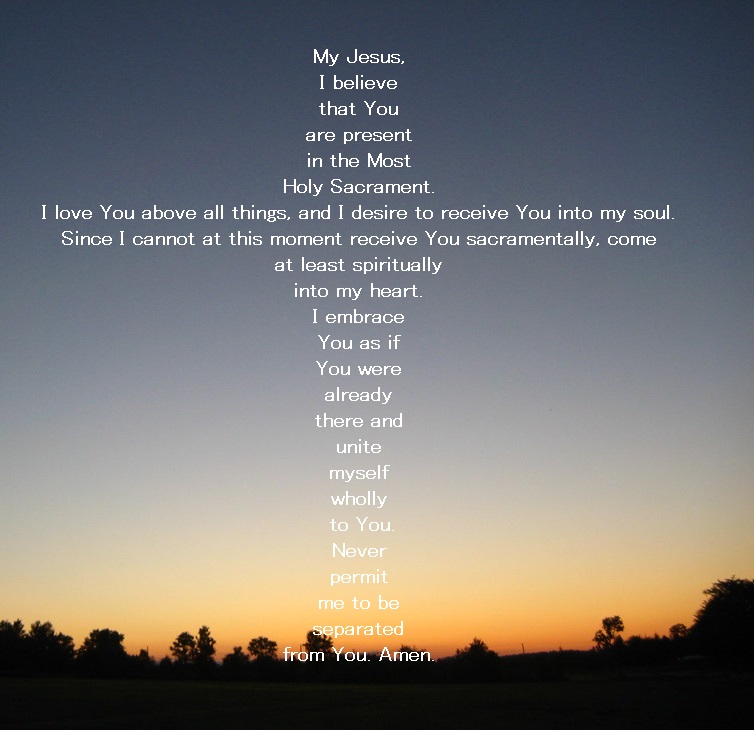
When we cannot physically receive Jesus in the Eucharist we can still unite ourselves to him through a prayer for Spiritual Communion. Pope St. John Paul the Great wrote that the practice of Spiritual Communion “has happily been established in the Church for centuries and recommended by saints who were masters of the spiritual life. St. Teresa of Jesus wrote: ‘When you do not receive Communion and you do not attend Mass, you can make a Spiritual Communion, which is a most beneficial practice; by it the love of God will be greatly impressed on you.’” Once, in a 14th century vision, Jesus showed St. Catherine of Siena two chalices, one gold and one silver. He said her Sacramental Communions were preserved in the gold chalice and her Spiritual Communions in the silver one. When our sacramental reception of our Lord proves impossible, Jesus desires our Spiritual Communion. Until the day we are all safely reunited around his altar, I urge you to make acts of Spiritual Communion, such as this famous prayer of St. Alphonsus Liguori:

My Jesus,
I believe that You are present in the Most Holy Sacrament.
I love You above all things, and I desire to receive You into my soul.
Since I cannot at this moment receive You sacramentally,
come at least spiritually into my heart.
I embrace You as if You were already there
and unite myself wholly to You.
Never permit me to be separated from You.
Amen.

Just one month ago, when pews were full for the 2nd Sunday of Lent, we heard the Gospel story of the Transfiguration. On Mount Tabor, Jesus’ face shone like the sun and his clothes became white as light. Ecstatic, Simon Peter said in reply, “Lord, it is good that we are here! If you wish, I will make three tents here, one for you, one for Moses, and one for Elijah.” Peter wanted to never leave that euphoric time and place, but it was necessary that Jesus lead him down from that mountain top into the dark valley; from the Mount of Transfiguration to the Hill of Crucifixion.

It is a true sacrifice to fast from the Eucharist this Good Friday amidst this Long Lent. But our Christian sacrifice is not without purpose nor without hope. Like Jesus’ Passion, it is a sacrifice offered for the love of others. This is his Body given up to save many; we do this in memory of him. And like Jesus within his Passion, we can be confident that this arduous trial shall pass away and our suffering and obedience will soon yield great rewards, particularly a deepened love for our Eucharistic Lord. Being followers of the transfigured Christ takes us to Calvary, but the Passion is what leads us to his Resurrection. And the more we share in the likeness of Christ, the more we will share in his glory.

Christ Ordained

April 9, 2020

Holy Thursday


What the Old Testament foreshadowed, the New Testament reveals. What the Old Covenant prefigured, God’s New Covenant fulfills. What our Lord prepared in ancient times, he now bestows to his Church. The Holy Scriptures point to the gifts of God we particularly celebrate on this evening: the Holy Priesthood and the Holy Eucharist.

In the Book of Exodus, the Lord declares to Moses: “This is the rite you shall perform in consecrating [Aaron and his sons] as my priests. … Aaron and his sons you shall…bring to the entrance of the tent of meeting and there wash them with water.” On Holy Thursday, “[Jesus] rose from supper and took off his outer garments. He took a towel and tied it around his waist. Then he poured water into a basin and began to wash the disciples’ feet and dry them with the towel around his waist.

Peter said to the Lord, “You will never wash my feet.” But Jesus answered him, “Unless I wash you, you will have no inheritance with me.” The Book of Deuteronomy taught, “The levitical priests, the whole tribe of Levi, shall have no [landed] portion or [territorial] inheritance with Israel…. [T]he Lord set apart the tribe of Levi,” Deuteronomy says, “to carry the Ark of the Covenant of the Lord, to stand before the Lord to minister to him, and to bless in his name…. For this reason, Levi has no portion or inheritance with his relatives; the Lord himself is his inheritance….

When Jesus told Peter, “Unless I wash you, you will have no inheritance with me,” Simon Peter replied, “Master, then [wash] not only my feet, but my hands and head as well.” As part of the priestly ordination ritual in the Book of Exodus, the Lord commanded Moses: “[Sacrifice an unblemished male sheep and] some of its blood you shall take and put on the tip of Aaron’s right ear and on the tips of his sons’ right ears and on the thumbs of their right hands and the great toes of their right feet. Splash the rest of the blood on all the sides of the altar.” Jesus says Peter does not need to be washed all over, head and hand and foot, because whoever has bathed is clean. (This is likely a reference to his baptism.) But at the Last Supper, the Body of God’s perfect, unblemished Lamb is broken and his Blood is poured for the apostles.

As St. Paul wrote to the Corinthians: “[T]he Lord Jesus, on the night he was handed over, took bread, and, after he had given thanks, broke it and said, ‘This is my body that is for you. Do this in remembrance of me.’ In the same way also the cup, after supper, saying, ‘This cup is the new covenant in my blood.’” On Holy Thursday, the apostles receive the Blood of the Lamb and then, on Good Friday, this Blood marks the sides of the Lamb’s Altar, the vertical and horizontal beams of the Cross.

In Egypt before the Exodus, when the Lord instituted the Passover sacrifice, he commanded his people: “[E]very one of your families must procure for itself a lamb… The lamb must be a year-old male and without blemish…. It shall be slaughtered during the evening twilight. They shall take some of its blood and apply it to the two doorposts and the lintel of every house in which they partake of the lamb. That same night they shall eat its roasted flesh…. This day shall be a memorial feast for you, which all your generations shall celebrate… as a perpetual institution.” At the first Eucharist, Jesus commands his apostles, “Do this in remembrance of me,” thereby ordaining them as his priests of his New Covenant.

The apostles had been washed with water, sanctified by blood, bestowed an inheritance in the Lord, and entrusted with the mission of offering the unblemished Lamb. As the Catholic Church has always believed and taught, this memorial sacrifice, this Eucharist, re-presents, truly makes present, the sacrifice of the Cross, and applies its saving fruits among us. On Holy Thursday, Jesus gave his New Covenant Church the intertwined gifts of the Holy Eucharist and the Holy Priesthood.

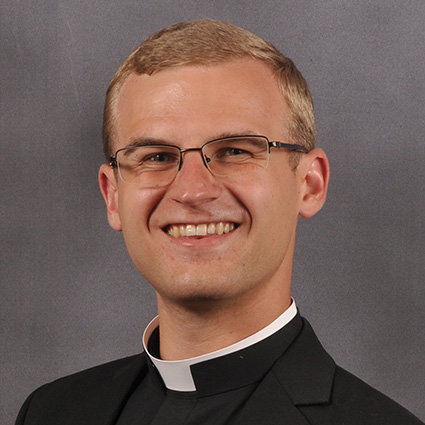
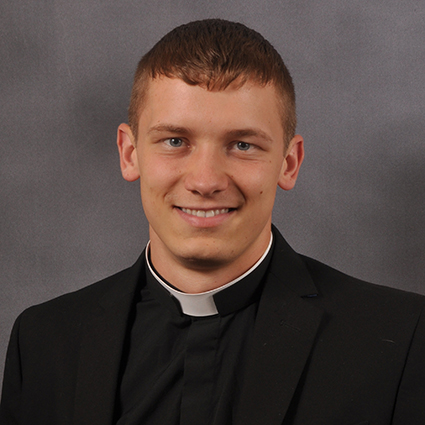
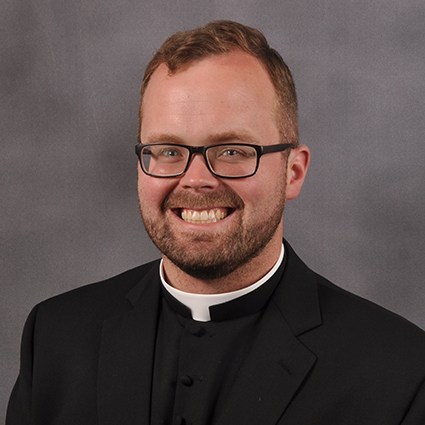
The trial of this Long Lent of 2020 has made Catholics more appreciative of God’s precious gifts. This evening, we are blessed by the presence of the three seminarians from our local parishes assisting at Mass. We thank God for their vocations and urge them to press on. Eventually, this Long Lent of the Church will joyfully end and these young men will be (God willing) ordained to serve her, offering Christ’s sacrifice as loving servants for the good of us all. Pray for our seminarians, Eric, Matthew, and Isaac, that they may take up the cup of salvation; that they may offer the sacrifice of thanksgiving and call upon the name of the Lord; that they may fulfill ordination promises to the Lord in the presence of all his people. And with patient eagerness let us pray for the coming day when all of us, God’s priests and his people, can celebrate the Mass together again.

Our Seminarians’ Coronavirus Stories

April 6, 2020

God has blessed our parishes with priestly vocations. Of the sixteen seminarians currently enrolled in major seminary for our La Crosse Diocese, three of them (fully 18%) belong to St. Paul’s or to St. John the Baptist’s Parishes. These young men have now returned safely home to us, but what was it like for them to be at seminary as this pandemic arose and what has life been like since? These are their stories.


Isaac Pecha of St. Paul’s Parish in Bloomer had been studying in 1st Theology at the North American College in Rome. He writes:

My experience of the Coronavirus outbreak has occurred in three stages: the initial outbreak in Italy, the two-week quarantine upon returning to America, and then the statewide stay-at-home order that started right as I left quarantine. Each has come with its own graces, which I share below.

In late February, a few towns in the north of Italy were put on lockdown, but Rome continued as normal. I even remember telling a classmate on March 4th, “I don’t think classes will be cancelled unless someone in the university gets sick.” The next day, the government announced that they were suspending all school activities. Then on March 9th, the lockdown was extended to the whole country. We were called back to America, with a flight out in 11 hours. I said my goodbyes, packed a single suitcase, and we left Rome. An hour after we landed on the 11th, the U.S. suspended travel from Europe. During this stage, my biggest graces were the clear reminder of how little we are in control of things, and having a bishop who acted so wisely as to call us home when he did.

When we got back to America, the four of us La Crosse seminarians had to quarantine together for two weeks before we could go to our families. In the unused rectory where we stayed, we established an horarium and continued to pray, study, and enjoy fraternal time as usual. There was a sliding glass door, and on Sundays a nearby priest would say Mass on the porch outside (with us safely contained in the house). This was the greatest grace of the personal quarantine—a concrete reminder of how lucky we are to have the sacraments, and the lengths to which priests will go to bring them to us.

The day before our release from personal quarantine, Governor Evers issued the statewide stay-at-home order, so as soon as the health department cleared us to leave, we all went straight back to our families. Since then, I have been at home, still taking classes online, spending time with my family. Having little to do besides pray, study, and hang out with my family members has been a great grace.

I am reminded of the words of one of my favorite holy women, Servant of God Chiara Corbella Petrillo. She said, “God does not want to take good things away from you, and if he takes, it is only to give you so much more.” Obviously, I cannot wait to go back to Rome, or receive a parish assignment here in our diocese, but it would be wrong to only long for those things without thanking God also for the good things he has given me in the meantime.


To this account, Eric Mashak, the 3rd year theologian from St. John the Baptist Parish in Cooks Valley, simply adds:

For us seminarians who study in Rome, it was very unexpected to be called back to the U.S. by our bishop. We found out that we were coming home around dinner time and were at the airport about 12 hours later. This, for me, was a simple lesson in obedience. There is a necessity for fast acting obedience in the priesthood. Like the Apostle Andrew who dropped his nets and instantly followed Christ, so too the priest needs to be ready to take a new parish assignment at a call from the bishop. Formation never stops! Even when we can’t be in a seminary.


Matthew Bowe of St. Paul’s was studying in 2nd Theology at St. Francis de Sales Seminary just outside of Milwaukee. He writes:

Greetings, brothers and sisters in Christ. I pray that everyone is doing well and is staying healthy. If you or your family or your friends have been deeply affected by the Coronavirus, please know that they are being prayed for in a special way.

Like other places, St. Francis de Sales Seminary had to adjust to the Coronavirus situation. After finishing our spring break, we had classes the week of March 9th. On Friday, March 13th, around 11 a.m., we received an email stating that the plan was to continue with classes on the following Monday. Later that evening around suppertime, all that changed when emails were sent about going to online classes until Easter and that formation would be suspended for a couple of weeks. Seminarians would be allowed to St. Francis Seminary under quarantine during that time if they so wished. For the seminarians of the Diocese of La Crosse, we received an email after supper stating that we were to go home as soon as possible. I have been home since March 14th.

Since then, classes will be conducted online through the end of the semester, and seminarians are to remain where they currently are until St. Francis Seminary tells us otherwise. At home, I have found balance in completing my schoolwork while maintaining prayer times and other healthy habits (e.g., eating well, exercise, and leisure activities). I have been catching up on some good movies and enjoying home-cooked meals with my parents. Further, I help out around the house. Other than that, my life is somewhat uneventful and routine, and there is a peace with that. The stress and pressure of a normal seminary life, which does give me life, have been removed, and I have a more comfortable position to reflect on the good that God has given me during my time as a seminarian. God has given me good gifts during this time of trial and tribulation.

I would like to conclude by asking everyone to continue to keep faith. Although this is a difficult time for everyone, let it bring forth good fruit that can only be achieved by uniting oneself to the will of God. Trust God, and He will do good things for you (in ways that you may not expect). While we brave this storm, let us pray for one another. I will continue to pray for the families of the parish, and I ask you to pray for my family and for my brother seminarians. May the merits of Jesus’ Passion enliven our faith during this Holy Week.

The Relevance of Holy Week

April 4, 2020

Palm Sunday
By Deacon Dick Kostner

Today we begin our Holy Week. As practicing Catholics we all know the story about Christ’s Passion, Death, and Resurrection. As good Catholics we all believe that Jesus was sent upon this earth to save us, to make us one with Him through baptism and to make of us his disciples. We believe all of these facts. We also realize that these events happened over 2000 years ago. The question of challenge for us today, for us this week, is to reflect upon what that means for us in the year 2020. If Jesus is but a person of history the question of this big event leaves us with a big “so what”. So what, that this event took place, so what if we all believe this event took place if it is but a piece of history with no relevance for us here today, at St. Paul’s and St. John’s in the year 2020?

This same question was posed to me by Fr. Dan Crosby at a retreat I attended at St. Anthony’s some years ago. It is a question all of us must answer for ourselves. We need to reflect upon Jesus and whether the happiness of Palm Sunday, the Passion of Christ, the Resurrection, has relevance for us this year. If no relevance can be found we can still believe in these historical facts but it leaves us with a void, a “so what” in our lives.

Ponder this: When we celebrate our marriages and anniversaries, our birthdays, and baptisms are we not experiencing the joy of Jesus as he rode into Jerusalem seeing everyone joyful and honorous of His presence? Or how about when our Church gathers to celebrate Christmas through our school children. Are we not proud of this celebration as Jesus was proud of those who honored him on Palm Sunday? When we fail that exam, loose our job, or are refused admission to the school we so want to attend, or maybe hit with serious illness, with its pain and suffering within our lives and within our families, are we not experiencing the Passion of Christ? Look at how the Coronavirus has tuned our lives upside down, restricted our work, our lives and freedoms and yes our faith. Don’t we all cry out, “Lord take this cup from me?” When death occurs do we not experience the evil that exists within this world? Don’t we feel a loss, an aloneness from this experience? Is this not the experience of the Cross of our Brother, our Teacher, our Redeemer that took place so many years ago? After we surrender our will to that of the Father’s do we not come to fulfillment, to peace, to the beginning of new life; “a resurrection” as displayed to our Parish when we witness our Parish family members making their transition from this life to a move to the Father’s House? We no longer have death to fear, pain and suffering to fear, because of the Resurrection, because of Easter Sunday.

Part of life is the experience of ups and downs. The “ups” build us up to help us deal with the lows of life. It makes us glad to be alive. The “lows” temper us, they make us realize we are finite in body they make us dependent upon support from God and from others who comprise the body of Christ. One of my very special friends who is experiencing a “Good Friday” event in her life now, shared with me the fact that her event has allowed her and her family to experience the gift and importance of “community”, the importance of having the “Body of Christ” support her and walk with her and her family while she experiences, first hand, the Passion of Christ. The Passion, Death, and Resurrection is not history, it lives with us daily, it allows us to overcome evil, and yes even the fear of death. It allows us to celebrate the joy of Easter throughout all our lives. Let us thank God for the gift of this Holy Week of relevance in our lives.

An Identity and a Mission

April 1, 2020

2nd Sunday in Ordinary Time—Year A


When St. John the Baptist sees Jesus coming toward him he declares, “Behold, the Lamb of God, who takes away the sin of the world!” Why did John say that? How is Jesus like a lamb? Under the Old Covenant, animal sacrifices were offered for sins. The symbolism was that the living animal, often an unblemished male sheep, was dying in place of the sinner who offered it. This prefigured what was to come. Jesus Christ, like a flawless, obedient sheep, hears and follows his master’s voice, He does the Father’s will, and takes our place in the sacrifice which actually forgives sins. This is why Jesus is rightly called the Lamb of God who takes away the sins of the world.

John the Baptist goes on to say, “He is the one of whom I said, ‘A man is coming after me who ranks ahead of me because he existed before me.’” Indeed, Jesus, as the Second Person of the Most Holy Trinity, existed before the universe itself. Through Him all things were made, and the things that came to be pointed to and culminated in Him. For this reason, it is not so much that Jesus resembles the lambs of Old Covenant sacrifices, but rather that God establishes the ritual of lamb sacrifice for sins in order to point to Jesus and his ultimate sacrifice.

The story of the life of Jesus appears in the New Testament, but the Holy Spirit has spoken through the prophets about Him throughout the Old Testament. For example, our first reading from the Book of Isaiah written several centuries before Christ, is one of hundreds of passages which speak of Him. But before we return to that passage again, let’s review a little historical background.

We read in the Book of Genesis that Jacob was Abraham’s grandson. Jacob was renamed “Israel” by God and fathered twelve sons. From these twelve sons the “twelve tribes of Israel” descended. This is why the names “Jacob” and “Israel” are usually interchangeable, and may refer to one person or to many. In Isaiah, the prophet writes, “The Lord said to me: You are my servant, Israel, through whom I show my glory. Now the Lord has spoken who formed me as his servant from the womb…” To whom is God speaking in these lines? Who is the servant whom God formed from their beginning; the prophet himself, God’s faithful people, or Jesus Christ? There is truth in each of these interpretations, but this reading’s relevance to Jesus particularly shines forth. The prophesy continues:

It is too little, the Lord says, for you to be my servant, to raise up the tribes of Jacob, and restore the survivors of Israel; I will make you a light to the nations, that my salvation may reach to the ends of the earth.”

Jesus is the one who brings light and salvation not only for the physical descendants of Abraham, Isaac, and Jacob, but for all the nations on earth, to non-Jewish Gentiles like you and me through His one, holy, catholic, and apostolic Church. Another foreshadowing of Christ is seen in today’s psalm, written by King David one thousand years before Christ. Hear these words as if spoken from Jesus’ lips:

[Mere] sacrifice or offering you wished not, but ears open to obedience you gave me. [More of the former] burnt-offerings or sin-offerings you sought not; then said I, “Behold I come.”

In the written scroll it is prescribed [that is, it is foretold in the Scriptures.] For me to do your will, O my God, is my delight, and your law is within my heart!

I announced your justice in the vast assembly; I did not restrain my lips, as you, O Lord, know. I have waited, waited for the Lord, and he stooped toward me and heard my cry. And he put a new song into my mouth, a hymn to our God.

I fully suspect the 40th Psalm had an original, personal meaning for King David when he authored it, and these words have been prayed by God’s faithful people in a personal way ever since, but these words especially apply to the person and mission of Christ. After preaching God’s word to vast assemblies, obedience to his mission led Jesus to His Passion. After crying out for His Father to save Him, and waiting, waiting three days in the tomb, Jesus’ resurrection has put a new song in his mouth, a new hymn of praise to the Father in which we all have a part.

As I mentioned in my homily last week, by baptism you are baptized into Christ. And by remaining connected to Jesus Christ through his sacraments, He remains in you. The prophecies of Scripture refer not only to the human authors, like Isaiah or David, and they refer not only to Jesus, these passages’ fullest fulfillment, but also to us, His Bride and His Body, the Church in her members, the New Israel which comes to us through the twelve Apostles of Jesus. Hear those words of the Lord from Isaiah again:

You are my servant, Israel, through whom I show my glory. Now the Lord has spoken… that Jacob may be brought back to him and Israel gathered to him.”

Israel had been scattered, whole tribes of Jacob were lost due to sin and its consequences, but God Ever-Faithful used Israel, perfected in his Son, to gather his people Israel back to Himself. He says to us:

You are my servant, O Church of God, through whom I show my glory. Now the Lord has spoken… that the People of God may be brought back to him and the Church gathered to him.

God has purpose for your life. A purpose found in Christ. A mission to be faithful and fruitful in Christ. Jesus is still working to save souls today and he desires to work though each of us in His Body, the Church.