Archive for July, 2020

Jesus Psalms

July 30, 2020

To pray the psalms in a fresh new way, wherever you see “the LORD” in a verse substitute the name “Jesus“. For example, here is most of this Sunday’s psalm (Ps 145:8-21) as explicit praise and celebration of God the Son:


Jesus is gracious and merciful,
slow to anger and abounding in mercy.

Jesus is good to all,
compassionate toward all your works.

All your works give you thanks, Jesus,
and your faithful bless you.

They speak of the glory of your reign
and tell of your mighty works,

Making known to the sons of men your mighty acts,
the majestic glory of your rule.

Your reign is a reign for all ages,
your dominion for all generations.

Jesus is trustworthy in all his words,
and loving in all his works.

The Jesus supports all who are falling
and raises up all who are bowed down.

The eyes of all look hopefully to you;
you give them their food in due season.

You open wide your hand
and satisfy the desire of every living thing.

Jesus is just in all his ways,
merciful in all his works.

Jesus is near to all who call upon him,
to all who call upon him in truth.

He fulfills the desire of those who fear him;
he hears their cry and saves them.

Jesus watches over all who love him,
but all the wicked he destroys.

My mouth will speak the praises of Jesus;
all flesh will bless his holy name forever and ever.

A Redecorated Soul — Funeral Homily for Linda Gorka, 70

July 29, 2020

There’s a natural sadness from the passing of a loved one and added stress from life’s current strains. But there is profound consolation from our faith in Jesus Christ and we are blessed in our freedom to be able to gather here today. St. Paul’s Parish is honored to be offering our greatest prayer, the Holy Mass, for Linda’s soul and for all of you who know and love her. No mere homily could capture the full mystery of a human life; no brief homily can tell the fullness of the story of how Christ has shepherded Linda’s life. But a funeral homily can reveal something of what Jesus Christ has done, and does, in the lives of Christians.

Rodney tells me that Linda loved interior decorating. Though never formally trained, she had a talent for it — a creative flair. For holidays, especially the Christian celebrations of Christmas and Easter, Linda’s house was transformed; nick-nacks here and there, wall and window coverings, all set the season; providing a pleasant backdrop when she would entertain welcomed guests at parties. She loved being a grand-hostess for her friends.

Another thing Rodney recollected to me is how the companionship between them helped them through each other’s serious health trials. She remained by his side, minded his meds, and drove him for treatments during his throat cancer nine years ago. And last year, Linda helped him through his recover from a bad car accident. Then, in this her final year, Linda received support and care during her purifying crucible experience of suffering with cancer. (Rodney wants to thank all those who helped before and after Linda death: her daughter Michelle and Arianne, son David, grandson Joe, friends Randy and Dawn, and others whom Rodney may have forgotten.) We believe, like St. Paul says, ‘this momentary light affliction is produced for her an eternal weight of glory beyond all comparison,’ because Linda died as a Christian with Christ.

Three weeks ago, I went to visit Linda in the hospital and did something I have never done before. Rodney had informed me that, though Linda believed in God and Jesus Christ, neither she nor her family members had any knowledge or evidence of her ever having been baptized. She was not speaking very much at that point, but when I asked her whether she wished to be baptized she answered that she did. I baptized Linda with water on her forehead right there in her bed, “in the name of the Father, and of the Son, and of the Holy Spirit” — a conditional baptism, ensuring that whether or not she had ever been baptized before, she was assuredly a baptized Christian after.

What is the meaning and purpose of all these trials of life? If this life were all there is, if Christ were not raised and all people and things were destined for unending death, our lives would have no enduring significance. But Jesus is risen, so this life is vitally important, yet it’s only the beginning of eternity, so the God allow trials to transform us more and more into the likeness of Christ, who often suffered with love and virtue. The famous Christian author C.S. Lewis once observed that, like Linda, God is something of a master interior redecorator as well:

Imagine yourself as a living house,” Lewis wrote, “God comes in to rebuild that house. At first, perhaps, you can understand what He is doing. He is getting the drains right and stopping the leaks in the roof and so on; you knew that those jobs needed doing and so you are not surprised. But presently He starts knocking the house about in a way that hurts abominably and does not seem to make any sense. What on earth is He up to? The explanation is that He is building quite a different house from the one you thought of – throwing out a new wing here, putting on an extra floor there, running up towers, making courtyards. You thought you were being made into a decent little cottage: but He is building a palace. He intends to come and live in it Himself.

St. Paul writes that, “We know that if our earthly dwelling, a tent, should be destroyed, we have a building from God, a dwelling not made with hands, eternal in Heaven.” And Jesus tells us, “Do not let your hearts be troubled. You have faith in God; have faith also in me. In my Father’s house there are many dwelling places. …I am going to prepare a place for you… I will come back again and take you to myself, so that where I am you also may be.” And so, today, while we mourn Linda’s departing from us, we rejoice in her going to God. The journey of life through death to a next life awaits us all. Let us, each and all, respond to Jesus Christ the Good Shepherd as one of his sheep, so that our story may be happily joined to his own great story forever.

Finding Your Treasure Map

July 27, 2020

17th Sunday in Ordinary Time

“The Kingdom of Heaven is like a treasure buried in a field, which a person finds and hides again, and out of joy goes and sells all that he has and buys that field. Again, the Kingdom of Heaven is like a merchant searching for fine pearls. When he finds a pearl of great price, he goes and sells all that he has and buys it.”

Jesus gives us few details but I imagine his first story like this. A traveler is walking a dusty road he has gone down many times before, but today as he looks out at a field nearby he notices a sunlit glint coming from the dirt. Now curious, he investigates and discovers a broken wooden crate full of gold and silver coins, apparently uncovered by recent plowing and rain. (Reportedly, in the turbulent conditions of the Holy Land in that era, it was not unusual to safeguard valuables by burying them in the ground.) Shoving the coins back inside, the man reburies the treasure on the spot with handfuls of dirt and then joyfully goes off to sell all he has in order to buy the entire field with the treasure in it. But why doesn’t he simply carry the treasure away? Who would ever know? Because that would be stealing, and in the words of our psalm the commands of God are “more precious (to him) than thousands of gold and silver pieces.” True happiness is not to be gained through evil, and one cannot come to possess the riches of God’s Kingdom using wicked means.

In Jesus’ second story today, a pearl merchant comes across a high-priced pearl for sale. Its price, let’s say, is a hundred thousand dollars. Others may have beheld this beautiful jewel before, but this pearl merchant has a discerning, expert eye. He recognizes that this pearl’s worth is significantly more than its cost and shrewdly sells everything he owns to possess it. To onlookers, he seems crazy. “Selling everything you own just for one pearl?” But the man knows what he’s about and that he will profit from this transaction.

Obviously, these two parables are similar. In both stories, men find things of great value and sell everything that they have to possess them. In this, both the traveler and the merchant display courage; courage against others’ judgments, and courage against their own natural fears. Onlookers might tell them, “What are you doing? Are you nuts? You’re giving up everything just for that?” And because we all have an incredible ability to doubt ourselves, the traveler and merchant might wonder, “What if I’m mistaken and the thing I found is a worthless fake? Or what if sell all I own and return to find the thing has disappeared?” These men will only possess the treasure or the pearl (and the profit which come from them) if they do not give in to their own unfounded fears or the misplaced criticisms of others.

We can also learn from these two stories’ differences. The fact that Jesus gives us two parables instead of just one suggests he’s teaching through their unique details. For instance, both the traveler and the merchant find valuable things, but the pearl merchant knows and actively seeks out what he’s looking for in market after market, while the traveler stumbles upon his treasure. As Jesus says, both of these parable stories describe aspects of the Kingdom of Heaven. “The Kingdom of Heaven is like…” he says.

Humanity seeks after Jesus and his Kingdom; some knowingly, but many without knowing. Some seek him everywhere and rejoice to find him. Others love truth, beauty, and goodness, and are surprised to find these in Christ in his Church. His parables tell us that when we find Jesus, he expects of us a total commitment, an all-in investment; that we would love and serve him more than all else, and that we would love everyone and everything in light of him. We do this especially by embracing and living out our vocation.

The word “vocation” comes from the Latin word “vocare,” which means “to call.” Your vocation is your life’s calling from God. Your vocation is the means by which he intends for you to become holy and a great blessing. Some people find their vocation like the traveler on the road – stumbling upon it without having sought it. I think this is often true for marriages. A man and woman can be drawn to each other, fall in love, delight in each other, and decide to spend their lives together with or without much discerning God’s purpose for their lives. Yet, since “we know that all things work for good for those who love God, who are called according to his purpose,” as St. Paul says in our second reading, leading us to where he wants us even despite ourselves. If you are in the sacrament of marriage, your vocation is clear: your primary mission in life is to be the best spouse and parent you can be and to help lead your spouse and children to Heaven. There will be other works to do and people to bless through your life, but your treasure is not to be found in different fields or shops; your means to holiness is already in your midst and in your grasp.

On the other hand, some people are still searching for their vocation, like the merchant for his pearl. One does not become a priest, a religious sister or brother, or a holy celibate person in the world without a firm commitment to live one’s life for God. To others, such a choice may seem crazy: “You won’t be happy! You’re throwing your life away! We want grandchildren!” And within ourselves, it’s possible to feel cold feet and doubts toward any real commitment in this life. (“What if… what if… what if?”) But when God calls us to our vocations, we will only possess the treasure or the pearl and the profit which come from them if we do not give in to their own unfounded fears or the misplaced criticisms of others. To find and embrace your vocation requires prayerful discernment, courage, and desire for what’s truly valuable, for what ever endures.

In today’s first reading, the Lord appears to Solomon in a dream and tells him, “Ask something of me and I will give it to you.” Solomon the new, young king, feels overwhelmed by his high office, and says, “I am a mere youth, not knowing at all how to act. I serve you in the midst of the people whom you have chosen, a people so vast that it cannot be numbered or counted. Give your servant, therefore, an understanding heart to judge your people and to distinguish right from wrong.” Solomon’s request of wisdom for the benefit of the kingdom of God pleased the Lord, so God granted him great wisdom and all the gifts he had not asked for as well. Likewise, Jesus says, “Seek first the Kingdom of God and his righteousness, and all these things will be given you besides.

Pray to God for the wisdom to find your vocation and, having found it, to joyfully embrace it (like the traveler and the merchant) with the investment of everything you have. In this way, you will come to possess treasure and the pearl of great price – Jesus Christ and his Kingdom.


Meet St. Paul’s Newest Teacher

July 20, 2020

Rachael Butek is a Cooks Valley native and graduate of Christendom College. She will be teaching English and Religion at St. Paul’s Catholic School this fall.

Why did you choose to teach at St. Paul’s?
Because to me teaching is a mission, not just a job, and as a member of St. John’s for the past 15 years I desired to give back to the community which has done so much for me.

What do you love about English?
Everything! I love the intricacy of our language, and delving into its origins in order to better understand how we communicate today. I also enjoy exploring the way that good literature can communicate Truth and Beauty to us.

What are ten other things you like?
In no particular order: Anglo-Saxon England, gardening, calligraphy, wild turkeys, book binding, singing, bugs, dancing, long walks, and good conversation. Feel free to ask me about any of them!

What do you wish to become patron saint of someday?
Good communication. I think about 90% of the worlds problems could be improved by better communication skills!

To learn more about enrolling into St. Paul’s Catholic School call our principal, Jackie Peterson, at 715-568-3233.

Prophetic Parables

July 19, 2020

16th Sunday in Ordinary Time

Why does Jesus speak in parables? Why does he use symbolic stories to teach about our salvation and the Kingdom of God? One reason Jesus employs parables is revealed by the story arc of Matthew’s Gospel.

After being baptized by St. John the Baptist and spending forty days in the desert, Jesus begins preaching and calling his first disciples. Then he proclaims his famous Sermon on the Mount through chapters 5, 6, and 7. As with parables, Jesus’ teachings in that sermon employ images – such as putting a lamp under a bushel basket, or serving two masters at once – but Jesus tends to explain his symbolisms there pretty clearly: your good deeds must shine before others, and you cannot serve both God and wealth. After his great sermon, Jesus works amazing miracles, healings, and exorcisms for two chapters, increasing his renown. Next Jesus commissions and sends forth his twelve apostles but warns them of coming persecutions. His disciples must be courageous; division and sacrifice will be inevitable, but they are promised great rewards. And then, Jesus faces doubters, answering John the Baptist’s disciples, chastising the disbelief in the familiar towns of Chorazin, Bethsaida, and Capernaum, and finally (in chapter 12) the Pharisees appear in force.

The Pharisees were those whom St. John the Baptist had called a “brood of vipers,” that is, a family of poisonous snakes; cunning predators, quick and deadly. They see Jesus’ hungry disciples picking and eating grains and complain, “Your disciples are doing what is unlawful to do on the sabbath.” They see a man with a withered hand in the synagogue and question Jesus, “Is it lawful to cure on the sabbath,” so that they might accuse him. And after Jesus performs an exorcism, the Pharisees denounce him, “This man drives out demons only by the power of Beelzebul, the prince of demons.” It is in Matthew chapter 12 that the Pharisees first take counsel against Jesus to put him to death. When Jesus realizes this he withdraws from that place and begins to teach in parables without explaining them to the crowds.

Today’s gospel says, “He spoke to them only in parables.” When his disciples asked him last Sunday, “Why do you speak to (the crowds) in parables,” Jesus’ response might have confused us: “This is why I speak to them in parables, because they look but do not see and hear but do not listen or understand.” Doesn’t Jesus want to be understood? Yes, by any of good will. Those who approach him with love, or at least an open mind, can ponder his parables and gain from them, while those who hate him will ignore his stories as being (in their eyes) irrelevant nonsense. As Jesus says, “To anyone who has, more will be given and he will grow rich; from anyone who has not, even what he has will be taken away.” If Jesus had come out and announced “I am the Christ, and I am not only the Messiah but also God incarnate in your midst,” his earthly ministry would not have lasted three Passovers. His parables allow the humble to become enlightened while providing his haters no ammunition against him. In Jesus Christ (and St. Paul after him in the Acts of the Apostles) we see that we should be shrewd against opponents in the midst of doing good, while recognizing that conflict with the mob may ultimately prove impossible for us to avoid.

Another reason Jesus preaches with parables is because we human beings love stories. Stories stick with us better than bare teaching alone. And the images Jesus uses are relatable for all generations – sowing and harvesting, wheat and weeds, bushes and birds, and making bread. All these things are very likely to exist until Jesus comes again, even if that proves to be thousands of years from now.

Yet today, some sixty-six generations after Jesus preached, one might wonder during moments of discouragement whether the promises Jesus makes in his parables will ever come to be. We see good and evil growing side by side. Will the Son of Man ever come with his angels to gather the good and confront the wicked? Will those who cause others to sin and all evildoers ever be compelled to stop and the righteous be blessed to shine like the sun in the Kingdom of their Father forever? If that feels improbable now, consider how impossible Jesus’ prophetic parables must have seemed in the era when he first preached them.

The Kingdom of Heaven,” Jesus said, “is like a mustard seed that a person took and sowed in a field. It is the smallest of all the seeds (that any passing bird might gobble up), yet when fully-grown it is the largest of plants. It becomes a large bush, and the birds of the sky come and dwell in its branches.” Jesus is a mustard seed buried in the earth – who would have imagined anything more to come of him after he died? His Church is also a mustard seed, threatened to be consumed by the nations from the beginning. Yet today the Church of him who rose from the dead has members that dwell in her from every nation.

The Kingdom of Heaven,” Jesus said, “is like yeast that a woman took and mixed with three measures of wheat flour until the whole batch was leavened.” Three measures of wheat flour weighs about fifty pounds, yet the admixture of a little yeast can change and raise up the entire batch of dough. So it has been with Christianity mixed into this world by the Bride of Christ, the Church. To take one example, slavery was ubiquitous in Jesus’ time, but today it is condemned around the world today because of the influence of Christianity. Wicked human traffickers still exists in our day, the Chinese government is operating concentration camps with slave laborers right now, and that is unacceptable. But these perpetrators must hide their deeds from the world only because Jesus Christ and his Church have changed and raised up the world’s understanding of human dignity.

Jesus’ prophetic parables have been proven true. His words have been fulfilled in history despite every earthly expectation. Whoever has ears ought to hear. Whoever has eyes ought to see. And whoever has an open mind can accept that Jesus Christ will come again with judgment on this world and salvation for his people.

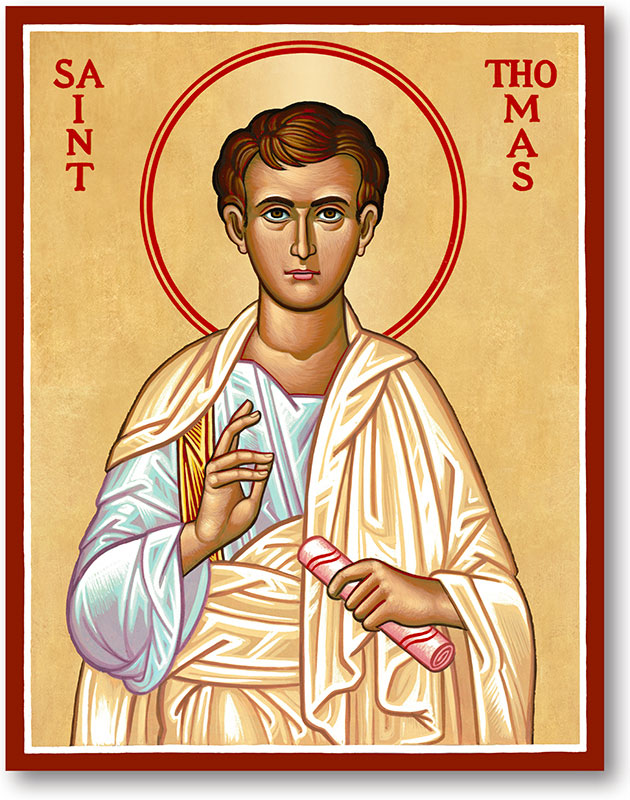
Virtuous Thomas

July 14, 2020

Doubting Thomas — That is how the apostle is remembered since he said, “Unless I see the mark of the nails in his hands and put my finger into the nailmarks and put my hand into his side, I will not believe.” Upon seeing Jesus alive he professed, “My Lord and my God,” but the ignoble nickname endures. St. Thomas has just four quotes in the gospels, all of them found in John; his two other quotes reveal more of his character.

After Lazarus had died, Jesus said, “Let us go back to Judea,” and the disciples objected, “Rabbi, the Jews were just trying to stone you and you want to go back there?” When Jesus insists on going, Thomas says to his fellow disciples, “Let us also go to die with him.” Then later, Jesus says at the Last Supper, “Where I am going you know the way.” And Thomas relies, “Master, we do not know where you are going; how can we know the way?

From his four quotes we glimpse Thomas’ weakness and his strengths. He should have believed his friends’ testimony that they had indeed seen and touched and spoken with Jesus resurrected (especially after having witnessed Lazarus risen from the dead) but Thomas was lacking in trust. Yet at the same time, Thomas possesses great loyalty and courage.

Where is Thomas one week after Easter Sunday? The disciples are gathered in the upper room, hiding behind locked doors for fear of those who murdered Jesus, and Thomas is right there with them. He could have chosen to retreat to someplace safer but he is loyal and brave and these virtues lead him to encounter the risen Christ.

We typically focus on our faults and flaws, on the vices and sins that hinder us. However we each possess virtues as well, areas where God has had success in us. Know and acknowledge these virtues, give thanks to God for them, and utilize them to grow. Pray for grace and use your strengths to lead you to perfect holiness like St. Thomas’ virtues led him to glory with Jesus Christ.

“As Nothing Compared with the Glory”

July 11, 2020

15th Sunday in Ordinary Time

Cardinal Timothy Dolan, the current archbishop of New York, tells a story from his first Lent as a newly ordained associate priest in a small Missouri parish. The president of their church’s men’s group told him unenthusiastically, “Father, you’re supposed to give us an evening of recollection in Lent.” So Fr. Tim, on fire to share the treasures of our Faith, worked earnestly for weeks preparing spiritual reflections about characters appearing in the Stations of the Cross. The big night for his men’s talk came. He opened the church doors early for all those who would be coming — and just two guys showed up. Fr. Tim gave his talk anyway, of course, but the young priest was crestfallen, crushed. When he returned to the rectory, his pastor said, “Oh, I should have told you those never work.” All of his devoted time and effort seemed wasted.

Twelve years later, the same Fr. Timothy Dolan was visiting a woman in the parish who was dying of Lou Gehrig’s disease. He was amazed at how tenderly her elderly husband was taking care of her, staying by her side and helping her with everything. As he was being walked to the door to leave, Father told the husband how much he admired his devotion to his wife. The man replied “Oh, Father, I’m just trying to be that Simon of Cyrene you talked about.” Father Dolan looked at him confused. “Remember that Lenten evening of recollection when you told us that just as Simon of Cyrene helped our Lord carry His cross, we do the same every time we help somebody else carry theirs? I’m just trying to help Ramona carry hers.

I first read about this story as a seminarian and it has stuck with me ever since. It’s a story of suffering. Granted, the young priest’s suffering was not so great as having a terminal disease or accompanying a dying loved one, but it was an experience of suffering whose value — though invisible at the time — was later wonderfully revealed. What Fr. Dolan had sown in painful labor and imagined to have been worthless toil proved beautifully precious and important. As one of the psalms say:

They go out, they go out, full of tears,
carrying seed for the sowing:
they come back, they come back, full of song,
carrying their [harvest] sheaves.

All suffering is painful, but any sort of suffering is worse when we think it has no meaning and all suffering is made easier when we know that it has worth. I speak of all this because of St. Paul’s words to the Romans in our second reading today: “I consider that the sufferings of this present time are as nothing compared with the glory to be revealed for us.” The sufferings of this present time are as nothing compared with the glory to be revealed for us.

Nobody likes suffering, but we all experience it in various ways regardless. We suffer from uncertainties and misunderstandings, from tribulations and persecutions, from worldly anxieties and temptations, but the saints tell us trials of suffering are rich soil which bear fruit manyfold for ourselves and others. St. Vincent de Paul declares, “If we only knew the precious treasure hidden in infirmities, we would receive them with the same joy with which we receive the greatest benefits, and we would bear them without ever complaining or showing signs of weariness.” In light of divine justice, St. Mary Magdalen de’Pazzi assures us, “You will be consoled according to the greatness of your sorrow and affliction; the greater the suffering, the greater will be the reward.” And St. Teresa of Avila encourages us, “Suffering is a great favor. Remember that everything soon comes to an end… and take courage. Think of how our gain is eternal.”

Sometimes God permits or sends sufferings for correction, that sinners may repent and be saved. But other times, sufferings are given in order to further purify, perfect, and glorify his friends. As St. Ignatius Loyola says, “If God sends you many sufferings, it is a sign that He has great plans for you and certainly wants to make you a saint.” St. Faustina Kowalska notes, “Suffering is a great grace; [for] through suffering the soul becomes like the Savior; in suffering love becomes crystallised; the greater the suffering, the purer the love.” And St. Augustine of Hippo observes truly, “God had one son on earth without sin, but never one without suffering.”

It was through the innocent suffering of his Passion that Jesus offered the sacrifice which converts hearts, forgives sins, and achieves Christ’s greatest earthly glory. Do you believe in the power of the Cross to save you? Then believe in the power of your own sufferings — lovingly endured and patiently offered up — to perfect you, save souls, and achieve your greatest glory.

False Paths to Paradise

July 9, 2020

Early in the Book of Genesis we read about a great flood wiping out humanity (sparing only Noah, his three sons, and their wives) and then about people building a great city and high tower until God confounds their efforts. These two inspired tales hold important lessons for every society in history, including our’s today.

When God saw how wicked the human race was he decided to pour down judgment on the earth and start over. So he told Noah, the best of men, to build an ark for his family to survive. Once the floodwaters had receded, “God blessed Noah and his sons and said to them: Be fertile and multiply and fill the earth.” This was to be Eden anew. But when Noah drank wine to excess and became drunk he was somehow violated by his son while laying naked inside his tent. The flood was meant to cleanse the earth of sin, but sin stowed away upon the ark.

Then, after detailing Noah’s descendants, Genesis tells how people said, “Come, let us build ourselves a city and a tower with its top in the sky, and so make a name for ourselves!” The Lord said, “If now, while they are one people and all have the same language, they have started to do this, nothing they presume to do will be out of their reach.” God confused their language so that they stopped building the city and scattered across the earth. Why did God react this way? That city is called Babel because God made them babblers but also likely in reference to ancient Babylon, the enemies of God’s people who had high towers called zigguratts on which they worshiped false gods and offered human sacrifices. God thwarts Babel to limit the evils they can accomplish.

The tales of the Great Flood and the Tower of Babel reflect two ineffective strategies for eradicating evil: purging all the wicked and uniting everyone apart from God. Our world seeks scapegoats, persons and groups to blame for our problems. “If only it were all so simple,” writes Aleksandr Solzhenitsyn. “If only there were evil people somewhere insidiously committing evil deeds, and it were necessary only to separate them from the rest of us and destroy them. But the line dividing good and evil cuts through the heart of every human being. And who is willing to destroy a piece of his own heart?” Our world also clamors for greater unity in one leader or party, nation or race, economic system or secular ideology. We must not ignore politics, realizing that a movement detached from God and sufficiently empowered will lead people to physical and spiritual deaths.

God’s desire is to unite all peoples in Christ, undoing Babel with Pentecost. The Church, Christ in his members, is sent to save our world through conversion rather than destruction “for God did not send his Son into the world to condemn the world but that the world might be saved through him.” Sin and sinners must be opposed but not without the love which we ourselves have received as sinners reconciled to God. Take courage today by recalling the conversions of Saul and the Romans Empire, Christianity’s early enemies – by grace and virtue the Church can win over even her worst persecutors.

“Take My Yoke (Instead)”

July 5, 2020

14th Sunday in Ordinary Time

“Take my yoke upon you and learn from me…
For my yoke is easy, and my burden light.”

What is Jesus telling us? For starters, what’s a yoke? A yoke is made of wood or metal and lays around the necks or shoulders of beasts of burden in order to pull something behind them, such as a plow or a wagon. Though there exists single yokes for animals working alone, yokes are typically designed for pairs of animals to work side-by-side, together. A wise farmer might pair a mature animal with a less experienced animal to help guide and train the junior one. Looking down from above, a yoke that connects two animals and the attached tongue beam connected to the implement behind them bears a likeness to the Cross.

“Take my yoke upon you and learn from me…
I am meek and humble of heart.”

Jesus criticized the proud and learned Pharisees for (in his words) tying up heavy burdens hard to carry and laying them on people’s shoulders without lifting a finger to help them. Do not imagine that Jesus is asking you to bear a yoke by yourself. Instead, Jesus asks us to share his yoke with him, to share in his labors and learn from his example.

“I give praise to you, Father, Lord of heaven and earth,
for although you have hidden these things
from the wise and the learned
you have revealed them to little ones.”

Jesus’ invitation to bear his yoke will seem unattractive to us if we mistakenly imagine ourselves being presently unyoked, totally free and unencumbered. But no one’s neck or shoulders are unyoked — everyone bears a burden. Some are yoked to serious sins. As St. Paul says, those who sin are slaves to sin. Other people yoke themselves by trying to do lots of good things which the Lord is not asking of them and they find it overwhelming. Both of these yokes are heavy and hard and chafe against us because they are not God’s will for us. Is the yoke you now carry Jesus’ yoke for you or one of your own fashioning? Perhaps bring that question to prayer to find relief.

“Come to me, all you who labor and are burdened,
and I will give you rest.
Take my yoke upon you and learn from me…
and you will find rest for yourselves.
For my yoke is easy, and my burden light.”

When animals’ shoulders are yoked together as a team, their work is the same. They plow through the same field or walk along the same road. Jesus wants you, wherever you are, to share in his labors. Jesus desires you to work alongside him with your family, with your friends, at your job, in all that you do. Ask the Lord to put you to salvific use, then be open and see what opportunities and encounters he sets before you. Ask Jesus that you may share in his works.

When two animals’ necks are yoked, facing forward together, their perspectives are the same. Jesus wants us, wherever we are, to share perspective, his outlook. To look up, and see the Father as Jesus sees him. To look out, and see other people and the world as he sees them. To look within, and see ourselves as Jesus sees us. “No one knows the Father except the Son and anyone to whom the Son wishes to reveal him.” And no one sees you and the rest of humanity more clearly and truly than Jesus Christ—and he loves us. Ask Jesus that you may share his sight.

So in conclusion, if you labor and feel burdened, go to Jesus and he will give you rest. Wear his yoke and learn from him, he’s a meek and humble partner. And you will find rest for yourself, for his yoke is easier and his burden is lighter.