Archive for August, 2020

Your Chosen Cross

August 30, 2020

22nd Sunday in Ordinary Time

In last Sunday’s gospel, Simon Peter was inspired to declare of Jesus, ‘you are the Messiah, you are the Christ,‘ and Jesus affirmed that it was true. Then, immediately following in Matthew’s Gospel, Jesus begins to show his disciples that he must go to Jerusalem and suffer greatly from the Jewish religious leaders, be killed, and on the third day be raised. Peter is scandalized by this news. The Messiah is supposed to be our triumphant king! How could the Christ suffer and be killed? Peter has seen Jesus’ powers; like curing the sick, casting out demons, multiplying loaves and fish. The Lord doesn’t have to let anyone get the better of him. Peter took Jesus aside and began to rebuke him, “God forbid, Lord! No such thing shall ever happen to you.” Peter presumes that he knows better than the Lord. Jesus turns and says to Peter, “Get behind me, Satan!” (“Satan” is the Hebrew word for “adversary.”) You are [being] an obstacle to me. You are thinking not as God does, but as human beings do.

God the Father did not prepare an easy life for his beloved Son. That’s what Peter had hoped for, a smooth and easy path to glory. Jesus’ life was marked by joy and sadness, struggles and sacrifice, death and resurrection. Christ’s was not an easy life but a great and glorious life, and Jesus calls you and I to follow him. Jesus says to his disciples, “whoever wishes to save his life (from every trial, hardship, and sacrifice) will lose it, but whoever loses his life for my sake (whoever devotes himself in love and service for me) will find it. Whoever wishes to come after me must deny himself, take up his cross, and follow me.” This call included Peter. Notice how Jesus in correcting Peter does not say to him “Depart from me, you accursed,” but rather “Get behind me”; in other words, “Follow me.

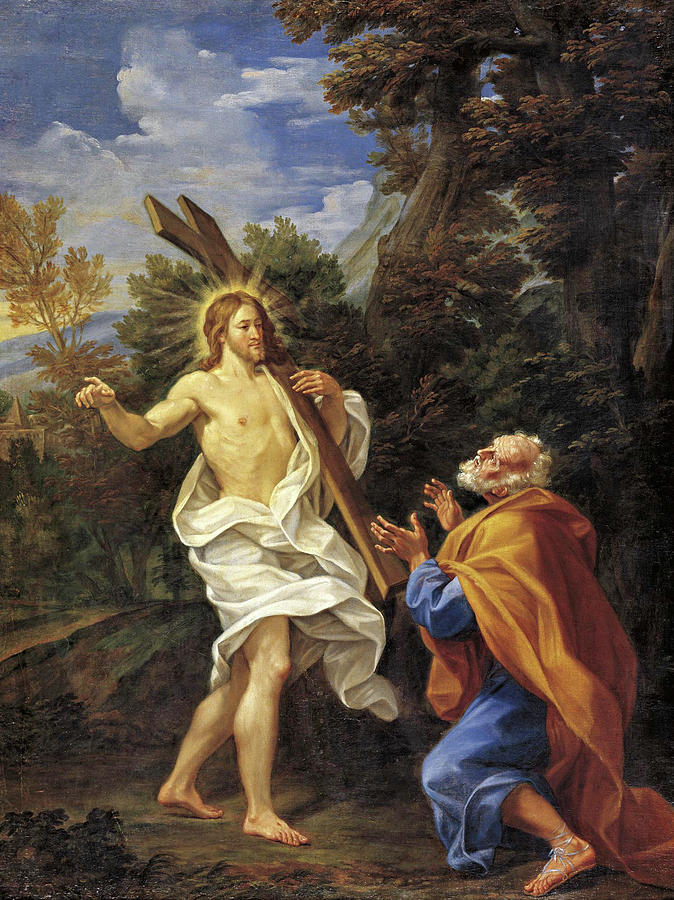
In the New Testament, we see that Simon Peter was not perfect. Both before and after Jesus’ resurrection, Peter made mistakes. Yet Peter’s faith in Jesus Christ was a foundation the Lord could build upon. And through a lifetime of providential trials, Simon Peter grew more and more into Christ’s likeness. Peter became the first pope, the first bishop of Rome, and while there, in 64 A.D., the Roman Emperor Nero unleashed a severe persecution of Christians, scapegoating the Church for a six-day fire that devastated Rome in July of that year. One tradition says that Peter, seeing the danger, reasoned that it would be better to flee the persecution so he could continue to lead the Church. However, on his way out of the city, Peter had a vision of Jesus walking in the opposite direction. Peter asked, “Lord, where are you going?” (“Domine, quo vadis,” in Latin.) “I am going to Rome to be crucified again,” Jesus replied.

This story comes to us from a late second century text and may or may not be pious legend, but what follows is very firmly known. St. Peter was arrested and condemned to die by crucifixion at Rome. However, Peter did not consider himself worthy to die in the very same manner as our Lord, so he made an unusual request. He asked to be crucified upside down, with his feet toward Heaven and his head toward the earth, and this is what the soldiers did. Peter died, his body was taken down from his cross, and Christians buried him in a grave very close-by. That place, a Roman hill, bears the same name now as it did then: Vatican Hill. The Emperor Constantine built a church over the place in the fourth century, and an even more magnificent St. Peter’s Basilica was built over the same site in the 1500’s and stands there to this day.

In the mid-twentieth century, archaeologists uncovered and forensic scientists studied ancient bones from below St. Peter’s, found some sixty feet directly below the main altar. Analysis indicates these bones came from a man between sixty and seventy years old, about five foot seven inches tall; and possessing a robust frame, as we might expect a fisherman to have. These bones were formerly wrapped in a very expensive cloth comprised of gold and purple threads in the pattern of an ancient Roman weave. The skeleton is largely complete but the feet are missing. If the Roman soldiers had no respect for Peter’s remains, it’s easy to imagine them using a sword to hack down his body from the cross, leaving his feet behind, nailed high on the wood. Jesus once declared, “You are Peter and upon this Rock I will build my Church.” It appears that Jesus has not only fulfilled his words spiritually, through St. Peter’s faithful life, but has literally built his Church over St. Peter’s bones as well. This is what Jesus did and achieved with a man formerly so flawed and fickle as St. Peter. The Lord would do great things through the transformative trials of our lives as well.

Once upon a time, one night, a Christian had a dream. They were carrying a cross, representing all of their burdens, temptations, and trials, and approached Jesus standing beside a large warehouse. The Christian said, “Lord, my cross is hard to carry. May I exchange it for another?” Jesus invited them inside the warehouse containing millions of crosses of different styles, materials, and sizes. Walking the aisles, the Christian sees an attractive, short cross with straight edges and flat sides made of pure gold. Gold is extremely heavy, about ten times denser than brick, so the Christian was not strong enough to lift it up. Going further on, there was a beautiful, tall and thin cross made entirely of diamonds. Now diamonds are very hard; they are sometimes employed at the tips of drill bits because they are harder than pretty much anything else. The Christian could lift this cross, but it poked and gnawed and cut into one’s palms and shoulder, so it was set down again. Circling back, the Christian saw a wooden cross of head-height leaning against the wall. Its sides were uneven but wear had smoothed them. It was not light, but not too heavy to carry. It was a simple cross, but a noble one. The Christian returned to Jesus and said, “This is the cross I’d like to carry.” And Jesus replied, “That’s the cross you came here with.

Jesus says, “Whoever wishes to come after me must deny himself, take up his cross, and follow me.”

Great Gifts Gained

August 16, 2020

20th Sunday in Ordinary Time

Jesus withdraws to the region of Tyre and Sidon. Sidon and Tyre were two pagan cities on the Mediterranean seacoast. Both cities still exist today, about twenty-five and fifty miles south of Beirut, in Lebanon. In today’s gospel, a local, non-Jewish, Canaanite woman, a gentile, finds Jesus and wins a grace from him.

This gospel story from Matthew is also told in Mark. Combining these two accounts, we learn that Jesus was staying in a house there and wanted nobody to know about it, yet he could not escape notice. This woman heard about Jesus, and came to him pleading. She cries out, “Have pity on me, Lord, Son of David! My daughter is tormented by a demon.” But surprisingly, Jesus does not say a word in answer to her. His disciples even complain to Jesus: “Send her away, for she keeps calling out after us.” Jesus replies, “I was sent only to the lost sheep of the house of Israel.” (That is, the Jews.) The woman comes, kneeling at his feet, and says, “Lord, help me.” He tells her: “Let the children be fed first. For it is not right to take the food of the children and throw it to the little dogs.” What’s going on with this unexpected reaction from Jesus?

Previously in Matthew’s Gospel, another gentile, a Roman centurion, a commander of soldiers, asked Jesus to heal his servant who was lying at home paralyzed and suffering dreadfully. Luke records that at the time some Jewish elders were urging Jesus to save the man’s dying servant, saying, “He deserves to have you do this for him, for he loves our nation and he built the synagogue for us.” Jesus said, “I will come and cure him.” But the centurion replied, “Lord, I am not worthy to have you enter under my roof; only say the word and my servant will be healed.” When Jesus heard this he was amazed at him and, turning, said to the crowd following him, “I tell you, not even in Israel have I found such faith.” From this we can gather that the centurion was more than just an unbelieving pagan, but a God-fearer; that is to say, he was a gentile who believed in and worshiped the God of Israel yet had not gone all the way over to becoming a Jew himself, enduring circumcision and keeping all the rules of the Law of Moses. The centurion showed great faith in both Yahweh and Jesus as the Christ. Perhaps Jesus’ challenging reply to the pagan woman was to elicit from her a greater display of faith in both God and Jesus as well.

In Matthew, a couple of chapters after healing the centurion’s servant, Jesus sends out the twelve apostles on mission to proclaim the Kingdom of God, having first instructed them: “Do not go into pagan territory or enter a Samaritan town. Go rather to the lost sheep of the house of Israel.” That’s just like he tells the woman, a few chapters later, in our gospel. Maybe Jesus is trying to keep a low profile during his stay near Tyre and Sidon and reluctant to work any miracles there because the time is not yet ripe for the pagans to be evangelized. “Let the children be fed first,” he tells the woman, signaling that her people will be fed later. This is the mission to the gentiles St. Paul speaks of in today’s second reading. Yet the woman wins Jesus over and he grants the miracle she seeks.

How does she do it? Through her faith, hope, and love, her asking and persistence, and her great humility. She has faith, calling him “Son of David,” a title for the Messiah. She hopes that he can heal and free her beloved daughter, the love for whom has led her to this encounter. She asks and keeps asking, until her humility wins the day. When Jesus tells her, “It is not right to take the food of the children and throw it to the little dogs,” she doesn’t hurl an insult at him, or storm off enraged. She replies, “Please, Lord, for even the dogs eat the scraps that fall from the table of their masters.” The eternal, divine, Son of God, who so had incredibly humbled himself by becoming human as an obedient suffering servant, admires this reply. She wins the dialogue by humbly speaking the truth. As a result of her faith, hope, and love, persistent asking, and humility, Jesus says to her, “O woman, great is your faith! Let it be done for you as you wish.” And the woman’s daughter was healed from that hour. Upon her return home she finds her daughter well, lying in bed, and the demon gone.

This Canaanite’s story provides a lesson for us in our life of prayer. When you wish to approach Jesus to ask for some grace imitate the virtues we see in her. Perhaps there is also a lesson in her example for how we dialogue with others, especially about contentious topics; at home in daily life, or in society during this election year. And here is a final reflection for our benefit. Imagine how joyful and grateful the woman must have been when she came home and found her daughter cured. She knew this was because of Jesus. It was a foretaste of the gifts and graces which were to come to the gentile nations. And the Church of Christ has since spanned across the world to us here and now, few of whom have much biological connection to the Jews. Most of us here have been Catholic for as long as we can remember. It’s been a given for us. But here’s a question for a car ride discussion or to bring to your prayer: If you couldn’t be Catholic anymore, and further, if you couldn’t be a Christian anymore, what things would you miss the most?

The gifts of Jesus which come to my mind are having a life with meaning, purpose, and hope. I’m not seeking to hasten my death, but I do not regard dying with horror. I posses a Sacred Tradition of moral truths which is not merely my opinion or the changing opinion of culture, but God’s teachings for how to live. And I have, in this era without heroes, a Communion of Saints on earth and in Heaven, to inspire and support me. Consider, discuss, and pray about this question yourself. Give thanks and rejoice that these great gifts are now yours through Jesus Christ and his Church.

The Saint Lawrence

August 10, 2020

The Feast of St. Lawrence

The Great Lakes (Superior, Michigan, Huron, Erie, and Ontario) comprise the largest body of freshwater in the world. All told, these five lakes contain one-fifth of all the freshwater on the surface of the earth, about six quadrillion gallons (that’s six million billions) a figure not fully fathomable for the human mind. Like all moving waters, these flow downhill from high to low. Near Buffalo, New York, between Lake Erie and Lake Ontario, they descend 167 feet with a mighty rushing sound at Niagara Falls. Leaving Lake Ontario, they become a river that flows past a “royal mountain” and city of the same name: Montréal. The name of this river in which whales swim, which empties into the world-spanning ocean, is the Saint Lawrence River.

The river is named for St. Lawrence, one of the Seven Deacons of Rome under St. Pope Sixtus II. (Both of these saints’ names are invoked at Mass in Eucharistic Prayer I.) In 258 A.D., the Roman Emperor Valerian issued an edict commanding that all bishops, priests, and deacons should immediately be put to death. The pope and many others were martyred, including St. Lawrence on his present feast day, August 10th. Back then, deacons managed the Church’s funds and charitable efforts. Though the tale is uncertain, St. Ambrose of Milan writes that when his persecutors demanded that Archdeacon Lawrence handover the Church’s treasures, he showed them the poor and the sick. This same source also recounts how during his slow death upon a gridiron over a fire St. Lawrence quipped, “I am cooked on that side; turn me over…

God’s graces are like The Great Lakes; vast, life-giving waters beyond our full comprehension. They flow down from above into a channel open to receive them, like the Saint Lawrence. Through such rivers, waters pour forth across the world in the sight of the Royal Mountain and the City of God to the delight of the angels. Let us imitate St. Lawrence and God’s other saints who by humble willingness became mighty streams of His goodness and glory.


Praying Like Jesus

August 9, 2020

19th Sunday in Ordinary Time

From the start to the finish of his public ministry, Jesus makes time for private, personal prayer. We see this throughout the gospels. In the first chapter of Mark’s Gospel, the morning after Jesus cured Simon Peter’s mother-in-law and others in the town of Capernaum, it says, “Rising very early before dawn, (Jesus) left and went off to a deserted place, where he prayed.” Then, before calling certain men from among his many followers to form his key inner circle, Luke’s Gospel notes: “(Jesus) departed to the mountain to pray, and he spent the night in prayer to God. When day came, he called his disciples to himself, and from them he chose Twelve, whom he also named apostles.” And Matthew’s Gospel records how, on the night before he died, “Jesus came with (eleven of those Apostles) to a place called Gethsemane, and he said to his apostles, “Sit here while I go over there and pray.” He took along Peter, James, and John, and began to feel sorrow and distress. Then he said to them, “My soul is sorrowful even to death. Remain here and keep watch with me.” He advanced a little and fell prostrate in prayer, saying, “My Father, if it is possible, let this cup pass from me; yet, not as I will, but as you will.” Today’s gospel begins with another example of Jesus’ commitment to private, personal prayer.

After Jesus had fed the crowds with the loaves and the fishes (which we heard about last Sunday) he made the apostles get into a boat and depart before him for the other side of the Sea of Galilee. Then Jesus went up on the mountain by himself to pray. When it was evening, he was there alone. Like the Prophet Elijah in our first reading, who retreated to a mountain to encounter God, Jesus seeks out a quiet and deserted place to pray. Though the wind, the earthquake, and the fire outside of Elijah’s cave all reflect something of God’s glory, chasing after these would be a distraction. God’s presence is revealed to Elijah as “a tiny whispering sound.” Do you put yourself in a place, do you give yourself enough time and space and silence, to encounter within you God’s tiny whispering sound through prayer? If it was very important for Jesus Christ the Son of God to devote focused time for prayer (and he did) how much moreso for you and me?

What was on Jesus’ mind and heart the night he prayed in today’s gospel? What did Jesus take to prayer? Recall that John the Baptist had recently been murdered. John’s disciples, after burying his body, went and told Jesus. When Jesus hears this news, he withdraws in a boat for a deserted place with the apostles where he finds thousands awaiting him. He heals them and teaches them and feeds them all. Then he dismisses the crowds, sends the apostles off ahead of him, and goes up the mountain to pray alone.

Was Jesus feeling sad that evening? Our Blessed Lord once said, “Blessed are they who mourn.” And he himself wept at the tomb of Lazarus. Jesus mourning at the death of John the Baptist, his friend, relative, and ally, is easy to imagine. Might Jesus have felt angry that night? Anger is the natural human reaction to a perceived injustice, and what happened to John was gravely wrong, a great injustice. Anger, like all human emotion, can be turned toward good or evil. For instance, zeal for his Father’s house moved Jesus to make a righteous mess of a marketplace that was hindering peoples’ worship and profaning the temple in Jerusalem. There are a number a divinely-inspired prayers among the Psalms which give voice to human sorrows, frustrations, and anxieties.

Did Jesus feel stress and strain about the steps of the path ahead of him? When people saw Jesus multiply those loaves and fishes, John’s Gospel tells us the crowd was going to carry him off to make him King of Israel, the Messiah of their dreams. But that would have derailed Christ’s redemptive mission as the Lamb of God, so Jesus did not permit his followers to do so. Jesus’ enemies, of course, presented obstacles as well. How was Jesus to reach and drink the cup at his mission’s end? In the Garden of Gethsemane, we see Jesus under great stress and strain even speak to his Father about the course of the Father’s plan. In prayer, Jesus could bring to God his Father, whatever he thought or felt.

Did Jesus pray for other people? In our second reading, St. Paul reveals a “great sorrow and constant anguish” in his heart. He swears by the Holy Spirit that he could wish himself “cut off from Christ,” could wish himself condemned to Hell, if that would somehow lead his people, the Jews, to Heaven. Do you think Paul prayed with that sorrow and anguish for others’ salvation? If Paul prays with such intense feeling, how much moreso does Jesus pray for the salvation of others from his Sacred Heart?

Jesus Christ is not only our Lord and Savior, he’s the best example for our Christian life. We must learn from him and imitate him. Here are three things Jesus does that we all should do likewise. First, Jesus makes time for private, personal prayer. Whether early morning or late at night, he created time for communing with the God who loves and leads him. Turn off the car radio, the TV, the devices, to make some silence to hear within you the “tiny whispering sound” of God. Second, Jesus prays with everything on his mind and heart. No thought or feeling need be hidden from the God who knows and loves you better than you do yourself. The Holy Trinity and our other heavenly friends want us to share these things, so that we may grow close together in their likeness and friendship. And third, Jesus prays for himself and others. Jesus says, “You shall love your neighbor as yourself.” Therefore, if you only pray for yourself, or only pray for other people, something is out of balance in your prayer. In conclusion, make time for personal private prayer. Pray about anything on your mind and heart. And pray for yourself and others. Make this sacrifice, give yourself this gift, of communing in prayer with the Lord who loves and leads you.

The Disciples’ Burdens

August 2, 2020

18th Sunday in Ordinary Time

Only one miracle (besides the Resurrection) appears in all four Gospels: that’s today miracle – Jesus’ multiplication of five loaves of bread and two fish into enough food to feed more than five thousand people. Bringing all four of these Gospel accounts together provides us with a detailed picture of that day, one of the most amazing days in Jesus’ ministry. However, for the apostles, much of that day probably felt far from awesome.

First, the terrible news had recently arrived that John the Baptist had been murdered by the government, his neck severed by a soldier at Herod’s command. John the Baptist was Jesus’ beloved relative. At least two of the apostles had once been John’s own disciples. They all held the Baptizer in high esteem. So the unjust killing of this righteous man was shocking, and the senseless death of their friend was sorrowful.

Another strain on them that day was their shared fatigue. The apostles had just come back from the villages Jesus had sent them out to in missionary pairs to preach, and heal, and cast out evil spirits. Upon their return to Jesus, Mark’s Gospel tells us that “people were coming and going in such great numbers that they had no opportunity even to eat.” So Jesus says to his apostles, “Come away by yourselves to a deserted place and rest a while.” The apostles might have thought to themselves, “Finally, a break.

Jesus and his apostles embark in the boat by themselves toward a deserted place called Bethsaida on the other side of the Sea of Galilee. But other people see them leaving, word gets around, and many come to know about it. They hasten there on foot from all the towns and arrive at the place even before the boat did. So when Jesus and the apostles disembarked, a vast crowd of thousands was already there waiting for them. Imagine the apostles’ mixed emotions; “Great, another massive crowd. I guess our retreat is over.” But Jesus beholds the crowd and his heart is moved with pity for them, for they are like sheep without a shepherd, unsettled and unled. Jesus cures their sick and proceeds to teach them many things. So maybe the apostles got a little break that afternoon after all.

When evening came, the apostles approached Jesus to say, “This is a deserted place and it is already late; dismiss the crowds so that they can go to the villages and buy food for themselves.” Jesus says to them, “There is no need for them to go away; give them some food yourselves.” They respond, “Five loaves and two fish are all we have here.” They’re already mourning an unexpected, painful loss. They’re burnt-out from their recent labors. And now, Jesus seems to expect the impossible from them. Can you relate to that today?

Of course, we’ve heard the gospel story and know how it ends. You and I now already know what happens next. Taking the five loaves and two two fish, and looking up to his Father in Heaven, Jesus says the blessing, breaks the loaves, and gives them to the disciples, who in turn (at Jesus’ command) give them to the crowds. They all eat an are satisfied and finish with more than they began. Jesus takes what his disciples offer him (as meager as it is), gives each of them an important role to lay, and works something amazing through them.

Brothers and sisters, what will separate us from the love of Christ? Will anguish, or distress, or persecution, or famine, or nakedness, or peril, or the sword? Do these things separate us from the love of Christ? What of pandemics, or quarantines, or closures, or face coverings, or financial troubles, or personal failures? Will these things separate us from the love of Christ? No, in all these things we can conquer overwhelmingly through him who loves us. For neither death, nor life, nor spirits, nor politicians, nor time, nor space, nor any other created thing will be able to separate us from the love of God in Christ Jesus our Lord. These are hard days, and we might be tired and discouraged. But do not doubt the good you are doing, nor the good that you will do, because Jesus Christ is with you.