Archive for January, 2021

When Demons Speak

January 31, 2021

4th Sunday in Ordinary Time

“The Devil Tempting a Young Woman” by André Jacques Victor Orsel, 1832.

Eve in the Garden of Eden, Jesus in the synagogue at Capernaum, and St. Paul on the roads of Greece each encountered demons speaking. The words of these rebellious, fallen angels are dangerous because they cleverly combine facts and falsehoods to mislead us toward sin and division. Jesus called the demonic warlord, Satan, the Devil, “a murderer from the beginning… a liar and the father of lies,” and the Book of Revelation identifies him as “the ancient serpent… who deceived the whole world.

Satan was the serpent who approached Eve and asked, “Did God really say, ‘You shall not eat from any of the trees in the garden’?” The woman answered the serpent: “We may eat of the fruit of the trees in the garden; it is only about the fruit of the tree in the middle of the garden that God said, ‘You shall not eat it or even touch it, or else you will die.’” But the serpent said to the woman: “You certainly will not die! God knows well that when you eat of it your eyes will be opened and you will be like gods who know good and evil.

The tree’s attractive fruit looked useful for nourishment and wisdom, so Eve took and ate it; and she gave some to her husband who was with her, and Adam ate it too. It’s true that they did not die in that instant and they did gain new insights into evil and its absence, but by this act of mistrust and disobedience toward God the grace and harmony of original holiness died within them. Adam and Eve were now separated from God, divided from each other, and doomed to suffer and someday die. The devil’s half-truths led them to this.

Another demon was inside of a man at the synagogue in Capernaum as Jesus taught there in today’s gospel. The unclean spirit cried out through the man in front of everyone, “What have you to do with us, Jesus of Nazareth? Have you come to destroy us? I know who you are – the Holy One of God!” It’s true that Jesus is indeed the “Holy One of God,” but what effect could hearing the demon’s other words have on the townspeople? “What have you to do with us… Have you come to destroy us?” The demon insinuates that Jesus is there to condemn and destroy, that all sinners should fear God’s Holy One and flee or fight the Christ who has come to save them. Jesus rebuked the demon, saying, “Quiet! Come out of him!” The unclean spirit could not resist Jesus’ command, and after a convulsion and a loud cry the man was freed. Demons are untrustworthy spokesmen to proclaim Christ and his gospel.

About twenty years later, while St. Paul was doing missionary work in Greece, he and his companions met a slave girl who had a demon. The demon would pronounce oracles through her, generating large profits for her owners. (Demons reportedly do not know the future, but using their very high intelligence and powers of observation they can make keen guesses.) The girl began to follow Paul and his companions, shouting: “These people are slaves of the Most High God, who proclaim to you a way of salvation!” She did this for many days and Paul became annoyed. He turned and said to the demon, “I command you in the name of Jesus Christ to come out of her.” And the demon left her at that moment.

So what was wrong with what the demon was saying through the girl? In addition to yelling the message at inappropriate times, it contained a subtle, fatal flaw which – if uncorrected – could undermine the saving work that Paul was doing: “These people are slaves of the Most High God, who proclaim to you a way of salvation.” If the Good News of Jesus Christ were merely a way of salvation, then you could take him or leave him, and opt instead to choose some other saving path. But as St. Peter preached, “There is no salvation through anyone else, nor is there any other name under heaven given to the human race by which we are to be saved.

As it was in the beginning and in the days of Jesus and his apostles, demons are still in our world today. Your baptism into Christ gives you great personal protection against them. You belong to Christ, so you should not be afraid, but I want you to be aware that the demons continue sowing seeds of sin and division in our time. Where are the demons active today? Where do we see the most harmful confusions and divisions? In so many teachings of our Catholic Faith the truth is a “both/and,” while the demonic errors and divisions of our time stem from false “either/or’s” and half-truths.

The demons either say that you need not change at all because you are loved by God, or that God will not love you until you become perfect. The truth is that you are loved by God as you are and called to repent and grow. The demons either tell you that God does not desire your happiness, or that you are entitled to avoid all suffering. The truth is God wills your greatest happiness and because of this he will lead you through trials. In this world, the demons encourage us to condemn one political party or politician and ignore the faults of the other, when the truth is both are flawed.

The demons don’t want you to see and promote full truths: that pregnant women need to be helped and unborn children must be protected; that immigrants should be welcomed and the rule of law should be respected; that all people are made for love, for intimacy with others, and sexual relations are meant only for holy matrimony; that there exists a God-given right to private property and a moral obligation to share with the needy; that we should live freely and use our freedom to honor God while safeguarding the good of others. Other examples are abundant around us.

Where there’s smoke there’s fire, and where truths are widely twisted and truncated demons have been at work with their old half-truth tricks. So do not conform to the demon-fueled factionalism of this world, but be transformed by the renewal of your mind in the teachings of Jesus Christ and his Holy Catholic Church, that you may know and do the complete will of God, what is good and pleasing and perfect.


You are Called to Read the Gospels

January 24, 2021

Word of God Sunday, The 3rd Sunday in Ordinary Time

When I was about thirteen years old, I remember once being in my living room thinking about death, until nature called, and I headed toward the bathroom on the other side of the house. Our entryway was the crossroads of my childhood home, with doorways and stairs leading to different rooms and levels. This would be the setting for a crossroads moment of my life. For as I set foot there I pictured myself standing before God’s judgement seat after my death. The Lord sat on a white stone throne. He didn’t look angry (that would have scared me off) but he seemed disappointed and frustrated, like I had promised to meet him somewhere and never showed up. And he asked me, “Why didn’t you live your life like I wanted you to live it?

I knew what he meant. I was a cradle-Catholic and not a terrible kid but I also wasn’t much of a disciple of Jesus Christ either. I still needed to use the bathroom but I knew this question would be wrong to ignore. So I stayed there, though pacing a bit, thinking with urgency what would I say, what could I say, in this situation? You only get one Last Judgment. So I replied, “Well God, I wasn’t even sure that you were really real. How could I entirely commit my one life to you while being so uncertain? How could you expect me to stand out on a cliff-ledge without me being sure that it would hold up my weight?

Once I had made my case, he promptly replied, “Did you ever really try to find out? Did you even read my book?” I laughed at that pithy line and said something slightly stronger than “Oh crud” because the Lord had called me out. If I were really looking for the truth, if I were truly seeking after him, I would be searching more seriously than I was. Soon after, I resolved to pray every day and read the whole Bible. I remember sneaking around my mother to fetch our big, family Bible from our dining room cabinet and quietly take it back to my room. I didn’t want her asking me, “What are you doing with that?” because then I’d have say, “Well, Mom, I may have had a vision and I need to read the Bible now.

I started regularly praying before bed and reading the Scriptures fifteen minutes a night, starting with the Book of Genesis. If I happened to miss one night, I’d read for thirty minutes the next. In this way I learned a lot more about the important and famous biblical characters and events I had previously only heard of. I saw the consistency of human nature throughout history and humanity’s need for a savior. I recognized Jesus Christ prefigured within the Old Testament, such as in the lambs of sacrifice at Passover and at the Temple. Somewhere in the midst of reading the books of the prophets I realized I didn’t want to risk dying without ever having read the gospels, so I skipped ahead. And reading the gospels changed my life.

The Sermon on the Mount in Matthew’s Gospel challenged me with a beautiful, new way of living: for instance, trusting in God rather than living in fear, generosity in giving rather than clinging to my every possession, and forgiveness with goodwill towards my enemies rather than nurturing poisonous hatreds. I did not wish to wind up someday on my deathbed without having given these teachings a try, so I did, and experienced their benefits. And Jesus Christ in the gospels inviting the fishermen to follow him opened me up to answering his calling for my life.

I recount these stories this morning because of today’s feast. In September of 2019, Pope Francis decreed the 3rd Sunday of Ordinary Time to be henceforth celebrated as “The Sunday of the Word of God”; a day “to be devoted to the celebration, study, and dissemination of the word of God.” Pope Francis wrote:

“As Christians, we are one people, making our pilgrim way through history, sustained by the Lord, present in our midst, who speaks to us and nourishes us. A day devoted to the Bible should not be seen as a yearly event but rather a year-long event, for we urgently need to grow in our knowledge and love of the Scriptures and of the Risen Lord, who continues to speak his word and to break bread in the community of believers. For this reason, we need to develop a closer relationship with Sacred Scripture; otherwise, our hearts will remain cold and our eyes shut, inflicted as we are by so many forms of blindness.”

The fifth century Doctor of the Church, St. Jerome once said, “Ignorance of Scripture is ignorance of Christ.” Since no books of Scripture reveal Jesus Christ better than the gospels of Matthew, Mark, Luke, and John, today I am urging you to begin reading these, the most important books within the most important book in history.

Have you ever read an entire gospel? If not, why not? There are many easily readable, modern translations these days, without any “thee’s” and “thou’s.” You can even read or listen to the Bible for free over the internet (though I would recommend choosing a Catholic edition with all seventy-three books.)

Let none of us claim that we don’t have time to read the gospels. Based on their word counts and a typical reading speed, Mark (the shortest gospel) can be read in a little more than an hour, and Luke (the longest gospel) can be read in less than two. To read all four gospels requires just slightly more than six hours’ time. To put that in perspective, six hours is two NFL football games, or two Major League baseball games, or three NCAA or NBA basketball games. How many sporting events have we seen in our lives, and how many complete gospels have we read or listened to in comparison? Even before this pandemic, the average American—at home, not at work—spent seventeen-and-a-half hours a week on the internet. So it’s not a question of time, but a question of our priorities.

If you read for fifteen minutes a day, or fifteen minutes a night, you can complete Matthew’s Gospel in a week and can finish all four gospels in twenty-five days. Of course, if you pause to ponder and to pray it will take you longer, but that’s OK, even preferable. I hope you’ll accept this gospel challenge and invitation.

As an epilogue to my first story, when my younger self finally reached the Book of Revelation at the end of Sacred Scripture, I found something of a confirming sign. When God judges the living and the dead—all people on the last day, the Scripture says he sits upon a “great white throne.” When you reach your deathbed, or when you stand before God’s judgment seat, will you have read the gospels and been blessed by the experience in life? “I tell you, brothers and sisters, the time is running out.” “This is the time of fulfillment. … Repent, and believe in the gospel.” And part of believing in the gospel means devoting our time and attention to it.

Knowing God by Name

January 16, 2021

Second Sunday in Ordinary Time

Andrew found his brother Simon and told him, “We have found the Messiah! (We have found the Christ!)” Then he brought him to Jesus. Jesus looked at him and said, “You are Simon the son of John; you will be called Cephas” — which is translated Peter.

It is a very significant thing when God changes someone’s name. This only happened four times in Bible history. First, God renamed Abram, Abraham (meaning “the Father of Multitudes”) and renamed his wife Sarai, Sarah (or “Princess”). Later, God renamed their grandson Jacob, Israel (or “He who wrestles with God”). From him, God’s first adopted people would receive their name. And finally, Jesus changes Simon’s name. His name becomes Cephas in Aramaic, Petros in Greek, which both mean Rock” or “Stone.” Jesus says, “You are Peter, and upon this rock I will build my church, and the gates of Hell shall not prevail against it.

All four of these extremely important figures in salvation history received a name from God reflecting their true identity in his plan. Abraham would go on to have a multitude of descendants, many by blood and many more by faith, while St. Peter would go on to be a stable rock for Christ’s Church as her first pope. The names God chooses are revelatory, and this is true for God’s own names and titles as well.

When God revealed himself to Moses through the burning bush and commanded him to be a messenger to his people, Moses said to God, “if I go to the Israelites and say to them, ‘The God of your ancestors has sent me to you,’ and they ask me, ‘What is his name?’ what do I tell them?” In those days the early Israelites, surrounded as they were by polytheistic cultures, did not realize that there was only just one God. So if Moses were to come to the Israelites saying God had sent him, they might reply “which one?” When asked for his name, God replies to Moses: “I AM WHO AM. This is what you will tell the Israelites: I AM has sent me to you.” In Hebrew, these words “I AM” are pronounced “Yahweh,” which some have mispronounced as “Jehovah”.

What is revealed in this name, “I am who am”? Firstly, that God is personal. God is a Who, rather than a what. Secondly, unlike the false gods of the pagans, this God is real. Unlike those so-called gods, ‘I AM, so I have the power to save you.’ Thirdly, God is not merely another being that exists in the world, but the foundation of all existence. “I am who AM.” To exist is of God’s very essence. Fourth and finally, that God is mysterious. To say “I am who am” is something of a refusal to provide a name. ‘Who am I? I am who I am.‘ God’s perfect, infinite essence surpasses man’s imperfect and limited labels and concepts.

God spoke further to Moses in that encounter at the burning bush saying: “This is what you will say to the Israelites: The Lord, the God of your ancestors, the God of Abraham, the God of Isaac, and the God of Jacob, has sent me to you. This is my name forever; this is my title for all generations.” Here the Lord identifies himself in terms a communal relationship (‘I am the God of your ancestors’) and then by three individual relationships (‘I am the God of Abraham, the God of Isaac, and the God of Jacob’). This foreshadows what would be revealed to us through Jesus Christ; that God is an eternal Trinity, a communal relationship of divine three persons: God the Father, God the Son, and God the Holy Spirit.

God provides other true titles for himself in the Sacred Scriptures he inspired: He is Lord. He is Most-High. He is Almighty. I AM who heals. I AM who sanctifies. I AM who will provide. I AM who is there. Our banner, our shepherd, our righteousness, our peace. And ultimately, God reveals himself through his Incarnate Word, Jesus, whose name means: “Yahweh is salvation” or “Yahweh saves.”

What is the significance of sharing one’s name with another? To reveal your name to others allows them to know you better, it opens up a more personal relationship than one has with a stranger. Sharing your name permits others to honor your name or to defame it, and it allows them to call upon you.

In today’s first reading, the Lord repeatedly calls by name the young Samuel sleeping in the temple: “Samuel, Samuel!” When Samuel keeps running to his foster-father, the High Priest Eli, saying, “Here I am. You called me,” Eli realizes that the Lord is calling the boy. So Eli tells Samuel, “Go to sleep, and if you are called, reply, ‘Speak, Lord, for your servant is listening.’” When Samuel goes back to bed, the Lord comes and reveals his presence, calling out as before, and Samuel answers, “Speak, for your servant is listening.” This response led to a deeper relationship for Samuel with the Lord, and Samuel went on to become one of God’s great prophets.

God has revealed his name, his very self, to you. You know his name, you know him, and he calls you. The Lord declares through the Prophet Isaiah, “Fear not, for I have redeemed you; I have called you by name, you are mine.” Will you answer the Lord’s next calling for you; to prayer, to service, to sacrifice, to love? This week, when he calls you, even in the quiet of your conscience, answer him: “Speak, Lord, for your servant is listening. Here am I, Lord; I come to do your will.

Who Conquers the World?

January 9, 2021

The Baptism of the Lord

I have a friend, Kathy, a former parishioner of mine now living in Michigan, whom I often call to converse about upcoming Sunday readings. She’s quite knowledgeable about the Scriptures and our Faith and, even now as she endures cancer, delights to discuss them. Talking with her always makes my homilies better. When we chatted this week I shared my hope, frustration, and challenge in preaching compellingly about the Baptism of the Lord. Virtually everyone who will encounter my homily is already baptized, a baptism they do not remember – they were baptized so young that they can’t remember any time in their lives when they were unbaptized. Getting people to appreciate having been baptized is like trying to get them excited about having once been born; or like getting an American to appreciate living their whole lives in a country where freedoms of religion, speech, and representative government are taken for granted. I didn’t know what message I was going to preach when I spoke with Kathy, but she encouraged me that God would give me something and promised to pray for me. Today I’d like to share with you some threads from other interesting conversations I’ve had this week and in the end I promise to tie their lessons together.

On Monday evening, my fortieth birthday, I spoke with my life’s longest friend. Josh is nine days older than me, we were in school together all the way from pre-K through college, and he grew up into a dynamic Christian businessman. Josh remarked that he is struck and bewildered by how much New Year’s matters to people – it’s far less big a deal for him than it seems to be for others. I likewise have memories of being underwhelmed by New Year’s Eve ever since I was a kid. Even though the ball that drops over Times Square is now covered with high-tech shimmering lights, the sight of that sphere’s slow descent still remains a disappointment to behold. A new year is just a change in number on our calendars and forms, a number whose only significance comes in reference to Jesus Christ. Maybe people like it in the way some of us have enjoyed watching a car’s mileage rollover to 100,000 on the odometer. Maybe people just like any excuse to party. But I think New Year’s appeal in popular culture owes greatly to the idea of a new time beginning, the start of a new chapter in our lives. Lots of people make New Years resolutions, typically related to health. They’re hoping for change, hoping this year will be different, yet their resolutions typically fail quickly because our human nature, by itself, is so very weak.

Thursday morning I did spiritual direction through Facebook for another past parishioner and friend of mine. I met Stephanie at my first priestly assignment, helped her become a Catholic, and today she is her parish’s Coordinator of Religious Education and Director of Youth Ministry in Neillsville. Stephanie’s family has an annual tradition of watching “It’s a Wonderful Life” and this year she saw it twice. I asked her if she took away any new insights from that rich film and indeed she had. The first time George Bailey goes to Martini’s Bar it’s a calm and friendly establishment where people show concern about him. George quietly prays there, “Dear Father in Heaven… Show me the way,” leaves, meets Clarence, and returns to the bar again in a world where he was never born. The bar is called “Nick’s” now and like the rest of town it has become more crowded and less wholesome, rude and cruel. These scenes impressed on her anew how much one life well-lived can make an extraordinary difference to all the lives around it.

On Thursday afternoon I partook of spiritual direction myself through Zoom with Fr. Bill Dhein, the thoughtful Chancellor of our diocese who sometimes celebrates Masses here for us. Father and I were both drawn by the Spirit to this passage from today’s second reading from the 1st Letter of John:

“Whoever is begotten by God conquers the world.
And the victory that conquers the world is our faith.
Who indeed is the victor over the world
but the one who believes that Jesus is the Son of God?”

Who indeed conquers the world? If the rioters at the Capitol this week or the rioters from this summer had succeeded, if they had prevailed and conquered, would they find peace in this world? History suggests not. Violence and death would continue to accompany them. In today’s first reading, the Lord tells us through the Prophet Isaiah:

“My thoughts are not your thoughts,
nor are your ways my ways, says the Lord.
As high as the heavens are above the earth
so high are my ways above your ways
and my thoughts above your thoughts.”

Fr. Bill told me one of his admired spiritual heroes is St. Mother Teresa of Calcutta. She was in the world but not of the world, and in Jesus Christ she conquered the world through a holy power which transforms this world for the better. Today’s gospel says:

“[Jesus of Nazareth] was baptized in the Jordan by John.
On coming up out of the water he saw the heavens being torn open and the Spirit, like a dove, descending upon him.
And a voice came from the heavens,
‘You are my beloved Son; with you I am well pleased.’”

Remember, Christian, that you have been baptized into Christ, the Holy Spirit rests on you, and the Father acknowledges you as his beloved child. Your human nature, by itself, is weak and frail, but you are clothed in Christ and ‘can do all things through Christ who strengthens you.’ Do you want to change yourself? Do you want to be a blessing to others? Do you want to change this world wonderfully for the better? Then ask God for his indispensable, gracious help; and also seek the support of Christian friends, for iron sharpens iron and coals stay hot when gathered.

As our culture becomes increasingly less Christian we can expect to see increasing examples of social decay and religious persecution. Just as you cannot remove the foundation of a house and expect its walls and ceiling to stand upright and level, so our nation will suffer in many ways from discarding its Christian faith. But when worse things come, do not fear and do not despair – ‘God works all things for the good of those who love him.’ Do not be afraid and do not give up. The good of this community depends on you and those around you. Who indeed is the victor over the world? Those who believe that Jesus is the Son of God, the children of God, whose faith shall conquer the world.

Meet the Holy Child

January 3, 2021

Feast of the Epiphany

In today’s Gospel, the Magi find the Holy Family now dwelling inside of a house in Bethlehem. This is not the same as Christmas night or Christmas day, but maybe weeks, or months, or even up to three years after. “On entering the house, they saw the child with Mary his mother. They prostrated themselves and did him homage.” Eastern cultures, especially Persians, would do homage by falling to their knees and touching their foreheads to the ground. Though this poor, tiny king’s only throne is his holy mother’s lap, these Magi love and honor him. He does not appear to them as a frightful overlord but as a little infant because his wish is not to be feared but loved. God the Father will have baby Jesus flee and hide from the wicked King Herod, but the Holy Child is happily revealed to these first foreigners from afar who seek him out as friends. The Magi were blessed to encounter Jesus as a little child, but they would not be the last to do so.

One day in the 16th century, St. Teresa of Avila was preparing to climb a stairway to the upper rooms of her Spanish convent when she was met at the stairs by a beautiful boy. He asked her “Who are you?” She replied, “I am Teresa of Jesus. And who are you?” The child responded, “I am Jesus of Teresa,” and vanished.

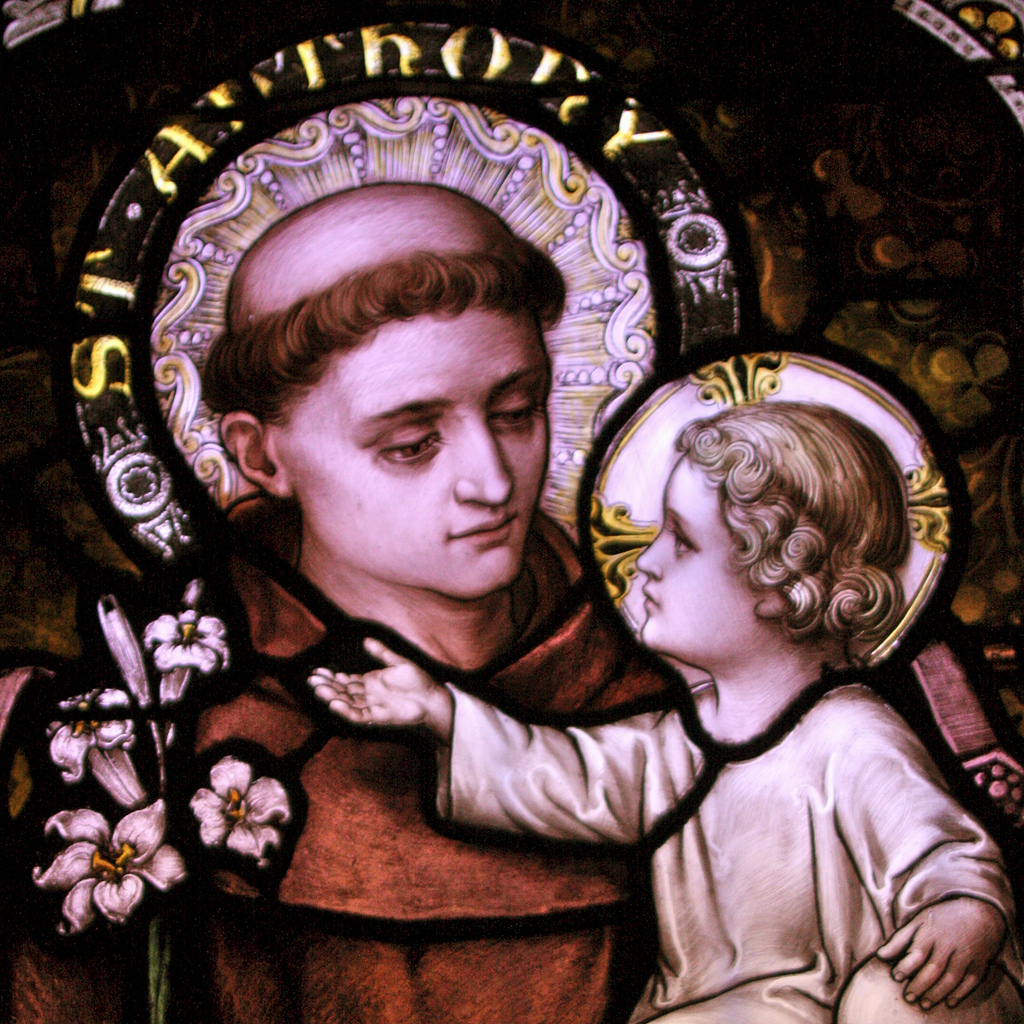
In the 13th century, while St. Anthony of Padua was traveling through France to preach against heresy, he was granted a quiet room for lodging. His host passed by the room one night and noticed an unusual light shining around the door. Peering inside, he saw Anthony kneeling and full of wonder, admiring a glorious child who hugged him. Seeing the boy’s supernatural beauty and hearing their conversation, the onlooker knew that this was Jesus visiting his saint. This encounter is why St. Anthony of Padua is depicted (as in our own stained-glass window of him) holding the Christ Child.

In the 1930’s, the Polish mystic St. Faustina Kowalska recorded in her diary, “I often see the Child Jesus during Holy Mass. He is extremely beautiful. He appears to be about one year old. Once, when I saw the same Child during Mass in our chapel, I was seized with a violent desire and an irresistible longing to approach the altar and take the Child Jesus. At that moment, the Child Jesus was standing by me on the side of my kneeler, and he leaned with his two little hands against my shoulder, gracious and joyful, his look deep and penetrating. But when the priest broke the Host, Jesus was once again on the altar, and was broken and consumed by the priest.

Even without miraculously beholding him, the great devotion of other saints toward the Christ Child is well-known. St. Francis of Assisi, having received permission from the pope, created the very first nativity scene in the year 1223; with hay and a manger along with a live ox and donkey in a cave. He then invited the Italian villagers to come and gaze upon it while he preached about “the Babe of Bethlehem” — Francis was too overcome by heartfelt emotion to say the name “Jesus.”

In the 12th century, Doctor of the Church St. Bernard of Clairvaux wrote this in a touching prayer:

“You have come to us as a small child…
Caress us with your tiny hands,
embrace us with your tiny arms
and pierce our hearts
with your soft, sweet cries.”

In the late 1800’s, the beloved St. Therese of Lisieux, also known as St. Therese of the Child Jesus and of the Holy Face, would pray this amidst her joys and trials:

“O Jesus, dear Holy Child, my only Treasure, I abandon myself to your every whim. I seek no other joy than that of calling forth your sweet smile. Grant me the graces and the virtues of your Holy Childhood, so that on the day of my birth into Heaven, the angels and saints may recognize your spouse, Therese of the Child Jesus.”

And for centuries, the Infant Child of Prague, a 19-inch statute of the Infant Jesus dressed in royal regalia, has been a beloved Czech devotion.

Despite all of these examples of mystical encounters and pious devotions with the Child Jesus, one might still wonder whether it is fitting to pray to a baby. Jesus does not even talk at that immature age, and he has since grown up beyond that phase of life. Yet even though he is a child, the Infant Jesus is still Almighty God who hears all of our prayers. If it would be wrong to pray across time to Our Savior in his manger, it would be wrong to now pray to Our Savior on his Cross as well. You and I were not born too late to adore the newborn King.

What benefits are there in praying to the Holy Infant? Jesus Christ is the same person yesterday, today, and forever, but some will find approaching the Baby Jesus less intimidating. His little form communicates his innocence, purity, gentleness, and tender affection; inviting us to share these virtues. In fact, Jesus tells us we must become as little children, like himself: “Amen, I say to you, unless you turn and become like children, you will not enter the Kingdom of Heaven. Whoever humbles himself like this child is the greatest in the Kingdom of Heaven.

During one Holy Hour, St. Faustina Kowalska was trying to meditate on Our Lord’s Passion, but her soul was filled with joy and she suddenly saw the Child Jesus. She writes, “His majesty penetrated me to such an extent that I said, ‘Jesus, you are so little, and yet I know that you are my Creator and Lord.’” And Jesus answered, “I am, and I keep company with you as a child to teach you humility and simplicity.

On another occasion, St. Faustina saw the Infant Jesus near her kneeler, once again appearing to be about one year old. She writes that, “He asked me to take him in my arms. When I did take him in my arms, he cuddled up close to my bosom and said, “It is good for me to be close to your heart… because I want to teach you spiritual childhood. I want you to be very little, because when you are little I carry you close to my Heart, just as you are holding me close to your heart right now.

So in conclusion, I encourage you to approach the Infant Jesus in your prayers; at this Mass, in this Christmas season, and throughout this year ahead. Picture and imagine him, speak and listen to him, and hold him close to your heart. The Holy Babe of Bethlehem has gifts of grace and consolation to offer you, and he awaits you with open arms.