Archive for May, 2022

Why Did Jesus Go?

May 29, 2022

The Ascension
By Fr. Victor Feltes

This week, our Catholic school celebrated our eighth graders’ graduation with a Mass and an awards ceremony. Afterwards, while the graduates were having their pictures taken, a teacher and I stood off to the side, looking on. He remarked, “It’s sad to see them go.” I replied, “Yeah, but it would be even sadder if they stayed.

Just whimsically imagine remaining an eighth grader well into your twenties. You don’t have a full-time job because you’re a full-time student without a high school degree. Of course you’re unmarried and have no kids—you’re still in middle school! And sure, after a decade of eighth grade, having had the same lessons over and over, you could ace all of your homework and tests (if you still had any motivation left to do so) but you would not be learning very much. It is bittersweet to see our graduates go forth from us, but it is better that they go. Though in one sense they are leaving us, they are not really gone. Yet this departure is necessary for them to reach their full human maturity and to fulfill God’s plans for their glory.

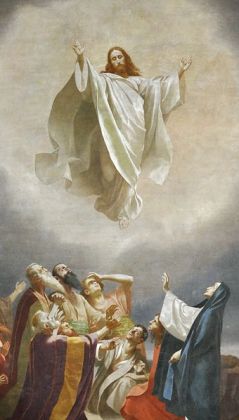
Today we celebrate Jesus’ bodily ascension into Heaven. The traditional day for celebrating the Ascension is forty days after Easter, which was last Thursday, or “Ascension Thursday.” Our diocese, like most dioceses in our country, transfers this celebration to this Sunday. I guess we like keeping Jesus around longer. But seriously, the ascension of Jesus into heaven raises this question: “Why did he go? Why didn’t Jesus stay?

Now Jesus does tell us, “Wherever two or three are gathered in my name I am there in their midst.” He says, “Behold, I am with you always until the end of the age.” And he is truly present for us in the Holy Eucharist. But Jesus’ presence now remains invisible or veiled to our eyes. By bodily ascending and disappearing into the clouds Jesus is visibly departing from us until he comes again with a glory manifested to all. “But I tell you the truth,” he says, “it is better for you that I go.” Why is this better? What would it be like if Jesus dwelt among us throughout the centuries like he did with his disciples those forty days, walking with them and talking with them, following his Resurrection?

There is no physical reason why Jesus could not have done this. His risen body is a glorified body no longer subject to injury or death, so that’s not the reason he did not remain. Did he go because on earth he’s reduced to being in one particular place, or limited in how much he can see, know, or do? Remember, Jesus is not merely human but divine, all-knowing and all-powerful, and his bi-locating saints (such as Venerable Mary of Ágreda or St. Padre Pio) who have manifested the miracle of being more than one place at once surely do not possess any supernatural ability which Jesus lacks.

So God the Father could have chosen “by his own authority” for his Son to remain visibly active here with us, in one, or thousands, or millions of locations at once, throughout the centuries up to our day. Jesus could be the pastor in every parish, the teacher in every classroom, the doctor in every hospital, and the leader in every country. He is the perfect priest, the best teacher, the greatest healer, and the rightful ruler of all. Who is better-qualified than Jesus to do any of these things? Nobody. People would demand this of him and resent him for not doing it. But if Jesus were visibly present and doing everything, then we would be left doing very little.

Would it be a better world if Jesus personally did everything? In some ways, yes. Earth would be closer to paradise in many respects. But would this lead to more souls being saved? I’m not so sure. Adam and Eve lived in an earthly paradise, too, before they fell. And the glory of Christ being manifested to the world in an undeniable way might gain peoples’ submission, but not necessarily their conversion or love. The demons who fell had no doubts about God’s existence and yet they chose to disobey him as far as they were able.

If Jesus did everything of importance on earth without us, one result which seems evident to me is that we would remain in an unending adolescence, like someone attending the eighth grade well into their adulthood. This is why it was better for us that Jesus ascended. We are children of God called to what St. Paul calls “the stature of the fullness of Christ.” If everything which matters were just Jesus’ job to handle, how would we grow from our immaturity into the full maturity of Christ?

Jesus says, “I tell you the truth, it is better for you that I go. For if I do not go, the (Holy Spirit) will not come to you. But if I go, I will send him to you.” By the Holy Spirit, the Church (which is Christ’s Body) is animated in this world. As members of his body we are moved by the Holy Spirit to love and to work united with Christ, growing more into his likeness and glory along the way. Would Jesus not ascending into heaven, remaining constantly here on earth and doing everything without us, have been easier than this present Christian life of ours? Perhaps, but Jesus desires that we would graduate with him to higher things and ascend to a greater glory with himself.

Resolving Christian Controversy

May 22, 2022

6th Sunday of Easter
By Fr. Victor Feltes

There was a serious religious controversy in the very early Church. The Acts of the Apostles records this story which contains important lessons for you and me and Christ’s one, holy, catholic, and apostolic Church in every age. In the first century A.D., some Jewish Christians came down to Antioch and were telling the Christians there: “Unless you are circumcised according to the Mosaic practice, you cannot be saved.” Many of the Christians in Antioch were Gentile converts. As Gentiles they had not followed the many Jewish religious laws, including circumcision. Now they were being told they had no share in Jesus Christ’s New Covenant unless they kept the entire Mosaic Covenant.

This was a crucial matter: either these Gentiles were not yet experiencing Christ’s salvation, or else the Law of Moses was being needlessly placed as a barrier between Gentiles and Jesus Christ. St. Paul and St. Barnabas strenuously opposed this alternate interpretation of the Gospel which was disturbing and dividing their community, but how could this important issue be decisively and infallibly settled? Everyone forming their own interpretations obviously would not resolve it. How could the Christian community be sure of the truth?

The Acts of the Apostles details how “it was decided that Paul, Barnabas, and some of the others should go up to Jerusalem to the apostles and presbyters about this question.” A Church council was held in Jerusalem and after they had discussed and discerned the matter, “the apostles and presbyters, in agreement with the whole church, decided to choose (a pair of) representatives and to send them to Antioch with Paul and Barnabas. (They selected) Judas, who was called Barsabbas, and Silas, (two) leaders among the brethren.

And they did not send Barsabbas and Silas empty-handed. The pair carried a letter from the council, which read in part: “It is the decision of the Holy Spirit and of us not to place on you any burden beyond these necessities.” It then listed a handful of culturally offensive and/or sinful acts to abstain from before concluding, “If you keep free of these, you will be doing what is right. Farewell.” In other words, the Gentile Christians would not be required to follow the full Mosaic Law.

Notice how the Church’s leaders, the apostles and presbyters in Jerusalem, pronounce their teaching with authority: “It is the decision of the Holy Spirit and of us…” As Jesus had promised at the Last Supper, “The Holy Spirit…will teach you everything and remind you of all that I told you.” The Church’s leaders teach in union with and in cooperation with the Holy Spirit.

Note as well how they do not send this letter by itself, but along with Barsabbas and Silas. This is partly to attest to the genuineness of the message—it’s not something Paul and Barnabas simply made up themselves. The accompanying witnesses are also sent to clarify any ambiguities and answer what remaining questions the Christians at Antioch might have. For instance, the Council of Jerusalem’s short letter bids the Christians to abstain from “porniea,” which various Christian Bibles translate as “sexual immorality,” or “fornication,” or “unlawful marriage.” But what was the precise meaning they intended here? One of these things or all of them together? Barsabbas and Silas could answer. We see that even a text inspired by the Holy Spirit (as this one was) can require an authoritative interpreter to be properly understood.

When the delegation from Jerusalem arrived at Antioch, the letter was read to the Christian community and the people were delighted. Barsabbas and Silas preached to them, encouraging them, and remained with them for some time. The controversy was resolved, and the community’s unity and peace of mind were restored; for the Bride of Christ, Mother Church, had spoken, removing all doubt about what Jesus wanted them to do.

This, of course, would not be the last controversy in Church history. Every century since has seen its heresies, and every error gains some followers because it is so easy to be mistaken. Clever minds and willful hearts in a fallen world can go down many false paths, and when lambs or sheep choose their own ways to go they scatter from Christ’s flock. Thankfully, God has given us his Holy Word in Sacred Scripture to help us to know him and his saving, loving will for our lives.

However, the Scriptures do not automatically interpret themselves. Even self-proclaimed “Bible Only” Christian denominations disagree with one another over important questions. The Protestant principle of Sola Scriptura (that “Scripture Alone” is the sole authority for Christian faith and life) is a self-refuting concept because the Bible does not teach it. How can someone even be sure which books are supposed to be in our Bible without there being an infallible Church to recognize them and place them into the canon of biblical books? Without a Spirit-guarded, infallibly-teaching Magisterium neither the Christians at Antioch nor Christians today could be sure about what we are to believe.

The Church of Jesus Christ is not meant to be many separate denomination, but one. Christ’s Church is not meant to bring salvation only to some, but to all. And the one, holy, catholic, and apostolic Church of Christ shares a continuity in her structure and in her teaching throughout the centuries from St. Peter and the apostles to Pope Francis and the bishops today.

In 1926, when G.K. Chesterton wrote his essay “Why I am a Catholic,” he presented a number of reasons, but the answer of his which has always stood out to me is this one: “(I am a Catholic because it) is the only thing that frees a man from the degrading slavery of being a child of his age.” Some secular people imagine our present generation is the first one to get everything right, but in one hundred years another secular generation will mock and cringe at this one while embracing another set of fashionable errors of their own. However, in one hundred years the Catholic Church will remain, built solidly upon rock, and united to the Person and teachings of Jesus Christ our Lord.

Here is a final reflection from the controversy at Antioch. The teaching of Paul and Barnabas was right, and Barsabbas and Silas carried authority from the apostles. They were important witnesses to the Faith. But their message would have been undermined in the minds of others if St. Paul, St. Barnabas, St. Barsabbas, or St. Silas had not lived as saints. Our fellow Christians, even popes or bishops, may disappoint or cause scandal by their poor personal example, harming souls. But let us, you and I, rededicate ourselves to Christ, loving him and serving him, remaining close to him in the Sacraments, allowing ourselves to be more fully converted to him, so that others may know, love, and faithfully follow Jesus alongside us in his Holy Catholic Church.

Her Core — Funeral Homily for Rose Lankey, 97

May 12, 2022

By Fr. Victor Feltes

Rose was born August 15, 1924, on the Solemnity of Mary’s Assumption into heaven. Today we offer her funeral Mass at St. Paul’s to aid Rose’s own journey to heaven. Three days after Easter in 1947, Rose got married here at St. Paul’s to her beloved husband, “Bud.” He himself joined the Church at this parish and Rose was proud to brag “he’s better than most Catholics!” They were married for 71 years. Rose often volunteered to serve funeral luncheons at St. Paul’s. After retirement, she came here for Mass six days a week; enjoying the holy meal of her dear Lord Jesus typically followed by having coffee with his friends and hers.

Rose had a lifetime of happy memories with her family and friends. During her last ten years on earth she would remark, “I’ve had a wonderful life.” But after Rose turned ninety years old, her mind began to fail her. Throughout the past two or three years her memory had become quite poor. For instance, she knew she had three daughters, but would fail to recognize their fully-grown faces. Yet, even as her human frailty in this damaged world stripped away so much from Rose, there was a deepest core which endured in her. What was that core within her? Her Catholic faith in Jesus Christ.

Rose’s faith and devotion would manifest even in final days. About a month ago, when her daughter handed her a Rosary, Rose looked at the beads not seeming to register their purpose or use. But when she was told “these are rosary beads which were blessed by the pope,” Rose cupped them in her hands and kissed them with her lips. About two weeks before her passing, her mind and body were so weakened that Rose had stopped speaking. Chaplain Lynn from Hospice visited her bedside and suggested to the family, “Let’s pray the Lord’s Prayer.” Rose’s three daughters and son-in-law had not heard Rose verbalize for days, but when they began saying the Our Father together they were in awe when Rose audibly joined in. Later, while Fr. Tim from St. Odilia gave Rose the Last Rites, her lips attempted at times to voice the words of prayer. She looked at the priest, that icon for Christ, with a look of comfort in her eyes.

Jesus tells us it is the will of God the Father that Christ lose nothing that our Father has given him, and Christ shall raise it all up on the last day anew. The poor will have the Kingdom. The mournful will be consoled, for “the Lord God will wipe away the tears from all faces.” And the meek will inherit the earth. And to those like Rose who lost nearly everything but him Jesus will restore to them everything again, “to dwell in the house of the Lord” forever. On that day it will be said: “Behold our God, to whom we looked to save us! This is the Lord for whom we looked; let us rejoice and be glad that he has saved us!” Jesus Christ is the good Lord to whom our beloved Rose faithfully looked. Let us rejoice and be glad that he has saved her.

Our Mother Needs Help

May 8, 2022

4th Sunday of Easter
By Deacon Dick Kostner

Happy Mother’s Day! Jesus refers to his Church as his mother and his bride. While God does not need us he requests that we be a part of his mystical body. The vocation he gives to his Church is to preach and live the gospel message of happiness and love not only in this life but also in the next with him, in heaven. The problem that this brings to us is that this vocation can only be accomplished in this life, by and through the carrying of crosses during this life.

At the beginning of Lent we walked through a trailer movie of our life here on Earth displayed to us by reflecting upon the “Way of the Cross,” displayed here on our Church Mother’s walls. We discovered that while completing his vocation, which was opening the door to heaven for his Church, he got tired of carrying the cross and fell three times. Three times he felt he could not go on. Ordinary people like you and me, together with his heavenly Father, gave him help and the courage to go on. Jesus relied on faithful friends and the Father for help and moral support.

As you know since I was ordained a Deacon some twenty plus years ago, I have been involved with the RCIA program which invites adults to become members of our faith and the Mother Church. In the early Church it was directed to people who did not know Jesus or the Christian faith. Now, that program has also been available to Christians of other faiths, who are interested in becoming members of the Catholic Church. In the twenty some years I have been involved in the program I believe there has only been three or four individuals who joined the Catholic Church who were not previously involved in and educated in the Christian faith. Times have changed and the Mother Church is now involved in what it calls the New Evangelization. It’s our new challenge which is trying to get Christian educated individuals back into being active members of the body of Christ. People know about Jesus but are finding it difficult to witness his presence and help within their busy lives.

Our RCIA team is determined to help RCIA Candidates to recognize just how involved God is within our lives. The best way to teach this is by sharing our encounters with God in ordinary experiences of life. At every class we share what we call our “Spirit Stories” with each other to show just how important a part we play in God’s plan for us to be active participants in His plan for our happiness and salvation goal for us and our friends and neighbors, to be with him for all eternity. We are blessed in this Community with many active members of the body of Christ but the Covid has weakened our mission to be example setters for making everyone’s life happier and more faith filled by supporting our Mother Church. Attendance has not returned to pre-Covid numbers for many of our parishioners at Sunday Mass. Those who are still active in Church ministry are not only getting older but also are being overwhelmed with the responsibilities of keeping our Parish healthy in mind and spirit.

Liturgy is the generator, the battery charger for the Faithful to continue to be example setters for the faith community. The Liturgy cross our parish is carrying is getting too heavy for it to handle without the help of the Simon’s and Veronica’s. There are many members in our Parish still attending our Liturgies who used to be active Liturgy ministers of the word; greeters; and Ministers of Holy Communion, that no longer wish to be active for a variety of reasons. All of us will fall down numerous times on our trip to eternity but with a little help from the Simon and Veronica’s our St. Paul’s and St. John’s Body of Christ will continue on as Jesus did to fulfill our vocation to preach and teach by example, the gospel message of love of God and neighbor.

You will find forms and pencils in your pews to sign up and help carry our Parish crosses on our “Way of the Cross.” Not ready to sign today? When my wife asks people to help with ministries and they are reluctant, I will quote her by saying to you. “Pray over it.” and return your sign up sheet next week. I would also suggest you request St. Joseph to “sleep over” your requests for help in making a decision. I have acquired for our Parish a Sleeping Joseph Statute which is located on our Sacred Heart of Jesus Altar. Saint Joseph had many communications from God in the form of dreams and he always obeyed these communications. You may ask St. Joseph to ask God to help you make important decisions in life by placing your written requests in the box on which the Statute rests. We will have the Sleeping St. Joseph statute available for your help requests for a couple of weeks. Pope Frances does this on a regular basis and he encourages the faithful to do the same.

The Church realizes that some of you are physically or mentally unable to help carry this ministry cross. Veronica was unable to help carry the cross for Jesus but she did what she could do to help him. To people who can’t help carry this vocation anymore, you can still be a “Veronica” to those who need help, wipe their face, tell them thanks, and tell them they are needed. As Jesus told us in today’s Gospel, “My sheep hear my voice; I know them, and they follow me. I give them eternal life, and they shall never perish. No one can take them out of my hand. My Father who has given them to me, is greater than all, and no one can take them out of the Father’s hand.”

I will close with a Psalm Prayer for our Parish “Mother”: “Lord, God, your only Son wept over ancient Jerusalem, soon to be destroyed for its lack of faith. He established the new Jerusalem firmly upon rock and made it the mother of the faithful. Make us rejoice in your Church and grant that all people may be reborn into the freedom of your Spirit. Amen!“ On behalf of Fr. Victor and all our Parish Ministers, Happy Mother’s Day to all the moms out there and to our Mother Church!

Transforming Love

May 1, 2022

3rd Sunday of Easter
By Fr. Chinnappan Pelavendran

Today we have another account of Jesus appearing to his disciples on Easter Sunday wherein he prepares a meal for them and gives them support. He comes constantly to the disciples to be with them, guide them and encourage them. All the three readings of today tell us of our vocation and our mission to be at the service of the word and not to hesitate to proclaim our closeness to Jesus. We admire the courage of the Disciples of Jesus who preach with boldness and are ready to face sufferings happily for His sake.

John the Evangelist tells us that God is love. God’s love is unconditional, unmerited, and without limit. It lasts forever. It’s the beginning and end. And it’s the essence of what it means to be a Christian – one who knows God’s love and forgiveness and who loves God in return with all one’s heart, soul, mind, body, and strength. God’s love heals and transforms our lives and frees us from fear, selfishness, and greed. It draws us to the very heart of God and it compels us to give to him the best we have and all we possess – our gifts, our time, our resources, and our very lives. St. Paul the Apostle tells us that God’s love has been poured into our hearts through the Holy Spirit which has been given us.

Why did Jesus question Peter’s love and fidelity three times in front of the other apostles? It must have caused Peter pain and sorrow since he had publicly denied Jesus three times. Now Peter, full of remorse and humility, stated that he loved his master and was willing to serve him whatever it might cost. Jesus asks him “do you love me more than these?

Jesus may have pointed to the boats, nets, and catch of fish. Do you love me more than these things? He may have challenged Peter to abandon his work as a fisherman for the task of shepherding God’s people. Jesus also may have pointed to the other disciples and to Peter’s previous boast: “Though they all fall away because of you, I will never fall away.” (Matthew 26:33) Peter now makes no boast or comparison but humbly responds: “You know I love you.”

The Lord Jesus calls each one of us, even in our weakness, sin, and failings, to love him above all else. Saint Augustine in his Confessions wrote: “Late have I loved you, O Beauty so ancient and so new. Late have I loved you! …You shone your Self upon me to drive away my blindness. You breathed your fragrance upon me… and in astonishment I drew my breath…now I pant for you! I tasted you, and now I hunger and thirst for you. You touched me! – and I burn to live within your peace.” (Confessions 10:27) Nothing but our sinful pride and willfulness can keep us from the love of God. It is a free gift, unmerited and beyond payment. We can never outmatch God in giving love. He loved us first and our love for him is a response to his exceeding graciousness and mercy towards us. Do you allow God’s love to change and transform your heart? “Lord Jesus, inflame my heart with your love and remove everything that is unloving, unkind, ungrateful, unholy, and not in accord with your will.”