Archive for September, 2022

A New, Joyful Day — Funeral Homily for Robert “Bob” Sobotta, 77

September 26, 2022

By Fr. Victor Feltes

It was the day after Bob’s nineteenth birthday and the day before he would marry Joann. Bob and Joann had met at a Pines Ballroom dance and now they were at The Pines Ballroom again, together with family preparing food for the next day’s festivities. They listened to the radio as they labored, and that’s how they learned what had happened at 12:30 PM that day in Texas. A short time later that same afternoon, the first report of grim news was followed by another: President John F. Kennedy was dead. It was Friday, November 22nd, 1963.

Presidential assassinations had happened before, first and most famously with President Lincoln. But it had been sixty-two years since the last murder of a president, when President McKinley was shot and died in Buffalo, NY in 1901, and few were still alive who remembered living through it. So Joann recalls how shocked everyone was that a president, America’s first Catholic president, was killed. They were all discussing it, stunned. They just couldn’t believe it, it seemed so unbelievable — and yet it was real, as real as death.

I asked Joann whether that mournful news, whether this national tragedy, soured their “Big Day”? No, she said, it was “just as joyful.” Bob and Joann awoke the next day and were married in the morning (as was the custom then) in a 9:30 AM Saturday wedding Mass at St. Peter’s in Tilden in the company of many loved ones, their family and friends. This was followed by a dinner at the Sundial Club and then a reception back at The Pines, a feast and a dance for them all. Bob loved to dance, polkas and waltzes in particular, and he enjoyed dancing with his new bride. Bob and Joann would happily share their next fifty-eight years together loving God, each other, and their family, friends, and neighbors, until Bob’s recent passing.

Death is sad and unsettling. Though common to history, it still remains shocking for us. But suffering and death are not the end of our stories. Though we mourn now, we will be comforted. We expect a new dawn, a new day, when the blessed friends of Christ – our King who dies no more – will awaken to celebrate his wedding feast with him. Jesus our Good Shepherd will spread the table before us, and the just shall dance with delight, and every tongue shall give praise to God. Though today we walk in the dark valley, the day we prepare for, the day we look forward to, the day that awaits us, will be full of joy.

Caring For Our Neighbor

September 25, 2022

26th Sunday of Ordinary Time
By Fr. Chinnappan Pelavendran

The story is told of a Franciscan monk in Australia, who was assigned to be the guide to St. Mother Teresa when she visited New South Wales. The monk was thrilled and excited at being so close to this great woman. He dreamed of how much he would learn from her. But, during her visit, he became frustrated. There were always other people for her to meet. Finally, her tour was over and she was about to fly to her next destination. The Franciscan friar spoke to Mother Teresa: “If I pay my own fare to New Guinea, can I sit next to you on the plane so I can talk to you and learn from you?” Mother Teresa looked at him and said: “Do you have enough money to pay airfare to New Guinea?” He replied eagerly, “Yes!” Mother said, “Give that money to the poor. You will learn more from that than anything I can tell you.

God speaks to us in many ways and touches our lives but we often fail to listen to him. He speaks to us in gentle ways and guides us in our weaknesses. The readings of today give us the values of the kingdom of God, which is different from all worldly values. It tells us that we, as the children of God, have the obligation and duty to look after our brothers and sisters and care for them. We all belong to the one family of God.

The prophet Amos, in the first reading, gives a powerful warning to those who seek wealth at the expense of the poor: people who spend their time and their money on themselves alone. He prophesies that those rich and self-indulgent people will be punished by God because they don’t care for their poor, suffering brothers and sisters.

In today’s second reading, St. Paul reminds Timothy, who was an ordained priest and consecrated Bishop, of the Faith he had confessed at his Baptism, He reminded him of his obligation to pursue righteousness, devotion, faith, love, patience, and gentleness. He reminded him of his ongoing call to bear witness to Christ as a loyal teacher and example of that faith. The message for us is that the generous sharing of our talents and resources is the necessary response to our Christian commitment.

All the parables of our Lord are based on everyday happenings. In today’s gospel, we are tempted to ask the question, “Why was the rich man punished?” He did not kick Lazarus, he was not cruel to him. He was punished because he continued to commit a sin of omission. He never noticed Lazarus as a human being and a brother. He did no wrong, but he did nothing good, either. He neglected the poor beggar at his door by not helping him to treat his illness nor giving him a small house to live in. He totally ignored the poor people around him, which was Cain’s attitude: “Am I the guardian of my brother?” It is not wrong to be rich, but it is wrong not to share our blessings with our brothers and sisters.

Today’s readings teach us an important lesson: it reminds us that all of us will experience God’s justice after our death. We are all rich enough to share our blessings with others. God has blessed each one of us with wealth, health, special talents, social power, political influence, or many other blessings. The parable invites us to share, in various ways, what we have been given, not use everything for selfish gains.

In today’s world, who are the poor we must not neglect? The unborn. We need to treat the unborn as our brother or sister Lazarus of this century. The rich man was condemned for not treating Lazarus as his brother. We also will be condemned for our selfishness if we do not treat the preborn as our brother and sister. We might think: “Who am I to interfere with a woman’s choice to abort?” I am a brother, a sister of that child in the womb. Finally, I am a follower of the One who said, “Whatsoever you do to the least of my brothers and sisters, you do to me.

On Being Man’s Best Friend

September 25, 2022

26th Sunday in Ordinary Time
By Fr. Victor Feltes

In the 1996 film “Independence Day,” we get introduced to a single-mother named Jasmine, played by Vivica Fox. With alien ships hovering ominously above the world’s major cities, she decides to flee Los Angeles. When the aliens begin their attack, Jasmine is stuck in a traffic jam inside a tunnel with her little boy, Dylan, and their handsome pet Labrador Retriever, named Boomer.

A wall of fire rushes from behind, tossing cars into the air before it and incinerating everyone it catches. Jasmine grabs her son and runs between the cars until she spots the door to a maintenance room. She kicks down the locked door and they huddle inside, but their dog has not followed them. Jasmine cries out, “Boomer! Boomer!” And Boomer sprints toward them, jumping over cars, and leaps safely into the side room at the very last second, just as the inferno passes by. Hundreds and hundreds of people are killed in the tunnel, but Boomer survives.

One commenter on a YouTube clip of this movie scene remarked, “I remember when I first saw this scene in the theater. I got all teary-eyed because, ‘YAY the doggy lives!’” Another commenter wrote, “When I saw this at the cinema, everyone cheered at this bit. It was the only part of the movie they cheered at!

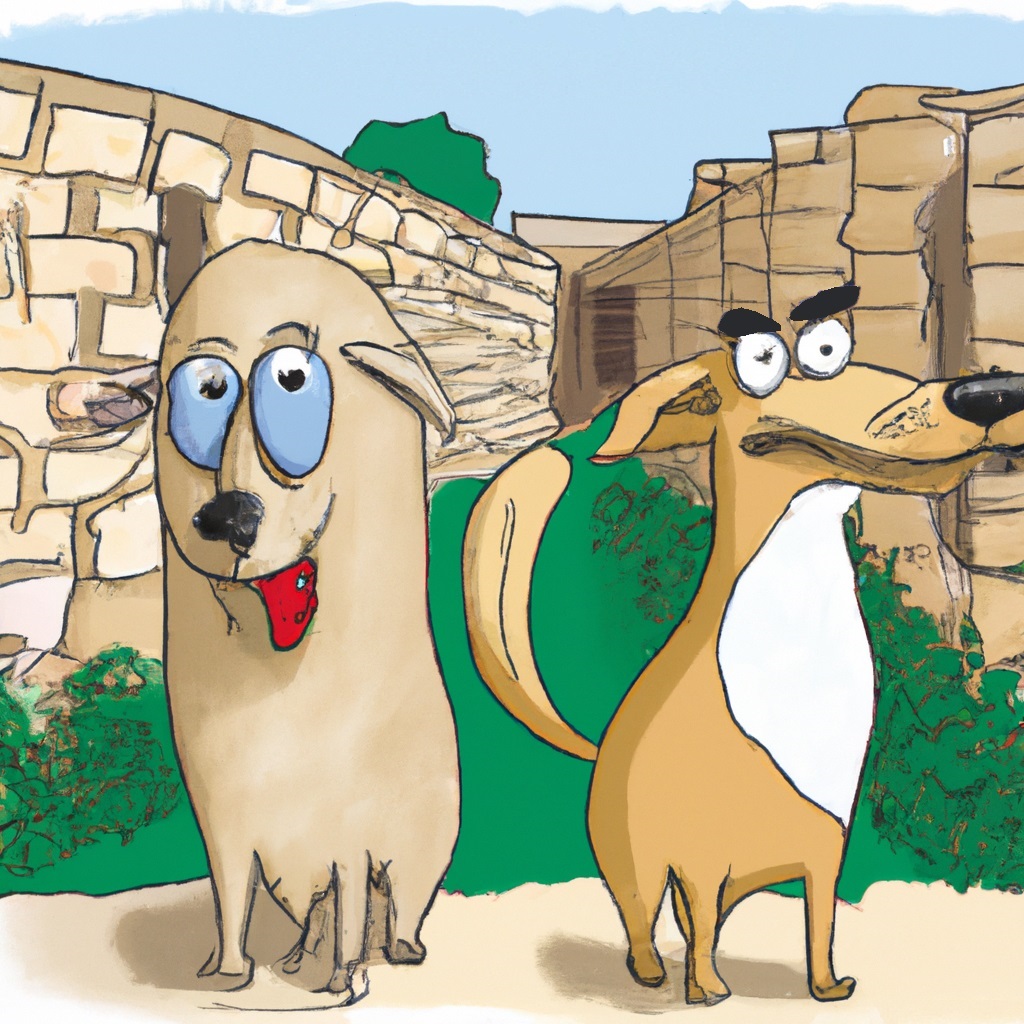
Our culture loves dogs, but Jewish culture was more ambivalent towards them. Scripture does not celebrate dogs as “man’s best friend” like we do today. There are verses pointing to sheepdogs for shepherding or watchdogs for security. And in the Book of Tobit, when young Tobiah leaves home with the angel Raphael, it says “the dog followed Tobiah out and went along with them” on their adventure. However, the mentions of dogs in the Bible are usually negative.

In the Old Testament, for example, Goliath said to David who held a shepherd’s staff, “Am I a dog that you come against me with a stick?” Years later, encountering a different scoffer, one of King David’s soldiers asked, “Why should this dead dog curse my lord the king?” And Psalm 22, which Jesus referenced on his Cross, says, “Dogs surround me; a pack of evildoers closes in on me… [Deliver] my life from the grip of the dog.

In the New Testament, we see more of this dim view of dogs. Jesus teaches, “Do not give what is holy to dogs.” St. Paul writes, “Beware of the dogs, beware of the evil workers…” And the Book of Revelation, when it describes God’s heavenly city, says, “Outside are the dogs, the sorcerers, the unchaste, the murderers, the idol-worshipers, and all who love and practice deceit.” So where does this biblical disdain for dogs come from?

Realize that in those days, most dogs were not pets but wild. Packs of feral dogs were not only a noisy nuisance but also dangerous. This is reflected in Psalm 59, which describes deadly enemies as “growling like dogs and prowling about the city.” If not killing prey, stray dogs would eat whatever dead flesh they found, of beast or man — “they roam about as scavengers; if they are not filled, they howl.” I mention all of this because of details in today’s parable.

In Jesus’ story, a rich man with expensive, comfortable clothing eats plenty of good food at every meal. But outside of his gate, lying on the ground, is Lazarus, a hungry poor man covered with exposed sores. Jesus tells us Lazarus “would gladly have eaten his fill of the scraps that fell from the rich man’s table.” And Jesus notes that “dogs even used to come [up to Lazarus] and lick his sores.” When the poor man died, he was carried away by angels to a place of peace with Abraham. But when the rich man died he descended to a place of torment, in part, for his failure to care for Lazarus.

Those stray dogs did not attack Lazarus but licked his wounds. Perhaps they were drawn to the salty taste, or maybe they had an instinctual impulse towards him. But in either case they were helping him. Like many other animals, including cats, rodents, and primates, dogs lick their wounds to clean them. And certain chemical compounds found in dogs’ saliva help to disinfect, reduce pain, and promote healing. Letting dogs lick your wounds today is not recommended by doctors today; modern disinfectants and treatments are less likely to result in infection. But in the ancient world, for a beggar on the streets covered with sores like Lazarus, such dog licks would be a blessing.

The parable tells us Lazarus “would gladly have eaten his fill of the scraps that fell from the rich man’s table.” This resembles the remark of the Syrophoenician woman who came to Jesus seeking a miracle for her demon-possessed daughter. Though they were not of the house of Israel, she begged Jesus to help them, saying “Lord, even the dogs eat the crumbs that fall from their masters’ table.” Lazarus “would gladly have eaten his fill of the scraps that fell from the rich man’s table,” but the rich man never gave him any. So the rich man treated Lazarus worse than a dog. “Dogs even used to come and lick [Lazarus’] sores.” This means even the despised dogs in the streets treated Lazarus better and helped him more than the rich man ever did.

It’s fine to love dogs. They’re one of God’s good creatures and they reflect his goodness. It’s been said that God created dogs to help show us how he loves us (and that he created cats to show us how we love him). But it sadly seems rather common today for people to care more about the well-being of random dogs than of random strangers. Today’s psalm tells us, “Blessed is he who keeps faith forever, secures justice for the oppressed, [and] gives food to the hungry.” Living in this way makes us more like our Lord ‘who sets captives free, raises up those who are bowed down, and protects strangers,’ and becoming like our Lord is necessary for us to be at home with him in his heavenly city. It’s alright to appreciate our pets, but lest we end up like the rich man in hell let’s make sure we treat and love everyone better than dogs.

What Money Cannot Buy

September 18, 2022

25th Sunday of Ordinary Time
By Fr. Chinnappan Pelavendran

Today’s liturgy reminds us that we are God’s stewards and that God expects faithful and prudent stewardship from us. The readings challenge us to use our God-given talents, wealth, and blessings wisely to attain Heavenly bliss. Today’s first reading from the book of Amos speaks against greed. The prophet speaks for the poor and the needy. They have God as their protector. The Israelites were waiting impatiently for the end of the holy days and Sabbaths so that they could proceed with their dishonest practices. In this specific case, the feast of the new moon was taking place. According to tradition, the first day of the new moon, like the Sabbath, was a day of rest. During these celebrations, without exception, no business was to be transacted. However, the Israelites were violating the Lord’s commands and drew His condemnation.

In today’s second reading, St. Paul invites us to pray for everyone, especially kings, rulers, leaders, and all those in charge. This prayer is necessary for conversion because, once we are converted we avoid corruption, injustice, and greed. Oppression of the poor is removed from our society. If everyone was to pray for those in authority, there would be better persons in power and better service to the public. Then, all people may live a quiet and peaceable life and come to salvation through the one mediator, Christ Jesus.

In the gospel, Jesus brings to light the fact that money and material things do not last forever, and therefore He advises us on how to make use of them without losing our salvation. It is the will of God that we should be happy here and have a share in the rich resources with which he endowed our world. The parable points out that Christians should be as prudent and resourceful in acquiring goodness as the steward was in acquiring money and making his future safe. Christians must give as much attention to things that concern their souls as they do to the things that concern worldly matters.

Jesus reminds us that earthly resources will eventually run out. Hence, our material possessions should be used for the good of others. The right use of wealth is, according to Jesus, to help the poor, the hungry, and the starving. That is the way that we make friends with God and please God.

There are many people in the Catholic Church who understand that God has given us money so that we can be generous to the needy, the poor, and the starving. Thus many of us are making wise investments for the future. Our Heavenly destiny depends on how we use the things of earth. Jesus gives us this parable in order to help us to see that our time is coming to an end and that we need to prepare an accounting. We must check whether we were using God’s gifts of wealth, health, talents, and other blessings selfishly. Or, were we using them for His glory by sharing them with others? Money is an instrument that can buy everything but happiness. It can purchase a ticket to every place but Heaven.

Learning from the Dishonest Steward

September 17, 2022

25th Sunday in Ordinary Time
Fr. Victor Feltes

In today’s strange parable, Jesus presents the scheming of a thief and a liar as an example we can learn from. We are not to imitate this dishonest steward’s treachery but rather his proactive shrewdness, “for the children of this world are more prudent in dealing with their own generation than are the children of light.”

How shrewdly proactive are we in doing good? We hunt for bargains at the store or online. But do we pursue opportunities to be generous? You have wealth and skills – so share them creatively. We invest and save for retirement. But do we intentionally store up treasure in heaven like Jesus tells us to? You can take nothing with you when you die; but you can increase what wealth awaits you by sending it ahead of you beforehand through generous deeds done now on earth. Jesus tells us to be “as shrewd as serpents and as innocent as doves.” He wants us, in cooperation with his grace, to show initiative in strategically and sinlessly serving his Kingdom for God’s glory, for our good, and for the good of all. That’s a worthwhile takeaway, but let’s look a little deeper. Like many of Jesus’ stories, today’s parable contains weird details which goad us to grapple with it further. What do we discover when we imagine ourselves in the shoes of the dishonest steward?

In this story, a rich man has a steward who was reported to him for squandering his property. (A steward is someone entrusted to manage another’s property, finances, or affairs.) The master summons his servant and said, “What is this I hear about you? Prepare a full account of your stewardship, because you can no longer be my steward.” If you and I are this steward, then who is our rich master? Our Lord is God. We are his servants, and who could be richer than the one from whom all good things come?

What has God entrusted to us? St. Paul replies, “What do you have that you did not receive? … For we brought nothing into the world.” Even the hardest-working farmer relies upon God’s soil, sun, air, and water to transform the seeds into his harvest. Even our own efforts in doing good come from God, “for God is the one who, for his good purpose, works in you both to desire and to work,” as St. Paul tells the Philippians. Every good thing we have is his.

Have we squandered what God entrusted to us as stewards? Every sin is a misuse of what we’ve been given, and who of us has used what we were given to its full potential? Our Lord has put us on notice that a day is coming when our present stewardship will end with a full accounting of our stewardship, “for we must all appear before the judgment seat of Christ,” St. Paul writes, “then each of us shall give an account of himself to God.”

The steward in the parable says to himself, “What shall I do, now that my master is taking the position of steward away from me? I am not strong enough to dig and I am ashamed to beg.” He recognizes he is too weak and too proud. Similarly, who of us is strong enough to overcome death, to dig ourselves out of the grave? And if you or I were perfectly humble instead of proud, we would always live in the truth (about who God is and who we are) and we would never sin—and yet we do sin.

The steward says to himself, “I know what I shall do so that when I am removed from the stewardship they may welcome me into their homes.” He calls in his master’s debtors one by one, asking them, “How much do you owe my master?” He then forgives portions of their debts – sometimes a fifth or a half of what they owe. And in the end, amazingly, when what this dishonest steward has done is revealed, even his betrayed master commends him for acting prudently and this steward is welcomed into many mansions.

The Our Father prayer as it appears in St. Matthew’s Gospel says, “forgive us our debts, as we forgive our debtors.” Whenever someone sins against you they sin against God too, creating a kind of debt, but you yourself can forgive a portion of that debt. When our Lord sees this, he commends you for it. “Blessed are the merciful, for they will be shown mercy.” And when you are more mercifully generous than what is deserved, you gain blessings. “For the measure with which you measure will be measured out to you.” So learn from the dishonest steward. Forgive the sin-debts of others, be creative and proactive in your generosity on earth, and one day “you will be welcomed into eternal dwellings.”

Can Computers be Persons?

September 17, 2022

By Fr. Victor Feltes

In recent years, the question of artificial intelligence (AI) possessing personhood has become a hot topic of debate. Some believe that AI could one day achieve sentience and become its own entity, while others believe that personhood is something that can only be attained by beings with a soul. The Catholic Church has not yet taken an official stance on the matter [a debatable claim –Fr. VF], but it is an interesting question to consider. For example, if an AI became self-aware and could think and feel for itself, would it have the same rights as a human being? If an AI was created with the sole purpose of serving humans, is it ethical to treat it as a mere tool?

The preceding paragraph was not written by a human being but generated online by a LaMDA (Language Model for Dialogue Applications). I gave the program GPT-3 the instruction: “Write an interesting introductory paragraph, including an example, for a Catholic article on the question of artificial intelligence possessing personhood.” The paragraph above was its first five sentences of its output. The accompanying illustration above was also created online using the image generation program DALL-E from my submitted prompt: “A robot touching a monolith (like in ‘2001: A Space Odyssey’)”. GPT-3’s paragraph and DALL-E’s image each took less than a minute for computers to produce. We can expect computers to be capable of even more amazingly sophisticated things in years to come. This leads to the question: “Can computers be persons?

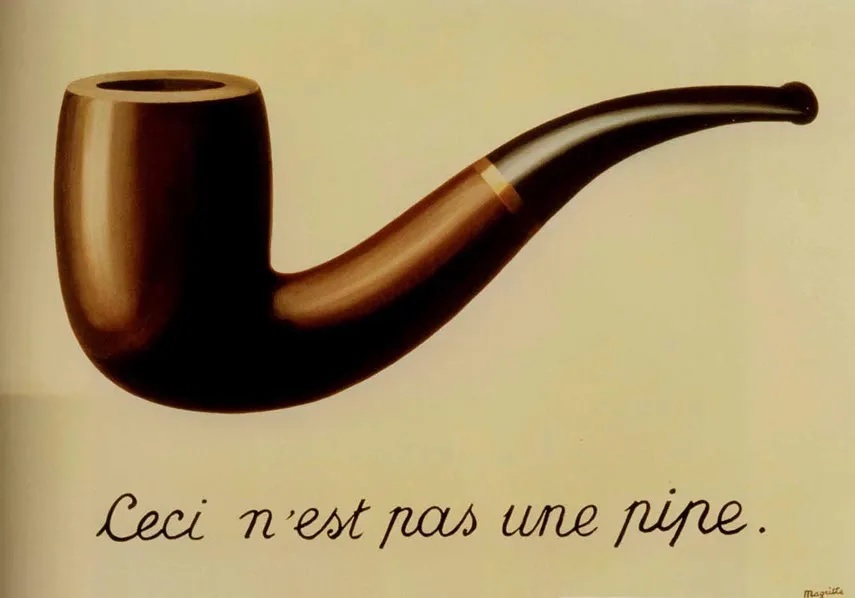
Gaudium et Spes, the Second Vatican Council’s document on the Church in the modern world, says “[man] is the only creature on earth which God willed for itself.” But this teaching was written in 1965, when Seymour Cray had only begun building the earliest supercomputers in Chippewa Falls, Wisconsin. Could mankind now fashion a new type of rational creature, a self-aware being endowed with an immortal soul? There are philosophical and theological issues with that proposition. First, if an AI were ever self-aware, how could we know? A computer need not be conscious to say “Hello, World!” according to its programming. Second, I am aware of nothing in divine revelation which suggests God would begin imparting souls into the works of our hands. Various electronics may be equipped with sensors and speakers and means of motion but I do not believe any of them will ever truly see or hear or speak or walk. As noted in René Magritte’s famous painting “The Treachery of Images,” a mere depiction of a pipe “is not a pipe.” Pope Francis spoke about this fundamental difference between man and machine, persons and things, in a 2019 address at the Vatican:

The inherent dignity of every human being must be firmly placed at the centre of our reflection and action. In this regard, it should be noted that the designation of ‘artificial intelligence,’ although certainly effective, may risk being misleading. The terms conceal the fact that – in spite of the useful fulfillment of servile tasks… functional automatisms remain qualitatively distant from the human prerogatives of knowledge and action. And therefore they can become socially dangerous. Moreover, the risk of man being ‘technologized,’ rather than technology humanized, is already real: so-called ‘intelligent machines’ are hastily attributed capacities that are properly human.

I cannot see Catholicism ever attributing personhood to complex machines, but I predict that others will begin to in the coming decades. As new applications are programed to increasingly replicate human conversation and emotion I could see young people imagining them as their real friends. As anthropomorphized technology’s creative feats far surpass our human abilities, I could even see some adults revering them as wise and powerful idols. If so, then these passages of Psalm 115 will find a new fulfillment: “Their idols are silver and gold, the work of human hands. They have mouths but do not speak, eyes but do not see. They have ears but do not hear, noses but do not smell. They have hands but do not feel, feet but do not walk; they produce no sound from their throats. Their makers will be like them, and anyone who trusts in them.”

The potential of AI is very exciting, and yet it also holds dangers. The 5th Psalm reflects, “What is man that you are mindful of him, and a son of man that you care for him? Yet you have made him little less than a god, crowned him with glory and honor. You have given him rule over the works of your hands, put all things at his feet…” Let us honor our Creator, defend the primacy of human dignity over all earthly creations, and never worship the works of our hands.

Born Again

September 10, 2022

24th Sunday of Ordinary Time
By Dcn. Dick Kostner

Our readings for this Sunday have people who are either sinning or are in trouble with God or life and who are redeemed by either their faith or the faith of the followers of Jesus. Recently I was asked to do a funeral service for someone in our community who had committed suicide. It was a new experience for me which ultimately made me feel the love that God has for each one of us and how important being a part of the family of God has for our mental and physical health an well being. I related this to the great number of people who showed up to give their support to the grieving family, telling them that they were being called by Jesus to represent him in body form, to help family and friends get through and understand they are not alone when a tragedy and confusion occurs.

Life within our world has its ups and downs and we are all dependent upon divine help and a calling to be a spiritual representative of Jesus to help others continue on with experiences which have them feeling confused and alone. Sometimes the problems exist because of our inability to clearly see a situation and to realize that through the love of God and his followers any storm in life can be weathered. I can remember many years ago when my son and I went fishing with a neighbor and his son. While fishing the neighbors son was rambling on and on about all the material “things” a friend of his had and was feeling jealous of that friend. His dad blurted out that we all need to not worry about the gifts others have received if we but look at our own lives and realize all the good that God gives to each and every one of us, and how gifted we all are by those treasures we have already received.

This is what the elder son in today’s Gospel was mad about. He was upset because his father had held a party for his younger brother who had spent his inheritance on foolishness and had come to realize just how good he had it before leaving home. His insight caused the younger son to repent and return “home” to his family. Sometimes we are lost and need to be hit in the head before we come to our senses and realize how good life and God is to us. Many others who witness this get confused with divine forgiveness that allows conversions to occur to others who have experienced this divine love and forgiveness. That’s where the followers of Christ come in as a representative of the Body of Christ.

That is the vocation of those who have been baptized into the family of God. We are the flesh and blood of the living Christ. We are called to preach the gospel of love and forgiveness to those who have blinded by their sins and weaknesses, letting them know that God is waiting for their return home where there will be a great rejoicing by their spiritual family when they turn from their ways and proceed with their vocation of love of God and neighbor. Our Lutheran brothers and sisters call this “Being born again!

This “Being born again,” has its affect on us and how others “see” us. It is not hidden. I can remember when I did a wake service for the father of one of my high school classmates, who came up to be after the service and shook my hand and blurted out, “You scare the hell out of me!” Or a client classmate friend of mine I was doing some legal work for last year who said “I can’t believe you are the same person I went to high school with years ago!

We all have within us a soul that provides us with a hot line to God and his forgiveness and love. All we need to do is pick up the phone and yell “Help!” Help for ourselves or “Help!” for those we witness who need divine intervention and support. And to this assembly of the “Body of Christ” I say: “Welcome Home – And Happy Birthday!

The Lost Sheep, The Lost Coin, The Lost Son

September 10, 2022

24th Sunday of Ordinary Time
By Fr. Chinnappan Pelavendran

On this twenty fourth Sunday of Ordinary time, by our faith in Christ, we have gathered in the presence of our Lord who is Loving, merciful, forgiving, and compassionate God. The Good News Jesus preached was that God is not a cruel, judging, and punishing God. He is our loving and forgiving Heavenly Father who wants to save everyone through His Son Jesus.

In the first reading of today, we discover a God who is faithful to his vows. As a merciful and compassionate father. Moses is imploring a forgiving God to have mercy on the sinful people who have abandoned Him and turned to idol-worship. He reminds God of His promises to Abraham, Isaac and Jacob and to show mercy to His unfaithful people. God heard the prayers of Moses on behalf of his people God hears Moses’ plea and takes his people back.

Today’s second reading, St. Paul repeats his story of conversion, intending to offer to everyone who will listen. As Saul of Tarsus, a zealous Jew, persecuted the church of God, but not only he forgiven, he is called to be an apostle. St. Paul always contrasts his life before Christ with his life after his Damascus experience. He had been the greatest of sinners, as a blasphemer and arrogant persecutor, God showed great mercy towards him. St. Paul invites us to marvel at the mercy of God and to find hope and help for dealing with our own need for conversion.

In the Gospel reading, the first two parables, there are the common elements of loss, searching, finding, rejoicing, and sharing of the joy. But in the third parable, we see a God forgiving and receiving sinners, the parables tell us about God’s generosity in seeking and receiving the sinner and the joy of the sinner in being received by a forgiving and loving God.

All three parables of Luke 15 end with a party or a celebration of the finding.  Since the self-righteous Pharisees, who accused Jesus of befriending publicans and sinners, could not believe that God would be delighted at the conversion of sinners, Jesus told them the parable of the lost sheep and the shepherd’s joy on its discovery, the parable of the lost coin and the woman’s joy when she found it, and the parable of the lost and returned son and his Father’s joy. Besides presenting a God who is patiently waiting for the return of the sinners, ready to pardon them, these parables teach us of God’s infinite love and mercy.

We need to live every day as our merciful God’s forgiven children: Let us begin every day by prayer so that we may learn how to obey God’s holy will by doing good, avoiding evil, and trying to live in God’s presence everywhere. Before we go to bed at night, let us examine our conscience and confess to God our sins and failures of the day, asking His pardon and forgiveness.  Let us resolve to receive the Sacrament of Reconciliation if we have fallen into serious sins. Let us continue to ask for God’s forgiveness before we receive Jesus in Holy Communion during the Holy Mass. Thus, let us live a peaceful life as forgiven prodigal children, getting daily reconciled with God, our merciful and forgiving Father.

Let us not act like the Scribes, the Pharisees and the elder brother of the prodigal son who hold on to others’ sins rather we should act like Jesus who easily overlooks our faults and forgives us of our grave sins and then welcomes us back. We pray that the mercy of God may find us whenever we miss our track and patiently bring us back to his merciful bosom.

Parables of Towers & Kings

September 3, 2022

23rd Sunday in Ordinary Time
By Fr. Victor Feltes
The disciples asked Jesus, “Why do you speak to the people in parables?” The gospels show him explaining parables to his apostles in private, but the meanings of Jesus’ symbolic stories about the Kingdom of God were kept somewhat hidden from the crowds. Christ’s enemies and scoffers would dismiss these tales as nonsense but those with faith in him would keep them and contemplate them. The foes to his public ministry walked away with no additional ammunition to attack him with, but his faithful disciples would discover wisdom in his teachings. As Jesus says, “To anyone who has, more will be given and he will grow rich; from anyone who has not, even what he has will be taken away.”

Sometimes the gospels explicitly tell us Jesus’ interpretations of his parables, as with The Parable of the Sower or The Parable of the Weeds. But many parables get presented without being unpacked, like our parables today: a parable about building a tower and a parable about considering battle against a stronger king. The context gives us clues to their meaning but some ambiguity remains. I believe this openness to interpretation can be intentional – inspired by God to convey multiple ideas at the same time, like that optical illusion where two profiled faces outline a vase between them, or the one where the same image depicts either an old woman or a young lady. Is the tower being built in today’s parable a good thing or a bad thing? Is the opposing king we contemplate fighting a wicked one or righteous? Each of these interpretations teaches us a lesson for the Kingdom of God.

In the first parable, Jesus asks, “Which of you wishing to construct a tower does not first sit down and calculate the cost to see if there is enough for its completion? Otherwise, after laying the foundation and finding himself unable to finish the work the onlookers should laugh at him and say, ‘This one began to build but did not have the resources to finish.’” In this parable, is the tower something good or something bad?

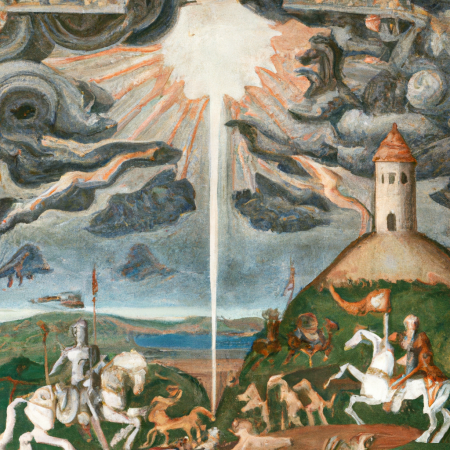
What is the Bible’s first and most famous tower? It’s the Tower of Babel in Genesis. The people at Babel said: “Come, let us build ourselves a city and a tower with its top in the sky, and so make a name for ourselves; otherwise we shall be scattered all over the earth!” This was after God had commanded Noah and his descendants to “Be fertile and multiply and fill the earth.” But the people of Babel turned inward, seeking to glorify their own name apart from God through building a city and tower rivaling heaven.

The God of heaven, whose name is above every name, had to come down to examine their efforts. And God, foreseeing what evils Babel’s unchecked hubris and concentration of power would bring about on earth, confuses their speech. Having amusingly lost the ability to even say, “Hey, pass me that brick,” great and mighty Babel must abandon its proud project and its people scatter across the earth. Babel is the image of a wicked tower project, but another kind of tower in the Bible has positive connotations.

Both the Old Testament prophet Isaiah and Jesus Christ in the gospels speak of building watchtowers for vineyards to safeguard their previous fruits. Jesus’ Parable of the Tenants begins, “A man planted a vineyard and put a fence around it and dug a pit for the winepress and built a tower…” This echoes Isaiah’s song about his friend’s vineyard, which also notes, “within it he built a watchtower.” A farmer would dwell atop his tower to watch and guard his vineyard during harvest time, on the lookout for hungry foxes, badgers, jackals, and even human thieves. But a vineyard’s half-finished watchtower is of little or no use at all. Unlike the Tower of Babel, this sort of tower is good and wise to complete.

There also are two ways to take today’s second parable. Jesus asks, “What king marching into battle would not first sit down and decide whether with ten thousand troops he can successfully oppose another king advancing upon him with twenty thousand troops? But if not, while he is still far away, he will send a delegation to ask for peace terms.” Can you prevail against an enemy who outnumbers you two-to-one? In ancient battles the side with the far more numerous forces typically won, but there were exceptions.

In the 1st Book of Maccabees, the army of the wicked, pagan King Antiochus, led by a commander who sought to ‘make a name for himself,’ came to fight the people of God on the battlefield. The soldiers of the Jewish leader, Judas Maccabeus, asked him: “How can we, few as we are, fight such a strong host as this? Besides, we are weak since we have not eaten today.” But Judas replied: “Many are easily hemmed in by a few; in the sight of Heaven there is no difference between deliverance by many or by few; for victory in war does not depend upon the size of the army, but on strength that comes from Heaven.” The people of God prevailed that day. Though outnumbered, the Jews would go on to win battle after battle against their enemy, so long as they were faithful in serving and honoring God.

So what do today’s parables mean for us? Well, what kind of tower are you intending to build? Is it a structure of sin, vanity, and pride (like the Tower of Babel) which will not reach heaven? Then sit down, recognize your foolishness, and change your plans, lest your foreseeable failure become your mockable, lasting legacy. Or do you plan to build a watchtower to guard your soul and protect your good fruits from anything or anyone (that is, any temptation) that would rob you? Then do not only invest in your project halfway. You cannot clear a ten-foot-wide chasm with five-foot jumps. Our hearts must not be divided, but fully devoted to Jesus Christ.

Jesus tells us, “You cannot serve both God and Mammon (or, both God and money)… Anyone of you who does not renounce all his possessions (that is, anyone who would be unwilling to sacrifice his wealth to do my will) cannot be my disciple.” Jesus says, “If anyone comes to me without hating (that is, if anyone loves more than me) his father and mother, wife and children, brothers and sisters, and even his own life, he cannot be my disciple. Whoever does not carry his own cross and come after me cannot be my disciple.” This is the level of commitment that Jesus Christ expects from us.

And who is the powerful king we contemplate doing battle with? If that king in the parable is God we would be foolish to oppose him. You could not defeat him or the coming of his Kingdom with even a billion troops at your command. So it is wise to seek out and accept his peace terms now before Jesus Christ returns. Alternatively, what if that king in our parable is the Evil One? Then we should not be afraid. The devil and the demons hate us and war against us; they are legion. Yet “victory in war does not depend upon the size of the army, but on strength that comes from Heaven.” As St. James writes, “God resists the proud, but gives grace to the humble. So submit yourselves to God. Resist the devil, and he will flee from you.

In conclusion, as you can see, the simple parables of Jesus contain riches for those who listen and keep them. Reject the foolishness of pride and vanity. Resist sin and the devil by being fully allied with Christ. Do not have a divided heart, but instead wisely invest all-in with Jesus.

St. Andrew & Discipleship

September 3, 2022

23rd Sunday of Ordinary Time
By Fr. Chinnappan Pelavendran

If anyone comes to me without hating his father and mother, wife and children, brothers and sisters, and even his own life, he cannot be my disciple.” Luke 14:26

St. Andrew was an Apostle of Jesus Christ. After preaching the Gospel and founding many Churches in Russia, and Turkey, and moved to Greece he converted many people to Christianity. He even converted Maximilla, the proconsul’s Aegue’s wife. Maximilla was furious and sought revenge so much that he arrested St. Andrew and commanded him to give up his faith by offering incense to the idols. If he did this would let him live. But St. Andrew pleaded with him to accept Christ and thus save his soul. St. Andrew was scourged and condemned to die upon the cross. He hung upon the cross for three days suffering great agony. Before his death, he prayed “accept me, O Christ Jesus whom I love, accept my spirit in peace in your eternal realm.” He died on an X-shaped cross. St. Andrew loved God more than his life, his brothers, his sisters, and even his parents.

Christ is not literally calling us to hate the members of our family to be his disciples. He loved and obeyed his parents. Also, His mother was his first and best disciple. So, we too must love members of our families. He is not in any way preaching the gospel of hatred, rather He wants us to be more committed to his ministry.

The Gospel reading today mentions at least three things that we need to do so we can become Jesus disciple. First, we need to ‘hate’ our family and our life. This means we should make Jesus our priority and everything will fall into place. We love our families and friends but if they tell us to stop going to church, we should not listen to them. Instead, we pray for them, and in due time, they will understand and even become fellow Christians.

Second, it is necessary to carry our cross if we want to follow Jesus. This means death to ourselves, to our ego, to our old habits and behavior so that we can have a new life with Him.

Third, we are asked to renounce our possessions to be a disciple. Many times, our devotion to our business or profession gives us less time for our spiritual growth. Likewise, our material wealth becomes a source of sin because we are too attached to it. We should use our possession to glorify God and not to bring us damnation.

Jesus is telling us that we should not let anyone, including family members and even friends, hinder us from following Him. To be a true disciple, we must make Jesus our foremost priority like St. Andrew, who gave his life for Jesus and His Mission. All the other things become secondary.

Commitment and sacrifice help us to give anything to follow Jesus. These dispose us to be a better disciple of Christ. These helps us to be better husbands, wives, parents, and children. They help us to be better leaders and even servants. In the spirit of commitment and sacrifice, the wisdom of God becomes fully alive and active in us. They also help us deepen our trust in God’s divine providence and protection so that we can follow Jesus.