By Fr. Chinnappan Pelavendran
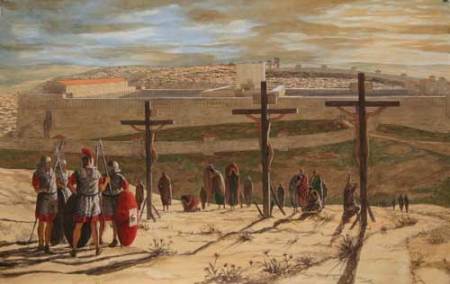
From history, we know that our Lord Jesus Christ died because He was condemned to death by the Jewish authorities who handed Him over to the Romans to be executed. He was put to death, because he said He was the Messiah, the Son of God, the one to whom God had given the power to judge all men. This statement was considered blasphemy, so the Sanhedrin said that He had to die. The Sanhedrin closely followed the teachings of Moses. They did not believe that Jesus was the Messiah. Throughout the history of Israel, the prophets often had to suffer injustices in order to carry out the mission God had given to them.
On Wednesday night, I talked about many of the people who were against Jesus. They inflicted very much pain and abuse on Jesus. Today, I want to remind you of the people who loved, trusted, and followed Jesus through His life and to His death.
The Blessed Virgin Mary
Jesus’s Mother was the most faithful of His followers. From the Annunciation to the Crucifixion of her Son, Mary can be seen as God’s ultimate validation of free will. She was obedient to God when He sent the Angel Gabriel to her. She was a very young woman, but her faith in God was strong. She was willing to do whatever God asked of her. She and St. Joseph were very loving parents. They protected Jesus from His birth, and during His years of growing to manhood. They taught Him and took him to the temple, where He learned the Jewish laws about God.
St. Joseph died before Jesus began His public ministry, but Mary continued to follow Jesus to His death. Mary was actually His first apostle. She was the first human to kiss the face of God and the first to believe in Jesus as her Savior. She was the first Christian. She was also probably the only disciple of Jesus who never left his side or doubted Him. She stayed and accepted to the very end, even as Jesus died on the Cross. Down through the ages, the weeping Mary of the Cross witnessing her son’s torture and death stands in solidarity with all believers who also suffer and live under the shadow of the Cross. Can you imagine how Mary felt watching her child die such a terrible death? She was helpless and all she could do was watch. She stayed at the foot of the Cross until the end. She never left all morning and was there in the afternoon when Jesus took His last breath. When His body was taken down from the Cross, she followed Him to the grave. She wanted to stay with Him as long as possible, even though it hurt her to watch Him suffer. Mary loved her son so much, she did not want to leave Him even after He died.
As Christians, we know we have to accept that suffering and death are just a part of life. It does not make it easier when we are living through it, but we should look to Mary as an example. We can copy her strength and bravery for the sake of our family and do whatever we can out of love, it will help us through those times. Mary showed incredible love, courage, and strength.
Peter the Apostle
St. Peter was a fisherman. He and his brother Andrew, were among the first four disciples of Jesus. Jesus called and they left everything behind, including their boats and fishing equipment. Peter was always a leader. He wanted to protect Jesus and keep Him safe. When Jesus told him that he would suffer and die, Peter would not believe it. When Jesus was arrested in the Garden of Gethsemane, Peter drew his sword and cut the soldier’s ear off. Peter was with Jesus and witnessed all the miracles, including the cure of Peter’s mother–in–law, and in the home of Jairus. He was at the Transfiguration, the Last Supper, and the Garden of Gethsemane. During the passion, he followed Jesus along the road to Calvary. Jesus gave him the keys to make him the head of the church. He was our first pope.
John the Apostle
At the very beginning of his public ministry, Jesus chose John and his brother as His disciples. The two are the sons of Zebedee, a fisherman. Jesus calls them, “Sons of Thunder.” It is a title that James and John earn by their quick judgment of others and eager enthusiasm. The gospels give John a position of importance among the twelve apostles. He is one of the first four disciples called by Jesus.
From the very beginning of his call, John is always with Jesus. He is one of the few who was with Jesus during the public ministry. He is probably one of the few disciples to witness all of the miracles performed by Jesus. During the passion and death of Jesus, John was with Him. He even stayed at the foot of the Cross as Jesus suffered and died.
St. John is also the author of the fourth gospel. His gospel is the only one that tells us that St. John and Mary were among those at the foot of the Cross when Jesus died. As Jesus was dying, He looked down at them and said; “Woman, behold your son!” Then He said to the disciple, “Behold, your mother.” And from that hour the disciple took her to his own home. (John 19:26–27) When Jesus said this, He was actually giving Mary to all of us as our Spiritual Mother. John at the foot of the Cross is a loyal friend. Faithfulness and loyalty are Love.
The Roman Centurion
In the Bible, we are given a glimpse of the roman centurion. He was the commander of over 100 soldiers in the Roman army. He was in charge of overseeing the crucifixion of Jesus. He may have been in charge of arresting Jesus. And he would have accompanied Jesus on the road to Golgotha. He had probably presided over the crucifixion of hundreds or even thousands of men and had probably become insensitive to the agony these men suffered.
The Roman Centurion is mentioned in three of the four gospel accounts. He is not mentioned for his cruelty, but for a marvelous transformation that occurred at the death of Jesus. Most of the men that were crucified were criminals, thieves, and murderers. They cried out in agony and pleaded for their lives. When Jesus died, he knew that this was not an ordinary execution. The darkness, the earthquake, and the cry of abandonment from Jesus convinced the soldiers that this was NOT an ordinary man. The events terrified them. The roman centurion said this man IS TRULY THE SON OF GOD.
The Good Thief
We know from St. Luke’s Gospel, that there were two thieves crucified with Jesus, one on either side of Him. One of the thieves mocked Jesus saying, “Are you not the Christ? Save yourself and us!” But the other thief said to him, “do you not fear God, since you are under the same sentence of condemnation? And we indeed justly, for we are receiving the due reward of our deeds, but this man has done nothing wrong.” Then he said to our Lord, “Jesus remember me when you come in your kingly power.” Jesus replied, “truly, I say to you today you will be with me in Paradise.” (Luke 23:3943) This second criminal has become known to us as St. Dismas, he is the patron saint of all criminals and convicts, especially thieves.
Mary Magdalene
St. Luke’s gospel tells us that Jesus cast seven devils out of Mary Magdalene. He also tells us that she poured expensive perfume over Jesus’ feet as she cried. She dried his feet with her long hair. Mary Magdalene, Mary the mother of Jesus, and several other women followed Jesus on the road to Golgotha, and remained at the foot of the Cross, even following to His burial place. She was a faithful disciple, following Jesus during most of His public ministry, passion, death, and resurrection.
Joseph of Arimathea and Nicodemus
Joseph of Arimathea is described as a good and just man, he was apparently wealthy, and a follower of Jesus. After the crucifixion, he requested permission from Pilate to remove Jesus’ body from the Cross. With the help of Nicodemus, he wrapped the body in fine linen and had it placed in his own unused tomb. These men were both members of the Sanhedrin, the supreme Jewish council. They were secret followers of Jesus. Nicodemus came to Jesus secretly at night to discuss the Jewish laws.
Both Joseph and Nicodemus did a great sacrifice—Joseph gave up his tomb and Nicodemus paid for costly burial spices and ointments. The Gospel of John (19:39) says it was seventy-five pounds, an extraordinary amount. This was an act of love for Joseph and Nicodemus. Two high-ranking religious officials, exhausting themselves to honor their Lord.
The worst night of their lives, when darkness seemed to cover the world, became the dawn of something new. The men and women who witnessed the trial, crucifixion, death, and resurrection of Christ saw more than words could ever express. What they saw in their lifetime, we have seen in the scripture, and the result is amazingly the same. We may not have seen Him physically, but we see Him in our Faith.

 Parishable Items