Archive for October 22nd, 2023

God & Government

October 22, 2023

29th Sunday in Ordinary Time
By Fr. Chinnappan Pelavendran

We generally hate to pay taxes, dues, and tithes. The rich and the poor both complain about taxes. We pay taxes to the government because the government maintains the infrastructure we enjoy and provides security for us. We are expected to contribute for other purposes, such as education and social services. However, we might forget that it is in the world of God that we live, move, and have our being: God is the universal King whose Kingdom does not have boundaries.

While we give respect to our president, we give honor, glory, and worship to God because He is the source of all power. The image of Caesar or the image of great men and women is found in our money, but the image of God is found in the souls of each one of us. The president, the prime minister, and every leader of the state belong to God.

The first reading teaches us about the relationship between God and Cyrus. He was the Persian king who conquered the Babylonians, who had taken the Israelites into captivity. Even though Cyrus did not know God, God worked through him. Talking to Cyrus through the prophet Isaiah, God says, “It is I who arm you, though you know me not, so that toward the rising and the setting of the sun men may know that there is none beside me. I am the Lord, there is no other.” (Isa 45:5-6) When the time came, King Cyrus allowed the Israelites to return home and he helped them to rebuild their temple. A very powerful king falls under the providence of God. God is working through him.

In the second reading, St. Paul, who was of course a great missionary, along with his friends Silvanus and Timothy, gives thanks to God for the Christians in Thessalonica. He tells the Thessalonians, the role of the Holy Spirit in their missionary work. “For our gospel did not come to you in word alone, but also in power and in the Holy Spirit and much conviction.” (1st Thess 1:5)

We know that Jesus the Son of God came into this world with a mission. Part of that mission was to teach us the truth about our relationship with God. In today’s Gospel, we see that Jesus was aware that the Pharisees and the Herodians were trying to trip him. Jesus gave the perfect answer to their difficult question. Jesus makes it clear that both political and religious obligations can be legitimately met. Paying taxes does not compromise one’s duties to God. Nor does serving God exempt one from civil responsibilities.

As Christians living in the world, we must respect our civil authority because in this way we cooperate with God’s plan. We give to Caesar by honest payment of taxes, voting in elections, serving in the military, obeying the law, and participating in public life. At the same time, we belong to God. We are celebrating World Mission Sunday today; it is our duty to preach the Good News to his people. This, too, is part of God’s plan.

The greatest way that we give back to God is to offer ourselves totally and completely for the service of God and our neighbor. There is nothing as great as offering ourselves to him who gave himself for us. God is generous to us, He gives us everything—even His own Son, “For God so loved the world that He gave His only Son.” How generous are we to God?
“Whose Image?”

October 22, 2023

29th Sunday in Ordinary Time
By Fr. Victor Feltes

The Pharisees saw Jesus as an enemy and plotted to entrap through his own words. They sent their followers to him along with some people allied with Herod, the local puppet-king installed by the Romans. If Jesus were to tell people not to pay Roman taxes, King Herod could have him arrested and even executed for sedition. After attempting to soften Jesus up with praises, their trap is set: “Tell us… what is your opinion? Is it lawful to pay the census tax to Caesar or not?

Jesus knew their ill intent. He knows the minds and hearts of all. Jesus loves an honest questioner, because those who seek the true and the good are actually seeking him. But insincere questions like theirs, seeking excuses to condemn or dismiss Jesus, understandably displease him. “Why are you testing me, you hypocrites,” Jesus says, “Show me the coin that pays the census tax.” They hand him the coin and he asks, “Whose image is this and whose inscription?” “Caesar’s,” they reply.

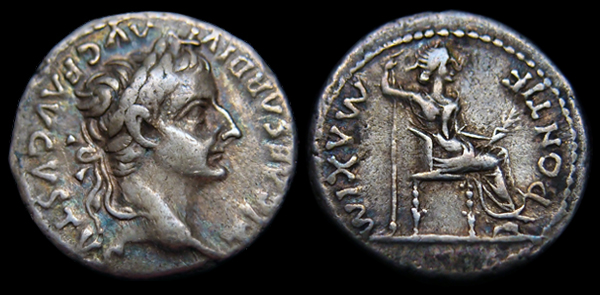
Which Roman coin were they considering? The gospel’s original Greek text tells us that it was “a denarius” bearing Caesar’ likeness and title. This coin, popularly known as “the Tribute Penny,” was most-likely one minted by Emperor Tiberius throughout his reign (14 A.D.–37 A.D.). It depicted a profile of the emperor’s face with the text “Caesar Augustus Tiberius, son of the Divine Augustus.” The reverse had an image thought to be the emperor’s mother, Livia, depicted seated and holding a laurel branch in the likeness of Pax, the Roman goddess of peace.

(It is interesting how that ancient pagan empire was led by a king who professed being the son of a god and honored his mother, a woman linked to peace. Of course, I do not think this means Christianity—with Christ our King, the Son of God, with his holy mother the Queen of Peace—is false, some mere imitation of paganism. I see this as another example of how the demons knowingly and sinful men unknowingly parody true reality in order to take the place of God, grasping at what belongs to him. Yet, God permits these evils in our world in part to prepare minds and hearts to turn to Christ, the King of all.)

What was the value of that silver Roman denarius coin? It was the standard, one-day wage for day laborers in the first century. How much is one of them worth today? Searching online, I found this webpage selling “Tribute Pennies” for prices between $700 and $1,650. Their accompanying images show their varying degrees of wear, yet even though these coins may have been lost for many years, each one still recognizably bears Caesar’s image.

When they handed Jesus one of these ancient coins, he asked them, “Whose image is this and whose inscription?” When they replied, “Caesar’s,” Jesus said, “Then repay to Caesar what belongs to Caesar and to God what belongs to God.” Beyond that historical context, besides any political theories of the relation of Church and state, Jesus is telling us something important through this gospel today.

In whose image are we made? Whose likeness do we bear? By what title are we known? “God created mankind in his image; in the image of God he created them…” And we are proud to bear the name and title of “Christian.” Always remember: even if you have ever been mistreated or neglected, or have been worn-down by your chosen sins, even if you have been lost for years like one of those Roman coins, you still bear the likeness of our Creator and have enduring, precious value. You belong to God; give yourself to him.