Archive for November 5th, 2023

Humility & Service

November 5, 2023

31st Sunday in Ordinary Time
By Fr. Chinnappan Pelavendran

This week’s readings offer a clear invitation to all of us to be humble and give loving service to God and others. To help us reflect on the readings and understand their context, let us recall some of the history of Israel. God the Father gave the Law through Moses and appointed him the Law’s official teacher. Moses handed his responsibility to Joshua, Joshua transmitted it to the elders, and the elders passed it down to the next generation. From them, the scribes and Pharisees received the Law, and the authority to teach and interpret it to His people. Their duty is to interpret the true meaning of the Law to his people.

In the first reading, then, God expresses his personal love towards Israel. However, the people of Israel did not respond to his divine love. Both the people and the priests had become prideful. For this reason, God was angry with the people of Israel at the same time, they had also become sinful in their lives, walking away from the righteousness of the Lord.

We have a different example in St. Paul, who, in our second reading today tells us his description of his humility among the Thessalonians, that he was a caring and dedicated leader. He tells them that he worked day and night while preaching the gospel. He was not trying to impress them or gain anything from them. Thus, he was giving to people not simply human words but the words of God. St. Paul is truly a great example, putting into practice what Jesus teaches today: “The greatest among you must be your servant.

In today’s gospel, Jesus affirms the leadership of Pharisees and Scribes. He tells His disciples to obey and respect them but not to follow their example. What they say is true so follow them, but in practice, they are misusing their authority for the sake of their selfish advantage. So, do not imitate their example. Authority is entrusted to us by God not to dominate or exploit others but for humble service to others. The Scribes and Pharisees had lost sight of this.

On the other hand, Jesus and Mother Mary are two great examples of humility and service. Mary said to the angel Gabriel, “Behold the handmaid of the Lord. Be it done unto me according to your word.” (Luke 1:38) When Mary consented to become the mother of Jesus, she ran the risk of being stoned to death because that was the penalty for an unmarried mother. Therefore, Mary, in her humility and desire to serve God. Mary is a model of humility and service for us. She is a model of giving and not counting the cost.

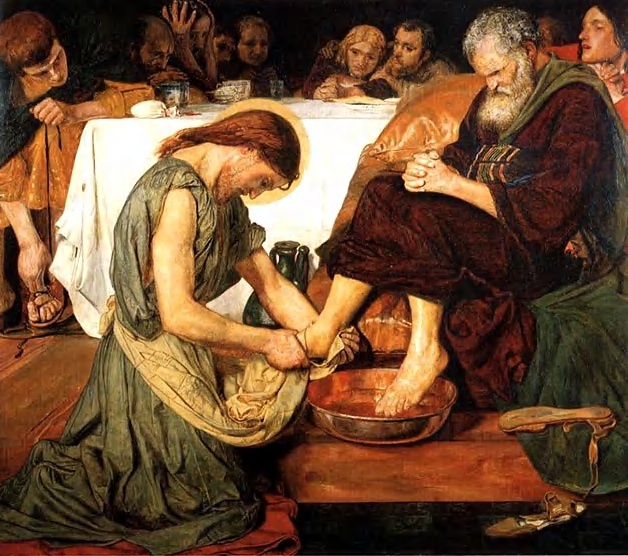
Jesus is our other greatest model of humility and service. In Gethsemane, in prayer, Jesus let go of his human will and submitted to the will of his Father. “Not my will but yours be done.” (Luke 22:42) Crucifixion was the form of the death penalty for common criminals at that time in the Roman Empire. Jesus was executed as a common criminal. He knew that this was the sort of death that awaited Him. However, through his death, he won life for us all. The Son of Man came to serve, not to be served.

Humble people are happy because they accept themselves for who they are – children of God. They are willing to learn and willing to serve. Are you a humble person?
Call No Man “Father”?

November 5, 2023

31st Sunday in Ordinary Time
By Fr. Victor Feltes

Today’s gospel understandably prompts a question. Jesus says, “Call no one on earth your father; you have but one Father in Heaven.” So why are Catholic priests called “Father”? Some non-Catholic Christians object to calling Catholic priests “Father” and abstain from doing so. However, I have never witnessed anyone similarly object to using the title “father” for their own beloved, male, biological parent. Jesus also says, “Do not be called ‘Rabbi,‘” and “Rabbi” means “Teacher,” yet every Christian school is staffed by “teachers.” Does Jesus intend us to take his words here literally or is he teaching us something deeper?

It is good to use Sacred Scripture to interpret Sacred Scripture, since the Holy Spirit inspired every passage and, rightly understood, God’s Word will not contradict itself. When we read the New Testament we see many men referred to as fathers. The 1st Letter of St. John says, “I write to you, children, because you know the Father. I write to you, fathers, because you know him who is from the beginning.” St. Paul writes in his Letter to the Romans about “our father Abraham” and “our father Isaac.” The Holy Spirit also inspired St. Paul in his 1st Letter to the Corinthians to call himself a spiritual father to those Christians. He writes, “Even if you should have countless guides to Christ, you do not have many fathers, for I became your father in Christ Jesus through the gospel.” St. Paul similarly says in his Letter to Philemon, “I urge you on behalf of my child Onesimus, whose father I have become…” So we see that it can be fine to call some living or deceased men fathers. It can even be good to call yourself someone else’s father. So what does Jesus mean to warn us about by teaching, “Call no one on earth your father”?

Today’s gospel says Jesus was speaking to the crowds and his disciples about the authority and the flaws of the scribes and the Pharisees. In the ancient world, teachers would teach seated. For instance, Jesus sat down to give his Sermon on the Mount and sat in Simon Peter’s boat to preach to people gathered onshore. Ancient rulers reigned from chairs called thrones, so Christ is now “seated at the right hand of the Father.” Jesus said the Jewish scribes and the Pharisees had “taken their seat on the chair of Moses.” Before the establishment of the Church they apparently possessed legitimate authority to teach. “Therefore,” Jesus said, “do and observe all things whatsoever they tell you, but do not follow their example. For they preach but they do not practice.

Jesus noted these teachers’ lack of concern for others: “They tie up heavy burdens hard to carry and lay them on people’s shoulders, but they will not lift a finger to move them.” He noted their vain egotism: “All their works are performed to be seen. … They love places of honor at banquets, seats of honor in synagogues, greetings in marketplaces, and the salutation ‘Rabbi.’” Instead of this, Jesus teaches us: “The greatest among you must be your servant.”

We who are fathers, or teachers, or who have any role of authority must remain humble. We are not flawless or perfect. We are not the Lord, our God. We are not given authority over others in order to serve ourselves. Jesus says, “Whoever exalts himself will be humbled; but whoever humbles himself will be exalted.” Resemble Jesus Christ in this and your reward will resemble his. Christians must also remember that our fathers, our teachers, and all people in roles of authority on earth are not perfect. Even if they are trying their best, they are not the Lord, our God. Even popes, preserved by the Holy Spirit from teaching errors “ex cathedra,” can still misstep as shepherds in their words and actions.

A faithful leader is a great blessing; promoting truth, and love, and righteousness within their sphere of influence. That is why it is so important for each of us to be good servant-leaders. But we must not make idols of ourselves or others, as if we were perfect, this world’s savior, or the source of every good. We have only one such Good Teacher. We have only one such Father, in Heaven. And we have only one such Master, Jesus Christ our Lord, who is worthy of our absolute trust and devotion.