Archive for August, 2024

Journeying With Jesus — Funeral Homily for James “Jim” Eder, 73

August 26, 2024

By Fr. Victor Feltes

Of all the Old Testament Psalms, the most famous is Psalm 23 by King David. King David writes, “The Lord is my shepherd,” and describes himself as a cared-for sheep in God’s flock. King David’s greatest descendant, Jesus Christ our Lord, goes on to declare, “I am the good shepherd.” However, St. John the Baptist proclaims on more than one occasion that Jesus is “the Lamb of God.” The presiding priest proclaims the same at every Mass. So Jesus Christ is both a sheep and our shepherd.

Amongst the New Testament Gospels, the most famous section may be Jesus teaching his Sermon on the Mount. And the most famous portion of the Sermon on the Mount is Jesus’ opening: the Beatitudes. “Blessed are the poor in spirit… those who mourn… [and] the meek… those who hunger and thirst for righteousness… the merciful… the clean of heart… the peacemakers… those who are persecuted for the sake of righteousness.” In these blessed statements, Jesus presents a portrait of people in this world who are well-aligned with the Kingdom of God. Christ’s Beatitudes describe his Christian saints, but they also describe Jesus Christ himself.

Jesus Christ is not only our teacher and Lord; he is also our Christian role-model. And Jesus is not only our shepherd, but also a lamb who understands us. So even as we walk through sad valleys in the shadow of death, like this passing of our brother Jim, we are not afraid. Jesus is at our side, guiding us and giving us courage; he has walked this path before us.

Jesus has become one of us; was born and lived among us. St. Paul notes “it is Christ Jesus who died, rather, was raised, who is also at the right hand of God and [now] indeed intercedes for us.” Jesus is that much on our side; so much in our favor. Such is his goodness and kindness. Such is “the love of God in Christ Jesus our Lord.”

He spreads a table before us. He anoints our heads with oil. His blessing cup overflows all the days of our lives. He invites us to dwell in this his house for years to come – until the day he calls each of us by name, just as he has called Jim before us. Let us pray for Jim and one another, that following our Lord we may be led to the place where we will journey no more and restful peace never ends.

The Holy Family Get Together

August 25, 2024

21st Sunday of Ordinary Time
By Deacon Dick Kostner

Today’s scripture readings from St Paul and St John give to us the meat and potatoes of how we gain salvation and the gift of heaven using the sacrament of Marriage for us to understand what we are called to begin and develop and that is a relationship with Jesus the “husband” and His Church, the “wife” the earthly body of Christ.

I requested from Fr. Victor, the opportunity to preach this message of direction because I chose St. Paul’s Letter to the Ephesians as a scripture reading when Barb and I were married 54 years ago. I must confess that I picked it not because of its intrinsic message about Jesus and His bride the Church but rather that I was just having fun with my Bride showing her that God has willed it that wives must be subordinate to their husbands “in everything” , for husbands are “the head of their wives”. Oh I didn’t disagree with the second part, that husbands are to “love their wives,” but it took me years before I realized the importance of how God gives wives a “get out of jail card” from being subordinate to their husbands in everything, the answer is, because of their husbands love for their wives.

Paul uses marriage to show us that God is not a dictator over us. Oh, God has power over us, but always qualifies that power over us because of His great love for his bride, the Church. The Church being “us.” We are Jesus’ bride. The bride he was willing to suffer for and even die for so that we could be with him for all eternity. That is why he desires not to rule over us but rather asks that we love him as much as he loves us, always putting the well being of his spouse over the wishes he has to have a relationship and desire to be with them for all eternity.

All married couples have disagreements. All married couples suffer disappointments with some things their spouses fail at. But the glue that allows us to accept imperfection is love.

Now lets move to our Gospel and the foods that will allow us to live. It doesn’t take a masters degree to know that if we don’t eat foods that we will perish. The body has to be fed in order for us to exist and grow in strength and health. But Jesus is trying to tell us that we are more than a body. Remember the scripture readings that tells us that God knew us before we were born? We are more than body we are each gifted with a spirit which does not have a body but is even more important to have life. Life that does not know death or governed by time. That is what Jesus is talking about. The Spirit like the body, needs food to live and mature. Jesus is telling his followers that he is the food and water that will allow the spirit within us to grow in love for him and his Church. We need him as food to grow in spirit with not only him but with his Church family.

Two people I have always looked up to for wisdom were Barb’s mom and dad Barb’s mom always looked forward to having family “get togethers”. It was there that we got to know Uncles, Aunts, nieces and nephews of our in-law’s, and yes some out-laws. As she got older we would hear her say more and more often: “We need to have a get together!

When Jesus is talking about him as food he is telling us of the importance of coming together as family to get updated on each other and to form a bond with our spiritual brothers and sister and with our God who offers to make the food for us to enjoy at the Holy Family “get together”. This is the food that will allow us to be happy in this life with family support for the challenges of life, and to grow in knowledge and wisdom by celebrating the Eucharist with our spiritual brothers and sisters and people we grow in love with.

Our gospel tells us that without the spiritual food of Jesus our spirit will not grow in love for him and the family of God and when are bodies witness death we will not want to spend all of eternity with people we never got to know or found need of when times got challenging. Bottom line folks: The greatest fear for us to overcome in this life is in not the fear of a earthly death but rather to face Jesus after this life when all meet Jesus face to face and have him come up to us and say, “Hi, my name is Jesus and this is my family, and what is your name?

Let me end with a thought for you to ask from Jesus above: “Jesus, if you knew me before I was born tell me what your plan is for me to help bring your Kingdom to the world I was born in?” Jesus tells us that our earthly life is short! How about we have a Holy Family “get together” with Barb’s mom and your family here every Sunday at Church? No need to bring anything but yourself and maybe a friend.

P.S. Jesus said he will bring the food and the entertainment.

The Importance of Obedience

August 24, 2024

21st Sunday in Ordinary Time
By Fr. Victor Feltes

Jesus agreed to come and cure the servant of a Roman centurion, but the centurion replied, “Lord, I am not worthy to have you enter under my roof; only say the word and my servant will be healed. For I too am a person subject to authority, with soldiers subject to me. And I say to one, ‘Go,’ and he goes; and to another, ‘Come here,’ and he comes; and to my slave, ‘Do this,’ and he does it.” This Roman centurion had commanding officers above him and soldiers and servants under his own command. He had carried out others’ orders and with authority he had given orders to others. This Roman centurion had faith that Jesus of Nazareth, this Jewish rabbi, was God’s servant and prophet — perhaps even the Christ — with authority over angels or the elements of creation. Jesus is under authority and possesses authority, through which God’s will is done. He told his Father, “Not my will but yours be done.” And he tells us, “You are my friends, if you do what I command.” We are called to obedience to legitimate authority and Jesus speaks to us in and through his Church.

During my ordination as a diocesan priest, I placed my wrapped hands inside the hands of my bishop in accordance with the rite. Bishop Listecki asked me, “Do you promise respect and obedience to me and my successors?” I responded, “I do.” I hold this obedience very seriously. In the areas of our bishop’s proper authority, what the bishop wants me to do is what Jesus wants me to do. Of course, I should share with the bishop my input and feedback because consultation helps him to make better decisions. And if the bishop were ever to command me to sin, that command would be unlawful and should be ignored. But I believe what the Church, or canon law, or our bishop commands me to do, that is what Jesus wants me to do.

The saints strongly advocate for holy obedience. Pope St. Gregory the Great taught, “Obedience is rightly placed before all other sacrifices, for in offering a victim as sacrifice one offers a life that is not one’s own; but when one obeys one is immolating one’s own will.” The Diary of St. Faustina Kowalska records Jesus telling her, “My daughter, know that you give me greater glory by a single act of obedience than by long prayers and mortifications.” And St. Francis de Sales said, “The Devil doesn’t fear austerity but holy obedience.” And there are many other quotes from the saints which commend holy obedience.

This brings us to our second reading from St. Paul’s Letter to the Ephesians. I have never been married, but as a priest and a pastor ‘I too am a person subject to authority, with persons subject to me,’ and I know that without obedience no house can function well. St. Paul writes, “Be subordinate to one another out of reverence for Christ. Wives should be subordinate to their husbands as to the Lord. For the husband is head of his wife just as Christ is head of the Church, he himself the Savior of the Body. As the Church is subordinate to Christ, so wives should be subordinate to their husbands in everything.” In other words, allow your husband to lead you and your family. Your input and feedback are very important in forming good decisions, and your husband has no authority to practice or command sin, but he does possess legitimate authority to lead. And “husbands, love your wives, even as Christ loved the Church and handed himself over for her to sanctify her… that she might be holy and without blemish.” In other words, you are commanded to love and serve, sacrificing for your wife and family, as Christ does for his Church.

Many of Jesus’ disciples listening in today’s Gospel said, “This saying is hard; who can accept it?” Jesus asked the Twelve, “Do you also want to leave?” And Simon Peter answered him, “Master, to whom shall we go? You have the words of eternal life.” And so it is for us. Sometimes what we are told may be difficult to hear, sometimes obedience or service will be hard, but to whom else shall we go if we are unwilling to trust and obey our Lord? He has the words of eternal life.

Sharing His Real Presence

August 12, 2024

19th Sunday & 20th Sunday in Ordinary Time
By Fr. Victor Feltes

All four Gospels recall the miracle of Jesus using five loaves and two fish to feed five thousand people. But only John’s Gospel records what Jesus taught the following day in Capernaum. The Gospels of Matthew, Mark, and Luke all quote Jesus’ Last Supper declaration “This is my Body.” But John’s Gospel, written after them all, clarifies what these words mean.

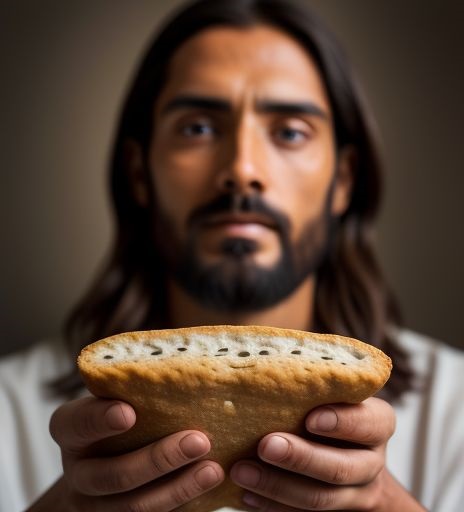
Today we hear from the sixth chapter of John, where Jesus says, “I am the bread that came down from heaven.” Some in the synagogue congregation murmur, “Is this not Jesus, the son of Joseph? Do we not know his father and mother? Then how can he say, ‘I have come down from heaven’?” Jesus of Nazareth was the son of Mary and the adopted son of Joseph, but Jesus also truly came down from God his Father in heaven. The people did not yet understand how what Jesus said was real.

Jesus then goes on to say, “I am the living bread … whoever eats this bread will live forever and the bread that I will give is my flesh….” The people quarrel among themselves about this, “How can this man give us [his] flesh to eat?” They envision something grotesque, but once again what Jesus said was real in a way his hearers did not yet understand.

In retelling Jesus’ response to this objection from the crowd, John’s Gospel repeatedly employs a Greek verb for eating which is more intense than before — a word which does not mean merely “to eat” but “to chew, or gnaw.” In other words, Jesus preaches:

Whoever [gnaws] my flesh and drinks my blood has eternal life, and I will raise him on the last day. … Whoever [chews] my flesh and drinks my blood remains in me and I in him. Just as the living Father sent me and I have life because of the Father, so also the one who [gnaws] on me will have life because of me. … Unlike your ancestors (during the Exodus) who ate (bread from heaven) and still died, whoever [chews] this bread will live forever.

Jesus does not intend to make his followers cannibals by feeding them a portion of his dead or detached flesh. Jesus would offer them his entire living self as food: his body and blood, soul and divinity. “Take this, all of you, and of eat it, for this is my body.” His Church has kept his commandment to do this in memory of him every Sunday throughout the centuries since.

Today, some Christians say, “This meal is only symbolic.” There is some symbolism present in the Eucharist: to separate a body from its blood and then reunite them is a symbol of death and resurrection. Jesus’ coming to us as food speaks to how essential receiving him in this sacrament is for our spiritual life. (“Amen, amen, I say to you, unless you eat the flesh of the Son of Man and drink his blood, you do not have life within you.”) And Jesus taking on the appearances of bread and wine reflects his wish to be one with us in both the ordinary and the exceptional. (“Whoever eats my flesh and drinks my blood remains in me and I in him.”) The Eucharist contains symbolism but the Eucharist is not just a symbol.

We are not idolaters. We do not worship bread. We worship Jesus Christ in the Eucharist. This is the teaching of the Sacred Scriptures. This is the faith of the early Church. This is a wonder confirmed by miracles. This is our Most Blessed Sacrament. This is Jesus, the joy of the saints.

At Capernaum, when Jesus’ disciples first hear him preach about this “Bread of Life” which is his flesh, many of them murmur, “This saying is hard; who can accept it?” Jesus replies, “Does this shock you?” They doubted if he really came down from heaven, so he asks, “What if you were to see the Son of Man ascending to where he was before? (Which is something Jesus went on to literally do.) … The words I have spoken to you are Spirit and life.” Jesus does not retract his teaching, and verse John 6:66 records that “as a result of this, many of his disciples returned to their former way of life and no longer accompanied him.” Jesus turns to his apostles and asks, “Do you also want to leave?” And St. Peter responds with trusting faith, “Master, to whom shall we go? You have the words of eternal life.

Notice how Christ did not immediately chase down those departing disciples. Like the father of the Prodigal Son who ran from home, Jesus’ great love was unable to keep them close to him that day. But Jesus hoped that time, God’s grace, and the welcoming witness of his disciples would bring them back to his Holy Communion someday. Does the disunity of Christians and waywardness of the world trouble you too? Jesus wants us to be his welcoming witnesses today.

Having encountered the goodness and love of Jesus, having received him in the Eucharist, invite others to his Church. Pray for souls and tell them the difference being a Catholic Christian makes in your life. Share good homilies, articles, videos, talks, your favorite prayer devotions and saintly heroes. Pray for and invite your family, friends, coworkers, neighbors to come to Mass with you, and when you see new faces here help to make them feel welcome. Our parish classes for becoming Catholic (for those above the age of reason who want to be baptized or confirmed and be received into the Church) begin next month. Now is the time to encourage people to consider registering, even if only to come, see, and learn more. You possess a great treasure it costs you nothing to share. So invite others, as our psalmist says, to “taste and see the goodness of the Lord.”

Controversies & A Sign

August 3, 2024

18th Sunday in Ordinary Time
By Fr. Victor Feltes

Some of the people who were present at the feeding of the 5,000 caught up with Jesus and his apostles at Capernaum. Jesus told them, “You are looking for me not because you saw signs but because you ate the loaves and were filled.” If Jesus’ sign had generated proper faith in them they would be seeking him for what he might reveal from God. Instead, they were led by their desire for more free bread. Jesus redirects them to himself: “Do not work for food that perishes but for the food that endures for eternal life, which the Son of Man will give you.” They said, “Sir, give us this bread always.” And Jesus replied, “I am the bread of life; whoever comes to me will never hunger, and whoever believes in me will never thirst.

Though I do not own a TV, I do follow news and entertainment through the internet, yet you may have noticed that I rarely preach on current events. Most of what fills the 24-hour news cycle today is forgotten by next week. And even when its reports are important it’s rare that they impact the lives of you or me very much. With continuous controversy, it’s easy to denounce what’s bad without actually doing any good. It keeps you focused on the affairs of others without growing in prayer or virtue. The spiritual enemies of your soul want you to be endlessly anxious, angry, distracted. The demons want you fixated on passing things instead of holding fast to the good things which ever endure. But today, I would like to highlight a recent event I take as a sign pointing to Christ.

The opening ceremony of the Summer Olympics featured a scandalous likeness of the Last Supper. The Catholic bishops of France called it “outrageous and provocative.… scenes of derision and mockery of Christianity, which we deeply deplore.” This Saturday, the Vatican issued a brief statement criticizing it as well. Why does God hate blasphemy and sacrilege? Because those sins are so harmful to us. Belittling God and holy things, treating our Lord’s name like excrement or a joke, creates obstacles to people knowing and loving God. Christian leaders were right to denounce that display being broadcast on a world stage. However, I would not be mentioning the Olympics’ sorry transgression — which reflects particular errors of our time — if not for a sign which occurred the following night.

Last Saturday, July 27th, shortly before midnight, four administrative districts in the city of Paris experienced a blackout. For up to ten minutes, French cultural landmarks in “the City of Lights,” including the Louvre Museum, the Paris Opera, parts of the Arc de Triomphe, and the Moulin Rouge cabaret, went dark. The French power company told reporters this brief power outage affected nearly 85,000 customers. What was most striking about this event was captured in images which quickly spread across social media. Shining on a hill as the tallest and most visible building in the city, The Basilica of the Sacred Heart remained lit amidst the darkness surrounding it. That beautiful church’s construction began and in 1891 as an act of reparation, as penance for sins of France which had led to national disasters.

That moment last Saturday night was a sign to the world for anyone with eyes to see it: that in the darkness of our times there is one Light for us to turn to. So do not obsess over bread and circuses which perish, and do not lose hope. Focus rather on the Light, the Bread of Life, Jesus Christ, who gives life to the world.