Archive for November, 2024

Our Advent Traditions

November 30, 2024

1st Sunday of Advent
By Fr. Victor Feltes

Jesus Christ’s Church has “Big T” Traditions and “small t” traditions. The first kind (“Big T” Traditions) are Sacred Traditions which come to us directly from Jesus and his Apostles. They belong to the unchanging Deposit of Faith entrusted once-for-all to Christ’s Church. The second sort (“small t” traditions) are the Church’s customs. For instance, how we celebrate the Advent season along with our Advent wreath are among those “small t” traditions.

The Bible details the historical events of Christmas and Easter, but it is interesting to note that the New Testament never explicitly teaches we must commemorate Christmas or Easter on specific days each year. And that is OK. Jesus Christ’s Church was never meant to be a strictly “Bible alone” Church; she existed even before the New Testament was compiled. The Holy Spirit dwells in her, preserving her from denying the Deposit of Faith and guiding her ways (as the Book of Acts says) as it ‘seems good to the Holy Spirit and to us.’ Let’s consider the customs and traditions of this new Advent season and its Advent wreath.

Over the next month, our predominant liturgical color is purple or violet. Old, black, Roman vestments used to gradually fade towards purple because of the inferior dyes they used. And so, over time, purple became a customary penitential color for the Church. Though less intensely than in Lent, we spiritually discipline ourselves during Advent preparing for the coming of Christ – both at Christmas and at his return in glory. It is fitting what we prepare for our King’s arrival with purple cloth, for purple in the ancient world was the most expensive color to dye, it was the color of cloths worn by kings. This season, we are preparing for the coming of the King of Kings.

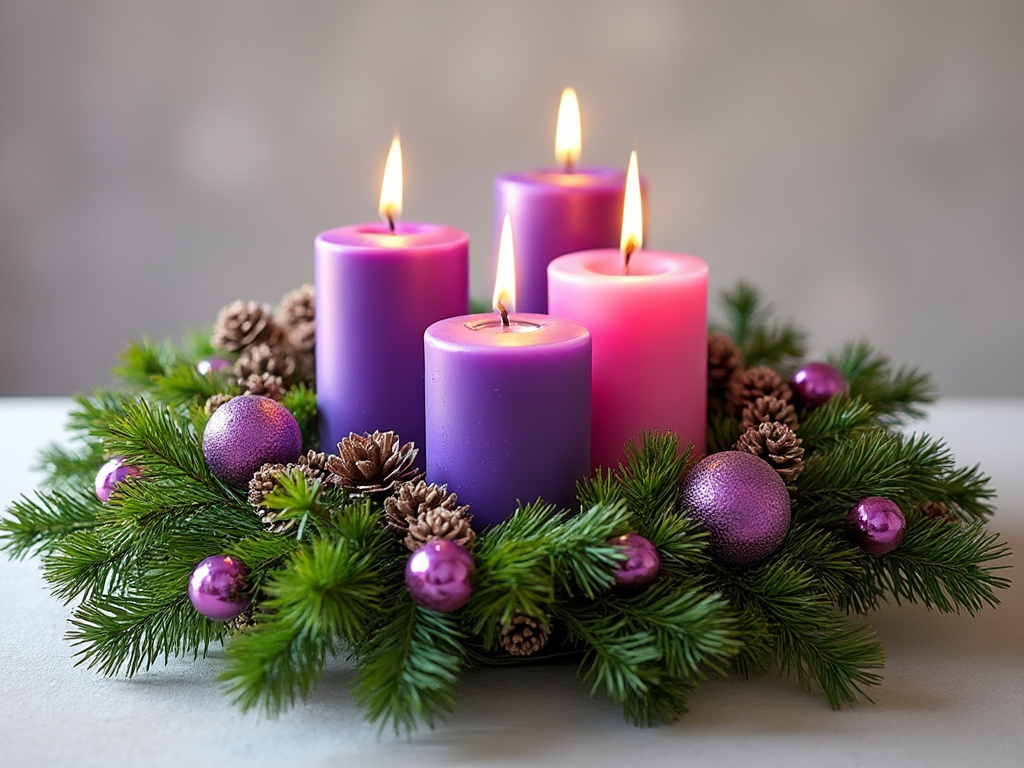
We mark this season’s Sundays with our Advent wreath: four candles amidst a circle of evergreen branches. These evergreen branches, still green during the dead of winter, symbolize eternal life. The circle symbolizes recurrence and eternity. And though we celebrate Advent and Christmas each year, these four candles remind us we look forward to definite end, a final fulfillment – not only December 25th, but the Last Day.

This world will not just be the same unsatisfying stuff forever. Christmas, Jesus’ birth at the center of history, changes our hopes. We light an additional candle each Sunday because Christ is coming. As the winter world darkens around us, we add these lights. They shine in the darkness and the darkness does not overcome them. We light these candles because we know the true Light which enlightens all men, the Word become flesh, has come and is coming into the world.

Beware,” Jesus says in our Gospel reading, “that your hearts do not become drowsy from carousing and drunkenness and the anxieties of daily life, and that day catch you by surprise.” Advent is our time for preparation for the coming of Christ. As St. Paul writes to the Thessalonians, “May the Lord make you increase and abound in love for one another and for all… so as to strengthen your hearts, to be blameless in holiness before our God and Father at the coming of our Lord Jesus.”
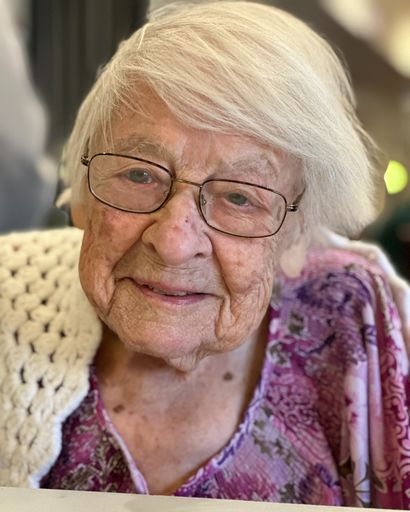
Prepared For Heaven — Funeral Homily for Verna Klemish, 105

November 26, 2024

By Fr. Victor Feltes

Verna was born in 1919 and grew up during the Great Depression. Like many who survived that national trauma, Verna had a tendency to keep and value everything. Always frugal and never borrowing, when she would go along on local bank-sponsored trips to the casino, she would return home with her free, unopened roll of quarters. What do we value in this life and how do we let go?

Verna fell in love and married Vernon in 1943, and their love was fruitful in their children. They were married some 40 years, and then Verna live as a widow some 40 years more. Verna taught in many rural schools, beginning in the days when stove fires had to be tended and water had to be carried in to teach eight grades together in one room. Going into the 1970s, just when Verna thought she had retired, a carload of nuns came to her house begging her to teach at St. Paul’s School. For love of God and neighbor, Verna changed her plans and taught for a couple years more.

Verna has lived her Catholic faith. She was one of St. Jude’s founding members, having worshiped at Mass in a New Auburn garage until the church was built in 1965. Almost 40 years later, when St. Jude’s Parish was suppressed Verna merged into St. Paul’s Parish as well. She was always faithful to Sunday Mass, to adoring our Lord in his Eucharist. And when she could no longer attend Mass in person she would watch Christ’s sacrifice on television – and her family learned not to call her during the service.

Verna drove a car into her 90s. Eventually, she made the decision to quit driving on her own, because of low visibility. The problem wasn’t her eyesight, her eyesight was fine — it was that she could no longer see over the steering wheel. In old age, her heart began to fail. When she became in need of a pacemaker at age 99, she had a decision to make. Her doctor asked her, “Do you want to see 100?” She considered and discerned and answered, “Yeah, let’s do it. I want to see 100.” Verna would live on this earth to age 105. She passed away one week ago, about half an hour after receiving the Last Rites. She was finally ready to let go.

St. Paul writes, “The One who raised the Lord Jesus will raise us also with Jesus… Therefore, we are not discouraged; rather, although our outer self is wasting away, our inner self is being renewed day by day. For this momentary light affliction is producing for us an eternal weight of glory beyond all comparison…” Sometimes older people, perhaps fatigued by their burdens, have said to me, “I don’t know why I’m still here. Why doesn’t God just take me?” I tell them, “If you are still living here on this earth, it is because God is doing things in you, or through you, or both.

Jesus tells us, “Do not let your hearts be troubled. You have faith in God; have faith also in me. In my Father’s house there are many dwelling places. …I am going to prepare a place for you… [and] I will come back again and take you to myself, so that where I am you also may be.” St. Paul adds, “We know that if our earthly dwelling, a tent, should be destroyed, we have a building from God, a dwelling not made with hands, eternal in Heaven.”

Jesus Christ is not only preparing a place for us above, he is preparing you and me for that place while we are still down here. Through our labors, our sufferings, and our sacrifices, he is growing us in virtue, devotion, and love for God and one another. Remember that God values each of us and he is loath to give up any of us. So pray for Verna, but be happy and consoled, that today she is headed home for Thanksgiving.

Jesus Christ Is King

November 24, 2024

Solemnity of Christ the King
By Fr. Victor Feltes

Today’s psalm says: “The Lord is King, in splendor robed… Your throne stands firm from of old… Your decrees are worthy of trust indeed…” The Old Testament prophets agreed. Isaiah said “the Lord is our King, it is he who will save us.” Jeremiah said our God “is the living God, the eternal King.” And Zephaniah said “the King of Israel, the Lord, is in your midst.” At the center of human history, when Jesus Christ is born among us, he comes as King as well.

Behold, magi from the east arrived in Jerusalem, saying, ‘Where is the newborn king of the Jews?’” And when Jesus rode into Jerusalem, the crowd cried out, “Hosanna! Blessed is he who comes in the name of the Lord, even the king of Israel!” Pontius Pilate unknowing proclaimed this truth when he had a sign placed above Christ’s head on the Cross: “This is Jesus the Nazorean, the King of the Jews.” This Sunday, we celebrate that our Lord Jesus Christ is King of the universe now.

After his Resurrection, when Jesus appeared to his apostles on a mountain in Galilee, he told them, “All power in heaven and on earth has been given to me” and he gave his Church our Great Commission to spread his Kingdom, reassuring us, “Behold, I am with you always, until the end of the age.” This raises a challenging question for us: why is Jesus not visibly doing more now? All power in heaven and on earth has been given to him, so why is he not making more things happen?

His disciples wondered about this, too. Before the Risen Jesus ascended into Heaven, they asked him, “Lord, are you at this time going to restore the Kingdom to Israel?” He answered, “It is not for you to know the times or seasons that the Father has established by his own authority. But you will receive power when the Holy Spirit comes upon you, and you will be my witnesses in Jerusalem, throughout Judea and Samaria, and to the ends of the earth.” The Kingdom of God is among us, and Jesus calls us to work with him to spread it and deepen it, everywhere in everyone.

But why doesn’t Jesus just force everything to be better? As God, he is omnipotent. He has the power to do all possible things. But one thing he cannot do is to force someone’s free “No” into a free “Yes.” When Jesus returns in unveiled glory, coming upon the clouds and flanked by his angels in full-force, humanity’s time for decision will be over. That day will bring the Last Judgment and sin will no longer be given any quarter. After that, there will be only God’s Kingdom and the outer darkness. Now is the time for freely choosing.

Do we desire God’s Kingdom? Around 1000 B.C., the elders of Israel came to the Prophet Samuel asking, “Appoint a king over us to rule us like other nations.” Samuel was displeased they said, “Give us a king to rule us,” but he brought the matter to the Lord in prayer. And the Lord replied: “Listen to whatever the people say. You are not the one they are rejecting. They are rejecting me as their king.” And during Christ’s Passion, Pilate asked the crowd, “Shall I crucify your king?” The chief priests answered for the mob, “We have no king but Caesar.” They were rejecting the Lord as their King. When we pray “thy Kingdom come, thy will be done, on earth as it is in Heaven,” do we really mean what we are saying?

When Pilate asked Jesus if he was a king, Jesus answered, “You say I am a king. For this I was born and for this I came into the world, to testify to the truth. Everyone who belongs to the truth listens to my voice.” Pilate then responds with a line which today’s Gospel reading cuts off. Pilate dismissively replies, “What is truth,” and then turns his back on Truth himself, and walks away. If you desire Jesus as your Savior, you must let him be your Lord.

Advent begins next Sunday—our annual season of preparation for the coming of the Lord. Here are three wise steps for a better Advent. First, his decrees are worthy of trust. Which of his words will you neglect no more but specifically begin putting into practice? Make yourself a short list. Second, make an Advent Confession, for a fresh beginning, a new infusion of grace. And third, pray every day, for you cannot thrive without him. The saints worked wonders in this world by following Christ and doing his will. So can you. The Lord is in your midst. He is the living God, our eternal King. And if we will let him, it is he who will save us.

Do Not Fear The Ending

November 16, 2024

33rd Sunday in Ordinary Time
By Fr. Victor Feltes

The Prophet Daniel says of the end of days, “It shall be a time unsurpassed in distress…” And Jesus foretells, “In those days after that tribulation the sun will be darkened, and the moon will not give its light, and the stars will be falling from the sky, and the powers in the heavens will be shaken.” Many Christians today regard the end times with aversion and dread. Many fear Jesus Christ as judge, as if he were coming to destroy us. And yet, at the conclusion of the Book of Revelation, in response to the One who declares, “Yes, I am coming soon,” God’s people cry out in answer, “Amen! Come, Lord Jesus!

The early Christians saw the arrival of God’s Kingdom for us—either when we die or at Christ’s Second Coming—as Good News. St. Paul the Apostle wrote, “For me, life is Christ and death is gain!” “Jesus Christ is the same yesterday, today, and forever,” and he tells us over and over, “Do not be afraid.” There will be trials before the end, in our own individual lifetimes and in the earthly pilgrimage of the Church, but what comes after this will be much, much better.

Out of fear of escapism, we fail to reflect upon Heaven enough. Great hope comes from having something great you’re looking forward to. Imagine Heaven, where sin will be no more; no shame or temptation; no guilt or condemnation; no ugliness, decay, or corruption; no sickness or suffering; no fear or tears; no pain or death; no more crime or injustice; no more separation from God and his saints. And remember not only what evils are absent in Heaven, but also what supreme goods are found there. In Heaven, there is peace and blessings; praise and rewards; knowledge and wonders; perfection and joys; beauty, delights, and unending love; reunion with loved ones; fellowship with the saints; and complete union with God.

The Prophet Daniel foretold about the Day of Resurrection: “At that time, [God’s] people shall escape, everyone who is found written in the book. Many of those who sleep in the dust of the earth shall awake; some to everlasting life, others to reproach and everlasting disgrace.” Sometimes Christians worry whether or not they are in that Book of Life. I do believe more of us need to be praying, going to Confession, and attending Holy Mass, but I like to reassure people by asking them this: First, what is your greatest desire? Next, what do you think is the greatest desire of a saint? If your answers are similar, then you have the desires of a saint—and that’s a very good sign.

Imagine another person just like you in every way; the same past, all the same strengths and weaknesses as you. What would you think of that person? Could you be friends with them? Do not treat yourself worse than you treat others, but love yourself like your neighbor. Be not afraid and remember that the Lord is preparing you for Heaven because God loves you.

The Widow’s Gift Was Love

November 9, 2024

32nd Sunday in Ordinary Time
By Fr. Victor Feltes

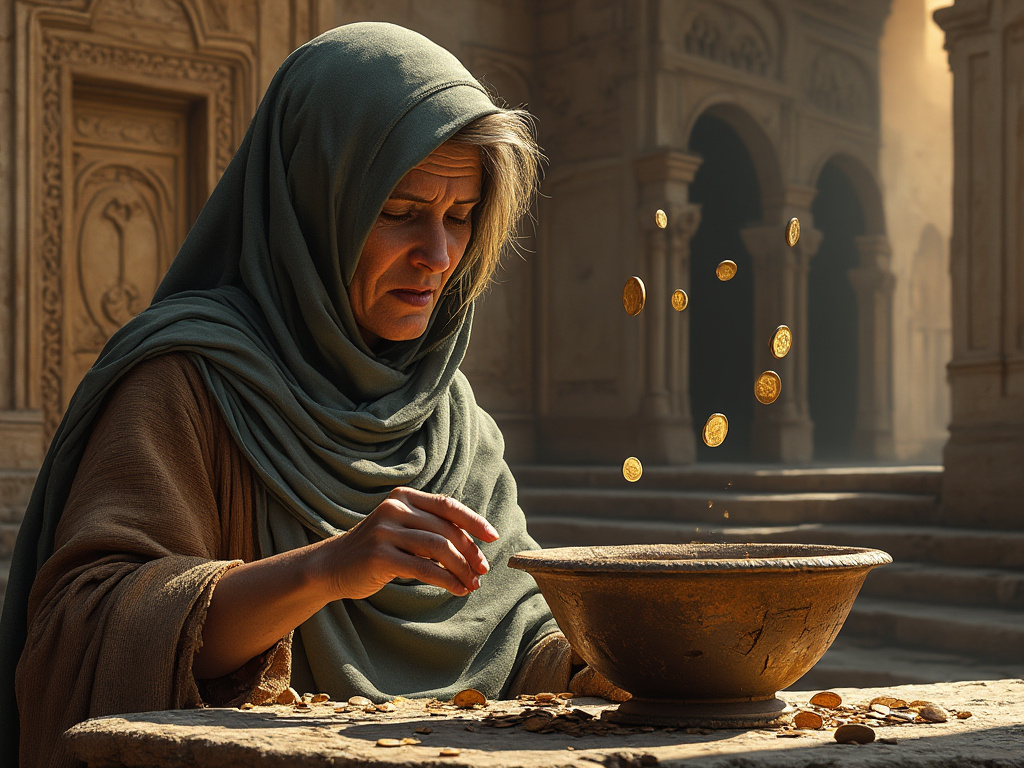
Jesus sat down opposite the temple treasury and watched how people gave money at God’s house. There were thirteen donation trumpets attached to sturdy chests into which people were dropping their contributions. Many rich people were donating large sums, causing loud commotions. But one poor widow’s two small coins went in quietly; a little click-click. Why did Jesus highlight her gift above everyone else’s that day?

Our Father in heaven is rich. He created the universe out of nothing. All things belong to him. Being the Almighty, he does not strictly need anything from us. In the 50th Psalm, God tells his people that he does not rebuke them for their animal sacrifices—he had commanded them to make them—but he notes “every animal of the forest is mine, beasts by the thousands on my mountains. I know every bird in the heights; whatever moves in the wild is mine. Were I hungry, I would not tell you, for mine is the world and all that fills it.” And yet, God insists upon our sacrifices for him.

God places us in a material world in which what we do matters. Whether and how we work and pray, learn and teach, plant and harvest, build and repair, save and donate, visit and invite, feed and clothe and care and love, these things really matter—for good or evil—for ourselves and others. It is true Almighty God could do everything all by himself, entrusting us with no mission and zero responsibility. But then, how would we ever mature and grow as glorious saints? Instead, God chooses to work through us, and with us, and in us. Our holy gifts and sacrifices, inspired and empowered by grace, advance God’s Kingdom while transforming us in Christ. Though, strictly speaking, God has no need of our gifts or praises, he insists upon them for our own good.

When Jesus saw that poor widow give God’s house just two coins worth only a few cents, he called his disciples to himself and said, “Amen, I say to you, this poor widow put in more than all the other contributors to the treasury; for they have all contributed from their surplus wealth, but she, from her poverty, has contributed all she had, her whole livelihood.”

Jesus condemns those who “devour the houses of widows,” but he celebrates this woman’s evident trusting, love for God. Jesus says to beware the scribes who love the robes, the titles, the honored seats at synagogues and feasts, who recite lengthy prayers in order to be seen by men. “They will receive a very severe condemnation,” Jesus says, because their focus is not on love of God and neighbor. That poor, loving widow, however, receives the praise of God. “The last shall be first, and the first shall be last.

As I preached in a homily three weeks ago, hierarchies are normal and natural, though some are better than others. The secular world has hierarchies according to power, wealth, or status. Christ establishes a hierarchy for his Church on earth according to sacramental holy orders. But amongst the Church in heaven, a hierarchy exists according to love. In heaven, God reigns supreme and God is love pouring out for all. There is no money to be had there, the sacraments are no longer needed, and there is perfect, perpetual peace. Greatness above is according to one’s capacity to give and receive love. So whoever wishes to be great in God’s Kingdom must imitate the faithful, self-gifting love Jesus highlights in that widow and which we see modeled for us by Jesus Christ himself.

How you love and what you do matters. In the words of St. Paul, “Let us not become weary in doing good, for at the proper time we will reap a harvest if we do not give up.” “Whatever you do, do it with all your heart as for the Lord … knowing that you will receive an inheritance from the Lord as a reward.” For when Christ comes “he will bring to light what is hidden in darkness and will manifest the motives of our hearts, and then everyone will receive praise from God.”

The Saints Come Marching In

November 3, 2024

31st Sunday in Ordinary Time
Deacon Dick Kostner

Today’s Gospel instructs us of how great a gift God has given us by and through His Commandments the divine rules for us to live a fulfilling life that gifts us with happiness even when we are carrying the crosses of life. Sometimes we think of laws and rules as a restriction on our lives but to our ancestors living during the time of Moses, the Commandments were a blessing for God gave them a road map to the place we call heaven. A way for them to live a life of happiness even during trying times, a life of fulfillment and worth, a true treasure.

Today’s Gospel has Jesus condensing for us God’s directives for us to live full lives of grace through just two great Commandments, two priorities containing for us, all we need to remember and practice during our lives. The First is to love God with all of our being knowing that the Creator designed us before we were even born, to display and represent His body, through a little but powerful directive he desires of His children and that is “Love”. The Second great Commandment, further defines how we are to show our love for God and that is to love our neighbor as we love ourselves.

As I pondered the two Great Commandments given us by the Father, I realized that Jesus during his earthly life, did not stop there. Rather he gave to his followers, to us, the tools necessary to carry out and obey the Commandment to Love God and neighbor, He gave us the Sacraments to allow all of His children the ability to become Saints. They are the building blocks, the steps leading to the House where Jesus and His saints live. Lets look at those tools.

The Sacraments come to us under three headings: Sacraments of Initiation; Sacraments of Healing; and Sacraments of Vocation. The Sacraments of Initiation are Baptism, Confirmation and Holy Communion. It is through celebration of these Sacraments that we are able to form a relationship with God. We become a member of the Holy Family; We mature in Spirituality and are invited to be fed by and become an active body member and spokes person of Gods Family. These Sacraments allow us to trust and learn to love God fulfilling the First Great Commandment. Remember, one cannot love without first gaining knowledge and trust in someone.

That brings us to the Sacraments of healing. As humans we will experience illness and disease God gifts us with the tool to overcome the fear of death and sickness of body through the Sacrament of Anointing of the Sick. It is a Sacrament through which we can be healed of worry and know that Jesus will provide us with strength to overcome the fear of sickness and find peace in knowing that we can be still, and know that God is with us as he was present for Jesus. Sometimes we lack faith and fail to listen or request help from God. A separation of Spirit occurs because of human weakness. Jesus gives to us the Sacrament of Reconciliation to reprogram ourselves and ask for God to forgive us. Through forgiveness and reconciliation, this Sacrament heals our division and we once again are in union with the Holy Spirit and are at peace and learn to form a strong spiritual relationship with God.

Knowing how important it is for us to form relationships with God Jesus gifts us with the Sacraments of Vocation. These Sacraments move us to follow the Second Greatest Commandment and that is to love not only God himself but also all of his Children as we love ourselves. This Commandment requires us to not be served but rather to serve others. For many of us the vocation of Marriage awakens within us the desire and reward that follows to find that we are made in the image and likeness of God and are called to love and serve others more than love of self. Others become more important in our lives than just caring for our selves. Through the Sacrament of Marriage we offer to our spouse and children, our life for them to enjoy and find happiness. We are learning to do what Jesus did for us in offering his human life so that we may find happiness and peace for all eternity.

The Sacrament of Holy Orders is Jesus hand picking a few humans and asking them to give their lives up for the privilege of mentoring his children on how to travel the road to Sainthood by and through the practice of loving and serving the body of Christ as Gods representative. I can remember a few years ago telling Jesus that I would not mind becoming a saint. That is what Jesus calls all of us to be. What we need to remember is sainthood does not bear the requirement of being perfect it only requires love.

Jesus tells us that we need to become as children to enter his kingdom. We need to follow His advice and as our school kids show us this weekend how, “The Saints come marching in!

Blessed are the Clean of Heart

November 3, 2024

31st Sunday in Ordinary Time
By Fr. Victor Feltes

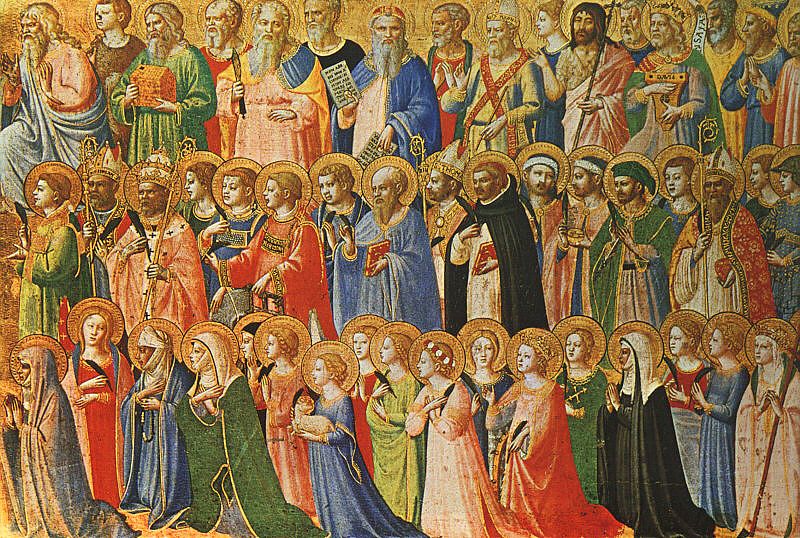
On November 1st, Christ’s Church celebrated all the saints in Heaven. The Gospel reading for that solemnity was Jesus’ beatitudes from his Sermon on the Mount. The beatitudes describe God’s saints, and they describe Jesus Christ himself as well. We are made in God’s image and our Lord grows us into his likeness. This Sunday, I would like to highlight one of those beatitudes: “Blessed are the clean of heart…” Most Bible translations render this: “Blessed are the pure in heart…” What is purity of heart?

Our first thoughts perhaps may go to purity in regards to chastity. Obscene materials and obscene acts are commonly called the opposite of “clean.” Yet human sexuality can be a means of sanctity. The marital embrace is even a constitutive part of one of the seven sacraments Christ gave us. Rightly-ordered chastity is a source of joy and life and holiness. Chastity is part of being clean of heart, but it’s not the whole or deepest sense of this beatitude.

When one of the scribes came to Jesus and asked him, “Which is the first of all the commandments,” Jesus answered with words from Deuteronomy: “Hear, O Israel! The Lord our God is Lord alone! You shall love the Lord your God with all your heart, with all your soul, with all your mind, and with all your strength.” A pure heart does not contain the sludge of sin. It does not willfully coddle an affection for evil. A clean heart is receptive to receive and return holy love.

I believe the Venerable Bishop Fulton Sheen once noted that the Archangel Gabriel addressing and declaring the Virgin Mary “full of grace” points to her Immaculate Conception. For if there were sin present in Mary, like inches of mud in the bottom a bucket, she would not be full of grace. But she was clean of heart and full of grace and loved God with her whole self, because our loving God is good and the source of every good.

Now to prevent people from drawing the wrong conclusions, Jesus immediately follows up sharing the greatest commandment with another command from Leviticus. He declares the second greatest commandment is this: “You shall love your neighbor as yourself.” If Jesus had not cited this second commandment, some people would have misunderstood and thought loving God with all our heart, mind, soul, and strength prohibits the love of anyone else. (After all, Jesus said, “No man can serve two masters.”) Instead, we are to love our neighbor as ourselves (and by implication, love ourselves as our neighbors) even as we love God with our whole selves. When our loves are rightly ordered, in loving God fully we will love who and what he loves like he loves them. Contrary to what some might expect, we will love ourselves and other people best by first and fully loving God.

So renew your love for God, choose him first and fully, opposed to your sins or selfish lesser loves, like those saints who lived and died before us who are now in Heaven. Blessed are the clean of heart, for they will see God.