Archive for January, 2025

The Importance of Confession

January 25, 2025

3rd Sunday in Ordinary Time
By Fr. Victor Feltes

Jesus came back to his hometown, stood up in the synagogue, and read this proclamation from the Book of Isaiah: “The Spirit of the Lord is upon me… to bring glad tidings to the poor… liberty to captives… recovery of sight to the blind… to let the oppressed go free and proclaim a year acceptable to the Lord.” Then he sat down and declared to all, “Today, this Scripture passage is fulfilled in your hearing.” Imagine if the people of Nazareth had replied, “That’s nice, Jesus, but you’re not talking about us.”

What if the Nazareans had been like the Laodiceans in the Book of Revelation and said, “‘Glad tidings to the poor’? We are rich and affluent and have no need of anything!” What if they had said like some Jews in John’s Gospel, “‘Liberty to captives… Let the oppressed go free’? We are descendants of Abraham and have never been enslaved to anyone. How can you say, ‘You will become free’?”? What if the Nazareans had said like some Pharisees in John’s Gospel, “‘Recovery of sight to the blind’? Surely we are not also blind, are we?”? Jesus might answer those at Nazareth who said such things with words he spoke elsewhere in Scripture: “You say, ‘I am rich and affluent and have no need of anything,’ and yet do not realize that you are wretched, pitiable, poor, blind, and naked. Amen, amen, I say to you, everyone who commits sin is a slave of sin. If you were blind, you would have no sin; but now you are saying, ‘We see,’ so your sin remains.” Consider the danger of you or me denying our need for the sacraments Christ offers.

You may have heard of the Precepts of the Church. I like to think of these rules as prescriptions for medicines which Mother Church absolutely insists her children take for our spiritual health. The Third Precept listed in the Catechism of the Catholic Church may strike some people as odd: “You shall humbly receive your Creator in Holy Communion at least during the Easter season.” Why is this a rule? Part of the First Precept of the Church already requires us to attend Mass every Sunday and holy day of obligation, so what is the purpose of this requirement? The reason for this command and why it seems strange to us is because Catholics in the past received Holy Communion much less frequently than we do today. Scripture passages from St. Paul suggest why.

Our post-Vatican II lectionary, the book of readings we use at Mass, incorporates more of Scripture than was read at Mass previously. However, our lectionary does not include the final portion of the 11th chapter of St. Paul’s 1st Letter to the Corinthians. Sometime in the 50’s A.D., the Lord’s Supper and the community meal accompanying it were being abused at Corinth. The Christians there were forming factions and showing favoritism; while some went hungry others got drunk. St. Paul recounts to them how Jesus instituted the Holy Eucharist at the Last Supper and then he writes these warning words: “Therefore, whoever eats the bread or drinks the cup of the Lord unworthily will have to answer for the body and blood of the Lord. A person should examine himself, and so eat the bread and drink the cup. For anyone who eats and drinks without discerning the body, eats and drinks judgment on himself. That is why many among you are ill and infirm, and a considerable number are dying. If we discerned ourselves, we would not be under judgment; but since we are judged by the Lord, we are being disciplined so that we may not be condemned along with the world.

Around 1264 A.D., the great theologian St. Thomas Aquinas composed the Lauda Sion hymn, which is our sequence for the Feast of Corpus Christi and includes these verses about the Holy Communion: “Both the good and bad receive him, but with different effects in them: true life or true destruction. It is death to the wicked, but life to the good. See how different is the outcome though each receives the same.” And still today, Christ’s Church teaches that “a person who is conscious of grave sin is not to… receive the Body of the Lord without previous sacramental confession unless there is a grave reason and there is no opportunity to confess; in [which] case the person is to remember the obligation to make an Act of Perfect Contrition [which arises from a love for God above all else, and] which includes the resolution of confessing as soon as possible.

Jesus came to forgive our sins and he does this through his Church. On Easter Sunday evening he appeared in the Upper Room and said to his apostles, “As the Father has sent me, so I send you.” And when he had said this, he breathed on them and said to them, “Receive the Holy Spirit. Whose sins you forgive are forgiven them, and whose sins you retain are retained.” This is a gift, a power, a sacrament, our Lord has entrusted to his Church. The Second Precept of the Church commands “you shall confess your (grave) sins at least once a year.” And, similar to bathing or exercising, going to Confession more than only once a year is very good for you. If there is an occasion at Mass when you ought not to receive our Holy Lord in the Eucharist, then approach the priest or deacon at Communion time with crossed arms to receive a blessing, or else remain in your pew, and form a plan to go to Confession. Our parishes have regular Confession times, but you can also call a priest to schedule one yourself. Our Communion lines are long while our Confession lines are short because many people do not know their own sins.

In today’s first reading, Ezra the Priest reads the Old Covenant to the Jews who have returned to Jerusalem after their Babylonian Exile. Ezra read the “Book of the Law” to the assembly from a wooden platform from daybreak to midday and by the end people were sad and weeping. They mourned when they realized they had not been keeping God’s commands, but Ezra encouraged them not to despair: “Rejoicing in the Lord must be your strength!” Review an Examination of Conscience such as this one (which lists various sins and vices you should review, along with the Precepts of the Church and step-by-step instructions for going to Confession.) Among both young and old, I have seen people having their sins forgiven in Confession experience amazing joy.

As in all of the sacraments, Jesus awaits to encounter you in the confessional. Do not doubt his love; his mercy and goodness and power to forgive and help you there. Jesus Christ would give liberty to captives, sight to the blind, freedom to the oppressed, and lead us to a better future. Today, may this Scripture be fulfilled through your hearing.

The Vision of Christian Marriage

January 18, 2025

2nd Sunday in Ordinary Time
By Fr. Victor Feltes

God created mankind in his image; in the image of God he created them; male and female he created them.” When God’s Old Covenant people only knew of God’s oneness, they may have assumed we only share in God’s image by our freewill, our intellect, and our rule over creation. But Jesus reveals to his New Covenant people that God’s oneness is not mere solitude but a unity of persons sharing one divine nature – the Holy Trinity. The Father eternally begets the Son, while the Son eternally gifts himself back to the Father, and from their love the Holy Spirit eternally proceeds. And in the beginning in the Garden of Eden, from Adam’s side close to his heart, Eve is fashioned — the woman of his dreams, his equal in dignity, sharing one human nature. And from their self-gift to each other, another person (children) can proceed. A family or loving community reflects a fuller image of God than an individual alone.

The human body speaks a language. In the one-flesh union, a man and woman’s bodies express a total gift of self to each other, open to enduring love and open to new life. This embrace says, “I give myself to you freely and completely for the rest of our lives. In the sight of God and neighbor I pledge my love for you and promise to will the very best for you.” When an occasion of this act does not match what the language of the body is saying, it is a lie, a sin, and often feels impure. But when what is being said matches the reality, then it is true, pure, and holy. Indeed, for Christian couples it seals or renews their covenant in the Sacrament of Marriage.

God made marriage before the Fall and created it good, but after the Fall the relationships between men and women have been impacted by sin. Since then, their unity has been threatened by discord, spirits of domination, selfishness, infidelity, jealousy, and conflict which can even escalate to hatred and separation. To prevail over sin, man and woman need the help of God’s grace which in his infinite mercy he never refuses them. The Sacrament of Marriage connects couples to Christ’s grace to create new holy families. Indeed, Christ the Bridegroom’s earthly mission was a courtship leading to a marriage with children.

Jesus’ first recorded miracle was performed at the wedding feast of Cana. “There were six stone water jars there for Jewish ceremonial washings,” and his public ministry began by transforming those Old Covenant waters into wine. In Sacred Scripture, six is a number of imperfection and incompletion while seven is a number of completion and perfection. And there is a seventh jar in the Gospel of John: “[On the Cross,] aware that everything was now finished, in order that the Scripture might be fulfilled, Jesus said, ‘I thirst.’ There was a jar filled with sour wine. So they put a sponge soaked in wine on a sprig of hyssop and put it up to his mouth. When Jesus had taken the wine, he said, ‘It is finished (or fulfilled, complete, consummated)’ And bowing his head, he handed over the Spirit.

Jesus is the New or Second Adam who, naked at a tree with the New Eve, proves faithful to God. Jesus enters the deep sleep of death, and from his side, from his heart, water and blood pour forth, the water for baptism and Blood for the Eucharist from which the Bride of Christ is fashioned. This bride, the Church, is fruitful in bearing, nurturing, and forming her children. The Old Testament foreshadowed this, like in our first reading from Isaiah: “As a young man marries a virgin, your builder shall marry you; and as a bridegroom rejoices in his bride, so shall your God rejoice in you.” And at the end of Scripture in the Book of Revelation it is declared in heaven: “Blessed are those who have been called to the wedding feast of the Lamb.”

The Sacrament of Marriage taps into the mystery and power of this loving union of Christ and his Church. In Ephesians 5, St. Paul writes how husbands and wives should love each other, with wives respecting their husbands’ leadership and husbands serving their brides like Jesus loves us. And Paul says in conclusion, “This is a great mystery, but I speak in reference to Christ and the Church.” Twenty years ago this year, when I was still a seminarian I attended my cousin’s wedding. Around the time when the bride and groom exchanged their vows, they were gazing in each other’s eyes, holding hands, and smiling. Then, without anything visibly changing, my perception shifted, and for several seconds I saw in them Jesus Christ marrying the Church. Now I hesitate to share this story because it might be like when someone talks about an “awesome” dream they had which fails to impress or translate for others. Yet I mention it all the same in hopes that, in addition to seeing the importance of being sacramentally married in the Church and being open to God’s will in bearing and raising children, you may have the vision to see your marriage in a new, real, more spiritual and mystical way.

The Great Gift of Baptism

January 11, 2025

Feast of the Baptism of the Lord
By Fr. Victor Feltes

As with the Jewish boys who received the rite of circumcision on their eighth day to enter the Old Covenant, the early Church gave the rite of baptism as a free gift for even newborns to enter the New Covenant. Unlike those of us who were baptized as babies, my friend Elena remembers her baptism from when she was nineteen years old.

She says, “Right up to the night (of that Easter Vigil in 2007), I was still partially afraid that God would strike me down when the baptismal waters touched me. I wanted so much to belong to him but half-thought that maybe he didn’t want me. I thought, ‘If he wanted me in the Church, why didn’t he have me born in a Catholic family?’” Full Christian initiation is accomplished through three sacraments: first, Baptism which is the beginning of new life; Confirmation which is its strengthening; and Holy Eucharist which nourishes the disciple with Jesus’ Body and Blood for transformation in Christ. Elena received all three sacraments that night, “and then after,” she says, “I could hear him in a whole new way (not like a voice but like thoughts that you know come from him). And I knew I was his and that he wanted me.

Through baptism, by being buried and rising again from the waters, we mystically enter the death and resurrection of Jesus. We are united with him as a member of his Church, members of his Body, members of his Bride. Through water and the Holy Spirit, we are “born from above” and “born again.” We become adopted children of God the Father and new temples of the Holy Spirit. Baptism forgives all our sins, indelibly changes our souls, bestows us graces enabling close relationship with God, and makes us sharers in the mission of his Church as priests, prophets, and kings in Christ. Jesus commands us to “go… and make disciples of all nations, baptizing them in the name of the Father and of the Son and of the Holy Spirit, teaching them to observe all that [he has] commanded [us].” Baptism opens the door to the other sacraments. It is the gateway into God’s Kingdom for salvation.

Jesus says, “Whoever believes and is baptized will be saved; whoever does not believe will be condemned.” Baptism is necessary for salvation for those to whom the Gospel has been proclaimed and who have had the opportunity to ask for this sacrament. God has bound salvation to his sacraments, yet he himself is not limited by his sacraments. His Church teaches that unbaptized martyrs, catechumens seeking baptism, and those who are ignorant of the Gospel of Christ and his Church but who seek the truth and do the will of God in accordance with their understanding of it can be saved through a baptism by blood or desire instead of water. How many are saved through these baptisms of desire? We don’t know. We do know that our clear salvific mission is the Great Commission Jesus gives us.

As St. Peter preached at Pentecost: “Repent and be baptized, every one of you, in the name of Jesus Christ for the forgiveness of your sins; and you shall receive the gift of the Holy Spirit!” Ordinarily, only deacons, priests, or bishops should baptize people by pouring, sprinkling, or immersion while invoking the Holy Trinity. However, in an emergency situation, anyone can baptize; simply intend to do what the Church does when it baptizes and pour water on the recipient’s head while saying “I baptize you in the name of the Father, and of the Son, and of the Holy Spirit.

This Sunday, we celebrate the Baptism of Jesus. Though sinless, he voluntarily submits himself to John’s baptism intended for sinners in order “to fulfill all righteousness.” By his own baptism, Christ connects himself with the baptized so the baptized can be united to Christ. Once Jesus was baptized, while he was praying, heaven opened and the Holy Spirit descended upon him in visible form like a dove. And the voice of God the Father came from heaven: “You are my beloved Son; with you I am well pleased.

My friend Elena recalls that after her baptism, “I had this almost euphoric joy for almost a whole year that nothing could touch. I remember some religious sisters I’d met just after my baptism warning me that would fade. I didn’t believe them, but they were right. Hard times came and it got more difficult to hold onto that joy. But I think that joy is what we’ll experience in heaven and I hold onto that hope now.” Our own baptisms may have been many years ago and perhaps we have no memories of that day at all. But the effects of baptism do not depend on our feelings. Remember who you are in Christ. The voice of the Father calls out from heaven for you to hear him: “You are my beloved one, my beloved child, and in you I delight.”

Doing The Lord’s Work — Funeral Homily for Sylvan Rothbauer, 87

January 6, 2025

By Fr. Victor Feltes

There is much more to life than work, but human work goes back to the beginning. Even before the Fall of Man, “the Lord God then took the man and settled him in the Garden of Eden, to cultivate and care for it.” Adam toiled tending plants and animals with Eve. Sylvan worked very hard farming his whole life alongside Leona.

He began with a herd on a dairy farm, but later purchased another farm in Tilden on which he grew crops and raised animals. His daughter tells me he taught his three children everything they know about farming. He gave them chores to do growing up, and “some of them were not so fun,” but they were helpful.

He and his wife of sixty-four years did everything together. They went to Mass here at St. John’s together, vacationed with the children to a cabin up north, and would gather the whole family together, especially for Christmas Eve. And when Leona eventually fell ill, Sylvan became her full-time caretaker, humbly cooking and cleaning and laundering for her for the first time.

St. Paul describes Jesus Christ as the New Adam, the “second” or “last Adam.” He writes that, “The first man was of the dust of the earth; the second man is of heaven. …. And just as we have borne the image of the earthly man, so shall we bear the image of the heavenly man.

Jesus the Good Shepherd began with one flock, but then purchased more fields and creatures through his blood, sweat, and tears. We are his people, the sheep of his flock, the children of the Father. He teaches us everything we must know to produce good fruit. The chores that he gives us are not always fun, but they support the work that he is doing and help us mature into saints like him. He humbly serves his beloved bride, feeding, cleansing, and clothing her, and he delights to be with her; on earth around this altar, in the joyful house above and away from here, together with his whole family.

The stories of our lives find their greatness in Jesus Christ’s story. Pray for Sylvan, so that his likeness to Christ may reach its full completion. And with faith in our Lord Jesus, do the holy work which will lead to your glory.

The Gift of Anointing

January 4, 2025

Feast of the Epiphany
By Fr. Victor Feltes

With Father Aro away in India for his annual vacation and spiritual retreat until February 12th I plan to celebrate all of our Masses for several weeks to come. This gives me a rare opportunity to preach with an ongoing theme. So over the next month and a half I will preach about the seven sensible signs instituted by Christ to give us his grace. These effective rituals entrusted to his Catholic Church through which we receive divine life are called the Sacraments. It is important for us to learn about these holy gifts of God so that we may benefit from them to the fullest. This Sunday, we begin with the final sacrament that many Catholics receive.

The Magi, upon entering the house of the Holy Family in Bethlehem, “saw the child with Mary his mother. They prostrated themselves and did him homage. Then they opened their treasures and offered him gifts of gold, frankincense, and myrrh.” These gifts pointed ahead to Christ’s Passion. Gold, for Christ is King. Frankincense, for he would offer God a pleasing sacrifice of himself. And myrrh, for his body would be anointed with this substance for his burial. The Holy Family was being hunted by King Herod, but God provided these gifts for his holy ones so they could escape the dangers of death and be saved. (That gold and those tradable goods were assets for the Holy Family in Egypt.) Through the Sacrament of the Anointing of the Sick, God provides for his holy ones as they face the threat of death. You are more precious to God than gold. Your sufferings can be united to Christ’s and offered up to heaven as a redemptive sacrifice. And the anointing of your body can better prepare you for either your recovery or your passing.

St. Mark records in his Gospel how the apostles “anointed with oil many who were sick and cured them.” And St. James instructs the 1st century Church in the New Testament letter which bears his name: “Are there any who are sick among you? Let them send for the priests of the Church, and let the priests pray over them, anointing them with oil in the name of the Lord.” James writes that “the prayer of faith will save the sick persons, and the Lord will raise them up. And if they have committed any sins, their sins will be forgiven them.” Whenever you begin to be in danger of death from illness, or from the frailty of old age, or because of an upcoming major surgery, the time for Holy Anointing has certainly already arrived. Call your priest, because he is unlikely to learn of your need unless you tell him. The hospital will not automatically contact us and only a priest can anoint you.

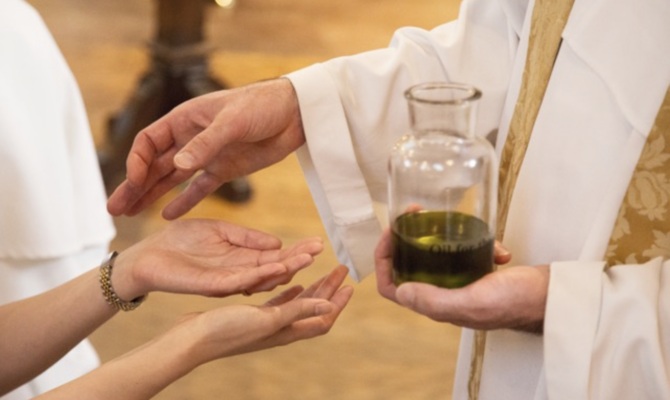
The priest will come and pray for you, silently laying his hands on your head. Then he will take some blessed oil and apply it in the shape of a cross on your forehead, saying “Through this holy anointing may the Lord in his love and mercy help you with the grace of the Holy Spirit.” Then he will anoint the palms of your hands in the same way, saying “May the Lord who frees you from sin save you and raise you up.” You can receive this anointing again either if your condition greatly worsens or if you recover and become seriously ill again later. When a priest believes it is likely to be the last time you’ll be anointed he will also give The Apostolic Pardon, Viaticum (or Holy Communion), The Litany of the Saints, and the Final Commendation as additional “Last Rites.

This sacrament gives strength, courage, and peace. It forgives your sins, if you were unable to obtain it through the Sacrament of Confession. And it unites you to Christ’s Passion to participate in his saving work, helping you offer redemptive sufferings like St. Paul describes to the Colossians: “I rejoice in my sufferings for your sake, and in my flesh I am filling up what is lacking in the afflictions of Christ on behalf of his body, which is the Church.” Sometimes this sacrament helps restore you to health, otherwise it prepares your soul to pass over to the next life.

Do not refuse or put off this sacrament. God is not an enemy like King Herod whom you should flee and hide from. Do not deprive yourself or loved ones by waiting too long to request holy anointing. Like gold given to an important person, like frankincense for offering holy sacrifice to God, or like myrrh to prepare us for the end of life, the Anointing of the Sick is a precious holy gift.