Archive for May, 2025

A Leader Like Us

May 31, 2025

Solemnity of the Ascension
By Fr. Victor Feltes

As a child in CCD class, I remember being told that a pope from the United States would never happen in our lifetimes. The common view was that having the earthly leader of the Catholic Church come from the world’s strongest superpower was something most cardinals would want to avoid. So it was quite surprising when the 69-year-old, Chicago-born Cardinal Robert Prevost was introduced to the world as Pope Leo XIV. But that concern about coming off as “America’s Pope” is probably why he only spoke Italian, Spanish, and Latin during his first public appearance.

If you’re like me, it’s surreal having so much in common with the pope. Like all of us here, he’s a Midwesterner. He speaks English without a foreign accent. He has consumed our movies, TV shows, and music and been active on social media. He has enjoyed American sports, like when he attended a White Sox World Series game. He has voted in our U.S. elections and attended the March for Life in Washington, D.C. He ministered in Peru for many years but we have something in common there too. Our diocese has supported Servant of God Fr. Joe Walijewski’s Casa Hogar orphanage in Lima for several decades. Like me, the new pope has a mathematics degree. My parents and relatives come from the Chicagoland area too. And we both picked the name “Leo XIV” — this new pope was literally named after my 12-year-old cat. He has a friendly smile and a sense of humor, he’s easygoing but takes Catholic teaching and worship seriously, he sings well, and writes out homilies to help him preach clearly. You probably have personal connections to our new pope yourself, like belonging to the same American Baby Boom generation.

Of course, the pontificate of Pope Leo XIV is still very young and its substantial fruits have yet to unfold. In the first week following his election, a reporter shook Pope Leo’s hand as he passed by and asked, “Holy Father… any message for the United States?” The pope smiled, lifted his hands, and replied, “Many! May God bless you all!” It’s exciting to have a pope who probably understands us, our country and our culture, both the good and the bad, better than any pope before him. So what does any of this have to do with the Solemnity of the Ascension we celebrate today? Much! And it relates to our June celebration of the Sacred Heart as well.

The Ascension marks the definitive entrance of Jesus Christ’s human nature into heaven. His humanity enters everlasting divine glory, symbolized by the cloud and sky. And from heaven, seated at God’s right hand, he constantly intercedes for us before the Father. Jesus Christ, being true God and true man, has a human intellect and will perfectly attuned to his divine intellect and will, knowing us and loving us all with a human heart. As Pope Francis wrote about the Sacred Heart last year, “The eternal Son of God, in his utter transcendence, chose to love each of us with a human heart.” Jesus possesses “genuine human emotions and feelings like ourselves, albeit fully transformed by his divine love. … Entering into the heart of Christ, we feel loved by a human heart filled with affections and emotions like our own.” Divine knowledge and love are eternal and we have had popes before. But the Ascension and Sacred Heart of Jesus are significant. Like a pope who intimately understands us, because he is one of us, we can rejoice that we now have a Lord in heaven, Jesus Christ, who knows us and loves us with a human heart like ours.

How Is Christ’s Peace Different Than The World’s?

May 24, 2025

6th Sunday of Easter
By Fr. Victor Feltes

Jesus tells his disciples at the Last Supper, “Peace I leave with you; my peace I give to you. Not as the world gives do I give it to you. Do not let your hearts be troubled or afraid.” If through his Gospel Jesus is speaking these words not only to his apostles but to us today, then we can conclude several things: Jesus would give us his peace. This gift of peace is different from how the world offers “peace.” And it should grant us calm consolation and courage. So how is peace from Jesus different from this world’s peace? How have previous popes and great saints answered this question?

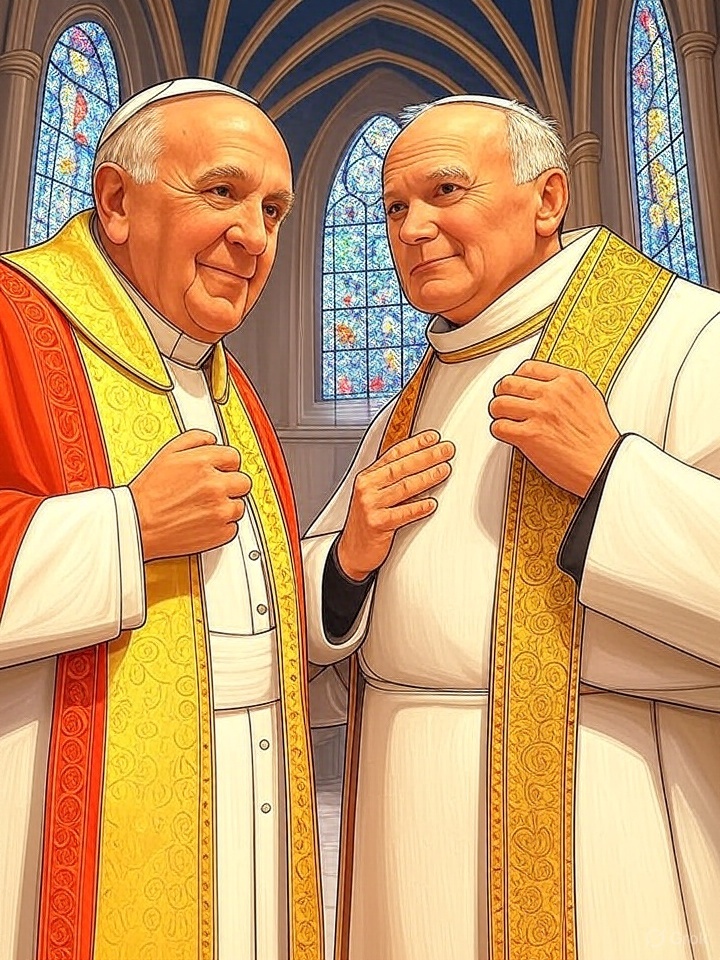
Three years ago, Pope Francis said one difference is in the manner which Christ brings about his peace: “This is how Christ brings peace into the world: through meekness and mildness, symbolized by that tethered colt, on which no-one had ever sat. No-one, because God’s way of doing things is different to that of the world. … The peace Jesus gives to us at Easter is not the peace that follows the strategies of the world, which believes it can obtain it through force, by conquest and with various forms of imposition. That peace, in reality, is only an interval between wars…. The peace of the Lord follows the way of meekness and mildness: it is taking responsibility for others. Indeed, Christ took on himself our evil, sin and our death. He took all of this upon himself. In this way he freed us. He paid for us. His peace is not the fruit of some compromise, but rather is born of self-giving.

St. Pope John Paul the Great shared similar reflections in 2004: “The world is longing for peace and needs peace, today as in the past, but often seeks it by inappropriate means, sometimes even with recourse to force or by balancing opposing powers. In these situations, people live with the distress of fear and uncertainty in their hearts. Christ’s peace, instead, reconciles souls, purifies hearts, and converts minds.

St. Thomas Aquinas highlighted this internal/external distinction about peace in the 13th century, saying “the peace of the world is a pretended peace since it is only on the outside: ‘The wicked… speak of peace with their neighbors while malice is in their hearts.’ But the peace of Christ is true, because it is both on the outside and inside. …The peace of Christ brings tranquility both within and without.

Aquinas also noted that worldly peace “is directed to the quiet and calm enjoyment of passing things, with the result that it sometimes helps a person to sin: ‘They live in strife due to ignorance and they call such great evils peace.’ But the peace of the saints is directed to eternal goods. … The world gives peace so that external goods can be possessed undisturbed; but [Christ gives] peace so that you can obtain eternal things.”

St. Augustine of Hippo said likewise in the 5th century: “For [the worldly,] their aim in giving themselves peace is so that, exempt from the annoyance of lawsuits and wars, they may find enjoyment—not in God, but in the friendship of the world. And although they sometimes give the righteous peace in ceasing to persecute them, there can be no true peace where there is no real harmony because their hearts are at variance.”

It is the alignment of our hearts with Jesus Christ’s heart which gives us harmony and true unity with one another and the Lord. As Jesus says, “Come to me … and learn from me, for I am meek and humble of heart; and you will find rest for yourselves. … My peace I give to you. … Do not let your hearts be troubled or afraid.” Go to Jesus and learn from him. Align your heart with his and rest.

As St. Augustine once concluded, “Let us, therefore, beloved, with whom Christ leaves peace and to whom he gives his own peace, not after the world’s way but in a way worthy of Him by whom the world was made, that we should be of one heart with himself, having our hearts run as one, that this one heart set on that which is above may escape the corruption of the earth.

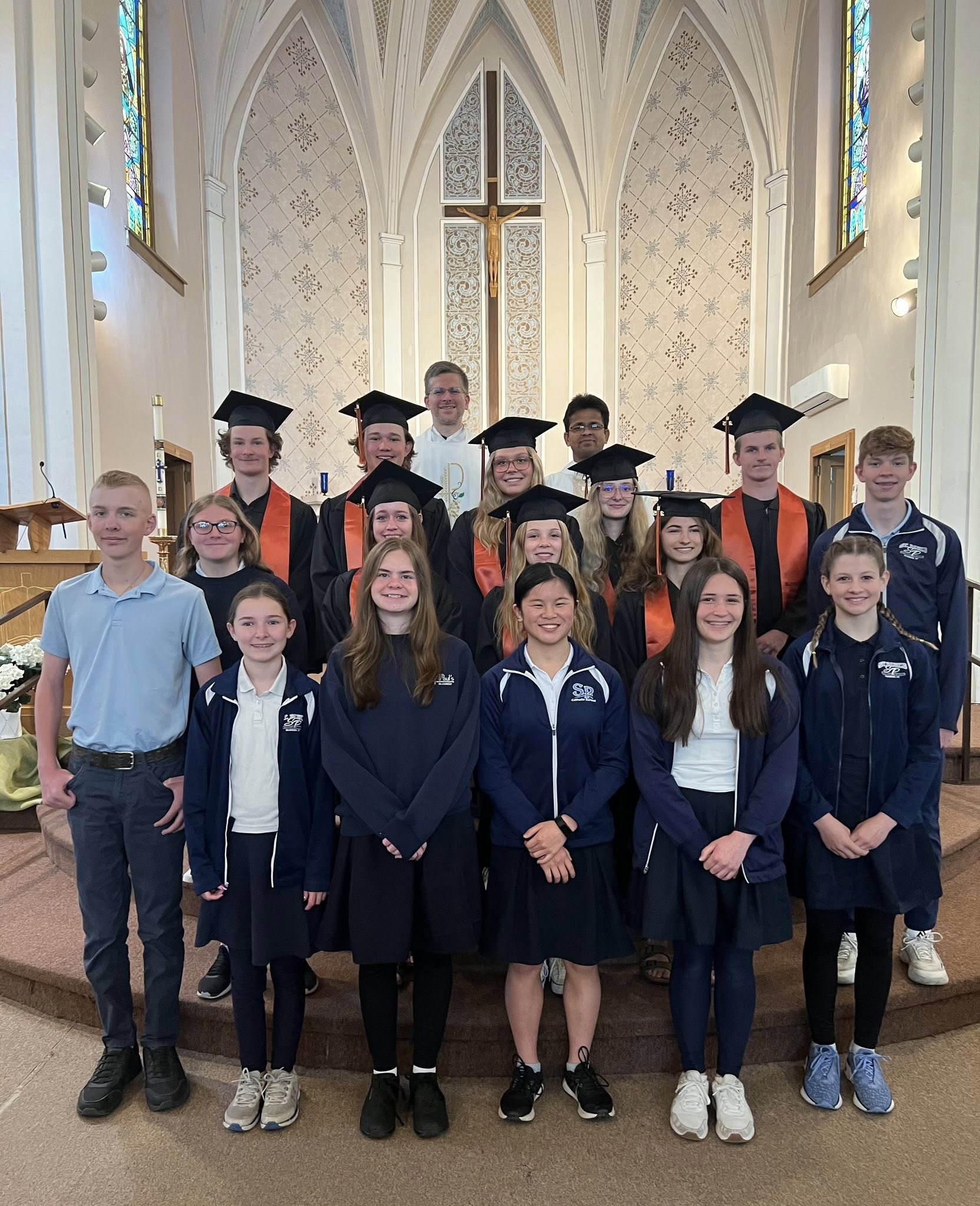
8th Grade Graduation Homily

May 23, 2025

By Fr. Victor Feltes

Each year, our La Crosse Diocese surveys all its Catholic school eighth graders about their religious views and attitudes. In order to encourage sincere responses these surveys are anonymous, but schools do receive a report indicating what percentage of its students affirmed various statements. Following this year’s assessment, we received word that our eighth graders had some of the most faithful answers in the entire diocese. For instance, 100% of you ‘agreed’ or ‘strongly agreed’ with these statements (among others):

• I believe that God knows and loves me personally.
• Sin offends God and harms me.
• There is a heaven and hell.
• It is important for me to be with God in heaven.
• Living a faithful life is the path to becoming happy and fulfilled.
• I am proud to be a Catholic.
• Belonging to the Catholic Church is an important part of my relationship with Jesus.
• I believe that Jesus is truly present in the Eucharist.
• I am willing to speak up to defend my faith.
• I have a duty as a Christian to help those in need.
• I believe that God has a calling or vocation for every person.

Jesus told his students, his disciples, “I have told you this so that my joy might be in you and your joy might be complete.” St. Paul’s School exists so that the joy of Christ and his Church might be in you and your joy may be complete. Your teachers and I—all of whom could probably be making much more money doing something else somewhere else—are at this school to help gift to you the great treasures of Christianity, so your responses give us joy. Your answers also reflect something of the good influence and priorities of your parents, for they have made sacrifices to send you to this school and 100% of you agree that you ‘enjoy spending time with your family.’ I wished to begin my words to you young people tonight with this praise, but now I must also share a word of warning, challenge, and calling.

Jesus gave his disciples this important message: “As the Father loves me, so I also love you. Remain in my love. If you keep my commandments, you will remain in my love, just as I have kept my Father’s commandments and remain in his love.” Graduating from our school and entering another leaves behind the close, sheltering Christian community of this school. Even if you go on to enroll in a Catholic school, your faith will be challenged. Remember that Jesus loves you and that you must remain close to him.

You will remain in his love if you keep his commandments. He commands us to pray daily, to worship at the Eucharist on Sunday, to approach him in the Sacrament of Confession as needed, to always be striving to grow in faithful friendship with him. If you are doing this, keep it up. If you neglect this, pick it up. Simon Peter was very fond of Jesus but his triple failure during the Passion of Christ caught him by surprise. Realize that you are called to be faithful friends of Christ even in a hostile world. Give us joy and make us proud. Jesus loves you. Remain in his love. If you strive to love him and keep his commandments, you will remain and live in his love.

Love Like Christ

May 19, 2025

5th Sunday of Easter
By Fr. Victor Feltes

The Lord is gracious and merciful, slow to anger and of great kindness. The Lord is good to all and compassionate toward all his works.” In times past, God spoke in partial and various ways through prophets (like in the previous psalm) validating his words with saving miracles. But at the beginning of this present age he spoke to us through his Son, through whom he has worked the greatest miracles of salvation.

We bow before the wonder of the Incarnation, that the Divine Person through whom all things were made would become man in the womb of the Virgin Mary and be born among his creatures. We are blessed that Jesus has revealed to us his way of Christian living, not only through the wisdom he preached but through his lived example. And greatest of all, we have access to peace, hope, and joy because of his willingness to suffer, die, and rise for us. Pause to consider where you would be if not for Christ’s love for you.

Now, Jesus gives us a new commandment: “Love one another. As I have loved you, so you also should love one another. This is how all will know that you are my disciples, if you have love for one another.” Now this love we are called to is not mere emotion. Oftentimes love is a warm, fuzzy, pleasure, but love will not always feel good. And this love we are called to is more than intellectual. The demons know that Jesus is Lord, but that does not save them, because they do not love him. We are called to love as Jesus has loved us.

This means we are called to love everyone like he does, the good and the wicked, our friends and foes. What this looks like will vary in life’s various circumstances, but we must will the good for everyone. And willing the good for others must lead to action. We are finite beings and cannot do everything for everyone all the time, but as St. James taught in his New Testament letter: “Faith by itself, if it does not have works, is dead.” And these loving works we are called to will not always feel good, but as Saints Paul and Barnabas preached: “It is necessary for us to undergo many hardships to enter the Kingdom of God.” Jesus entered his Kingdom’s glory through painful trials, and so must we.

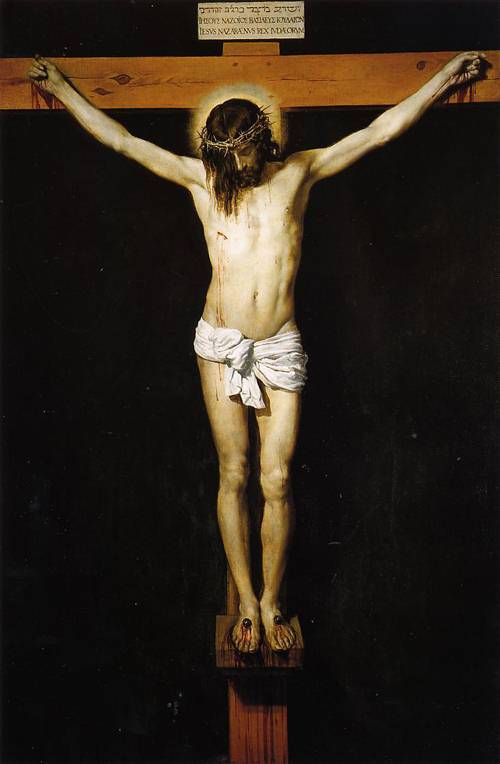
For the sake of the joy that lay before him, [Jesus] endured the cross, despising its shame, and has taken his seat at the right of the throne of God.” Supreme happiness also awaits Christ’s faithful followers as well. In his Revelation, St. John sees a New Heaven and a New Earth and a New Jerusalem coming down out of Heaven from God. “Behold,” John writes, “God will dwell with the human race… and will always be with them as their God. He will wipe every tear from their eyes, and there shall be no more death or mourning, wailing or pain, for the old order has passed away.”

Jesus Christ loves us. He offers us his peace and joy and has placed his hope before us. And Christ calls us to love like him by loving him and remaining close to him, for apart from him we can do nothing. Our Christian life begins with Baptism, but must continue with daily prayer, Sunday Mass, regular Confession, a life of true discipleship. You must remain close to—or return to—his grace to enter the Kingdom of God. Remember Christ’s love for you, hold onto his hope, peace, and joy, and love everyone as he has loved you.

On Pope Leo’s First Homily

May 16, 2025

By Fr. Victor Feltes

In Pope Leo XIV’s first homily after his election he spoke on how people at the time of Jesus fall into two camps or attitudes about him. The wealthy and powerful consider Jesus “a completely insignificant person, at best someone with an unusual and striking way of speaking and acting. And so, once his presence becomes irksome because of his demands for honesty and his stern moral requirements, this ‘world’ will not hesitate to reject and eliminate him.”

The other group and attitude is “that of ordinary people. For them, the Nazarene is not a charlatan, but an upright man, one who has courage, who speaks well and says the right things, like other great prophets in the history of Israel. That is why they follow him, at least for as long as they can do so without too much risk or inconvenience. Yet to them he is only a man, and therefore, in times of danger, during his passion, they too abandon him and depart disappointed.”

What is striking about these two attitudes is their relevance today. They embody notions that we could easily find on the lips of many men and women in our own time, even if, while essentially identical, they are expressed in different language. Even today, there are many settings in which the Christian faith is considered absurd, meant for the weak and unintelligent. Settings where other securities are preferred, like technology, money, success, power, or pleasure. These are contexts where it is not easy to preach the Gospel and bear witness to its truth, where believers are mocked, opposed, despised or at best tolerated and pitied. Yet, precisely for this reason, they are the places where our missionary outreach is desperately needed. A lack of faith is often tragically accompanied by the loss of meaning in life, the neglect of mercy, appalling violations of human dignity, the crisis of the family and so many other wounds that afflict our society.”

Today, too, there are many settings in which Jesus, although appreciated as a man, is reduced to a kind of charismatic leader or uber-man. This is true not only among non-believers but also among many baptized Christians, who thus end up living, at this level, in a state of practical atheism. This is the world that has been entrusted to us, a world in which, as Pope Francis taught us so many times, we are called to bear witness to our joyful faith in Jesus the Savior. Therefore, it is essential that we too repeat, with Peter: ‘You are the Christ, the Son of the living God.’”

This homily was an excellent reflection for us but there is one more takeaway I wish to share with you. In its reporting, The New York Times’s headline read: “Leo XIV Vows to Lift Up ‘Ordinary People’ in first Mass as Pope. In Pope Leo XIV’s first homily on Friday, he put himself squarely on the side of ‘ordinary people,’ and against the rich and powerful…” Someone who only read that would think the new pope’s homily was about political class struggle, but having read his words yourself you can see what Leo really taught: that if we consider Jesus to be merely a man, we will either despise him or abandon him. “Therefore, it is essential that we too repeat, with Peter, ‘You are the Christ, the Son of the living God.’”

I have learned a lesson from watching the coverage of both Francis and Benedict’s pontificates which prompts me to offer this word of warning at the start of Leo’s pontificate: Do not trust the media to accurately report on what the pope teaches. Through ignorance, bias, or malice they will regularly have things wrong. It is good for us that a pope now speaks English as his first language, but expect the press to sometimes misleadingly excerpt even those remarks. So if and when you hear a strange report about the pope, do not let your heart be troubled. Learn from Leo directly and trust in the Lord.

The Church Reveals His Beauty

May 11, 2025

4th Sunday of Easter
By Fr. Victor Feltes

Churches should be marked by great beauty. Beauty attracts and delights. God, among his other perfections, is capital “B” Beauty, so a beautiful church glorifies God among us and helps draw people to him. One of the most famous and beautiful churches in the world is St. Peter’s Basilica in Rome. St. Peter’s Basilica is actually a shrine for the burial site of St. Peter the Apostle. He was crucified upside-down on Vatican Hill by the Romans and buried in a nearby cemetery. And in the early 1940s, archeological excavations below the main altar discovered what are most likely his bones. Jesus gave Peter his name, which means “Rock,” and said, “Upon this Rock, I will build my Church.” And today we see the largest and most renowned Christian Church in the world is built above that Rock.

It is wonderful for churches to be beautiful, but it is also important for our church architecture and decorations and to be meaningful—reflecting truths of our faith. For instance, St. Peter’s Basilica is capped by a dome designed by Michelangelo which is the world’s tallest. And two colonnades designed by Bernini, extend out in front of the basilica on both sides around St. Peter’s Square. The effect of this dome and these colonnades together present an image of God the Father. As one approaches St. Peter’s Square, the dome is like his head, the church is like his chest, and the colonnades are like his arms. God the Father is reaching out to beckon, welcome, receive, and embrace all people of the world. When St. Peter’s Square is filled with pilgrims as we saw last week it is like St. John’s vision in today’s second reading, “a great multitude… from every nation, race, people, and tongue,” joyfully standing before God the Father and the Lamb of God. The Kingdom of Heaven begins for us now in his Church on earth.

Once you enter inside St. Peter’s Basilica the architecture there also conveys spiritual truth. The dimensions are huge. The distance from the floor to ceiling—not under dome but in the nave of the basilica—is 152 feet. That’s about twelve stories high; and yet because of architectural tricks of perspective you do not feel tiny. For instance, there are two tiers of statues in alcoves along the sides—lower and higher—but the statues on the higher level are actually bigger than the lower statues so that when you look up at those saints they do not seem so distant. The scale of the arches, doors, and windows make you feel like you are inside of, not a hollow skyscraper, but a great, beautiful mansion. It is an image of the Father’s house, where there is room enough for a countless multitude but where no one is made to feel small or unimportant. In heaven, everyone is valued and has a place with God.

Last Thursday, from the exterior balcony of St. Peter’s Basilica called the Loggia of the Blessings, Pope Leo XIV was introduced to the world. It was quite a surprise and a moment we will remember the rest of our lives. In this Sunday’s Gospel, Jesus says his sheep have been given into his hand by the Father. Our Lord has now entrusted us into Pope Leo’s hands as well. I did not know much about him before the conclave, but I am excited by what I have seen and heard since.

Some people have predicted and hoped for a quiet papacy where very little will happen. But I do not want a quiet pope when so many people need Jesus, his Gospel, and his Church. Pope Leo has spoken insightfully—both years before and following his election—about evangelization in our time, and I look forward to him being a “Lion” for the Gospel. I do not expect our American pope to show the United States special favoritism, nor should he, but I believe this pope will be a great blessing for the Church in our country. When you freeze or boil water, nothing happens before the temperature reaches a threshold. But with the addition or subtraction of just a few more degrees the liquid transforms into a solid or gas. I believe this new American pope will trigger many fruitful responses in those whom God is already calling. There is a new openness and hunger in our culture and I believe great things will happen.

Yet do not just sit back and wait for the pope and priests to draw people closer to Christ. By your sacrificial love, by your Christian joy, by your growing devotion, by your deepening holiness, by your Catholic witness, by your unashamed invitations, the Lord wants you to help bring others—people you know—to a fuller relationship with him and his Church. The papal motto of Pope Leo XIV is the same as he chose when he became a bishop. It comes from a homily of St. Augustine: “In the One, we are one.” (That is, “In Christ, we are one.”) In Christ we are called to all be truly one, and each of us in these years of Pope Leo ahead have important parts to play.

Upon This Rock Christ Built His Church

May 4, 2025

3rd Sunday of Easter
By Fr. Victor Feltes

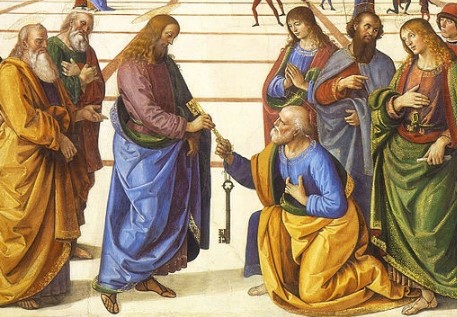
Jesus changed Simon the Apostle’s name to Peter or “Rock” and said, “Upon this rock I will build my Church, and the gates of the netherworld shall not prevail against it.” Jesus told him, “I will give you the keys to the Kingdom of Heaven,” and declared “Whatever you bind on earth shall be bound in heaven; and whatever you loose on earth shall be loosed in heaven.” This promise assures us that Peter would not bind the Church to error, for binding the Church on earth to lies would bind heaven to the same. What is the purpose of this awesome authority to teach and lead? Jesus tells him and us in today’s Gospel: it is to ‘Feed his lambs, tend his sheep, and feed his sheep.’

Jesus had specifically told Simon at the Last Supper, “Behold, Satan has demanded to sift all of you like wheat, but I have prayed that your own faith may not fail; and once you have turned back, you must strengthen your brothers.” In the Gospels, Simon Peter’s name is always first among his fellow apostles in any listing where he appears, while Judas Iscariot’s name is always placed last. All of this reflects the God-given preeminence of St. Peter as the servant-leader of Christ’s Church on earth. Jesus remains the invisible Head of his One, Holy, Catholic Church, but he knew that without providing clear and visible apostolic shepherds to give us clarity and unity his flock would surely scatter.

This was true in the 1st century with St. Peter as 1st bishop of Rome, and Peter’s office has continued in his successors, the popes, as recognized by Christians throughout the first millennium. Jesus had told the apostles “whoever hears you hears me” and promised the Holy Spirit would guide them “into all the truth.” The New Testament also proclaims the Church to be “the pillar and foundation of truth.” Was only the first century to be graced with such divine gifts and assurances? No. Jesus is the wise man who built his house on Rock so that even when the rains fell, the floods came, and winds blew and buffeted his Church it would not collapse into heresy.

Indeed, when a pope (or a Church council together with him) definitively defines a doctrine of faith or morals to be held by the whole Church, the Holy Spirit protects their teaching from error. This is called infallibility. Through divine inspiration, the Holy Spirit previously utilized imperfect men to pen precisely what he wished to be written as Holy Scripture; so simply protecting Holy Church from officially teaching errors is an important but lesser miracle. Though popes can teach infallibly and possess full authority as chief shepherds, they are not flawless people. Simon Peter, even after denying, repenting, and returning to Christ, sometimes still slipped up.

Through St. Paul’s Letter to the Galatians we learn that St. Peter was accustomed to eating with Gentile Christians who did not keep the Old Covenant’s rules about ritually clean and unclean foods, as Christ’s New Covenant allowed. That was all well and good, but once when some Jewish Christians arrived in town who cared about keeping all those dietary laws, Peter began to withdraw from his previous table companions. Peter probably wished to avoid causing offense and division, but this action caused confusing scandal by implying that keeping all the Old Laws of Moses was necessary for salvation.

St. Paul writes, “I opposed him to his face because he clearly was wrong.” Paul corrected Peter in front everyone, saying, “If you, though a Jew, are living like a Gentile and not like a Jew, how can you compel the Gentiles to live like Jews?” St. Peter had not denied the Gospel but his personal example in this case caused harm and he received a fraternal correction from St. Paul. In the Church’s two-millennium-long history there have been some very bad and scandalous popes, but by God’s grace none of them bound the Church to heresy, and that’s a priceless blessing.

Having mourned and prayed for Pope Francis, the cardinals will gather this Wednesday inside the Sistine Chapel at the Vatican for the important task of electing a new pope. Some 133 cardinals, appointed by previous popes from places around the world, will sequester themselves away until they elect a Holy Father. After any failed rounds of voting, they will burn the ballots to make black smoke. But once a pope has been elected by a two-thirds of the vote they will burn the ballots to make white smoke accompanied by the ringing of St. Peter’s Basilica’s bells. Then our new pope will be introduced to the world and impart his papal blessing. All the conclaves in recent decades have been short, concluding within three days, but do not be alarmed even if this conclave takes more than a week. We will have a pope again soon.

People sometimes wonder, “Does the Holy Spirit choose who will be the pope?” Before he became Pope Benedict XVI in 2005, Cardinal Joseph Ratzinger was asked about this in a 1997 interview. He replied, “I would not say so, in the sense that the Holy Spirit picks out the Pope…. [“There are too many contrary instances of popes the Holy Spirit obviously would not have picked!”] I would say that the Spirit does not exactly take control of the affair but rather like a good educator, as it were, leaves us much space, much freedom, without entirely abandoning us. Thus the Spirit’s role should be understood in a much more elastic sense, not that he dictates the candidate for whom one must vote. Probably the only assurance He offers is that the thing cannot be totally ruined….”

When I was younger, I would have imagined there was just one cardinal in any conclave who could be the right pope; but now I suspect the Holy Spirit perhaps beholds dozens of cardinals with whom he could accomplish comparable good fruits. God works with what we give him. So pray that the cardinals will be receptive to the Holy Spirit’s guidance, but do not be anxious or afraid. Whatever happens, we already know that Christ and his Church will endure and triumph in the end, for “the gates of the netherworld shall not prevail against it.” Pray this week that the Church of Christ on earth may soon be led by another great pope who will feed his lambs, tend his sheep, and feed his sheep.