Solemnity of Saints Peter & Paul
By Fr. Victor Feltes
Today, I wish to speak to you about Saints Peter and Paul, vocations, the Catholic Church and the Churches in her, and two aspects of the Holy Mass. This homily will be a bit longer than usual, but each of its parts are interesting. Saints Peter and Paul shared many similarities but manifested in different ways:
🔸 Both were personally called by Christ to become apostles; Peter quite early during Jesus’ public ministry, but Paul rather late, after Jesus’ Ascension.
🔸 Both beheld Jesus in his transfigured glory; making his friend Peter feel ecstatic, but making his persecutor Paul go temporarily blind.
🔸 Both preached the Gospel; Peter primarily to the Jews, but Paul particularly to the Gentiles.
🔸 Both taught the Faith; Paul the Pharisee was highly-educated, but Peter the uneducated fisherman was not.
🔸 Both experienced weakness; Peter in conquering his passions, but Paul by enduring “a thorn in the flesh.”
🔸 Both were martyred by the Roman Empire in Rome; Peter was crucified upside-down, but Paul the Roman citizen was beheaded.
That Saints Peter and Paul whom we celebrate this Sunday shared one Faith, one Lord, and one calling, and yet manifested these differently in their faithful lives. We also see this in the Catholic Church today. Peter and Paul were called to be apostles. Today, some are called to be bishops, priests, or deacons. Others are called to be consecrated male or female religious. Many more are called to the vocation of holy marriage. Others live out their baptismal mission and call as single persons or consecrated virgins. Which of these ways is the greatest way to live a Christian life? The greatest, most glorious, most fruitful path for you is the one Christ has called or is calling you to. Your life may look differently than others’, even amongst people living out the same vocation, but you can still be living a faithful, fruitful Christian life.
We belong to Christ’s Catholic Church. The word “Catholic” comes from Greek, meaning “universal, worldwide, (or) all-inclusive.” The Catholic Church, established by God for all people and places in this present age, unites humanity in our diversity, but even within our unity we see legitimate variety. Did you know that the one Catholic Church contains 24 Churches with apostolic roots and varying liturgical traditions practiced in full communion with the pope? The largest of these Catholic Churches is the Roman Catholic Church, to which we belong along with more than 98% of the world’s 1.3 billion Catholics. About 18 million other Catholics are in Churches in full communion with Rome; the three largest being the Ukrainian Greek Catholic Church (mainly in Western Ukraine), the Syro-Malabar Catholic Church (mainly in India), and the Maronite Church (mainly in Lebanon). Our one Faith differently celebrated. (Other Churches called the Orthodox Churches have nearly 300 million members put together, with valid priests and bishops and all seven sacraments like us, yet they are not in communion with the pope. Pray for our reunion. The gap between us is less than any Protestant group.) There is even legitimate variation within the Holy Mass of our Roman Catholic Church. I wish to highlight two examples: one in how one receives the Eucharist and another in how the Eucharist is celebrated.
The early Church Fathers mention the Eucharist being placed upon communicants’ hands. Other Communion customs also existed but Communion in the hand was explicitly described. For instance, St. Cyril in Jerusalem and St. Theodore in Turkey instructed the faithful to lay one hand over the other to create a throne (for both saints declare one is about to receive a King) cupping one’s palm to receive “The Body of Christ” and answering “Amen.” St. John Chrysostom observes how a communicant’s hands “hold [the Eucharistic Sacrifice] but for a time.” He writes, “Oh! What a marvel! What love of God to man! He who sits on high with the Father is at that hour held in the hands of all…” And St. Basil the Great records “in the church, when the priest gives the portion, the recipient takes it with complete power over it, and so lifts it to his lips with his own hand.” These and the writings of other Church Fathers show that receiving Communion in the hand existed in the Early Church.
However, though Communion in the hand is allowed today, the many-centuries-long tradition of receiving Communion on one’s tongue is also permitted, either standing or kneeling. Some find receiving our Lord on the tongue strengthens their reverence and devotion; acknowledging the glory of their Great Guest, extending the red carpet of one’s tongue for him to enter under one’s roof through the doors of one’s lips, humbly receiving this priceless Gift of pure grace. After next summer’s church renovation, once there is more space in front of these steps to our sanctuary, I plan to place a kneeler in the center-front as an option, as you may have seen offered already at churches in Chippewa Falls. How you receive our Lord, standing or kneeling, on your hand or on your tongue, is for you to personally discern, since they each option is permitted for you by the present liturgical rules of the Church.
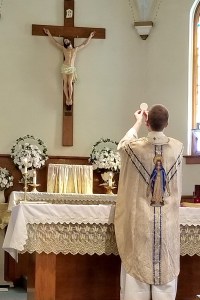 The next legitimate Mass option I would like to explain pertains to the celebrant leading the congregation. Since the Second Vatican Council, the most common way priests have celebrated Mass is versus populum, or “towards the people.” Yet the much-longer-practiced custom has been for the priest and the people to face (literally or symbolically) towards the east together, or “ad orientem.” Like the Jews used to pray towards the Holy Temple in Jerusalem, the writings of the Church Fathers show the early Christians prayed toward the east. St. Clement of Alexandria writes “prayers are made looking towards the sunrise in the east.” And Origen notes: “…Of all the quarters of the heavens, the east is the only direction we turn to when we pour out prayer…” Tertullian records that Christians facing east to pray caused some non-Christians to mistakenly believe we worshiped the sun. But the Christians praying toward the sunrise saw a symbol of Christ rising from the dead and of his promised return to earth in radiant glory one day. Throughout the centuries, even in churches which were not built to face east like our St. Paul’s Church, the priest and the people faced the same direction (or “liturgical east”) together. However, since the 1970’s the prevailing custom has been for the priest to face the congregation.
The Catholic Church approves both versus populum and ad orientem as valid options, and these two ways of celebrating the Mass emphasize different truths. Celebrating versus populum, toward the people, emphasizes the horizontal aspect, the communal meal. And the Holy Mass is indeed a meal, a memorial of the Last Supper, where Jesus Christ and his disciples gather at his table. Celebrating ad orientem, toward the east, emphasizes the vertical aspect, the sacrificial offering. And the Holy Mass is indeed a sacrifice, a memorial of the Cross, where Jesus Christ is offered up for us from his altar.
I experienced my first ad orientem Mass when I was still in seminary. The celebrant was a visiting alumnus and priest of our diocese, Fr. Derek Sakowski. I remember fearing that I would hate the Mass being said that way because I often dislike changes. (For instance, our seminary once changed the toaster in the dining hall and—even though I almost never used the old familiar toaster—I was annoyed when they had replaced it with a new one.) Fr. Sakowski said the same English prayers as at other Masses but watching him celebrate that Mass ad orientem, facing us when speaking to us and facing God when praying to God, I found it surprisingly beautiful and it made a lot of sense. When weekday Massgoers at St. John the Baptist Parish first experienced Mass ad orientem more than five years ago, the attendees reported positive experiences similar to mine.
I mention all this because I would like our weekday Massgoers to experience ad orientem in at least a few Masses this July and hear their feedback. After Vatican II, when Mass facing the people became the prevailing custom in the Church, pastors often introduced that liturgical change abruptly, without consultation, and without adequate explanation. It was jarring, and many lay people were bewildered and hurt. I do not wish to repeat such mistakes going in the opposite direction. Nothing will change without thorough consultation and consensus support. At the end of such a dialogue at St. John the Baptist’s Parish, one weekend Mass changed and the other stayed the same and today everyone seems happy or content with that. Our Faith, our calling, and our Lord are one, even as our faithful lives will manifest them differently. We are Catholic. So in essential things, unity. In non-essential things, liberty. And in all things, charity—that is, love.

 Parishable Items