Archive for September, 2025

The Last Things

September 27, 2025

26th Sunday in Ordinary Time
By Fr. Victor Feltes

Last week, the season of fall officially began. Soon we will see the leaves fade and fall and many living things will enter a long, deep sleep. Imagine how much we would despair seeing the skeletons of trees in the wintertime if we did not remember the new life to come in spring. Like our falling asleep at night and reawakening in the morning, the changing of the seasons foreshadow our dying and rising again in Christ.

Last week, there was also an online rumor that all Christians would be taken up into heaven last Tuesday. Though, once again, no one really knew the day nor the hour. We Catholics do not believe in “The Rapture”— that true Christians will one day vanish from the earth while unbelievers are “left behind” for years. This idea was only imagined for the first time in 1830, which is discrediting in itself. We faithfully await Christ’s return to call forth the living and the dead, but his coming will be visible to all. “For,” Jesus says, “just as lightning flashes and lights up the sky from one side to the other, so will the Son of Man be in his day.”

In this Sunday’s Gospel, we hear Jesus’ story about a rich man and a poor man. The poor man is named Lazarus but the rich man goes unnamed. “When the poor man died, he was carried away by angels to the bosom of Abraham. The rich man also died and was buried, and from the netherworld, where he was in torment, he raised his eyes and saw Abraham far off and Lazarus at his side.” St. Augustine suggests that God “kept quiet about the rich man’s name because he did not find it written in heaven.” St. Jerome reproaches the rich man saying: “You have five brothers: sight, smell, taste, hearing, and touch…. Since they were the brothers you loved, you could not love your brother Lazarus…. These brothers of yours loved wealth and they had no eye for poverty.”

Unless Jesus Christ returns during our lifetimes, each of us will experience death before facing an eternal judgment. But some people completely avoid thinking about their own deaths. They are like to my late aunt who wouldn’t go in for annual health checkups because she feared what the doctor might tell her. Yet by contemplating “The Last Things” (Death, Judgment, Heaven, and Hell) we can become more confident and well prepared for what is to come.

Though God fashioned us for everlasting life, we experience death as a result of human sin. However, because of Jesus’ Passion and sacrificial death, we can unite our sufferings to his to advance his mission of salvation in this world and increase our glory in Christ. Our bodies will undergo natural decay, eventually returning to the dust from which they were made, but our souls are everlasting. At the moment of death, our immortal souls separate from our mortal bodies. Our earthly remains remain on earth to await our Resurrection, but our souls go immediately to our particular judgment.

Then we will be judged according to our faith and deeds in Christ. Remember that what will matter in the end is our connection to Christ and our love of God and love of neighbor. Then our personal reward or punishment will begin: an entrance into the unending blessedness of heaven—either immediately or through the purifying process of purgatory, or else immediate and everlasting damnation. These are the weightiest matters in the world, but I do not want you to ever feel burdened or discouraged.

Do you recall how in The Lord of the Rings the dark lord Sauron created a ring into which he poured his cruelty, malice, and will to dominate all life? This ring would slowly corrupt its bearer and resize itself to fit its wearer’s finger. Whenever Frodo wore it, Sauron would see and hear him immediately and send his ghostly servants after him. Gandalf warned Frodo to remember “the Ring is trying to get back to its master. It wants to be found.”

Now consider our Good Lord of Light. He poured his mercy, kindness, and grace into you at baptism to give you abundant life and bring you into the glorious freedom of the children of God. God’s gifts adapt to their recipients; from the simplest small children to fully-grown-up geniuses, and they sanctify us over time. With the Christian identify you bear you can call on our Lord at any time, and he will see and hear you and send his angels for you. Jesus Christ is striving to bring you to our Father. So if you ever wander off, remember that they want you to be found.

Be faithful to daily prayer and the sacraments, especially Confession and Holy Mass. Live your one and only life with and for our Lord Jesus Christ. And always be well prepared to journey from this world, eager for your reward and the many joys which await us in the next season to come.

Stewardship Sunday & The Hug

September 22, 2025

25th Sunday in Ordinary Time
By Deacon Dick Kostner

Today Jesus gives to us a new parable to ponder and think about. God gives to his followers the responsibility of being the body of Christ, a visible flesh and blood team of his to carry out the 11th Commandment Jesus gave us to “love as he has loved us.” His parable story tells us that one of his stewards was cheating and was caught. He was called to account for his dealings and knowing that he would lose his job he gave gifts of his master’s assets to debtors owing the master in hopes that the debtors would give him a place to stay after he lost his job. He was in a sense providing for himself and his future.

The master, instead of condemning his actions, commended the steward for acting prudently and taking action to provide for his future welfare. Once again Jesus tells us to spend our life doing things that will gain us a place to stay with him in heaven after our earthly life ends. Things that will give us a high place in heaven and a room to be proud of at the Father’s house. The responsibility is great for all of us to be good and faithful stewards of God’s heavenly assets. But why does God ask for our help in building the Kingdom of God here on earth?

I am reminded of a story that Fr. John Heagle told our Parish during a talk on Stewardship many years ago. He is the brother of Larry Heagle the song writer of the Wood Tick Song we all enjoy listening to every spring. He told the story of attending a party at his Nieces house one evening. His Niece had a young daughter and had sent her to her upstairs room to go to bed before the party started. After the party got going, the child came downstairs and told her mother she could not get to sleep and that she was afraid. The mother took her upstairs but after the third time she came down, the mother was getting impatient with her and said, “Why are you afraid? Don’t you know that God will protect you?” The child looked at her and finally said, “I know Mama that God will protect me, but sometimes you just need to have someone with ‘skin on’ to feel safe.”

God knows that as humans we sometimes need to have someone to grab a hold of, someone with skin on to give us a hug and get us through our difficulties of life. The solution was to send his son, Jesus, a divine human being, to teach us and help us get through the crosses of life. And when Jesus went up to heaven to join the Father, Jesus gave us His Church, to be the Steward for His children who need someone to grab a hold of when the crosses of life get too heavy for us to carry it alone.

Recently I had one of our Parishioners stop to thank me while I was smoking pork roasts to serve people who work at the Pavilion. She knew that I had been praying for her to come back to our parish as her attendance at Mass has been missed by our Parish family. She said, “I just can’t believe that a Deacon, would be praying for me to come back to Church!” I told her that she was missed not only by me but by other Parish members, and that I pray for all people who have left and for one reason or another not come back to join us, to give thanks at Mass, for all the gifts we have received. She thanked me again and said, “Can I ask one more question? Can I have a hug?? I told her sure, but I probably smell like smoke.” We hugged and I told her that I hope to see her at Mass at St. Paul’s soon.

As humans, we all will encounter difficulties in life but one thing is for sure, we all need to seek help from a higher power to get through difficult times. We have all witnessed and seen how suicides have sky rocketed in the last few years. And I am sure that the Church Parishes in our world have seen a drop in church attendance especially in younger adults. People need their Church, and God, a higher power, to overcome depression. Priests continue to be in short supply for many communities. Many are saying that the answer for the priest shortage is caused by priests not being allowed to marry. If you want my opinion on that I believe that priests would not be able to take on any more responsibility than what they now have. They have more than enough people to care for without adding a spouse and children to the list of people they care for. Yes, a spouse can and is support for her husband. And yes I would miss my wife keeping me proper, like telling me I have holes in my tee-shirts or that my socks don’t match, or I am getting too “heady” with my homilies, but I also know that priests already have an army of gals in any parish they serve at, that will take care of any problems pastors run into trying to be successful in their chosen vocation. I believe that’s why God gifts women with what I call extra Holy Spirit to take care of our deficiencies.

Back to the rise in suicides. Young and old alike, my take is that cell phones and Zoom will never be able to compete with or replace a good hug from a steward mentor of Christ, in helping us get through and overcome all the challenges of life. And for that I say: “Amen!

Lifted Up & Exalted

September 13, 2025

Feast of the Exultation of the Holy Cross
By Fr. Victor Feltes

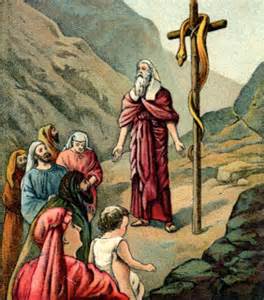
During their long Exodus journey, the Hebrews once again began rebelling, despising God and his servant Moses. They even sinfully complained about the Manna bread God was providing for their survival in the desert saying, “We are disgusted with this wretched food!” So God sent venomous serpents—or perhaps he merely lifted his shield of protection around their camp—resulting in many getting snakebitten and dying. So the people repented and pleaded with Moses, who prayed to the Lord. The Lord then commanded Moses to fashion a bronze serpent and affix it to a pole so that whoever looked at it would live. Moses and the Hebrews did not realize this at the time, but that bronze serpent on a wooden pole was a symbol pointing ahead to Jesus Christ who would die for our sins on his wooden Cross so that we may live.

In today’s Gospel, Jesus says: “Just as Moses lifted up the serpent in the desert, so must the Son of Man be lifted up, so that everyone who believes in him may have eternal life.” Later in John’s Gospel, Jesus uses the same Greek verb to declare, “When I am lifted up from the earth, I will draw everyone to myself.” And the inspired author notes, “[Jesus] said this indicating the kind of death he would die.” But this same Greek word for “lifted up” or “exulted” appears again later to recount Jesus’ Ascension and heavenly enthronement. The Book of Acts says, “God exulted/lifted up [Jesus] to his right hand as leader and savior to grant repentance to Israel and forgiveness of sins.” “Jesus, exulted/lifted up to God’s right hand, received the promise of the Holy Spirit from the Father and poured it forth….” This is what I want to highlight: how the first lifting up of Jesus leads to the second; his exultation on the Cross leads to his exultation in heaven.

Christ Jesus, though he was in the form of God, endured our human suffering and death, even death on a cross. And because of this, God greatly exalted him, and bestowed on him a heavenly glory above any other glory. The early Christians fully believed in Jesus’ death by crucifixion, but they did not depict Jesus on the Cross in sacred art for several centuries. This was partly due to persecution but also because crucifixion still remained so scandalous, horrific, and shameful in their culture. This Sunday, we celebrate the Exultation of the Holy Cross and I want you to behold Christ crucified. Too many are turned away from him—the God who suffered, died, and rose for them—and we see where their dark paths lead. But the message I feel moved to preach to you who have kept your eyes on Jesus and walked with him for years is to understand that our crosses lead to glory.

Each of us is going to suffer in this world and—unless Jesus Christ comes back first—each of us will taste death. But just because you suffer greatly does not necessarily mean you are being punished for doing something wrong like the Hebrews in the desert were. And suffering does not mean that you are not loved by God. (Jesus Christ was perfectly good yet God’s Beloved Son was murdered.) And when you suffer, no matter how incomprehensible or unjust the pain, realize where you are: on your Cross with Jesus Christ. Whatever you endure with him advances his mission of salvation in this world and increases your heavenly glory, for it conforms you to himself. St. Peter wrote, “Beloved, do not be surprised that a trial by fire is occurring among you, as if something strange were happening to you. But rejoice to the extent that you share in the sufferings of Christ, so that when his glory is revealed you may also rejoice exultantly.” Whatever may happen, let nothing deprive you of your Christian peace or purpose and never forget the incredible love that our God has for you and everyone.

Unconditional Alliance

September 7, 2025

23rd Sunday of Ordinary Time
By Fr. Victor Feltes

At the Last Supper, when Jesus told his disciples “one of you will betray me,” all of them replied “Surely, it is not I, Lord,” except for Judas. Judas answered, “Surely it is not I, rabbi (or teacher).” Jesus Christ must be more than merely our teacher. He insists on being our supremely-loved Lord. He told the crowds following him: “If anyone comes to me without hating his father and mother, wife and children, brothers and sisters, and even his own life, he cannot be my disciple.” Does Jesus really want us to be hating our loved ones? It would be strange for him to command that we love our enemies yet hate our families. Parallel Gospel passages prove Jesus is actually forbidding us from preferring anyone or anything to him, even our loved ones or our own lives. He must be our number one.

The Lord is like the conquering king in today’s parable; the King of kings and Lord of lords who has a rightful claim on everything. He made everything, sustains everything, and without him nothing finds true fulfillment, for he is Goodness itself. He marches toward our petty kingdoms with vastly greater forces. Can anyone successfully oppose him? No, only to our own destruction. So while his hosts of angels for the Day of Judgment are still far away, we should seek his peace terms, welcoming his offered covenant. The Lord seeks our unconditional surrender. He says “anyone of you who does not renounce all his possessions cannot be my disciple.” We must place everything we have and everything we are at his disposal. But his goal is not to destroy us like enemies or to dominate us like slaves but to have us as his siblings and friends. He says, “I came so that they might have life and have it more abundantly.” Ask yourself and seriously consider, “What am I holding back from him, keeping me from greater faithful love and fruitfulness?

Entering into Christ’s covenant is only the beginning. A tower (like the one in Jesus’ parable) is not finished by merely laying the foundation. Towers in Old Testament times symbolized security. They allowed you to see your enemies approaching and then to hole up behind high, thick walls safe and secure in an easily defended position. However, a half-finished tower was of little use, except as an object of mockery as onlookers remarked: “This one began to build but did not have the resources to finish!” Some Christian disciples begin following Jesus, laying a foundation, but then abandon the project, like the people mentioned in John 6:66. They say, “This saying is hard; who can accept it” and no longer accompany him, going off to do their own thing. After many of Jesus’ disciples left him after the Bread of Life Discourse at Capernaum, he asked his apostles, “Do you also want to leave?” And Peter answered, “Master, to whom shall we go? You have the words of eternal life.”

We must build brick-by-brick, floor-by-floor, day-by-day, even amidst construction setbacks, until our tower of faithfulness is finished at the end of our lives. But we must not labor all by ourselves, like the builders of the Tower of Babel did, failing to reach heaven. Of ourselves, we do not have enough resources to reach completion. We must receive the Lord’s support. As Psalm 127 says, “Unless the Lord builds the house, in vain do the workmen labor.” Our prayer should be that from Psalm 90 today: “May the gracious care of the Lord our God be ours. Prosper the work of our hands for us! Prosper the work of our hands!” This is your part: let the Lord Jesus Christ be your true Lord, and do not be too proud to call upon our Savior’s constant help.