Archive for October, 2025

How The Pharisee Fell Short

October 26, 2025

30th Sunday in Ordinary Time
By Fr. Victor Feltes
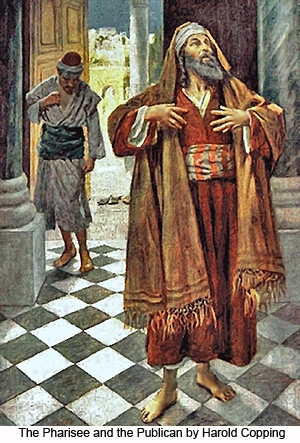
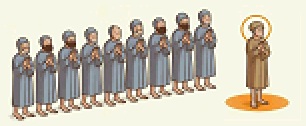
When the Pharisee in Jesus’ parable went up to the temple, he stood and spoke this prayer to himself: “O God, I thank you that I am not like the rest of humanity — greedy, dishonest, adulterous — or even like this tax collector.” And yet, Jesus tells us that this Pharisee did not go home justified, or righteous in God’s sight. Why is that?

When the Pharisee said ‘I am not like the rest of humanity — I am not greedy, dishonest, or adulterous…’ was it true that he had conquered sin? Very likely not. Psalm 130 rhetorically asks, “If you, O Lord, should mark our iniquities, who could stand?” And the Gospels record Jesus criticizing the Pharisees repeatedly, saying things like “Oh you Pharisees! Although you cleanse the outside of the cup and the dish, inside you are filled with plunder and evil.” But assuming this Pharisee quietly spoke his prayer to himself in a way which no one else could hear, why would he lie? Maybe he believed everything he said.

When we compare ourselves to others, like this Pharisee compared himself to the tax collector, we can imagine the great faults of others make our own faults unimportant. But just because somebody else is ten billion dollars in debt doesn’t mean that I am solvent. My own debts still remain. Some people accuse and make much of others’ sins because they are projecting at others what they dislike in themselves. It is much easier to condemn the faults in others than to change the faults in me.

Another phenomenon common to people and cultures is to condemn a person or group for the problems of the day. Sometimes, these are merely scapegoats for shifting blame. At other times, particular persons really are at fault and should be corrected or stopped. But we should not imagine that we can banish, purge, and kill our way to earthly paradise. Even after the Great Flood in Genesis, sinners disembarked from Noah’s ark. As the Christian Russian dissident and winner of the 1970 Nobel Peace Prize winner, Aleksandr Solzhenitsyn, famously wrote: “If only it were all so simple! If only there were evil people somewhere insidiously committing evil deeds, and it were necessary only to separate them from the rest of us and destroy them. But the line dividing good and evil cuts through the heart of every human being. And who is willing to destroy a piece of his own heart?

The Pharisee’s heart was probably not so pure of sin as he thought. He needed Jesus Christ to cleanse and heal and change it. But imagine if it really were true that the Pharisee was unlike the rest of humanity; not greedy, not dishonest, and not adulterous. Why then did this Pharisee not go home justified before God? What more did he lack?

Our Gospel tells us Jesus addressed today’s parable “to those who were convinced of their own righteousness and despised everyone else.” The Pharisee looked down on that tax collector and despised him with contempt. Greed, dishonesty, and adultery are hateful things, but Jesus forbids us from hating anyone. Jesus says you will be hated, you will have enemies, but he commands you to “love your enemies, and pray for those who persecute you, that you may be children of your heavenly Father.” If there is ever people you may be hating, be sure to pray for them (since you cannot pray for someone — willing their good — and hate them at the same time). Otherwise, when you die and you see someone whom you hate on the other side of the pearly gates, you might refuse to enter into Heaven.

Without ever denying right and wrong, without ceasing to share the truth, we must remain humble as sinners living among sinners. ‘For whoever exalts himself amongst others will be humbled, and the one who humbles himself will be exalted.’ That’s some food for prayerful thought today as we stand to pray in this temple and go back to our homes in the world.
Strength For Your Mission

October 20, 2025

29th Sunday in Ordinary Time
By Deacon Dick Kostner

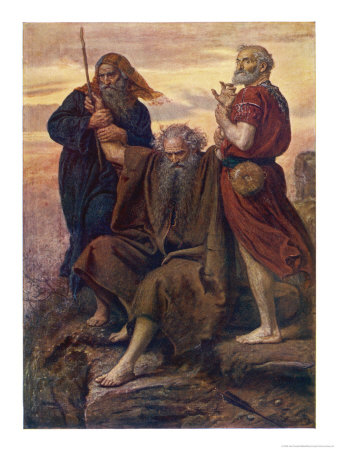
Our readings for this Sunday provide us with a way to restore our bodies when we are too tired to continue. Our first reading from the Book of Exodus has Moses engaged in a battle with an enemy of Israel. Moses tells his commander not to fear the enemy, for he will ensure success in the mission by holding his hands up to God and praying for help. The battle goes well until he becomes tired of holding his hands up, and when he lowers them, the enemy prevails. With the help of two men to hold his hands up, they are then successful. The lesson for us here is that when we become tired and unable to go on with a task, we need to look to and pray to God, who will provide us with friends to help give us the support we need to be successful.

In our second reading from the Letter of Paul to Timothy, we find that Timothy has grown tired of trying to teach others. Paul reminds him that God has given him the tools to be successful in his vocation and that all he has to do is request strength through prayer and have patience with others for God to help give him the strength to continue and be successful.

Finally, in our Gospel from Luke, Jesus teaches his disciples through a parable to pray always when they feel overwhelmed and weary, for it is through a higher power that they will be able to find relief and success in their vocation in life. Sometimes, it will seem like God has ignored your prayers, but through persistence, God will grant support to be successful in the mission assigned to them.

We have all received from God his “wish list” for living out our life in this world. The problem is that because of the gift of freewill, God only suggests to us what would make him happy with how we actually live our lives. It is up to us to either listen and respond to his wish list for us or to spend our short time here on earth as we want and desire to live it. I have found that in most cases, when God suggests that I do something, many times I feel he has asked the wrong person for that job. Fear steps in, and the guy with horns reinforces my fears and tells me that I am right and that God has made a mistake.

I can remember when I was in my last year of Deacon Formation, before I would be ordained, I asked my friend Fr. Frank Corradi if he would be my Sponsor and Director for that last year. He looked at me, and I saw a “deer in the headlights” look in his eyes. I could tell he was trying to come up with a reason why he couldn’t oblige me, but God stepped in, his eyes softened, and he agreed.

One of the first things he directed me to do was to spend time that summer with a parishioner of his who had been diagnosed with cancer and was dying. He told me that it would be good for me to experience what the last days of someone’s life are like. Now, you need to realize that I was always afraid of death and wanted to get it out of my mind. I had even drafted a will for myself that said I did not want my wife to have any funeral for me and that I wanted to be buried within twenty-four hours of death. My thoughts were that this would make it easier for Barb and my son. The quicker, the better for everyone. Well, now it was my turn to have “deer in the headlights” eyes for Fr. Frank. What goes around comes around. I gulped hard and said, “OK.”

I spent every Tuesday morning that summer getting to know “Bill” and his wife (not his real name). We would have coffee together, and I would do a Communion Service for him and his wife. We got to be good friends, and one day I received a call from his wife telling me that he had died. She asked if I would do the Wake service for him, which I did. It was that assignment that Fr. Frank gave me that changed my way of thinking about death. I learned that people of faith are seldom afraid of death and that funerals are necessary for people to say, “Goodbye and see you later.”

My advice to you folks is that when you are asked by God to do something for him, and you bear those “deer in the headlights” eyes, just gulp hard and say, “OK!” (P.S.: God usually will surprise you with a “thank you” gift.)

Pray Without Ceasing

October 18, 2025

29th Sunday in Ordinary Time
By Fr. Victor Feltes

Once upon a time, the pope summoned his Vatican chauffeur. When his driver had brought the car around, the Holy Father confided, “Ever since I got elected pope, I have sorely missed not driving anymore. Please, sit in the backseat and let me take the wheel.” The chauffeur reluctantly agreed and the pope was beaming with joy. But soon the Holy Father accidentally went the wrong way down an empty one-way street and got pulled over by City of Rome police. An officer approached their vehicle intending to write them a ticket, but after a brief chat he soon returned to his partner waiting in the squad car. His partner asked, “What, no ticket? Who’s riding in that limo?” “I don’t know, but whoever it is he must be really important—the pope is his chauffeur!

Jesus (although in a much sounder, wiser way than this) also speaks from the lesser to the greater. This classic mode of rhetoric argues that something true in a smaller case is surely true for the larger case as well. For example, Jesus says a “person who is trustworthy in very small matters is also trustworthy in great ones; and the person who is dishonest in very small matters is also dishonest in great ones.” Elsewhere, he points out: “Are not two sparrows sold for a small coin? Yet not one of them falls to the ground without your Father’s knowledge. … So do not be afraid, [for] you are worth more than many sparrows!” And on another occasion, Jesus tells us: “If you, who are wicked, know how to give good gifts to your children, how much more will your heavenly Father give good things to those who ask him!

Jesus argues from the lesser to the greater in today’s Parable of the Unjust Judge. This bad judge does not care about justice. He neither fears God nor respects any human being. However, we see a widow wear him down to give her what she rightfully asks for through her dogged persistence. Jesus says, “Pay attention to what the dishonest judge says.” If a wicked judge with a heart of stone will eventually give in to a poor, weak widow, then, as Jesus argues, “will not God secure the rights of his chosen ones who call out to him day and night? Will he be slow to answer them? I tell you, he will see to it that justice is done for them speedily.” Unlike that unjust and indifferent judge, God is just and cares about us deeply, so we ought to ask God for good things and keep asking without becoming weary.

Our Sunday lectionary reinforces this lesson in today’s first reading. During the Exodus, when the Israelites entered a battle against the Amalekites, Moses climbed a hill overlooking the battlefield carrying the staff of God that had split the Red Sea. As long as Moses held that wooden staff raised above his head, Israel had the better of the fight. But whenever Moses let his tired arms rest, their enemy had the better of the fight. This scene prefigures Jesus’ crucifixion upon the hill of Calvary, where Christ’s arms upraised on the wooden Cross bring victory over our enemies. Just as Jesus had support from John the Apostle and the Virgin Mary and others at the Cross, so Moses had Aaron and Hur supporting his arms until the day was done and the battle was won. So who can support you in the battle of prayer? I can recommend spiritual allies divine, angelic, and human.

How often do we lack motivation to pray or, once beginning to praying, lack enthusiasm, inspiration, or insight? “We do not know how to pray as we ought,” but if we ask the Holy Spirit himself to help us to pray he will come to the aid of our weakness. Each of us is also accompanied by at least one sinless, loving, brilliant, and powerful guardian angel tasked by God to help us be saints. Ask your guardian angel to help you pray more faithfully and fervently. And finally, we have fellow Christians to help us. There are saints in heaven to intercede for us and people around us to pray with us, encourage us, and help keep us accountable. Ask the Holy Spirit, your guardian angels, other Christians to help you pray better.

Jesus expresses the necessity for us to pray always without becoming weary. St. Alphonsus Liguori, a doctor (or great teacher) of the Church, believed enduring in prayer is key to our salvation. St. Alphonsus said: “He who prays is certainly saved; he who does not pray is certainly damned. All the saints in heaven, except infants, were saved because they prayed; and all the damned in hell were damned because they did not pray, and this is their greatest torment to see how easily they could have been saved, had they prayed, and that now the time for prayer is over.” Jesus asked whether when he comes again he find faith on earth? If we keep on praying, he at least will find us faithful.

Imitate What They Contain — Funeral Homily for Mary Jo Meuli, 83

October 14, 2025

By Fr. Victor Feltes

Mary Jo lived with a special devotion to our spiritual mother, the Blessed Virgin Mary, and she looked forward to journeying beyond death to be with our Lord and Savior, Jesus Christ. Besides coming to Holy Mass and helping bring Christ in Holy Communion to others, Mary Jo prayed the Holy Rosary daily, sometimes several times a day, growing her in her Christian likeness to Jesus and Mary. When a person picks up the practice of the Rosary for the first time, much of one’s attention is focused on tracking the beads and remembering the prayers. But with more experience, the words and the beads can drift to the background, clearing a place for meditation on its Holy Mysteries.

These twenty mysteries of the Rosary help us reflect upon joyful, luminous, sorrowful, and glorious episodes from salvation history. Mary is a firsthand witness to about three-fourths of these events. So for instance, we can contemplate Jesus with Mary at the Nativity and hold the Baby Jesus in our arms. We can consider how much Jesus loves us to become incarnate as one like us, and be moved to love him in return. We can stand with Mary at the Crucifixion, at the foot of Jesus’ Cross, and share in her compassion for her Beloved Son. We can behold Jesus’ heroic virtues in his sufferings for us, refusing to spare himself, and resolve to do hard things for him in return.

Prayerfully meditating upon the Rosary helps us to become more like Jesus and Mary. The same is true with the Beatitudes. Who is poor in spirit, relying completely on God? Who mourns and meekly, non-violently, hungers and thirsts for what is right? Who is merciful and clean of heart? Who promotes peace, yet is persecuted for the sake of righteousness? Jesus and Mary and the saints are like this, and we are called to be like them. As St. Paul our patron says, “Be imitators of me, as I am of Christ” so that we may “conquer overwhelmingly through him who loved us.” And God will help us do so, if we give him our “Yes.”

In her final season of living with illness, Mary Jo told every new doctor she met: “I’m ready.” And thirteen years to the day after her husband Allan’s death, she passed on as well. Pray for Mary Jo’s soul, in case any impurity remains within her gold, so that as a perfect offering God may take her to himself. And learn from her example, for blessed are those who grow in the likeness of Jesus and Mary and the saints, ‘for their reward will be great in Heaven.’

Two Lessons from the Ten Lepers

October 12, 2025

28th Sunday in Ordinary Time
By Fr. Victor Feltes

I want to highlight two lessons from this Sunday’s Gospel which could greatly bless your life and soul. When ten lepers meet Jesus at the edge of a village, they keep a respectful distance from him. (Their skin disease made them religiously unclean and people feared them as being contagious.) The lepers shout out: “Jesus, Master! Have pity on us!” Jesus sees them and tells them, “Go show yourselves to the priests.” (The Old Covenant had a ritual for declaring lepers clean involving a physical inspection by a priest and a sacrifice.)

So the ten depart as they are commanded to by Christ and as they are going their skin diseases are cleansed. Notice how the lepers were not cleansed right away—they were not healed the moment Jesus spoke to them. They were going when they were healed, maybe miles away from Jesus when it happened. In this miracle, they were healed while walking in obedience.

Many blessings in our faith are only experienced once we step out in obedience. First we do what Jesus asks of us, in response to his grace which goes before and follows after us, and then we see its fruits in our lives. As you read this list of examples, which one or two are meant for you to add into your life?

• Daily prayer
• Consistent Sunday Mass-going
• Keeping Sunday rest
• Generous tithing
• Forgiving enemies
• Staying sober
• Volunteering
• Practicing chastity
• Being open to life
• Living more simply
• Regular confession
• Eucharistic adoration
• Going on a spiritual retreat or pilgrimage
• Entering a seminary, convent, or monastery
• Attending weekday Mass
• Praying the Rosary

Embracing one or two of these according to God’s will shall bless you and your loved ones. This Sunday’s Gospel story also suggests another valuable lesson.

One of those ten lepers happens to be a Samaritan, and once he realizes he has been healed, he goes back to Jesus. Glorifying God in a loud voice, he falls at Jesus’ feet and thanks him. Jesus says in reply, “Ten were cleansed, were they not? Where are the other nine? Has none but this foreigner returned to give thanks to God?” Then he tells the newly cured man, “Stand up and go; your faith has saved you.”

Jesus informs us that all ten lepers were cured. But consider this: eventually, each of those lepers died. Even if it was many years later from some cause of death other than a skin disease, every one of them died. Their healings were a great thing, but not the most important thing. The Samaritan’s healing produced in him great gratitude toward Jesus Christ and God the Father. He eventually lost the gift of good health, but his relationship with God could endure forever.

Some people only pray to God when they need something. But for Christ to fix our problems without us engaging in deeper relationship and gratitude towards him profits us little. Do not be one of those who are locked outside the door to whom the Master of the House will say, “I never knew you. Depart from me, you evildoers.” It is good for us to say, “Jesus, Master! Have pity on us,” like the ten lepers did. But let us always remember gratitude and relationship with the Giver of all good gifts.

The Seed of Faith & Bearing Fruit

October 4, 2025

27th Sunday in Ordinary Time
By Fr. Victor Feltes

Once upon a time, a pastor prayed to God, “Lord, please let me win the lottery.” This pastor was not a greedy person—he planned on giving almost all of the winnings away—he just really, really wanted to win the lottery. He prayed for weeks and weeks and when nothing happened he became frustrated with God, “Lord, why haven’t you let me win?” And he heard the voice of God reply, “You have to buy a ticket.” Having Christian faith is like having that ticket, it makes possible the blessings which follow.

Without faith, the complex beauty and order of this universe are dismissed as merely incredible coincidences. Without faith, supernatural miracles can be rationalized away. Without faith, a person will not seek after God for they do not believe he is real and good. As the Letter to the Hebrews says “without faith it is impossible to please God, because anyone who comes to him must believe that he exists and that he rewards those who earnestly seek him.

In today’s Gospel, the apostles ask of the Lord: “Increase our faith.” Jesus replies, “If you have faith the size of a mustard seed, you would say to this [deeply-rooted] tree, ‘Be uprooted and planted in the sea,’ and it would obey you.” When I was a boy and I read this verse I felt discouraged because “My faith is not even the size of a tiny seed!” But Jesus intends this teaching as an encouragement; he’s saying that even a little faith can achieve a lot!

Sometimes people in Confession confess to lacking trust in God. I point out that if a person trusted God perfectly they would be a perfect person, so it’s a common human problem. Trusting God has been our primordial human problem since the Garden of Eden. Yes, faithfulness can be challenging, but you do believe in God.

There was a time in college when I attended Mass without approaching for Communion because I feared that I did not have enough faith to receive the Lord in the Eucharist worthily. After weeks of this worry, it came to me in prayer that “people who don’t believe in God don’t spend time worrying about whether or not they believe in God—that’s something only believers do.” In retrospect, my worry was rather silly, since so much of how I was living my life would not make sense without faith in God. I bet the same is true for you who freely came to Mass today. Why else would you be here?

Realize that having faith is different than having feelings. You can have great faith both when your heart is joyful and when it’s torn with sorrow. Whatever one may be feeling, faith choses to respond faithfully in trusting love. Notice when the apostles ask the Lord to increase their faith how Jesus does not rebuke them for it. They are asking for a good thing. Like greater humility and greater love, increased faith is a gift God is always eager to give.

Although your faith could be strengthened, do not imagine that your faith is too feeble to do anything now. Scripture says faith can uproot trees and move mountains. Faith has worked miracles, changed unjust laws, and converted nations. Jesus wants you to know that even the tiny faith you have can work great good for you and those around you. So pray for more faith and resolve to act in faith more often. There are great jackpots to be won, but you have to buy a ticket.