Archive for December, 2025

Holy Family Lessons

December 28, 2025

Feast of the Holy Family
By Fr. Victor Feltes

Modern popes (including St. Paul VI, St. John Paul the Great, and Benedict XVI) have reflected upon and recommend the Holy Family of Joseph, Mary, and Jesus as a model, an example, for all Christian families to contemplate and learn from. This morning I wish to share some insights for children and parents, husbands and wives, drawn from the Holy Family. First, a reflection on Jesus in relationship to his parents.

The Archangel Gabriel told Mary at the Annunciation, “Behold, you will conceive in your womb and bear a son, and you shall name him Jesus.” Then, when an angel of the Lord appeared to Joseph in a dream he said, “[Mary, your wife,] will bear a son and you are to name him Jesus…” And St. Luke records that indeed, “when eight days were completed for his circumcision, he was named Jesus…” So Jesus was named by both Joseph and Mary, though his name originated with God. Adam was given authority in the Garden of Eden, reflected by him authoring the names of his wife Eve and all the animals. Jesus’ mother and foster-father were likewise given authority over him, and Luke writes that Jesus “was obedient to them.”

We just heard Sirach’s words that “God sets a father in honor over his children; [and] a mother’s authority he confirms over her sons,” and we heard St. Paul urging “Children, obey your parents in everything, for this is pleasing to the Lord.” St. Paul notes elsewhere that amongst the Ten Commandments, “Honor your father and mother” is the first commandment with a promise—“so that it may go well with you and that you may enjoy long life on the earth.” And Sirach observes that those who revere and honor their parents receive many earthly and heavenly blessings.

The Catechism of the Catholic Church teaches that “as they grow up, children should continue to respect their parents. They should anticipate their wishes, willingly seek their advice, and accept their just admonitions.” It says, “obedience toward parents ceases with the emancipation of the children; [but] not so respect, which is always owed to them.” And “as much as they can, [children] must give [parents] material and moral support in old age and in times of illness, loneliness, or distress.” Jesus supported his parents in the Holy Family. St. Joseph is the patron saint of a happy death because Jesus and Mary would have comforted and cared for him on his deathbed. And one of Jesus’ final deeds before he died on the Cross ensured that his widowed mother would be cared for.

This Sunday’s Gospel reading offers husbands and wives another valuable reflection from the Holy Family. After the Annunciation, the Gospels record no more angelic messages being given to the Blessed Virgin Mary. Her husband, Joseph, however receives multiple messages through dreams. First, the angel of the Lord tells Joseph not to fear receiving Mary his wife into his home. Then, as Herod is poised to hunt down the Christ Child, the angel tells Joseph to take Jesus and Mary to Egypt. Once Herod dies, the angel directs Joseph to take them back to the land of Israel. Finally, once Joseph has led his Holy Family back to Israel, he is warned in a dream not to live in the region of Bethlehem (Judea) and decides instead to resettle back up north in Nazareth.

Those messages from heaven came to the leader of the Holy Family, and Mary had to trust and entrust herself to Joseph. Joseph was called to servant-leadership, loving his wife and their child self-sacrificially, even as Christ loves the Church. Mary, in turn, was called to be subordinate to her husband, like a priest to his bishop. Of course, I am not obliged to obey my bishop in things that are immoral or irrational, but otherwise the Lord wills me to be obedient to him as my leader. I can voice my personal preferences to him and I ought to raise my concerns with him, but the ultimate decision and responsibility falls to him. Likewise, St. Paul writes, “Wives, be subordinate to your husbands, as is proper in the Lord.” And elsewhere St. Paul teaches in the Spirit, “As the Church is subordinate to Christ, so wives should be subordinate to their husbands in everything.”

Children and parents, husbands and wives, may all of us learn from the Holy Family as our example. And may their prayers beside the throne of God the Father gain us abundant graces to be great and fruitful saints in their likeness.


A Manger Sign

December 25, 2025

Christmas Day
Fr. Victor Feltes

The shepherds were in the countryside keeping night watch over their flocks when an angel of the Lord appeared to them and the glory of the Lord shone around them. The angel proclaimed “good news of great joy”: a baby born that day in Bethlehem, a Savior who is Christ and Lord. And the angel gave the shepherds a confirming sign: “You will find an infant wrapped in swaddling clothes and lying in a manger.” Seeing a newborn baby swaddled (that is, snugly wrapped up in cloth) would not have been an unusual sight back then. As the Old Testament author of the book called The Wisdom of Solomon writes: “In swaddling clothes and with constant care I was nurtured. For no king has any different origin or birth; one is the entry into life for all…” A much stranger sight for the shepherds on Christmas would be to see a baby in a manger.

Now when I was a kid, I thought the manger in any “manger scene” was the Holy Family’s barn or shelter, but that’s mistaken. A manger is not a building but a feedbox for dry feeds, like grain, for animals to eat. On Christmas, one such manger served as a makeshift cradle. Once the herald angels had departed, the shepherds excitedly said to each other: “Let us go, then, to Bethlehem to see this thing that has taken place!” They went in haste into Bethlehem and found the Holy Family, with the newborn King lying in the manger.

The angel had told the shepherds “this will be a sign for you.” Seeing the child in the manger confirmed that they had found the Christ, but this Savior in the manger is a sign for us in another sense. The name of the city of Christ’s birth, Bethlehem, means “House of Bread” in Hebrew. Finding our Lord inside a box for eating grain within the House of Bread is a sign for us foreshadowing the Holy Eucharist. Jesus would go on to teach us, “I am the living bread that came down from heaven; whoever eats this bread will live forever; and the bread that I will give is my flesh for the life of the world.”

God’s Son became man for a closer unity with humanity; “the Word became flesh and dwelt among us.” The shepherds in the countryside and the Magi in a distant land were called to draw nearer to Christ at his dwelling place in Bethlehem. But Jesus offers and calls us to an even closer union with him, within this church, his dwelling place. Jesus declares, “Amen, amen, I say to you, unless you eat the flesh of the Son of Man and drink his blood, you do not have life within you. … Whoever eats my flesh and drinks my blood remains in me and I in him. Just as the living Father sent me and I have life because of the Father, so also the one who feeds on me will have life because of me.” When Jesus teaches us to pray for daily bread he wants us to eat more than only once or twice a year. As normal food sustains our natural lives, so we need “the Bread from heaven” to sustain our spiritual lives, to remain in Christ and he in us.

Behold, as a messenger of the Lord, I proclaim to you good news of great joy: Jesus Christ, who is Savior and Lord, has come down from heaven. Born long ago in Bethlehem, he remains really present for us here today. Please allow the miracle of Christmas to produce enduring fruit in you. Return here to Christ’s dwelling place each Sunday and holy day, to adore him and receive him in his Holy Eucharist. Through his Incarnation, Jesus chose to become one of us; but through his Holy Eucharist, he wishes to remain one with you.


Born to Die & Rise — Funeral Homily for Matthew “Matt” Jaworski, 63

December 23, 2025

By Fr. Victor Feltes

In one sense, no date on the calendar is a good time for a funeral. Any day for a loved one’s funeral rites will feel off, discordant. But today, on this eve of Christmas Eve, it feels like an especially strange time to have Matt’s funeral. We will soon be marking the glorious birth of Baby Jesus — how God becomes man and lives among us. We rightly celebrate that as one of the most joyous feasts of the year. But the life and joy of Christmas seems to be stark contrast with the loss and sadness of today. And yet it may be said that Jesus Christ “was born to die.” If Jesus Christ, the God-Man, had lived without ever becoming our redeeming sacrifice, we would still remain hostages to Satan, sin, death, and suffering forever. Instead, God the Father “did not spare his own Son but handed him over for us all.

The signs of Christ’s salvific mission were there from the beginning. The very name “Jesus” (or “Yeshua”) means “God Saves.” He was born in the hometown of David the shepherd-king, at Bethlehem, from where lambs to be sacrificed at the temple came. Jesus would go on to be sacrificed as our Good Shepherd-King, at Jerusalem, as the Lamb of God who takes away the sins of the world. On Christmas night, his Mother Mary wrapped his body in cloth and laid him down inside a borrowed cave. Years later on Good Friday, she would wrap his body in cloth again and lay his body down inside another borrowed cave. Jesus’ Christmas birth and Easter resurrection, these sources for our hope, did not come without difficult trials.

The first Christmas was not easy but the Holy Family was always in God’s care. Imagine being poor, being far from home, and having your first child in a place for animals. Yet Mary and Joseph carried faith and peace within them, from the words and miracles from heaven recorded in salvation history and experienced in their own lives. Jesus Christ’s young and unexpected death stunned those who knew and loved him; however, even that awful day was foreseen in heaven’s providence. God’s Beloved One was remembered and soon would rise again. Blessed were those who mourned for him and prayed for him, for they were soon comforted. Matt’s unexpected passing saddens and a day like this is always painful. But we carry faith and hope from God, for Matt—for whom we pray—and for every one of us. Though God’s beloved one must pass through Good Friday, Christmas leads us to Easter joy.

Jesus & The Wingless Angels

December 22, 2025

4th Sunday of Advent
By Fr. Victor Feltes

Today, Jesus reminds us that our earthly experience is limited to a specific time. We all think that our time here on earth is unlimited, but it is not. We are given a certain time to accept or reject our requested vocation in life: to love God and neighbor. Let me share with you Deacon Dick’s call and views on a vocation of love and service.

When I was about six or seven years old, my dad and I went to Reetz’s Grocery Store to buy some meat. At that time, the grocery part was run by Lorraine Reetz and her sister Jean Reetz. Jean was not a very smiley person, but she was in charge of checking out the customers. One day, Dad was buying meat at the meat counter, and I heard a yell from the checkout counter. Jean was checking out someone, and when she overfilled the bag, it broke, with all the groceries falling on the ground. I saw that and ran over to Jean to help her repackage the bag that had broken. I saw her give me the biggest smile ever. From that day on, she always put me—who she called “Dickie”—in the front of the line to check out whenever I went to their store. Jean never forgot that event for years to come. She was to me a wingless angel.

Today we find that Mary is confronted by an angel to be the mother of God. We also find Joseph, who finds a person he is in love with and engaged to, is pregnant. Mary had an angel ask for her help. Joseph had another angel tell him she did not betray him. Who do we look to for truth in what God desires of our life? The answer is Jesus and the Body of Christ, His Church. Both Mary and Joseph had faith to believe the unbelievable. Who do we have? The answer is the Holy Spirit and the Body of Christ—service people, who I call the “Wingless Angels.”

When I was contemplating becoming a deacon, I did not want to become seen as a “holy roller.” The Dick I had grown up with could not handle that. I told God I would give it a try, but I felt He should give this job to someone more qualified than myself. Well, God gave me mentors. He gave me a wife, a son, and a daughter-in-law who give themselves in service to me and to others. He gave me parents who always put others in front of their own desires. He gave me friends and relatives who always looked out for others, even if it meant sacrificing their time so others could have some good time. He gave me my priest friends who showed me that just because you are holy doesn’t mean there is something not right with you—men who loved their vocation in life and serving God and His children. All were and are “wingless angels.”

When I was considering whether I should go through the program to become a deacon, I sat one Saturday at a bar with my best friend. I told him I was thinking about becoming a deacon and wanted his input on whether I should go on. He looked at me and said, “Go for it!” Another angel without wings. Finally, I looked at the parishioners of St. Paul’s and St. John’s—people who shared much of their life in service to their Church and to the community at large. Although many times they looked tired, they always had a smile on their face when serving God’s children. People who are and were truly “Wingless Angels.” I will close with an email I recently sent to my only granddaughter who began dating. I told her to choose her friends closely and to look to people who look to helping others more than they look to themselves. She answered me with a smiley face with tears on it. Barb asked me what that meant, and I said, “I think she got it!” Another angel without wings? I hope so!

Through the birth of Jesus—a “skin-on Person of God”—He gave us a great gift for Christmas: the angels without wings, people with “skin on,” to help direct our lives and be happy serving others. Food for thought before you celebrate Christmas? Without Mary and Joseph saying “Yes,” there might be no Jesus, no Church, and no Body of Christ. There might be no angels without wings! Jesus invites all children of God to join Him at Mass, and He will provide them with a meal of Himself—food that Fr. Tom called “angel food,” energy food that will put a smile on your face as you serve His children. Finally, Jesus told me to tell you, “Wingless Angel folks,” thanks for saying “Yes” and loving others as He loves us, and that He is preparing a room for you. And for those of you who are being called to become “Wingless Angels,” and who—like this deacon—questioned the wisdom of Jesus in calling you into the College of Saints, Jesus responds with a grin on His face and tells you: “Be still and know that I Am!”

You Can Ask Jesus Your Questions

December 13, 2025

3rd Sunday of Advent
By Fr. Victor Feltes

St. John the Baptist, despite his continued imprisonment, had heard about the works Jesus was doing and sent two of his disciples to ask him, “Are you the one who is to come, or should we look for another?” John was no pushover, not some reed swayed by the wind, but from this question we can gather that while John sat in Herod’s prison some doubt arose about whether Jesus was their long-awaited Messiah.

Notice how Jesus reacts to the question. He does not lose his temper or condemn them for asking. He gives them a helpful response: “Go and tell John what you hear and see: the blind regain their sight, the lame walk, lepers are cleansed, the deaf hear, the dead are raised, and the poor have the good news proclaimed to them. And blessed is the one who takes no offense at me.” In other words: “Report to John my mighty works for these show that I am the Messiah of whom Isaiah wrote (e.g., ‘Then will the eyes of the blind be opened, the ears of the deaf be cleared; then will the lame leap like a stag, then the tongue of the mute will sing.’) How I accomplish my purposes may appear strange, but remember that a person who takes no offense at me is blessed.” Jesus was patient with people who asked him questions in good faith.

Nicodemus did not want to be seen in public with Jesus. That’s why Nicodemus approached him at night. But Jesus still engaged with his questions. The Samaritan woman at the well may have first thought the man speaking to her was weird, but Jesus invited her probing questions. And the rich young man who asked Jesus about the way to eternal life wasn’t quite ready to fully commit to following Christ, but Jesus looked at him, loved him, and gave personalized responses. Despite their flaws, they asked Jesus questions in good faith and Jesus answered them. What Jesus does not like is questions asked in bad faith.

When the Pharisees would set traps for him, Jesus knew their ill intent, saying, “Why are you testing me, you hypocrites?” He knew they were just looking for ways to condemn and reject him. And when Jesus appeared before King Herod during his Passion, Herod questioned him at length because he had heard about him and hoped to see him perform some sign. But when Jesus gave him no replies, Herod treated him with contempt and mocked him and sent him away. Wicked Herod was merely curious about Jesus and uninterested in repenting of his sins. We should not test God like the Pharisees and Herod did. Jesus delights, however, in genuine seekers and is pleased to answer them.

Whoever asks, receives,” and “whoever seeks, finds,” though the answer might not be instantaneous. Job, while doing nothing wrong, questioned for some time before the Lord answered him. Sometimes our answer is already readily available through Christ’s Church, and we should listen to him through her. But sometimes God, who is supremely brilliant and creative, will answer us through different avenues (though without contradicting himself). Sometimes his answer will come during prayer, or maybe through something we providentially see or hear, or perhaps through a friend or a stranger.

What are your questions for the Lord? I encourage you to ask him and keep your eyes and ears and heart open. If you’re seeking the truth and not seeking excuses; if you’re looking to love and serve Jesus better, pay Christ the compliment of approaching him as the One who knows all things and loves you. Blessed is the one who does so.

From Eden to Nazareth

December 8, 2025

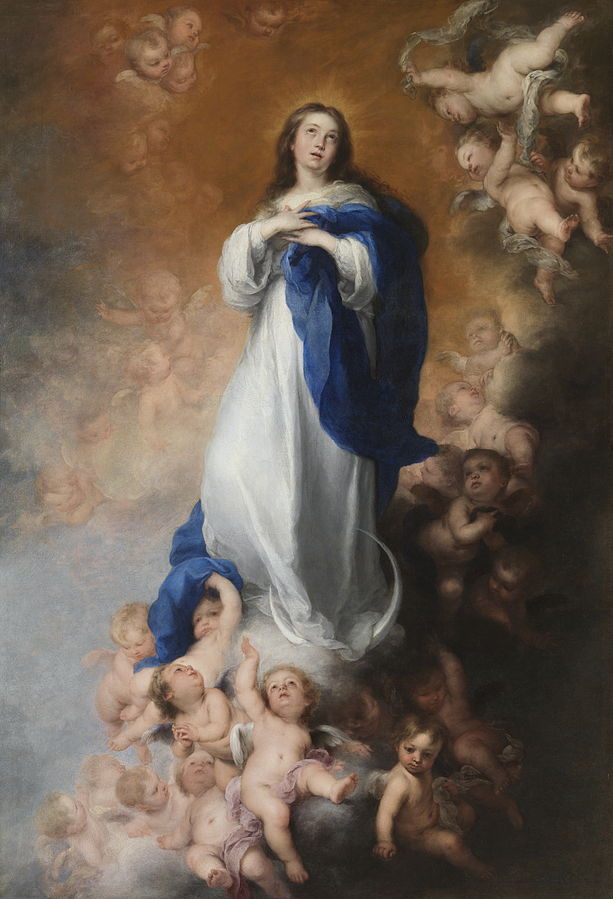
Solemnity of the Immaculate Conception
By Fr. Victor Feltes

In the story of Genesis, the Lord God declares to the serpent: “I will put enmity [that is, hostility] between you and the woman, and between your offspring and hers; he will strike at your head, while you strike at his heel.” There is more going on here than an account of humanity’s dislike for slithering, venomous snakes. That tempter at the Fall was not a mere snake. The Book of Revelation identifies “the ancient serpent” as “the Devil and Satan.” And the Church saw in that declaration of the Lord God in Genesis the first proclamation of the Gospel, the Protoevangelium, foretelling what God intended to do to accomplish our salvation through Jesus Christ. “I will put enmity between you and the woman, and between your offspring and hers…” (or literally in the Hebrew) “between your seed and her seed”. That’s curious, since folks typically speak of the seed a man rather than the seed of a woman. Who is this woman whom God decrees to be in a state of opposition to Satan, whose Son would suffer due to the Evil One until he crushed the Serpent’s head?

The angel Gabriel was sent from God to a virgin in the city of Nazareth named Mary. And coming to her, he said, “Hail, full of grace! The Lord is with you.” Gabriel hails Mary with a title, like people cried “Hail, King of the Jews” during Jesus’ Passion. But the angel is not speaking ironically like Jesus’ tormentors and the angel does not lie. What we translate into English as “full of grace” has a deeper meaning in the original Greek. Heaven’s messenger calls Mary “Kecharitomene,” a perfect passive participle of a word which means “to fill or endow with grace.” Because it is in the Greek perfect tense, it declares Mary was graced as a completed action in the past but with effects continuing to the present. Mary had already been prepared by God for that moment, to become the sinless, grace-filled mother of our Incarnate Lord.

So why did God do this? One reason is so that she could give to God a full and free “Yes.” Once the angel explained that she would give birth to the Messiah and that this child would be God’s Son conceived by the Holy Spirit, Mary said, “Behold, I am the handmaid of the Lord. May it be done to me according to your word.” The Catechism of the Catholic Church teaches that “in order for Mary to be able to give the free assent of her faith to the announcement of her vocation, it was necessary that she be wholly borne by God’s grace.” (CCC #490) Mary says “Yes” to God not due to coercive fears, nor from selfish motives, but freely and faithfully on behalf of all Creation and the Holy Church to be.

Another reason God created her pure and filled her with grace, was to make her a fitting mother — not only for her Son but all his Christian siblings, his brothers and sisters, including you and me. She is the New Eve who, by her faithful loving obedience, “became the mother of all the living.” Today we celebrate with Blessed Mary how the Almighty has done great things for her, through which we now have Jesus Christ our Lord and a heavenly mother who knows us and loves us and prays for us now.

Heralding the Best Path

December 7, 2025

2nd Sunday of Advent
By Fr. Victor Feltes

St. John the Baptist taught his hearers that the time had come for them to take action and change course. St. Matthew writes it was of John the Baptist the Prophet Isaiah spoke when he foretold of “a voice of one crying out in the desert,” saying, “Prepare the way of the Lord! Make straight in the wasteland a highway for our God! Every valley shall be filled in, every mountain and hill shall be made low; the rugged land shall be made a plain, the rough country, a broad valley. Then the glory of the Lord shall be revealed…” So what is this imagery about?

In ancient times, preceding a king’s journey somewhere, a messenger would be sent ahead to announce how people should get ready for the royal arrival. One practical task was to improve his road: removing rocks, filling potholes, and smoothing ruts. For the coming of the King of kings, Isaiah even envisions lowering mountains and raising valleys to form a straight and level highway. John the Baptist calls everyone to reevaluate our priorities to better prepare the way for encountering Christ.

An angel of the Lord had announced to the Baptist’s father, Zechariah, that John’s mission had an intergenerational component. John was to “turn the hearts of fathers toward children and the disobedient to the understanding of the righteous, to prepare a people fit for the Lord.” St. John, inspiring adults to seek the very best for children and to form them in godly ways, would “turn many of the children of Israel to the Lord their God.” Today, I wish to inspire you to do the same for children now through our St. Paul’s Catholic Grade School.

We have an excellent Catholic school. For our most recent reaccreditation, administrators from four other Catholic schools thoroughly evaluated us and told us: “You have a beautiful school.” “[It’s] welcoming, faith-filled, and charming!” “[It’s] filled with excellent educational instruction.” “[There are] high expectations.” “The students are so well-mannered.” “[And there are] great relationships between teachers and students.” And all of them agreed, “We wish we could work at your school.”

Our highly-qualified teachers can provide one-on-one attention in a wholesome environment more like a family than a factory. And we have great young people who positively influence each other. Our reinvigorating new principal, Mr. Brad Cody, has been struck by our students’ respectfulness and politeness, noting how in all his time here he has yet to hear any student swear. Our behavioral expectations, our academic expectations, and our moral expectations are not found in many other schools today. St. Paul’s devoted teachers and substitutes who have taught in both worlds can attest to the differences in our Catholic school.

God and Christ’s teachings are not excluded here. We have daily prayer, weekly Mass, Confession, and seasonal devotions. Our students get to know Catholic clergy beyond just at Sunday Mass, like when we eat our excellent school lunches with them at their tables. Our littlest ones enjoy the Catechesis of the Good Shepherd, which introduces Christianity to them in an engaging way on their level. And while people of all faiths are welcome at our school, the Catholic Faith is taught and lived.

Our 4K through 8th grade Catholic school prepares the way for the Lord without the rocks, ruts, and pitfalls found in other paths; a smooth and straight road for children to get to know Jesus Christ and walk forward with him together. So if you or your acquaintances have school-aged children, please work to get them enrolled here in 2026. Make a call, take a tour. School Choice makes tuition free at higher incomes than you would think. But even families who don’t qualify can receive grants and scholarships we offer, so do not imagine cost to be an obstacle. In addition to recruiting for our great school, I invite you to join our work in person. We could always use more playground supervisors, substitute teachers, or helpers in the library, office, or classrooms.

It’s not so much that our Catholic school has a mission, as our Catholic mission here in Bloomer has a school. Please help prepare the way for our Lord, make straight our children’s paths, by supporting our St. Paul’s Catholic School.