Archive for November, 2026

What Is Jesus Thankful For?

November 22, 2026

Bloomer Ecumenical Thanksgiving Service Sermon
By Fr. Victor Feltes
Every year, Thanksgiving time is a helpful reminder for us to be giving thanks to God. Sacred Scripture meanwhile reminds us to be giving thanks to God every day. For instance, in 1st Thessalonians, Ephesians, and Colossians St. Paul tells us to: “Rejoice always, pray continually, [and] give thanks in all circumstances.” “Sing and make music from your heart to the Lord, always giving thanks to God the Father for everything…” “And whatever you do, whether in word or deed, do everything in the name of the Lord Jesus, giving thanks to God the Father through him.” (1st Thessalonians 5:16-18, Ephesians 5:19-20, Colossians 3:17) When contemplating what to preach about Thanksgiving to you, it occurred to me to explore what Scripture mentions our Lord Jesus being grateful or giving thanks for.

During Jesus’ public ministry, when his seventy-two disciples returned from their missionary journeys very pleased at their successes, Jesus joyfully gave thanks. Luke and Matthew’s Gospels recount how Jesus rejoiced in the Holy Spirit and said: “I thank you, Father, Lord of heaven and earth, for although you have hidden these things from the wise and the learned you have revealed them to the childlike.” Jesus gives thanks that his Father reveals the things of Heaven, offering an invitation to enter loving relationship with God even to simple people. Whether or not the world regards us as wise or learned, powerful or praiseworthy, Jesus gives thanks that the Father has enabled us to know God. We are here this evening because God the Father has revealed his Son and God the Son has revealed his Father for us. We have great reason to be grateful.

Later, at the tomb of Lazarus, before resurrecting his friend from the dead, Jesus raises his eyes and says, “Father, I thank you for hearing me. I know that you always hear me; but because of the crowd here I have said this, that they may believe that you sent me.” Jesus is grateful that his Father always hears him. How wonderful it is that God the Father, Son, and Holy Spirit always hear us, too. At any time of day or night, we can enter a royal audience with the King of heaven and earth. We have great cause to be thankful that such free and immediate access to God is always available to us through prayer.

The return of the seventy-two and the raising of Lazarus are two famous occasions of Jesus giving thanks in the Gospels. But the most frequent setting in New Testament where Jesus expresses gratitude is at meals. At the miraculous feeding of the 5,000 with five loaves and two fish, John writes, “Jesus took the loaves, gave thanks, and distributed them to those who were reclining, and also as much of the fish as they wanted.” At the feeding of the 4,000 with seven loaves and a few fish, Matthew writes that Jesus, “looking up to heaven… took the seven loaves and the fish, gave thanks, broke the loaves, and gave them to the disciples, who in turn gave them to the crowds.” And even after the Resurrection, while at table incognito with two disciples at Emmaus, Luke writes that Jesus “took bread, said the blessing, broke it, and gave it to them. With that their eyes were opened and they recognized him….” What is this blessing of thanksgiving Jesus said before the meals?

In the first century, the head of a family at a Jewish meal would take the food and speak a prayer of thanks to God before distributing it. Later, the Jews standardized the prayer one would say over bread to this: “Blessed are you, Lord our God, King of the universe, who brings forth bread from the earth.” In the Gospels, Jesus presides as the head of his household. He raises his eyes to the Father in heaven and gives thanks for God’s provision. Jesus is thankful to our Father, who art in Heaven, who gives us each day our daily bread. We should be grateful too for God’s daily provision in our lives.

So we see Jesus Christ showing gratitude in the Gospels: for his Father revealing, for his Father listening, and for his Father providing. Each of us can and should be grateful for the same, since God reveals for us, listens to us, and provides for us. There is at least one more thing in the New Testament for which Jesus has gratitude. John’s Gospel features what are called Jesus’ Last Supper Discourses. John writes how Jesus “raised his eyes to heaven” and prayed to God the Father for his disciples. Jesus says: “I pray for them. I do not pray for the world but for the ones you have given me… I pray not only for them, but also for those who will believe in me through their word, so that they may all be one, as you, Father, are in me and I in you, that they also may be in us, that the world may believe that you sent me. I in them and you in me, that they may be brought to perfection as one, that the world may know that you sent me, and that you loved them even as you loved me. Father, they are your gift to me.” Now in this passage, Jesus does not say explicitly that he is grateful to receive us; this is, his Apostles and we who have come to believe thought their word. But Jesus calls us his Father’s gift to him, and can you imagine Jesus Christ not being thankful for his Father’s gift? We are the Father’s gift to him and Jesus is grateful and thankful for us.

In the passage I read from the Last Supper, our Lord Jesus prays that we would be one, as God the Father and Jesus are one, so that we may be brought to perfection as one and the world may come to believe in Christ too. St. Paul in his 1st Letter to the Corinthians teaches that Christians are one in Christ by sharing the Lord’s Supper. He writes: “The cup of blessing that we bless, is it not a participation in the Blood of Christ? The bread that we break, is it not a participation in the Body of Christ? Because the loaf of bread is one, we, though many, are one body, for we all partake of the one loaf.” This meal, the Lord’s Supper, has been called Eucharistia (or “the Eucharist”) since the 1st or early 2nd century A.D.; a Greek word which means “thanksgiving” or “gratitude.” Thanksgiving is a great American holiday which brings families together as one to share a meal expressing our thanksgiving and gratitude to God. Likewise, our Lord Jesus Christ seeks to bring his whole family together to share his great meal of thanksgiving and make us perfectly one.

I am thankful for our Bloomer Clergy Association; for the fellowship we share, for the good work we do, and for opportunities to prayerfully come together like this. I believe this group is important, for how can we ever be brought to perfection as one if we cannot be ecumenically friendly and work and pray together? What troubles me that we are not fully one like Christ wants us to be perfectly one. This is the Christian world we have inherited, so it feels normal for us to be apart, but I believe our future can be better than the past. Our oneness is something we should pray for, because Jesus prayed for it. It is something we should work towards, because it is Christ’s will. God divided the Red Sea for his people; pray that we may see God reunite his people. We believe Jesus can resurrect the dead, so surely our Lord can reunite the living Christians. If this is something you would like to explore, I am eager to begin that conversation.

In conclusion, thank you for this opportunity to preach this message to you tonight. Jesus wills us to be grateful and we have much to be grateful for. May God bless you and yours this Thanksgiving, and may he keep us always thankful.

“Who Are You, Sir?”

November 22, 2026

Solemnity of Christ the King
By Fr. Victor Feltes

Around 35 A.D., Paul (also known by his Hebrew name, Saul) was persecuting the early Church. Armed with authority from the Jewish chief priests, he was journeying to Damascus on a mission to find men and women who belonged to the Way of Jesus Christ so that he might bring them back to Jerusalem in chains. As Saul drew near the city at midday, a great light from the sky, brighter than the sun, suddenly shone around him. He fell to the ground and heard a voice saying to him, “Saul, Saul, why are you persecuting me?” Saul replied, “Who are you, sir?” The voice answered, “I am Jesus, whom you are persecuting. Now get up and go into the city and you will be told what you must do.” Realize that at this point, Jesus had already resurrected and ascended into Heaven. It seems Jesus and Saul had never previously met. Yet Jesus asks him, “Saul, Saul, why are you persecuting me?” So how was Saul persecuting Jesus? Today’s Gospel points to a mystical presence of Jesus Christ in his people.

As we heard, at the Last Judgment, Jesus says he will sit upon his glorious throne, with all peoples gathered and sorted before him. To those on his right he will say, in so many words: ‘Come, enter my heavenly Kingdom. When I was in need you gave me food, you gave me drink, you welcomed me, you clothed me, you cared for me, you visited me.’ Then the righteous will reply, ‘Lord, when did we see you and do any of those things?’ And he will answer, “Amen, I say to you, whatever you did for one of the least brothers of mine, you did for me.” Then he will say to those on his left, ‘Depart from me, into eternal fire. When I was in need you gave me no food, you gave me no drink, you did not welcome me, you did not clothe me, you did not care for me, you did not visit me.’ Then they will answer, ‘Lord, when did we see you and fail to do such things?’ And he will answer them, “Amen, I say to you, what you did not do for one of these least ones, you did not do for me.”

So in summary, Jesus solemnly assures us: ‘If you do (or do not do) these things for the least of mine, you do (or do not do) these things for me.’ Add to this how St. John’s Gospel recounts Jesus declaring: “Whoever eats my flesh and drinks my blood remains in me and I in him.” Inspired by the Holy Spirit, St. Paul teaches the Colossians, Corinthians, and Romans: “[Jesus] is the Head of the Body, the Church.” “You are Christ’s Body, and individually parts of it.” And “we, though many, are one body in Christ.” I do not fully understand the mystery of the mystical presence of Jesus Christ in the members of his Church. But I believe we would be wise to take this idea to heart, applying it in how we regard and treat one another. I have heard stories about St. John Paul the Great or St. Teresa of Calcutta that when they would meet someone it was like that person was the only person in the world. We should respect and love the people in front of us too.

Jesus’ words in today’s parable are famous, but notice how he foretells both the righteous and the wicked replying with surprise, saying, ‘Lord, when did we see you and do (or not do) these things for you?’ Though it is easy to forget, try to remember that Jesus Christ is present in your brothers and sisters.

Stewarding a Fortune

November 18, 2026

33rd Sunday in Ordinary Time
By Fr. Victor Feltes

Jesus Christ preached to different crowds throughout the countryside and villages. Traveling from place to place, Jesus likely taught his parables on more than one occasion. As he retold his stories, it’s unsurprising that he might craft different details according to his audience or to highlight different truths. That would explain why today’s Parable of the Talents from Matthew is so similar yet different from Luke’s Parable of the Gold Coins. These are two versions of the same story as Jesus told them; complementary parables conveying complementary truths.

The master in Matthew’s Gospel is a man who is very rich. The master in Luke’s Gospel is a nobleman who becomes the king. They both represent Jesus Christ, the Eternal Son who is God and man and who will return one day as our King and Judge. The servants in these parables represent us. The servants in Matthew are entrusted with different amounts to steward. In Luke, each servant receives the same amount: one gold coin. Likewise, God entrusts everyone with different gifts to serve him, and some of us have more than others, but God also gives each of us just one life. The servants in Matthew’s Gospel receive various silver talents, with each one worth ten to twenty years of a common laborer’s wages. So the servant given even just one talent was being entrusted with about one million dollars. The servants in Luke’s Gospel each receive one gold mina, worth one hundred days of laborer’s wages. So the servants given one mina coin apiece were entrusted with about five thousand dollars. So whether God has entrusted us with large or small responsibilities, all of us are expected to be faithful and fruitful with what we have been given. And even the least among our Lord’s servants have been entrusted with gold, or a great fortune, which we should not discount or mishandle. Our lives and how we live them are more important in God’s Kingdom than we may realize.

In today’s Gospel, the first two servants both double their talents and receive the same praise and reward from their master, who says: “Well done, my good and faithful servant. Since you were faithful in small matters, I will give you great responsibilities. Come, share your master’s joy.” In Luke’s Gospel, a servant who generates ten more coins is also praised and rewarded. His king says, “Well done, good servant! You’ve been faithful in this very small matter; take charge of ten cities.” Another servant who produced five more coins is likewise placed in charge of five cities. So in one sense, the reward of all the saints in Heaven is the same; they all come to share in the joy of Jesus in God’s glory. Yet in another sense the rewards of the saints are not the same, for those more faithfully fruitful in our King’s service will receive a greater glory in the Kingdom of Heaven. Consider how many places today celebrate the saints, calling upon them as patrons and benefiting from the help of their prayers before the throne of God.

So what did the condemned servant do wrong in today’s Gospel? Interestingly, notice what he didn’t do with his master’s million-dollar talent. He does not spend it on himself. He does not steal it and run away. He expects his master to return one day and does not believe he can escape him forever. He fears his master, but does not love him. When called to give an account of his stewardship, he responds with disrespectful resentment: “Master, I knew you were a demanding person, harvesting where you did not plant and gathering where you did not scatter; so out of fear I went off and buried your talent in the ground. Here it is back.” His master says in reply, “You wicked, lazy servant! So you knew that I harvest where I did not plant and gather where I did not scatter? Should you not then have put my money in the bank so that I could have got it back with interest on my return?” If this servant had had any love for his lord instead of contempt, he would have deposited that talent in the bank to generate at least some low-risk, passive income. He believed his lord was returning, but he did not love him, and so he produced no good works. So his master commands that his talent to be taken away and condemns the man, saying: “throw this useless servant into the darkness outside, where there will be wailing and grinding of teeth.”

These parables of Jesus teach us that we are Jesus Christ’s servants. We have been entrusted with his valuable gifts, and one day he will summon us to give an account of our service, Jesus teaches us we will be judged on our faith, love, and good works. As St. Paul wrote to the Galatians, “In Christ Jesus… the only thing that counts is faith working through love.”

Remaining Well-Oiled

November 8, 2026

32nd Sunday in Ordinary Time
By Fr. Victor Feltes


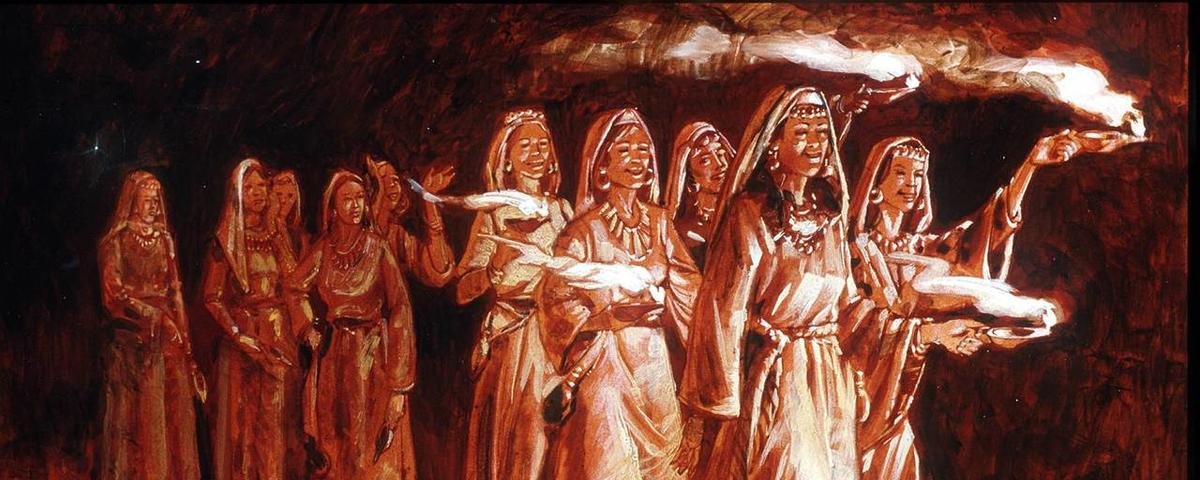
Today’s parable about the wise and foolish virgins teaches about Jesus Christ and us. Jesus elsewhere calls himself the Bridegroom and we are encouraged to enter his wedding feast. So we are those wise or foolish virgins awaiting the Bridegroom’s coming.

Realize that all ten virgins in this parable believed in the bridegroom. All ten hoped for and awaited his arrival. All ten became drowsy and fell asleep. All ten held lamps and wanted to enter his wedding feast. But when the ten awoke, the foolish virgins did not have enough oil for their lamps. (Apparently, this oil represents a thing which the wise virgins could not share with them.) When the foolish ones return, they find the door to the wedding feast locked. They say, “Lord, Lord, open the door for us!” But he says in reply, “Amen, I say to you, I do not know you.” So what did those five foolish virgins do wrong?

When I pondered upon this parable, I considered what a timely lighted oil lamp would have allowed those virgins to do. Recall that the Bridegroom arrives after midnight. Someone who walks in the dark of night without a light will stumble. But the virgins with well-oiled, lit lamps can encounter the Bridegroom. They can find him, see him, follow him, and walk with him. They can know him and be known by him. The important takeaway for us is that we must keep our lamps lit and well-oiled.

If I were to bring out my bigboom box, plug it in, and scroll through the FM dial, we could listen to Country music, Top 40 hits, or 80s and 90s songs. We can easy forget that these radio stations are broadcasting every day. We can ignore their invisible signals flying past us right now. Without tuning-in our radios to them, their broadcasts are imperceptible to us. If we want to listen to them, it’s obvious what we must do. So it is with God.

Sometimes people say, “If God is everywhere, then why do I need to go to church?” I reply, “The air around us holds water vapor, so water is all around us! But if you only swallow air, you’ll die from dehydration! When you’re thirsty for life-giving water, you should go to a faucet, or a well, or a water bottle.” As the psalmist says, “O God, you are my God whom I seek; for you my flesh pines and my soul thirsts like the earth, parched, lifeless and without water. Thus have I gazed toward you in the sanctuary to see your power and your glory…”

You know how radios work. You know what to do when you’re thirsty. And you already know what you should be doing to tune in to God and be refreshed and refilled by his grace. The ways of obtaining oil for our lamps are not actually difficult, but we must prioritize them and do them ourselves since others cannot do them for us. Be steadfast about attending Mass and receiving Christ in Holy Communion. Be dedicated to daily prayer, both speaking to God and listening. Be committed to regular Confession and practicing penances. Meditate upon Christ’s mysteries, by reciting the Rosary, or studying Scripture, or contemplating his Stations of the Cross, or through other holy devotions. Perhaps commit to be with the Lord for a monthly Holy Hour of Eucharistic Adoration. Allow the Bridegroom to fill your lamp to keep it lit so that you may see him, follow him, and walk with him, and know him like you are known.

The Joy Set Before Us

November 1, 2026

Solemnity of All Saints’ Day
By Fr. Victor Feltes

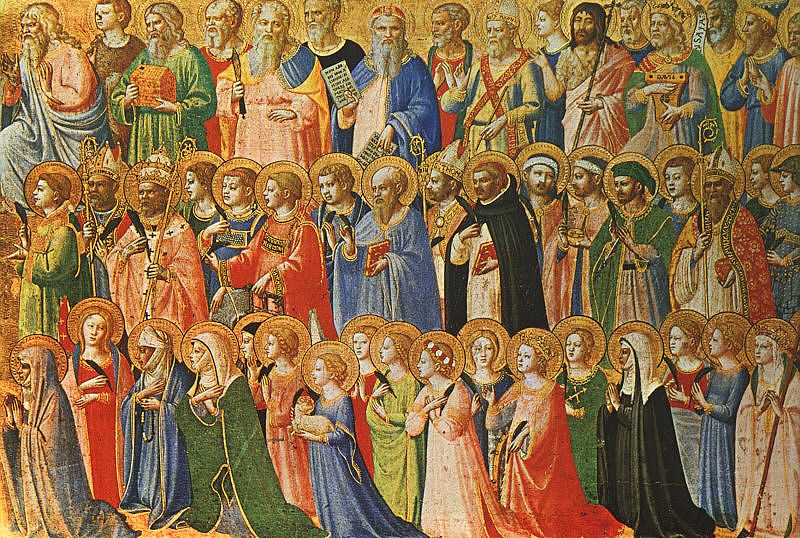
The hardest part of writing a homily is figuring out what to preach about. For this All Saints’ Day homily, I prayed to the saints for inspiration, asking what they would preach to you. The response that entered my thoughts was a short phrase: “It’s worth it.” I believe the saints now basking and delighting and shining in the glory of God’s Presence want to encourage you to faithfully endure, “for your reward will be great in heaven.”

Now, my own eyes have not yet seen and my ears have not heard firsthand what the saints now perceive in Heaven. But God has revealed to us glimpses and whispers of these things through the Holy Spirit. For instance, St. Paul once wrote to the Christians in Corinth about a taste he had of Heaven. He recounts the mystical experience of “someone in Christ,” but from the context we can tell that Paul is modestly referring to himself.

Paul writes: “I know someone in Christ who, fourteen years ago (whether in the body or out of the body I do not know, God knows), was caught up to the third heaven.” What is this third heaven he speaks of? The ancient Jews called our earthly sky—where clouds and birds are found—the first heaven. They called the realm of the Sun, Moon, and stars above the sky the second heaven. But the third heaven, the highest heaven, or heaven of heavens, was the dwelling place of God. St. Paul is recounting a time he saw and heard things in a realm beyond this material universe.

He continues: “I know that this person (whether in the body or out of the body I do not know, God knows) was caught up into Paradise and heard ineffable things, which no one may utter.” St. Paul’s experience of Heaven was partly indescribable, and he was humbled to have received such a blessing. He says, “About this person I will boast, but about myself I will not boast, except about my weaknesses. Although if I should wish to boast, I would not be foolish, for I would be telling the truth.” In other words, Paul is saying, ‘I consider myself unworthy to have been graced with such a gift. What am I? I know how weak I am. But I honestly assure you that God chose to bless me with this experience and to preach to you in his name.’

This provides more context for when St. Paul, speaking in part from personal experience, was moved by the Holy Spirit to declare “the sufferings of this present time are as nothing compared with the glory to be revealed for us.” (Romans 8:18) “For our light and momentary troubles are achieving for us an eternal glory beyond all comparison, as we fix our eyes not on what is seen but on what is unseen, since what is seen is temporary but what is unseen is eternal.” (2nd Corinthians 4:17-18) “Therefore, my beloved brethren, stand firm. Let nothing move you. Always give yourselves fully to the work of the Lord, because you know that your labor in the Lord is not in vain.” (1st Corinthians 15:58)

“For the sake of the joy set before him, [Jesus] endured the cross… and has taken his [glorious] seat at the right of the throne of God.” (Hebrews 12:2) Jesus wants to say to you one day (as he said in his parables): “Well done, my good and faithful servant. … Come, share your master’s joy. … Come, you who are blessed by my Father. Inherit the Kingdom prepared for you from the foundation of the world.” He wishes us to be blessed; comforted, satisfied, to be like God and see him as he is. In the Book of Revelation, Jesus promises: “Remain faithful until death and I will give you the crown of life.” Jesus Christ and his saints, greatly blessed in Heaven, call out to us and urge us on, promising us: “It’s worth it!”