Archive for the ‘Catholic Church’ Category

Catholic Diversity In Unity

July 3, 2025

Solemnity of Saints Peter & Paul
By Fr. Victor Feltes

Today, I wish to speak to you about Saints Peter and Paul, vocations, the Catholic Church and the Churches in her, and two aspects of the Holy Mass. This homily will be a bit longer than usual, but each of its parts are interesting. Saints Peter and Paul shared many similarities but manifested in different ways:

🔸 Both were personally called by Christ to become apostles; Peter quite early during Jesus’ public ministry, but Paul rather late, after Jesus’ Ascension.

🔸 Both beheld Jesus in his transfigured glory; making his friend Peter feel ecstatic, but making his persecutor Paul go temporarily blind.

🔸 Both preached the Gospel; Peter primarily to the Jews, but Paul particularly to the Gentiles.

🔸 Both taught the Faith; Paul the Pharisee was highly-educated, but Peter the uneducated fisherman was not.

🔸 Both experienced weakness; Peter in conquering his passions, but Paul by enduring “a thorn in the flesh.”

🔸 Both were martyred by the Roman Empire in Rome; Peter was crucified upside-down, but Paul the Roman citizen was beheaded.

That Saints Peter and Paul whom we celebrate this Sunday shared one Faith, one Lord, and one calling, and yet manifested these differently in their faithful lives. We also see this in the Catholic Church today. Peter and Paul were called to be apostles. Today, some are called to be bishops, priests, or deacons. Others are called to be consecrated male or female religious. Many more are called to the vocation of holy marriage. Others live out their baptismal mission and call as single persons or consecrated virgins. Which of these ways is the greatest way to live a Christian life? The greatest, most glorious, most fruitful path for you is the one Christ has called or is calling you to. Your life may look differently than others’, even amongst people living out the same vocation, but you can still be living a faithful, fruitful Christian life.

We belong to Christ’s Catholic Church. The word “Catholic” comes from Greek, meaning “universal, worldwide, (or) all-inclusive.” The Catholic Church, established by God for all people and places in this present age, unites humanity in our diversity, but even within our unity we see legitimate variety. Did you know that the one Catholic Church contains 24 Churches with apostolic roots and varying liturgical traditions practiced in full communion with the pope? The largest of these Catholic Churches is the Roman Catholic Church, to which we belong along with more than 98% of the world’s 1.3 billion Catholics. About 18 million other Catholics are in Churches in full communion with Rome; the three largest being the Ukrainian Greek Catholic Church (mainly in Western Ukraine), the Syro-Malabar Catholic Church (mainly in India), and the Maronite Church (mainly in Lebanon). Our one Faith differently celebrated. (Other Churches called the Orthodox Churches have nearly 300 million members put together, with valid priests and bishops and all seven sacraments like us, yet they are not in communion with the pope. Pray for our reunion. The gap between us is less than any Protestant group.) There is even legitimate variation within the Holy Mass of our Roman Catholic Church. I wish to highlight two examples: one in how one receives the Eucharist and another in how the Eucharist is celebrated.

The early Church Fathers mention the Eucharist being placed upon communicants’ hands. Other Communion customs also existed but Communion in the hand was explicitly described. For instance, St. Cyril in Jerusalem and St. Theodore in Turkey instructed the faithful to lay one hand over the other to create a throne (for both saints declare one is about to receive a King) cupping one’s palm to receive “The Body of Christ” and answering “Amen.” St. John Chrysostom observes how a communicant’s hands “hold [the Eucharistic Sacrifice] but for a time.” He writes, “Oh! What a marvel! What love of God to man! He who sits on high with the Father is at that hour held in the hands of all…” And St. Basil the Great records “in the church, when the priest gives the portion, the recipient takes it with complete power over it, and so lifts it to his lips with his own hand.” These and the writings of other Church Fathers show that receiving Communion in the hand existed in the Early Church.

However, though Communion in the hand is allowed today, the many-centuries-long tradition of receiving Communion on one’s tongue is also permitted, either standing or kneeling. Some find receiving our Lord on the tongue strengthens their reverence and devotion; acknowledging the glory of their Great Guest, extending the red carpet of one’s tongue for him to enter under one’s roof through the doors of one’s lips, humbly receiving this priceless Gift of pure grace. After next summer’s church renovation, once there is more space in front of these steps to our sanctuary, I plan to place a kneeler in the center-front as an option, as you may have seen offered already at churches in Chippewa Falls. How you receive our Lord, standing or kneeling, on your hand or on your tongue, is for you to personally discern, since they each option is permitted for you by the present liturgical rules of the Church.

The next legitimate Mass option I would like to explain pertains to the celebrant leading the congregation. Since the Second Vatican Council, the most common way priests have celebrated Mass is versus populum, or “towards the people.” Yet the much-longer-practiced custom has been for the priest and the people to face (literally or symbolically) towards the east together, or “ad orientem.” Like the Jews used to pray towards the Holy Temple in Jerusalem, the writings of the Church Fathers show the early Christians prayed toward the east. St. Clement of Alexandria writes “prayers are made looking towards the sunrise in the east.” And Origen notes: “…Of all the quarters of the heavens, the east is the only direction we turn to when we pour out prayer…” Tertullian records that Christians facing east to pray caused some non-Christians to mistakenly believe we worshiped the sun. But the Christians praying toward the sunrise saw a symbol of Christ rising from the dead and of his promised return to earth in radiant glory one day. Throughout the centuries, even in churches which were not built to face east like our St. Paul’s Church, the priest and the people faced the same direction (or “liturgical east”) together. However, since the 1970’s the prevailing custom has been for the priest to face the congregation.

The Catholic Church approves both versus populum and ad orientem as valid options, and these two ways of celebrating the Mass emphasize different truths. Celebrating versus populum, toward the people, emphasizes the horizontal aspect, the communal meal. And the Holy Mass is indeed a meal, a memorial of the Last Supper, where Jesus Christ and his disciples gather at his table. Celebrating ad orientem, toward the east, emphasizes the vertical aspect, the sacrificial offering. And the Holy Mass is indeed a sacrifice, a memorial of the Cross, where Jesus Christ is offered up for us from his altar.

I experienced my first ad orientem Mass when I was still in seminary. The celebrant was a visiting alumnus and priest of our diocese, Fr. Derek Sakowski. I remember fearing that I would hate the Mass being said that way because I often dislike changes. (For instance, our seminary once changed the toaster in the dining hall and—even though I almost never used the old familiar toaster—I was annoyed when they had replaced it with a new one.) Fr. Sakowski said the same English prayers as at other Masses but watching him celebrate that Mass ad orientem, facing us when speaking to us and facing God when praying to God, I found it surprisingly beautiful and it made a lot of sense. When weekday Massgoers at St. John the Baptist Parish first experienced Mass ad orientem more than five years ago, the attendees reported positive experiences similar to mine.

I mention all this because I would like our weekday Massgoers to experience ad orientem in at least a few Masses this July and hear their feedback. After Vatican II, when Mass facing the people became the prevailing custom in the Church, pastors often introduced that liturgical change abruptly, without consultation, and without adequate explanation. It was jarring, and many lay people were bewildered and hurt. I do not wish to repeat such mistakes going in the opposite direction. Nothing will change without thorough consultation and consensus support. At the end of such a dialogue at St. John the Baptist’s Parish, one weekend Mass changed and the other stayed the same and today everyone seems happy or content with that. Our Faith, our calling, and our Lord are one, even as our faithful lives will manifest them differently. We are Catholic. So in essential things, unity. In non-essential things, liberty. And in all things, charity—that is, love.

A Leader Like Us

May 31, 2025

Solemnity of the Ascension
By Fr. Victor Feltes

As a child in CCD class, I remember being told that a pope from the United States would never happen in our lifetimes. The common view was that having the earthly leader of the Catholic Church come from the world’s strongest superpower was something most cardinals would want to avoid. So it was quite surprising when the 69-year-old, Chicago-born Cardinal Robert Prevost was introduced to the world as Pope Leo XIV. But that concern about coming off as “America’s Pope” is probably why he only spoke Italian, Spanish, and Latin during his first public appearance.

If you’re like me, it’s surreal having so much in common with the pope. Like all of us here, he’s a Midwesterner. He speaks English without a foreign accent. He has consumed our movies, TV shows, and music and been active on social media. He has enjoyed American sports, like when he attended a White Sox World Series game. He has voted in our U.S. elections and attended the March for Life in Washington, D.C. He ministered in Peru for many years but we have something in common there too. Our diocese has supported Servant of God Fr. Joe Walijewski’s Casa Hogar orphanage in Lima for several decades. Like me, the new pope has a mathematics degree. My parents and relatives come from the Chicagoland area too. And we both picked the name “Leo XIV” — this new pope was literally named after my 12-year-old cat. He has a friendly smile and a sense of humor, he’s easygoing but takes Catholic teaching and worship seriously, he sings well, and writes out homilies to help him preach clearly. You probably have personal connections to our new pope yourself, like belonging to the same American Baby Boom generation.

Of course, the pontificate of Pope Leo XIV is still very young and its substantial fruits have yet to unfold. In the first week following his election, a reporter shook Pope Leo’s hand as he passed by and asked, “Holy Father… any message for the United States?” The pope smiled, lifted his hands, and replied, “Many! May God bless you all!” It’s exciting to have a pope who probably understands us, our country and our culture, both the good and the bad, better than any pope before him. So what does any of this have to do with the Solemnity of the Ascension we celebrate today? Much! And it relates to our June celebration of the Sacred Heart as well.

The Ascension marks the definitive entrance of Jesus Christ’s human nature into heaven. His humanity enters everlasting divine glory, symbolized by the cloud and sky. And from heaven, seated at God’s right hand, he constantly intercedes for us before the Father. Jesus Christ, being true God and true man, has a human intellect and will perfectly attuned to his divine intellect and will, knowing us and loving us all with a human heart. As Pope Francis wrote about the Sacred Heart last year, “The eternal Son of God, in his utter transcendence, chose to love each of us with a human heart.” Jesus possesses “genuine human emotions and feelings like ourselves, albeit fully transformed by his divine love. … Entering into the heart of Christ, we feel loved by a human heart filled with affections and emotions like our own.” Divine knowledge and love are eternal and we have had popes before. But the Ascension and Sacred Heart of Jesus are significant. Like a pope who intimately understands us, because he is one of us, we can rejoice that we now have a Lord in heaven, Jesus Christ, who knows us and loves us with a human heart like ours.

The Church Reveals His Beauty

May 11, 2025

4th Sunday of Easter
By Fr. Victor Feltes

Churches should be marked by great beauty. Beauty attracts and delights. God, among his other perfections, is capital “B” Beauty, so a beautiful church glorifies God among us and helps draw people to him. One of the most famous and beautiful churches in the world is St. Peter’s Basilica in Rome. St. Peter’s Basilica is actually a shrine for the burial site of St. Peter the Apostle. He was crucified upside-down on Vatican Hill by the Romans and buried in a nearby cemetery. And in the early 1940s, archeological excavations below the main altar discovered what are most likely his bones. Jesus gave Peter his name, which means “Rock,” and said, “Upon this Rock, I will build my Church.” And today we see the largest and most renowned Christian Church in the world is built above that Rock.

It is wonderful for churches to be beautiful, but it is also important for our church architecture and decorations and to be meaningful—reflecting truths of our faith. For instance, St. Peter’s Basilica is capped by a dome designed by Michelangelo which is the world’s tallest. And two colonnades designed by Bernini, extend out in front of the basilica on both sides around St. Peter’s Square. The effect of this dome and these colonnades together present an image of God the Father. As one approaches St. Peter’s Square, the dome is like his head, the church is like his chest, and the colonnades are like his arms. God the Father is reaching out to beckon, welcome, receive, and embrace all people of the world. When St. Peter’s Square is filled with pilgrims as we saw last week it is like St. John’s vision in today’s second reading, “a great multitude… from every nation, race, people, and tongue,” joyfully standing before God the Father and the Lamb of God. The Kingdom of Heaven begins for us now in his Church on earth.

Once you enter inside St. Peter’s Basilica the architecture there also conveys spiritual truth. The dimensions are huge. The distance from the floor to ceiling—not under dome but in the nave of the basilica—is 152 feet. That’s about twelve stories high; and yet because of architectural tricks of perspective you do not feel tiny. For instance, there are two tiers of statues in alcoves along the sides—lower and higher—but the statues on the higher level are actually bigger than the lower statues so that when you look up at those saints they do not seem so distant. The scale of the arches, doors, and windows make you feel like you are inside of, not a hollow skyscraper, but a great, beautiful mansion. It is an image of the Father’s house, where there is room enough for a countless multitude but where no one is made to feel small or unimportant. In heaven, everyone is valued and has a place with God.

Last Thursday, from the exterior balcony of St. Peter’s Basilica called the Loggia of the Blessings, Pope Leo XIV was introduced to the world. It was quite a surprise and a moment we will remember the rest of our lives. In this Sunday’s Gospel, Jesus says his sheep have been given into his hand by the Father. Our Lord has now entrusted us into Pope Leo’s hands as well. I did not know much about him before the conclave, but I am excited by what I have seen and heard since.

Some people have predicted and hoped for a quiet papacy where very little will happen. But I do not want a quiet pope when so many people need Jesus, his Gospel, and his Church. Pope Leo has spoken insightfully—both years before and following his election—about evangelization in our time, and I look forward to him being a “Lion” for the Gospel. I do not expect our American pope to show the United States special favoritism, nor should he, but I believe this pope will be a great blessing for the Church in our country. When you freeze or boil water, nothing happens before the temperature reaches a threshold. But with the addition or subtraction of just a few more degrees the liquid transforms into a solid or gas. I believe this new American pope will trigger many fruitful responses in those whom God is already calling. There is a new openness and hunger in our culture and I believe great things will happen.

Yet do not just sit back and wait for the pope and priests to draw people closer to Christ. By your sacrificial love, by your Christian joy, by your growing devotion, by your deepening holiness, by your Catholic witness, by your unashamed invitations, the Lord wants you to help bring others—people you know—to a fuller relationship with him and his Church. The papal motto of Pope Leo XIV is the same as he chose when he became a bishop. It comes from a homily of St. Augustine: “In the One, we are one.” (That is, “In Christ, we are one.”) In Christ we are called to all be truly one, and each of us in these years of Pope Leo ahead have important parts to play.

Upon This Rock Christ Built His Church

May 4, 2025

3rd Sunday of Easter
By Fr. Victor Feltes

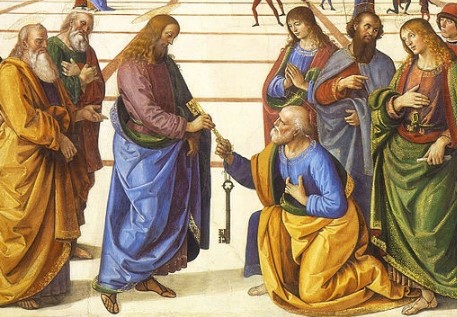
Jesus changed Simon the Apostle’s name to Peter or “Rock” and said, “Upon this rock I will build my Church, and the gates of the netherworld shall not prevail against it.” Jesus told him, “I will give you the keys to the Kingdom of Heaven,” and declared “Whatever you bind on earth shall be bound in heaven; and whatever you loose on earth shall be loosed in heaven.” This promise assures us that Peter would not bind the Church to error, for binding the Church on earth to lies would bind heaven to the same. What is the purpose of this awesome authority to teach and lead? Jesus tells him and us in today’s Gospel: it is to ‘Feed his lambs, tend his sheep, and feed his sheep.’

Jesus had specifically told Simon at the Last Supper, “Behold, Satan has demanded to sift all of you like wheat, but I have prayed that your own faith may not fail; and once you have turned back, you must strengthen your brothers.” In the Gospels, Simon Peter’s name is always first among his fellow apostles in any listing where he appears, while Judas Iscariot’s name is always placed last. All of this reflects the God-given preeminence of St. Peter as the servant-leader of Christ’s Church on earth. Jesus remains the invisible Head of his One, Holy, Catholic Church, but he knew that without providing clear and visible apostolic shepherds to give us clarity and unity his flock would surely scatter.

This was true in the 1st century with St. Peter as 1st bishop of Rome, and Peter’s office has continued in his successors, the popes, as recognized by Christians throughout the first millennium. Jesus had told the apostles “whoever hears you hears me” and promised the Holy Spirit would guide them “into all the truth.” The New Testament also proclaims the Church to be “the pillar and foundation of truth.” Was only the first century to be graced with such divine gifts and assurances? No. Jesus is the wise man who built his house on Rock so that even when the rains fell, the floods came, and winds blew and buffeted his Church it would not collapse into heresy.

Indeed, when a pope (or a Church council together with him) definitively defines a doctrine of faith or morals to be held by the whole Church, the Holy Spirit protects their teaching from error. This is called infallibility. Through divine inspiration, the Holy Spirit previously utilized imperfect men to pen precisely what he wished to be written as Holy Scripture; so simply protecting Holy Church from officially teaching errors is an important but lesser miracle. Though popes can teach infallibly and possess full authority as chief shepherds, they are not flawless people. Simon Peter, even after denying, repenting, and returning to Christ, sometimes still slipped up.

Through St. Paul’s Letter to the Galatians we learn that St. Peter was accustomed to eating with Gentile Christians who did not keep the Old Covenant’s rules about ritually clean and unclean foods, as Christ’s New Covenant allowed. That was all well and good, but once when some Jewish Christians arrived in town who cared about keeping all those dietary laws, Peter began to withdraw from his previous table companions. Peter probably wished to avoid causing offense and division, but this action caused confusing scandal by implying that keeping all the Old Laws of Moses was necessary for salvation.

St. Paul writes, “I opposed him to his face because he clearly was wrong.” Paul corrected Peter in front everyone, saying, “If you, though a Jew, are living like a Gentile and not like a Jew, how can you compel the Gentiles to live like Jews?” St. Peter had not denied the Gospel but his personal example in this case caused harm and he received a fraternal correction from St. Paul. In the Church’s two-millennium-long history there have been some very bad and scandalous popes, but by God’s grace none of them bound the Church to heresy, and that’s a priceless blessing.

Having mourned and prayed for Pope Francis, the cardinals will gather this Wednesday inside the Sistine Chapel at the Vatican for the important task of electing a new pope. Some 133 cardinals, appointed by previous popes from places around the world, will sequester themselves away until they elect a Holy Father. After any failed rounds of voting, they will burn the ballots to make black smoke. But once a pope has been elected by a two-thirds of the vote they will burn the ballots to make white smoke accompanied by the ringing of St. Peter’s Basilica’s bells. Then our new pope will be introduced to the world and impart his papal blessing. All the conclaves in recent decades have been short, concluding within three days, but do not be alarmed even if this conclave takes more than a week. We will have a pope again soon.

People sometimes wonder, “Does the Holy Spirit choose who will be the pope?” Before he became Pope Benedict XVI in 2005, Cardinal Joseph Ratzinger was asked about this in a 1997 interview. He replied, “I would not say so, in the sense that the Holy Spirit picks out the Pope…. [“There are too many contrary instances of popes the Holy Spirit obviously would not have picked!”] I would say that the Spirit does not exactly take control of the affair but rather like a good educator, as it were, leaves us much space, much freedom, without entirely abandoning us. Thus the Spirit’s role should be understood in a much more elastic sense, not that he dictates the candidate for whom one must vote. Probably the only assurance He offers is that the thing cannot be totally ruined….”

When I was younger, I would have imagined there was just one cardinal in any conclave who could be the right pope; but now I suspect the Holy Spirit perhaps beholds dozens of cardinals with whom he could accomplish comparable good fruits. God works with what we give him. So pray that the cardinals will be receptive to the Holy Spirit’s guidance, but do not be anxious or afraid. Whatever happens, we already know that Christ and his Church will endure and triumph in the end, for “the gates of the netherworld shall not prevail against it.” Pray this week that the Church of Christ on earth may soon be led by another great pope who will feed his lambs, tend his sheep, and feed his sheep.

Let The Children Come

October 5, 2024

27th Sunday in Ordinary Time
By Fr. Victor Feltes

People were bringing their little children to Jesus that he might touch them, pray for them, and bless them through laying his hands on them. His disciples, however, rebuked those parents. “No, stop doing that. Leave the teacher alone.” Why did his disciples behave this way? Jesus was very busy with his work. His time was very valuable and they believed he had much more important things to do. They saw those children as an unwelcome inconvenience.

Pascal-Emmanuel Gobry details how the ancient world had small regard for little ones in his excellent article “How Christianity Invented Children.” “Society,” he writes, “was organized in concentric circles, with the circle at the center containing the highest value people, and the people in the outside circles having little-to-no value. At the center was the freeborn, adult male, and other persons were valued depending on how similar they were to the freeborn, adult male. Such was the lot of foreigners, slaves, women…and children.” In pagan Rome, a father could kill his kids for any reason until they came of age; unwanted infants were abandoned to die by exposure, youths were subjected to all forms of abuse, and all of this was legal. The early Christians, however, protected children and loved them. This marked difference is because of Jesus Christ.

Though children are small and weak, Jesus says, “See that you do not despise one of these little ones, for I say to you that their angels in heaven always look upon the face of my heavenly Father.” They have no wealth, no worldly power, but Jesus declares, “Unless you turn and become like children, you will not enter the Kingdom of Heaven.”

Calling over a child and putting his arms around it, Jesus teaches, “Whoever humbles himself like this child is the greatest in the Kingdom of Heaven.” Just as a good shepherd hates to lose even one lamb from his flock, Jesus insists “it is not the will of your heavenly Father that one of these little ones be lost.” Jesus says children are to be treasured and loved like himself, for “whoever receives one child such as this in my name receives me.” And in this Sunday’s gospel, in response to those who were turning the children away, Jesus says, “Let the children come to me, and do not prevent them; for the Kingdom of Heaven belongs to such as these.” Then Jesus welcomed, embraced, and blessed the children.

Jesus taught that all children should be loved. How well have we listened? If we have personally sinned against little ones in the past, then we must repent—if we have not done so already. Go to God for Divine Mercy, for if you are baptized into Christ then you are God the Father’s precious child also. And going forward, we must do our Christian duty to protect and care for them, the most vulnerable in our country.

The Bride of Christ, his Church, teaches that “abortion, the deliberate killing of a human being before birth, is never morally acceptable and must always be opposed.” In light of the upcoming elections, our U.S. bishops as successors to the apostles insistthe threat of abortion remains our preeminent priority, because it directly attacks life itself, because it takes place within the sanctuary of the family, and because of the number of lives destroyed.” Last year, that number of innocent children killed before birth in our country was more than one million. Pope Francis himself has observed that abortion is not primarily a Catholic or even a religious issue, it is first and foremost a human rights issue. Our Holy Father has said that if we fail to protect life, no other rights matter.

Have we, as Roman Catholics, fully rejected the spirits of pagan Rome? How we choose to live, to love—and yes, how we choose to vote—will be revealed as our answer at the Last Judgment.

For Love & Life

September 21, 2024

25th Sunday in Ordinary Time
By Fr Victor Feltes

What is the act of eating for? It is good for eating and drinking to be enjoyable, but they are intended for supporting life. What if people tasted but refused to consume? What if it became common and culturally accepted for people to eat and expel their meals without digestion? A normalization of bulimia would obviously be very unhealthy. It would be psychologically unhealthy — warping attitudes about food and our bodies — and also physically unhealthy, leading to malnourishment and the death of many. However, new technologies, products, and politics would rise to promote this way of life despite its harms. The divine purpose for eating and drinking is our nourishment. It is not merely for our delight but for the good of supporting life. As Jesus once taught in a conversation about marriage, “What God has joined together, no human being must separate.”

Did you know, less than one hundred years ago, all Christian denominations opposed contraception? Contraception is an intentional act, before, during, or after a marital embrace to render it unfruitful. It is like the priest at Mass consecrating the wine while refusing to consecrate the bread; a distortion which is not how the Lord wills us to renew our covenant. Natural and artificial forms of contraception are nothing new. Scrolls from 1850 B.C. describe various Egyptian methods, and pagans practiced contraception in the Roman Empire. Church Fathers like St. Clement of Alexandria, St. Augustine, and St. John Chrysostom condemned contraception and sterilization. Protestants like Martin Luther (the founder of Lutheranism), John Calvin (the founder of Calvinism), and John Wesley (the co-founder of Methodism) all wrote against contraception as well. Naturally, not every occasion of marital union creates new life. But until about a century ago, all groups of Christians agreed that whenever a husband and wife renewed their one-flesh union they must be open both to love and the possibility of life.

In 1917, the Anglicans called contraception “demoralizing to character and hostile to national welfare.” But then, in 1930, they became the first Protestants to officially approve the use of contraception in limited cases. By the 1960s, most Protestants had changed their previous teachings. The Catholic Church, however, stood firm in the unchanging truth. At the end of 1930 and again in 1968, popes reaffirmed the constant teaching of Christ’s Church on the nature, purpose, and goodness of marriage and the marital act. In 1968, St. Pope Paul VI warned that great harms would come from the acceptance use of contraception: broadly lowered morality, increased marital infidelity, lessened respect toward women, coercive impositions by governments, and the self-destructive belief that we have unlimited dominion over our bodies and human life in general. Advocates for contraception insisted back then that it would increase women’s happiness, strengthen marriages, prevent unplanned pregnancies, and reduce abortions. But today in our country, after decades of widespread contraceptive use, women report lower levels of happiness, nearly half of pregnancies are unplanned, nearly half of marriages end in divorce, and every year an estimated one million unborn children are murdered.

Powerfully driven by modern media, one false cultural idea has led to another. Contraception promises couples child-free relations, so when a child is conceived that child is viewed as a mistake for which his or her parents do not feel personally responsible, making abortion seem like an acceptable solution to the problem of an unwanted human being. When contraception strips away the idea of the creation of children as a primary purpose for marital relations, marriage need not require a man and a woman. From there, it is hard to explain why marriage need be limited to only two people who love each other. Once sexuality becomes detached from human biology, gender identity becomes easily confused. Where sexuality is viewed as exclusively for pleasure, unchastity grows and interest in marriage itself collapses. On the other hand, spouses who respect the God-given meaning of sexuality and are aware of their fertility levels throughout the month can faithfully practice Natural Family Planning (or NFP) as a safe and reliable way to space or postpone the conception of children. These couples are statistically less likely to divorce and grow together in communication, self-control, and intimacy.

The world, hostage to its passions, does not welcome the Catholic Church’s message but instead attacks the messenger. The crowds foretold of in the Book of Wisdom say, “Let us beset the just one, because he is obnoxious to us; he sets himself against our doings…” Jesus suffered in this way before us. Even Jesus’ apostles began with worldly views on many things. For instance, they argued over who among them was the greatest. Following Jesus requires our repentance, turning to him for mercy and healing, which he lovingly extends to us in confession, whatever our past sins may be. Christ’s love redeems us. From there, we are called to imitate him, carrying our crosses for God and each other, growing in virtue, growing in the gift of self, and growing together in love.

To follow Jesus requires humility, to confess and turn away from our sins, and to be open, teachable, and trusting in Christ. Jesus, taking a child, put his arms around it and said, “Whoever receives one child such as this in my name, receives me; and whoever receives me… receives the One who sent me.” So let us love purely and be open to life, welcoming, protecting, and cherishing all little ones, for the person who loves these least ones is loving Jesus Christ.

The Importance of Obedience

August 24, 2024

21st Sunday in Ordinary Time
By Fr. Victor Feltes

Jesus agreed to come and cure the servant of a Roman centurion, but the centurion replied, “Lord, I am not worthy to have you enter under my roof; only say the word and my servant will be healed. For I too am a person subject to authority, with soldiers subject to me. And I say to one, ‘Go,’ and he goes; and to another, ‘Come here,’ and he comes; and to my slave, ‘Do this,’ and he does it.” This Roman centurion had commanding officers above him and soldiers and servants under his own command. He had carried out others’ orders and with authority he had given orders to others. This Roman centurion had faith that Jesus of Nazareth, this Jewish rabbi, was God’s servant and prophet — perhaps even the Christ — with authority over angels or the elements of creation. Jesus is under authority and possesses authority, through which God’s will is done. He told his Father, “Not my will but yours be done.” And he tells us, “You are my friends, if you do what I command.” We are called to obedience to legitimate authority and Jesus speaks to us in and through his Church.

During my ordination as a diocesan priest, I placed my wrapped hands inside the hands of my bishop in accordance with the rite. Bishop Listecki asked me, “Do you promise respect and obedience to me and my successors?” I responded, “I do.” I hold this obedience very seriously. In the areas of our bishop’s proper authority, what the bishop wants me to do is what Jesus wants me to do. Of course, I should share with the bishop my input and feedback because consultation helps him to make better decisions. And if the bishop were ever to command me to sin, that command would be unlawful and should be ignored. But I believe what the Church, or canon law, or our bishop commands me to do, that is what Jesus wants me to do.

The saints strongly advocate for holy obedience. Pope St. Gregory the Great taught, “Obedience is rightly placed before all other sacrifices, for in offering a victim as sacrifice one offers a life that is not one’s own; but when one obeys one is immolating one’s own will.” The Diary of St. Faustina Kowalska records Jesus telling her, “My daughter, know that you give me greater glory by a single act of obedience than by long prayers and mortifications.” And St. Francis de Sales said, “The Devil doesn’t fear austerity but holy obedience.” And there are many other quotes from the saints which commend holy obedience.

This brings us to our second reading from St. Paul’s Letter to the Ephesians. I have never been married, but as a priest and a pastor ‘I too am a person subject to authority, with persons subject to me,’ and I know that without obedience no house can function well. St. Paul writes, “Be subordinate to one another out of reverence for Christ. Wives should be subordinate to their husbands as to the Lord. For the husband is head of his wife just as Christ is head of the Church, he himself the Savior of the Body. As the Church is subordinate to Christ, so wives should be subordinate to their husbands in everything.” In other words, allow your husband to lead you and your family. Your input and feedback are very important in forming good decisions, and your husband has no authority to practice or command sin, but he does possess legitimate authority to lead. And “husbands, love your wives, even as Christ loved the Church and handed himself over for her to sanctify her… that she might be holy and without blemish.” In other words, you are commanded to love and serve, sacrificing for your wife and family, as Christ does for his Church.

Many of Jesus’ disciples listening in today’s Gospel said, “This saying is hard; who can accept it?” Jesus asked the Twelve, “Do you also want to leave?” And Simon Peter answered him, “Master, to whom shall we go? You have the words of eternal life.” And so it is for us. Sometimes what we are told may be difficult to hear, sometimes obedience or service will be hard, but to whom else shall we go if we are unwilling to trust and obey our Lord? He has the words of eternal life.

Three Pillars

May 26, 2024

Solemnity of the Most Holy Trinity
By Fr. Victor Feltes

Sacred Scripture proclaims, “God created mankind in his image; in the image of God he created (us); male and female he created (us).” And our Catholic Faith teaches the divine image is present in every human person. The image of God also shines forth in the communion of human persons, communion in the likeness of the union of the Trinity’s Divine Persons among themselves. We are finite and sinful while God is infinite and perfect, yet we reflect his image and likeness in many ways: as individuals, as families, and as the Church of Jesus Christ.

Each one of us, made in God’s image, “possesses the dignity of a person, who is not just something, but someone.” Like God, we can know things, choose freely, and love. Like God, we can fashion things beyond ourselves, we can enter into relationship with others and reign over Creation. One psalmist in the Book of Psalms asks God: “What is man that you are mindful of him, and a son of man that you care for him? Yet you have made him little less than a god, crowned him with glory and honor. You have given him rule over the works of your hands, [and] put all things at his feet.” These words proclaim the glory of human persons, but also foretell the coming of Christ, who called himself “the Son of man.” Jesus Christ reveals to us that which was veiled yet always true before: God is not the solitary oneness of a single person but a unified oneness in three eternal Persons. This revelation of the Trinity opens our eyes to how the image of God is reflected among us not only individually but communally, such as in a family and as in the Church.

In the beginning, when God created the first human person, he saw that it was not good for the man to be in utter solitude. So, perhaps because it was the bone closest to his heart and core, God brought forth the woman from the man’s rib, ‘bone of his bone, flesh of his flesh.’ This is a reflection of God where, “God from God, Light from Light,” the Son is eternally begotten of the Father. God the Father lovingly gives all that he is to the Son and God the Son gives himself back as a total gift to the Father. And from this mutual self-gifting love, the Holy Spirit eternally proceeds. This is likewise reflected in marriage, where a husband and wife gift their whole selves to each other and a third distinct person can proceed.

Jesus Christ the Bridegroom founds the Church as his Bride, unites us in her and makes us fruitful, yet even though he makes us one he does not make us all the same. There are more than a billion Catholics spread across the earth. We have different strengths, cultures, and treasures, “different gifts according to the grace given to each of us.” No one of us mere creatures completely manifests the infinite goodness of God. But united together as his holy Church, our diversity of goods more fully reflects God’s glory.

God has created mankind in his image; in the image of God he has created us. So reverence each and every human person he has made, honor the holiness and fruitfulness of marriage, and celebrate the plethora of goodness present in the Church. For all of these are God’s creations, pillars of Christian civilization, and each one reflects the glory of our Triune God.

Call No Man “Father”?

November 5, 2023

31st Sunday in Ordinary Time
By Fr. Victor Feltes

Today’s gospel understandably prompts a question. Jesus says, “Call no one on earth your father; you have but one Father in Heaven.” So why are Catholic priests called “Father”? Some non-Catholic Christians object to calling Catholic priests “Father” and abstain from doing so. However, I have never witnessed anyone similarly object to using the title “father” for their own beloved, male, biological parent. Jesus also says, “Do not be called ‘Rabbi,‘” and “Rabbi” means “Teacher,” yet every Christian school is staffed by “teachers.” Does Jesus intend us to take his words here literally or is he teaching us something deeper?

It is good to use Sacred Scripture to interpret Sacred Scripture, since the Holy Spirit inspired every passage and, rightly understood, God’s Word will not contradict itself. When we read the New Testament we see many men referred to as fathers. The 1st Letter of St. John says, “I write to you, children, because you know the Father. I write to you, fathers, because you know him who is from the beginning.” St. Paul writes in his Letter to the Romans about “our father Abraham” and “our father Isaac.” The Holy Spirit also inspired St. Paul in his 1st Letter to the Corinthians to call himself a spiritual father to those Christians. He writes, “Even if you should have countless guides to Christ, you do not have many fathers, for I became your father in Christ Jesus through the gospel.” St. Paul similarly says in his Letter to Philemon, “I urge you on behalf of my child Onesimus, whose father I have become…” So we see that it can be fine to call some living or deceased men fathers. It can even be good to call yourself someone else’s father. So what does Jesus mean to warn us about by teaching, “Call no one on earth your father”?

Today’s gospel says Jesus was speaking to the crowds and his disciples about the authority and the flaws of the scribes and the Pharisees. In the ancient world, teachers would teach seated. For instance, Jesus sat down to give his Sermon on the Mount and sat in Simon Peter’s boat to preach to people gathered onshore. Ancient rulers reigned from chairs called thrones, so Christ is now “seated at the right hand of the Father.” Jesus said the Jewish scribes and the Pharisees had “taken their seat on the chair of Moses.” Before the establishment of the Church they apparently possessed legitimate authority to teach. “Therefore,” Jesus said, “do and observe all things whatsoever they tell you, but do not follow their example. For they preach but they do not practice.

Jesus noted these teachers’ lack of concern for others: “They tie up heavy burdens hard to carry and lay them on people’s shoulders, but they will not lift a finger to move them.” He noted their vain egotism: “All their works are performed to be seen. … They love places of honor at banquets, seats of honor in synagogues, greetings in marketplaces, and the salutation ‘Rabbi.’” Instead of this, Jesus teaches us: “The greatest among you must be your servant.”

We who are fathers, or teachers, or who have any role of authority must remain humble. We are not flawless or perfect. We are not the Lord, our God. We are not given authority over others in order to serve ourselves. Jesus says, “Whoever exalts himself will be humbled; but whoever humbles himself will be exalted.” Resemble Jesus Christ in this and your reward will resemble his. Christians must also remember that our fathers, our teachers, and all people in roles of authority on earth are not perfect. Even if they are trying their best, they are not the Lord, our God. Even popes, preserved by the Holy Spirit from teaching errors “ex cathedra,” can still misstep as shepherds in their words and actions.

A faithful leader is a great blessing; promoting truth, and love, and righteousness within their sphere of influence. That is why it is so important for each of us to be good servant-leaders. But we must not make idols of ourselves or others, as if we were perfect, this world’s savior, or the source of every good. We have only one such Good Teacher. We have only one such Father, in Heaven. And we have only one such Master, Jesus Christ our Lord, who is worthy of our absolute trust and devotion.

Three Parables About God’s Vineyard

October 8, 2023

27th Sunday in Ordinary Time
Fr. Victor Feltes

For a third Sunday in a row, we hear Jesus telling a parable featuring a vineyard. First, there was the parable about the generous vineyard owner who hired more and more laborers throughout the day and paid them all the same amount. Then, there was the tale of a father who asked his two sons to go and work in his vineyard. Today, Jesus refashions the Prophet Isaiah’s allegory (which we heard in our first reading) into a story about a vineyard owner’s wicked tenants. In these parables, Jesus tells us what “the Kingdom of Heaven” is like.

His stories prefigure how the Gentiles would join the Jews as the people of God’s Kingdom. For example, like vineyard workers called late-in-the-workday, God calls the Gentiles long after he called the Jews, yet both are offered the same wage of salvation. The wayward, Gentile, pagan peoples were like the son in the parable who at first denies his father but later changes his mind and faithfully serves him. And the religious leaders of the Jews were like those wicked tenants who betrayed the vineyard owner, mistreated his messengers, and ultimately murdered his son. Because of this, those leaders’ roles of leadership were taken away and given to others in Christ’s Church to produce more fruit for God.

Gospel parables are profound, inspired stories which contain more than one true meaning. Jesus’ vineyard parables not only describe what the Kingdom of God is like for groups of peoples but for individual persons as well. For instance, Jesus’ Parable of the Generous Landowner teaches us that it is not too late for a sinner to repent, answer God’s call and serve him now, while it is still day. His Parable of the Two Sons teaches us that doing the right thing is better than merely saying the right thing. Faithful obedience to our Father God means actually following through. And today’s Parable of the Wicked Tenants teaches us that even those who labor or have authority in God’s vineyard must act justly towards God and his servants. Blessed are those who respond to the Lord, profiting of the precious opportunity he has made possible for us.

Jesus’ parables foreshadow peoples entering God’s Kingdom from all lands. Today, we can see this realized in his Church. Look at us, Americans in Wisconsin, with a pastor of German ancestry ministering alongside a priest from India, and all of us worshipping the God of Israel together. Jesus Christ, the stone rejected by the builders, has become the cornerstone of a new Temple made of living stones, people from every land. By the Lord has this been done and it is wonderful in our eyes.

The Prophet Isaiah once proclaimed a song of his friend concerning his vineyard: “A vineyard on a fertile hillside. He spaded it, cleared it of stones, and planted the choicest vines (to make it fruitful); within it he built a watchtower (to protect it), and hewed out a wine press (to delight in its fruits).” Isaiah’s friend was the Lord God, whose vineyard was Old Israel, which contained the cherished plant of his people. Jesus Christ’s Church, his Bride, is the New Israel; not defined by soil or blood but open to all people. God protects her, makes her fruitful, and delights in her. He delights in us and makes us one. This is Jesus Christ’s desire for every person in our world. May the whole world come to know Christ in his Church and know the peace of God.

Like Gentiles or Tax Collectors

September 9, 2023

23rd Sunday in Ordinary Time
By Fr. Victor Feltes

Jesus teaches us today about how to practice fraternal correction. In short, if a brother or sister in the Church sins against you, approach him or her privately. If that fails to persuade, come again with one or two others. If that does not work, bring the matter to the Church. And “if he refuses to listen even to the Church,” Jesus says, “then treat him as you would a Gentile or a tax collector.” Jesus says to treat an obstinately unrepentant Christian like “a Gentile or a tax collector.” What are we to make of this?

How would the Jewish crowds hearing Jesus’ preaching treat Gentiles or tax collectors? The Old Covenant kept Jews and Gentiles (that is, non-Jews) separate. For example, archeologists have found stone signs from the Jewish temple dating to the Gospel era which warned Gentiles or foreigners not to enter its inner courts. Those signs’ chiseled, red letters declared in Greek: “No foreigner is to enter within the stone railing [balustrade] around the sanctuary and the enclosure. Whoever is caught will himself be responsible for his ensuing death.” Without full conversion to Judaism, Gentiles in those days could not enjoy full communion with God’s people. Meanwhile, Jewish tax collectors were viewed as collaborators with Israel’s enemies, traitors harming their own people, and shunned. So how would the early Church respond in the case of a persistently unrepentant Christian?

In the First Letter to the Corinthians, St. Paul addresses a scandalous matter brought to him concerning the Church in Corinth. He writes, “It is widely reported that there is immorality among you, and immorality of a kind not found even among pagans — a man living with his father’s wife,” that is, his stepmother. I imagine if you had asked this romantic couple why they were together, they might have answered, with sincerity, “We love each other!” They might have said what they were doing made them happy. They might have even said, “All love is love.” How would St. Paul answer? In today’s second reading from God’s inspired word, he says, “Love does no evil to the neighbor; hence, love is the fulfillment of the law.” But not all things called “love” are loving in accord with Christ’s commands. Not all pleasures lead to true and lasting happiness. Not all paths lead to God.

In the case of that scandal at Corinth, St. Paul the Apostle declares to the Church:

“The one who did this deed should be expelled from your midst. I, for my part, although absent in body but present in spirit, have already, as if present, pronounced judgment on the one who has committed this deed, in the name of our Lord Jesus: when you have gathered together and I am with you in spirit with the power of the Lord Jesus, you are to deliver this man to Satan for the destruction of his flesh, so that his spirit may be saved on the day of the Lord.”

St. Paul excommunicates the man. It is a strong response because grave sin is serious business. (The man’s partner who goes unmentioned was apparently not a member of the Church.) The goal of an excommunication, beyond the spiritual welfare of the community, is the sinner’s conversion and salvation. St. Paul’s loving hope was that this offender’s sufferings would eventually lead to the salvation of his soul. For better or worse, formal excommunications are uncommon today. Nevertheless, just because one’s body remains inside the church building does not mean his or her soul remains with Christ. If we are living in grave sin, we need to repent and go to confession. And if someone else gravely sins, we could be called, with discernment and prayer, to share the truth in love.

When Jesus says to treat the unrepentant like “a Gentile or a tax collector,” recall how he himself treated Gentiles and tax collectors. Though not yet converted, he loved them. He cared about them and wanted to draw them to himself. He wished for them to change their ways and eventually come into full communion with him in his Church. If we are prayerful and loving, Jesus will enable us to correct the errant in a Christ-like way, and perhaps they will be saved.

Like our Lord appointed the Prophet Ezekiel in today’s first reading to be a watchman for the house of Israel, the Lord may call on you to invite sinners to change their way. As a watchman who loves God’s holy city and wishes the blessed number within her to grow, without abandoning your post on the walls of truth, encourage those who are spiritually outside of her walls to pass through the gate of mercy.

Jesus’ Praising & Rebuking of Simon Peter

September 3, 2023

22nd Sunday in Ordinary Time
By Fr. Victor Feltes

When Jesus asked his disciples, “Who do you say that I am,” Simon answered, “You are the Christ, the Son of the living God.” And Jesus replied, “Blessed are you, Simon son of Jonah. For flesh and blood has not revealed this to you, but my heavenly Father. And so I say to you, you are Peter, and upon this rock I will build my Church.” Jesus changed Simon son of Jonah’s name to “Rock,” or “Petros” in Greek, which we render as “Peter.” In the entire Old Testament, God changed the names of only three people: Abram to Abraham, Abram’s wife Sarai to Sarah, and Jacob to Israel, so the changing of Simon’s name is a big deal in salvation history. Jesus then declared to Peter, “I will give you the keys to the Kingdom of Heaven. Whatever you bind on earth shall be bound in Heaven; and whatever you loose on earth shall be loosed in Heaven.”

In last Sunday’s readings we heard of how in the days of the Prophet Isaiah the Lord chose “Eliakim son of Hilkiah” to become chief steward of the royal house, that is, prime minister for the reigning Davidic king. The Lord declared, “I will place the key of the House of David on Eliakim’s shoulder; when he opens, no one shall shut, when he shuts, no one shall open.” The holder of that office possessed plenary power under the king throughout the kingdom and reportedly carried a visible key indicating this authority that he would pass on to his successors.

The great Doctor of the Church, St. Augustine of Hippo, taught that the New Testament is concealed in the Old and that the Old Testament is revealed in the New. In the Old Testament, the Lord gave Eliakim “the key of the House of David” and authority to open and close. Likewise, Jesus Christ the new Davidic king gave Peter “the keys to the Kingdom of Heaven” and authority to bind and loose. Eliakim’s authority extended throughout an earthly kingdom, but Jesus promised Peter that his earthly decrees for the Church would also be confirmed in Heaven. Eliakim would become, in the words of the Lord through Isaiah, “a father to the inhabitants of Jerusalem and to the house of Judah.” St. Peter became the Church’s first “pope,” a title which comes from the Greek word for a “papa” and an office held today by Peter’s successor, our Holy Father Pope Francis. Jesus foresaw that without a visible shepherd his Christian flock would inevitably scatter. Like Moses for the Hebrews in the desert, or like King David for God’s people in Israel, Christ established a chief shepherd for his Church on earth through his popes, beginning with St. Peter.

That highlight moment for Simon Peter is followed this Sunday in St. Matthew’s Gospel by a very humbling event. Jesus begins revealing to his disciples that he must suffer greatly from the Jewish leaders, be killed, and be raised on the third day. So Peter takes Jesus aside and starts rebuking him, “God forbid, Lord! No such thing shall ever happen to you!” Jesus turns and says to Peter, “Get behind me, Satan! (That is, “Get behind me, Adversary!”) You are (being) an obstacle to me. You are thinking not as God does but as human beings do.” Notice how Jesus here reproaches Peter differently than how he once rebuked Satan in the desert, to whom he said, “Get away, Satan!” Jesus does not cast Peter away but tells him to “get behind me,” that is, “Follow me again.” Whenever you or I go wrong, Jesus calls us to follow him anew. Satan wants you to fall and stay down, but Jesus wants you to rise again.

Why was Simon Peter praised last week and why was he corrected today? First, Jesus tells him, “Blessed are you, Simon…. Flesh and blood has not revealed this to you but my heavenly Father.” Now, Jesus reproves him, “You are thinking not as God does but as human beings do.” Peter was praised for accepting the truth God had revealed and rebuked for trying to substitute his own ideas for God’s will. In today’s second reading, St. Paul urges us:

Do not conform yourselves to this age
but be transformed by the renewal of your mind,
that you may discern what is the will of God,
what is good and pleasing and perfect.”

Who in this age could correctly discover these things in our world apart from Christ’s one Church built on rock? Our Catholic Faith is a religion revealed by God with infallible teachings about what is true and how we are to live. Being faithful can be a cross, but our Lord always sees us, and he will repay each person according to our deeds with punishments or rewards. Jesus tells us, “Whoever wishes to come after me must deny himself, take up his cross, and follow me.” To get fully behind Christ and receive his endless blessings, receive everything that God has revealed to us through his Holy Catholic Church.

The Keys to the Kingdom

August 26, 2023

21st Sunday in Ordinary Time
By Fr. Victor Feltes

The great doctor of the Church St. Augustine of Hippo taught that the New Testament is concealed in the Old and that the Old Testament is revealed in the New. We see an example of this in our readings. In the days of the Prophet Isaiah, the Lord chose “Eliakim son of Hilkiah” to become chief steward of the royal house, that is, prime minister for the reigning Davidic king. The Lord declared, “I will place the key of the House of David on Eliakim’s shoulder; when he opens, no one shall shut, when he shuts, no one shall open.” The holder of this office possessed plenary power under the king throughout the kingdom. He reportedly carried a visible key indicating this authority that he would pass on to his successors.

In our gospel today, when Jesus asks his disciples, “Who do you say that I am,” Simon answers, “You are the Christ, the Son of the living God.” And Jesus replies, “Blessed are you, Simon son of Jonah. For flesh and blood has not revealed this to you, but my heavenly Father. And so I say to you, you are Peter, and upon this rock I will build my Church.” Jesus changes Simon son of Jonah’s name to “Rock,” or “Petros” in Greek, which we render as “Peter.” In the entire Old Testament, God only changed the names of three people: Abram to Abraham, Abram’s wife Sarai to Sarah, and Jacob to Israel, so the changing of Simon’s name is a big deal in salvation history.

Jesus then declares to Peter, “I will give you the keys to the Kingdom of Heaven. Whatever you bind on earth shall be bound in Heaven; and whatever you loose on earth shall be loosed in Heaven.” In the Old Testament, the Lord gave Eliakim “the key of the House of David” and authority to open and close. Likewise here, Jesus Christ the new Davidic king gives Peter “the keys to the Kingdom of Heaven” and authority to bind and loose. Eliakim’s power extended throughout an earthly kingdom, but the Lord promises Peter that his earthly decrees for the Church will also be confirmed in heaven. Eliakim would become, in the words of the Lord through the Prophet Isaiah, “a father to the inhabitants of Jerusalem and to the house of Judah.” St. Peter became the Church’s first “pope,” a title that comes from the Greek word for a “papa” and an office held today by Peter’s successor, our Holy Father Pope Francis. Jesus knew that without a visible shepherd his Christian flock would inevitably scatter. Like Moses for the Hebrews in the desert, or like King David for God’s people in Israel, Christ establishes a chief shepherd for his Church on earth through his popes, beginning with St. Peter.

Yet, this highlight moment in Simon Peter’s life is immediately followed by a humbling event in St. Matthew’s Gospel, which will be our gospel reading next Sunday. Jesus starts revealing to his disciples that he must suffer greatly from the Jewish leaders, be killed, and be raised on the third day. So Peter takes Jesus aside and begins to rebuke him, saying, “God forbid, Lord! No such thing shall ever happen to you!” Jesus turns and says to Peter, “Get behind me, Satan! (That is, “Get behind me, Adversary!”) You are (being) an obstacle to me. You are thinking not as God does, but as human beings do.” Notice how Jesus here reproaches Peter differently than how he rebuked Satan in the desert, to whom he said, “Get away, Satan!” Jesus does not cast Peter away. He tells him to “get behind me,” that is, ‘Follow me again.” Whenever you or I go wrong, Jesus calls us to follow him anew.

For what was Peter praised by Jesus and for what was he corrected? First Jesus tells him, “Blessed are you, Simon…. For flesh and blood has not revealed this to you, but my heavenly Father.” But later Jesus reproves him, “You are thinking not as God does, but as human beings do.” Peter was praised for accepting the truth God had revealed and rebuked for trying to substitute his own ideas for God’s will. In today’s second reading, St. Paul reflects, “Oh, the depth of the riches and wisdom and knowledge of God! How inscrutable are his judgments and how unsearchable his ways! For who has known the mind of the Lord or who has been his counselor?” Our Catholic Faith is a revealed religion with infallible teachings about what is true and how we are to live. Who could discover all of these things correctly apart from Christ’s one Church built on rock? Jesus says, “Whoever wishes to come after me must deny himself… and follow me.” To get fully behind Jesus Christ, always accept what God has revealed to us through his Holy Catholic Church.

Fruitful Love Despite Our Flaws — The Justin Wachtendonk & Brenna Werner Wedding

July 8, 2023

By Fr. Victor Feltes

Justin and Brenna, you have chosen beautiful readings for your wedding Mass. Including your second reading, the most popular of all wedding reading options: St. Paul’s famous poetic hymn about love. In the 13th chapter of his 1st Letter to the Corinthians, St. Paul teaches what love does and does not do. These words contain blessed lessons for us all. Today, I wish to highlight the rarely-considered context of those passages to help married couples and people within Christ’s Church of our day.

When we think of the early Church, we tend to picture it as a golden age. The apostles were still alive on earth preaching the Gospel, performing miracles, and founding Christian communities. Divinely inspired books were still being written for what would become the New Testament of the Bible. The Church’s membership was growing widely and rapidly, while producing great saints and martyrs. But this does not mean that everything was perfect. Far from it!

You can see this in St. Paul’s 1st Letter to the Corinthians. He writes them to address the many things that were going wrong at the Church in Corinth. For instance, Paul corrects the Corinthian Christians’ bitter internal rivalries and factionalism. He notes the external scandal caused by them suing each other in secular courts. He critiques the Corinthians’ inflated pride. He excommunicates a certain man for his unrepentant sexual sins. He condemns the Church at Corinth’s liturgical abuses (against the Real Presence of Jesus and one another) at their celebrations of the Holy Eucharist. And St. Paul cites still more controversies than these. So things in the early Church were not so idyllic as we might imagine. And that can be a great encouragement for us today!

The early Church, despite the many flaws of her members, produced good, much good, world-transforming good and the salvation of many souls, in those days and thereafter. The Church today, despite the many flaws of her members, still produces much good, world-transforming good and the salvation of many souls. His Church build upon a rock is, as Jesus says in our Gospel, “a city set on a mountain which cannot be hidden.” She remains, “the salt of the earth” and “the light of the world” — purifying, enlightening, enhancing, and saving.

Whatever goodness is found in Christ’s Bride, the Church, is like the worthy wife the Book of Proverbs describes in our first reading. As the pearl of great price, “her value is far beyond pearls.” “Her husband, entrusting his heart to her, has an unfailing prize. She brings him good, and not evil, all the days of her life.” She labors alongside him, “reaches out her hands to the poor,” and he will “give her a reward of her labors, and let her works praise her.” This is a great encouragement for us in his Church, but also a great encouragement for all Christian married couples here.

Justin and Brenna, you are about to enter a new covenant with Christ. In your sacramental marriage, you will encounter each other’s flaws and experience trials, as every married couple will. Do not be surprised when not everything is perfect and do not be alarmed. Maintain your peace. With a love that is patient, a love that is kind, a love that most importantly has its origin and strength in Christ, you will ‘bear all things and endure all things.’ His “love never fails.” Like his Church, which despite the imperfections of her members produces much good fruit, your marriage — if united to Christ — will never fail.

The New Manna

June 11, 2023

Solemnity of Corpus Christi
By Fr. Victor Feltes

In the Old Testament, God freed his people with the Prophet Moses. The Hebrews in Egypt were slaves to Pharaoh since birth, but God’s mighty works through Moses liberated them. Though he had led them through the waters of the Red Sea their journey was not yet completed. They were still in the arid desert and God wished to lead them into his Promised Land, “a land of milk and honey” he had promised to their ancestors. God had already blessed his people, yet he wished to give them his even fuller blessings there.

How were the Hebrew people sustained for forty years in the desolate Sinai desert? What did they eat to survive? Every day, God made fine flakes appear on the ground around their camp. These flakes were “white, and tasted like wafers made with honey.” Upon seeing them the people asked, “What is this?” (in Hebrew, “Manna?”) Moses told them, “It is the bread which the Lord has given you to eat.” Without that manna they would have starved to death. God’s people ate this bread until they entered the Promised Land.

Here we see things and events of the Old Testament foreshadowing events and things of the New. In the New Testament, God liberates his people with Christ Jesus his Son. We all were slaves to sin, Satan, and hopeless death, but God’s mighty works through Jesus Christ freed us. He has led us through the waters of baptism; however, our journey is not yet completed. We possess renewed life in this fallen world but God wishes to lead us into his Promised Land of Heaven. God has already blessed us, yet he wishes to give us his even fuller blessings there.

So how are we to endure as we walk through the present desert of this world? Every day, in churches like this one, God offers us the Bread that has come down from Heaven. Jesus says, “I am the living bread that came down from heaven; whoever eats this bread will live forever; and the bread that I will give is my flesh for the life of the world.” He gives us himself in the Eucharist. People see the Blessed Sacrament and wonder, “What is this?” It is the New Manna; the Body and Blood, Soul and Divinity of Jesus Christ.

In addition to Sacred Scripture, the Early Church Fathers attest to this. These theologians living in the first centuries of the Church teach and document what the earliest Christians believed about Jesus Christ’s Real Presence in the Eucharist. For instance, shortly after 100 AD, St. Ignatius of Antioch said, “The Eucharist is the Flesh of our Savior Jesus Christ.” Around 150 AD, St. Justin Martyr taught, “The Eucharist… is both the Flesh and the Blood of that incarnated Jesus.” St. Augustine of Hippo wrote in the early 400’s that, “Christ was carried in his own hands when, referring to his own body, he said, ‘This is my body.’ For he carried that body in his hands.” And there are many other examples of such teaching from that era.

This is what Christ’s one, holy, catholic, and apostolic Church has always believed and taught, and God has affirmed its truth here and there by Eucharistic miracles throughout the centuries. In the Old Testament, God’s people ate the manna until they entered the Promised Land. Had they not regularly eaten of it, they would have died from starvation. This reflects how important faithfully receiving and promoting the Holy Eucharist must be for you and me.

Never neglect Sunday Mass. To skip Mass from Saturday evening through Sunday night (without a grave reason for doing so) is to prioritize something else above of Jesus, spurning the Lord who commands us to keep his day holy. Let Jesus Christ be first in your life through faithfully worshipping and receiving him at Mass. And opportunities to worship and receive our Lord at Mass are not limited to the weekends.

If your schedule permits, I welcome and invite you to try weekday Mass, celebrated at St. Paul’s on Monday through Friday at 7:15 AM and mornings at St. John’s on Mondays, Thursdays, and First Fridays. Weekday Mass is only a half-hour long, it features a homily, and is among the best devotions for drawing closer to Jesus.

Are any of your friends or relatives interested in our Catholic Faith? Invite them to come with you to Mass or bring them to that other great way to encounter our Eucharistic Lord: Eucharistic Adoration.

What greater treasure do we have than Jesus, truly present in the Eucharist? Let us treasure him as we ought and introduce this treasure to others. Strengthened by his food, our Lord would bring us all together into his Promised Land of Heaven.