Archive for the ‘Catholic Church’ Category

God’s Glorious Temples

May 7, 2023

5th Sunday of Easter
By Fr. Victor Feltes

For the Jewish people, the temple in Israel was the one place where they could offer Old Covenant sacrifices to God. Jerusalem’s temple was at the center of their relationship with God. So it was very disturbing to Jesus’ hearers when he declared in its temple courts, “All that you see here—the days will come when there will not be left a stone upon another stone that will not be thrown down.” Jesus was proven right about forty years later when the Romans conquered Jerusalem and destroyed that temple in 70 AD.

On another occasion, Jesus said, “Destroy this temple and in three days I will raise it up.” Some Jews objected, “This temple has been under construction for forty-six years, and you will raise it up in three days?” But St. John’s Gospel tells us Jesus “was speaking about the temple of his body.” In the New Covenant, Jesus Christ himself supersedes that temple in Israel at the center of our relationship with God.

Here in this holy church building we encounter Jesus and his one sacrifice. In this church, this New Covenant temple, we draw near to the Body of Christ, in his tabernacle, upon his altar, in his Most Blessed Sacrament. And as if that were not enough, in this church through baptism and the Holy Eucharist we become the body of Christ.

After his Ascension, when Christ appeared to an early enemy of his Church on the road to Damascus, he said, “Saul, Saul, why are you persecuting me?” Saul asked, “Who are you, sir?” And the voice from heaven replied, “I am Jesus the Nazorean whom you are persecuting.” This Saul became better known after his conversion as St. Paul and his story affirms that Christ’s Church is more than just buildings but his holy people, and that Jesus is now mystically one with us.

In today’s second reading, we hear St. Peter—the Catholic Church’s first pope—tell us, “let yourselves be (like living stones) built into a spiritual house (that is, a temple) to offer spiritual sacrifices acceptable to God through Jesus Christ.” We are called to be holy, called to be more like Jesus, called to offer spiritual sacrifices to God not only at Mass but throughout our lives.

What good is a having beautiful church building if our souls do not become more beautiful too? Jesus says possessing pleasing outward appearances without internal conversion and holiness is like being a whitewashed tomb, beautiful on the outside yet full of dead bones and uncleanliness within. So having a very beautiful church building is not enough. Jesus Christ must be our way, our truth, and our life, for no one comes to the Father except through him. Yet, it is most fitting and right our churches should be supremely beautiful, reflecting the beauty of our faith and the beautiful glory of God, so that others may be transformed by encounters with Jesus Christ like St. Paul our patron was.

Meet our Risen Lord at Mass with Opened Eyes and Burning Hearts

April 22, 2023

3rd Sunday of Easter
By Fr. Victor Feltes

On Easter Sunday afternoon, two of Jesus’ disciples were walking seven miles to Emmaus. Everyone journeys down the road of life. They have heard stories of Jesus’ Resurrection yet feel uncertain, pondering it, discussing it, and debating it. This is how they first meet the Risen Lord, with eyes not yet recognizing him as he walks with us. Jesus initiates the encounter. One whose name means “Glory to the Father” (whose life is meant to give glory to the Father) has questions about Jesus, the Nazarene called Christ. Cleopas and another disciple discover on their journey the very best person to answer the questions on their hearts. This meeting on the road to Emmaus parallels, beat-for-beat, how Jesus meets us in the Holy Mass.

Upon greeting and gathering his disciples near himself, Jesus begins a presentation of God’s Word. Starting with the Old Testament, he proclaims and explains how the Scriptures refer to him. Jesus preaches a homily pointing to himself. They hear, listen, and believe. These Christians would now profess as their creed, “I believe in Jesus Christ… For our sake he was crucified under Pontius Pilate; he suffered, died, and was buried, and on the third day he rose again in fulfillment of the Scriptures.” Next, they repeatedly petition the Lord: ‘Stay with us, for it is nearly evening and the day is almost over. We pray, Lord, that you will grace us amid the darkness of this world.’ And the Lord grants their requests.

Before, his disciples’ spirits had been heavy and downcast. But now that the Lord is with them, with a new spirit they lift up burning hearts to the Lord our God, rightly giving him thanks. Then at table, having presented to Jesus the customary bread and wine, he takes the bread, says the blessing, breaks it, and gives it to them. With that their eyes are opened and they recognize his real presence, made known to them in the breaking of bread. In conclusion, they go at once and with rapid steps walk seven miles more to share their Good News about Jesus Christ with others.

Every Sunday since those early days, Christ’s Church has celebrated the Breaking of Bread, the Holy Eucharist, the Mass, in fulfillment of his instruction to “Do this in memory of me.” As the Catechism of the Catholic Church notes, we have testimony from the second century showing that the basic outlines of early Eucharistic celebrations match the Holy Mass today. Around the year 155 A.D., St. Justin Martyr composed an open letter to the pagan Roman emperor to explain Christians’ beliefs and worship. St. Justin wrote:

On the day we call the day of the sun (that is, Sunday), all who dwell in the city or country gather in the same place. The memoirs of the apostles and the writings of the prophets are read… When the reader has finished, he who presides over those gathered admonishes and challenges them to imitate these beautiful things. Then we all rise together and offer prayers for ourselves…and for all others… Then someone brings bread and a cup of water and wine mixed together to him who presides over the brethren. He takes them and offers praise and glory to the Father of the universe, through the name of the Son and of the Holy Spirit and for a considerable time he gives thanks that we have been judged worthy of these gifts. When he has concluded the prayers and thanksgivings, all present give voice to an acclamation by saying: ‘Amen!’ [Then] those whom we call deacons give to those present the ‘eucharisted’ bread, wine and water and take them to those who are absent.

And St. Justin Martyr adds:

This food we call the Eucharist, of which no one is allowed to partake except one who believes that the things we teach are true, and has received the washing for forgiveness of sins and for rebirth (that is, baptism), and who lives as Christ handed down to us (that is, the Christian moral life). For we do not receive these things as common bread or common drink… [W]e have been taught that the food consecrated… is the flesh and blood of that incarnate Jesus.

Like the disciples on the road to Emmaus and St. Justin Martyr, we today are invited to encounter Jesus Christ at Holy Mass. Let us always recognize him, rejoice in him, and receive him with eyes opened with faith and hearts burning with love.

3 Mysteries Remembered

April 6, 2023

Holy Thursday
By Fr. Victor Feltes

[Our] Lord Jesus, on the night he was handed over, took bread, and, after he had given thanks, broke it and said, ‘This is my body that is for you. Do this in remembrance of me.’” At this same Supper, Jesus washed his apostles’ feet, drying them with a towel. Then, when he reclined at the table again, Jesus told them, “If I, therefore, the master and teacher, have washed your feet, you ought to wash one another’s feet. I have given you a model to follow, so that as I have done for you, you should also do.”

For this Mass of Holy Thursday, the Church directs me to preach “a homily in which light is shed on the principal mysteries that are commemorated in this Mass, namely, the institution of the Holy Eucharist and of the priestly Order, and the commandment of the Lord concerning fraternal charity.” This no heavy burden. Jesus makes it easy by his actions that night. At the Last Supper, Christ gives us these precious gifts: his Holy Eucharist, his Holy Priesthood, and his holy model of loving service which he commands us all to follow.

Our Bishop William Callahan noted at this week’s Chrism Mass that without priests there would be no Eucharist, and without the Eucharist there would be no Church. The priesthood is essential to the Eucharist, and the priesthood and the Eucharist are essential to Christ’s Church. The Catechism of the Catholic Church echoes the words of the first century bishop and martyr St. Ignatius of Antioch in teaching “that without the bishop, presbyters, and deacons, one cannot speak of the Church.” (CCC #1593) And the Second Vatican Council famously teaches that the Eucharist is “the source and summit of the Christian life.” For in the Most Blessed Sacrament is contained the whole spiritual good of the Church, for it is Jesus himself. All the Church’s other sacraments, ministries, and good works flow from this one sacrifice, are united to it, and united to Christ.

Perhaps there are young men here tonight with a vocation to the priesthood. If you think you may have this divine calling, I urge you to actively pursue it. If you pursue this path and discover you are not called, you will be no worse off but blessed from the experience, and for the rest of your life you will never have to wonder or worry whether you might have had this calling. But if priesthood is your vocation, you will not find anywhere a greater life.

When Jesus commands at the Last Supper, “Do this in remembrance of me,” and declares, “I have given you a model to follow, so that as I have done for you, you should also do,” he was not only ordaining priests of the New Covenant and showing how them how to serve. Christ’s words are addressed to all disciples; not only that we should faithfully attend Holy Mass, but that we should live the way of love we see from him. The night before offering his Body and Blood on the Cross, Jesus gives these sacramentally in the Eucharist. Before offering up his death on the Cross, we see Jesus humbly provide loving service at table. Do you realize what he has done for you? Jesus has given us a model to follow, so that as he has done for us, we should also do. Do this in memory of him.

Three Imperfections in the Life of Saint Paul

February 4, 2023

5th Sunday of Ordinary Time
By Fr. Victor Feltes

 The oldest known depiction of St. Paul the Apostle, a fresco from the Catacomb of Saint Thekla in Rome dated to the 300’s A.D.

St. Paul is one of history’s greatest saints. Today I would like to talk about his vision, his preaching, and his early church communities. But what I would like show you (for your benefit) is that his vision, his preaching, and his early Church communities were not as perfect as you probably imagine.

First of all, St. Paul had vision problems. I do not mean anything was wrong with his inspired Christian insights, but that his physical ability to see was limited. When he beheld the glorified and risen Jesus on the road to Damascus, an intense light shone from the sky around him. Paul got up from the ground and opened his eyes but he could not see anything. After three days, our Lord sent a Christian named Ananias to prayerfully lay his hands upon him. “Immediately, things like scales fell from his eyes and he regained his sight.” Yet issues with Paul’s vision seem to have lingered or later reemerged. While writing to the Christians of Galatia more than a decade after his conversion, St. Paul recalls, “You know that it was because of a physical illness that I originally preached the gospel to you.” He does not directly identify his malady, but he observes, “Indeed, I can testify to you that, if it had been possible, you would have torn out your eyes and given them to me.” And in closing this letter to the Galatians, Paul writes, “See with what large letters I am writing to you in my own hand!” These clues suggest that swapping-out his eyes for another pair would have improved Paul’s poor and ailing eyesight.

Another historical detail few notice about St. Paul is that his letters were apparently more impressive than his public speaking abilities. In his second letter to Corinth, St. Paul addresses criticisms about himself, noting “someone will say, ‘his letters are severe and forceful, but his bodily presence is weak, and his speech is contemptible.’” Paul acknowledges in today’s second reading that he met the Corinthians and proclaimed the Gospel to them without “sublimity of words or of wisdom.” “I came to you,” he writes, “in weakness and fear and much trembling, and my message and my proclamation were not with persuasive words of wisdom…” By God’s grace, his preaching did bear fruit, but Paul’s writings came across as being more eloquent and powerful.

A third overlooked aspect of St. Paul’s life is that the Christian communities he led were far from perfect. People often think of the early Church as a golden age. We lament the Catholic Church’s present problems and idealize her past. Yet throughout his New Testament letters, St. Paul is constantly correcting the early Christians’ beliefs and behaviors. Consider the Church at Corinth. Paul admonishes those Corinthians for their pride, for their internal divisions, for their liturgical abuses, and for their toleration of “immorality of a kind not found even among pagans.” Early Christian communities had real issues, and St. Paul did not find it easy to pastor them.

So to recap, St. Paul’s health was not perfect, his human talents were not perfect, and his parishes were not perfect. And yet, neither his poor health, nor his uneven talents, nor the problems within the Church prevented St. Paul from faithfully bearing everlasting fruits. I wanted to highlight the weaknesses and imperfections of St. Paul and the early Christians to help us appreciate that our circumstances are not so different today. When Jesus Christ declares, “You are the salt of the earth,” and “You are the light of the world,” he really is talking about us too. Our Lord would do great and important things through you, and the good you are doing now does more good than you know. So carry your burdens, endure your trials, and keep the Faith like St. Paul did. As Jesus once said to console St. Paul in his struggles, “My grace is sufficient for you, for power is made perfect in weakness.”

Share the Gospel

January 15, 2023

2nd Sunday in Ordinary Time
Fr. Victor Feltes

The message of the Gospel is simple:

1. We are created by an all-good and loving God.
2. But sin separates us from him.
3. So God has sent his Son to be our Savior.
4. Therefore, believe & repent, that he may save you.

St. John the Baptist proclaimed this Good News to sinners. John preached that God’s judgement is at hand (indeed, each of us only lives once, and after this life comes the judgment). And as John warned, “Every tree which does not bear good fruit is cut down and thrown into the fire. … [So] flee from the wrath to come.” After our harvest time, the “chaff” will “burn with unquenchable fire,” he said, but the Savior will safely “gather his wheat into his barn.” The reason why John came baptizing with water was so that this Savior might be made known. Christ is the one of whom John said, “A man is coming after me who ranks ahead of me because he existed before me.” After baptizing Jesus, John proclaimed him the sacrificial “Lamb of God, who takes away the sin of the world,” saying, “Now I have seen and testified that he is the Son of God.” Repent and believe in Jesus Christ, so that his sacrifice may save you.

Who will be saved? How many professed atheists, or Hindus, or Muslims, or Jews, or Protestants, or Orthodox, or Catholics will go to Heaven? Thankfully, perfect, final, Divine Judgement is not my job. My mission and your mission is the Great Commission. After his Resurrection, Jesus said, “Go… and make disciples of all nations, baptizing them in the name of the Father, and of the Son, and of the Holy Spirit, teaching them to observe ALL that I have commanded you.”

Baptism and the other sacraments are the ordinary (that is, normal) means through which Christ offers the grace necessary for salvation. Jesus established his Catholic Church as both the ordinary minister of these seven sacraments and as the one, reliable guardian of Christ’s teachings on faith and morals in a hostile, sinful world through the centuries. Our Lord Jesus Christ and his one, holy, catholic, and apostolic Church are the ordinary means of salvation for the world. Your non-practicing or non-Catholic relatives, friends, and neighbors are called to more with Christ. Like St. John the Baptist, your witness can help others receive this gift.

Your non-Catholic or non-practicing family, friends, and close acquaintances know you, like you, and respect you. They rarely (if ever) see or hear me, but they frequently encounter you. So here are three ways you can draw them closer to Christ and his Church: by sharing your prayers, by sharing your stories, and by sharing your invitations.

Share your Prayers
It is important to pray for the conversion of others, but you can easily pray with them, too. Whenever someone asks you for your prayers, or even when someone entrusts their burdens to you, offer to pray with them then and there. The words of your prayer don’t need to be eloquent, just sincere. People are usually quite receptive to this and very grateful for it.

Share your Stories
Today’s Gospel reading is simply St. John the Baptist sharing the story of what he had experienced with the Lord. And through this testimony, more came to know and follow Jesus. What has the Lord done for you, how have you encountered him, what are your miracles and spirit stories? Don’t hide these highlight experiences of your life under bushel baskets; be humble enough to share them with others for their good.

Share your Invitations
Invite them to accompany you to Holy Mass, Eucharistic Adoration, or our community events. Invite them to share in the life of the Gospel. Even if they decline, you will have planted a seed that may bear fruit someday. You and they were made for the fullness of God in Jesus Christ, and our hearts are restless until they rest in him.

In conclusion, here is your homework for this week: share a prayer, or a story, or an invitation with someone it could help – you may well save a soul.

Holy Shepherds and a Holy Mother

January 1, 2023

Solemnity of Mary, Mother of God
By Fr. Victor Feltes

The shepherds, after encountering the herald angels, went in haste to Bethlehem. They knew they were searching for an animal stable, for the angel had told them their “Messiah and Lord” would be “lying in a manger.” They came to the cave of the Nativity and found St. Joseph, Mother Mary, and her holy child. She had wrapped Jesus’ tiny body in strips of cloth called swaddling clothes and laid him in a feed trough to serve as his first crib. On the first Christmas night, lots of people were in and around the little town of Bethlehem. The Roman census had brought so many visitors that there was no room for the Holy Family at the inn. So of all the people in the area why did the angels announce the big news of the Savior’s birth to the shepherds in particular?

Jesus was “born of a woman, born under the law,” about five miles from the Jewish Temple in Jerusalem. In the law of the Old Covenant, God commanded his people to sacrifice lambs. Every day and especially for the Feast of Passover, lambs were offered on Jerusalem’s holy altar. God’s instructions were clear: the “lamb must be a year-old male and without blemish.” By custom, these lambs came from the fields outside of Bethlehem. And so, the young, male, flawless lambs to be sacrificed in Jerusalem were first presented by these shepherds. Mary had a little lamb; the Lamb of God who would take away the sins of the world, and these shepherds made him known. The circumstances of Jesus’ birth foreshadowed what was to come.

Jesus Christ, the perfect Lamb of God, would go on to be slain, sacrificed at Passover. His mother Mary, who had wrapped him in swaddling clothes, would go on to see him wrapped in a linen shroud. One Joseph had arranged the place for his birth, another Joseph would provide the place for his burial. Mary, who had given birth to Jesus in a cave, would deliver his body to a rock-hewn tomb. And Baby Jesus, who was laid in a grain box in a city whose name means “House of Bread,” would offer his own Body as the Bread of Life for the salvation of the world.

Today we celebrate Mary as the mother of God. How is she the mother of God? Is she the mother of God the Father? No. Is she the mother of the Holy Spirit? No. Is she the mother of Jesus? She is. Is Jesus God? Yes, he is. Therefore, Mary is rightfully called the mother of God. Celebrating her as the mother of God at the start of each year helps to preserve and protect the truth about who her Son is. Jesus is fully human, born of a human mother, while at the same time he is also fully divine, begotten by God the Father. On Christmas, Mary gives birth to a single person who is both God and man. Without Mary, we would not know Jesus in the way that we do now.

There is further reason to celebrate Mary: God created her to be Jesus’ mother and to be our mother, too. As the recently departed Pope Benedict XVI said, “Mary has truly become the mother of all believers.” He observed that “if Mary no longer finds a place in many theologies and ecclesiologies, the reason is obvious: they have reduced the faith to an abstraction. And an abstraction does not need a mother.” Our faith is more than a mere concept—it is about relationship as part of a family. “Being Christian,” Pope Benedict wrote, “is not the result of an ethical choice or a lofty idea, but the encounter with an event, a person, which gives life a new horizon and a decisive direction.” He wrote: “Each of us is the result of a thought of God. Each of us is willed, each of us is loved, each of us is necessary. There is nothing more beautiful than to be surprised by the Gospel, by the encounter with Christ.

In the future, Pope Benedict is very likely to be canonized a saint and declared a Doctor (that is, a great teacher) of the Church. He is arguably the greatest theologian of the 20th century. So what would you guess were the last dying words of this brilliant man (according to his private secretary)? They were simply, “Jesus, I love you.” We are blessed and rejoice to have a mother in Mary. And through her we have a Brother, Friend, Lord, and Savior in her Son, Jesus. With this new year, let us rejoice in Jesus Christ, our Mother Mary, and our Catholic Faith, for they produce great saints and salvation from Christmas in Bethlehem to across our world today.

David’s Kingdom Prefigures Christ’s Kingdom

November 20, 2022

Solemnity of Christ the King
By Fr. Victor Feltes

When the ancient Romans would crucify someone they displayed upon the cross the person’s name and the reason they were punished. For the Holy Cross on Good Friday, Governor Pilate had a sign inscribed in Hebrew, Latin, and Greek with Christ’s identity and the why he was condemned. It read: “Jesus the Nazorean, the King of the Jews.” (The famous first letters of this phrase in Latin were “I.N.R.I.”) The Jewish chief priests told Pilate, “Do not write ‘The King of the Jews,’ but that he said, ‘I am the King of the Jews.’” But Pilate replied, “What I have written, I have written.” Pilate did not have faith in Jesus — he wrote what he did to troll the Jewish leaders — but what he had written was true. Jesus was condemned, suffered, and rose again as the King of the Jews and King of the Universe. This Sunday, we celebrate Christ the King, but where is Christ’s Kingdom today?

During his public ministry, Jesus preached, “Behold, the Kingdom of God is among you!” And at the Last Supper, Jesus prophesied, “Amen, I say to you, I shall not drink again the fruit of the vine until the day when I drink it new in the Kingdom of God.” The next time Jesus drinks “the fruit of the vine,” (that is to say, wine) is on his Cross, when he drinks it from a sponge held up to his lips. From these passages, we can gather that the Kingdom of God has arrived. Yet we can also see that his Kingdom has not yet reached every place and every heart in every way. This is why the world was able to hand Jesus over to death and why Christians still pray to our Father above: “thy Kingdom come, thy will be done, on earth as it is in Heaven.” So where are we to find Christ’s Kingdom on earth? There are clues for us present in Sacred Scripture and history.

In our first reading, all the tribes of Israel become joined to David as their king. The Jews believed that the coming Messiah, their Christ, would be the King of Israel. And Jesus in the Gospels is repeatedly called the Son of David (that is, King David’s descendant, the heir to David’s throne). As St. Augustine taught, the Old Testament is the New Testament concealed, and the New Testament is the Old Testament revealed. The old foreshadows and points to the new. And though imperfect, the Old Testament Kingdom of David and his successors prefigures Jesus’ New Testament Kingdom. Several aspects of the old Davidic Kingdom help us to identify Jesus’ Kingdom in our midst; in particular, the Queen Mother, the Chief Steward, and the royal eunuchs.

One flawed feature of the old Davidic dynasty was that the kings each had multiple wives. From the beginning, God intended marriage to be a union of one man and one woman, but the kings of Israel — believing blood is thicker than water — used multiple marriages to seal their peace treaties and alliances with other lands. However, this creates a problem: when the king has many wives, who is the queen? You can imagine the rivalry and discord this question could cause. The Davidic dynasty’s solution to this problem was for the mother of the king to hold that prominent place as Queen Mother. The Queen Mother had a throne of honor at the king’s right hand and she served as an intercessor for the kingdom. If people had a request, they might bring it to her to present to the king. And if her request were pleasing to her son and served the kingdom’s good, the king would happily grant it to please his beloved mother.

Like in other kingdoms of past and present, the Davidic Kingdom had many royal ministers serving the king. But there was one prime minister among them: the king’s chief steward, the master of the royal household. The Davidic king’s chief steward bore on his shoulders a large wooden key as a sign of his office and authority. Today we honor citizens by giving them a symbolic key to the city; but this chief steward carried a symbolic key to the kingdom. His power was that of the king, on whose authority and with whose authority he acted, to open or to close, to permit or to forbid. However, any chief steward acting contrary to the king’s will would soon find himself replaced by another.

In the courts of ancient kingdoms like Israel’s, one would find royal eunuchs. A eunuch is a male who is either born or made physically incapable of marrying and having children. Kings preferred eunuchs for practical reasons: first, these men were safe to be around the king’s harem; and second, since they had no wife or children of their own, these eunuchs were fully-focused on the work of the kingdom.

The trusted eunuch’s mission, personal success, and legacy were wedded to that of the king and his kingdom. Perhaps you may already realize how the old Davidic kingdom foreshadows the Kingdom of God among us now. Jesus calls disciples who are willing and able to be “eunuchs for the sake of the Kingdom of Heaven.” Today, in his Church, celibate clergy and consecrated religious are dedicated to serving Christ’s Kingdom. Jesus told St. Peter, “I give you the Keys to the Kingdom of Heaven. Whatever you bind on earth shall be bound in Heaven, and whatever you loose on earth shall be loosed in Heaven.” Jesus made Peter his prime minister, the first Pope, his chief steward and master of his household on earth Pope Francis is St. Peter’s successor in that office today.

Jesus has sealed his peace treaty and alliance with peoples of all lands through a single marriage: his marriage to his bride, the Church, bone of his bone and flesh of his flesh. But among the Church’s many members, is anyone the queen? As before, our queen is the mother of our King. Christ the King has raised up his Blessed Mother Mary to a throne at his right hand where she intercedes for his Church. We can ask her to present any request to her Son, and if it is pleasing to him and serves his Kingdom’s good, Christ our King will happily grant it, because he loves his mother and us so much.

The beginning of the Kingdom of God on earth is the one Church of Jesus Christ. Let us remain loyal to Christ our King, and remain loyal to his Kingdom, a Kingdom that is among us now, his Holy Catholic Church.

Good Tweetman Speaks

November 7, 2022

By Fr. Victor Feltes

This image from The Simpson’s provided the avatar (or avi) which Goodtweet_man used for his pseudonymous Twitter account.

Good Tweetman (Goodtweet_man) is a Catholic attorney in Kansas who, until recently, had a significant and devoted following on Twitter. There he would crack jokes, post others’ prayer requests, and offer sometimes salty commentary on religion and politics. But on October 27th, the same day that Elon Musk was completing his purchase of Twitter, Goodtweet_man’s account was ‘permanently suspended’ by the company for “violating our rules against abuse and harassment.”

Goodtweet_man had tweeted in reference to the Catholic bishops of Germany, whose ongoing “Synodal Way” drew a warning from the Holy See this July. (The Vatican statement clarified that “the ‘Synodal Way’ in Germany does not have the power to compel the bishops and the faithful to adopt new ways of governance and new approaches to doctrine and morals” and to do so “would represent a wound to ecclesial communion and a threat to the unity of the Church.”) The image below is a screenshot of Goodtweet_man’s suspension notice from Twitter which includes his flagged tweet and the policy Twitter found he had violated:

As word of his suspension spread throughout the Twitterverse, The Pillar editor and cofounder J.D. Flynn and others posted the hashtag #FreeGoodTweetman, and various tributes, satires, and jokes, were shared about the situation. The next day, the ambassador of Hungary to the Holy See and the Sovereign Order of Malta, Eduard Habsburg, tweeted: “This is a reminder that @Goodtweet_man is still suspended. Twitter, you don’t want all of us to lose faith in you, right?” Though the online clamor has since died down, many of Goodtweet_man’s former followers still hope for his account’s reinstatement.

This is his first public interview following the suspension.

What is your perspective on this suspension by Twitter?
While I should very much not have said what I said as it was uncharitable, it is completely silly that this of all things garnered a permanent suspension. I am aware that even people who aren’t particularly fond of me thought the same. It was likely just an algorithm.

Have you appealed your suspension? What are your hopes your account will be restored?
I have appealed the suspension, and I would have to imagine it gets restored if a human being at their offices gets some eyes on it. Of course, that may be the biggest obstacle I face.

What has your life been like unplugged from Twitter?
Well I do have an alt account which I’m slowly introducing. The name isn’t particularly vulgar but I don’t think it particularly would fit an interview from a priest we’ll say. Also, for now, it’s somewhat nice not having to deal with the people I don’t like knowing about my twitter. It’s been nice to have a little bit of a respite in any event.

Are you concerned that this other account might run afoul of Twitter’s ban evasion policy?
No, I made that account a couple years ago and the rules specifically state that only accounts made to evade the ban are subject. My account wasn’t made to evade the ban, therefore it is fine.

Any thoughts on Twitter’s new owner, Elon Musk, and the hot topic of content moderation on the platform?
As for Musk: I’m pretty indifferent overall, and I expect most people will find things aren’t terribly different once the dust settles. There’s advertisers and users to take into account after all.

What would you like to say to your friends on Twitter?
I’ll be back.


(Twitter owner @ElonMusk, @TwitterSupport, and @TwitterSafety had not responded to requests for comment on the @Goodtweet_man account suspension by the time of this interview’s publication.)

Our Upper Room

June 4, 2022

Pentecost Sunday
By Fr. Victor Feltes

Before his Passion in Jerusalem, Jesus desired a gathering place for him and his disciples. He sent Peter and John into the city, telling them to find a certain house and ask the owner of the home to use its guestroom. They did as Jesus asked and found “a large upper room, furnished and ready.”

This famous room, known as “the Cenacle,” was the site of the Last Supper, the First Holy Eucharist or Mass. Here the Risen Lord appeared to his Apostles after his Resurrection. This is where Mary, the Apostles, and other disciples (“a group of about one hundred and twenty persons in the one place”) “devoted themselves with one accord to prayer.” And here on Pentecost, following the Church’s first novena, the Holy Spirit descended upon the disciples in the likeness of separating flames. Then they went forth from there into the world, joyfully proclaiming Jesus to the nations with confidence and power.

Jesus desired his disciples to gather together in the Upper Room. There they meet with him, heard his teaching, and came to know that he is risen. They ate with him and worshiped him. And there his followers socialized, prayed as one, and received the Holy Spirit.

Sometimes people ask, “If God is everywhere, why do I have to go to church?” Yes, there is no place where God is not, but this excuse misses something important. Water is likewise everywhere around us—in clouds, in blades of grass, as vapor in the air—but if you do not wish to die of thirst you are well-advised to drink water from a well or a faucet. Jesus tells us, “If anyone is thirsty, let him come to me and drink.

In the words of the Letter to the Hebrews, “We should not stay away from our assembly, as is the custom of some.” This church, St. John the Baptist’s, is our Upper Room. Here we gather together and encounter Jesus Christ in his sacraments, Here we listen, and worship, and receive his gifts, blessings meant for us and for others in this world. Like the Apostles in the Upper Room, we did not build this room or parish. This holy place has been lent to us by those who were before us, and the Holy Spirit inspires us to care for and sustain it.

This weekend at St. John’s is Commitment Weekend for our Inspired by the Spirit” Capital Campaign. You have probably heard me speak about this campaign before, either at receptions or back on Announcement Weekend. 35% of our $80,000 goal funds our 2022-2023 Annual Appeal and other worthy diocesan initiatives, while 65% the goal returns to us to replenish our greatly diminished building maintenance fund.

Now the maintenance of parish facilities is not a flashy thing. Patching cracks in our parking lot or replacing our furnaces as they fail from old age are less exciting endeavors than when we renovated this church of ours into one of the most beautiful in our area. But without funding for the care and maintenance of the mundane things this parish and its mission will fail. That is why I ask you to join me in making a pledge to this five-year capital campaign.

Our pledging phase ends on June 17th, less than two weeks away. So far our recorded pledges total $60,000, so we have $20,000 in pledges to go. If we happen to raise more than our $80,000 goal, know that 80% of that surplus comes back to our parish. I’ll give you an opportunity to fill out a pledge card today during announcement time before the final blessing. I ask you to prayerfully consider pledging a $3,000 gift spread-out over five years, which (after a 10% initial down payment) works out to $45 monthly (above your usual tithing) for 60 months. If you are blessed to be able to pledge more generously than this, please do. If you can only pledge less, that’s ok too. And if you pledge a certain amount now and three of four years from now your financial circumstances change, you can just let us know and we’ll modify your pledge.

On the first Pentecost, the Holy Spirit inspired Christ’s disciples to go out into the world, sharing Jesus Christ and his salvation with all nations. But realize this mission began in their Upper Room. Please pledge generously to support our Upper Room: St. John the Baptist Parish.

Resolving Christian Controversy

May 22, 2022

6th Sunday of Easter
By Fr. Victor Feltes
There was a serious religious controversy in the very early Church. The Acts of the Apostles records this story which contains important lessons for you and me and Christ’s one, holy, catholic, and apostolic Church in every age. In the first century A.D., some Jewish Christians came down to Antioch and were telling the Christians there: “Unless you are circumcised according to the Mosaic practice, you cannot be saved.” Many of the Christians in Antioch were Gentile converts. As Gentiles they had not followed the many Jewish religious laws, including circumcision. Now they were being told they had no share in Jesus Christ’s New Covenant unless they kept the entire Mosaic Covenant.

This was a crucial matter: either these Gentiles were not yet experiencing Christ’s salvation, or else the Law of Moses was being needlessly placed as a barrier between Gentiles and Jesus Christ. St. Paul and St. Barnabas strenuously opposed this alternate interpretation of the Gospel which was disturbing and dividing their community, but how could this important issue be decisively and infallibly settled? Everyone forming their own interpretations obviously would not resolve it. How could the Christian community be sure of the truth?

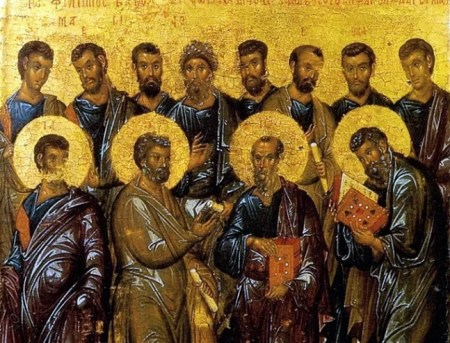
The Acts of the Apostles details how “it was decided that Paul, Barnabas, and some of the others should go up to Jerusalem to the apostles and presbyters about this question.” A Church council was held in Jerusalem and after they had discussed and discerned the matter, “the apostles and presbyters, in agreement with the whole church, decided to choose (a pair of) representatives and to send them to Antioch with Paul and Barnabas. (They selected) Judas, who was called Barsabbas, and Silas, (two) leaders among the brethren.

And they did not send Barsabbas and Silas empty-handed. The pair carried a letter from the council, which read in part: “It is the decision of the Holy Spirit and of us not to place on you any burden beyond these necessities.” It then listed a handful of culturally offensive and/or sinful acts to abstain from before concluding, “If you keep free of these, you will be doing what is right. Farewell.” In other words, the Gentile Christians would not be required to follow the full Mosaic Law.

Notice how the Church’s leaders, the apostles and presbyters in Jerusalem, pronounce their teaching with authority: “It is the decision of the Holy Spirit and of us…” As Jesus had promised at the Last Supper, “The Holy Spirit…will teach you everything and remind you of all that I told you.” The Church’s leaders teach in union with and in cooperation with the Holy Spirit.

Note as well how they do not send this letter by itself, but along with Barsabbas and Silas. This is partly to attest to the genuineness of the message—it’s not something Paul and Barnabas simply made up themselves. The accompanying witnesses are also sent to clarify any ambiguities and answer what remaining questions the Christians at Antioch might have. For instance, the Council of Jerusalem’s short letter bids the Christians to abstain from “porniea,” which various Christian Bibles translate as “sexual immorality,” or “fornication,” or “unlawful marriage.” But what was the precise meaning they intended here? One of these things or all of them together? Barsabbas and Silas could answer. We see that even a text inspired by the Holy Spirit (as this one was) can require an authoritative interpreter to be properly understood.

When the delegation from Jerusalem arrived at Antioch, the letter was read to the Christian community and the people were delighted. Barsabbas and Silas preached to them, encouraging them, and remained with them for some time. The controversy was resolved, and the community’s unity and peace of mind were restored; for the Bride of Christ, Mother Church, had spoken, removing all doubt about what Jesus wanted them to do.

This, of course, would not be the last controversy in Church history. Every century since has seen its heresies, and every error gains some followers because it is so easy to be mistaken. Clever minds and willful hearts in a fallen world can go down many false paths, and when lambs or sheep choose their own ways to go they scatter from Christ’s flock. Thankfully, God has given us his Holy Word in Sacred Scripture to help us to know him and his saving, loving will for our lives.

However, the Scriptures do not automatically interpret themselves. Even self-proclaimed “Bible Only” Christian denominations disagree with one another over important questions. The Protestant principle of Sola Scriptura (that “Scripture Alone” is the sole authority for Christian faith and life) is a self-refuting concept because the Bible does not teach it. How can someone even be sure which books are supposed to be in our Bible without there being an infallible Church to recognize them and place them into the canon of biblical books? Without a Spirit-guarded, infallibly-teaching Magisterium neither the Christians at Antioch nor Christians today could be sure about what we are to believe.

The Church of Jesus Christ is not meant to be many separate denomination, but one. Christ’s Church is not meant to bring salvation only to some, but to all. And the one, holy, catholic, and apostolic Church of Christ shares a continuity in her structure and in her teaching throughout the centuries from St. Peter and the apostles to Pope Francis and the bishops today.

In 1926, when G.K. Chesterton wrote his essay “Why I am a Catholic,” he presented a number of reasons, but the answer of his which has always stood out to me is this one: “(I am a Catholic because it) is the only thing that frees a man from the degrading slavery of being a child of his age.” Some secular people imagine our present generation is the first one to get everything right, but in one hundred years another secular generation will mock and cringe at this one while embracing another set of fashionable errors of their own. However, in one hundred years the Catholic Church will remain, built solidly upon rock, and united to the Person and teachings of Jesus Christ our Lord.

Here is a final reflection from the controversy at Antioch. The teaching of Paul and Barnabas was right, and Barsabbas and Silas carried authority from the apostles. They were important witnesses to the Faith. But their message would have been undermined in the minds of others if St. Paul, St. Barnabas, St. Barsabbas, or St. Silas had not lived as saints. Our fellow Christians, even popes or bishops, may disappoint or cause scandal by their poor personal example, harming souls. But let us, you and I, rededicate ourselves to Christ, loving him and serving him, remaining close to him in the Sacraments, allowing ourselves to be more fully converted to him, so that others may know, love, and faithfully follow Jesus alongside us in his Holy Catholic Church.

Our Mother Needs Help

May 8, 2022

4th Sunday of Easter
By Deacon Dick Kostner

Happy Mother’s Day! Jesus refers to his Church as his mother and his bride. While God does not need us he requests that we be a part of his mystical body. The vocation he gives to his Church is to preach and live the gospel message of happiness and love not only in this life but also in the next with him, in heaven. The problem that this brings to us is that this vocation can only be accomplished in this life, by and through the carrying of crosses during this life.

At the beginning of Lent we walked through a trailer movie of our life here on Earth displayed to us by reflecting upon the “Way of the Cross,” displayed here on our Church Mother’s walls. We discovered that while completing his vocation, which was opening the door to heaven for his Church, he got tired of carrying the cross and fell three times. Three times he felt he could not go on. Ordinary people like you and me, together with his heavenly Father, gave him help and the courage to go on. Jesus relied on faithful friends and the Father for help and moral support.

As you know since I was ordained a Deacon some twenty plus years ago, I have been involved with the RCIA program which invites adults to become members of our faith and the Mother Church. In the early Church it was directed to people who did not know Jesus or the Christian faith. Now, that program has also been available to Christians of other faiths, who are interested in becoming members of the Catholic Church. In the twenty some years I have been involved in the program I believe there has only been three or four individuals who joined the Catholic Church who were not previously involved in and educated in the Christian faith. Times have changed and the Mother Church is now involved in what it calls the New Evangelization. It’s our new challenge which is trying to get Christian educated individuals back into being active members of the body of Christ. People know about Jesus but are finding it difficult to witness his presence and help within their busy lives.

Our RCIA team is determined to help RCIA Candidates to recognize just how involved God is within our lives. The best way to teach this is by sharing our encounters with God in ordinary experiences of life. At every class we share what we call our “Spirit Stories” with each other to show just how important a part we play in God’s plan for us to be active participants in His plan for our happiness and salvation goal for us and our friends and neighbors, to be with him for all eternity. We are blessed in this Community with many active members of the body of Christ but the Covid has weakened our mission to be example setters for making everyone’s life happier and more faith filled by supporting our Mother Church. Attendance has not returned to pre-Covid numbers for many of our parishioners at Sunday Mass. Those who are still active in Church ministry are not only getting older but also are being overwhelmed with the responsibilities of keeping our Parish healthy in mind and spirit.

Liturgy is the generator, the battery charger for the Faithful to continue to be example setters for the faith community. The Liturgy cross our parish is carrying is getting too heavy for it to handle without the help of the Simon’s and Veronica’s. There are many members in our Parish still attending our Liturgies who used to be active Liturgy ministers of the word; greeters; and Ministers of Holy Communion, that no longer wish to be active for a variety of reasons. All of us will fall down numerous times on our trip to eternity but with a little help from the Simon and Veronica’s our St. Paul’s and St. John’s Body of Christ will continue on as Jesus did to fulfill our vocation to preach and teach by example, the gospel message of love of God and neighbor.

You will find forms and pencils in your pews to sign up and help carry our Parish crosses on our “Way of the Cross.” Not ready to sign today? When my wife asks people to help with ministries and they are reluctant, I will quote her by saying to you. “Pray over it.” and return your sign up sheet next week. I would also suggest you request St. Joseph to “sleep over” your requests for help in making a decision. I have acquired for our Parish a Sleeping Joseph Statute which is located on our Sacred Heart of Jesus Altar. Saint Joseph had many communications from God in the form of dreams and he always obeyed these communications. You may ask St. Joseph to ask God to help you make important decisions in life by placing your written requests in the box on which the Statute rests. We will have the Sleeping St. Joseph statute available for your help requests for a couple of weeks. Pope Frances does this on a regular basis and he encourages the faithful to do the same.

The Church realizes that some of you are physically or mentally unable to help carry this ministry cross. Veronica was unable to help carry the cross for Jesus but she did what she could do to help him. To people who can’t help carry this vocation anymore, you can still be a “Veronica” to those who need help, wipe their face, tell them thanks, and tell them they are needed. As Jesus told us in today’s Gospel, “My sheep hear my voice; I know them, and they follow me. I give them eternal life, and they shall never perish. No one can take them out of my hand. My Father who has given them to me, is greater than all, and no one can take them out of the Father’s hand.”

I will close with a Psalm Prayer for our Parish “Mother”: “Lord, God, your only Son wept over ancient Jerusalem, soon to be destroyed for its lack of faith. He established the new Jerusalem firmly upon rock and made it the mother of the faithful. Make us rejoice in your Church and grant that all people may be reborn into the freedom of your Spirit. Amen!“ On behalf of Fr. Victor and all our Parish Ministers, Happy Mother’s Day to all the moms out there and to our Mother Church!

Who is the Fig Tree? Three Interpretations

March 19, 2022

3rd Sunday of Lent
By Fr. Victor Feltes

“There once was a person who had a fig tree planted in his vineyard, and when he came in search of fruit on it but found none, he said to the gardener, ‘For three years now I have come in search of fruit on this fig tree but have found none. So cut it down. Why should it exhaust the soil?’ He said to him in reply, ‘Sir, leave it for this year also, and I shall dig around around it and fertilize it; it may bear fruit in the future. If not you can cut it down.’”

The fig tree in Jesus’ parable was fruitless for three years and in danger of being chopped down. Who does this fig tree represent? The prophets Jeremiah and Hosea likened Old Covenant Israel to a fig tree, and the early Church Fathers commonly identified the barrenness of the parable’s fig tree with Israel’s refusal to accept their Messiah. Israel experienced three years of Christ’s public ministry and had still another season of opportunity to become fruitful by embracing Christ’s Church thereafter. But Jerusalem, its Temple, and all its towers were cut down, put to the sword and destroyed by the Romans in 70 A.D.. Parables, however, can have more than one valid and inspired interpretation. Beyond symbolizing an era of history now passed, what meaning does the barren fig tree hold for us today?

In today’s second reading, St. Paul warns the Christians at Corinth against presumption. The Hebrews during the Exodus all shared in a baptism with Moses when they passed through the Red Sea. In the desert, they all ate bread from heaven and drank a miraculously-given drink on their journey. “Yet God was not pleased with most of them, for they were struck down in the desert.” St. Paul says “these things happened as examples for us… as a warning to us,” lest we who are baptized into Christ and regularly consuming his Holy Eucharist think we do not need to reject all grave sins. Do not grumble or rebel like the Hebrews in the desert. Stop following your desires for evil things, or you will perish as they did. Instead, repent and follow our good and loving Lord. He will help and guide you to his Promised Land.

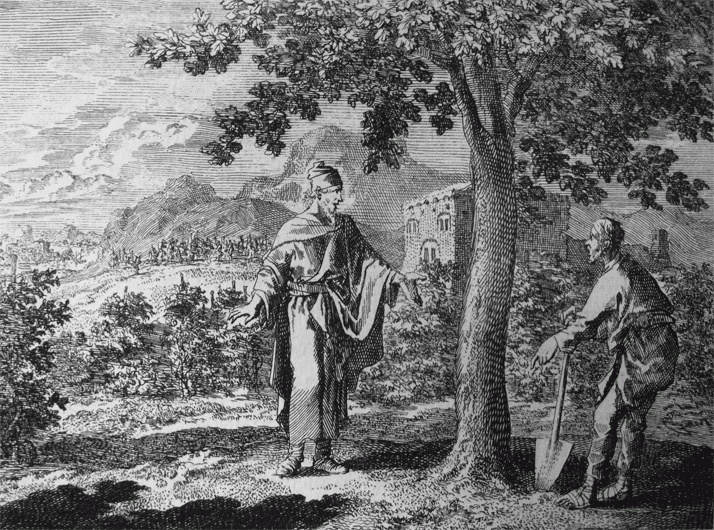
A fig tree may be lush with leaves, giving off a splendid appearance, and yet be barren within. A Christian may appear complete to others, and yet have a sickly soul. To help the barren fig tree, the gardener in our parable pleads to dig around it and add fertilizer. This describes root pruning and the application of manure. Root pruning as a method to make fig trees more fruitful is still recommended today. One article suggests this technique: at the end of winter before new growth begins, go about two feet away from the tree trunk and plunge a spade or shovel down, severing the roots. Skip over one shovel’s-width to the side and then repeat this pattern in a circle once around the tree. Cutting off some of its roots spurs the fig tree to divert its energies from growing foliage to creating fruit. The manure, for its part, provides nutrients (especially nitrogen) which plants require and benefit from. So, if you are a barren fig tree, Jesus the Gardener wishes to radically sever your connections to vices and distractions, in order to productively redirect your energies. He wants to introduce you to stuff which you may now find repellant (including regular confession and daily prayer) but which you need and will benefit from. You do not know how many seasons you have left. Jesus offers you this opportunity to change and become fruitful. Please let Christ the Gardener work with you.

But what if you already follow Christ closely and are aware of no grave sins? What if you have mature self-knowledge, a well-formed conscience, and cannot detect any mortal sins in yourself? Then praise God for that, and consider how our Lord wishes to glorify you through still greater fruitfulness. In the Old Testament Book of Leviticus, God commanded his people not to eat from any tree they planted in Israel throughout its first three growing years. In the fourth year, all of the tree’s fruit was to be dedicated to God as an offering of praise to the Lord. Only in the fifth year, and any years after that, could they eat its fruit. (Leviticus 19:23-25) So how would God dedicate your fruit as an offering to himself and grant you a greater enjoyment of his blessings ever after? A third interpretation of today’s parable suggests how.

Jesus’ parable begins: “A man had a fig tree planted in his vineyard…” (Our New American Bible translates that line’s last word as “orchard” but the Greek word St. Luke uses means “vineyard.”) A vineyard is for growing grapevines. This raises a question I found answered online: why would someone plant a fig tree in a vineyard? A “consulting viticulturist” from New Zealand who has worked fifty years in the vineyard and wine industry says some vineyards plant fig trees because “in some regions figs ripen at about the same time as grapes – birds seem to prefer pecking figs [and] so leave the grapes alone (more-or-less).” Another online commenter, a “cook for over sixty years,” adds that “some vineyards have a problem with small birds who peck at the grapes looking for the seeds and causing the grapes to rot. One solution is to plant fig trees around the vineyard. The birds prefer the figs because they have more seeds and the seeds are more accessible, they then leave the grapes alone.”

The reason a fig tree is planted by a vineyard is to offer up its fruits as a sacrifice for the good of the vineyard, to the delight of the vineyard owner. Who or what is this vineyard in the parable? Jesus teaches, “I am the true vine, and my Father is the vine grower,” and tells his Church, “I am the vine, you are the branches.” (In another parable, The Parable of the Wicked Tenants, Jesus identifies a vineyard as “the Kingdom of God.”) So the fig tree is called to self-sacrifice for the good of God’s vineyard, which is the Church, the Body of Christ, the Kingdom of God. But what does this look like?

In the midst of the French Revolution, a community of Carmelite nuns in Compiègne felt moved to make an offering themselves to God as a sacrifice for their troubled nation and the Catholic Church in France. Almost two years later, after the state had closed and seized all the convents and outlawed the wearing of habits, the sisters were found, arrested, and condemned to death. On July 17th, 1794, sixteen chanting nuns ascended the scaffold one-by-one and were guillotined before a silenced crowd. Ten days after the Blessed Martyrs of Compiègne’s sacrifice the evil “Reign of Terror” ended.

More recently, Fr. John Hollowell, a diocesan priest about my age of the Archdiocese of Indianapolis, was diagnosed in February of 2020 as having a brain tumor. Though grave news, Fr. John saw in his illness an answer to his own prayer. He wrote on his blog at the time, “When the scandals of 2018 broke out, most of you know that they [] affected me deeply, as they have most of the Church. I prayed in 2018 that if there was some suffering I could undertake on behalf of all the victims, some cross I could carry, I would welcome that. I feel like this is that cross, and I embrace it willingly.” Following surgery and treatment, he continues serving today as a pastor in Indiana.

Now it’s natural to hesitate at making such a self-offering. Who wants to suffer – to have our roots cut or be surrounded by dung? Even Jesus prayed before his own self-sacrifice, “My Father, if it is possible, let this cup pass from me; yet, not as I will, but as you will.” Yet Jesus loved his Father and loved us, trusting that whatever his Father willed would be best for us all. The hour had come for the Son of Man to be glorified. Was not this most-difficult thing the greatest thing that Jesus did? Jesus tells us, “Whoever serves me must follow me, and where I am, there also will my servant be. The Father will honor whoever serves me.”

In its first years, a fig tree grows only for itself. A fig tree typically begins bearing fruit when it is three to five years old. So after three years of barrenness, it remains unknown whether the fourth year will witness the tree producing pleasing fruits. Jesus now offers you an opportunity to be fruitful and be glorified like himself. Please love and trust him enough to offer him your fruitful sacrifice.

Why the Catholic Church is Always so Behind the Times

November 20, 2021

Solemnity of Christ the King

A teenager recently asked me, “Why does the Catholic Church have ideas so behind the times?” It was a written question submitted alongside other students’ “Questions for Father.” The question reflected the young person’s doubts and I’m glad that it was asked, because after some reflection and with the help of grace I gave what I believe was an inspired answer.

I began with a review of some late modern history. In 1789, the leaders of the French Revolution took power in France. They rejected faith and wished to entirely replace Catholicism with their own invented “Cult of Reason.” They redefined the number of days in a week from seven to ten to deconsecrate Sunday – the Lord’s Day. They killed or exiled Catholic clergy and converted churches into “Temples of Reason.” They confiscated the convents and monasteries and expelled or martyred the monks and nuns, ending charitable ministries all across France. In their Reign of Terror they executed thousands and then turned on one another. Their revolution ended after ten years with a military coup which gave France a dictator who would crown himself their emperor: Napoleon Bonaparte.

In the early 1930’s, when Hitler rose to power in Germany, he was opposed by Catholics there. In fact, a map of the regional vote shares that the Nazi Party received across Germany looks like the photographic negative of the percentages of Catholic populations in place to place. The dark places of one map were the light places on the other. The Catholic Church proclaims universal human dignity, the preciousness of every human person, but the anti-Catholic Nazis believed in racial supremacy. They claimed the modern science of eugenics proved Germans to be the master race and showed Jews, Slavs, the disabled, and others to be lesser human beings. The Nazis arrested, deported, and murdered millions in concentration camps (including Catholic clergy, religious, and activists) and started a world war which killed millions more. Hitler’s “thousand year Reich” died with him after twelve terrible years.

The 1917 Russian Revolution and the Chinese Revolution of 1949 were violent, atheistic, communist movements. They heralded divisive class warfare as the path to utopia, denouncing and persecuting religion as the “opiate of the Masses.” The governments of the Soviet Union and Communist China, thoroughly corrupt with unchecked power, trampling human rights and freedom, are responsible for tens of millions of deaths over the past one hundred years.

I concluded my answer to that anonymous student’s question by asking the class to consider: if we had lived in France, or Germany, or Russia, or China during those times of social change would we have gone along with the spirits of the age? What would have prevented us from being swept up by and falling for their seductive errors? Our best protection against them, what would have preserved us, would be our firm conviction in our Catholic Christian Faith. The teachings of the Catholic Church will always seem to be “behind the times” because the world is always finding new ways of going gravely wrong. But timeless truth never changes. As the Letter to the Hebrews says, “Jesus Christ is the same yesterday, today, and forever.” Christ is the King “who is and who was and who is to come,” and our allegiance to him is our salvation.

For the feast of Passover, the 1st century Roman Governor of Judea, Pontius Pilate, was accustomed to release for the Jews one of his prisoners. So when the crowds assembled on Good Friday, Pilate asked them, “Which one do you want me to release to you, Jesus Barabbas or Jesus called Christ?” Barabbas was a notorious prisoner imprisoned for a rebellion which had taken place in Jerusalem and for murder. The name Barabbas means “son of the father.” So the crowd had a choice: which savior, which son of the father, which king did they prefer? Many Jews expected the Christ, their Messiah, to be a military leader who would forcefully drive out the Romans and rule an earthly kingdom like David’s or Solomon’s. Most of the crowd chose Barabbas over and against the Lord.

Pilate asked Jesus, “Are you the King of the Jews? …[So] you are a king?” Jesus’ responses to him mean, ‘Yes, but not like you imagine. If my kingdom were like the other kingdoms you know, my followers would be fighting an armed revolt right now.’ Christ’s Kingdom is in our world but not of this world. Jesus called and sent his twelve apostles to proclaim the Kingdom of God and upon the “Rock” of Peter he built his Church to teach and heal, sanctify and save. The Church continues her work with Christ to this day. She is the seed and the beginning of his kingdom. She is “the reign of Christ already present in mystery.

It can be easy to get discouraged by the evils and errors of today. As faith declines within our culture, challenging times are ahead for our Church and her mission. But there always remains reason for hope. Even amid the great evils of Good Friday, Jesus was still advancing his saving mission. Always remember: if Jesus could achieve his saving work on that most wicked day then he can surely accomplish his saving work in our day as well.

Our Shared Roots — Funeral Homily for Maxine Zwiefelhofer, 90

November 12, 2021

In her first ninety years of life, Maxine has been a daughter, a sister, a wife and a mother; an aunt, a grandma, a great grandma, and a great-great grandma; a talented nurse, a good friend, and a devoted Catholic. Among her many traits and experiences, on this day of her funeral I would like to highlight one hobby of hers which has been a blessing to our community and a point of pride for her family.

Maxine has been a hobbyist in history. She wrote “The History of St. John the Baptist Catholic Church” in Cooks Valley, which detailed more than one hundred years of this parish from 1885 to 1995. Maxine spent many days researching genealogy at the Chippewa County Historical Society, and even traveled with family to Scandinavia and Denmark to explore their ancestral roots. She wrote books of family history, recounting the lineages of the Toppers, the Olsons, the Zwiefelhofers, and the Bleskaceks.

Here’s an interesting bit of trivia: the U.S. Census Bureau says there are more than 150,000 different last names in our country today, with some 5,000 last names in common use. Have you ever noticed, that with the whole forest of humanity to choose from, most people prefer to research those family trees which have branches which reach themselves? For instance, Topper was the family name of Maxine’s father, Ernest; Olson was the maiden name of her mother, Elizabeth; and Zwiefelhofer was the last name of her husband, David. Here’s another statistic: there are more than 20,000 Catholic churches in America. Of all the churches in all the towns in all the land, why did she write a history about this one?

You know the answer. Maxine explored the genealogies of those particular families and recounted the history of this particular parish because she belonged to them and they belonged to her. Our past provides us with our identity. If we were to lose all of our memories but could still think and walk and talk, we would wonder about who we are. Our family and community, our origins and past, inform us about who we are. As Christians we know our family, community, origins, and past are more than merely natural.

Who was Jesus describing in the gospel we just heard? Who is merciful and meek? Who are peacemakers, clean of heart? Who hungers and thirsts for righteousness and unjustly suffers for what is right? Who do these Beatitudes refer to? The Beatitudes describe the blessed saints, but first and foremost they describe Jesus Christ himself. You and I as Christians you are their siblings, brothers and sisters within the family, the community, the communion, of God’s Church. Our origin is that we were created by God in love. That is your origin. Our past is that Jesus Christ came and died and rose for us. That is your past. And rooted in this true identity, our future is full of hope.

St. Paul’s Letter to the Romans declares “that we who were baptized into Christ Jesus were baptized into his death,” and if “we have died with Christ… we shall also live with him.” As foretold through the Prophet Daniel, one day, “those who sleep in the dust of the earth shall awake,” some to everlasting disgrace and others to eternal life. Then “the wise shall shine brightly… and those who lead the many to justice shall be like the stars forever.

Let us pray today for Maxine’s soul and renew our true identity in Jesus Christ, so that she and we with him may be one holy family, one holy Church dwelling in the house of the Lord forever.

Widows’ Gifts

November 6, 2021

32nd Sunday in Ordinary Time

In today’s gospel, Jesus says, “Beware of the scribes… They devour the houses of widows and, as a pretext, recite lengthy prayers. They will receive a very severe condemnation.” Jesus denounced those scribes for their greedy hypocrisy. In recent decades, some televangelists and megachurches’ prosperity preachers have told believers ‘give your money to our ministry and God will bless you back with even more,‘ and then used the meager wealth of many widows to purchase mansions or private jets. This of course, gives scandal, leading many to think faith is just a grift and alienating people from Christ. Is it wrong for preachers to be paid? St. Paul defends the right of ministers to receive compensation, “for scripture says, ‘The laborer deserves his wages,’” but our holy work is not meant to be about getting rich.

The presence of unworthy motives among some Christian ministers is nothing new. St. Paul writes to the church at Corinth, “We are not like so many others who trade on the word of God for profit.” Such men were a problem in Paul’s day, too. So it might seem that poor widows should never be asked to give and that poor widows should never donate. That answer would be simple, yet God’s truth is not that simple.

In today’s first reading, the Prophet Elijah meets the widow of Zarephath during a time of great drought. He asks her for a cup of water and a bit of bread. She replies, “There is only a handful of flour in my jar and a little oil in my jug. Just now I was collecting a couple of sticks, to go in and prepare something for myself and my son; when we have eaten it, we shall die.” (She is preparing their last meal.) But Elijah says, “Do not be afraid. Go and do as you propose. But first make me a little cake and bring it to me. Then you can prepare something for yourself and your son. For the Lord, the God of Israel, says, ‘The jar of flour shall not go empty, nor the jug of oil run dry, until the day when the Lord sends rain upon the earth.’” She left and did as Elijah had said. And the poor widow, her fatherless child, and God’s prophet were all able to eat for a year. The jar of flour did not go empty, and the jug of oil did not run dry, as the Lord had foretold through Elijah. As today’s psalm tells, “The Lord keeps faith forever… The fatherless and the widow he sustains.

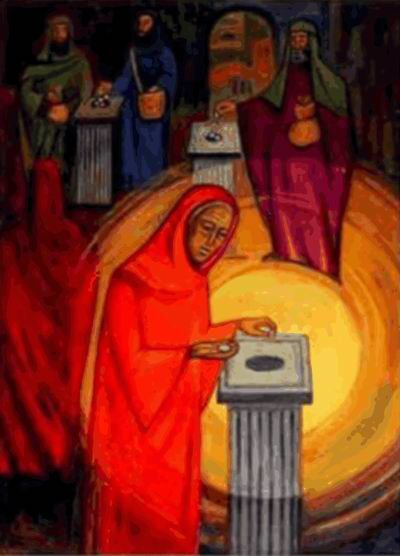
And in our gospel today, when Jesus sees a poor widow putting into the Temple treasury two small coins, which is all she has and her whole livelihood, what does he do? He does not try to stop her. He does not criticize her for being foolish. He calls his disciples to himself, he points her out to them, and he glorifies her trust in God in having given more than all the others. Her deed is still remembered to this day. Would it have been better if she had not given her gift?

I do not have a one-size-fits-all answer for how much poor widows should give. The Catechism teaches that the Church’s precept, “’You shall help to provide for the needs of the Church,’ means that the faithful are obliged to assist with the material needs of the Church, each according to his own ability,” so there’s recognition that some people have greater or lesser ability than others to materially assist the Church’s mission in this world. But if even poor widows are sometimes called to give, to trust in the Lord and give him the chance to prove himself their faithful provider, how much more so are the rest of us called to be generous?

We live in the wealthiest country in all of human history, and yet most of us only give a tiny fraction of our income to church and charity to support the good works they do. What accounts for this? Some of it is from the love of money and some of it is from fear. The Book of Ecclesiastes says, “He who loves money is never satisfied by money, and he who loves wealth is never satisfied by income.” Some are slaves to their greed, and some are shackled to their anxiety.

As an early teen, I felt reluctance at giving any money away for anything. I thought, “Who knows what my future holds? What if I need that money later? Every dollar I give away now is another dollar I’m exposed to future, unseen danger.” My mindset wasn’t informed by the Gospel, but when I finally read the Gospels myself I encountered Jesus’ teaching there. He says: “Do not worry and say, ‘What are we to eat?’ or ‘What are we to drink?’ or ‘What are we to wear?’ All these things the pagans seek. Your heavenly Father knows that you need them all. But seek first the Kingdom of God and his righteousness, and all these things will be given you besides. … Give and gifts will be given to you; a good measure, packed together, shaken down, and overflowing, will be poured into your lap.” The Lord was calling me beyond my comfort zone and into a deeper relationship with him.

I remember standing in St. Paul, Minnesota’s awe-inspiring cathedral. It was my first time there and I saw near the south exit a donation box labeled “For The Poor.” The largest bill in my wallet was a ten or a twenty, and I both wanted and very much did not want to give it, yet I knew what I should do. Once I had done it, I walked out smiling. It was a small donation, but even then I knew it was a big moment, and it changed the rest of my life.

I recall the story of one married couple. They used to pay their bills and then give to God if there was something left —and sometime there was nothing left. But God put it on their hearts to tithe consistently, so they began setting aside their gift to him first before paying their bills. And when they approached their giving in this way they discovered there was providentially always enough for both God and the bills.

God commands, “You shall not put the Lord, your God, to the test,” yet in his Old Testament Book of Malachi he says to test him in this: “Bring the whole tithe into the storehouse, that there may be food in my house. Put me to the test, says the Lord of hosts, and see if I do not open the floodgates of heaven for you, and pour down upon you blessing without measure!

And so, without embarrassment, I ask you to be generous in giving, not only so that our church may put your gifts to good use, but for the sake of deepening your personal relationship with our good and faithful God.