Archive for the ‘Catholic Church’ Category

Associated Priests

October 30, 2021

31st Sunday in Ordinary Time

For the past four weeks, our second reading has come from the Letter to the Hebrews. This New Testament book shows Jesus Christ as our great, faithful, and merciful high priest: holy, innocent, and undefiled, yet patient and compassionate. He is able to personally sympathize with us in our weaknesses because, though sinless, he shares in our humanity and struggle. Jesus Christ is a priest forever offering his one perfect sacrifice to God the Father in a priesthood which does not pass away.

As the Catechism teaches, the redemptive sacrifice of Christ is unique, accomplished once for all; but this sacrifice is made present for us at Mass. The same is true of the one priesthood of Christ; Jesus’ priesthood is unique, but it is made present for us through the ministerial priesthood which he founded at the Last Supper. Jesus commands his apostles, “Do this in memory of me,” ordaining them priests of his New Covenant. Yet only Christ is the true priest, while they are merely his ministers.

Besides the unique priesthood of Jesus Christ and the ministerial priesthood of his ordained bishops and priests, there is the common priesthood (that is to say, an equally-shared priesthood) of all the faithful, which is ours through baptism. Sharing in Christ’s identity as priest, prophet, and king, each of us have holy sacrifices to offer, each of us have holy truth to proclaim, and each of us have holy power to wield. The Second Vatican Council noted, pastors “know that they themselves were not meant by Christ to shoulder alone the entire saving mission of the Church toward the world.” The ministerial priesthood is at the service of your priesthood, so that you — sanctified, strengthened, enlightened, and formed — can be as Jesus Christ and his saints for this place and time.

The scribe in today’s gospel approaches Jesus and asks: “Which is the first of all the commandments?” Jesus answers that the first in importance is this: “You shall love the Lord your God with all your heart, with all your soul, with all your mind, and with all your strength.” And the second is this: “‘You shall love your neighbor as yourself.’ There is no other commandment greater than these.” We must be entirely devoted to God, lovingly serving his kingdom according to our personal gifts and callings. And yet, even when we’re giving our all, we remain limited creatures. For instance, time spent doing one thing cannot be spent doing something else. And we are not pure, angelic spirits but physically embodied creatures, beset by weakness and fatigue.

I have experienced this these past four years as your pastor, having two parishes and a school, celebrating thirteen or fourteen Masses a week, with usually five Masses to offer on the weekends. Plus there’s confessions, funerals, anointings, and weddings; school activities and CCD; answering correspondence and completing paperwork; writing for the bulletins and the Sunday homily; and meetings or appointments on most weeknights. I mention this not to brag or complain, but to show why this is grinding and draining and why I do not do more — there is only one of me. I would like to do more than these things I do, but I feel I can’t – not without some help or relief. That’s why I have been working with our parish councils for several months seeking a good solution.

Today, I can announce good news: St. Paul’s and St. John the Baptist’s parishes will soon have an additional priest. This associate priest will assist me, your pastor, in serving you. His name is Fr. Chinnappan, a priest from India, who presently happens to be Fr. John Potaczek’s associate in Mauston. Fr. Potaczek will have a new associate, but Fr. Chinnappan will officially begin ministry here with us, with lodging at St. John’s rectory, on December 1st of this year.

This means that our current weekend Mass schedule will not need to change next year. We’ll have more flexibility in scheduling funerals and more opportunities for confession. Weekday Masses will become Communion Services much less often than before. And visiting priests will no longer be needed for helpouts. Fr. Chinnappan is excited to teach a religion class at St. Paul’s School next semester, and now there will typically be at least one priest around at both parishes for each night of CCD.

I look forward to the unique gifts and perspective Fr. Chinnappan will bring to St. Paul’s and St. John the Baptist’s. I trust that you will make him welcome, and be patient with us who serve you. For myself, I am most excited to have more opportunities to engage, teach, and evangelize, drawing souls more closely and profoundly to Christ here at our church and school. I have some new ideas in mind, and I want to hear your ideas and any offers to help. Jesus wills for you and I to be one hundred percent devoted, with all our heart and mind, soul and strength. Let us serve Jesus Christ, our priest and king, as saints for this parish according to our own unique gifts and callings.
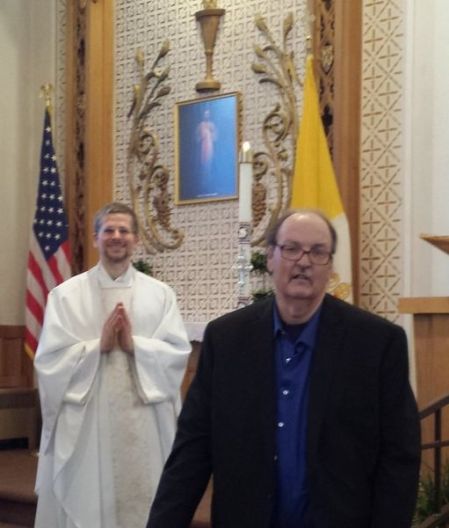
Lovingly Received — Funeral Homily for Allen Pietz, 62

June 22, 2021

Allen is a dear acquaintance of mine. Unlike many of the persons I offer funerals for, I know him really well. But today I’m going to begin by telling you about another warm acquaintance of mine and the story he once told me. I went to seminary with a fellow who is now a diocesan priest in South Carolina named Fr. Andrew Trapp. Fr. Andrew looks a lot like the actor Tobey Maguire (who starred in the Spider-Man movie franchise) and Andrew also has a Peter-Parker-like friendly goodness. Fr. Andrew got a little famous back around 2010 when he beat the champion poker player Daniel Negreanu on a TV game show. He won $100,000 and donated his whole prize (after taxes) to his parish’s renovation project. Before he was ordained, Andrew spent a summer in Paris, France improving his French and helping out at a Catholic church.

There he met a former satanic worshipper who had repented, reconciled to God, and became a member of that parish. Andrew knew that Satanists were known to steal the Holy Eucharist, the Body of Christ, for use and abuse in their rituals. (I’ve heard elsewhere that Satanists are interested in stealing only the Catholic Church’s Communion Hosts to perform Black Masses and other sacrileges.) Andrew asked the man whether it was true that Satanists test their followers using these stolen Hosts, placing a Consecrated Host in a line-up of identical, unconsecrated wafers to see if the person could identify which one it is. The man responded that he had undergone this test and successfully passed it. Andrew asked him, “How did you know which host was the Lord?” And the man replied, “It was the one that I felt hatred towards.”

No brief funeral homily can tell the whole story of a person’s life, but sometimes a particular aspect of a Christian’s life can proclaim the most important things. Allen did not grow up Catholic. He started attending Mass at St. Paul’s in the front row with Sylvia. And it was here that he fell in love with the Holy Eucharist. Sylvia remembers Allen pointing to the altar and saying, “I want that Bread.” This desire was the main reason Allen became Catholic, got Confirmed, and received his First Holy Communion here in 2020, exactly a year and one week before his death. Allen was always eager to receive the Holy Eucharist on Sundays. And whenever he couldn’t come, he missed it profoundly. Sometimes he could barely walk and he still came to Mass. What fueled this intense longing and devotion in Allen? It was the love he felt for Jesus in the Eucharist.

It was Jesus, who said, “I am the living bread that came down from heaven; whoever eats this bread will live forever; and the bread that I will give is my Flesh for the life of the world.” When those in the crowd murmured at this, objecting, “How can this man give us his flesh to eat?” Jesus answered, “Amen, amen, I say to you… [M]y Flesh is true food, and my Blood is true drink. Whoever eats my Flesh and drinks my Blood remains in me and I in him.” Jesus says, “Whoever eats my Flesh and drinks my Blood has eternal life, and I will raise him on the last day.”

In truth, Allen’s great love for Jesus in the Eucharist was only a weak reflection of Jesus’ love for Allen. And what will separate friends of Jesus Christ from the love of Christ? Neither death nor life, neither present things nor future things, neither height nor depth, neither angels nor powers, nor any other created thing will be able to separate them from the love of God in Christ Jesus our Lord. It is right that we pray today for the perfection and glory of our friend Allen’s soul, but we do so with great peace and confidence that Allen, who was so eager to receive our Lord in the Eucharist, will himself be eagerly received by our loving Lord.

Allen Pietz after his 1st Communion

Allen Pietz on the day of his First Communion, June 7, 2020

You are Called to Service

May 22, 2021

Pentecost Sunday


You have hands and arms, feet and legs, ears and eyes, a mouth and a nose. They are all valuable parts of your body. But without the presence of your animating soul extending throughout them, these parts would just lie around, inactive, achieving nothing. God has likewise fashioned his Church as the Body of Christ with an animating Spirit. The Holy Spirit is like the soul of the Church, extending through all its members. St. Paul teaches the Corinthians in our first reading:

As a body is one though it has many parts, and all the parts of the body, though many, are one body, so also Christ. For in one Spirit we were all baptized into one body… and we were all given to drink of one Spirit.”

As your soul moves your body to achieve your works and purposes, so the Holy Spirit moves God’s Church to achieve his good works and purposes with us. St. Paul also tells us:

There are different kinds of spiritual gifts – but the same Spirit; there are different forms of service – but the same Lord; there are different workings – but the same God who produces all of them in everyone. To each individual the manifestation of the Spirit is given for some benefit.”

So each baptized person in communion with Christ has the Holy Spirit, and has gifts of the Spirit, and important works to do, and is called to Christian service.

I’ve heard people remark recently that their lives now feel like a clean and open slate. So many routines were cancelled by the pandemic that we now get to decide what worthwhile things to refill our lives and schedules with. I believe this is a important time and an opportunity for our parish. This season must begin a new springtime for the Church, otherwise our “new normal” could be an unchecked decline into decades of winter. How we respond will impact the salvation of souls for generations.

A week ago, I urged you to ask, “Lord, what do you want me to do?” What gifts are you being called to use? What new works are you being called to do? What service are you being called to begin? Let’s contemplate the gifts and desires the Holy Spirit has given you, and consider different works of service you may be called to in our parish.

► Are you a friendly person who knows our community and can make strangers feel welcome? You might be called to be an usher-greeter at our church.

► Can you appreciate the sense and mood of a sacred text, and read it well for others? You might be called to be a lector/reader.

► Are you a good singer or musician? You might be called to sing or play your instrument at Mass.

► Do you want to be close to God at his altar? You might be called to be an altar server, deacon, or priest.

► Do you have a heart for the homebound or those in nursing homes and desire to bring Jesus Christ to them? You might be called to be an Extraordinary Minister of the Holy Eucharist for them.

► Do you desire to be closer to Christ and appreciate that without prayer the Church’s efforts will not be fruitful? You might be called to be an adorer at St. John’s 24-hour Eucharistic Adoration (which precedes the 1st Fridays of each month), or called to join our parish prayer chain, or called to begin attending weekday Masses.

► Do you desire fellowship with other Catholic men or women and want to support charitable works? You might be called to join our Parish Council of Catholic Women or the Knights of Columbus.

► Do you enjoy reading great books and discussing them with friends? You might be called to start a parish book club here.

► Do you love a Catholic video series, like Jeff Cavins’ “The Great Adventure Bible Series,” or Bishop Barron’s “Catholicism” series, or Steve Ray’s “The Footprints of God”? You might be called to host a parish viewing and discussion group for it.

► Do you want to help the poor, the environment, and our church and school while having a fun time? You might be called to join our Thrift Sale volunteers, who do great work.

► Are you good with numbers and a person of integrity? You might be called to be collection counter or to help selling Scrip.

► Are you good with social media or data entry? You might be called to create posts for our parish Facebook page, or called to update our parishioner and school alumni databases.

► Do you care deeply about children, their education and well-being? You might be called to be a mentor, or a tutor, or a playground supervisor, or a school librarian, or even a teacher’s aide at St. Paul’s Catholic School.

► Do you want to help hand-on our Catholic faith to young people? You might be called to be a CCD teacher. After years of good and faithful service, Jenny Hoecherl is stepping down this summer as St. Paul’s CCD and youth ministry coordinator. You may be called to take this important, salaried position.

That’s about two dozen different roles and missions to which you may be called, and I’m sure the Holy Spirit could show you others. So what does the Lord want you to do? To what holy service are you being called? Before Pentecost, the disciples were uncertain and hesitant, hiding behind locked doors. But on Pentecost the Holy Spirit showed them what to do and gave them the courage to do it. Jesus says in today’s Gospel: “When he comes, the Spirit of truth, he will guide you to all truth.” So ask him what you are called to do. Sometimes God uses other people to show us his will. Tell your friends and family members what gifts of God you see in them and encourage them to put them to good use. Jesus sent his disciples on mission in pairs, two-by-two. Perhaps ask a friend or relative to join you in some holy endeavor so that neither of you need go alone. Who could you invite to what? As members of Christ’s Body you, are called to faithful service. So allow the Holy Spirit to enlighten and empower you to achieve God’s works and purposes in this important time.

The Spirit’s Blessings Through God’s Church

March 20, 2021

5th Sunday of Lent

Right before ascending into heaven to sit at his Father’s right hand, Jesus gave his disciples these final instructions: “I am sending the promise of my Father upon you; but stay in the city until you are clothed with power from on high. …You will receive power when the Holy Spirit comes upon you.” After seeing Jesus ascend, the disciples returned to Jerusalem rejoicing. There in the Upper Room, the apostles, the Blessed Virgin Mary, and other Christians (a group of about one hundred twenty persons) devoted themselves with one accord to prayer. After nine days of prayer—the first Christian novena—the Holy Spirit descended upon them on Pentecost.

The apostles had received this eternal, divine Person before. On Easter Sunday evening, Jesus appeared in the Upper Room and breathed upon them saying, “Receive the Holy Spirit. Whose sins you forgive are forgiven them, and whose sins you retain are retained.” You and I first received the Holy Spirit at our baptisms, when we were “born again / born from above…of water and Spirit,” and made temples of the Holy Spirit. But just as the Spirit came down on Pentecost and filled the disciples in a new way, inspiring and empowering them to announce, make present, and spread Christ’s Church in the world, so we receive the Holy Spirit anew for mission in the Sacrament of Confirmation.

When God the Father sends his Word he also sends his Breath, and the mission of the Holy Spirit is united to the Son’s. Our faith in Jesus leads to our belief in the Spirit and in the good things which flow from both. These blessings are brought to completion through God’s Holy Catholic Church. As the Apostles’ Creed proclaims:

I believe in the Holy Spirit,
the Holy Catholic Church,
the communion of Saints,
the forgiveness of sins,
the resurrection of the body,
and life everlasting. Amen.

As Jesus Christ is the Church’s body, we being his members, so the Holy Spirit is the Church’s soul, our animating Spirit. The Holy Spirit inspires the Church’s Sacred Scriptures, he safeguards her Sacred Tradition and Magisterium from error, he is the Spirit of her liturgies, he empowers her sacraments, he intercedes in her prayers, he builds her up by charisms and ministries, and he manifests holiness in her by each vocation and every saint. As the early Church Fathers said, the Church is the place “where the Spirit flourishes.” The Holy Spirit gives his people gifts of wisdom, understanding, counsel, fortitude, knowledge, piety, and fear of the Lord; and his fruits of love, joy, peace, patience, kindness, goodness, faithfulness, gentleness, and self-control are seen in us. Jesus Christ and the Holy Spirit form the Church and make her holy. At the Last Supper, Jesus prayed for the holy unity of his Church. He said, “Holy Father, I pray not only for [these apostles of mine,] but also for those who will believe in me through their word, so that they may all be one, as you, Father, are in me and I in you, that they also may be in us, that the world may believe that you sent me.” This loving unity is reflected in the communion of the Saints.

In today’s Gospel, some Greeks who had come to worship at the Passover Feast approach the Philip the Apostle and ask him, “Sir, we would like to see Jesus.” Philip goes and tells Andrew the Apostle; then Andrew and Philip go and tell Jesus. Jesus answers them, “The hour has come for the Son of Man to be glorified.” Jesus’ salvific mission is catholic (that is, “universal”). He has come to unite every people and nation in himself. and he sees in this overture from the visiting Greeks a sign that his moment has come. Jesus says, “When I am lifted up from the earth, I will draw everyone to myself.” Jesus gathers them into communion with the one Church he founded, a hierarchical Church (with Christ its Head ordaining that apostles and priests to be her servant leaders) but a Church which is first and foremost interpersonal, communal. No one can baptize themselves; it requires another person. And not even a priest can absolve his own sins. Just so, we are not saved alone, but in communion with others. In the words of Pope St. Paul VI, “We believe in the communion of all the faithful of Christ, those who are pilgrims on earth, the dead who are being purified, and the blessed in heaven, all together forming one Church; and we believe that in this communion, the merciful love of God and his saints is always attentive to our prayer.” As Sts. Andrew and Philip helped those Greeks in reaching out to Jesus, so we lovingly aid one another, by our prayers, penances, and sacrifices, by sharing our material and spiritual goods, helping each other on the way to heaven. But entry into heaven is impossible without the forgiveness of sins.

We believe in the forgiveness of sins. Through Jesus Christ, God’s promises spoken through the Prophet Jeremiah in our first reading are fulfilled: “I will make a new covenant with the house of Israel… I will forgive their evildoing and remember their sin no more.” What was the Risen Christ’s first order of business for his Church when he appeared to his apostles in the Upper Room on Easter? After assuring them that it was really him and that he wished them peace, he gave his apostles the power and authority to forgive sins (as we noted before). Baptism into Christ washes away our past sins, but what if we grievously sin after baptism? We cannot be baptized twice. Since Christ has given his Church the power to forgive sins, then baptism cannot be her only means of forgiveness. The Sacrament of Penance is necessary for salvation for those who have fallen after Baptism, just as Baptism is necessary for salvation for those who have not yet been reborn in Christ.

There is no offense, however serious, that the Church cannot forgive. There is no one, however wicked or guilty, who may not confidently hope for forgiveness, provided their repentance is sincere. Christ, who died for all men, desires that the gates of forgiveness in his Church should be open to anyone who turns away from sin. If you could use a good Confession, mark your calendars to come here to St. Paul’s next Sunday, on Palm Sunday afternoon. Apart from making another appointment, it might be your last chance for a Lenten Reconciliation with God.

But what good would God’s forgiveness be if death were the end of us? We believe in the resurrection of the body. Jesus tells Philip and Andrew, “Amen, amen, I say to you, unless a grain of wheat falls to the ground and dies, it remains just a grain of wheat; but if it dies, it produces much fruit.” Here, as elsewhere, Jesus foretells of his resurrection, for the buried seed which dies then rises from the earth. Jesus then goes on to say, “Whoever serves me must follow me, and where I am, there also will my servant be.” This is not only a call to discipleship but a promise of resurrection: ‘Whoever serves me must follow after me, from the tomb of death to the resurrection of life, and where I am (whether in heaven or in the New Creation to come) there also will my servant be with me.’ Jesus says, “Whoever loves his life loses it, and whoever hates his life in this world will preserve it for eternal life.

We believe in life everlasting. And this new life doesn’t begin only once we die, or after God raises up our bodies “on the last day.” We can already taste eternal life now. From your worst sins you have had small glimpses of hell, and in Jesus Christ you have already experienced small glimpses of heaven. But our eyes have not seen, and our ears have not heard, and our hearts have not conceived the fullness of what God has prepared for those who love him. Scripture speaks of it in images: of life, light, peace, wine, a wedding feast, the Father’s house, the heavenly Jerusalem, paradise. God will wipe away every tear from our eyes and death will be no more, neither will there be any more mourning or crying or pain, for these things will have passed away. And when we enter this perfect, unending life with the Most Holy Trinity and all the saints, it will be the ultimate fulfillment of our deepest human longings; supreme and definitive happiness.

In conclusion, The Apostles’ Creed ends with the same final word as the last book of the Bible, the word at the end of the Church’s many prayers: “Amen.” In Hebrew, “amen” comes from the same root as the word “believe,” expressing solidity, trustworthiness, and faithfulness. In saying “Amen” we are professing both God’s faithfulness towards us and our trust in him. The Creed’s last word “Amen” repeats and confirms its first words, “I believe,” and everything in between. As St. Augustine preached, “May your Creed be for you as a mirror. Look at yourself in it, to see if you believe everything you say you believe, and rejoice in your faith each day.” This is our Faith. This is the Faith of the Church. We are proud to profess it in Christ Jesus our Lord. Amen

At the Father’s Right Hand

March 13, 2021

4th Sunday of Lent

Jesus tells Nicodemus, “Just as Moses lifted up the serpent in the desert, so must the Son of Man be lifted up, so that everyone who believes in him may have eternal life.” First, Jesus is raised up on the Cross. Next, he is raised up from the tomb. And finally, he is raised up to heaven. As this week’s section of The Apostles’ Creed proclaims:

He ascended into heaven,
and is seated at the right hand of God the Father Almighty
from there He will come to judge the living and the dead.

Jesus’ body was glorified at the moment of his Resurrection on Easter. Then he visited his disciples in his body over more than a month, appearing and vanishing, conversing and teaching, eating and drinking, and showing painless wounds in his hands, side, and feet. (Jesus keeps these wounds from his Passion as trophies of his victory.) And then, on the fortieth day, Jesus led his Apostles and disciples a short ways east out of Jerusalem, past the Garden of Gethsemane where he had agonized, and up the Mount of Olives which looks down over the Holy City. He raised his hands and blessed them, and as he blessed them he parted from them and was taken up to heaven. He was lifted up as they looked on and a cloud took him from their sight. They did him homage and returned to Jerusalem rejoicing. Of course, one cannot fly an airplane or ride a rocket to enter God’s presence (unless the flight ends very badly). Heaven is not a place here or there, but another dimension of reality, distinct from us but not far distant. Jesus ascends in his disciples’ sight to manifest the invisible, his entry into heaven in fulfillment of what King David had foretold about the Christ, one thousand years before, in the 110th Psalm:

The Lord [God] says to my Lord [the Christ]:
“Sit at my right hand until I put your enemies under your feet. Yours is princely power from the day of your birth. In holy splendor, before the daystar, like the dew, I have begotten you.” The Lord [God] has sworn an oath he will not change: “You are a priest forever…” At your right hand is [Christ] the Lord, who will crush kings on the day of his great wrath, who judges nations…

From ancient times the right hand has been considered the favored spot, the seat of honor for your right-hand man. Being at the right hand means closeness, allowing for intimacy and confidence. You and I have a great friend in high places who “always lives to make intercession” for “those who draw near to God through him.” Jesus, the high priest of the new and eternal Covenant, has “entered, not into a sanctuary made by human hands… but into heaven itself, now to appear in the presence of God on our behalf.” Jesus Christ is not only humanity’s priest and advocate in Heaven, before ‘his Father and our Father, his God and our God,‘ he also sits enthroned as our king. As the Prophet Daniel once foresaw concerning Christ in a vision:

“To him was given dominion and glory and kingdom, that all peoples, nations, and languages should serve him; his dominion is an everlasting dominion which shall not pass away, and his kingdom one that shall not be destroyed.”

Jesus Christ is King, the Lord of the cosmos and of history, who dwells in his Church where his Kingdom is now present in mystery. The Catholic Church is the seed and beginning of the Kingdom come on earth as it is in heaven. We now await Christ’s Second Coming in fully-unveiled glory, such that he can no longer be dismissed or ignored by anyone. Jesus will return as ruler of all and come to judge the living and the dead. “‘As I live, says the Lord, every knee shall bend before me, and every tongue shall give praise to God.’ … Then each of us shall give an account of himself to God.” The conduct of each person and the secrets of every heart will be brought to light before his throne. Then the wicked “will go away into eternal punishment, but the righteous into eternal life.”

It is very important that we take God and personal conversion seriously. Our first reading chronicles how God’s people had “added infidelity to infidelity, practicing all the abominations of the nations.” The Lord had sent them his messengers, early and often, for he had compassion on his people, “but they mocked the messengers of God, despised his warnings, and scoffed at his prophets.” God’s anger became so inflamed that he permitted them to be conquered by the Babylonian Empire six hundred years before Christ. Those who escaped the sword were carried off into Babylon captivity to be unhappily subjugated there. As today’s psalm recalls, “by the streams of Babylon we sat and wept.” Many never knew true freedom and peace for the rest of their days. But eventually, the Babylonians were conquered by the Persians, and the Lord inspired King Cyrus of Persia to issue a proclamation throughout his empire encouraging the Jews to return to Jerusalem, rebuild the Temple, and worship God there. Notice how the king made this possible but didn’t force anyone to go. They were free to choose; to either return home or stay far away. Wickedness has grave consequences, in this life and hereafter, yet we do not earn our salvation by doing good deeds. As St. Paul tells us, “by grace you have been saved — [God] raised us up with [Jesus] and seated us with him in the heavens… By grace you have been saved through faith, and this is not from you; it is the gift of God; it is not from works, so no one may boast.” Salvation comes from accepting God’s invitation to come home to him.

On the Last Day, Jesus will come again as our Judge, yet “God did not send his Son into the world to condemn the world, but that the world might be saved through him.” “For God so loved the world that he gave his only Son, so that everyone who believes in him might not perish but might have eternal life.” In Christ “the light came into the world, but people preferred darkness to light, because their works were evil. For everyone who does wicked things hates the light and does not come toward the light, so that his works might not be exposed. But whoever lives the truth comes to the light, so that his works may be clearly seen as done in God.” A very powerful way to shed the darkness of sin and come into the light is through Jesus’ Sacrament of Reconciliation.

Here is another divine invitation to freedom and peace: I will be hearing Confessions in St. Paul’s Main Sacristy this Thursday, from 8 AM to 6 PM, at the start of every hour until all are heard. If those times won’t work let me know and we’ll set up something else. Maybe it’s been a long time since your last Confession? Maybe you’re nervous? You don’t need to be. I’ll help you through it. Know that when you come out you will feel absolutely wonderful. And Jesus Christ, seated at the right hand of our Father above, will look upon you and smile.

Living Christ’s Mysteries — Funeral Homily for Deacon Ed Feltes, 65

February 23, 2021

On the day Victor and Ramona brought their eighth son to be baptized, while his little head was still damp from holy water, Edward Joseph was draped with white linen. And the priest said (in Latin), “Receive this white garment, which mayest thou carry without stain before the judgment seat of our Lord Jesus Christ, that thou mayest have life everlasting.” Today, we bring Ed’s body before the Lord, draping him in white cloth once more. My uncle Ed told me that as a deacon he would always say yes to doing baptisms. It was, he said, “the introduction of a new life into the Church. By baptizing them you are basically installing them into a Catholic environment and hopefully they will grow in it and not back away from it.” Ed has been a Catholic Christian for more than sixty-five years, ever since he was baptized into Christ’s death and resurrection. And throughout his nearly twenty-four thousand days Jesus Christ accompanied him through life. The life of a Christian is found in Jesus Christ. And the mysteries of Christ’s life are reflected in, shared with, the faithful Christian. We see this throughout Ed’s life.

At his First Communion, young Edward approached and saw the Real Presence of his Lord held before his eyes: “The Body of Christ / Corpus Christi.” Ed received Jesus and Jesus received Ed into a more profound union, a more intimate relationship, between them. In receiving Christ’s Body, Ed was called to be the Body of Christ for this world. When Jesus tells us at the Last Supper, “Do this in memory of me,” he not only commands that we would receive him at the Holy Sacrifice of the Mass, but that we would imitate him in his self-gift: “This is my body, which will be given up for you. Do this in memory of me.” When Ed was sealed with the gift of the Holy Spirit at his Confirmation, he entered a more powerful relationship with that same Spirit of inspiration, grace, and power who led Jesus in his works on earth. The Holy Spirit’s gifts manifested through Ed not merely for himself, for his own salvation, but to serve the wider mission of Christ’s Church, that every person in this wayward world might be saved.

The main vehicle of Ed life’s work and witness would be through his first vocation: marriage. Ed and Jessica met during his studies at Notre Dame University and the year he graduated they entered a new covenant together. Almost forty years ago, they freely committed without reservation to give themselves to each other in marriage, to love and honor each other for as long as they both would live, and to accept children lovingly from God—raising them up according to the law of Christ and his Church. Recall that Jesus Christ called himself the Bridegroom and that in Sacred Scripture his Church is called his Bride. Every Christian is called to imitate Christ, and every Christian soul is spiritually his Bride. But just as the Holy Eucharist we celebrate is not merely a symbol or a memory but Jesus’ Real Presence among us so the Sacrament of Marriage makes present the mystical marriage of Jesus and his Church, within and between a husband and a wife. In beholding a holy, Christian marriage, in its loving, mutual, and lasting fidelity, we see a sign for us and for the world. That love is real, that love is foundational, that love is fruitful. That we were made in love, made to love, made for a holy communion of love, a family. We saw this in Ed and Jessica’s strong marriage which bore fruit, not least of all in their children: in their living son, Christopher, of whom they are so proud, and four other loved children who passed away very, very young; Francis, Steven, Elizabeth, and Meagan. Ed said he looked forward to meeting them and now has that opportunity.

In his marriage, together with Jessica, Ed discerned and pursued a call within his call, a second vocation. Relying on the help of the Lord God and our Savior Jesus Christ, Ed was chosen and ordained for the Order of the Diaconate. After the laying of the bishop’s hands and being dressed with stole and vestment, he was handed a Book of the Gospels with this admonition: “Believe what you read, teach what you believe, and practice what you teach.” Deacon Ed then ministered here at St. Catherine’s, celebrating in this sanctuary and serving throughout this parish. Teaching and preaching, even though he often found preaching difficult. Ed told me that he primarily sought to advance the Kingdom by sharing his life, showing how he lived. He said, “Always live your life such that people want the same that you do.” Looking back at the end of his quiet life, Ed had few regrets, but he did wonder if he was “maybe quiet too long.” Deacon Ed understood well that we need not enter into every pointless, unhelpful argument, but the Spirit does call and help us to speak the important words people need to hear alongside seeing our deeds.

In these last years, these final years, Ed reflected Christ and became configured to him in a new way, by joining him in suffering. Ed had at least six different strokes—twice nearly dying yet surviving—and endured strokes’ debilitating effects. Ed and Jessica described these past several years to me as an experience of continuous loses and grief, but also of continuous mercy and grace. Reportedly, the devastating impact of strokes often breaks up families, but this family grew closer through the trials. I think Ed also became bolder in Christ. While under hospice care at home he never stopped offering good things to his guests; blessings, prayers, holy water and blessed salt, to anyone who visited, wherever they might be in their faith walk.

When I last spoke with my uncle Ed I asked him what he was looking forward to. He simply said, “Heaven. I poured a lot of my life into experiencing, into living life on earth with a heavenly approach.” Asked as to what his near future held, he said, “It’s really up to God. I accept everything he has for me.” Ed and Jessica related to me that it was last March, almost a year ago, over a lunch at Panera Bread, that he told her, “I’m going to go to the Lord in six months to a year.” And he was right. Ed knew he was in God’s hands, being led and offered like an oblation for his glory and as a blessing for many. Knowing that this day was not in the far-distant future, I asked Ed about his wish for all of you on this day of his funeral. He answered, “Pray that they seek God more closely and live a more Christian life. I wish they would seek God for the answers and not just rely on themselves.” So if you have seen Jesus Christ in the life of Deacon Ed Feltes, please listen and heed his words.

And now, in conclusion, like Edward heard in his Last Rites:

I commend you, our dear brother, to almighty God and entrust you to your Creator. May you return to God who formed you from the dust of the earth. May holy Mary, the angels, and all the saints come to meet you as you go forth from this life.

May Christ who was crucified for you bring you freedom and peace. May Christ who died for you admit you into his garden of paradise. May Christ, the true Shepherd, acknowledge you as one of his flock.

May the Lord forgive all your sins and set you among those he has chosen. May you see your Redeemer face to face and enjoy the vision of God for ever.

Anno Domini

December 13, 2020

3rd Sunday of Advent – Gaudete Sunday

Nearly two thousand years ago, in the synagogue at Nazareth, Jesus Christ proclaimed the words of the Prophet Isaiah as being fulfilled in himself, “fulfilled in your hearing”:

The Spirit of the Lord God is upon me,
because the Lord has anointed me;
he has sent me… to announce a year of favor from the Lord
and a day of vindication by our God.

The Earth orbits the Sun year after year. Our planet’s spinning makes days and nights, and its tilted-axis causes the seasons. When Earth’s northern hemisphere is most towards the Sun, our sunrises come earlier, our sunsets come later, and we experience summer warmth. Six months later, when the top of the Earth is tilted away from the Sun our daytimes are shorter, bringing the winter’s cold. Because of this yearly cycling of the seasons—summer, fall, winter, spring—even simple, ancient peasants possessed the concept of “years.” Their civilizations would mark time by counting years from some event of shared cultural significance (such as the Founding of Rome), or by referring to their leader’s reign (like saying, “in the fifth year of Ramses II”).

What year is it now for us? It’s 2020 A.D. — but why? “A.D.” stands for “Anno Domini,” a Latin phrase which means, “In the Year of the Lord.” Some 2,020 years ago, Jesus Christ, the King of Kings, was born to bring the Kingdom of Heaven to earth. Now we live in his Kingdom, the Kingdom of God, during this the 2,020th year of our Lord Jesus Christ.

Since Jesus is God, the Lord is present to all things at all times, but he foresaw how his visible departure through his Ascension could affect us thereafter. Year after year, his saving acts, his words and deeds, would fade and fall further and further into the past. Who he is and what he has done for us would seem ever more distant. So Jesus established his Church to preach his word and do his works, to perform his sacraments and do good deeds together with him all around the world until he comes again. Jesus says, “where two or three are gathered together in my name, there am I in the midst of them,” and “Behold, I am with you always, until the end of the age.

One of the great things his Church gives us is her liturgical year. Our feasts and seasons throughout each year celebrate what Christ has done, show us who he is, and remind us of who we are to him. It’s very important to remember who we are – the truth about who we are in the eyes of Truth himself – but it’s something easy to forget.

St. John the Baptist on today’s Gospel knows both who he is and who he is not. They ask him in today’s Gospel, “Who are you,” and John answers the question on their minds, “I am not the Christ.” So they ask him, “Are you Elijah?” “I am not.” “Are you the Prophet (the Prophet of whom Moses foretold)?” “No.” “So who are you?” “I am the voice of one crying out in the desert, ‘make straight the way of the Lord,’ [for] the one who is coming after me, whose sandal strap I am not worthy to untie.” Untying a sandal strap is something a slave might do for his master, but John the Baptist saw that the gap between his Lord and himself was far more vast than that. God the Father and Christ his Son are all-holy, all-good, and justly entitled to our everything; our time, our bodies, our wealth, our love. His servant must remember that “God is God, and I am not.

True humility is living in the truth about who God is and who you are. The word humility comes from the Latin word for ground. Humility doesn’t mean thinking you are dirt; it’s being well-grounded in the truth, the reality of things. With perfect humility the Blessed Virgin Mary can make this extraordinary proclamation, “From this day all generations will call me blessed. (And she was right!) The Almighty has done great things for me [his lowly servant].” Likewise, acknowledge the great things that God has done in you and praise him for them all, for this is humility.

Though each of us is in need of ongoing conversion in Christ, if you did not take God very seriously I doubt that you would be reading this. A common misperception among sincere Christians is that they do not see themselves as they really are. You are not yet perfect, but that doesn’t mean you’re trash. Let me show you this in some ways that others have found helpful.

Think of your greatest desire. What is it? Perhaps it’s for you and others to be blessed and someday reach Heaven? Now think of the greatest desire of a saint. In as much these two answers align, you have the desires of a saint and so you’re on the right track. Now imagine meeting someone, another person who is just like you in every way, having all of your strengths and weaknesses. What would you think of this person? Would you like them? Could you be their friend? If you would have more kindness or compassion toward him or her than you do on yourself, then try loving yourself like your neighbor for a change. If you, who are imperfect, can like and love that other person, then surely God can like and love you too. If I were a demon, an enemy of your soul, I would try to keep you stuck in lies about yourself to make you despair or limit the good you would do. However, I suspect the truth is that you are doing far better than you fear and are far more loved by God than you can imagine.

The holy seasons and feasts of Christ’s Church present to us year after year anew what God has done, and who he is for us, and who we are to him. Let us live this Advent in the truth about who we are, realizing and rejoicing that this is a year of favor from the Lord and today is a day of salvation.

Jesus or Barabbas?

November 23, 2020

The Solemnity of Our Lord Jesus Christ, King of the Universe

For the feast of Passover, the Governor Pontius Pilate observed a tradition of releasing to the crowds any one prisoner they wished. On Good Friday, in addition to holding Jesus of Nazareth, the Romans in Jerusalem had a notorious prisoner named Barabbas. When the crowd came forward and began to ask Pilate to do for them as he was accustomed the governor dryly asked, “Do you want me to release to you the king of the Jews?” The chief priests stirred up the crowd to have him release Barabbas for them instead.

Pilate asked, “Which of the two do you want me to release to you? Barabbas, or Jesus who is called Christ?” They answered, “Barabbas!” Pilate said to them in reply, “Then what do you want me to do with the man you call the king of the Jews?” They shouted again, “Crucify him!” Pilate said to them, “Why? What evil has he done?” But they only shouted the louder, “Crucify him!” So Pilate, wishing to satisfy the crowd lest they riot, released Barabbas to them and, after he had Jesus scourged, handed him over to be crucified.

This episode with Jesus and Barabbas is recounted each Palm Sunday and Good Friday when the Passion narratives are read at church. However, the Gospels’ Passion accounts are so lengthy and rich with themes to consider that the crowds’ choice between these two figures is rarely ever preached on. Today, I would like to show you the deeper significance in this rejection of Christ the King.

The first interesting detail is in the meaning of these two men’s names. “Jesus” was the name given through angelic messages to Mary and Joseph, a name chosen in Heaven for the Son of God on earth. “Jesus” or “Yeshuah” in Hebrew means “God saves.” The name Barabbas breaks down into the Aramaic words “Bar” and “Abba”; “Bar” means “the son of,” while “Abba” means “father.” And thus, the name Barabbas means “the son of the father.” So Pilate is proposing a question to the crowd more profound than they realize: “Which son of the father do you choose? Do you desire God’s salvation?

The New Testament tells us that Barabbas was a Jewish revolutionary who, along with other captured rebels, had committed murder in a rebellion against Roman rule. The Jews commonly hated the Romans and resented the occupation of their Promised Land by a foreign, Gentile power. Jews expected that the Christ, the Messiah, if he were to come in Jesus’ day, would drive out the Romans and their puppets using the force of arms. Then they imagined that this man, God’s Anointed One, would take his seat upon his ancestor King David’s throne, establishing a renewed Israeli kingdom of worldly glory, with international power, military strength, and overflowing wealth. So when Jesus came among them they failed to recognize him as the Christ.

Unlike Barabbas, Jesus did not promote hatred for the Romans but a love for enemies. Jesus did not raise an army nor a sword, but preached “blessed are the peacemakers.” On Palm Sunday, Jesus does not enter Jerusalem riding on a warhorse, but on a donkey, as the Old Testament prophet Zechariah had foretold: “Shout for joy, O daughter Jerusalem! See, your king shall come to you; a just savior is he, meek, and riding on a donkey.” But when presented with Jesus and Barabbas, the people rejected their true King and Savior, the Christ. St. Peter would go on to preach to the people of Jerusalem on Pentecost, “You denied the Holy and Righteous One and asked that a murderer be released to you.” The choice between Barabbas and Jesus is a choice between two sorts of saviors, two very different kinds of revolutionaries and kings; one whom the earth thinks would be most effective and the one whom Heaven has sent us. The Christ and an anti-Christ.

It was within Jesus’ power to have forcibly imposed his rule over the whole world. At Jesus’ arrest in the Garden of Gethsemane, Peter is ready to fight—he draws a sword and cuts off the ear of the high priest’s servant. But Jesus intervenes, “Put your sword back into its sheath, for all who take the sword will perish by the sword. Do you think that I cannot call upon my Father and he will not provide me at this moment with more than twelve legions of angels? But then how would the scriptures be fulfilled which say that it must come to pass in this way? Put your sword into its scabbard. Shall I not drink the cup that the Father gave me?” Jesus then heals to slave’s ear before he is led away by the guards.

Like a gentle lamb silently led to slaughter, Jesus endures his Passion and death. And who would have thought any more of him? But God raised him from the dead and he appeared to his disciples, who then courageously proclaimed to everyone that Jesus is the Christ. The Jews and Romans persecuted the early Christians. Though peaceful and innocent, Christians suffered indignities, imprisonments, and martyrdoms, yet the number of those saved by the Church continued to grow. Then, in 313 A.D. the Emperor Constantine legalized Christianity and ten years later gave it the most favored religious status throughout the Roman Empire. “Blessed are the meek, for they will inherit the land … Blessed are those who are persecuted for the sake of righteousness, for they will be satisfied.” Indeed, Jesus Christ and his Church succeeded where Barabbas failed: they conquered the Roman Empire not by destroying it but by converting it.

Today we celebrate Jesus Christ, the King of the Universe. Jesus the Almighty now reigns over us and over the whole world. But this knowledge, upon reflection, can raise troubling questions in our hearts. When we see the horrors of this world, grave evils throughout history and evil happening in our time, we may ask, “Lord, why aren’t you doing more?” Every year in our country, hundreds of thousands of unborn children are being legally murdered. Right now, millions of people in Asia are being held in concentration camps. How many billions of grave sins are being committed every day which cause innocents to suffer? Lord, why don’t you end this evil? Why don’t you force the world to bow down to your will?

We may wish Jesus and others to go violently into full Barabbas-mode against all the world’s evil, but this is not his way. Christ’s goal is the salvation of souls, as many souls as possible. Jesus the Good Shepherd shepherds the world subtly but in every place, speaking to the souls of both his friends and sinners, drawing them freely toward his salvation. But what about the grievous sufferings and injustices along the way? Jesus is not at all indifferent to these. Our loving shepherd is the best of shepherds because he has been a sheep like us, a lamb who was slain. He endured such sufferings and injustices personally as the lamb of God, and he still mystically suffers in and with the innocent. “Amen, I say to you, what you did [or did] not do for one of these least ones, you did [or did] not do for me.

The evil of this world is a heart-breaking scandal. But sin and death do not have the final word. The last word will belong to Jesus Christ. Trust in the crucified One, our suffering God who died and rose for us, the Shepherd of souls, the victorious Lamb, Christ our King. May his Kingdom come and his will be more fully done, on earth as it is in Heaven, in each and every soul.

Great Gifts Gained

August 16, 2020

20th Sunday in Ordinary Time

Jesus withdraws to the region of Tyre and Sidon. Sidon and Tyre were two pagan cities on the Mediterranean seacoast. Both cities still exist today, about twenty-five and fifty miles south of Beirut, in Lebanon. In today’s gospel, a local, non-Jewish, Canaanite woman, a gentile, finds Jesus and wins a grace from him.

This gospel story from Matthew is also told in Mark. Combining these two accounts, we learn that Jesus was staying in a house there and wanted nobody to know about it, yet he could not escape notice. This woman heard about Jesus, and came to him pleading. She cries out, “Have pity on me, Lord, Son of David! My daughter is tormented by a demon.” But surprisingly, Jesus does not say a word in answer to her. His disciples even complain to Jesus: “Send her away, for she keeps calling out after us.” Jesus replies, “I was sent only to the lost sheep of the house of Israel.” (That is, the Jews.) The woman comes, kneeling at his feet, and says, “Lord, help me.” He tells her: “Let the children be fed first. For it is not right to take the food of the children and throw it to the little dogs.” What’s going on with this unexpected reaction from Jesus?

Previously in Matthew’s Gospel, another gentile, a Roman centurion, a commander of soldiers, asked Jesus to heal his servant who was lying at home paralyzed and suffering dreadfully. Luke records that at the time some Jewish elders were urging Jesus to save the man’s dying servant, saying, “He deserves to have you do this for him, for he loves our nation and he built the synagogue for us.” Jesus said, “I will come and cure him.” But the centurion replied, “Lord, I am not worthy to have you enter under my roof; only say the word and my servant will be healed.” When Jesus heard this he was amazed at him and, turning, said to the crowd following him, “I tell you, not even in Israel have I found such faith.” From this we can gather that the centurion was more than just an unbelieving pagan, but a God-fearer; that is to say, he was a gentile who believed in and worshiped the God of Israel yet had not gone all the way over to becoming a Jew himself, enduring circumcision and keeping all the rules of the Law of Moses. The centurion showed great faith in both Yahweh and Jesus as the Christ. Perhaps Jesus’ challenging reply to the pagan woman was to elicit from her a greater display of faith in both God and Jesus as well.

In Matthew, a couple of chapters after healing the centurion’s servant, Jesus sends out the twelve apostles on mission to proclaim the Kingdom of God, having first instructed them: “Do not go into pagan territory or enter a Samaritan town. Go rather to the lost sheep of the house of Israel.” That’s just like he tells the woman, a few chapters later, in our gospel. Maybe Jesus is trying to keep a low profile during his stay near Tyre and Sidon and reluctant to work any miracles there because the time is not yet ripe for the pagans to be evangelized. “Let the children be fed first,” he tells the woman, signaling that her people will be fed later. This is the mission to the gentiles St. Paul speaks of in today’s second reading. Yet the woman wins Jesus over and he grants the miracle she seeks.

How does she do it? Through her faith, hope, and love, her asking and persistence, and her great humility. She has faith, calling him “Son of David,” a title for the Messiah. She hopes that he can heal and free her beloved daughter, the love for whom has led her to this encounter. She asks and keeps asking, until her humility wins the day. When Jesus tells her, “It is not right to take the food of the children and throw it to the little dogs,” she doesn’t hurl an insult at him, or storm off enraged. She replies, “Please, Lord, for even the dogs eat the scraps that fall from the table of their masters.” The eternal, divine, Son of God, who so had incredibly humbled himself by becoming human as an obedient suffering servant, admires this reply. She wins the dialogue by humbly speaking the truth. As a result of her faith, hope, and love, persistent asking, and humility, Jesus says to her, “O woman, great is your faith! Let it be done for you as you wish.” And the woman’s daughter was healed from that hour. Upon her return home she finds her daughter well, lying in bed, and the demon gone.

This Canaanite’s story provides a lesson for us in our life of prayer. When you wish to approach Jesus to ask for some grace imitate the virtues we see in her. Perhaps there is also a lesson in her example for how we dialogue with others, especially about contentious topics; at home in daily life, or in society during this election year. And here is a final reflection for our benefit. Imagine how joyful and grateful the woman must have been when she came home and found her daughter cured. She knew this was because of Jesus. It was a foretaste of the gifts and graces which were to come to the gentile nations. And the Church of Christ has since spanned across the world to us here and now, few of whom have much biological connection to the Jews. Most of us here have been Catholic for as long as we can remember. It’s been a given for us. But here’s a question for a car ride discussion or to bring to your prayer: If you couldn’t be Catholic anymore, and further, if you couldn’t be a Christian anymore, what things would you miss the most?

The gifts of Jesus which come to my mind are having a life with meaning, purpose, and hope. I’m not seeking to hasten my death, but I do not regard dying with horror. I posses a Sacred Tradition of moral truths which is not merely my opinion or the changing opinion of culture, but God’s teachings for how to live. And I have, in this era without heroes, a Communion of Saints on earth and in Heaven, to inspire and support me. Consider, discuss, and pray about this question yourself. Give thanks and rejoice that these great gifts are now yours through Jesus Christ and his Church.

Prophetic Parables

July 19, 2020

16th Sunday in Ordinary Time

Why does Jesus speak in parables? Why does he use symbolic stories to teach about our salvation and the Kingdom of God? One reason Jesus employs parables is revealed by the story arc of Matthew’s Gospel.

After being baptized by St. John the Baptist and spending forty days in the desert, Jesus begins preaching and calling his first disciples. Then he proclaims his famous Sermon on the Mount through chapters 5, 6, and 7. As with parables, Jesus’ teachings in that sermon employ images – such as putting a lamp under a bushel basket, or serving two masters at once – but Jesus tends to explain his symbolisms there pretty clearly: your good deeds must shine before others, and you cannot serve both God and wealth. After his great sermon, Jesus works amazing miracles, healings, and exorcisms for two chapters, increasing his renown. Next Jesus commissions and sends forth his twelve apostles but warns them of coming persecutions. His disciples must be courageous; division and sacrifice will be inevitable, but they are promised great rewards. And then, Jesus faces doubters, answering John the Baptist’s disciples, chastising the disbelief in the familiar towns of Chorazin, Bethsaida, and Capernaum, and finally (in chapter 12) the Pharisees appear in force.

The Pharisees were those whom St. John the Baptist had called a “brood of vipers,” that is, a family of poisonous snakes; cunning predators, quick and deadly. They see Jesus’ hungry disciples picking and eating grains and complain, “Your disciples are doing what is unlawful to do on the sabbath.” They see a man with a withered hand in the synagogue and question Jesus, “Is it lawful to cure on the sabbath,” so that they might accuse him. And after Jesus performs an exorcism, the Pharisees denounce him, “This man drives out demons only by the power of Beelzebul, the prince of demons.” It is in Matthew chapter 12 that the Pharisees first take counsel against Jesus to put him to death. When Jesus realizes this he withdraws from that place and begins to teach in parables without explaining them to the crowds.

Today’s gospel says, “He spoke to them only in parables.” When his disciples asked him last Sunday, “Why do you speak to (the crowds) in parables,” Jesus’ response might have confused us: “This is why I speak to them in parables, because they look but do not see and hear but do not listen or understand.” Doesn’t Jesus want to be understood? Yes, by any of good will. Those who approach him with love, or at least an open mind, can ponder his parables and gain from them, while those who hate him will ignore his stories as being (in their eyes) irrelevant nonsense. As Jesus says, “To anyone who has, more will be given and he will grow rich; from anyone who has not, even what he has will be taken away.” If Jesus had come out and announced “I am the Christ, and I am not only the Messiah but also God incarnate in your midst,” his earthly ministry would not have lasted three Passovers. His parables allow the humble to become enlightened while providing his haters no ammunition against him. In Jesus Christ (and St. Paul after him in the Acts of the Apostles) we see that we should be shrewd against opponents in the midst of doing good, while recognizing that conflict with the mob may ultimately prove impossible for us to avoid.

Another reason Jesus preaches with parables is because we human beings love stories. Stories stick with us better than bare teaching alone. And the images Jesus uses are relatable for all generations – sowing and harvesting, wheat and weeds, bushes and birds, and making bread. All these things are very likely to exist until Jesus comes again, even if that proves to be thousands of years from now.

Yet today, some sixty-six generations after Jesus preached, one might wonder during moments of discouragement whether the promises Jesus makes in his parables will ever come to be. We see good and evil growing side by side. Will the Son of Man ever come with his angels to gather the good and confront the wicked? Will those who cause others to sin and all evildoers ever be compelled to stop and the righteous be blessed to shine like the sun in the Kingdom of their Father forever? If that feels improbable now, consider how impossible Jesus’ prophetic parables must have seemed in the era when he first preached them.

The Kingdom of Heaven,” Jesus said, “is like a mustard seed that a person took and sowed in a field. It is the smallest of all the seeds (that any passing bird might gobble up), yet when fully-grown it is the largest of plants. It becomes a large bush, and the birds of the sky come and dwell in its branches.” Jesus is a mustard seed buried in the earth – who would have imagined anything more to come of him after he died? His Church is also a mustard seed, threatened to be consumed by the nations from the beginning. Yet today the Church of him who rose from the dead has members that dwell in her from every nation.

The Kingdom of Heaven,” Jesus said, “is like yeast that a woman took and mixed with three measures of wheat flour until the whole batch was leavened.” Three measures of wheat flour weighs about fifty pounds, yet the admixture of a little yeast can change and raise up the entire batch of dough. So it has been with Christianity mixed into this world by the Bride of Christ, the Church. To take one example, slavery was ubiquitous in Jesus’ time, but today it is condemned around the world today because of the influence of Christianity. Wicked human traffickers still exists in our day, the Chinese government is operating concentration camps with slave laborers right now, and that is unacceptable. But these perpetrators must hide their deeds from the world only because Jesus Christ and his Church have changed and raised up the world’s understanding of human dignity.

Jesus’ prophetic parables have been proven true. His words have been fulfilled in history despite every earthly expectation. Whoever has ears ought to hear. Whoever has eyes ought to see. And whoever has an open mind can accept that Jesus Christ will come again with judgment on this world and salvation for his people.

Called & Led into His Friendship & Community

June 17, 2020

Elena Feick at 2007’s Easter Vigil where she received the Sacraments of Initiation

How does a 15-year-old unbaptized Canadian girl, a practicing Wiccan with SSA, come to find a relationship with Jesus in his Catholic Church? For Elena Feick, her journey began when she sought to join a coven.

Elena used to meditate by herself, worshiping the five elements and a pagan goddess, but she longed for more community. A particular coven, before they would admit her, asked that she research another religion besides Wicca first. Elena chose to read Christianity’s Gospels thinking she would be able to easily dismiss them. However, to her surprise, “I just… believed them. I didn’t want to. But when I got to Luke 11:9 (“And I tell you, ask and you will receive; seek and you will find; knock and the door will be opened to you”), I realised I did believe. But I didn’t like how the Christian God wasn’t willing to share me with other ‘gods’ so I resisted for a long time.” She still wanted to practice Wicca and worship a goddess yet she couldn’t say she didn’t believe in Christianity. So, instead of joining a coven, she joined the Unitarian Universalists (a creedless religious movement founded in 1961).

Elena’s journey to God was then helped by another unlikely source: “Sex and the City.” That was her favorite TV show as a teenager and her favorite character on it was Charlotte (played by Kristin Davis). In one episode, Charlotte converted to a new religion in hopes that her Jewish boyfriend would marry her. Elena was very disappointed in Charlotte, convinced that she had the ordering of things all wrong. “One’s relationship with God should come before even romantic relationships,” she thought. That’s when Elena decided not to date anyone seriously until she figured out for sure what she believed. She went on to explore lots of religions. Eventually, against her will, she ended up at a Catholic Mass.

The Mass was held at her new Catholic school and she was very afraid to attend. She thought the priest might supernaturally read her soul and denounce her as a witch. But when he gave her a blessing at Communion time something happened. In a way she couldn’t explain or put a finger on, she felt different and overwhelmed. “I can still sometimes feel his thumb tracing a cross on my forehead. It was the first time I really experienced the feeling of the love of God.” A few weeks later she decided to ask the priest about the experience and that was her inroad to the Church. A year later, she joined the local RCIA program to become Catholic. “It took quite a few conversations before I would agree to stop practicing Wicca though! But I did, just before I started RCIA.

Elena beside a reliquary of St. Therese of Lisieux in Scotland in the fall of 2019

When her RCIA teachers instructed the class about the Real Presence of Jesus in the Holy Eucharist, Elena was skeptical. “Ok, so they’re crazy,” she thought. But at the encouragement of the now-trusted priest who had blessed her (Fr. Terence Runstedler of Ontario) she began going to the perpetual adoration chapel every day and recognized its graces. “[I] realised that things I had prayed over at home that made no sense made perfect sense if I prayed over them in the chapel. …Every time I went to Adoration, Jesus spoke to me in some way. Every time. I couldn’t ignore it. … The Eucharist is the reason I didn’t completely ignore Church teaching on SSA [same-sex attraction] and find myself a girlfriend.

Elena had been in denial about her attractions growing up. After discovering Catholicism, she prayed for these feelings to go away but they wouldn’t. She decided that maybe the Church was wrong and started going to LGBT support groups. Her mind changed back again at her grandmother’s funeral. It was a non-Catholic service and everyone was invited to come forward and receive their communion, “but I just knew so powerfully that I couldn’t because it wasn’t *Him*. It was lacking the Real Presence. Which meant I still believed in the Eucharist. Which meant the Church has to be right. So I changed my whole life again even though I didn’t understand the teachings on chastity.”

In 2007, at the age of 19, Elena was baptized, confirmed, and received her First Communion at the Easter Vigil. “Right up to the night, I was still partially afraid that God would strike me down when the baptismal waters touched me. I wanted so much to belong to Him but half thought that maybe He didn’t want me… I thought if He wanted me in the Church, why didn’t He have me born in a Catholic family? But then I received Him for the first time and I just *knew*. I could hear Him (not like a voice but like thoughts that you know come from Him) saying that I always belonged to Him and always would.” Elena notes that some people have deeply intellectual reasons for converting but her reasons were more relational. “[The Lord] just kept inviting me and pulling me along and putting things in my path I couldn’t ignore. He kept introducing me to Himself, over and over, until I finally recognised it was Him I was longing for.

Elena at The March for Life UK in London, May 2019

Today, Elena is 32 years old, lives in Scotland, and prior to the pandemic she worked as a personal support healthcare worker. (I myself made her acquaintance and learned her story this year through the social media website Twitter.) In her spare time, Elena enjoys writing songs and making rosaries and is a member of both Courage International and Eden Invitation, two groups which support those with same-sex attractions in living chaste and saintly lives. Through Catholic faith and community, she says, “I started to learn my identity as belonging to Christ and as a daughter to the Father.” Elena hopes to help other LGBT-identifying persons to also discover a deeper self-identity in God. Even in the discouraging modern culture we live in, Elena’s story encourages us that Jesus Christ is still powerfully, lovingly, calling and leading people into his friendship and community.

Virtue in Obedience

June 11, 2020

According to likely tradition, St. Ignatius the bishop of Antioch learned about our Faith from St. John the Apostle. Around the year 110 A.D., St. Ignatius was brought by Roman guards from Syria to Rome for his martyrdom. On this long journey, he wrote seven famous letters which provide insight into the teachings and beliefs of the Early Church. In his letter to the Christians in Smyrna, he wrote:

See that you all follow the bishop even as Jesus Christ does the Father, and the presbytery [priests] as you would the apostles; and reverence the deacons as being the institution of God. Let no man do anything connected with the Church without the bishop. Let that be deemed a proper Eucharist which is administered either by the bishop or by one to whom he has entrusted it. Wherever the bishop shall appear, there let the multitude of the people also be; even as wherever Jesus Christ is, there is the Catholic Church.”

Catholic priests at ordination promise obedience to their bishop and his successors, but religious submission to one’s bishop-shepherd (in things which are not sinful) is Christ’s will for all the faithful. “Whoever hears you, hears me,” Jesus said, and “whatever you shall bind on earth shall be bound in Heaven, and whatever you shall loose on earth shall be loosed in Heaven.” “Let us be careful, then, not to set ourselves in opposition to the bishop,” St. Ignatius wrote to the Ephesians, “in order that we may be subject to God.” Before he lost the kingdom, King Saul was told by the Prophet Samuel, “Obedience is better than sacrifice; to listen, better than the fat of rams.” The Lord delighted in obedience to his will more than in burnt offerings and animal sacrifices because holy obedience is a sacrifice of one’s own self.

Even the yoke of Christ remains a yoke. It’s natural to feel frustration at our gradual return to normal, towards the careful procedures our bishop has promulgated throughout our diocese to help protect against a still-deadly pandemic. These policies may prove overly cautious in retrospect—and I hope that is the case rather than seeing our safeguards prove tragically inadequate—but the will of Christ for you and I is to obey our God-ordained successor to the apostles. Blessed is that servant whom the Lord on his arrival finds doing so.

Joyful Gifts — The Reception of Lane Severson into Full Communion

May 17, 2020

6th Sunday of Easter—Year A

Today we have special cause for joy. This Sunday, Lane Severson formally joins the Catholic Church and will receive the Sacraments of Confirmation and First Holy Communion. His story bears a likeness to today’s first reading from the Book of Acts, in which the people of Samaria heard the preaching of the Gospel:

“Philip went down to the city of Samaria and proclaimed the Christ to them. … Once they began to believe Philip as he preached the good news about the kingdom of God and the name of Jesus Christ, men and women alike were baptized.”

Lane became a Christian thirteen years ago when, professing faith in our Lord and Savior Jesus Christ, he was baptized in a Washington State pond. This was God’s greatest gift to him since the day of his birth. Today, he comes to Jesus Christ’s Church because, as it was for the people of Samaria, God has additional great gifts he delights to give him and calls him to receive.

“[W]hen the apostles in Jerusalem heard that Samaria had accepted the word of God, they sent them Peter and John, who went down and prayed for them, that they might receive the Holy Spirit, for it had not yet fallen upon any of them; they had only been baptized in the name of the Lord Jesus. Then they laid hands on them and they received the Holy Spirit.”

Those Samaritans had each been baptized, but there was still more for them to receive, still more for each to experience. God does not merely seek to cleanse us of former sins and fill us with new grace — as wonderful as that is — the Most Holy Trinity desires personal and profound relationship with each of us, desires that we would become intimately united to each Divine Person. God calls us to be more deeply united to the Spirit through Confirmation, to be more deeply united to the Son through the Eucharist, and to be led to the Father and the eternal life of Heaven beginning in his Church here on earth.

The Sacrament of Confirmation is a special outpouring of the Holy Spirit as once granted to the apostles on the day of Pentecost. It increases the gifts and fruits of the Holy Spirit within us. It roots us more deeply as prayerful children of God, moving us to cry out, “Abba! Father!” And it provides the Spirit’s strength to spread and defend the faith by word and deed as true witnesses of Christ; to confess the name of Christ boldly, unashamed of the Cross; to “always be ready,” as St. Peter says in our second reading, “to give an explanation to anyone who asks you for a reason for your hope.

The Holy Eucharist is also an incredible gift of God. This sacrament is a partaking in the same holy meal and offering Jesus gave his apostles at the Last Supper. It increases and deepens our union with Christ. As Jesus says, “Whoever eats my flesh and drinks my blood remains in me and I in him. Just as the living Father sent me and I have life because of the Father, so also the one who feeds on me will have life because of me.” The Holy Eucharist separates us from sin, wiping away venial sins when we receive the Lord worthily and strengthening us against future temptation. And it unites us as one with each other in the Mystical Body of Christ, his Church. As St. Paul writes, “The cup of blessing which we bless, is it not a participation in the blood of Christ? The bread which we break, is it not a participation in the body of Christ? Because there is one bread, we who are many are one body, for we all partake of the one bread.

We are all excited for Lane joining the Catholic Church and receiving her great God-given gifts this day. And we Catholics who have already received these precious sacraments will profit to remember their powerful effects which, in the state of grace, endure within each of us. In Samaria, at the preaching of the Gospel and the mighty signs of God, “There was great joy in that city.” We, like they, have cause for joy today. So in the words of today’s psalm:

“Shout joyfully to God, all the earth,
sing praise to the glory of his name;
proclaim his glorious praise.
Say to God, ‘How tremendous are your deeds!’”


New Catholic Lane Severson & Carol Kaszubowski, his Confirmation Sponsor, on May 17, 2020.

On Returning to Sunday Masses

May 14, 2020

On May 14th, following the repeal of Wisconsin’s statewide Safer at Home order, our Bishop William Callahan promulgated this letter and these guidelines on the possible resumption of public Sunday Masses in Diocese of La Crosse parishes as early as May 31st.

St. Paul’s and St. John the Baptist’s Churches will be actively pursing a safe return to weekly Sunday Masses. However, it appears likely that the issuing of new Wisconsin state and/or Chippewa County rules in the near future may restrict aspects of what our diocese seeks to allow. Stay tuned for updates in these weeks ahead.

Christ Ordained

April 9, 2020

Holy Thursday


What the Old Testament foreshadowed, the New Testament reveals. What the Old Covenant prefigured, God’s New Covenant fulfills. What our Lord prepared in ancient times, he now bestows to his Church. The Holy Scriptures point to the gifts of God we particularly celebrate on this evening: the Holy Priesthood and the Holy Eucharist.

In the Book of Exodus, the Lord declares to Moses: “This is the rite you shall perform in consecrating [Aaron and his sons] as my priests. … Aaron and his sons you shall…bring to the entrance of the tent of meeting and there wash them with water.” On Holy Thursday, “[Jesus] rose from supper and took off his outer garments. He took a towel and tied it around his waist. Then he poured water into a basin and began to wash the disciples’ feet and dry them with the towel around his waist.

Peter said to the Lord, “You will never wash my feet.” But Jesus answered him, “Unless I wash you, you will have no inheritance with me.” The Book of Deuteronomy taught, “The levitical priests, the whole tribe of Levi, shall have no [landed] portion or [territorial] inheritance with Israel…. [T]he Lord set apart the tribe of Levi,” Deuteronomy says, “to carry the Ark of the Covenant of the Lord, to stand before the Lord to minister to him, and to bless in his name…. For this reason, Levi has no portion or inheritance with his relatives; the Lord himself is his inheritance….

When Jesus told Peter, “Unless I wash you, you will have no inheritance with me,” Simon Peter replied, “Master, then [wash] not only my feet, but my hands and head as well.” As part of the priestly ordination ritual in the Book of Exodus, the Lord commanded Moses: “[Sacrifice an unblemished male sheep and] some of its blood you shall take and put on the tip of Aaron’s right ear and on the tips of his sons’ right ears and on the thumbs of their right hands and the great toes of their right feet. Splash the rest of the blood on all the sides of the altar.” Jesus says Peter does not need to be washed all over, head and hand and foot, because whoever has bathed is clean. (This is likely a reference to his baptism.) But at the Last Supper, the Body of God’s perfect, unblemished Lamb is broken and his Blood is poured for the apostles.

As St. Paul wrote to the Corinthians: “[T]he Lord Jesus, on the night he was handed over, took bread, and, after he had given thanks, broke it and said, ‘This is my body that is for you. Do this in remembrance of me.’ In the same way also the cup, after supper, saying, ‘This cup is the new covenant in my blood.’” On Holy Thursday, the apostles receive the Blood of the Lamb and then, on Good Friday, this Blood marks the sides of the Lamb’s Altar, the vertical and horizontal beams of the Cross.

In Egypt before the Exodus, when the Lord instituted the Passover sacrifice, he commanded his people: “[E]very one of your families must procure for itself a lamb… The lamb must be a year-old male and without blemish…. It shall be slaughtered during the evening twilight. They shall take some of its blood and apply it to the two doorposts and the lintel of every house in which they partake of the lamb. That same night they shall eat its roasted flesh…. This day shall be a memorial feast for you, which all your generations shall celebrate… as a perpetual institution.” At the first Eucharist, Jesus commands his apostles, “Do this in remembrance of me,” thereby ordaining them as his priests of his New Covenant.

The apostles had been washed with water, sanctified by blood, bestowed an inheritance in the Lord, and entrusted with the mission of offering the unblemished Lamb. As the Catholic Church has always believed and taught, this memorial sacrifice, this Eucharist, re-presents, truly makes present, the sacrifice of the Cross, and applies its saving fruits among us. On Holy Thursday, Jesus gave his New Covenant Church the intertwined gifts of the Holy Eucharist and the Holy Priesthood.

The trial of this Long Lent of 2020 has made Catholics more appreciative of God’s precious gifts. This evening, we are blessed by the presence of the three seminarians from our local parishes assisting at Mass. We thank God for their vocations and urge them to press on. Eventually, this Long Lent of the Church will joyfully end and these young men will be (God willing) ordained to serve her, offering Christ’s sacrifice as loving servants for the good of us all. Pray for our seminarians, Eric, Matthew, and Isaac, that they may take up the cup of salvation; that they may offer the sacrifice of thanksgiving and call upon the name of the Lord; that they may fulfill ordination promises to the Lord in the presence of all his people. And with patient eagerness let us pray for the coming day when all of us, God’s priests and his people, can celebrate the Mass together again.