Archive for the ‘Catholic Church’ Category

Across the Waters — Tuesday, 18th Week in Ordinary Time—Year II

August 3, 2010

Today’s gospel follows from yesterday’s. In yesterday’s gospel, Jesus hears that his relative and friend, John the Baptist, has been murdered—for that is what it is to intentionally kill the innocent, even when kings and governments do it. Jesus tries to go to a deserted place, but insistent crowds meet his boat. John’s death turns Jesus’ thoughts to the events ahead of Him. He has the people sit, takes the bread, says the blessing, breaks it, and gives it to His disciples, that they may share this miraculous bread with the people.

When evening comes, He sends off the Twelve ahead of Him in the boat and He dismisses the crowds on their way. Jesus climbs the mountain and communes with His Father in that solitude He longed for. Imagine if you were there with Jesus, giving Him silent company on that hill overlooking the Sea of Galilee, as He contemplated the things that were before Him.

Perhaps Jesus would turn to you, and ask, “Do you see that boat captained by Peter, the likeness of my Church? Shall I walk through the darkness across the waters of this world’s chaos and death? Should I face the headwinds of spiritual evil for you and them?” Of course, Jesus knows what He is going to do, but He wants to hear you answer. Let Him hear how precious His sacrifice is, for you and all His own.

The Kingdom is Like… — Monday, 17th Week in Ordinary Time—Year II

July 26, 2010

Jesus says the Kingdom of heaven is like a mustard seed sown in a field, or like some yeast worked into three measures of dough. These passages are usually taken to describe how the Church, or the Christian faith, despite small beginnings, has spread and transformed the entire world for the better. This is a valid interpretation, but the Kingdom of heaven is not only an external reality; it is internally and personally experienced. Since the Scriptures are written not only by human authors, but by the Holy Spirit as well, every passage contains more than one true interpretation. Jesus’ similies also describe faith in the life of individual Christians.

At the beginning of one’s discipleship, the seed of faith is small and vulnerable. Any challenge or trial, any passing bird, can potentially come along and consume it. This seed of faith must be guarded, watered, and given light. This means vigilence, education, and contact with Christ in prayer and the sacraments. In time, faith grows to the point that trials and challenges are no longer a grave threat, but calmly accepted.

The faith of the Christian is also like yeast which is not meant to be merely kept in a jar in on the shelf, segregated to Church or private life. It is meant to be mixed into the whole of life; at home, at work, and everywhere, so that the entire batch of life will be transformed and raised.

If your faith is young and fledging, or a confined and isolated part of your life, be encouraged by the hope these passages promise. The Kingdom of God is at hand for you.

Rejoice, Daughter Zion! — The Visitation

June 2, 2010

The Blessed Virgin Mary is the Icon of Israel and the Icon of the Church. Mary is the bridge between the Old and New Testaments and we can discover her in both. Whenever we encounter positive descriptions of “Jerusalem,” “Zion,” “Daughter Zion,” or “Israel” in the Old Testament, or praises of “Mother Church” today, these words often apply quite fittingly to Mary as well. Today’s first reading is a great example of this. But before returning there, let me share with you this interesting detail. Even though we traditionally pray, “Hail Mary, Full of Grace,” the Archangel Gabriel’s greeting to Mary at the Annunciation [“Chaire” in Greek] literally means , “Rejoice… Full of Grace!” Now hear again the words from the Book of Zephaniah:

Shout for joy, O daughter Zion!
Sing joyfully, O Israel!
Be glad and exult with all your heart,
O daughter Jerusalem!

In today’s Gospel, Mary fulfills these words, glad and exulting with all her heart:

My soul proclaims the greatness of the Lord
My spirit rejoices in God my savior

Zephaniah says:

The LORD has removed the judgment against you,
he has turned away your enemies;
The King of Israel, the LORD, is in your midst,
you have no further misfortune to fear.

And Mary agrees:

He has mercy on those who fear Him
In every generation.
He has shown the strength of his arm,
he has scattered the proud in their conceit.

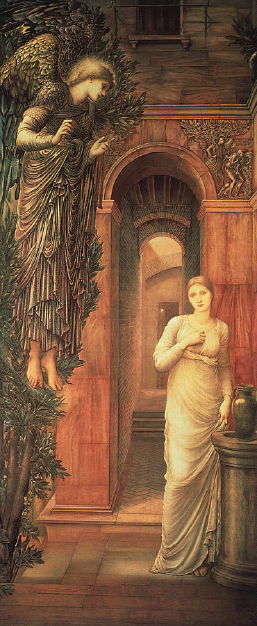
Earlier, at the Annunciation, when the angel Gabriel came to Mary, He said to her:

“Hail, [Rejoice,] full of grace! The Lord is with you.” But she was greatly troubled at what was said and pondered what sort of greeting this might be.

As Zephaniah foretells,

On that day, it shall be said to Jerusalem:
Fear not, O Zion, be not discouraged!
The LORD, your God, is in your midst,
a mighty savior;

And the angel says to her, “Do not be afraid, Mary, for you have found favor with God. Behold, you will conceive in your womb and bear a son, and you shall name him Jesus,” a name which means, “God saves.”

Zephaniah foretold of the Lord’s pleasure in Mary,

He will rejoice over you with gladness,
and renew you in his love,
He will sing joyfully because of you,
as one sings at festivals.

The Lord rejoices over Mary, and Mary in her Lord. Let us always remember, that the Lord rejoices over us as well. Despite our sins and failings, we are the Church, the new Israel, and whatever one can say of Mary usually applies quite fittingly to us as well. Mary is the icon of the Church, the sign of who we are, and who we are called to be with Christ.

Rabbi Gamaliel’s Wisdom — Friday, 2nd Week of Easter

April 16, 2010

The apostles were brought before the Sanhedrin, the Jewish High Council, to be questioned for why they continued to teach in “that name.” At hearing the apostles’ answers, the Jewish leaders “became infuriated and wanted to put them to death,” but a Pharisee in the Sanhedrin stood up and had the apostles put outside. This was Gamaliel, a great teacher of the law who was respected by all the people. (It was at this rabbi’s feet that St. Paul received his Pharisaical training.)

Gamaliel said, “Fellow children of Israel, be careful what you are about to do to these men.” Now his form of address here is interesting and revealing. He could have addressed his peers in the Sanhedrin in many different ways, but by calling them “fellow children of Israel” he recalls Jacob (whose name God changed to Israel) and his twelve sons.

Now of all those sons, Joseph was Jacob’s favorite. This made the others so jealous that they sold Joseph into slavery. But through suffering this dishonor Joseph would go on to become the instrument of their salvation. Even though they meant to destroy him, they failed. God intended this for good, to achieve the salvation of many.

Gamaliel concluded his speech to the Sanhedrin wisely observing, “If this endeavor or this activity is of human origin, it will destroy itself. But if it comes from God, you will not be able to destroy them…”

Evil endeavors or activities are destroyed in time. But what is of God endures, even if it is sometimes setback by evil and sins. In these beleaguering times, for our country, for our Church, and for our pope, this lesson from Rabbi Gamaliel gives us good reason for hope.

Faithful Despite Doubts — Divine Mercy Sunday—2nd Sunday in Easter—Year C

April 11, 2010

Thomas, called Didymus, one of the Twelve, was not with them when Jesus came. So the other disciples said to him, “We have seen the Lord.” But he said to them, “Unless I see the mark of the nails in his hands and put my finger into the nailmarks and put my hand into his side, I will not believe.”

Why is “Doubting” Thomas so slow to believe. Why is Thomas so reluctant to trust? A clue might be found in the gospel’s interesting inclusion of Thomas’ Greek nickname: Didymus. Didymus means “twin,” but in relation to whom was Thomas a twin? Some speculate that Thomas the Apostle bore a striking resemblance to Jesus Himself. This tradition is sometimes reflected in iconography where Thomas is the apostle who looks a lot like Jesus.

If this is why Thomas was the apostle called “the twin” then we can understand his rational skepticism. How many times during Jesus’ ministry had people come up to Thomas and said, “O Jesus, we’re so happy to see you! We’ve walked for miles to see you again!” Then, with some annoyance, Thomas might have answered, “We’ll you’ll have to walk a little bit further. Jesus is over there.” So now, when the other disciples come up to Thomas after Easter and say, “We have seen the Lord,” Thomas replies, ‘I’ll need more evidence than that.’

Thomas’ resistance to believing the good news about Jesus might not only be coming from his mind, but also from his heart. Jesus was Thomas’ hero, his teacher, and his close, beloved friend. Thomas thought that Jesus was going to be the savior and messianic king of Israel. But their close relationship and all of Thomas’ great hopes were destroyed for him at the crucifixion. Imagine how Thomas might have prayed then: “My God, why have you let this happen? How could you let Him be taken instead of me? Jesus was so good! He was completely innocent, and you let Him be die! Why?”

The unexpected death of Jesus broke Thomas’ heart, and having been so hurt once, Thomas was resolved not to let his heart be taken in again: “Unless I see the mark of the nails in his hands and put my finger into the nailmarks and put my hand into his side, I will not believe.”

Yet, though he doubts, notice where Thomas is one week after Easter. He is with the other apostles in the upper room in Jerusalem, gathered behind locked doors for fear of the authorities who killed Jesus. Now there are lots of other places Thomas could have chosen to be. There were safer places he could have gone, like back to his hometown and to the extended family and friends he had left behind to follow Jesus a few years before. Though Thomas doubts, he does not leave this house of faith. He struggles with his faith, but does not abandon it. He seeks within this house of faith, this Church, and because of it, Thomas finds sufficient evidence for his mind and healing for his heart.

The risen Lord appears in the upper room and how does Jesus respond to Thomas’ resistant unbelief? Not with anger.  Not with condemnation.  But with the divine mercy we celebrate today. Jesus appears in their midst and says, “Peace be with you.” Then he says to Thomas, “Put your finger here and see my hands, and bring your hand and put it into my side, and do not be unbelieving, but believe.”

In our lives we too will struggle with our faith and our doubts, with our emotions and with our thoughts, in our hearts and in our minds. Jesus does not condemn our honest struggles. But Jesus wants us to sincerely seek within this house of faith; this, His apostles’ Church, where the truth and healing is found by all those who seek Him.

One Catholic Church — Tuesday, 3rd Week of Lent

March 9, 2010

In the first reading we hear the ardent prayer of an Old Testament Jew named Azariah who finds himself in a pretty hot spot. He fervently prays, “… O Lord, do not deliver us up forever, or make void your covenant. [Save us for] the sake of Abraham, your beloved… to whom you promised to multiply … offspring like the stars of heaven, or the sand on the shore of the sea.”

This was God’s covenant promise to Abraham, and God has indeed made Abraham’s spiritual offspring vast and numerous. Today, half of the people on earth claim Abraham as their father in faith—these are Christians, Muslims and Jews who all seek to worship the God of Abraham.

Yet Jesus prayed that all people would be one in Him, as one holy family of God—a diversity of persons sharing one perfect unity. To achieve this goal Jesus established one, holy, catholic, and apostolic Church, so that all may be one, as He and the Father are one. Our Church was established by Jesus, Himself, who said to Peter, our first pope, “You are rock, and upon this rock I will build My Church.”

Our Catholic family is made up of every race and reaches to every nation. To illustrate this, I would ask all high school students; freshmen, sophomores, juniors, and seniors, to stand up now. Imagine that these 146, or so, young men and women represent the world’s nearly 1.2 billion Catholics. Each one represents about eight million of our  Catholic brothers and sisters.

In the United States we have 68 million Catholics, but this is only 5.7% of all the Catholics in the world. I would now ask the male freshmen to remain standing and for everyone else to sit down. These guys represent the Catholics of the United States, plus the rest of North America and the Caribbean—just 9% of Catholics worldwide.

The freshmen can sit down and I would ask the male sophmores to stand up. This is Asia, Australia, and the Pacific Islands, totaling 11% of all Catholics.

You can sit and I’ll ask the senior males to stand. This is Africa’s Catholics, 12% of the Catholics in the world.

You can sit and we’ll have the male juniors and the female seniors rise. This is Europe, 27% of all Catholics.  (The pope is in there somewhere.)

You can sit and we’ll have our largest region of all, represented by the female juniors and the full sophomore class, please stand. This is Central and South America, where 39% of all Catholics live.

So, as you can see our Catholic family is far more diverse than you might have imagined. We are young and old, men and women, rich and poor, sinners and saints.

Our Catholic family not only spans the globe, it also spans the centuries. This is reflected in the ancient prayers we sing today, such as the Latin Sanctus and Agnus Dei, the Kyrie which is ancient Greek, and the Amen which is Hebrew.

Let me put this another way: Could I have one high school student please stand up. This one person represents about 13½ years, which is about how long you have had to explore and get to know about your faith. Now could all of the high schoolers please stand up. You represents all the years that the Church has been on earth, since 33 AD. Our Church has been around a lot longer than we have. You may be seated.

Roman Catholics make up the largest religious denomination in the United States.  However, it is said that the second largest denomination in our country would be former Catholics. Tragically, many Catholics leave the Church. Oftentimes, they experience one or two parishes and a couple of priests, in one region, of one country, over a handful of years, and they imagine that they have exhausted the riches of the 2,000 year-old worldwide Church and Faith of Jesus Christ. But in reality, you can explore the mysteries of Catholic beauty and truth for a lifetime and never exhaust them.

My message for you, with all passionate the urging of Jesus Christ, is this: always remain in the Church that Jesus Christ founded. Never walk away from the fullness of God’s family, but dwell in the household of God.

Sources:
Distribution of Catholic Population, by Region: 2000
USCCB: The Catholic Church in the United States At A Glance

The Our Father — Tuesday, 1st Week of Lent

February 23, 2010

When the apostles asked Jesus how they should pray, Jesus taught them what is called the perfect prayer, the “Our Father.” It is a concise prayer, with just seven petitions (a perfect number for the Scriptures,) yet there is great depth beneath its simplicity.  This morning I show you three insights into this prayer which I hope will come to your mind from time to time as you pray this prayer for the rest of your lives.
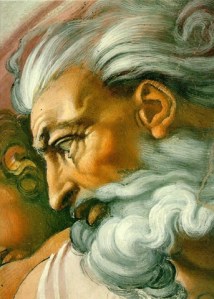
First, Jesus teaches us that we are to pray to “Our Father.”  This is a far more wonderful thing than we realize.  To see its greatness, just imagine if the prayer were different. We do not pray, “Our tyrant, who art our ruler, before thee we grovel.” Nor, “Our master, we art thy slaves, for thee we must toil.” And we do not say, “Unknowable one, whom none can name, unapproachable be thy being.” We pray, “Our Father who art in heaven,” hallowed be His name.  We have the privilege to call God our Father on account of our faith in His Son, Jesus Christ. Jesus is God’s Son by His nature, (God from God, light from light,) but we are made God’s children by adoption through Christ. One way to see why this is such a big deal is to imagine if God were everyone’s heavenly Father, except for you. Whatever applies to a good father’s relationship with his natural children, also goes (with limited exceptions) for the perfect Father’s relationship towards us, His spiritual children. Keep in mind how privileged we are when you pray to “Our Father.”

The second insight this prayer yields is the proper attitude we should have towards prayer. Perhaps you’ve heard some people say, “Well, if you like to pray that’s fine—I mean, if that helps you to motivate yourself that’s great,” as if the only power of prayer was to change one’s personal attitude. This is something said by people who don’t pray, and if we thought as they did then we wouldn’t pray either, for who would bother to ask someone else to receive what is already in one’s own hands (i.e., the choice of one’s own attitude.) A second motivation among people who do not pray is more faithful, but also misguided. These say, “I can’t change God’s mind, so why should I bother to pray? Whatever He wills will be, whether I pray to Him or not.”

The first three petitions of the “Our Father” are worded carefully. They do not say, “Our Father, who art in heaven, make your name holy among us, make your kingdom come upon us, and make your will be done among us.” This would put everything on God. Nor do the opening lines read, “Our Father, who art in heaven, we will glorify your name, we will make your kingdom come, and we will make your will be done, on earth as it is in heaven.” This would put everything in our own hands.

The prayer which Jesus gives us does not put everything on God, or put everything on us. Jesus presents the middle and true way of faith. We are not called to an independent activism, nor to a vacant passivity, but to an active receptivity in relationship with God. Like the Virgin Mary, we are to stand before our Father, with a spirit of active receptivity, and pray, “Behold, I am yours, may your will be done, in and through me, and on earth as it is in heaven.”

There are some things which are simply beyond my human ability.  For instance, I can no more forgive my own sins than I can pull up on my belt loops and hold myself up in midair. However, that does not mean I can do nothing to help my situation. I can first forgive others as I wish to be forgiven. I can pray, go to confession, and tell God that I’m sorry. God calls us to do our part and to cooperate in His work.

Maybe this explains why Jesus could not work great miracles where people were lacking faith. It was not that such things were beyond God’s omnipotent power, it is that God insists upon doing His works in relationship with us, rather than entirely apart from us. (This is His purpose in establishing the Church—to do His saving work with and through us.) Like St. Augustine said, ‘The God who created us without us, will not save us without us.’

The third and final insight into the Lord’s Prayer regards the meaning of the petition for “our daily bread.” We say, “Give us this day our daily bread.” We can pray for this “bread” in three senses; literal, spiritual, and Eucharistic.

First, there is the literal sense, praying that God would provide for our material needs in life; such as housing, clothing, and food. We take these things for granted—your daily bread already waits for you in the cafeteria or in your kitchen at home—but there are many people around the world, who are much less well-off than we are, who pray these words from their hearts every day. Occasionally we should call these brothers and sisters of ours to mind and pray these words as intercession on their behalf before our Father.

Second, there is the spiritual sense, asking for the graces and helps that money can’t buy; such as peace and virtue, faith, hope, and love. Without these things, even a rich man remains impoverished, for man is not meant to live on material bread alone.

Third and finally, there is the Eucharistic sense, which asks for the bread from this altar which is God’s Son. Whenever we receive Jesus in the Eucharist He remains with us and in us until we receive Him again (unless we should disinvite and evict Him by committing grave sin.) In this way, Jesus persists as our “Daily Bread.”

So when you pray the “Our Father” realize your privilege in being His child through Jesus Christ. Consider that the coming of the Kingdom is a joint effort of God with man, in which our prayers play an important part. And pray for all your daily bread; literal, spiritual, and Eucharistic. May you remember these insights for all of your life and may the words of Christ’s perfect prayer make you a fruitful child of our Father.

Our World’s Salvation — February 2 — Presentation of the Lord

February 2, 2010

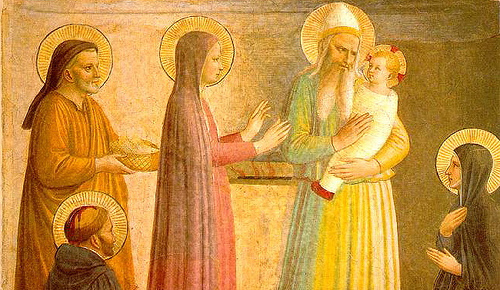
Simeon’s eyes looked upon a baby and foresaw our salvation in Him. When we look back today, at the centuries past, we can see that Jesus Christ has indeed been a light for all the nations.

Even if one were to look at Jesus of Nazareth without the eyes of faith, any fair assessment of history must name Him and the Church that He founded as the greatest cause for good in human history. Jesus Christ came and was the light for a darkened world.

For example, in the ancient world, women’s status ranked near that of slaves, but Jesus showed a reverence towards all women, even intimately involving them in His ministry. Christianity noted His example and began to acknowledge women’s dignity and equality as persons.

While the ancient world wielded total dominance over slaves, Christianity professed slaves’ equality as persons before Christ. (In fact, several early popes were former slaves themselves.) Christianity told masters that they would be held accountable at the Judgment for the good or bad treatment of their slaves, for Jesus had said, “Whatever you do to the least of my brothers you do to me.” The abolishment of slavery came gradually, but it finally came as the result of Christians’ efforts in light of Christ.

Infanticide was common in the ancient world. Sometimes the unwanted little one was physically disabled, or female, or merely inconvenient. But Jesus treasured all children, and He said, “Whoever receives one child such as this in my name receives me.” So Christianity renounced infanticide and would later establish orphanages and promote child adoption.

Jesus showed concern for sick persons and healed them. Jesus also feed hungry crowds. So Christianity has established hospitals and soup kitchens. Today, as throughout the centuries, the Catholic Church is the largest charitable organization on earth.

An eye for an eye was the ancient law, and hating one’s enemies comes naturally, but Jesus did not seek revenge.  Jesus said, “Love your enemies,” and He prayed for His enemies from the cross. Many Christians have followed His example, promoting peace and reconciliation.

Jesus taught his wisdom to great crowds of men and women, the poor and rich, the young and old, so Christianity established schools and universities. Today the Catholic Church educates more children than any other scholarly or religious institution and you are a part of this number.

Our Marshfield area Catholic schools exist today because of Jesus Christ, the greatest person who has ever lived. The public schools have Jesus to thank for their schools, too, but they are not allowed to speak His name. But we can speak His name, and we can thank Him like Simeon here today, for coming into our darkened world and shining His saving light.

(Recommended viewing:  “Epic” produced by Catholics Come Home )

Traveling to God — Epiphany of the Lord

January 3, 2010

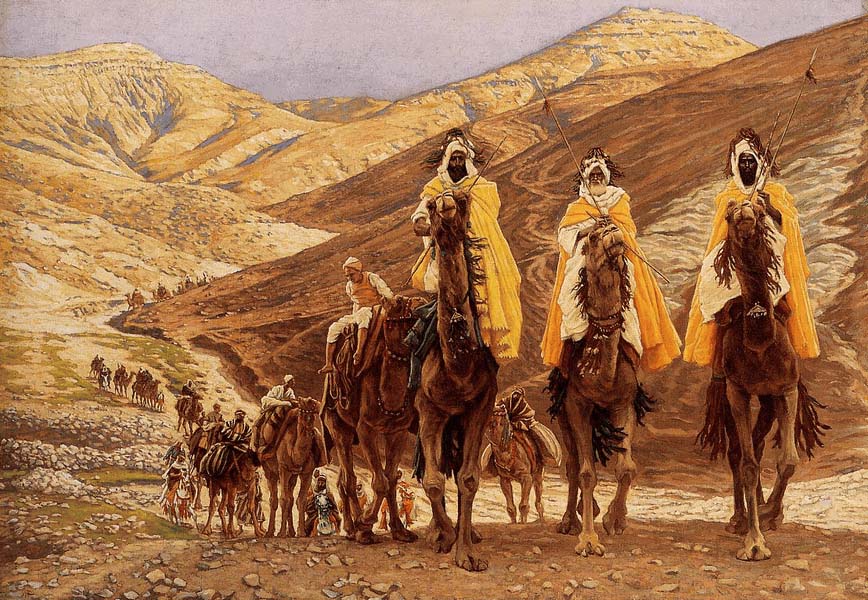
Today the nations come to Christ, to bring Him their gifts and to worship Him. We see it in the gospel, where great, wise ones called Magi travel afar to Bethlehem of Judea. And we see it in our world today, wherever those honored to be called Christians gather in Christ’s Church throughout the world. Every Sunday is a little Epiphany where, like the Magi, all the nations come to worship the One whom all the world ought not to be able to contain.

Our responsorial psalm prayed, “Lord, every nation on earth will adore you.” In another psalm, Psalm 87, the Lord foretells that every nation on earth would adore Him. The Lord says,

“Babylon and Egypt I will count among those who know me; Philistia, Tyre, Ethiopia, these will be her children and Zion shall be called ‘Mother’ for all shall be her children.”

Today there are Christians in all of these places: in Egypt and Iraq, in the Holy Land and Africa.  In fact Christians span entire continents about which the ancients never knew. There are Christians all nations who have entered the Lord’s house and found Jesus with Mary, who is the symbol of Mother Church. She is rightly called mother, for all nations are her children.

In many lands Christians suffer harsh persecution, as in China, where a red dragon like that of Revelation still seeks to destroy the Christ Child and the God-bearing mother. How fortunate we are to be able to safely gather here, to be free to practice our faith without fear, to come to Christ’s house easily and often, not in hiding or in secret, and without having to travel for months across desert expanses like the Magi.

Yet, in our ease, we can take our religion for granted. In our routine, we can be blind to how we are blessed. And in our closeness to Christ, we can overlook Him. So, from time to time, it is important for our faith to be renewed. One way we can do this is to imitate what the Magi did. At least once every year we should make a pilgrimage to Christ and stay to retreat some days with Him.

After spending precious time with Jesus in the heart of their pilgrimage the gospel says the Magi “departed for their country by another way.” Their physical journey changed (for they had been warned in a dream not to return to Herod,) but their spiritual way changed as well. The Magi were believers even before they came, but after adoring Jesus and giving their gifts, they went away spiritually richer. We too would be spiritually richer if we were to give Christ some gift of our time and treasure to pilgrimage and retreat with Him.

As busy as priests are, the Church requires all of them to go on several days of retreat each year, for she knows how important this is for spiritual renewal and intimacy with Christ. Imagine what difference a pilgrimage to a shrine and a quiet, prayerful weekend on retreat center would have for you.

You must love and care for your children, so show them by your own example the importance of seeking after Christ. Give your spouse the opportunity to spend two days alone with the Lord, or take the whole family along for a trip to a holy shrine. For instance, there is a new, magnificent shire to Our Lady of Guadalupe which everyone should make it a priority to see. If you are looking for destinations or ideas, I’m more than happy to help.

In this year of our Lord, 2010, 51 weekends remain. Let us act now to prepare even just one of those many weekends for a gift-bearing journey. Pilgrimages and retreats are a gift to Christ and a gift to ourselves. Let us follow the Magi and come, let us adore Him this year, with days of pilgrimage and retreat.