God does not do bad things, for “God is not subject to temptation to evil” and “what he hates he does not do.” However, God is all-knowing and all-powerful. There is nothing knowable that God does not know, and nothing good and doable that he cannot do. Therefore, when a bad thing happens, God has allowed that to happen. Yet we also “know that God causes all things to work together for the good of those who love him.” We see these truths reflected in today’s Gospel reading.
God clearly permitted Lazarus to fall ill. And when Jesus received the urgent message from Martha and Mary that their brother was sick, he remained in the place where he was and allowed Lazarus to die. “Now Jesus loved Martha and her sister and Lazarus.” So why did Jesus not come earlier, when he was told “the one you love is ill.” Or why did Jesus not heal his friend Lazarus’ sickness from a distance, like he cured the centurion’s servant or the royal official’s son? Jesus says the dying and rising of Lazarus was “for the glory of God, that the Son of God may be glorified through it,” and “that you may believe.”
Earlier in his public ministry, Jesus had raised Jairus’ daughter from the dead, having told mourners that the little girl was “asleep.” But that resurrection miracle was performed privately, shortly after death, and with strict orders to its witnesses that no one should know of it. By publicly raising Lazarus from the tomb in the presence of a crowd, Jesus manifests his power not only to heal the sick but to restore the dead to life.
Picture this: One moment, Lazarus was ailing and fading out of consciousness on his deathbed. The next thing he knows, he wakes up wrapped in bandages inside of a cave, and comes out toward the light at the sound of his friend Jesus’ call. His sisters would have filled him in on what he missed when he was dead.
The Gospels tell us Lazarus later attended a dinner with Jesus the day before Palm Sunday at the house of Simon the Leper. Martha served the meal while Mary took costly perfumed oil and poured it on Jesus’ head as he reclining at table. “A large crowd of the Jews found out that he was there and came, not only because of Jesus, but also to see Lazarus… And the chief priests plotted to kill Lazarus too, because many of the Jews were turning away and believing in Jesus because of him.” After Holy Week, the New Testament tells us no more of what happened to Lazarus. But we can imagine what it was like, years after Easter Sunday, when Lazarus died again.
Knowing that Jesus died and was risen, and having personally experienced death and resurrection himself, must have given Lazarus great peace even during his final passion. Consider Martha or Mary watching their brother die once more; having to burying him again. There would naturally still be sadness and ache in that parting, but I imagine the sisters would feel different this time: ‘We know he will rise in the Resurrection on the Last Day. Jesus Christ is the resurrection and the life who has come into the world, and whoever believes in him, even if they die, will live.’ Our brother Jesus died and has risen from the dead “for the glory of God” and “that you may believe.” Knowing and embracing this reality changes our life and how we face death. Do you believe this?
Last week, April 2nd, marked the twentieth anniversary of the passing of Pope St. John Paul the Great. And if you are like me, having witnessed how he lived and died, is inspiring. Pope John Paul’s famous motto was “Be not afraid!” In this, of course, he was quoting Christ who frequently said, “Be not afraid!” “Be not afraid,” Jesus tells us, “If you believe you will see the glory of God.”
Once upon a time, many years ago, a man who knew nothing about food production resettled to the countryside. He saw a farmer tilling a field and thought, “What a waste of effort! He’s just turning over dirt!” Then he saw the farmer planting seeds and wondered, “What’s he burying? Pebbles?” When the plants began to sprout and grow, he thought, “Ah, I see now! He’s growing a garden.” But the man was shocked at harvest time, “He’s cutting down everything he grew!” And when the farmer and his wife began hand-threshing, the man was baffled, “Why are they beating the plants?” The farmer’s wife ground flour and made loaves, placing them inside an oven, and the man was dumbfounded, “Now they’re burning it in a fire!” The farmer, of course, was growing grain and his wife was baking bread, but the onlooker did not understand all this until he was invited over to their house for supper.
Once upon a time in another tale, a little girl sat on the carpet of her living room while her mother sat in a nearby chair weaving embroidery stitches. The girl looked up and saw the chaotic, mishmashed underside of the embroidery and asked her good, and wise, and loving mother why she would create something so ugly. Her mother turned over the cloth, revealing what she was weaving and the little girl saw a beautiful, half-completed work of art.
Our God is all-good, and wise, and loving, and he is currently fashioning a beautiful, meaningful, lasting masterpiece for us on a scale the size of the universe. But until its completion we will see and experience ugly, painful things we will not understand, like the sufferings of Christ on Good Friday. His thoughts are not our thoughts, nor are his ways our ways, for we “are thinking not as God does but as human beings do.” Following Jesus will mean picking up the difficult crosses which come to us, denying ourselves, and acknowledging Christ before others.
Did Jesus care about what other people thought of him? Yes and no. Jesus asks, “Who do people say that I am?” and “Who do you say that I am?” That question is important, for Jesus declares, “I am the way and the truth and the life,” and “No one comes to the Father except through me.” Jesus gives his Church our Great Commission because all people are called to receive his baptism and to embrace all that he has taught for human thriving and salvation. But in another sense, he did not care what people thought of him.
Jesus did not allow what other people thought prevent him from doing what he should. Not even his friend Peter could change Jesus’ mind to do something against God’s will. Jesus knew that he would “suffer greatly and be rejected by the elders, the chief priests, and the scribes and be killed” but he went up to Jerusalem anyway and testified that he is the Christ. Christians today are called to courage too.
This week, I created an online survey to which 135 self-identified Christians responded. The poll’s question was: “Do you suffer for Christ?” 67% answered, “Yes, a little.” 12% replied, “Yes, significantly.” And 21% said, “No.” Do you suffer because you are a Christian? I asked a pastor-friend of mine how a Christian might discern if we’re suffering for Christ “significantly” or just “a little.” He thought that if we’re not sure, then it’s probably just “a little” — suffering greatly for Christ would be unmistakable.
So most Christians seem to suffer only a little for Christ, if at all, and yet we’re so afraid. You pray before meals, and that is good. Do you also pray before your meals in public? Do your coworkers or neighbors know you are a Catholic Christian? Have you invited anyone to our worship, to share this precious treasure? (Our classes for becoming Catholic begin two weeks from today.) As St. James says, ‘A faith without works is dead.’ We are called to be courageous, like the Prophet Isaiah, ‘to set our faces like flint, knowing that we shall not be put to shame, for the Lord God is our help.’
I doubt the sufferings which flow from your Christian witness will be as severe as you might fear, but if sufferings do come your way know that you are not abandoned. When you suffer for Jesus and his Gospel, know that you are living out your faith with him. If you are faithfully carrying your Christian crosses, then you are following Christ.
The Book of Wisdom declares, “God did not make death… For God formed man to be imperishable; the image of his own nature he made him. But by the envy of the devil, death entered the world…” With an overflowing love, God created us for immortality with him. Satan, jealous of our glorious calling, misled us to misuse our freedom and suffer sin and death. Human death is unnatural. If it were natural for us it would feel normal to us; like eating, or sleeping, or bonding in pairs. Instead, we perceive death as unsettling, uncanny and dreadful. But, thanks be to God, Jesus Christ came to our aid with his divinity to achieve a remedy for us through mortality itself, so our downfall could become the means of our salvation. Jesus tells us to “be not afraid,” to pick up our cross and follow him, through our Passion to his Resurrection.
Linda faced her final trial when more than one doctor told her she had only six weeks to live. Her form of brain cancer was identified as the fasted growing kind. That was a year ago. She had fifteen radiation treatments in Eau Claire and one course of chemotherapy, yet every hospital visit brought more bad news. Each of us have our own personal strengths and weaknesses. Linda was married to Eugene for 50 years and he says she “never got angry, but worried about everything.” In years gone by she used to tell him, “When we retire, we’re not going to have money to buy bird food!” Yet Linda’s prognosis never bothered her. She wished to never go into to a nursing home, and providential opportunities and finances allowed her to have great care at home. God, who even feeds the sparrows, ensured she was provided for. She never lost weight and ate well until her final month. And amazingly, she never suffered. When people would ask, “Do you have any pain?” her response was always, “No.” Many people die suddenly, with no chance to say goodbye. Linda’s prolonged illness allowed her many friends and relatives to visit her and express their love, and for her to see and smile at them. She passed away on an early Sunday morning. Linda knew and trusted in Christ’s promises. She read the entire Bible twice and faithfully communed with Jesus in the Eucharist.
Death remains a sad and ugly thing, but Linda was blessed with a beautiful death. We pray for her soul, but the details of her passing point to the joyful fulfillment of her hopes and ours. She lived far longer than experts predicted and has embarked into life unending. She endured her illness without pain and in heaven there is no pain now. She faced her death without anxiety and in heaven there is perfect peace. She was lovingly cared for at her home and is going to the home of divine love. As her dear ones on earth said goodbye, the saints in heaven waited to greet her. And Linda’s Sunday morning passing is now joined to Our Lord’s Easter rising. So let us be “courageous,” as St. Paul writes, and let us all “aspire to please him, whether we are at home or away.”
After our first parents ate the forbidden fruit, when they heard the sound of God walking about in the Garden of Eden, they hid themselves among the trees. The Lord God called to Adam and asked him, “Where are you?” He answered, “I heard you in the garden; but I was afraid, because I was naked, so I hid myself.” Did Blessed Mary the New Eve or St. Joseph her husband ever feel afraid? Indeed, Scripture records several such occasions.
In today’s gospel, at the Annunciation the Archangel Gabriel comes to Mary saying, “Hail, full of grace! The Lord is with you!” “But she was greatly troubled at what was said…” Then the angel said to her, “Do not be afraid, Mary, for you have found favor with God.’”
Later, when Joseph learned of Mary’s unprecedented pregnancy, he either suspected her and feared she was unworthy of him, or he believed her and feared he himself was unworthy of her and this holy child. “Since (Joseph) was a righteous man and not wanting to expose her to shame, (he) decided to divorce her quietly.” Such was his intention when an angel appeared to him in a dream and said, “Joseph, son of David, do not be afraid to take Mary your wife into your home.”
After the birth of Christ and the visit of the magi, Joseph was told by God’s angel in dream to flee with Mary and Jesus into Egypt. Once the murderous King Herod had died, the angel told Joseph in another dream to return to the land of Israel. “But when he heard that Archelaus was ruling over Judea in place of his father Herod, he was afraid to go back there. And because he had been warned in a dream, he departed for the region of Galilee” and resettled his Holy Family in the town of Nazareth.
In another episode from the Gospels, when Jesus was 12 years old Mary and Joseph lost track of him during their family pilgrimage to Jerusalem for Passover. They found him on the third day engaging with the religious teachers at the temple. When his parents saw him, they were astonished, and his mother said to him, “Son, why have you done this to us? Your father and I have been looking for you with great anxiety.”
That’s four incidents of fearfulness in Mary, Joseph, or both, which are clearly referenced in the Gospels. What are we to make of this?
Jesus Christ had holy parents on earth. At this Mass we celebrate how Mary was sinless from the moment of her Immaculate Conception and full of grace throughout her life. Joseph her husband was a righteous and virtuous man. However, both Mary and Joseph sometimes experienced fear. This shows us that feeling fear is not the same as sin or lacking in faith.
Realize and remember that faith is not primarily a feeling. Though it is nice when our feelings line up with our beliefs, sometimes they won’t match. You can believe one thing while feeling something else and still choose to act faithfully. For example, you can believe that commercial air travel is safe. Perhaps you have seen the data showing that flying compared to other modes of ground-based travel is, mile-for-mile, safer by far. When the moment comes for you to board your important flight, you might feel natural anxiety. But if you get on that airplane anyway, your faith in flight is on display. You trust in the pilots, in the aircraft, and in what you know, and this trusting faith enables you to reach your good destination.
Mary had such trusting, loving faith in Joseph. One night, her husband woke from sleep and told her he had received another message from God’s angel in a dream; they were in danger from King Herod and must quickly escape to Egypt. Mary had not beheld Joseph’s dream, but whatever she was feeling she trusted him and took the flight with him into Egypt, and her acceptance of this hard thing enabled their salvation.
Mary also had trusting, loving faith in God. St. Elizabeth praises her faith at the Visitation. Filled with the Holy Spirit, Elizabeth cries out, “Most blessed are you among women… Blessed are you who believed that what was spoken to you by the Lord would be fulfilled!” Years later, during Jesus’ public ministry, a woman in a crowd called out to him, “Blessed is the womb that carried you and the breasts at which you nursed!” Jesus replied, “Rather, blessed are those who hear the word of God and observe it.” The Blessed Virgin Mary can be called “most blessed among women” because of her enduring faithfulness — she hears God’s word and keeps it.
It is essential that we not only hear God’s word but also faithfully obey it. Jesus declares, “Not everyone who says to me, ‘Lord, Lord,’ will enter the Kingdom of Heaven, but only the one who does the will of my Father in Heaven.”
Mary and Joseph loved and trusted God and each other, and God loved and trusted them to raise our Lord. Their faithfulness on earth is now rewarded with heavenly glory. God has entrusted them with shares in the spiritual care of his people on earth today. St. Joseph is the patron and protector of the entire Church, and St. Mary is the spiritual mother of every Christian. Ask Mary and Joseph to pray for you and ask Jesus to give you his grace to be always faithful despite whatever you might feel. For faith in Christ is not so much about feelings but about loving and trusting Jesus enough to be faithful to him.
During the Exodus, before descending in fire and smoke upon a trembling Mount Sinai, God gave instructions to prepare the Hebrews for this encounter. The Lord said to Moses:
“Go to the people and have them sanctify themselves today and tomorrow. Have them wash their garments and be ready for the third day; for on the third day the Lord will come down on Mount Sinai in the sight of all the people. Set limits for the people all around, saying: ‘Take care not to go up the mountain, or even to touch its edge. All who touch the mountain must be put to death. No hand shall touch them, but they must be stoned to death or killed with arrows. Whether human being or beast, they must not be allowed to live.’ Only when the ram’s horn sounds may they go up on the mountain.”
Then Moses came down from the mountain to the people and had them sanctify themselves, and they washed their garments. He said to the people, “Be ready for the third day.”
On the third day, as all the people witnessed the thunder and lightning, the blast of the ram’s horn and the mountain smoking, they became afraid and trembled. So they took up a position farther away and said to Moses, “You speak to us, and we will listen; but do not let God speak to us, or we shall die!” Moses answered the people, “Do not be afraid, for God has come only to test you and put the fear of him upon you so you do not sin.” So the people remained at a distance, while Moses approached the dark cloud where God was.
A pair of themes throughout the Old Testament are the holy otherness of God and the deadly sinfulness of man. Our Fall made it dangerous to approach God carelessly. And even Moses was mysteriously told, “You cannot see my face, for no one can see me and live.” Compare and contrast that with this Sunday’s Gospel.
On the third day, despite the doors being locked where the disciple were, the Risen Jesus came and stood in their midst and said to them, “Peace be with you.” When he had said this, he showed them his hands and his side. And he said again, “Peace be with you.” A week later when Thomas was there, Jesus appeared again and said, “Peace be with you.” He then invited Thomas, “Put your finger here and see my hands, and bring your hand and put it into my side, and do not be unbelieving, but believe.”
In former times, seeing the Lord or merely touching the mountain or ark of his holy presence could mean death. But disciples in the New Testament are invited to see his face and touch his wounds. In the New Covenant, we are called to receive Jesus Christ alive in the Eucharist. Today we celebrate Divine Mercy, mercy reflected in how — even after our sins led him to his Cross — Jesus returns and repeatedly wishes us “Peace.” In forgetting our past, we fail to appreciate what the Lord has done for us. And too few rejoice in his Divine Mercy because so many do not realize their need for it.
On Easter Sunday evening, Jesus breathed on his apostles saying, “Receive the Holy Spirit. Whose sins you forgive are forgiven them, and whose sins you retain are retained.” Why would Jesus give them this power to forgive sins if he did not intend them to use it? Why would he give his Church such a Sacrament if we did not need it? Jesus wishes you a peace beyond your fear. He desires to forgive your sins and personally give himself to you in the Eucharist. Will you trust him enough to regularly encounter his healing Divine Mercy in the confessional so that you may receive him all the more reverently, fittingly, lovingly and joyfully at his altar?
This Sunday’s celebration comes in a moment of two overlapping times. This is a Sunday in November, the month in which we particularly remember, celebrate, and pray for the dead. This Sunday is also the beginning of Advent, a season in which we prepare for the coming of Christ. Through Advent we prepare not only for Christmas, the first coming of Christ, but also for Jesus’ Second Coming one day. Here and now at this Sunday Mass, our past and our future, the living and the dead, this world and the next, meet together.
When we hear Jesus’ words in today’s gospel about the Last Days we may feel apprehensive. Jesus tells us “people will die of fright in anticipation of what is coming upon the world.” And even if you or I do not belong to that final generation, we may fear to contemplate the coming sure reality of our own earthly deaths. But across time and space, an ancient saint and martyr urges us: “Let us shut out the fear of death and meditate upon immortality.”
This is what St. Cyprian preached in the mid-third century A.D. as the bishop of Carthage, a North African city on the Mediterranean coast. God wills us to be good stewards of his gift of life, not recklessly pursuing self-harm or death, and yet not dreading the approach of death with mortal terror either. Listen to these words of St. Cyprian of Carthage as if he stood here before you preaching to you today:
“Our obligation is to do God’s will, and not our own. We must remember this if the prayer that our Lord commanded us to say daily (that is, the “Our Father”) is to have any meaning on our lips. How unreasonable it is to pray that God’s will be done, and then not promptly obey it when he calls us from this world! Instead we struggle and resist like self-willed (servants) and are brought into the Lord’s presence with sorrow and lamentation, not freely consenting to our departure, but constrained by necessity. And yet we expect to be rewarded with heavenly honors by him to whom we come against our will! Why then do we pray for the Kingdom of Heaven to come if this earthly bondage pleases us? What is the point of praying so often for its early arrival if we would rather serve the devil here than reign with Christ?
The world hates Christians, so why give your love to it instead of following Christ, who loves you and has redeemed you? John is most urgent in his (first New Testament letter) when he tells us not to love the world by yielding to sensual desires. Never give your love to the world, he warns, or to anything in it. A man cannot love the Father and love the world at the same time. All that the world offers is the lust of the flesh, the lust of the eyes and earthly ambition. The world and its allurements will pass away, but the man who has done the will of God shall live forever. Our part, my dear brethren, is to be single-minded, firm in faith, and steadfast in courage, ready for God’s will, whatever it may be. Banish the fear of death and think of the eternal life that follows it. That will show people that we really live our faith.
We ought never to forget, beloved, that we have renounced the world. We are living here now as aliens and only for a time. When the day of our homecoming puts an end to our exile, frees us from the bonds of the world, and restores us to paradise and to a kingdom, we should welcome it. What man, stationed in a foreign land, would not want to return to his own country as soon as possible? Well, we look upon paradise as our country, and a great crowd of our loved ones awaits us there, a countless throng of parents, (brothers and sisters), and children longs for us to join them. Assured though they are of their own salvation, they are still concerned about ours. What joy both for them and for us to see one another and embrace! O the delight of that heavenly kingdom where there is no fear of death! O the supreme and endless bliss of everlasting life!
There is the glorious band of apostles, there the exultant assembly of prophets, there the innumerable host of martyrs, crowned for their glorious victory in combat and in death. There in triumph are the virgins who subdued their passions by the strength of (chastity). There the merciful are rewarded, those who fulfilled the demands of justice by providing for the poor. In obedience to the Lord’s command, they turned their earthly inheritance into heavenly treasure.”
And so brothers and sisters, these are St. Cyprian’s lessons for us today. Love and obey Christ over and against this sinful world. Do not fear Jesus’ Second Coming. The Bible concludes with the prayer, “Come, Lord Jesus,” because his return is Good News for his friends. And do not dread your last days, but look forward to going to paradise. Jesus Christ and his holy saints, who love us, cheer us, and intercede for us, await the day we’ll join them in the fullness of joy.
On my last homily I talked about the fact that faith can produce miracles. Today’s scripture readings helps us to understand how we acquire that gift of faith and participate in God’s divine partnership plan.
When I was studying for my Masters Degree in Pastoral Studies one of the revelations that God shared with me and that stood out in my mind was the fact that although God has no need to ask for help from anyone, that contrary to that he desires humans to participate in advancing and growing the body of Christ through human involvement in preaching and practicing the gospel message of love and service to others. The gift he bestows on those he asks for help from, and who accept his requests, is peace and happiness not only in this life but also the gift of the key to everlasting life in heaven.
For humans this presents us with obstacles in accepting those requests God asks from us, the greatest of which is our fear of inadequacy. Let me give you an example of this. When I began ministry studies one of my greatest fears was facing death or witnessing death. When I first got out of law school one of the first things I did was draft a will for myself and I placed a directive in it that I wished no funeral and requested that I be buried within twenty-four hours of my death. My thoughts were that this would make it easier for my family and friends to move on with their lives.
This fear stayed with me until I became a deacon and one day when our priest was on vacation, I received a call late one evening from our hospital. A car accident had happened and the family of the victim was trying to find a priest to administer the Sacrament of Healing for this young man. I advised the nurse that Father was gone out of town. She asked if I could come and be with the family. Fear hit me, and I told the nurse that I could not administer the Sacrament as deacons cannot do this. She then asked if I would come and maybe say some prayers with the family. My thoughts were that I was not adequate for the job and I did not feel I could do anything that would be beneficial for the family or their loved one. Then I remembered that part of my training for deacon ministry was to walk with someone and minister to someone who was dying. Fr. Frank, my director had assigned me to a elderly gentleman in Eau Claire who was terminally ill. I would meet with him on a weekly basis, at his home, and I would take Communion to him and his wife while spending time with him. I remember how after he died his wife called me and asked if I would do the Wake Service for him as he so much appreciated the times we got together while he was dying. I remembered how good this made me feel to know that they appreciated my company even though I felt inadequate for the mission Fr. Frank had assigned to me.
I decided to go and pray with that family at the hospital, and after doing so the family said they so much appreciated that I was willing to come and be with them during their suffering I finally realized that all that one needs to do is to show up and be there for those suffering and fearing death as the representative body of Christ. Jesus and the Holy Spirit do the rest. God knows that this is difficult for us but he always rewards those who say “Yes” to his call for help.
Our Gospel this weekend has Jesus telling his friends that its time for them to stand up and accept the job of helping others overcome their fears through their presence and healing. Jesus knows they don’t feel adequate for the job and so he sends them out in two’s knowing that this will help them feel more comfortable and capable of accepting their ministry mission. He tells them to not prepare and to take nothing with them as he promises to provide all the help that they will need to be successful.
Our parish at St. Paul’s is having a meeting this coming Monday to request help for our Fall Festival. This event provides not only financial support for the Parish but also allows its members to participate and say “Yes” to God’s requests for help. This will give evidence that Jesus is with us in helping not only others but ourselves to overcome our feelings of inadequacies. Like Jesus, the Parish is going to ask groups to come together as a unit to accomplish fellowship and support within our Parish Family Ministry. To the St. Paul’s committee people please plan on attending the meeting and by saying you will help build and exercise the Body of Christ in our community. St. John’s people encourage others to join you in planning your Parish activities to help reduce the fear we all have of being inadequate for the ministries asked of us by Jesus.
Remember the words of Jesus in today’s Gospel: “Take nothing for the journey but a walking stick—no food, no sack, no money.” Remember that God will provide you with everything necessary for his mission requests.
I have a friend, Kathy, a former parishioner of mine now living in Michigan, whom I often call to converse about upcoming Sunday readings. She’s quite knowledgeable about the Scriptures and our Faith and, even now as she endures cancer, delights to discuss them. Talking with her always makes my homilies better. When we chatted this week I shared my hope, frustration, and challenge in preaching compellingly about the Baptism of the Lord. Virtually everyone who will encounter my homily is already baptized, a baptism they do not remember – they were baptized so young that they can’t remember any time in their lives when they were unbaptized. Getting people to appreciate having been baptized is like trying to get them excited about having once been born; or like getting an American to appreciate living their whole lives in a country where freedoms of religion, speech, and representative government are taken for granted. I didn’t know what message I was going to preach when I spoke with Kathy, but she encouraged me that God would give me something and promised to pray for me. Today I’d like to share with you some threads from other interesting conversations I’ve had this week and in the end I promise to tie their lessons together.
On Monday evening, my fortieth birthday, I spoke with my life’s longest friend. Josh is nine days older than me, we were in school together all the way from pre-K through college, and he grew up into a dynamic Christian businessman. Josh remarked that he is struck and bewildered by how much New Year’s matters to people – it’s far less big a deal for him than it seems to be for others. I likewise have memories of being underwhelmed by New Year’s Eve ever since I was a kid. Even though the ball that drops over Times Square is now covered with high-tech shimmering lights, the sight of that sphere’s slow descent still remains a disappointment to behold. A new year is just a change in number on our calendars and forms, a number whose only significance comes in reference to Jesus Christ. Maybe people like it in the way some of us have enjoyed watching a car’s mileage rollover to 100,000 on the odometer. Maybe people just like any excuse to party. But I think New Year’s appeal in popular culture owes greatly to the idea of a new time beginning, the start of a new chapter in our lives. Lots of people make New Years resolutions, typically related to health. They’re hoping for change, hoping this year will be different, yet their resolutions typically fail quickly because our human nature, by itself, is so very weak.
Thursday morning I did spiritual direction through Facebook for another past parishioner and friend of mine. I met Stephanie at my first priestly assignment, helped her become a Catholic, and today she is her parish’s Coordinator of Religious Education and Director of Youth Ministry in Neillsville. Stephanie’s family has an annual tradition of watching “It’s a Wonderful Life” and this year she saw it twice. I asked her if she took away any new insights from that rich film and indeed she had. The first time George Bailey goes to Martini’s Bar it’s a calm and friendly establishment where people show concern about him. George quietly prays there, “Dear Father in Heaven… Show me the way,” leaves, meets Clarence, and returns to the bar again in a world where he was never born. The bar is called “Nick’s” now and like the rest of town it has become more crowded and less wholesome, rude and cruel. These scenes impressed on her anew how much one life well-lived can make an extraordinary difference to all the lives around it.
On Thursday afternoon I partook of spiritual direction myself through Zoom with Fr. Bill Dhein, the thoughtful Chancellor of our diocese who sometimes celebrates Masses here for us. Father and I were both drawn by the Spirit to this passage from today’s second reading from the 1st Letter of John:
“Whoever is begotten by God conquers the world. And the victory that conquers the world is our faith. Who indeed is the victor over the world but the one who believes that Jesus is the Son of God?”
Who indeed conquers the world? If the rioters at the Capitol this week or the rioters from this summer had succeeded, if they had prevailed and conquered, would they find peace in this world? History suggests not. Violence and death would continue to accompany them. In today’s first reading, the Lord tells us through the Prophet Isaiah:
“My thoughts are not your thoughts, nor are your ways my ways, says the Lord. As high as the heavens are above the earth so high are my ways above your ways and my thoughts above your thoughts.”
Fr. Bill told me one of his admired spiritual heroes is St. Mother Teresa of Calcutta. She was in the world but not of the world, and in Jesus Christ she conquered the world through a holy power which transforms this world for the better. Today’s gospel says:
“[Jesus of Nazareth] was baptized in the Jordan by John. On coming up out of the water he saw the heavens being torn open and the Spirit, like a dove, descending upon him. And a voice came from the heavens, ‘You are my beloved Son; with you I am well pleased.’”
Remember, Christian, that you have been baptized into Christ, the Holy Spirit rests on you, and the Father acknowledges you as his beloved child. Your human nature, by itself, is weak and frail, but you are clothed in Christ and ‘can do all things through Christ who strengthens you.’ Do you want to change yourself? Do you want to be a blessing to others? Do you want to change this world wonderfully for the better? Then ask God for his indispensable, gracious help; and also seek the support of Christian friends, for iron sharpens iron and coals stay hot when gathered.
As our culture becomes increasingly less Christian we can expect to see increasing examples of social decay and religious persecution. Just as you cannot remove the foundation of a house and expect its walls and ceiling to stand upright and level, so our nation will suffer in many ways from discarding its Christian faith. But when worse things come, do not fear and do not despair – ‘God works all things for the good of those who love him.’ Do not be afraid and do not give up. The good of this community depends on you and those around you. Who indeed is the victor over the world? Those who believe that Jesus is the Son of God, the children of God, whose faith shall conquer the world.
“The Kingdom of Heaven is like a treasure buried in a field, which a person finds and hides again, and out of joy goes and sells all that he has and buys that field. Again, the Kingdom of Heaven is like a merchant searching for fine pearls. When he finds a pearl of great price, he goes and sells all that he has and buys it.”
Jesus gives us few details but I imagine his first story like this. A traveler is walking a dusty road he has gone down many times before, but today as he looks out at a field nearby he notices a sunlit glint coming from the dirt. Now curious, he investigates and discovers a broken wooden crate full of gold and silver coins, apparently uncovered by recent plowing and rain. (Reportedly, in the turbulent conditions of the Holy Land in that era, it was not unusual to safeguard valuables by burying them in the ground.) Shoving the coins back inside, the man reburies the treasure on the spot with handfuls of dirt and then joyfully goes off to sell all he has in order to buy the entire field with the treasure in it. But why doesn’t he simply carry the treasure away? Who would ever know? Because that would be stealing, and in the words of our psalm the commands of God are “more precious (to him) than thousands of gold and silver pieces.” True happiness is not to be gained through evil, and one cannot come to possess the riches of God’s Kingdom using wicked means.
In Jesus’ second story today, a pearl merchant comes across a high-priced pearl for sale. Its price, let’s say, is a hundred thousand dollars. Others may have beheld this beautiful jewel before, but this pearl merchant has a discerning, expert eye. He recognizes that this pearl’s worth is significantly more than its cost and shrewdly sells everything he owns to possess it. To onlookers, he seems crazy. “Selling everything you own just for one pearl?” But the man knows what he’s about and that he will profit from this transaction.
Obviously, these two parables are similar. In both stories, men find things of great value and sell everything that they have to possess them. In this, both the traveler and the merchant display courage; courage against others’ judgments, and courage against their own natural fears. Onlookers might tell them, “What are you doing? Are you nuts? You’re giving up everything just for that?” And because we all have an incredible ability to doubt ourselves, the traveler and merchant might wonder, “What if I’m mistaken and the thing I found is a worthless fake? Or what if sell all I own and return to find the thing has disappeared?” These men will only possess the treasure or the pearl (and the profit which come from them) if they do not give in to their own unfounded fears or the misplaced criticisms of others.
We can also learn from these two stories’ differences. The fact that Jesus gives us two parables instead of just one suggests he’s teaching through their unique details. For instance, both the traveler and the merchant find valuable things, but the pearl merchant knows and actively seeks out what he’s looking for in market after market, while the traveler stumbles upon his treasure. As Jesus says, both of these parable stories describe aspects of the Kingdom of Heaven. “The Kingdom of Heaven is like…” he says.
Humanity seeks after Jesus and his Kingdom; some knowingly, but many without knowing. Some seek him everywhere and rejoice to find him. Others love truth, beauty, and goodness, and are surprised to find these in Christ in his Church. His parables tell us that when we find Jesus, he expects of us a total commitment, an all-in investment; that we would love and serve him more than all else, and that we would love everyone and everything in light of him. We do this especially by embracing and living out our vocation.
The word “vocation” comes from the Latin word “vocare,” which means “to call.” Your vocation is your life’s calling from God. Your vocation is the means by which he intends for you to become holy and a great blessing. Some people find their vocation like the traveler on the road – stumbling upon it without having sought it. I think this is often true for marriages. A man and woman can be drawn to each other, fall in love, delight in each other, and decide to spend their lives together with or without much discerning God’s purpose for their lives. Yet, since “we know that all things work for good for those who love God, who are called according to his purpose,” as St. Paul says in our second reading, leading us to where he wants us even despite ourselves. If you are in the sacrament of marriage, your vocation is clear: your primary mission in life is to be the best spouse and parent you can be and to help lead your spouse and children to Heaven. There will be other works to do and people to bless through your life, but your treasure is not to be found in different fields or shops; your means to holiness is already in your midst and in your grasp.
On the other hand, some people are still searching for their vocation, like the merchant for his pearl. One does not become a priest, a religious sister or brother, or a holy celibate person in the world without a firm commitment to live one’s life for God. To others, such a choice may seem crazy: “You won’t be happy! You’re throwing your life away! We want grandchildren!” And within ourselves, it’s possible to feel cold feet and doubts toward any real commitment in this life. (“What if… what if… what if?”) But when God calls us to our vocations, we will only possess the treasure or the pearl and the profit which come from them if we do not give in to their own unfounded fears or the misplaced criticisms of others. To find and embrace your vocation requires prayerful discernment, courage, and desire for what’s truly valuable, for what ever endures.
In today’s first reading, the Lord appears to Solomon in a dream and tells him, “Ask something of me and I will give it to you.” Solomon the new, young king, feels overwhelmed by his high office, and says, “I am a mere youth, not knowing at all how to act. I serve you in the midst of the people whom you have chosen, a people so vast that it cannot be numbered or counted. Give your servant, therefore, an understanding heart to judge your people and to distinguish right from wrong.” Solomon’s request of wisdom for the benefit of the kingdom of God pleased the Lord, so God granted him great wisdom and all the gifts he had not asked for as well. Likewise, Jesus says, “Seek first the Kingdom of God and his righteousness, and all these things will be given you besides.”
Pray to God for the wisdom to find your vocation and, having found it, to joyfully embrace it (like the traveler and the merchant) with the investment of everything you have. In this way, you will come to possess treasure and the pearl of great price – Jesus Christ and his Kingdom.
Doubting Thomas — That is how the apostle is remembered since he said, “Unless I see the mark of the nails in his hands and put my finger into the nailmarks and put my hand into his side, I will not believe.” Upon seeing Jesus alive he professed, “My Lord and my God,” but the ignoble nickname endures. St. Thomas has just four quotes in the gospels, all of them found in John; his two other quotes reveal more of his character.
After Lazarus had died, Jesus said, “Let us go back to Judea,” and the disciples objected, “Rabbi, the Jews were just trying to stone you and you want to go back there?” When Jesus insists on going, Thomas says to his fellow disciples, “Let us also go to die with him.” Then later, Jesus says at the Last Supper, “Where I am going you know the way.” And Thomas relies, “Master, we do not know where you are going; how can we know the way?”
From his four quotes we glimpse Thomas’ weakness and his strengths. He should have believed his friends’ testimony that they had indeed seen and touched and spoken with Jesus resurrected (especially after having witnessed Lazarus risen from the dead) but Thomas was lacking in trust. Yet at the same time, Thomas possesses great loyalty and courage.
Where is Thomas one week after Easter Sunday? The disciples are gathered in the upper room, hiding behind locked doors for fear of those who murdered Jesus, and Thomas is right there with them. He could have chosen to retreat to someplace safer but he is loyal and brave and these virtues lead him to encounter the risen Christ.
We typically focus on our faults and flaws, on the vices and sins that hinder us. However we each possess virtues as well, areas where God has had success in us. Know and acknowledge these virtues, give thanks to God for them, and utilize them to grow. Pray for grace and use your strengths to lead you to perfect holiness like St. Thomas’ virtues led him to glory with Jesus Christ.
June 22nd is the feast day of St. Thomas More, one of my favorite saints. Back in 1929, the great Catholic writer G.K. Chesterton wrote: “Thomas More is more important at this moment than at any moment since his death, even perhaps the great moment of his dying; but he is not quite so important as he will be in about a hundred years’ time.” This prediction’s one hundred year anniversary arrives this decade. So who is St. Thomas More, what made him a martyr, and what lessons does he have for us today?
In 1509, the new eighteen-year-old Catholic King of England, Henry VIII, married a smart and extremely beautiful Spanish princess, Catherine of Aragon. Seventeen years later, King Henry, without a male heir, with his affections now shifted toward a mistress, began citing a passage from the Old Testament book of Leviticus to argue that his marriage to Catherine was invalid and he asked the pope to annul his marriage. What happened thereafter is a story retold in my favorite movie, 1966’s Best Picture Winning film, A Man for All Seasons. That remarkable man for all seasons – adept in all circumstances – was St. Sir Thomas More.
A successful attorney, judge, diplomat, and statesman, Thomas More served in many official roles, including as Speaker of the British House of Commons. His brilliance is reflected by his witty quotes and writings. Four hundred ten English words have their invention (or at least their first-known appearances) from him, including the word “Utopia,” the title of his most famous book. A deeply devout Catholic, Thomas More had seriously considered becoming a monk, but instead discerned a call to marriage, family, and a career in public life. All these traits combined made him a great asset to the King. For instance, More once helped Henry VIII write a treatise in “Defense of the the Seven Sacraments” against Martin Luther’s errors for which the pope bestowed upon the king the title “Defender of the Faith.” The king trusted and admired Thomas More for years and appointed him to be the Lord Chancellor of England, a very high office. Then a season of great evil came to that land.
When King Henry asked Pope Clement VII to annul his marriage the pope refused. What Henry sought would have been a divorce, and Jesus said, “Whoever divorces his wife and marries another commits adultery.” Henry continued petitioning, but the Holy Father’s refusal was steadfast against this king spurning his queen. In response, Henry divorced and remarried anyway and went on to assert his supremacy over and against the pope, declaring himself to be the leader of the Catholic Church throughout his realm. Henry then used the power of the state to make all his subjects fall into line. It became a crime to agree with the pope against the king and all public figures were required to swear oaths affirming the king’s supreme headship over the Church in England. Those who denied the king’s claims would be executed.
Thomas had resigned his office and withdrawn from public life because of and prior to the king’s illegitimate remarriage and Thomas did not attend the wedding ceremony. Thomas was not going to endorse, by his words or actions what he did not believe. The king’s remarriage was wrong, but Thomas hoped that by maintaining public silence he and his family would be left alone. However, the compelled oath affirming the king’s supremacy would no longer tolerate Thomas’ neutrality. The oath was evil. Jesus, from his own lips while on this earth, had entrusted the role of supreme governance of the Church to St. Peter and his successors, the popes. Thomas was absolutely resolved not to swear a false oath, for Jesus warns us, “Whoever denies me before others, I will deny before my heavenly Father.”
When Thomas would not take the oath, he was imprisoned in the Tower of London and was charged with high treason. Thomas, the brilliant expert of law and debate, put up a sound defense that under the law they had no grounds to punish him, but following evidently false testimony from an ambitious acquaintance who betrayed him, Thomas More, under this pretext, was found guilty. The condemned man then spoke out against the unchristian oath and the injustice being done, yet in closing he said this to his judges: “More have I not to say, my lords, but that like as the blessed apostle Saint Paul, as we read in the Acts of the Apostles, was present and consented to the death of St. Stephen, and kept their clothes that stoned him to death, and yet be they now [both] holy saints in heaven and shall continue there friends forever: so I verily trust and shall therefore right heartily pray, that though your lordships have now in earth been judges to my condemnation, we may yet hereafter in Heaven merrily all meet together to our everlasting salvation.” At his beheading for being condemned as a traitor, at his martyrdom for being faithful to Christ and his Church, St. Thomas More spoke these words: “I die the king’s good servant and God’s first.”
Today, like willful King Henry VIII, much of our prevailing culture also wants things contrary to God’s will and Christ’s teachings. They declare that all who do not fully agree with them are evil and should be expelled, cancelled from society. And the powers of government, our courts and leaders, seem to be taking their side. Jesus said:
“Have you not read that from the beginning the Creator ‘made them male and female’ and said, ‘For this reason a man shall leave his father and mother and be joined to his wife, and the two shall become one flesh’? So they are no longer two, but one flesh. Therefore, what God has joined together, no human being must separate.”
God made us male and female, he created marriage, all peoples and races share a common origin and dignity from him, and Christ was sent to save us all. Thus, marriage is a lifelong union between one man and one woman, an adult female is a woman and an adult male is a man, no one should be judged for the color of their skin, and Jesus Christ is the only way to the Father. These beliefs are not always popular, but ignoring these truths leads to pain and loss. The story of St. Thomas More shows us that public silence and private disagreement may not be tolerated by this world. Sooner or later, it may be demanded that you too either submit or suffer. At that time, and all times, remember: do not lie, never ever lie, and do not be a party to a lie.
Jesus says, “Blessed are they who are persecuted for the sake of righteousness… thus they persecuted the prophets who were before you.” In years past, this passage made me think of suffering Christians in the distant mission lands of Asia or Africa, where they are the vulnerable minority, or of how the Roman pagans persecuted the early Church. But who was Jesus referring to when he said “they persecuted the prophets who were before you”? Who persecuted the Jewish prophets in the Old Testament? It wasn’t so much the unbelieving pagans as the prophets’ own leaders and neighbors they were sent to, the people of God. Likewise, a Christian can easily become a betrayer or a passive party to evil if he or she does not resolve like St. Thomas More to live in the truth and stand with Christ no matter what.
Though Thomas More was clearly innocent, it took his twelve jurors only fifteen minutes to find him guilty. They were afraid. There were fifteen judges at his trial, many of whom had been his friends, but none of them were willing to defend him. They were all afraid too. The saint might have been saved if only one had stood firm instead of just standing by. The Church in England might not have collapsed if there had been more upright men like St. Thomas More. What we do in the time that is given us matters. Stand with him and the Lord will strengthen you like he did the Prophet Jeremiah. You may feel alone, but you won’t be, and Jesus Christ will be proud of you.
This stand may cost you dearly. Will it be worth it? Jesus tells us, “Blessed are you when they insult you and persecute you and utter every kind of evil against you falsely because of me. Rejoice and be glad, for your reward will be great in Heaven.” So do not be afraid. Jesus says, “Fear no one.” Remember there is only One whose opinion ultimately matters. “Do not be afraid of those who kill the body but cannot kill the soul; rather, be afraid of the one who can destroy both soul and body in Gehenna. Everyone who acknowledges me before others I will acknowledge before my heavenly Father.” St. Thomas More said, “I do not care very much what men say of me, provided that God approves of me.”
Last Friday evening, a statue of St. Junipero Serra, the Franciscan missionary to California, was pulled down and desecrated by about one hundred people in San Francisco. The police did nothing to stop them. Those people who did this probably believed false and horrible things about the saint, and that would be some encouragement except that many people believe false and terrible things about our Church today. Along this path it’s not hard to imagine Catholic churches being firebombed sooner or later. But remember, even if this happens, whatever may come, whatever persecution we may face, Jesus says, “love your enemies and pray for those who persecute you.” Love God and everyone because it’s Christian love that saves. This is what Jesus Christ, St. Thomas More, and all the martyrs showed in their courageous words and actions. Let’s learn from them and imitate them in whatever seasons await us, and so come to share in the eternal reward of the Just in Christ’s Kingdom.
My childhood memories of summer include the Osseo City Pool. I remember having fun in the water with friends, the 80’s songs playing from the lifeguards’ boombox, and the big brown door with red letters, warning something like: “Danger, Deadly Chlorine Gas, Staff Only!” As you might imagine, I never ventured into that room. Another memorable experience from my youth involving chemicals happened some years later. My science teacher, Mr. Hall, placed a bucket of water into the snow outside of our high school. Then, using tongs, he carefully dropped into it a chunk of pure sodium, and quickly backed away. The water steamed and bubbled and exploded a couple of times. It was intimidating and awesome. Two potent chemicals: chlorine and sodium. What happens when you combine them? You get sodium chloride. Today, this compound is present in the environment and inside of our homes. It’s in the oceans, on our streets, and even in the food we eat. Sodium Chloride may sound dangerous, but you know this common compound by another name: it’s salt.
Sodium Chloride (a.k.a. Salt)
Salt preserves, salt disinfects, and salt also adds flavor. Salt can preserve food from spoiling. In the days of sailing ships, unrefridgerated salted-pork could safely feed a crew for three months at sea. Salt has been used as a disinfectant and cleaning product since ancient times. The Egyptians, Greeks, and Romans employed salt water to treat cuts, wounds, and mouth sores. Even in 2010, a study from the Mayo Clinic found that gargling warm salt water reduces cold symptoms, including sore throat pain and mucus. And you know firsthand from a lifetime of eating that the addition of salt can make an otherwise bland dish taste much better.
Today, Jesus tells his disciples: “You are the salt of the earth.” Like salt, Christianity is found all over the world, preserving its good, purifying its evil, and adding flavor to what would otherwise be bland, meaningless life. And yet, like Sodium Chloride, Christianity is irrationally feared. This is nothing new. Listen to this second century Letter to Diognetus describing how Christians are present throughout the world, both helpful and good, and yet feared and opposed:
“Christians are indistinguishable from other men either by nationality, language or customs. They do not inhabit separate cities of their own, or speak a strange dialect, or follow some outlandish way of life. … With regard to dress, food and manner of life in general, they follow the customs of whatever city they happen to be living in, whether it is Greek or foreign. And yet there is something extraordinary about their lives. They live in their own countries as though they were only passing through. They play their full role as citizens, but labor under all the disabilities of aliens. Any country can be their homeland, but for them their homeland, wherever it may be, is a foreign country. Like others, they marry and have children, but they do not expose [their children to death]. They share their meals, but not their wives. They live in the flesh, but they are not governed by the desires of the flesh.”
“They pass their days upon earth, but they are citizens of Heaven. Obedient to the laws, they yet live on a level that transcends the law. Christians love all men, but all men persecute them. Condemned because they are not understood, they are put to death, but raised to life again. They live in poverty, but enrich many; they are totally destitute, but possess an abundance of everything. They suffer dishonor, but that is their glory. They are defamed, but vindicated. A blessing is their answer to abuse, deference their response to insult. For the good they do they receive the punishment of malefactors, but even then they rejoice, as though receiving the gift of life. They are attacked by the Jews as aliens, they are persecuted by the Greeks, yet no one can explain the reason for this hatred.”
Why does the world oppose devout Christianity? One reason is they imagine believing Christians behave like sodium in water, boiling hot with hatred and intolerance and violent in their reactions. Yet Christians’ allegiance to Jesus and his teachings on mercy, love, and the value of every human person are the best antidotes to mankind’s natural hatred and indifference toward others. Who is more responsible for sharing bread with the hungry, sheltering the oppressed and the homeless, and clothing the naked in world history than Christians in general and the Catholic Church in particular?
Another reason why worldly people oppose Christianity is that they think our faith is lethal to life’s pleasures; they fear that embracing Christianity would asphyxiate their happiness, like breathing chlorine gas. This too is nothing new. In Roman times, Christians were charged with “hatred of humanity” because the Romans believed ‘a lover of man should love what men love.’ The Early Christians would not partake of common sins for passing pleasures while, at the same time, living joyful lives. Joyful even at their martyrdom. As Diognetus’ pen-pal observed in the second century: “The world hates the Christians, not because they have done it any wrong, but because [Christians] are opposed to its enjoyments.” And so it is today. When we tell the world some things it loves are false roads to happiness the world hates us for it.
Jesus said, “If the world hates you, realize that it hated me first. If you belonged to the world, the world would love its own; but because you do not belong to the world, and I have chosen you out of the world, the world hates you. If they persecuted me, they will also persecute you. … In the world you will have trouble, but take courage, I have conquered the world.” So what are we to do? First, realize that the modern animosity to Christianity is nothing new. Don’t wait for that cultural hostility to pass; it won’t pass in our lifetimes. Next, never accept or act like your faith is a shameful thing. Jesus declares: “You are the light of the world. Your light must shine before others, that they may see your good deeds and glorify your heavenly Father.” If you are a Christian, Jesus wants the people around you to see something different in you and wonder, “What’s your secret.” Be unafraid to tell them the truth, “It’s my personal relationship to Jesus Christ and his Holy Church.” Cooperating with Christ to live like this saves souls and transforms our world.
There is another, more literal translation of Jesus’ words in our gospel: “You are the salt of the earth… You are the light of the world”: “You are the salt of the ground… You are the light of the cosmos.” Through your life, and every Christian life however humble, Jesus would reveal his divine light to the world, the glory and love that sustain the cosmos.
Last week, Jesus told us a parable about a penitential tax collector. This Sunday, St. Luke recounts for us a true story about real one. Jesus came to Jericho and a man there named Zacchaeus, a chief tax collector and a wealthy man, was seeking to see him. You just heard the ending of that story; Zacchaeus joyfully succeeds in to beholding and encountering Jesus, and Jesus happily succeeds in finding and saving Zacchaeus. But Zacchaeus’ story would have ended differently if he had allowed any earthly obstacle or any human excuse to stop him. What sort of things could have gotten in Zacchaeus’s way of seeing and encountering Jesus? Many of the same things that can get in our way.
For starters, Zacchaeus could have believed or claimed that he was too busy to devote time for Jesus. Zacchaeus was a chief tax collector, a busy man, and this appears to have been a working business day. Faithful Jews did not walk long distances on the Sabbath day of rest. The rabbinic tradition set the limit for Saturday travel at 2,000 cubits or about ¾ of a mile. (That’s not very far.) But Jesus walked to Jericho and had intended to pass through the town, suggesting that tolls and taxes from toilers and traders and travelers were there for the tax man’s taking. But Zacchaeus made time for Jesus in his busy day.
Are we busy? I’d bet that most people would say that they are, but busy with what? Last year, the average American adult spent 3 hours and 44 minutes a day watching television; that’s more than 28 hours per week, that’s a full 56 days in a year! Maybe you don’t watch TV at home (I don’t) but how much time do we expend with games and social media and entertainments online? Whether we have time or not for something is really a question of priorities.
We just celebrated All Saints’ Day’s. Have you ever considered, if you get canonized as a saint someday, what you would like to become the patron saint of? If I get canonized I’d like to be the patron saint of packing. I have a number of reasons for desiring this niche but needed patronage, but it all goes back to a lesson from my father. One time, for an Illinois trip, he taught me how to pack a car trunk. He said, “Put the big things in first, and then fit the smaller things in around them.” So it is with life; put the big things in first. Make time for weekly Mass, daily prayer, spiritual study, and spiritual growth. Make them your priority.
Another reality that could have made Zacchaeus give up on Jesus when they got in his way was other people. “Zacchaeus was seeking to see who Jesus was; but he could not see him because of the crowd, for he was short in stature.” (In other words, Zacchaeus wasn’t tall.) The crowd was not only an imposing physical barrier, but a hostile obstacle as well. They all knew him by sight and despised him as a sinner. Because of Zacchaeus’s small size, they could easily and effectively block him out or even push him away from Jesus.
On this occasion, the short of statue Zacchaeus was one of the “little ones” whom Jesus warns us not to despise: “It is not the will of your heavenly Father that one of these little ones be lost.” And Jesus warns of great woe for anyone who causes his little ones spiritual harm: “Whoever causes one of these little ones who believe in me to sin, it would be better for him to have a great millstone hung around his neck and to be drowned in the depths of the sea.” It is gravely wrong to push people away from Jesus through sin, but it is also a great error for us to allow others to push us away from Jesus. Jesus’ Church is holy but it’s the home of sinners, too. Do not let Judas’s betrayals or Peter’s denials, as horrible as these scandals are, keep you away from meeting Jesus here.
Zacchaeus did not let the obstacle of other people thwart him. When he was unable to penetrate the crowd, “he ran ahead and climbed a sycamore tree in order to see Jesus, who was about to pass that way.” It is debated within scripture commentaries whether is was considered undignified for a first century Jewish man to run apart from an emergency. But another embarrassing aspect of this story remains recognizable for us today. When was the last time you saw a grown man climb a tree for any reason other than to cut down a branch? Climbing trees is something kids do. When people saw Zacchaeus, the rich man, sitting in a tree on Main Street they probably pointed and laughed at him. But Zacchaeus ignored their gossip and mockery to do this for Jesus, and that made the difference for his soul.
Jesus expects us to be different from the world sometimes, both in the things we do and the things we don’t or refuse to do. And people will not always respect us or like us because of it. There are various reasons for this hostility, but a major one was noted in the second century by a Christian who wrote: “the world hates the Christians not because they have done it any wrong, but because they are opposed to its enjoyments.” Jesus tells his disciples at the Last Supper before his death: “If the world hates you, realize that it hated me first. If you belonged to the world, the world would love its own; but because you do not belong to the world, and I have chosen you out of the world, the world hates you.”
Do you sometimes avoid doing good things because you’re afraid of looking too pious or of being thought of as a goody-two-shoes? Do pray before meals to give thanks to God and ask him to bless your food at home but never at restaurants? Do you avoid receiving Jesus’ absolution in sacramental confession because you’re afraid of what the priest or others might think? When and where was the last time you mentioned the name of Jesus outside of church or apart from prayer? We need to be unashamed to be Christians, unashamed to be Catholics, not cowed by peer pressure but bold in doing what Jesus desires of us.
Let’s make a quick review of the things that might have prevented Zacchaeus, or might prevent us, from seeking and encountering Jesus: believing or saying we’re too busy; obstacles from other people, their sinfulness or peer pressure; and finally, our own resistance to full or true conversion.
When Jesus reached the tree he saw a fruit hanging in it for his harvest. Jesus looked up and said, “Zacchaeus, come down quickly, for today I must stay at your house.” And Zacchaeus came down quickly and received him with joy. Jesus was not content to simply exchange pleasantries and then go their separate ways. Jesus says, “I must stay at your house.” This more than merely a historical detail–this is a profound utterance; the Lord desires to dwell with Zacchaeus for all his days.
In encountering Jesus Christ, Zacchaeus realizes he must change the way he lives. He can’t play host to Jesus one day and then behave like it never happened. Well, he could, that’s the temptation. He can keep clinging to his sins, but his sins haven’t made him happy. If Zacchaeus had been content with his life he would not have been trying so hard to see Jesus. Now, Zacchaeus is free to change his life with Christ, and he’s excited by the new hope set before him. Zacchaeus declares: “Behold, half of my possessions, Lord, I shall give to the poor, and if I have extorted anything from anyone I shall repay it four times over.” The focus of Zacchaeus’ life has changed. No more defrauding. No more hoarding. Now, the Lord dwells in Zacchaeus’ house as his honored guest. And giving away one-half of all his wealth suggests his heart’s intention to love his neighbor as himself. And Jesus says to him, “Today salvation has come to this house.”
The name Zacchaeus is a Hebrew name. It means “clean” or “pure.” While Zacchaeus was still imperfect, still unclean, still impure, Jesus called out to him by name and said “today I must stay at your house.” And Zacchaeus, by finding and knowing Jesus, became true to his name, realized his true identity, became his true self. The Lord desires the same for each of us. So allow nothing to get in your way of seeing and encountering Jesus.
We tend to think of Mexico as one of the most Catholic countries on earth, but for a time in 1920’s it was illegal to publicly celebrate Mass there. Following a revolution, the new, socialist, Mexican government effectively sought to outlaw the Catholic Church. They seized church property, expelled all foreign priests, and closed the monasteries, convents and religious schools.
But this did not stop priests like Blessed Miguel Pro from secretly ministering to the faithful; celebrating the Eucharist, distributing Holy Communion, hearing confessions, and anointing the sick clandestinely. He would often sneak from place to place in disguise, sometimes as a mechanic, or an office worker, or as a beggar. After many close calls, Fr. Pro was arrested by the government and, without trial, condemned to death on false charges that he was connected to a bombing assassination plot.
On November 23, 1927, Fr. Pro was led out for his execution by firing squad. He blessed the soldiers, knelt and quietly prayed for a time. He declined the blindfold and faced his executioners with a crucifix in one hand and a rosary in the other. He held out his arms like the crucified Christ and shouted, “May God have mercy on you! May God bless you! Lord, you know that I am innocent! With all my heart I forgive my enemies!”
Just before the order was given to fire, he proclaimed, “Viva Cristo Rey!” (which means “Long live Christ the King!”) When the initial bullets failed to kill him, a soldier shot him point-blank. The anti-Catholic government had a photographer on hand to capture these moments for propaganda purposes, but soon after these images were published in all the newspapers the possession of these pictures was outlawed. Seeing this Catholic priest dying innocently, bravely, and faithfully was an inspiration to the oppressed people of Mexico, who eventually won back their freedom of religion and freedom for Christ’s Catholic Church.
Today we celebrate “Christ the King,” but where is his Kingdom? During his ministry, Jesus said, “If I cast out devils by the finger of God, [and he did] then the kingdom of God has come upon you.” On another occasion he said, “Behold, the Kingdom of God is among you.” And at the Last Supper he declared, “Amen, I say to you, I shall not drink again the fruit of the vine until the day when I drink it new in the kingdom of God.” The next time he drank the fruit of the vine (that is to say, wine) was the next day, Good Friday, when he drank it from a sponge held to his lips as he hung upon the Cross. So when Jesus tells Pilate, “My kingdom does not belong to this world,” and, “My kingdom is not here,” he is not saying it is entirely absent from this world, that we will only begin to see it in Heaven or at his Second Coming when his Kingdom will come in its fullness. His Kingdom is not here because it is not yet here fully, and his Kingdom does not belong to this world because it is not from this world but from Heaven.
So where is Jesus’ Kingdom on earth? Jesus was called the “Son of David,” that is, the descendant of King David and heir to his throne. It was believed that the Christ would become the new King of Israel. And in fact, when Jesus was put to death on the Cross, the written charge declared above his head was: “This is Jesus the Nazarene, King of the Jews.” The Kingdom of David and his successors (the old, Davidic dynasty) was imperfect but it prefigured Jesus’ Kingdom. As St. Augustine taught, the Old Testament is the New Testament concealed, and the New Testament is the Old Testament revealed. The old foreshadows and points to the new. So, we can draw clues from the old Davidic Kingdom to identify Jesus’ new Kingdom in our midst.
The kings in the Davidic dynasty had many, many wives. From the beginning, God intended marriage to be between one man and one woman, but the kings of Israel – thinking blood is thicker than water – used marriages to seal their peace treaties and alliances with other nations. But this presented a problem: when the king has many wives, who is the queen? You can imagine the rivalry and discord this question could generate. The solution in the Davidic dynasty was to have the mother of the king fulfill that role, as Queen Mother. She had a throne of honor at the king’s right hand and served as an intercessor for the people of the kingdom. If someone had a request, one might bring it to her to present to the king. If the request were pleasing to the king and good for the kingdom he would happily grant it to please his well-loved mother.
The king of Israel had many ministers, but there was one prime minister among them: the king’s chief steward, the master of the royal household. As a sign of that man’s office and authority, the chief steward carried a large wooden key on his shoulders. When he would retire, or die, or be removed from office, another would take his place. His power was that of the king, on whose and with whose authority he acted. But a chief steward acting contrary to the king’s will would soon find himself replaced.
In the courts of ancient kingdoms, including Israel’s, you would find eunuchs. A eunuch is a man born or rendered physically incapable of marrying or having children. Eunuchs were preferred for practical reasons. First, they were safe to be around the king’s wives and harem. Secondly, since they had no wife or children of their own, eunuchs were entirely focused on the king and the kingdom. Their mission, personal success, and legacy were entirely wedded to that of the king’s.
Now we can see how the old conceals the new, and how the new reveals what the old prefigured. Jesus called all those willing and able to be “eunuchs for the sake of the Kingdom of Heaven.” Today, many ministers serve him devotedly in his celibate Priesthood. Jesus told Peter, “I give you the Keys to the Kingdom of Heaven. Whatever you bind on earth shall be bound in Heaven, and whatever you loose on earth shall be loosed in Heaven.” Jesus made Peter the first Pope, the first prime minister, chief steward, and master of his royal household on earth. Jesus has sealed his peace treaty and alliance with peoples of all nations through a single marriage: his marriage to his bride, the Church. But among the Church’s many members, is anyone the queen? As before, she is the mother of the King. The Lord has called Mary to a throne at his right hand where she intercedes for his people. If we have a request, we can ask her to present it to her Son, and if the request is pleasing to the King and good for his Kingdom he will happily grant it because he loves his mother so.
We are called to be good citizens of this country, but we are first and foremost citizens of Christ’s Kingdom. We are to vote and participate in the political process (for good polices and laws do good, while bad laws and policies do great harm) but we are not to put our trust in princes or politicians. We are to obey the law, but we know there is a higher law that supersedes unjust laws, and we know that above every earthly leader there is a higher King. That is why Blessed Miguel Pro was willing to defy the laws and president of Mexico to celebrate the Church’s sacraments and was not too terrified to face death before a firing squad. Let us remain loyal to Christ our King, and remain loyal to his Kingdom, a Kingdom which is among you, in His Holy Catholic Church.
I do not think that the apostles wanted to get into that boat. Jesus made them do it.
After he had fed the people, Jesus made the disciples get into a boat and precede him to the other side, while he dismissed the crowds.
Why would they not want to go? Peter, Andrew, James, and John were previously fishermen working on this Sea of Galilee. They could recognize an approaching storm. The apostles did not want to be on the sea that night, but they obediently went.
[After sending away the apostles and the crowds, Jesus] went up on the mountain by himself to pray. When it was evening he was there alone. Meanwhile the boat, already a few miles offshore, was being tossed about by the waves, for the wind was against it.
Why did Jesus dismiss them without himself? Jesus wanted to be alone to pray after hearing about the killing of his relative and friend, John the Baptist. (Even Jesus needed dedicated times for prayer.) But there was another reason: Jesus wanted the apostles to experience one of the most memorable, most difficult, most amazing nights of their lives. After battling against the winds and waves from evening through the hours before dawn, the apostles were exhausted physically and emotionally. Then…
During the fourth watch of the night, he came toward them walking on the sea. When the disciples saw him walking on the sea they were terrified. “It is a ghost,” they said, and they cried out in fear. At once Jesus spoke to them, “Take courage, it is I; do not be afraid.”
The apostles have been casting out demons with Jesus for a long time. Perhaps they fear that this angry storm has been the work of a demon who is coming toward them in visible form on the water to finally kill them. In fact, the source of their greatest fear is actually their salvation. Jesus says, “Take courage, it is I; do not be afraid.” Jesus says, “Be not afraid,” more frequently than anything else. And it is not a suggestion, it is a command. When it feels like a the hurricane blows above, and an earthquake shakes below, and fire surrounds you, it can be difficult to hear God’s tiny whispering sound. However, the Lord is always close. People are afraid of many things: Loss and poverty, loneliness and suffering, disease and pain, dying to ourselves and dying from this life. What are you most afraid of?
After [Jesus and Peter] got into the boat, the wind died down.
Jesus says, “Take courage, it is I; do not be afraid.” Like the Apostles, if any distress comes to you, the Lord has permitted this for your good. “Be not afraid.” Jesus comes to meet us in the storm. He does this because meeting Jesus in the storm is among the most memorable, most amazing, and most powerful experiences of our lives. As we see with Saint Peter, these difficult experiences make us more like Jesus. In everything, Jesus is near and telling us, “Be not afraid.”
No creo que los apóstoles querían entrar en ese barco. Jesús les hizo hacerlo.
En aquel tiempo, inmediatamente después de la multiplicación de los panes, Jesús hizo que sus discípulos subieran a la barca y se dirigieran a la otra orilla, mientras Él despedía a la gente.
¿Por qué ellos no quieran ir? Pedro, Andrés, Santiago y Juan eran anteriormente los pescadores que trabajan en este mar de Galilea. Podían reconocer una tormenta que se aproxima. Los apóstoles no quieren estar en el mar esa noche, pero obedientemente se fueron.
Después de despedirla, [Jesús] subió al monte a solas para orar. Llegada la noche, estaba él solo allí. Entre tanto, la barca iba ya muy lejos de la costa y las olas la sacudían, porque el viento era contrario.
¿Por qué Jesús despedirlos sin él? Jesús quería estar a solas para orar después de enterarse de el asesinato de su pariente y amigo, Juan el Bautista. (Incluso Jesús necesitaba tiempos dedicados para la oración.) Pero había otra razón: Jesús quería que los apóstoles de experimentar una de las más memorables, más difíciles, más increíbles noches de sus vidas. Después de luchar contra los vientos y las olas de la noche a través de las horas antes del amanecer, los apóstoles estaban exhaustos física y emocionalmente. Entonces…
A la madrugada, Jesús fue hacia ellos, caminando sobre el agua. Los discípulos, al verlo andar sobre el agua, se espantaron y decían: “¡Es un fantasma!” Y daban gritos de terror. Pero Jesús les dijo enseguida: “Tranquilícense y no teman. Soy yo”.
Los apóstoles han sido echando fuera demonios con Jesús durante mucho tiempo. Tal vez tienen miedo de que esta tormenta enojado ha sido obra de un demonio que ahora viene hacia ellos en forma visible en el agua para finalmente matarlos. De hecho, la fuente de su miedo más grande es en realidad su salvación. Jesús dice: “Tranquilícense y no teman. Soy yo”.
Jesús dice: “No temas,” con más frecuencia que cualquier otra cosa. Y no es una sugerencia, es una orden. Cuando parece que un huracán sopla encima, y un terremoto sacude a continuación, y el fuego le rodea, puede ser difícil de oír el murmullo de una bias suave. Sin embargo, el Señor siempre está cerca. La gente tiene miedo de muchas cosas: la pérdida y la pobreza, la soledad y el sufrimiento, la enfermedad y el dolor, muriendo a nosotros mismos y muriendo algún día. ¿Qué es lo que más miedo?
En cuanto [Jesús y Pedro] subieron a la barca, el viento se calmó.
Jesús viene para encontrarnos en la tormenta. Él hace esto porque un encuentro con Jesús en la tormenta es una de las experiencias más sorprendentes, más memorables y más poderosos de nuestras vidas. Como vemos con San Pedro, estas experiencias difíciles nos hacen más como Jesús. En todo, Jesús está cerca, y nos diciendo, “Tranquilícense y no teman.”
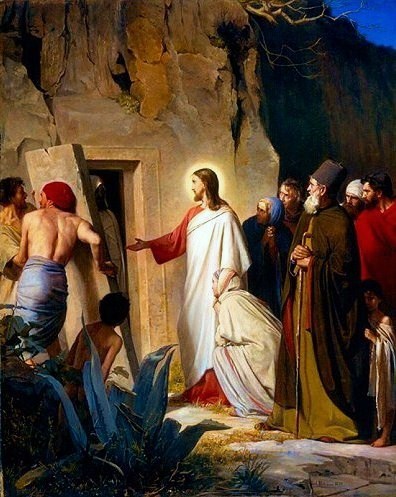 Picture this: One moment, Lazarus was ailing and fading out of consciousness on his deathbed. The next thing he knows, he wakes up wrapped in bandages inside of a cave, and comes out toward the light at the sound of his friend Jesus’ call. His sisters would have filled him in on what he missed when he was dead.





 On my last homily I talked about the fact that faith can produce miracles. Today’s scripture readings helps us to understand how we acquire that gift of faith and participate in God’s divine partnership plan.

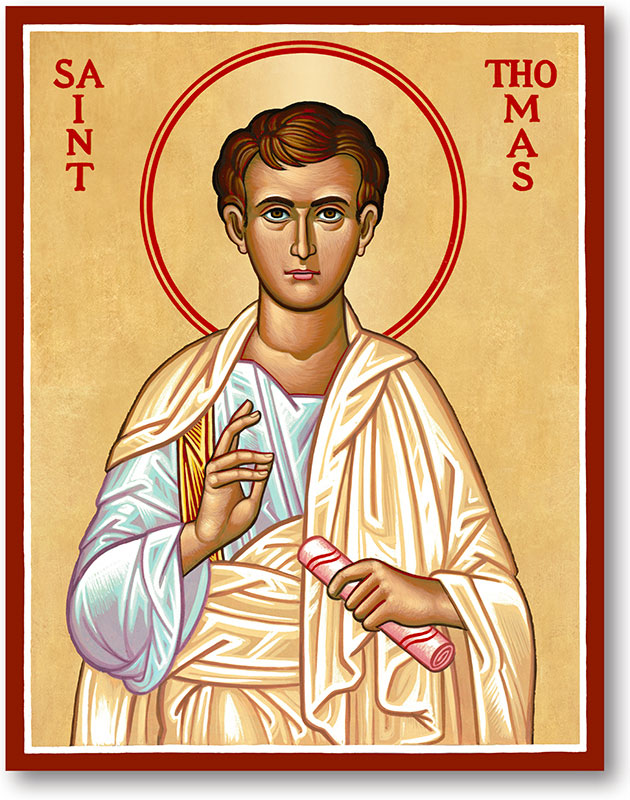



 Parishable Items