Archive for the ‘Faith’ Category

3 Myths / 3 Mitos — 9th Sunday in Ordinary Time—Year A

March 6, 2011

Many today assume three modern myths: One, that we get into Heaven based on whether our good works out-weigh our sins. Two, that as long as we claim Jesus Christ as our personal Lord and Savior we are assured Heaven. And three, that one Christian church is just as good as another. Let us consider these common myths one by one, and come to understand the truth about Christianity.

If you ask people whether they think they’ll go to Heaven, many say something like this, “I’m a pretty good person. I mean I’ve never robbed any banks or killed anybody. I’ve done good things, so yeah, I think I’ll go to Heaven.” In their minds, such people seem to envision the Last Judgment as a giant scale, with their good deeds on one side and their sins on the other.

The truth is, we cannot earn our own salvation. God is all good and deserving of all our love. When we do good we are just giving Him what He deserves. But when we sin, we disfigure ourselves and our relationship with God in ways that only He can repair. “…All have sinned and are deprived of the glory of God.” But thanks be to God, we “are justified freely by his grace through the redemption in Christ Jesus…. What occasion is there then for boasting?” asks St. Paul. “It is ruled out.” We do not save ourselves. We are saved only through Jesus Christ.

Many Christians like to ask, “Have you accepted Jesus Christ as your personal lord and savior?” Do not hesitate to answer “Yes,” for every time you receive Him worthily in the Eucharist you are accepting Him as your Savior and Lord. Evangelical Christians also like to ask, “Are you saved?” They say this because they think whoever professes faith in Christ is assured of their salvation. However, according to Jesus, “Not everyone who says to me, ‘Lord, Lord,’ will enter the kingdom of heaven, but only the one who does the will of my Father in heaven.”

Think of it this way: the demons recognize that Christ is Christ, but that does not save them. They are not saved because they do not love Him, and love is about more than just words. As Jesus told His Apostles, “If you love me, you will keep my commandments. … This is my commandment: love one another as I love you.” (Jn 14:15, 15:12)

Consider the New Testament words of St. James, “What good is it, my brothers, if someone says he has faith but does not have works? Can that faith save him? If a brother or sister has nothing to wear and has no food for the day, and one of you says to them, ‘Go in peace, keep warm, and eat well,’ but you do not give them the necessities of the body, what good is it? So also faith of itself, if it does not have works, is dead.” (James 2:14) As St. Paul observes, “If I have all faith so as to move mountains but do not have love, I am nothing.” Our salvation in Christ requires faith and love in action.

We know that more than a few Catholics have wandered away from the Church. Some have been drawn away, after being told the Catholic Church does not know the Bible. Others have simply left, thinking that one Christian church is just as good as another. Do not be misled by myths.

In truth, Jesus Christ has built only one house, one Church. And, being a wise man, he built the house on a rock, St. Peter, our first Pope. However, men have built other houses. These Christian denominations have many good characteristics from the one Church of Christ: like Scripture, prayer, the Apostles’ Creed, baptism, marriage, and Christian morals. However, in time, the rains fall, the floods come, and the winds blow and buffet their houses and they collapse ruined. Those houses separate from the truth and separate from within into new houses. Therefore, never abandon the beliefs and the sacraments of the Catholic Church. There is one true house of Jesus Christ. Do not be misled by myths.

Muchos hoy aceptan tres mitos modernos: Uno, que entramos en el cielo si nuestras buenas obras son más que de nuestros pecados. Dos, si nos declararía Jesucristo como nuestro Señor personal y Salvador estamos seguros de entrar en el cielo. Y tres, que una iglesia Cristiana es tan buena como la otra. Consideremos estos mitos populares uno por uno y comprender la verdad acerca del cristianismo.

Si se pregunta a las personas si piensan que van a ir al cielo, muchos dicen algo como esto, “Soy una persona buena bastante. Yo nunca he robado al banco ni matado a nadie. He hecho cosas buenas, entonces sí, creo que voy a ir al cielo.” Estas personas imaginan el juicio final para ser una escala gigante, con sus buenas acciones en un lado y sus pecados en el otro.

La verdad es que no podemos ganar nuestra propia salvación personal. Dios es el sumo bien y digno de ser amado sobre todas las cosas. Cuando hacemos bueno sólo damos lo que se merece Dios. Pero cuando pecamos, nos hacemos daño a nosotros mismos sino a nuestra relación con Dios in maneras que solo Dios puede reparar. “Como todos pecaron, todos están privados de la presencia salvadora de Dios; pero todos son justificados gratuitamente por su gracia, en virtud de la redención llevada a cabo por medio de Cristo Jesús… por medio de la fe.” “¿Dónde, pues, quede el orgullo del hombre ante Dios,” pregunta de San Paulo. “Queda eliminado!” Nosotros no ganamos nuestra salvación por nosotros mismos. Somos salvados sólo a través de Jesucristo.

A veces otros cristianos nos preguntan, “Has aceptado a Jesucristo como tu Señor personal y Salvador?” No duden en responder “Sí”, porque cada vez que le reciban dignamente en la Eucaristía  lo aceptan como su Salvador y Señor.  Nuestros amigos cristianos evangélicos también quieren preguntar, “¿Eres salvado?” Dicen porque piensan que la person que profesa la fe en Cristo se asegura su salvación. Sin embargo, según Jesús, “No todo el que me diga ‘Señor, Señor!’, entrará en el Reino de los cielos, sino el que cumpla la voluntad de mi Padre, que está en los cielos.”

Consideren esto: los demonios reconocen que Cristo es Cristo, pero no los salva. No se salva porque ellos no lo aman, y amor es más que decir palabras. Como Jesús les dijo a sus apóstoles, “Si ustedes me aman, obedecerán mis mandamientos. … Mi mandamiento es este: Que se amen unos a otros como yo los he amado a ustedes.”

Consideren las palabras del Nuevo Testamento de San Santiago, “Hermanos míos, ¿de qué le sirve a uno decir que tiene fe, si sus hechos no lo demuestran? ¿Podrá acaso salvarlo esa fe? Supongamos que a un hermano o a una hermana les falta la ropa y la comida necesarias para el día; si uno de ustedes les dice: ‘Que les vaya bien; abríguense y coman todo lo que quieran’, pero no les da lo que su cuerpo necesita, ¿de qué les sirve? Así pasa con la fe: por sí sola, es decir, si no se demuestra con hechos, es una cosa muerta.” Como San Pablo observa, “Si tengo la fe necesaria para mover montañas, pero no tengo amor, no soy nada.” Nuestra salvación en Cristo requiere fe y amor en acción.

Sabemos que más que unos católicos pocos han vagado de la Iglesia Católica. Algunos son atraídos, oyen falsamente que la Iglesia Católica no conoce la Biblia. Otros simplemente dejaron, piensan falsamente que una iglesia cristiana es tan buena como la otra. No se engañen por mitos.

En verdad, Jesucristo ha construido sólo una casa, una iglesia. Y, siendo un hombre sabio, construyó la casa sobre una roca, San Pedro, nuestro primer Papa. Pero, hombres han construido otras casas. Estas denominaciones cristianas tienen muchas características buenas de la única casa de Cristo: como escritura, oración, el credo de los apóstoles, bautismo, matrimonio, las morales cristianas. Pero, en tiempo, viene la lluvia, bajan las crecientes, se desatan los vientos, contra esas casas y las arras an.  Esas casas sparan de las verdad y sparan desde los interiors en las casas nuevas. Por lo tanto, nunca abandonen las creencias y los sacramentos de la Iglesia Católica. Es la única casa de Jesucristo. No se engañen por mitos.

Seen and Unseen — December 28 — St. John the Evangelist

December 27, 2010

Today’s Gospel says that when John the Apostle went into the tomb on Easter morning “he saw and believed.” What did he see that led him to believe? Was it how the burial cloth which had wrapped Jesus’ body wasn’t taken away or tossed in a mess on the floor,  but left behind (perhaps deflated) in its place? Or was the cloth which had covered the Lord’s head rolled up in a familiar way, such that John recognized Jesus’ hand behind it. Or perhaps, if the Shroud of Turin is truly the burial shroud of Christ, John believed through beholding its testimony to the resurrection.

On the other hand, maybe it wasn’t something John saw that led him to believe, but something he didn’t see. Perhaps it was from the fact that Jesus wasn’t there that he infered the truth. “Dead bodies don’t just disappear for no reason at all. I didn’t do this. None of us did this. And what motive would our enemies have to take Him? This is the work of God.”

Just as John may have inferred the resurrection of Jesus from the empty tomb, so we can infer the truth of God from the presence of the universe: “Things don’t just appear for no reason at all. I didn’t make this. None of us made this. And how could an enemy have to create beauty, life, and love? This is the work of God.”

Tradition says that after Jesus entrusted the care of His mother into the care of John the Apostle, they went to live in what is modern-day Turkey.  What if we had gone to visit them in their home at Ephesus and asked them how someone can believe in the God of the universe, or the Lord Jesus Christ, when their reality can sometimes seem so distant.

I can imagine Mary or John replying, “Beloved, the One who was from the beginning, whom we have heard, whom we have seen with our eyes, whom we looked upon and touched with our hands, the Word of God, the Word of Life, the Lord Jesus Christ——we have seen Him, and testify to Him, and proclaim to you His eternal life.” The Christian faith is firmly founded, upon the unseen things we can infer and the things which we  have seen.

The Joyful Mysteries, Meditations with the Saints

October 28, 2010

The 1st Joyful Mystery: 
The Annunciation

The Blessed Virgin Mary may have been just 13 years old when the angel Gabriel announced to her that she would give birth to Jesus. She shows us that even if you are young, God can still do big things with you, if you say “Yes” to Him.

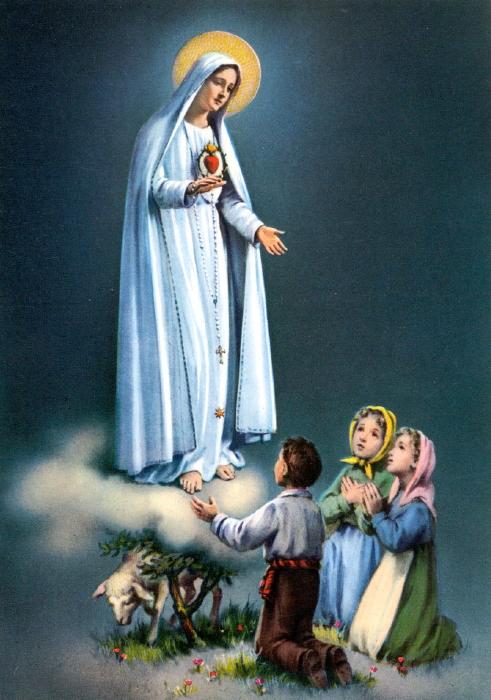
On May 13, 1917, three Portuguese children were praying the rosary after lunch in a field on a clear blue day.  The eldest was Lucia, age 10, and she was with her cousins, Francisco and Jacinta, ages eight and seven. Suddenly, they saw two bright flashes. They looked up and saw “a lady, clothed in white, brighter than the sun…” The Lady smiled and said, “Do not be afraid, I will not harm you.” Lucia asked her where she came from. The Lady pointed to the sky and said, “I come from heaven.” Lucia asked what she wanted. The Lady said, “I have come to ask you to come here for six months on the 13th day of the month, at this same hour.”

On July 13, the incredibly beautiful Lady appeared again. Lucia asked her who she was, and for a miracle so everyone would believe. The Lady answered, “Continue to come here every month. In October, I will tell you who I am and what I want, and I will perform a miracle for all to see and believe.” Then she taught them this prayer: “Oh my Jesus, forgive us our sins, save us from the fires of hell. Lead all souls to Heaven, especially those in most need of Thy Mercy.”

At noon, on October 13, 1917, some 70,000 people were gathered in the field. With a flash of light, the Lady appeared to the children and declared, “I am the Lady of the Rosary.” Some spectators cried out and the crowd turned their eyes upward to the cloudless sky, and they gazed on the sun without the least discomfort.  They saw it tremble and danced in a miraculous way.

Mary, Lucia, Francisco and Jacinta teach us this lesson: Even if you are young, God can do big things with you, if you say “Yes” to Him. Let us pray that we would be open to doing God’s will every day.

The 2nd Joyful Mystery:
The Visitation

“During those days Mary set out and traveled to the hill country in haste to a town of Judah, where she entered the house of Zechariah and greeted Elizabeth. When Elizabeth heard Mary’s greeting, the infant leaped in her womb, and Elizabeth, filled with the Holy Spirit, cried out in a loud voice and said, ‘Most blessed are you among women, and blessed is the fruit of your womb. And how does this happen to me, that the mother of my Lord should come to me? For at the moment the sound of your greeting reached my ears, the infant in my womb leaped for joy.’” (Luke 1)

Imagine how St. Elizabeth must have felt to have Mary, Mother of God, walk in through her door. Elizabeth could not see the tiny Jesus, a fetus in Mary’s womb, but she was convinced that He was hidden there. How would you treat someone if you knew that Jesus was hidden inside of them?

Blessed Mother Theresa cared for the poorest of the poor in the streets of Calcutta, India. Despite years of strenuous physical, emotional and spiritual work, Mother Teresa seemed unstoppable. Though frail and bent, with numerous health problems, she always returned to her work, to those who received her compassionate care for more than 50 years. How did she do it? She could do it because she encountered her beloved Christ both in times of prayer and in the people she cared for. Mother Teresa remembered Jesus’ words, “Amen, I say to you, whatever you did for one of these least brothers of mine, you did for me.” (Matthew 25:40) Mother Teresa loved others as if they were the Lord Himself.

Blessed Mother Teresa and St. Elizabeth teach us this lesson: Jesus is present in your classmates here at school, so you should always be welcoming and loving toward them. Let us pray for the grace to love others in this way.

The 3rd Joyful Mystery:
The Nativity

In his youth, Francis had been quite rich, the son of a wealthy merchant, yet he sensed that there was more to life. He put his former life behind him and devoted himself to following Christ. One day, at Mass, the Gospel told of how Christ’s disciples were to possess neither gold nor silver, nor traveling items, but were to exhort sinners to repentance and announce the Kingdom of God. Francis took these words as if spoken directly to himself, and as soon as Mass was over he threw away what little he had and went forth at once, exhorting the people of the country-side to penance, brotherly love, and peace. He was poor, but clearly happy, and others were attracted to join his movement. By the time of his death, hundreds had joined his religious order. On October 3, 1226, St. Francis died a penniless, but happy man. 

St. Francis of Assisi loved Christmas.  In fact, one story tells of how he petitioned the Holy Roman Emperor to make an edict that grain and bread should be provided to birds, beasts, and the poor this day, so that all God’s creatures would have occasion to rejoice in the Lord. St. Francis also invented the Christmas tradition of making a model of the nativity scene. These nativity scenes, called Crèches, remind us that even though Christ was rich in Heaven, he became poor when he was born on earth in a barn. Yet, Jesus was a happy man, despite his poverty.

Jesus and St. Francis teach us this lesson: You do not need to be wealthy in order to be happy. Let us pray that we may be content and happy with the riches that we have.

The 4th Joyful Mystery: 
The Presentation of Jesus in the Temple

In the year that Jesus was born, “there was a man in Jerusalem whose name was Simeon. This man was righteous and devout” and he longed to see the Messiah who would save God people. It had been revealed to him by the Holy Spirit that he would indeed see the Christ before he died and Simeon trusted and hoped in that promise.

One day, the Spirit inspired him to come into the temple. When he say Mary and Joseph carrying in the baby Jesus to offer a sacrifice for Him, Simeon “took him into his arms and blessed God, saying: ‘Now, Master, you may let your servant go in peace, according to your word, for my eyes have seen your salvation, which you prepared in sight of all the peoples, a light for revelation to the Gentiles, and glory for your people Israel.’” (Luke 2)

What are the promises the Lord has made to us?  Do we trust and hope in these promises? Simeon teaches us this lesson: That we ought to trust and hope in the Lord’s promises, for all of them will be fulfilled in the sight of all someday.

The 5th Joyful Mystery:
The Finding of Jesus in the Temple

This is a true story, the story of a Catholic mother of three whose oldest son joined an anti-Catholic religious cult. It started him down a path of sinful pride and many sensual sins. It broke her heart and for years she prayed tearful prayers for his conversion.

She even asked the bishop to intervene in winning over her son. He counseled her to be patient, saying, “God’s time will come.” When she persisted in asking, the bishop (perhaps busy with many other things) famously reassured her: “Go now, I beg you; it is impossible that the son of so many tears should perish.”

That mother was St. Monica, and that son of hers, who was lost and found, was the great St. Augustine. Sts. Monica and Augustine teach us this lesson: that your persistent prayer can help people to find Christ. Let us pray for someone that we know, that he or she may be drawn closer to Jesus Christ.

Sources:
On Fatima
On St. Francis
On Blessed Mother Teresa

Faith Enough — 27th Sunday in Ordinary Time—Year C

October 3, 2010

The apostles say to Jesus, “Increase our faith.” They have faith, but they feel like it’s not enough so they ask for more. Jesus replies, “If you have faith the size of a mustard seed, you would say to this mulberry tree, ‘Be uprooted and planted in the sea,’ and it would obey you.” In saying this, Jesus’ is not expressing disappointment in His disciples—He’s means to encourage them and us.

He wants us to understand that we have enough faith right now to be faithful in his service and to do incredible things. You have already enough faith to do what He asks you to do today. You need only to act upon it.

As we see with Habakkuk, we may need patience to see the fruits of our faithfulness. And as Paul reminds Timothy, we must put our faith into action. But the thing Jesus wants us to understand today is that we do not need to wait for more faith before we begin to be more faithful. We have already enough faith to do what He asks of us today.

If you had a perfect faith, what would you do? Try acting that way today, and you will find yourself living in faithfulness. Wouldn’t you like to see the difference that makes?

Jesus once called the mustard seed as the smallest of seeds. The mustard seed may be tiny, but its flavor is most powerful.  So it is with our faith.  The faith within us can be powerful despite its small size. A faith-filed Christian can transform the world. Think of Blessed Mother Teresa of Calcutta. Her faith helped and blessed so many people. Our faith can do great good too, but we do well to remember Mother Teresa words, “We are called upon not to be successful, but to be faithful.” Our job is to be faithful. If we do that, the Lord take care of the miracles. 

After teaching the apostles about the incredible power of their faith, Jesus reminds them of them of the importance of their being humble. We need to remember that the He is the master, and we are only His servants. Like the sorcerer’s apprentice, if we try to work great magic on our own we will only make a mess of things. Our efforts and projects must be from Him, with Him, and for Him if they are to do any lasting good.

We need not wait for God to increase our faith to begin to be more faithful. Christ has already given us enough faith to begin transforming our lives, our families, our communities, and our world. But our efforts must be those of humble servants of Christ our Lord, from whom all good things come.

The Kingdom is Like… — Monday, 17th Week in Ordinary Time—Year II

July 26, 2010

Jesus says the Kingdom of heaven is like a mustard seed sown in a field, or like some yeast worked into three measures of dough. These passages are usually taken to describe how the Church, or the Christian faith, despite small beginnings, has spread and transformed the entire world for the better. This is a valid interpretation, but the Kingdom of heaven is not only an external reality; it is internally and personally experienced. Since the Scriptures are written not only by human authors, but by the Holy Spirit as well, every passage contains more than one true interpretation. Jesus’ similies also describe faith in the life of individual Christians.

At the beginning of one’s discipleship, the seed of faith is small and vulnerable. Any challenge or trial, any passing bird, can potentially come along and consume it. This seed of faith must be guarded, watered, and given light. This means vigilence, education, and contact with Christ in prayer and the sacraments. In time, faith grows to the point that trials and challenges are no longer a grave threat, but calmly accepted.

The faith of the Christian is also like yeast which is not meant to be merely kept in a jar in on the shelf, segregated to Church or private life. It is meant to be mixed into the whole of life; at home, at work, and everywhere, so that the entire batch of life will be transformed and raised.

If your faith is young and fledging, or a confined and isolated part of your life, be encouraged by the hope these passages promise. The Kingdom of God is at hand for you.

Preparing for Tests — Friday, 8th Week of Easter

May 31, 2010

Today were heard from the first encyclical of the first pope. Today’s first reading came from the First Letter of St. Peter. And what he said applies to you: “The end of all things is at hand.” Originally, St. Peter meant that Christians should always be ready for the end of their lives or the end of the world (whichever comes first.) But this morning I think we can hear the Holy Spirit speaking to us about the coming end of this school year.

At Columbus, the end of all things is at hand: that means finals week, with all of its due dates, studying, and exams. Don’t be surprised that this trial by fire is occurring among you, as if something strange were happening to you. Finals week happens every year. I know that finals time is a challenge and that it takes some hard work, but why should this trial overwhelm us or make us behave ugly towards each other? If we have Jesus Christ in our lives we should face difficulties differently than the world does. The beauty of a soul at peace in Christ, is seen through the person’s  graceful actions.

So how should we face our finals? First of all, have faith in God, and remain at peace, confident that no matter what, everything is going to be ok.  Second, be serious and sober-minded. You’ve worked for the whole semester. Now keep going just one more week to maintain or even improve those grades you’ve worked for all semester. And third, above all and through it all, let your love for one another be intense, be hospitable to one another without complaining, and as each of you has received gifts. Use them to help one another.

At this Mass, prepare yourself. Ask Jesus for constant peace, for steady focus, and for generous love throughout finals week so that you may perform at your best in every respect. It’s nice to get good grades in school, but that’s not the most important thing. The most important thing is to be prepared for the final exam which awaits us all.

Faithful Despite Doubts — Divine Mercy Sunday—2nd Sunday in Easter—Year C

April 11, 2010

Thomas, called Didymus, one of the Twelve, was not with them when Jesus came. So the other disciples said to him, “We have seen the Lord.” But he said to them, “Unless I see the mark of the nails in his hands and put my finger into the nailmarks and put my hand into his side, I will not believe.”

Why is “Doubting” Thomas so slow to believe. Why is Thomas so reluctant to trust? A clue might be found in the gospel’s interesting inclusion of Thomas’ Greek nickname: Didymus. Didymus means “twin,” but in relation to whom was Thomas a twin? Some speculate that Thomas the Apostle bore a striking resemblance to Jesus Himself. This tradition is sometimes reflected in iconography where Thomas is the apostle who looks a lot like Jesus.

If this is why Thomas was the apostle called “the twin” then we can understand his rational skepticism. How many times during Jesus’ ministry had people come up to Thomas and said, “O Jesus, we’re so happy to see you! We’ve walked for miles to see you again!” Then, with some annoyance, Thomas might have answered, “We’ll you’ll have to walk a little bit further. Jesus is over there.” So now, when the other disciples come up to Thomas after Easter and say, “We have seen the Lord,” Thomas replies, ‘I’ll need more evidence than that.’

Thomas’ resistance to believing the good news about Jesus might not only be coming from his mind, but also from his heart. Jesus was Thomas’ hero, his teacher, and his close, beloved friend. Thomas thought that Jesus was going to be the savior and messianic king of Israel. But their close relationship and all of Thomas’ great hopes were destroyed for him at the crucifixion. Imagine how Thomas might have prayed then: “My God, why have you let this happen? How could you let Him be taken instead of me? Jesus was so good! He was completely innocent, and you let Him be die! Why?”

The unexpected death of Jesus broke Thomas’ heart, and having been so hurt once, Thomas was resolved not to let his heart be taken in again: “Unless I see the mark of the nails in his hands and put my finger into the nailmarks and put my hand into his side, I will not believe.”

Yet, though he doubts, notice where Thomas is one week after Easter. He is with the other apostles in the upper room in Jerusalem, gathered behind locked doors for fear of the authorities who killed Jesus. Now there are lots of other places Thomas could have chosen to be. There were safer places he could have gone, like back to his hometown and to the extended family and friends he had left behind to follow Jesus a few years before. Though Thomas doubts, he does not leave this house of faith. He struggles with his faith, but does not abandon it. He seeks within this house of faith, this Church, and because of it, Thomas finds sufficient evidence for his mind and healing for his heart.

The risen Lord appears in the upper room and how does Jesus respond to Thomas’ resistant unbelief? Not with anger.  Not with condemnation.  But with the divine mercy we celebrate today. Jesus appears in their midst and says, “Peace be with you.” Then he says to Thomas, “Put your finger here and see my hands, and bring your hand and put it into my side, and do not be unbelieving, but believe.”

In our lives we too will struggle with our faith and our doubts, with our emotions and with our thoughts, in our hearts and in our minds. Jesus does not condemn our honest struggles. But Jesus wants us to sincerely seek within this house of faith; this, His apostles’ Church, where the truth and healing is found by all those who seek Him.

Single-Minded Faith — Monday, 6th Week in Ordinary Time—Year II

February 15, 2010

From the letter of St. James we hear that ‘God gives to all generously and ungrudgingly,’ yet in the Gospel the Pharisees asked Jesus for a sign and received nothing. The Lord told them, “no sign will be given to this generation.”

Why didn’t the skeptical Pharisees receive what they asked for? As St. James says, they were men of two minds: “Yeah, we believe in the messiah and that he’s coming, but we’re certain that he’s not you!” Are we people of two minds in our lives of faith?

“Yeah, I hope for a renewal, a new springtime in the Church, but I don’t think much will change here in the United States.”

“Sure I want unity in our parish, but with the people we have to deal with it’s not very likely.”

“I really want my children to know Christ and to fall in love with the faith, but I can’t teach them very much.”

“Of course I’d like to be a saint, but I know the limits to my holiness and God ought to know and accept those limits too.”

Let us not be people of two minds. Let us pray and act with a single-minded faith, so that we may see, in this generation, the signs of Christ’s power.

Holy Reminders — Friday, 1st Week in Ordinary Time—Year II

January 16, 2010

Jesus said to the paralytic, “I say to you, rise, pick up your mat, and go home.”But why did Jesus send the man home with his mat? Why say anything more than, “I say to you, be healed and rise”? Why send the man home and have him take his mat with him?

Was it that Jesus was annoyed with the intrusion of this man and his amateur skylight instillation crew? That’s not it, for throughout the Gospels Jesus is always pleased by seeing displays of faith, and it says here that Jesus “saw their faith.” Rather, it is those who obstinately hold on to their faithlessness against all positive evidence who elicit Jesus’ annoyance in the Gospels. Recall when He said elsewhere:

“Woe to you, Chorazin! Woe to you, Bethsaida! For if the mighty deeds done in your midst had been done in Tyre and Sidon, they would long ago have repented in sackcloth and ashes.”

So why did Jesus send the cured man away with his mat? In setting the scene, the Gospel says that when “it became known that [Jesus] was at home… many gathered together so that there was no longer room for them, not even around the door, and [Jesus] preached the word to them.” Jesus preaches the word to the crowd so that they may be prepared to receive the Gospel about Himself. It seems that Jesus sends the cured man home because in his short time with Jesus he has been brought fully up to speed. Jesus sends the man home because, for now, the man knows everything he needs to know. Jesus forgives the man’s sins and cures him. From this the man understands why Jesus has come: for the forgiveness of sins and the healing of persons.

And why does Jesus send him home with his mat? I bet that the man would have gladly left it behind, happy to be rid of it, without a second thought. I think there are two reasons he’s told to take the mat: First, so that he may preach to others about Jesus. The mat will be conversation starter (“Hey, what’s with the mat?”) and it will also serve as “exhibit A” when the man gives his testimony about Jesus. The second reason for having him keep the mat is so that the man will always remember what Jesus did for him and what it meant. What good would it be for Jesus to teach the man everything he needed to know, if he were to quickly forget everything he had learned?

Perhaps we have need for such concrete reminders for ourselves in our life of faith. Maybe we don’t have souvenirs laying around from times that Jesus helped you, but I bet we all have access to Post-It Notes. If you think you would benefit from being reminded of Jesus’ past goodness shown to you, then write down titles for a few of these great moments.  Post them up on your wall, your mirror, your computer monitor, or wherever you will see them. This will help keep you mindful of Christ, what He did for you and what it means. And maybe, someday, someone will ask you, “Hey, what’s with the Post-it Note?”

Saying Amen — Golden Mass

December 26, 2009

Can you guess what word I’m thinking of? It’s a Hebrew word… it’s four letters long… and you’ll say it seven times in this (weekday) Mass. Have you got it?  I’ll give you one more hint… It starts with “A” and ends with “Men.” That’s right… “Amen.”

What do we mean when we say “amen”? Sometimes we say “amen” as a declaration of our faith. In this case our “amen” translates to us saying, “I believe it; this is true.” The sign of the cross, the Gloria, and the Creed all end with “amen’s” by which we declare, “This is true.”

At other times, we say “amen” to entrust our prayers (and ourselves) to God. Whenever we come to the end of our prayers, whether we’re alone or in a group, we always conclude by saying “amen.” With this “amen” we are saying, “Please, Lord, let this be done for us.”

What do we mean when we say “amen”? We’re saying “This is true,” as a confident profession of our faith, or we’re entrusting our prayers to God, saying, “Let this be done for us, Lord, according to your will.” That is what we’re saying when we say “Amen.”

Now here’s another riddle… Who was the first Christian, by which I mean, the first person to believe in Jesus Christ? You might be thinking it was John the Baptist, or one of Jesus’ apostles, but it wasn’t. Mary was the first Christian; she was the first person to believe in Jesus Christ. (Adam and Eve believed in the Redeemer, but they did not know His name.)

The angel announced to Mary, ‘Behold, you will conceive in your womb and bear a son, and you shall name him Jesus. …and He will be called the Son of the Most High.’ And Mary said, “Behold, I am the handmaid of the Lord. May it be done to me according to your word.”

In a word, Mary said “Amen,” in both senses, to the angel’s message: “I believe it, Lord; let this be done.” With this word, the Second Person of the Trinity took on flesh within her. Jesus the Christ was small within her, but truly present as God and man. Imagine the joy Mary must have experienced as she thought of His presence within her.

Just minutes from now, you will stand before a Eucharistic minister who will say to you, “The Body of Christ.” And you will answer “Amen,” like Mary answered the angel. “Amen, Lord, I believe you that are truly present in the Eucharist,” and, “Amen, Lord, let this be done to me, let me become your body; your presence in the world.”

With this word, you will receive the Christ; small within you, but truly present as God and man. When you return to your pew today consider Jesus’ presence within you and ask Mary that you be given a taste of her joy from the day the Lord first dwelt in her.

Tuesday, 34th Week in Ordinary Time—Year I

November 25, 2009

The prophets go beyond what is seen, to reveal what is hidden. Their purpose is to lead people to God.

In the first reading, Daniel reveals what was seen in the king’s dream. In the Gospel, Jesus reveals what will be seen in Jerusalem and at the end of this world as it no stands. In this homily, I will reveal to you three prayers hidden within the Mass which are always present there, but which you may have never heard before.

The first of these hidden prayers comes after the presentation of the gifts. A few of the faithful bring forth the bread and wine to the altar. It is no empty chore. This symbolizes the offering of all your gifts and of your whole lives to God.

I receive the gifts and then I say a prayer of praise to the God of all creation for this bread which we have to offer. Yet before I go on to a similar prayer with the cup of wine you may have noticed something unusual. The priest takes the water and pours a little into the cup of wine. It’s only a few drops, and the wine appears unchanged, but the water and wine have become inseparably one. As he pours, the priests silently prays this:

“By the mystery of this water and wine may we come to share in the divinity of Christ, who humbled himself to share in our humanity.”

You and I will always be God’s finite creatures, but, by the Incarnation, Jesus has made Himself inseparably one with our humanity. It is Jesus’ desire to make us more and more like His divine self through our personal union with Him.

What is the lesson for us here at Mass? We should come to each Mass with high expectations. Do you believe that your whole-hearted participation in this sacrament can make you a better, more beautiful, or more admirable person, and do powerful things for our world? Approach this sacrifice with high expectations. On this point St. John of the Cross and St. Therese of Lisieux agree: “We receive from God as much as we hope for.”

After these prayers for the bread and wine, you will see me bow at the altar. At this moment comes the second hidden prayer. The priest prays:

“Lord God, we ask you to receive us and be pleased with the sacrifice we offer you with humble and contrite hearts.”

What is the lesson for us here at Mass? We should strive to be fully-present at every Mass. Pray the Mass and sing the songs with your whole heart. Offer God this sacrifice with humility, contrition, gratitude and love.

After this comes the washing of the hands and a third silent prayer. The priest prays:

“Lord, wash me of my iniquity; cleanse me from my sin.”

I pray this prayer from particularly from the heart because I do not want my offering and partaking of this most holy sacrament to be the cause of my condemnation and death on account of my sins. (If you think of it, pray for your priest as he washes his hands, that He may offer this sacrifice well for you.) Approaching our all-holy God is serious stuff.

What is the lesson for us here at Mass? If you are aware of serious sins on your soul, come to  confession, the sacrament of reconciliation. Come and be cleansed. Lighten your burden. Do it today.

The prophets go beyond what is seen, to reveal what is hidden. Their purpose is to lead people to God. Through the revealing of these holy prayers I pray you be led to closer to our Lord Jesus Christ at this very Mass.

Tuesday, 33rd Week in Ordinary Time—Year I

November 17, 2009

Imagine if the United States of America, with all its freedoms and rights, were not the United States of America, and on your way to school today, you were stopped along roadside by the secret police. They ask you for your name. You cooperate give it. Then they order you to put your hands on the hood of the squad car. They handcuff you and place you under arrest.

You ask them, “What’s going on? What have I done?” They reply, “You’re under arrest for the charge that you are a believing Catholic Christian.” You didn’t realize it, but the police have had you under intense surveillance for the past several weeks, wire-tapping your phone, monitoring your computer, searching your personal belongs, and watching all your movements and activities.

Imagine yourself in this situation. This is the question I pose to you: At your trial, when all of the evidence they have gathered is presented against you, will there be enough to convict you? Would there be sufficient evidence to find you guilty of being a believing Catholic Christian? What would they have on you?

Would they have testimony from informants that you observe every Friday as a day of penance, that you keep every Sunday as a special, day of rest, and faithfully go to Mass and frequent the sacrament of reconciliation? Could anyone testify against you that they heard you saying positive things about Jesus Christ, or that you spoke up for the Catholic faith when it was mocked or criticized in your presence? Could they put into evidence a rosary, or a Bible, or some other Catholic book, marked with fresh traces of DNA from your fingertips? Would they have hidden camera footage of you praying before meals at school or at restaurants? Would they have grainy night-vision footage of you praying before going to bed, or praying the first thing in the morning, making the tell-tale sign of the cross.

A few hours after your arrest you find yourself in a courtroom (because the “people’s” authoritarian government believes in speedy trials.) The intimidating judge looks down at you from the bench, “It says here that you were picked up on your way to the Columbus school. We have evidence of illegal Christian propaganda being taught there and we also have reliable reports that various Catholic rituals are done there, superstitions which are offensive to reason and the spirit of our times. Now I imagine that you went to that school because that’s where your parents sent you. And I’m sure that your parents would be shocked to discover that such repugnant activities as these are happening at your school.”

The judge continues, “The punishment for being found guilty of being a believing Catholic Christian is a grave one. But… if you were simply mixed-up in these activities, unthinkingly, by accident—if you were just doing them because that’s what everyone else around you was doing—well then that would be a different story. Spies and traders may come to our government rallies, but that doesn’t make them loyal citizens now does it? So just going through the motions doesn’t make you a believing Catholic at all, am I right?”

“So I can completely understand how this regretable misunderstanding has occurred. You didn’t really understand what you were doing did you? Now if you would simply formally renounce any and all belief in these silly superstitions, you may go on your way. Just sign your name here on this piece of paper testifying to that effect, and you’re free to go.”

What would you do? What do you wish you would have the courage to do? Would we have the courage to refuse to sign, just as Eleazar refused to eat? The eating of a little meat, like the movement of a pen, is a small act, but Eleazar refused and accepted an unjust death because to do otherwise would mean a rejection of the Lord, the one true God, the King of all other kings.

Now it is very unlikely that you or I will ever have to lay down our lives as red, or bloody martyrs for our faith in Christ. But, like Zacchaeus, there will be certainly times when we will have to go out on a limb for Christ. The crowd laughed to see the rich man Zacchaeus up in that tree, but what did Zacchaeus care about? His focus was totally fixed upon his connection with Jesus Christ.

Be like Eleazar, and don’t swallow whatever the world sets before you, because a lot of it is not good and can alienate you from God. Be like Zacchaeus, with the courage to go out on a limb regardless of what other people might think or say, for the sake of your relationship with Christ.

[The images for this post come from the movie Sophie Scholl–The Final Days. If you liked A Man for All Seasons, you’ll like this one too (but I’ll warn you up front that it ends the same way.)]

August 24 – St. Bartholomew (or Nathaniel), Mass for the Catholic School System

August 24, 2009

Before entering seminary, I had never attended, a single, full day, in any Catholic school. I had kindergarten and all 12 grades in public school, followed by four years at a Wisconsin state university. So, out of this poverty of first-hand experience regarding Catholic schools, I will not claim that I have a perfect vision of how our Marshfield area Catholic schools should be. I’m the definitely the new guy here, and I don’t know all the answers. But I do think I know the big question; the question that every Catholic school needs to answer: Why do we have Catholic schools?

It’s certainly not for the money. The bishops of Catholic dioceses are just happy to see the Catholic schools break even. And it’s not only so our kids can learn reading, writing and arithmetic, along with the humanities, sports, and all the rest. The public schools can provide all that without us. And it’s not only so we can give our kids religion classes. Catholic kids attending public school have CCD like I did, or after-school Religious Education classes. So… why do we have Catholic schools?

What is it that we have uniquely to offer that the public schools don’t? I think the answer to these questions may be discovered through another question: What is the difference between an American and a faithful Catholic American?

If we think the difference is merely one of Mass attendance, then simply incorporating a Mass and a religion class into our curriculum would be sufficient to make our schools “Catholic.” But if a Mass and a religion class are the only things more that our Catholic schools have to offer, then why not sell off our schools or close them down? We could hand over all the headaches and liabilities of education systems to others, and still have our kids go to Mass before school and to a religious class after. But, if the difference in being faithfully Catholic (or Christian) means more than just going to church, if it extends to all aspects of our lives, in a way that makes us stand-out in a crowd, then we as Catholic school educators have something unique to offer.

What do we have to offer? Catholic schools promote the highest ideals and moral excellence.  These are fruits of our faith that we can pass on, but these are not the heart or the root of our faith. As Pope Benedict says, “Being Christian is not the result of an ethical choice or a lofty idea, but the encounter with an event, a person, which gives life a new horizon and a decisive direction.” Having a friendship with Jesus Christ, a personal relationship with Him in His Church, uniquely transforms how we see the world and live our lives. If we are formed and empowered by our relationship with Christ, then we can share with our students what we have received. We begin with the love of Christ, which directs and touches everything, including Catholic education.

For example, alongside the study of history, our Catholic faith delivers us from the blind slavery of being a child of our age.

With the study of world cultures and languages, our faith takes us beyond our own particular nationality to identify ourselves as belonging to a worldwide family in Christ, made up of every race and nation.

In politics and current events, our Catholic faith enlightens us to be informed Christians who happen to be Americans, instead of Americans who only happen to be Christians.

In literature and writing, our faith teaches us that the truth is good, that the truth is richer than my own narrow experience, and that the truth is what is to be honored and shared, instead of my cherished prejudices.

In music and art, our Catholic faith affirms the conviction that to behold beauty is not an illusion, or merely a human fancy; beauty reflects what is most real.

In biology and ecology, our faith teaches us that living creatures, and all Creation, merit our reverence as God’s handiwork and gift.

With mathematics, physics and chemistry, our faith unmasks the Logos, the order and reason, within and behind our universe. Scientific knowledge leads to wonder; and with faith, wonder leads to praise.

We must not merely teach knowledge. All academic study yields knowledge, and knowledge is power, but power without wisdom can and will easily turn to selfish and harmful ends. Catholic schools must teach knowledge and wisdom, and not just knowledge alone.

What is our mission? One can say it other ways, but we, are in the work, of forming and educating, saints, for the lives that they will lead. Like St. Bartholomew (or Nathaniel) Christ is calling us to follow Him closely. He calls us to show others the City of God, in all its splendor.

5th Sunday of Easter—Year B

August 23, 2009

This Sunday our country celebrates our mothers—and rightly so.  For the care and love which our mothers have given us cannot be measured or given a price.  Of course, our earthly parents are not perfect. Sometimes they’re quite far from perfect.  But any love we’ve known from them is a likeness of the love God has for us. A religious icon is made of mere wood and paint, but it can be a window to heavenly realities. In the same way, we can see through our parents’ love a glimpse to God himself.

Most of us have more memories about our mothers than we could possibly count, but today I would like to go with you back to a time and place about which you have no clear memories—to the time in your mother’s womb. Just as the Hebrews were 40 years in the desert; just as Jesus prepared 40 days in the wilderness; and just as Christ rested 40 hours until his resurrection from the tomb; so you remained 40 weeks, more or less, within your mother’s womb, being prepared for a new life.

Through your mother’s vine you grew into the mature fruit of her womb. You were nourished and grew within her. You were never far from her heart or mind. You existed in within her, connected to her at the center of your being.      She fed you with her very self. She provided for all your needs. Apart from her, you could do nothing. You remained in her and found rest in her.

At the early stages of our life in the womb, our minds did not comprehend very much, but what if you could have understood everything that your mom was doing for you at the time? Certainly you would have directed your thoughts to her often.  And certainly, from time to time, you would have turned to her with the eyes of your heart to bask in her love for you.

And imagine further what if you could have talked with your mom from the womb? Would you not have taken the opportunity to speak with her every day? Would you not have thanked her daily out of a deep gratitude? Would you not have let her know each day how much you love her? Whoever would refuse or neglect to do so would continue to live, at least functionally or biologically, but the person would not be fully alive without this relationship .

As you and your mother would continue to talk as the days and months of pregnancy passed, she would eventually present you with a most-frightening prospect: She might say, “My child, soon, in a little while, you are going to begin an new stage of life. You will be departing from the life you know, and then you’ll experience a world of people and things you have never known before.” But you would say, “I’m scared, I don’t want to go, not now, not ever!” But she would say, “I realize this concept is scary for you, but trust me when I say that it is better that you go. In fact, someday soon you’ll look back and think it a silly thought to be again as you are now. This transition is going to hurt a little bit… trust me, I know… but when the appointed time comes, I’ll be right here with you. Do not be afraid.”

This morning we reflect on this time in the womb because our life in our mothers is like our life in Christ. As it was with our mothers, so it is, in this life, with Christ. You are nourished and grow within Him. You are never far from His heart or mind. You exist in within Him, connected to Him at the center of your being. He feeds you with His very self. He provides for all your needs. Apart from Him, you can do nothing. You remain in Him and find rest in Him.

Knowing and believing this, shouldn’t we direct our thoughts to Him often? Shouldn’t we, from time to time, turn to Him with the eyes of our hearts to bask in His love for us.

We have the ability to talk with Jesus Christ. Who would not take the opportunity to speak with Him every day? Who would not thank Him daily out of deepest gratitude? And who would not let Him know each day how much we love Him? Whoever would refuse or neglect to talk with Him, that is to pray, would continue to live, at least functionally or biologically, but the person would not be fully alive without this relationship with Jesus Christ. We need to pray every day if we want to remain in Him and to bear much fruit.

None of us want to die and that’s perfectly natural. But Jesus says to us, “Soon, in a little while, you are going to begin a new stage of life. You will be departing from the life you know, and then you’ll experience a world of people and things you have never known before. I realize this concept is scary for you, but trust me when I say that it is better that you go. In fact, someday soon you’ll look back and think it a silly thought to be as you are now again. This transition is going to hurt a little bit… trust me, I know… but when the appointed time comes, I’ll be right there with you. Be not afraid.”

Today, let us thank God for the gift of our mothers and the gift of Jesus Christ.  God bless our mothers, and praised be Jesus Christ.

2nd Sunday of Easter—Year B

August 23, 2009

Jesus said to “Doubting” Thomas, “Have you come to believe because you have seen me? Blessed are those who have not seen and believed.”

This gospel passage has a very fond and special place in my heart, because when I was younger it used to really tick me off. If I had had my choice between either seeing and believing, or not seeing and being blessed, I’d have picked the seeing option every time. But now looking back, I realize  that if Jesus had actually appeared to me in a vision that would have just raised more doubts and questions in me. I once shared my various frustrations about faith and doubt with a priest.  After he had patiently listened, He suggested that perhaps I was going through these kinds of trials so that I could help others through similar trials someday.  At the time, that also ticked me off… but he was right. I hope that six lessons I’ve learned in the years since will be of help for you today. Today the Church celebrates Divine Mercy Sunday, but on account of Doubting Thomas one might also call it Doubter’s Sunday. I feel a lot of mercy for the doubters out there, and Jesus does too.

Lesson One:  Jesus does not condemn the honest doubter, the sincere questioner, the genuine seeker.

When Jesus appears to doubting Thomas notice that he is not angry with him.  He says, “Peace be with you!”  Then he says, “Put your finger here and see my hands, and bring your hand and put it into my side, and do not be unbelieving but believe.” The Gospel does not say whether Thomas actually took Jesus up on touching his wounds, but Jesus was not patronizing him when he made the offer—it was an sincere invitation that met Thomas where he was at.

Still today, Jesus is not angered by our honest questions.  In fact, it is a compliment to him to ask tough questions of our faith because it shows that we believe there are good answers out there to be found. Honest questions make our faith stronger, not weaker. However, our questioning must be sincere. We must not build a comfortable home upon our doubts, doing nothing to answer or resolve them. This sort of questioning is not sincere, but often self-serving.  Jesus wants to give to those who ask, to reveal to those who seek, to open for those who knock, so that they will not be unbelieving, but believe.  But, when we refuse to ask, or to seek, or  to knock, we frustrate the Lord.  Jesus is pleased, however, by the genuine seeker because the genuine seeker will find him.

Lesson Two:  Having beliefs is unavoidable and our faith is reasonable.

Some people object to faith saying that “reason” or “science” is certain while “belief” is doubtful.  But in reality, all of our knowledge depends upon trusted beliefs. We cannot live, or even reason, without accepting beliefs. Before the scientist calmly walks across the street he assumes a thousand things without certain proof of them. We can learn many valuable things from science, but science itself cannot prove all of its own assumptions. There are even questions that science cannot answer, such as the transcendent goodness, worth, or purpose of things. Our faith answers such questions and our faith is not unreasonable. Our true faith is no more in conflict with reason than the truth could contradict the truth. Not everyone shares our faith, but you cannot live as fully alive without it.

Lesson Three:  If you ever worry about whether you really believe in God, you shouldn’t be worried.

Some people experience real spiritual anxiety when they ask themselves, “Do I really believe in God?” Realize this: people who don’t believe in God, don’t spend time worrying about whether they believe in God. Only a believer would do that. So if you ever worry about your belief in God, you shouldn’t be worried; you’re actually a believer and your mind should be at ease.

Lesson Four:  You already have enough faith to do what Jesus asks of you today.

Some people say, “I believe in Jesus Christ, but I just don’t have enough faith to do what he wants me to do.” These people experience a spiritual paralysis: they’re waiting for faith to show up, before they’ll take the next step in living the Gospel, whatever that might be. They’re actually psyching themselves out. They are like the apostles who once begged the Lord, “Increase our faith!” Jesus told them if they had faith the size of a mustard seed they could uproot trees or mountains with a word and plant them in the sea. At first this might seem like a word of discouragement, but it is actually a word of hope. Your tiny, microscopic speck of faith is already enough for you to accomplish everything Christ asks of you today. Your faith right now may be only a pinhole-sized trust in him, but the God who can fit a camel through the eye of a needle can pour a river through your pinhole-sized faith. You already have enough faith to do what Jesus asks of you today.

Lesson Five:  Faith grows through being exercised.

We often keep very low expectations of God.  Maybe we think that if we don’t expect too much from him he won’t expect too much from us. Or maybe we think we won’t be disappointed by him, if we never get our hopes up. In this way our faith stays small. Our faith, which is our openness to the Gospel and our trust in Jesus Christ, remains small and weak because our faith is so rarely exercised. Do we really want to come to the end of our lives and have to look back and wonder what our lives could have been if we had committed ourselves more completely to Jesus Christ and his Gospel?

Consider this question:  If you had all the faith in the world, how would you pray, what would you pray for, and what would you do? If you want to see you faith grow, if you want to see the power of Jesus Christ active in your life, then try doing these things today.

Now sometimes Christ comes out of nowhere and powerfully reveals himself to those who have never really striven for him, or even looked for him, but it is more often the case with Christ that the more we give him the more we get. Imagine you hold in your hand seeds which symbolize your life; your time, your talents, and your treasure. You received all these seeds from Christ as pure gift. As long as we cling to the seeds in our hand, they will never bear fruit. But once we begin letting Christ plant these seeds, and we see the good fruit they produce, we will eagerly give him more and more. In this way, our faith grows through being exercised.

And finally, the sixth lesson:  Faith is about trusting in Jesus Christ.

Faith is not so much about generating a certain feeling, or a feeling of certainty, about particular facts.  The demons know that Jesus is Lord—and shudder. Faith is more about trust, trusting in a person who is worthy of our trust, Jesus Christ. Living-out such trust requires a personal relationship of knowledge and love with him.

What might be holding us back in the life of faith could be that we have unresolved sins, past and present, impeding our relationship with Christ. This Divine Mercy Sunday we celebrate the infinite mercy God shows toward all those who ask for it. Through the sacrament of reconciliation, we can receive a fresh start, a clean slate, an infusion of grace, a healing of the heart and mind, a full restoration of personal relationship with Jesus Christ.

Whenever I go to confession, I encounter Christ through the priest, like Thomas encountered Jesus in the upper room. Jesus enters into the locked inner room of my heart, where I would otherwise hide out of fear on account of my sins. I see his wounds, I admit the ways that I helped to put them there, and I tell him I’m sorry. And his response is always the same: mercy. “Peace be with you. Your sins are forgiven.” Confession gives us pardon and peace, it increases our trust and love for Jesus Christ, and strengthens our faith in him.

This Divine Mercy Sunday, let us pray the prayer that he has given us for our uncertain times: “Jesus, I trust in you.”