Archive for the ‘Hope’ Category

Beware of False Dilemmas

March 24, 2020

Tuesday, 4th Week of Lent

Now there is in Jerusalem at the Sheep Gate a pool called in Hebrew Bethesda, with five porticoes. In these lay a large number of ill, blind, lame, and crippled. One man was there who had been ill for thirty-eight years. When Jesus saw him lying there and knew that he had been ill for a long time, he said to him, “Do you want to be well?” The sick man answered him, “Sir, I have no one to put me into the pool when the water is stirred up; while I am on my way, someone else gets down there before me.” Jesus said to him, “Rise, take up your mat, and walk.” Immediately the man became well, took up his mat, and walked.


Jesus asks the infirm man lying near the pool, “Do you want to be well?” He answers, “Sir, I have no one to put me into the pool when the water is stirred up; while I am on my way, someone else gets down there before me.” The best early Greek manuscripts of John’s Gospel do not contain the verse (John 5:4) and many modern Bibles omit it, but this ancient passage explains what the surrounding verses imply: “From time to time an angel of the Lord would come down and stir up the waters. The first one into the pool after each such disturbance would be cured of whatever disease they had.

The afflicted man perceives only two possibilities, a dilemma; either be healed by being the fastest into the water or continue in his infirmity. The first path is impossible and the second leaves him miserable. The man is tempted toward despair yet he remains patiently near the pool. And there he encounters Jesus who reveals a new, third way he had not imagined, a better option he had not seen. Jesus says to him, “Rise, take up your mat, and walk,” and immediately the man arises cured.

Beware of accepting false dilemmas in life. They can take many forms. Should I keep on being late into the water or give up on ever being cured? Should I ignore the Church’s teaching or be unhappy for the rest of my life? Should I keep on sinning and confessing or give up on my fight against habitual temptation? Should we allow this pandemic to totally destroy our economy or just let everybody die? Realize that the Lord can deliver us through ways we are not perceiving. When facing a painful “either-or”, an intolerable Trolley Problem, ask Jesus to reveal a third track. What if Jesus can heal my legs? What if following the Church’s teaching will lead to both my holiness and my joyful peace? What if my necessary resolutions and humble appeals for Christ’s saving grace can lift me up from my struggle? What if, in the near future, more treatments, testing, and technologies will allow us to save both lives and livelihoods?

Do not despair of your deliverance. “Do not conform yourselves to this age but be transformed by the renewal of your mind, that you may discern what is the will of God, what is good and pleasing and perfect. … Now to him who is able to accomplish far more than all we ask or imagine, by the power at work within us, to him be glory in the Church and in Christ Jesus to all generations, forever and ever. Amen.” (Romans 12:2, Ephesians 3:20)

Jesus and His Wounded Church

October 27, 2019

On October 15th, her feast day, I heard a story told of St. Teresa of Avila I had never heard before. It may be a pious legend (as I have not found any primary sources for the tale) but it contains a truth all the same. The story goes that Satan once appeared to the 16th century Spanish nun in the glorious guise of Jesus. Satan intended to lead Teresa astray, but she quickly saw he was not Christ. Before departing from her the Devil asked how she was so certain. She replied, “Because you have no wounds.”

In the Book of Acts we read that on the road to Damascus Saul heard a voice say, “Saul, Saul, why are you persecuting me?” “Who are you, sir,” asked the afflictor of the Early Church. “I am Jesus, whom you are persecuting.” Jesus had already, some months or years before, bodily ascended into Heaven, but Our Lord felt all the afflictions of the Church on earth as his own. Saul repented, converted, and became St. Paul.

Jesus hates the grave mistreatment and harming of his members but his Body suffers and bears wounds still; wounds inflicted both from outside and within his Church. Jesus told his disciples, “Things that cause sin [literally “skandala,” scandals or stumbling-blocks] will inevitably occur, but woe to the person through whom they occur.” Yet even as Jesus heals and avenges his innocent, injured sheep he desires the salvation of wrongdoers too – that, justly-chastised, the sinner would ultimately appear before God as a saint.

Pray for our whole Church without despairing, for the victory of our Faithful Bridegroom is assured. St. Teresa of Avila said, “I do not fear Satan half so much as I fear those who fear him,” and she urged her sisters to unshakable confidence in Jesus Christ:

“Let nothing disturb thee; Let nothing dismay thee:
All thing pass; God never changes.
Patience attains all that it strives for.
He who has God finds he lacks nothing:
God alone suffices.”

Stories of Glory

May 22, 2019

Readings for the 6th Sunday of Easter – Year C

Liberty Films was an independent motion picture production company founded in 1945. They only produced two films before dissolving six years later. Their first film, released in 1946, was the story of a depressed loan officer in upstate New York who is contemplating ending his own life. The critical reviews to the movie were mixed. It had good stars and did rather well at the box office, but not well enough to recoup its production costs and show a profit. It won no Academy Awards except for one in Technical Achievement; for developing a better way to simulate falling snow on a movie set. The co-founder of the company and director of the picture would go on to consider this his favorite film, screening it towards the end of every year for his family. However, he said that creating Liberty Films had proven virtually fatal to his professional career.

After Liberty Films folded up, the ownership of rights to the film changed hands from one media company to the next. I suspect the movie would have been largely forgotten today, if not for a providential oversight. You see the Copyright Act of 1909 granted copyright protection to original creative works for twenty-eight years. This copyright protection could be renewed for an additional twenty-eight years by filing out some paperwork and paying a nominal fee. However, the new owners of the film neglected to renew its 1946 copyright, so the film automatically entered the public domain. As a result, from 1974 until 1993 (when other laws came into play) anyone and everyone was free to copy, sell, or broadcast the film without paying any royalties to anyone. TV stations showed it repeatedly during the Christmas season, more than one hundred distributors sold it on tapes, and the film became immensely popular. I would bet you’ve seen this wonderful film yourself. Today it is considered one of the greatest movies ever made, and rightly so. The name of its main character, the loan officer in upstate New York, who is persuaded by an angel not to end his own life, is George Bailey, and the film is Frank Capra’s “It’s a Wonderful Life.”

In our Gospel, Jesus says: “I give you a new commandment: love one another. As I have loved you, so you also should love one another.” And throughout “It’s a Wonderful Life,” we see George Bailey denying himself out of love for others. He gives up his dreams of going to college, of becoming a rich and famous architect, in order to keep his late father’s Savings & Loan open. He gives up his around-the-world honeymoon vacation to save Bedford Falls’ Savings & Loan again to protect the community from the wicked Mr. Potter. He is willing to suffer in place of another when old Uncle Billy loses track of the Savings & Loan’s $8,000 cash deposit. George, the good man, goes through many trials. As Paul and Barnabas tell us in our first reading: “It is necessary for us to undergo many hardships to enter the kingdom of God.”

In our Gospel, when Judas had left the the Upper Room and the Last Supper to go and arrange Jesus’ arrest, our Lord said, “Now is the Son of Man glorified, and God is glorified in him. If God is glorified in him, God will also glorify him in himself, and God will glorify him at once.” Remember: Jesus was about to suffer crucifixion and death, but also be raised again. Similarly, in “It’s a Wonderful Life” we find George Bailey at his lowest point; he’s worse than sick, he’s discouraged, on the edge of abandoning all hope. But Clarence the angel shows him all the positive difference that his life has meant, and the dark despair surrounding George is lifted. As our second reading tells us, one day God “will wipe every tear from [our] eyes, and there shall be no more death or mourning, wailing or pain, for the old order [will have] passed away.” After glimpsing a world in which he was never born, George realizes how very blessed he is. He still thinks he’ll be going to prison, but he’s overjoyed to have his life, his wife, and his children back. “Behold,” says the Lord, “I make all things new.” When George’s many friends come to his house and come to his aid – donating to cancel out his debt – the long-suffering Mr. Bailey realizes that he’s actually the richest man in town.

Our psalm says, “Let all your works give you thanks, O Lord, and let your faithful ones bless you. Let them discourse of the glory of your kingdom and speak of your might.” This is what I have been discussing, for God’s might and glory in his Kingdom are manifested in ways we might not expect. The Roman Catholic Frank Capra was inspired to make “It’s a Wonderful Life,” and it was his subsequent business failure which allowed this work to become recognized and celebrated as one of the most beautiful stories on film. The character George Bailey’s darkest night led him, with heavenly help, to more clearly see the light. Jesus’ Passion and death proved to be the means of Our Lord’s glory. And so it is our life’s trials. What we give and endure for love of God and others, which will prove to be the means of our greatest glory as well.

Theological Gifts & Obligations — Tuesday, 15th Week of Ordinary Time

July 15, 2014

Gospel: Matthew 11:20-24

Jesus began to reproach the towns where most of his mighty deeds had been done, since they had not repented. “Woe to you, Chorazin! Woe to you, Bethsaida! … For if the mighty deeds done in your midst had been done in Sodom, it would have remained until this day. But I tell you, it will be more tolerable for the land of Sodom on the day of judgment than for you.”

In the visitation of Jesus Christ, Chorazin and Bethsaida had advantages that no people before them had ever enjoyed. The Word of God was before them, but they did not accept him. Incarnate love was among them, but they did not embrace him. The hope of the world was in their midst, but they did not change their ways.

Consider how much more understanding we have of Christ and his teachings than they, how much we have experienced the love of Christ and his people, how many prophesies of Christ we have seen fulfilled. How much more cause do we have to respond to him with faith, hope, and love; how much more of an obligation. As St. Bonaventure said:

“Three things are necessary to everyone regardless of status, sex, or age, i.e., truth of faith which brings understanding; love of Christ which brings compassion; endurance of hope which brings perseverance. No adult is in the state of salvation unless he has faithful understanding in his mind, loving compassion in his heart, and enduring perseverance in his actions.”

Peter & Judas — Wednesday, 14th Week of Ordinary Time—Year II

July 11, 2014

Judas Iscariot and the chief priests and elders at the temple, their money on the floor.Readings: Hosea 10, Matthew 10:1-7

The names of the Twelve Apostles are these: first, Simon called Peter,  … and Judas Iscariot who betrayed Jesus.

What was the difference between Peter and Judas? Both were full-fledged apostles (although the Gospels always list the twelve apostles with Peter first and Judas last, much like how the Lord’s Prayer begins with “our Father” and ends with “the Evil One/evil.”) Was the difference that Peter believed Jesus was a good man and Judas did not? No, for Judas said after betraying Jesus, “I have sinned in betraying innocent blood.” Was the difference that Judas was a sinner and Peter was not? No, for at one of their first encounters, Peter “fell at the knees of Jesus and said, ‘Depart from me, Lord, for I am a sinful man.'” In the Passion, Judas betrayed Jesus and while Peter denied him three times beside the charcoal fire in the high priest’s courtyard. The vital difference between Peter and Judas was in their ultimate responses to their sins.

Judas fled and fell into utter despair. Like those in our first reading who “cry out to the mountains, ‘Cover us!’ and to the hills, ‘Fall upon us,’ Judas welcomed dark oblivion. After the resurrection, when Peter was fishing in his boat, Jesus appeared on the shore. Though Peter was lightly clad, he did not run and hide like Adam and Eve in shame, but swam to Jesus enthusiastically. At that second charcoal fire, Peter professed three times that he loved Jesus.

Let us follow Peter’s example rather than that of Judas and encounter Jesus in the confessional. For those who love Christ, hope in Christ, seek Christ, and run to Christ, will find his mercy.

Stained Glass Symbols — The Anchor

January 28, 2014

AAnchor - Sacred Heart Catholic Church -  Wauzeka WI Symbol of Hope

An anchor keeps a ship safely in its proper place, despite powerful waves and winds. The author of the Letter to the Hebrews says of hope: “This we have as an anchor of the soul, sure and firm” (Hebrews 6:19). If we have hope in Christ, hope in the good things he has promised, then we will be anchored securely against currents and storms in our lives.

Looking Forward to Heaven — 2nd Sunday of Lent—Year C

March 3, 2013

In Genesis, God promises descendants and a land to Abraham.  However, Abraham and his wife are very old, and Abraham feels uncertainty about whether they will have children. Therefore, God says to Abraham: “Look at the sky and count the stars, if you can. So shall your descendants be.” You may imagine this happening at night, but perhaps God has Abraham look during the day. We cannot see the stars in the daylight, but we know that they are there. Likewise, God’s promises to Abraham will be fulfilled even though Abraham cannot see it.

Like Abraham, we hope in God’s promises about things we cannot see. While Abraham wants to have children so that his legacy continues, we want eternal life. He hopes that his descendants someday get the Promised Land. We hope for the Promised Land of Heaven. I think we should feel hope in these things more.

In the Gospel, Peter is euphoric about seeing Jesus with Moses and Elijah and says something very silly. “Master, it is good for us to stay here and build three tents: one for you, one for Moses and one for Elijah.” How could Moses and Elijah prefer to live in tents on a mountain top on earth rather than return to paradise? Yet, sometimes we behave like our greatest hope isn’t heaven but to live here on earth forever.

Saint Paul says about sinners:  “… Just think of earthly things. We, however, are citizens of heaven, and from it we also await a savior, the Lord Jesus Christ. He will change our lowly body to conform with his glorified body… ” We all have a natural fear of death, and this is healthy and good. And we feel sad when persons depart from us, and this is understandable. But we should look forward to going to heaven. We should feel at least as much excitement about going to heaven as we would in winning an around-the-world vacation.

Have you encountered beauty here on earth? There is greater glory in heaven. Have you felt happiness and contentment here? There is overflowing joy in heaven. Have you known love? Every person loves perfectly in heaven. Which friends and family do you want to see again in heaven? Which saints or angels do you want to meet there? What will it be like to see Jesus face to face? Reflect on these things, and let this hope inspire you.

En el Génesis, Dios promete descendientes y una tierra a Abraham. Sin embargo, Abraham y su esposa son muy viejo, y Abraham se siente incertidumbre acerca de si van a tener hijos. Por lo tanto, Dios le dice a Abraham: “Mira el cielo y cuenta las estrellas, si puedes. Así sera tu descendencia.” Usted puede imaginar que esto ocurra por la noche, pero tal vez Dios ha Abraham mirar durante el día. No podemos ver las estrellas en la luz del día, pero sabemos que están ahí. Del mismo modo, las promesas de Dios a Abraham se cumplirá aunque Abraham no lo puede ver.

Como Abraham, esperamos que en las promesas de Dios acerca de cosas que no podemos ver. Mientras Abraham quiere tener hijos, para que su legado continúa, queremos la vida eterna. Él espera que sus descendientes algún día obtener a la Tierra Prometida. Esperamos que recibimos la tierra prometida de los Cielos. Creo que deberíamos sentir esperanza en estas cosas más.

En el Evangelio, Pedro es eufórico de ver a Jesús con Moisés y Elías y le dice algo muy tonto: “Maestro, sería bueno que nos quedarámos aquí y hiciéramos tres chozas: una para ti, una para Moisés y otra para Elías” sin saber lo que decía. ¿Cómo pudo Moisés y Elías prefieren vivir en tiendas de campaña en la cima de una montaña en la tierra en lugar de regresar al paraíso? Sin embargo, a veces nos comportamos como nuestra mayor esperanza no es el cielo sino a vivir aquí en la tierra para siempre.

San Pablo dice acerca de los pecadores: “…Sólo piensan en cosas de la tierra. Nosotros, en cambio, somos ciudadanos del cielo, de donde esperamos que venga nuestro salvador, Jesucristo. El transformará nuestro cuerpo miserable en un cuerpo glorioso, semejante al suyo…” Todos tenemos un temor natural de la muerte, y esto es sano y bueno. Y nos sentimos tristes cuando las personas salen de nosotros, y esto es comprensible. Pero debemos mirar hacia adelante para ir al cielo. Debemos sentir excitación cerca de ir al cielo como ganar unas vacaciones alrededor del mundo.

¿Se ha encontrado la belleza aquí en la tierra? Hay una mayor gloria en el cielo. ¿Se ha sentido la felicidad en la tierra? Hay mas alegría en el cielo. ¿Ha conocido el amor? Cada persona ama perfectamente en el cielo. ¿Lo que amigos y familiares qué quieres volver a ver en el cielo? ¿Que los santos y ángeles te quiero conocer allí? ¿Qué se sentiría al ver a Jesús cara a cara? Reflexiona sobre estas cosas que esta esperanza os inspire.

Parables About Jesus — Monday, 17th Sunday in Ordinary Time—Year A

July 26, 2011

Jesus speaks of Kingdom of God (or the Kingdom of Heaven) more times in the Gospel than perhaps anything else. But what is this kingdom? The Kingdom dwells among us when God’s will is done on earth as it is in Heaven. The Kingdom reigns wherever the will of God is known and followed. His Kingdom is not equally present at all times and everywhere, which is why we pray for the kingdom to fully come, yet it can be present within a good community, in a loving family, or within a Christian’s soul.

Jesus leads us into the Kingdom of God. He teaches us how to live as kingdom people. There’s an interesting twist contained in Jesus’ teachings: whenever He speaks about the kingdom of God, He is usually teaching us something true about Himself. This is so, because Jesus is the kingdom incarnate. Wherever Jesus is, you find the Kingdom, and wherever the Kingdom is, Jesus is there.

Because of this close identification between Jesus and the Kingdom, we can substitute between these terms and reread Scripture with new eyes. For example, “In those days John the Baptist appeared, preaching in the desert of Judea saying, ‘Repent, for (Jesus Christ) is at hand!’” The beatitude becomes: “Blessed are the poor in spirit, for theirs is (Jesus Christ).” One time, when Jesus sees how his disciples are shooing the little children away, He becomes indignant and says to them, “Let the children come to me; do not prevent them, for (I) belong to such as these.” And we hear it said, “Seek ye first (Jesus Christ) and his righteousness, and all these things will be given you besides.” When applied to today’s Gospel, Jesus three parables become revelatory of Jesus Himself.

Jesus is like a treasure buried in a field. This means that Jesus must be found. In the movie Forrest Gump, a down-in-the-dumps Lt. Dan Taylor asks Forrest derisively, “Have you found Jesus, Gump?” Forrest replies, “I didn’t know I was supposed to be looking for Him, Sir.” If I ask you if you’ve found Jesus you might feel like a bit Forrest; you’re baptized, you’re here at church, how could you still need to find him?

Well, think of it this way: do you have a joy and excitement in your relationship with Christ anything like a man who finds a hidden treasure? Does you life feel rich and full of opportunity because you know Him? If not, then you have not yet found Him like He wants you too. We need to seek after Him in prayer and learning. Encounter Him in the Gospels, especially if you never have before. (Do you want to reach the end of your days without ever having read the Gospels?) Jesus is a rich treasure whom we must seek out and discover.

The second parable: Jesus is like a merchant searching for fine pearls. (Notice that Jesus was first the treasure, now He’s the searcher.) This means that Jesus searches after us. We should not despair. He pursues more passionately than a man searching a profit. Jesus seeks us as a man in love. A pearl may get dirty and think it is no longer desirable, but Jesus has the solution for cleansing pearls. He emptied Himself of glory to become man for us, and then he gave everything He had to die as a man for us. Do not forget that if we were the only sinner on earth He would have still come for you. Never despair. Jesus will always pursue you like a man in love.

In the third and final parable, Jesus is like a net thrown into the sea, which collects fish of every kind. This means that Jesus confronts us all. As Simenon foretold of The baby Jesus when Mary and Joseph brought Hi to the temple, “Behold, this child is destined for the fall and rise of many in Israel, and to be a sign that will be contradicted so that the thoughts of many hearts may be revealed.” The truth of Jesus Christ confronts all people, even if they’ve never heard the name of Jesus. But we have heard His name, and we must not put off responding to Him forever.

Jesus is the treasure we must seek. We must not despair, for Jesus relentlessly seeks after us. Jesus is the net who confronts us all, so we must not put Him off forever.

Prayers Gradually Answered — Wednesday, 6th Week in Ordinary Time—Year I

February 16, 2011


Noah’s Ark was no cruise ship, and forty days and nights on stormy waters is no pleasure cruise. Imagine what it was like for Noah; shoveling food for the animals all morning, shoveling something else all afternoon; hearing the squawking of the animals all night, hearing the complaints of your family all day. Noah must have been praying hard for land. He sends out a raven and it doesn’t come back. He sends out a dove and it brings back with a twig. After sending out the dove again they finally make landfall. Noah’s prayer was fulfilled in a gradual way, just like Jesus healed the blind man of today’s gospel in stages.

Sometimes we get impatient and question when our prayers for ourselves and others are not answered immediately, but we should not lose hope.  But remember, slow, gradual progress doesn’t mean that God’s plan is not being fulfilled. And just because you’re not instantly healed doesn’t mean that your prayer for healing is not being answered.

Have A Holy Halloween!—31st Sunday in Ordinary Time—Year C

October 31, 2010

Have you ever noticed how our Christian holidays get filled with stuff that distracts us from what we’re really celebrating? Take Christmas, for example. There’s nothing wrong with exchanging gifts and decorating with tress and lights, but there is good reason in that season that we need be reminded, to “Keep Christ in Christmas.” For many people, celebrating the birth of the Prince of Peace on earth is the most stressful time of the year. Or consider Easter: There’s nothing wrong with chocolate bunnies and hunting for Easter eggs, but the connection between egg-laying rabbits and Jesus’ resurrection is tenuous at best.

However, this disconnection between Christian holy days and the cultural observance of holidays is the greatest when it comes to Halloween. There’s nothing wrong with kids playing dress-up and going door-to-door to ask for candy, (I have many happy memories of this myself,) but Halloween’s connection to its Christian holy day seems to have been forgotten. The name “Halloween” comes from “All Hallows Eve,” or the evening before All Saint’s Day. Something is “Hallowed” when it is sanctified or respected, as in, “Our Father, who art in Heaven, Hallowed be thy name.” All Saints Day celebrates the “hallowed” ones, the holy ones, the saints who are now in Heaven. Some of these saints are canonized, but most of them are not.

For every friend and relative we knew on earth who is now in Heaven, November 1st is their feast day in the Church. And for our holy dead who are still being purified and made perfect so that they may enter the fully-unveiled presence of our infinite God, there is November 2nd, the Feast of All Souls. In this fall season, when the natural world appears dying, our Church celebrates the holy dead, for we have hope in the new life.

Halloween, or “All Hallows Eve,” is to All Saints Day what Christmas Eve is to Christmas. As Christmas Eve reminds us of Christ’s coming, so Halloween should remind us of the victory of the saints, and of our own life’s calling: to become the best possible versions of ourselves, to become saints.

I think it is in no way an overreaction to observe that the secular observance of Halloween has overtones in dark, demonic things; the things of horror. Isn’t it suspicious that from a feast celebrating the saints in light, we have a secularized holiday focused on things of darkness? Instead of Christian hope in the resurrection of the dead, Halloween gives us images of zombies. Instead of the consolation that we are surrounded by the perfected souls of the saints, who love us and are full of concern to help us, Halloween gives us tales of ghosts and demons who want to harm and scare us. How does this sort of thing happen? I don’t think it is crazy to think that the Evil One wants to distract people from the true reason for this season; that the Devil would have us thinking about him, rather than the saints, that he wants us to be terrified, rather than full of hope.

Did you know that this Sunday, Satanic worshipers will come to Masses and Catholic Churches around the country trying to steal our Lord in the Eucharist? (Interestingly, they don’t go after the communions of Protestant denominations, but only the Catholic Eucharistic Hosts.) Their plan is to desecrate Jesus in a ritual they call a Black Mass. In doing this they are trying to rebel, seeking a false freedom that cannot make them happy. They try to harm Jesus, but only hurt Him in as much as they sadden Him. These sad people, who strike out at Jesus, are really hurting themselves and the Jesus still loves them. We know that the Lord loves every person He has made, for as the first reading notes, if the Lord did not love His creations, they would not continue to exist. As we see in today’s gospel about Zacchaeus the sinful tax-collector, there is hope for them and all of us, for Jesus “has come to seek and to save what was lost,” and He calls every one of us to be happy and holy with Him.

This Halloween, let us pray for the misguided persons, who knowingly or unknowingly, will dabble in bad things tonight, that they may turn to Christ. Let also offer Jesus our consolation for how the feelings of His Sacred Heart will be wounded by their offenses against His love. And for ourselves, let us try celebrating Halloween in some different ways this year.

Maybe everyone in your household already has their trick-or-treat costumes ready (but I know it can sometimes be a last minute decision.) If you’re still looking for costume ideas, how about dressing up as an awesome saint? Saint costumes can be easy and very creative. Dressing like this delights the saints (and it will probably score you more candy.)

Does your family have a patron saint? If not, then pick one this Halloween and entrust your family to them for the year ahead. Print off their picture from the internet and put it on the wall, learn about them as a family, and pray to them, asking that they pray for you. (I, for myself, am choosing St. John Vianney this year; the patron saint of priests and a good guy to know.) Great saints are waiting, just waiting, to grow in friendship with you.

This year, make it a point to celebrate the vigils and feasts of All Saints and All Souls. Our family and friends who are now in Heaven or on their way there expect us to be joyful on these feast days in their honor, and there is not better place for us on earth to draw near to them than here, around the altar of Jesus Christ.

Christ is the Light who shines through the darkness. This Halloween, let us claim the night for Jesus Christ and His saints.

The Joyful Mysteries, Meditations with the Saints

October 28, 2010

The 1st Joyful Mystery: 
The Annunciation

The Blessed Virgin Mary may have been just 13 years old when the angel Gabriel announced to her that she would give birth to Jesus. She shows us that even if you are young, God can still do big things with you, if you say “Yes” to Him.

On May 13, 1917, three Portuguese children were praying the rosary after lunch in a field on a clear blue day.  The eldest was Lucia, age 10, and she was with her cousins, Francisco and Jacinta, ages eight and seven. Suddenly, they saw two bright flashes. They looked up and saw “a lady, clothed in white, brighter than the sun…” The Lady smiled and said, “Do not be afraid, I will not harm you.” Lucia asked her where she came from. The Lady pointed to the sky and said, “I come from heaven.” Lucia asked what she wanted. The Lady said, “I have come to ask you to come here for six months on the 13th day of the month, at this same hour.”

On July 13, the incredibly beautiful Lady appeared again. Lucia asked her who she was, and for a miracle so everyone would believe. The Lady answered, “Continue to come here every month. In October, I will tell you who I am and what I want, and I will perform a miracle for all to see and believe.” Then she taught them this prayer: “Oh my Jesus, forgive us our sins, save us from the fires of hell. Lead all souls to Heaven, especially those in most need of Thy Mercy.”

At noon, on October 13, 1917, some 70,000 people were gathered in the field. With a flash of light, the Lady appeared to the children and declared, “I am the Lady of the Rosary.” Some spectators cried out and the crowd turned their eyes upward to the cloudless sky, and they gazed on the sun without the least discomfort.  They saw it tremble and danced in a miraculous way.

Mary, Lucia, Francisco and Jacinta teach us this lesson: Even if you are young, God can do big things with you, if you say “Yes” to Him. Let us pray that we would be open to doing God’s will every day.

The 2nd Joyful Mystery:
The Visitation

“During those days Mary set out and traveled to the hill country in haste to a town of Judah, where she entered the house of Zechariah and greeted Elizabeth. When Elizabeth heard Mary’s greeting, the infant leaped in her womb, and Elizabeth, filled with the Holy Spirit, cried out in a loud voice and said, ‘Most blessed are you among women, and blessed is the fruit of your womb. And how does this happen to me, that the mother of my Lord should come to me? For at the moment the sound of your greeting reached my ears, the infant in my womb leaped for joy.’” (Luke 1)

Imagine how St. Elizabeth must have felt to have Mary, Mother of God, walk in through her door. Elizabeth could not see the tiny Jesus, a fetus in Mary’s womb, but she was convinced that He was hidden there. How would you treat someone if you knew that Jesus was hidden inside of them?

Blessed Mother Theresa cared for the poorest of the poor in the streets of Calcutta, India. Despite years of strenuous physical, emotional and spiritual work, Mother Teresa seemed unstoppable. Though frail and bent, with numerous health problems, she always returned to her work, to those who received her compassionate care for more than 50 years. How did she do it? She could do it because she encountered her beloved Christ both in times of prayer and in the people she cared for. Mother Teresa remembered Jesus’ words, “Amen, I say to you, whatever you did for one of these least brothers of mine, you did for me.” (Matthew 25:40) Mother Teresa loved others as if they were the Lord Himself.

Blessed Mother Teresa and St. Elizabeth teach us this lesson: Jesus is present in your classmates here at school, so you should always be welcoming and loving toward them. Let us pray for the grace to love others in this way.

The 3rd Joyful Mystery:
The Nativity

In his youth, Francis had been quite rich, the son of a wealthy merchant, yet he sensed that there was more to life. He put his former life behind him and devoted himself to following Christ. One day, at Mass, the Gospel told of how Christ’s disciples were to possess neither gold nor silver, nor traveling items, but were to exhort sinners to repentance and announce the Kingdom of God. Francis took these words as if spoken directly to himself, and as soon as Mass was over he threw away what little he had and went forth at once, exhorting the people of the country-side to penance, brotherly love, and peace. He was poor, but clearly happy, and others were attracted to join his movement. By the time of his death, hundreds had joined his religious order. On October 3, 1226, St. Francis died a penniless, but happy man. 

St. Francis of Assisi loved Christmas.  In fact, one story tells of how he petitioned the Holy Roman Emperor to make an edict that grain and bread should be provided to birds, beasts, and the poor this day, so that all God’s creatures would have occasion to rejoice in the Lord. St. Francis also invented the Christmas tradition of making a model of the nativity scene. These nativity scenes, called Crèches, remind us that even though Christ was rich in Heaven, he became poor when he was born on earth in a barn. Yet, Jesus was a happy man, despite his poverty.

Jesus and St. Francis teach us this lesson: You do not need to be wealthy in order to be happy. Let us pray that we may be content and happy with the riches that we have.
The 4th Joyful Mystery: 
The Presentation of Jesus in the Temple

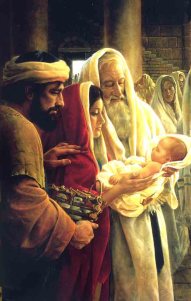
In the year that Jesus was born, “there was a man in Jerusalem whose name was Simeon. This man was righteous and devout” and he longed to see the Messiah who would save God people. It had been revealed to him by the Holy Spirit that he would indeed see the Christ before he died and Simeon trusted and hoped in that promise.

One day, the Spirit inspired him to come into the temple. When he say Mary and Joseph carrying in the baby Jesus to offer a sacrifice for Him, Simeon “took him into his arms and blessed God, saying: ‘Now, Master, you may let your servant go in peace, according to your word, for my eyes have seen your salvation, which you prepared in sight of all the peoples, a light for revelation to the Gentiles, and glory for your people Israel.’” (Luke 2)

What are the promises the Lord has made to us?  Do we trust and hope in these promises? Simeon teaches us this lesson: That we ought to trust and hope in the Lord’s promises, for all of them will be fulfilled in the sight of all someday.

The 5th Joyful Mystery:
The Finding of Jesus in the Temple

This is a true story, the story of a Catholic mother of three whose oldest son joined an anti-Catholic religious cult. It started him down a path of sinful pride and many sensual sins. It broke her heart and for years she prayed tearful prayers for his conversion.

She even asked the bishop to intervene in winning over her son. He counseled her to be patient, saying, “God’s time will come.” When she persisted in asking, the bishop (perhaps busy with many other things) famously reassured her: “Go now, I beg you; it is impossible that the son of so many tears should perish.”

That mother was St. Monica, and that son of hers, who was lost and found, was the great St. Augustine. Sts. Monica and Augustine teach us this lesson: that your persistent prayer can help people to find Christ. Let us pray for someone that we know, that he or she may be drawn closer to Jesus Christ.

Sources:
On Fatima
On St. Francis
On Blessed Mother Teresa

Job’s Desolation — Tuesday, 26th Week in Ordinary Time—Year II

September 28, 2010


The sadness of Job is like a heavy stone hanging from his neck.

In his pain, he seems to forget that he is surrounded by people who care about him very much. When Job’s friends learn of his misfortune they come to him. For days and nights they sit with Job, listening, not saying a word, yet saying a great deal by just being there. He is not alone.

In his despair, Job imagines that his life will never get better. Yet he cannot see the future. The Lord is going to bless Job and happiness will return to him.

In his darkness, Job wishes he were dead. He asks, “Why did I not perish at birth?” Yet death is not the way. When the Samaritans rejected Jesus, James and John asked to rain down fire, but Jesus rebuked them for it. As long as there is life, there is hope, for the Samaritans, and for us.

How wrong it is if we mistake death for the way of peace, for that is not Christ’s answer. How wrong it is if we imagine that we will never be happy again, for sun’s light shines beyond our horizon or behind the clouds, even if we cannot see it. And how wrong it is if we forget that people care about us, for each of us here is loved more than we know.

Rabbi Gamaliel’s Wisdom — Friday, 2nd Week of Easter

April 16, 2010

The apostles were brought before the Sanhedrin, the Jewish High Council, to be questioned for why they continued to teach in “that name.” At hearing the apostles’ answers, the Jewish leaders “became infuriated and wanted to put them to death,” but a Pharisee in the Sanhedrin stood up and had the apostles put outside. This was Gamaliel, a great teacher of the law who was respected by all the people. (It was at this rabbi’s feet that St. Paul received his Pharisaical training.)

Gamaliel said, “Fellow children of Israel, be careful what you are about to do to these men.” Now his form of address here is interesting and revealing. He could have addressed his peers in the Sanhedrin in many different ways, but by calling them “fellow children of Israel” he recalls Jacob (whose name God changed to Israel) and his twelve sons.

Now of all those sons, Joseph was Jacob’s favorite. This made the others so jealous that they sold Joseph into slavery. But through suffering this dishonor Joseph would go on to become the instrument of their salvation. Even though they meant to destroy him, they failed. God intended this for good, to achieve the salvation of many.

Gamaliel concluded his speech to the Sanhedrin wisely observing, “If this endeavor or this activity is of human origin, it will destroy itself. But if it comes from God, you will not be able to destroy them…”

Evil endeavors or activities are destroyed in time. But what is of God endures, even if it is sometimes setback by evil and sins. In these beleaguering times, for our country, for our Church, and for our pope, this lesson from Rabbi Gamaliel gives us good reason for hope.

August 27 – St. Monica

August 27, 2009

Today I would like to tell you a true story, the story of a Catholic woman in a very difficult marriage to a non-Christian husband. Her husband was a man with a hot temper and hostility towards Christianity. He was unfaithful in their marriage, but she remained faithful to him—not out of weakness, but out of an inner-strength.

She bore his faults with patience and persistently sought after his conversion. The daily example of her gentleness and kindness finally had its victory. Her husband became a Christian one year before his death. However, the year after that, she had to face a new burden alone.

The oldest of her three children joined an anti-Catholic religious cult. It started him down a path of sinful pride and many sensual sins. It broke her heart. Then one night, she had a dream.

She was standing on top of a wooden ruler, and she saw a young man coming towards her, surrounded by a glorious halo. Although she felt sad and full of grief, the young man smiled at her joyfully. He asked her for the reason for her sadness and daily tears. (This wasn’t because he didn’t know, but because he had something to tell her—this is the way things happen in visions.) When she answered that her tears were for the lost soul of her son he told her to take heart for, if she looked carefully, she would see that where she was, there also was he. And when she looked, she saw her son standing beside her on the same ruler. Reassured by this dream she continued, for years to come, praying tearful prayers for his conversion.

She even asked the bishop to intervene in winning over her son. He counseled her to be patient, saying, “God’s time will come.” When she persisted in asking, the bishop (perhaps busy with many other things) famously reassured her: “Go now, I beg you; it is impossible that the son of so many tears should perish.”

That son, as you may have guessed by now, was the great St. Augustine. And his mother is St. Monica. May her story encourage us to pray and strive for the conversion of our loved ones to the Catholic faith. Remember and take hope: God loves us with a human heart and He cares about your loved ones even more than you do.

Wednesday, 21st Week in Ordinary Time—Year I

August 27, 2009

Today the psalmist reflects on the truth that you just can’t get away from the Spirit of God.  Psalm 139 is good to remember whenever God feels absent.

If I go up to the heavens, you are there;
if I sink to the nether world, you are present there.
If I take the wings of the dawn,
if I settle at the farthest limits of the sea,
even there your hand shall guide me…

Have you ever come to Mass with serious doubts that you would get anything worthwhile out of the homily? Maybe you saw this priest or that priest come out, and said to yourself, “oh, him again.” However, we should always approach the homily, and the entire Mass, with a hopeful receptivity to the work of the Spirit.

Is it really possible that the Holy Spirit, who is everywhere, could be completely absent from the priest’s homily? Regardless of whether the priest preaches long or short, with refined style or with bare simplicity, in his first language or not, we should trust that the Holy Spirit will speak something to us through his words as long as we are spiritually open to listening.