Christmas, the Nativity of the Lord
By Fr. Victor Feltes

Christmas, the Nativity of the Lord
By Fr. Victor Feltes
3rd Sunday of Advent
Dcn. Dick Kostner

Today we celebrate “Rejoice” Sunday Take notice of the pink candle on our Advent wreath. We are getting close to celebrating the birthday of Jesus the “Light” of the world. We celebrate this birthday by decorating a tree with bright lights overshadowing the darkness we experience in the world we live in. For this Deacon, the fact that I was called to preach on this Sunday, displays the fact that God does have a sense of humor for he knows how much I like to be vested in bright pink. Usually this happens only twice a year but this year I will be gifted with this color for four Masses instead of only two.
As people faith we are very much aware of how dark it is living in this world. How can we be joyful always as St. Paul calls us to do in our Second Reading? How can we be joyful when our loved ones are dying or seriously ill? Or joyful about the cost of living, or being laid off or fired from our job? Or joyful that crime is at an all time high with people not caring about the rights or feelings of others? Or, to put it bluntly, what is joyful about this world going to hell in a basket?
The answer is easy. Nothing! That’s the point of our readings this Sunday. There is nothing great about what our readings refer to as “darkness.” Darkness is a part of the world that we live in. No I am not saying that there is no good in this world and that God does not love this world. It was through the love of our Creator that we were gifted with the birth of a new King and a new world or Kingdom where “darkness” cannot exist. A world gifted with a light so bright that evil darkness cannot sneak in. One of the revelations I received while studying to get my masters degree in Pastoral Studies was that we do not have to wait for death to occur to witness and partake in the Kingdom of God for it shows its presence within our present world.
We are surrounded with darkness in this world, that is why Jesus made the statement that his Kingdom was not of this world. The new Kingdom, the new world of Jesus is a place of love and respect. It is a place where sin and darkness cannot exist. And guess what? All of us have been given an invitation to become a citizen of this new Kingdom by its King. All of us have been given the mission of being a light shinning in the darkness of a world heading for the dark city scripture calls “Gehenna”.
How do we get to shine bright and experience the new Kingdom of God? Well, we can’t shine if we are dirty so we need to get cleaned up. Jesus gives us the necessary soap and water to accomplish this task. He gives us Sacraments to not only clean us up but also also provide us with the battery power to make our light shine bright. Jesus also gives us the help and support of his faith family to help us not only get clean but to stay clean so that our light will maintain its brightness.
We only have a short time to get ready for the Christmas Party of light. We are called to be the lights of Christ which will decorate the tree of everlasting life and let the Kingdom shine through. We have in our Parish many mentors of light both living and deceased that will help us be a bright light so pray for their help. Are we ready? We might think we are not ready but that’s OK. Jesus himself maybe felt he was not ready for public ministry when his mother asked him to perform his first miracle of changing water into wine to celebrate the Sacrament of Marriage for a young couple. But his mother knew better and he gave in to her wishes. It is here that Mary gives us the key to the Kingdom of God when she proclaims to the servants and to us “Do whatever he (Jesus) tells you.” St. Paul and St. Peter likewise also maybe felt they were not the right people to take on being the light of Christ, but they gave it a try, and look how bright the Kingdom of God got from their acceptance of the challenge to help light up the world.
It’s our time now to make a decision on whether we will join other parish family members this Christmas, on becoming one of the lights on the Christmas tree to present to Jesus on his birthday, of the tree of life in the Kingdom of God. It is a matter of life and death on how we will proceed as a follower of Jesus. The bottom line folks is for us to listen to the words of Mary, and “Do whatever he tells you.”
One of my most blessed gifts of ordination is when on a dark and scary night of darkness I, as a Deacon of Christ, am able to provide to my people of Bloomer at the Easter Vigil, the light of salvation, by proclaiming for all the parish to see “THE LIGHT OF CHRIST!”
3rd Sunday of Advent
By Fr. Chinnappan Pelavendran
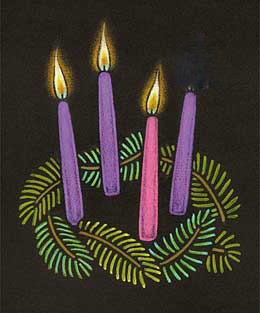 The third of Advent is called “Gaudete” Sunday and it means “Rejoice.” As we wait for the birth of our Savior, we need to rejoice. I am wearing rose-colored vestments to be joyous. It is a day of celebration as we look forward to the birth of our Savior. Our readings today invite us to be happy because the promised messiah is coming. We are thankful to god for the savior who has come, who is present, and who promises to return.
In our first reading this Sunday, the prophet Isaiah tells us to be joyful because God himself is coming to save his people. He says to us, “Courage! Do not be afraid, look your God is coming.” Our God is a generous God and has lots of good things for us. He can do all of the miraculous healing that we have read about in the Bible. There will be much rejoicing when our Savior comes, for whom we have waited so patiently. We cannot imagine the joy that will fill our hearts. Our sorrow and sadness will be gone and the future is bright with lots of prospects for us.
When we are children we get excited with anticipation before our birthdays, Christmas, and other special occasions. Waiting can be very difficult when something wonderful is going to happen. A good example is a farmer, he plants the crops and patiently waits for the time of harvest. In the second reading St. James reminds us of the promises of Christ and tells us that we need to be patient until the lord comes. As human beings, we know it is difficult to be patient when we are eagerly waiting for something. “Do not lose heart, because the Lord is coming soon.”
In today’s Gospel, the prophecy of Isaiah is being fulfilled through Jesus Christ. John the Baptist who is in prison, his longing for Christ keeps him full of hope in the midst of suffering. He lives with the expectation that he will see the glory of the lord, the splendor of our God. John hears of the miraculous deeds that Jesus is performing and wonders if he is the Messiah. Is it possible that someone can make the blind see, the lame walk, and the deaf hear? He is even bringing the dead back to life. Is this the one he has been waiting for all of his life? We too have been waiting for him all of our life.
Therefore this season, God and the Holy mother church in their wisdom have arranged our journey in such a way that there is a brief moment of joy and refreshment on Gaudete Sunday, the middle point our Journey. Let us rejoice, enjoy, and be refreshed for the rest of the journey ahead of us.
We need to learn how to survive a faith crisis. John the Baptist even after having had a direct encounter with Jesus, the messiah, had his doubts about Jesus and his teachings, we can have our crisis of faith. It is up to us to learn our Faith and ask the Lord to remove our doubts.
Go and tell others what you see and hear. We rejoice at the thought that Jesus is going to be reborn in our lives, increasing in us his gifts of love, mercy, forgiveness, and service during this Christmas season. Share your gifts with others. We need to open our hearts and God will transform our lives if we are patient and place our trust in God. The message of Advent is that God is present among us, every day. We must prepare our hearts to welcome him.
3rd Sunday of Advent
By Fr. Victor Feltes

On Friday afternoon, while Fr. Chinnappan offered the funeral Mass for Dr. John Eberle, I drove to McDonnell high school in Chippewa Falls to hear sacramental Confessions with several other area priests. Before everyone else arrived, I was able to spend some time with Fr. Paul Hoffman, whom I had not seen for a while. He heard my Advent confession and afterwards I asked him about what he had been reading lately. Fr. Paul has previously told me that his senior priest status allows him read more theology books like he has desired, to learn more about God before he ultimately departs to go to him. One of the questions Fr. Paul has been pondering lately is, “What will bring them back?” That is, what will bring the younger generations back to church?
I am now almost 42 years old, and I am among the youngest people at most Sunday Masses. This is a troubling trend. Young adults today usually do not believe they need the Church. Many disbelieve they even need Jesus Christ’s salvation. What could change this outlook? What might bring them back? The answer which occurred to me was: “Real Hope.”
As the culture continues to abandon the wisdom it has inherited from Christianity, the consequences of foolishness and sin will become increasingly clear. It will be seen in the sickness of society and felt in the pain of peoples’ personal lives. A life without true meaning or purpose in a world “with no hell below us and above us only sky” is an emptiness full of suffering. Where can people discover real hope—hope in something within this world and yet beyond this world? This real hope is found in Jesus Christ and his Catholic Church.
After our first round of hearing confessions from students and staff in the gym, we priests got a bit of a break, so I walked over to see Fr. Bill Felix and Fr. Brandon Guenther. We chatted a bit about Bishop Callahan, who was hospitalized with an illness this week, Then I asked them a question: “What are you thinking about preaching this weekend? I’m still looking for ideas.” Fr. Felix said, “Well, there’s always the obvious: Joy.” (“Oh, of course,” I thought. This Third Sunday of Advent is Gaudete Sunday and in Latin, “Gaudete” means “Rejoice.”)
Fr. Felix said the great thing about joy is that we can have it even when many things in our lives are bad. Happiness depends upon what happens, but joy does not and so it endures. To press this idea, I asked them in so many words how someone can feel joy when things are crummy? The answer given by both priests was: “Hope.” Fr. Guenther added, “Joy without hope is just optimism.” This reminded him of an old, witty observation: “An optimist is a happy fool. A pessimist is an unhappy fool. But someone with hope (real hope) is not a fool and will one day be happy.”
We then returned to our confessionals to hear the older students’ confessions. Some people come to Confession after many months and confess rather superficially, but I was edified by hearing these teenagers confessed. Unlike many young people of their generation, their earnestness, honestly, and striving after God and his holiness were evident. I expect Christ’s Church to struggle in the coming decades, but our Faith is far from dead. Christian hope produces joy and manifest joy shines out. It shines out in the darkness of this world, drawing others to Jesus Christ and his Church. Our Lord lives and we possess a real hope. So let your Christian hope generate joy in you, and your joy will help save souls.
By Fr. Victor Feltes

Rodger has experienced years of suffering and years of joy. After being born into a large, poor family and serving in the Vietnam War, he returned home and joyfully joined a new household. Facing life’s struggles, what a man could do is be bitter and glum, but Rodger loved making people laugh; sometimes with his Donald Duck voice or an intentional stumble. Even after enduring four, painful back surgeries, he still would roll down a hill to amuse his nieces and nephews.
Rodger knew that just because something is broken doesn’t mean that it’s without value. At what he dubbed his “Polish Shopping Center” (or what others call the city dump) Rodger would take things which others had despised. He would tinker with them as necessary, restoring them and prizing them as treasures to keep for himself or to share with others.
One thing I learned about Rodger and his beloved Donna is that they share a great, personal love for ice cream. Giving up ice cream for Lent was a great personal sacrifice in their house because they could eat an entire pail of it for a meal. In recent years, with his memory declining, they would often go to a particular restaurant. When the friendly staff would ask him, “Is it your birthday?” He would sincerely reply, “I think so,” and be treated to ice cream.
September 2nd of this year marked the 50th anniversary of Rodger and Donna’s wedding day here at St. Paul’s Church, and the family celebrated this occasion simply and sweetly together. Their daughters were getting Dad and Mom an ice cream cake and the employee was making a mess of squeezing-out the inscription on top, but Kelly or Lisa said, ‘It’s fine, really, just put sprinkles on it.‘ The party was a happy, intimate family gathering at home. And despite what had seemed to go wrong the cake still tasted very delicious in the end.
In today’s psalm the psalmist speaks of his suffering, praying for deliverance: “Relieve the troubles of my heart and bring me out of my distress. Put an end to my affliction and my suffering and take away all my sins. To you, O Lord, I lift my soul.” It’s not wrong to pray for relief, like Jesus himself did in the Garden of Gethsemane, but in Christ we see that our sufferings play a role in our glory. Jesus says, “unless a grain of wheat falls to the ground and dies, it remains just a grain of wheat; but if it dies, it produces much fruit. …Whoever serves me must follow me… [to the Cross].”
When Jesus suffered and died, “people saw and did not understand,” but in light of his resurrection Christians know death is not the end of the world. As St. Paul says, “We know that if our earthly dwelling, a tent, should be destroyed, we have a building from God, a dwelling not made with hands, eternal in heaven. [So] we are courageous, and we would rather leave the body and go home to the Lord. …We must all appear before the judgment seat of Christ, so that each may receive recompense, according to what he did in the body, whether good or evil.”
For the faithful and righteous the sufferings this world sees as worthless are taken up by Jesus to rework our souls. Our Lord will claim us from this junk yard, he will fully restore us and prize us as treasures for himself and to share with others. The messed-up cake of this world will be salvaged. Once God’s family is gathered together again, we will simply and sweetly agree that everything turned-out fine in the end. Can this day of Rodger’s funeral be his birthday to new life? I think so. In heaven, our Lord “will wipe every tear from their eyes,” and convert the sufferings of his people to joy. “Behold,” he says, “I make all things new.”

A subtle theme threads throughout this Sunday’s readings: the theme of joy. When the Jews return to Jerusalem from the Babylonian Exile their leaders read the Old Covenant to them. And the crowd weeps as the scrolls are read because they realize they have not been keeping God’s laws. But Nehemiah the governor, Ezra the priest, and the many Levites say: “Do not be sad and do not weep—for today is holy to our Lord. Do not be saddened this day, for rejoicing in the Lord must be your strength!” They tell the assembly to celebrate, to feast on rich food and sweet drinks. God’s covenant is cause to be joyful, for the Lord is offering not only his teaching but also his friendship. As a passage we hear today from Psalm 19 says: “The precepts of the Lord are right, rejoicing the heart.” God’s words are true and reliable and proof that he cares about us. And that’s always reason for us to rejoice.
In today’s Gospel, Jesus comes to his hometown synagogue and is handed a scroll of Isaiah the prophet. The words Jesus reads to the people of Nazareth are “fulfilled in their hearing” because they describe the Christ and his mission: “The Spirit of the Lord is upon me, because he has anointed me to bring glad tidings to the poor.” Jesus Christ tells us an important part of his mission is to bring us joy. He does this together with the Holy Spirit. Ezra, Nehemiah, and the Levites instructed the Jewish people to feast, and that was a good thing to do, but Christian joy goes beyond passing pleasure. Like St. Paul teaches the Christians in Rome: “the Kingdom of God (is more than mere) eating and drinking, but righteousness and peace and joy in the Holy Spirit.”
What is Christian joy and how can it be ours? First, realize that joy is a delight which is different from happiness. Happiness depends upon what happens: good things please us and bad things pain us, but joy endures despite changing happenstance. Unlike happiness – which is fickle – joy is grounded in unchanging things providing lasting hope. If our treasure is confined to this earth, thieves can steal it, moths can eat it, and decay can destroy it, plunging our hearts into despairing darkness. But if our great treasure is in heaven, a treasure that cannot be destroyed or stolen (namely, our Lord, his promises and rewards) then our hearts can persevere in hopeful light. “For where your treasure is, your heart will be there also.”
Now I am not saying clinical depression is impossible for a Christian. We would not tell a diabetic to “just perk up and make more insulin.” Likewise, clinical depression is not merely a matter of the will, and someone burdened by it should pursue medical help. As the Book of Sirach teaches, “from God the doctor has wisdom.” Seeking out a doctor’s help is an ordinary means by which God heals. If visiting a doctor meant a Christian lacked faith in God’s healing power, then visiting your grocer would mean a lack of faith in God’s power to give daily bread. We should not refuse the good gifts God makes so easily available to us.
Possessing joy does not mean that Christians will never suffer. St. Paul teaches in today’s second reading that we Christians are one Body of Christ in one Holy Spirit, and “if one part suffers, all the parts suffer with it, (and) if one part is honored, all the parts share its joy.” Joy can be present at the same time as suffering. As St. Paul later wrote to the Corinthians, “I am overflowing with joy in all our affliction.” Jesus – even while suffering on his Cross – had joy, and we can also possess such joy.
How can this joy be ours? First recognize that joy comes from God, then pray asking for this gift, and then be open to living joyfully. God is the cause and reason for our Joy. St. Paul mentions to the Galatians that joy is a fruit of the Holy Spirit. And Jesus Christ, his promises and rewards, are our joyful treasure that cannot be taken away. Jesus says at the Last Supper: “Ask (in my name) and you will receive, so that your joy may be complete.” So be sure to pray and ask for joy. And be open to receiving this holy gift.
Who would refuse the gift of joy? Maybe someone who uses discontent as a comfortable cop-out. If I have no wealth, no one can ask me to share. If my cup is empty, no one can expect me to pour myself out. The joyful cup, however, will richly runneth over. Or perhaps the joy-resistant person has been wounded by past disappointments and hesitates to hope again. But consider: if you can’t trust God, who can you trust? Besides, without God you have nothing, so what do you have to lose from accepting joy?
Jesus says: “I have told you this so that my joy may be in you and your joy may be complete.” Today, may this scripture passage be fulfilled in your hearing.

How was my vacation? It was a wonderful adventure! Missouri’s solar eclipse was beautiful; a black circle with white wisps extending over a surprisingly blue background. In the first seconds when the Sun began reemerging from the Moon there was a bright speck and then an expanding light so intense that it could not be looked at. It was like seeing the large stone rolled away from the mouth of the tomb on Easter morning at the moment of the Resurrection.
We touched the St. Louis Arch, a structure whose geometric simplicity belies the amazing landmark that it is. Ask yourself, how would you build such a thing sixty-three stories in the air?
In Arizona, I was pleased to providentially cross paths with Clare Shakal from Cooks Valley. I was surprised to learn she happens to work at the parish where a friend from seminary I was visiting is now pastor.
In Southern California I saw the last line of light from a red Sun be swallowed by the ocean. Pedestrians paused on the pier to watch the Earth eclipse of the Sun (what we call a sunset) but there was nothing like the numbers who gathered for the much rarer eclipse the week before.
One morning, I body-surfed in the Pacific Ocean, and went to bed in Wisconsin that night. While flying home (over a distance it would have taken me months to travel on foot) I gazed down upon the Grand Canyon for the first time. Our pilot never mentioned it.
My trip had many highlights but the part I enjoyed the most and what seasoned all the rest was the good friends I was blessed to share my adventure with.
What makes something wondrous? Things we encounter often feel less precious and usually go unnoticed. If solar eclipses happened daily at noon they would be no less beautiful but they never make the news. Our world is filled with wonders but even when we live in appreciative gratitude we still long for more. This is a sign to us that we were made to live forever; in a loving communion of persons with an infinitely interesting and beautiful God.


King Herod said to his daughter, “Ask of me whatever you wish and I will grant it to you.” He even swore many things to her, “I will grant you whatever you ask of me, even to half of my kingdom.” If Herod, who was wicked, could be moved to give his daughter gifts, how much more will our heavenly Father give us good things if we ask Him. Praying for good things is something Jesus commands us to do.
While many Christians fall into the mistake of only praying when they want something from God, there are other Christians, who pray every day, who make an opposite mistake. These Christians pray for good things for others, but they never ask anything for themselves, fearing that this would be a selfish prayer. But the danger in this, in never requesting and never expecting God’s gifts and consolations, is that we’ll become discouraged and gradually embittered.
If we never ask for a share in the Father’s gifts we risk becoming like the older brother in Luke’s parable of the prodigal son. Eventually we’ll say to God, “Look, all these years I served you and not once did I disobey your orders; yet you never even gave me something to feast on with my friends.” But our generous and forgiving Father would say to us, “My child, you are here with me always; everything I have is yours for the asking.”
Jesus said, “Whatever you ask in my name, I will do, so that the Father may be glorified in the Son.” So ask God to give you gifts—this is not a selfish prayer, for it will strengthen you in holiness and glorify God. I suggest that you try out a little experiment. Pray, “Lord, please treat me to something special today,” and then watch for his gift to come.

(The Micro Machines Aircraft Carrier – Not the Summum Bonum)
When I was a kid, in preparation for Christmas, I remember how my sisters and I would explore those big Sears and J.C. Pennies catalogues and circle the things we really wanted. I also remember the intensity of my excitement when I would open my presents to discover the toys that I had dreamed about. But over the years, I saw a pattern develop that maybe you’ve begun to start noticing for yourself.
Christmas after Christmas, I would play with all my toys, but I discovered that I would never get as much happiness from as I had imagined they would give me when they were still in their boxes. No Christmas toy ever delivered the supreme happiness I had hoped for from them. I was blessed through these experiences to learn a very valuable lesson. I learned that that getting stuff would not and could not complete me—it couldn’t make me truly happy.
 Stuff won’t make you truly happy, but there are lots of people who don’t know this. Why do you think it is that TV and advertisers are always going after that “target demographic” of 18 to 34 year-olds, especially that younger segment of 18 to 24 year-olds? It’s because these consumers have significant amounts of disposable income, perhaps for the first time in their lives. And, since they do not have the wisdom of years, many of them can still be fooled into thinking that this or that product will really make them as happy as advertised.
Don’t let yourself be fooled into taking that bait. Keep in mind the words Jesus who said, “It is more blessed to give than to receive” (Acts 2:35). It’s really about giving that I want to speak to you today. There are many ways that we can give of ourselves, of our time, talent and treasure, but this morning I want to address the importance and blessedness of giving from our incredible wealth.
Now I doubt that you would describe yourself as a rich person. In terms of our society, you’re probably not. But realize, that when compared to the rest of the world, you are a very wealthy individual. Did you know that about half of the people in the world live on less than $2.50 a day?

From our great material blessedness comes the great responsibility to share. Yet, the fact that we are far richer than many other people is really beside the point. Even if we were poor compared to everyone else, Jesus would still ask us to share of what we have. For whenever we give out of love, and a desire to spread and advance God’s kingdom, we imitate Jesus Himself, who gave of Himself to us first.
 Maybe you feel like you have nothing much to give. The disciples thought they had next to nothing to give too, and they were right. They had just five loaves of bread and two fishes, but Jesus said to them, ‘Give the crowd some food yourselves.’ The disciples wondered what good so little could do for so many, but in Jesus’ hands their small gifts multiplied. Their deed first feed thousands, and then, through its retelling in the Gospel, it feed untold millions.
It would be hubris, or foolish pride, for us to think that if only we had a million dollars, a billion dollars, a trillion dollars, or any sum, that we by ourselves could save the world. Yet, when we place what little we have into Christ’s hands, giving where and when the Holy Spirit prompts us, Jesus blesses it and our deed does more good within His kingdom than we realize.
Though you never fully see all of the good your giving causes on earth, you can immediately feel some of its goodness inside yourself. Part of the blessedness of charitable giving is in the joy you feel in always knowing that you have done a good deed. When you consume something you may enjoy it for a moment, but when you give something away in love you can enjoy that act forever. If fact, when we get to heaven, we should find ourselves made the instant friends of many strangers when it is revealed to us how our lives were profoundly connected through the smallest gifts.
To help in put our faith into practice, to love our neighbors and advance the Kingdom, we are going to begin taking more regular collections at our weekly school Masses in support various causes. We will be starting by helping a number of area organizations suggested by the Student Senate. And, once our Liturgy & Campus Ministry Committee is up and running, about which Mr. Zimmerman will be speaking to you about at the end of Mass, the selection of worthy charitable causes will one of the important tasks that will fall to them.
Today our collection will be going, in its entirety, to support the Hope Lodge here in Marshfield. The Hope Lodge provides temporary accommodations for patients and their family members while they are receiving cancer treatments at the Marshfield Clinic. Please give as generously as the Holy Spirit may prompt you and know that you will certainly be blessed.
Can you guess what word I’m thinking of? It’s a Hebrew word… it’s four letters long… and you’ll say it seven times in this (weekday) Mass. Have you got it? I’ll give you one more hint… It starts with “A” and ends with “Men.” That’s right… “Amen.”
What do we mean when we say “amen”? Sometimes we say “amen” as a declaration of our faith. In this case our “amen” translates to us saying, “I believe it; this is true.” The sign of the cross, the Gloria, and the Creed all end with “amen’s” by which we declare, “This is true.”
At other times, we say “amen” to entrust our prayers (and ourselves) to God. Whenever we come to the end of our prayers, whether we’re alone or in a group, we always conclude by saying “amen.” With this “amen” we are saying, “Please, Lord, let this be done for us.”
What do we mean when we say “amen”? We’re saying “This is true,” as a confident profession of our faith, or we’re entrusting our prayers to God, saying, “Let this be done for us, Lord, according to your will.” That is what we’re saying when we say “Amen.”
Now here’s another riddle… Who was the first Christian, by which I mean, the first person to believe in Jesus Christ? You might be thinking it was John the Baptist, or one of Jesus’ apostles, but it wasn’t. Mary was the first Christian; she was the first person to believe in Jesus Christ. (Adam and Eve believed in the Redeemer, but they did not know His name.)
The angel announced to Mary, ‘Behold, you will conceive in your womb and bear a son, and you shall name him Jesus. …and He will be called the Son of the Most High.’ And Mary said, “Behold, I am the handmaid of the Lord. May it be done to me according to your word.”
In a word, Mary said “Amen,” in both senses, to the angel’s message: “I believe it, Lord; let this be done.” With this word, the Second Person of the Trinity took on flesh within her. Jesus the Christ was small within her, but truly present as God and man. Imagine the joy Mary must have experienced as she thought of His presence within her.
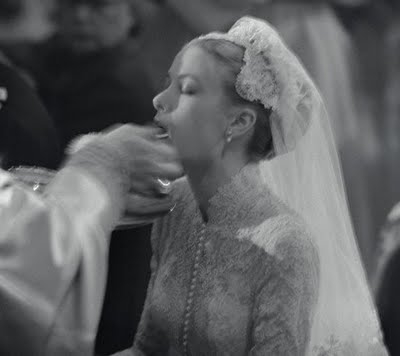 Just minutes from now, you will stand before a Eucharistic minister who will say to you, “The Body of Christ.” And you will answer “Amen,” like Mary answered the angel. “Amen, Lord, I believe you that are truly present in the Eucharist,” and, “Amen, Lord, let this be done to me, let me become your body; your presence in the world.”
With this word, you will receive the Christ; small within you, but truly present as God and man. When you return to your pew today consider Jesus’ presence within you and ask Mary that you be given a taste of her joy from the day the Lord first dwelt in her.

Is it more important to say the right thing, or to do the right thing? As people like to say “Talk is cheap,” but “Actions speak louder than words.”
Some Christians say that if we merely confess Jesus Christ as our personal Lord and Savior then we are assuredly saved. But Jesus Himself says that ‘not everyone who says to me, ‘Lord, Lord,’ will enter the kingdom of heaven, but only the one who does the will of my Father in heaven.
It is easy to feel righteous like the chief priests and the elders if we subscribe to the right and enlightened opinions, but we should be humbled by the fact that scandalous sinners have turned to Christ and today harvest more fruit in the vineyard than we do.
We have to do more than talk a good game, we have to show up on the court. For example, you say you oppose the killing of the unborn? Good! But what are you doing to end it? Do you pray for mothers and their babies? Do you march for life?
You say that hatred between peoples should end. Absolutely! But is there someone here that you cannot bring yourself to pray for, or say “hello” to in the hallway?
You say that we must care for people in need. Indeed, and Jesus says the same. But do you give of your time, talent and spending cash until it hurts a bit, like an actual sacrifice?
 If I were to end this homily here and now with an exhortation that you should go out into your world and to work hard for good in that vineyard, you might decide to listen and your life might change a little bit for a little while. But I would not expect your life change a great deal, unless you also respond to another calling; the calling from our Father that you work in another vineyard first. This vineyard is within you, it is an inner-vineyard. You work it alongside Christ in prayer and what you harvest from it is intimacy with God. Of this encounter, St. Augustine wrote:
“Late have I loved you, O Beauty ever ancient, ever new, late have I loved you! You were within me, but I was outside, and it was there that I searched for you. In my unloveliness I plunged into the lovely things which you created. You were with me, but I was not with you. Created things kept me from you; yet if they had not been in you they would not have been at all. You called, you shouted, and you broke through my deafness. You flashed, you shone, and you dispelled my blindness. You breathed your fragrance on me; I drew in breath and now I pant for you. I have tasted you, now I hunger and thirst for more. You touched me, and I burned for your peace.”
In the labor of prayer (and it does take a daily effort) you encounter God. He surprises you with gifts of consolation and peace, and you overflow with His love. This overflow is what makes the saints the saints. It is what makes their holy lives possible. The saints are not self-made men and women. Their cups runneth over within them, and it is from out of this abundance that they love the vineyard of the world and work in it for the better.
You say that you believe in God, and in Jesus Christ as your Lord and Savior. So come to the work of prayer each day, or your devotion and service to God will remain forever little more than lip-service.
Advent is a season for penance and conversion, for the confession of sins and the changing of lives, but this Sunday of Advent reminds us that it is also time for joy. Today we celebrate Gaudete Sunday, a name which comes from the Latin command “rejoice!” This command is heard from St. Paul in today’s second reading:
“Rejoice in the Lord always.
I shall say it again: rejoice!”
But is it that why do we need to be reminded, even commanded, to rejoice? Why are we not a people of constant joy and peace, even though we have great reason to be? I think it is because our hearts and minds give in to fear.
God is near, but when we give in to fear we do not trust that He really cares about us and really provides for us. In fear we become anxious about our future. In our fear we feel too stressed-out to be thankful. And in fear we forget or refuse to pray. St. Paul seems to have realized all this, that may be why he followed his command to rejoice with these words, words that it would do a lifetime of good to know by heart:
“The Lord is near.
Have no anxiety at all,
but in everything,
by prayer and petition,
with thanksgiving,
make your requests known to God.
Then the peace of God
that surpasses all understanding
will guard your hearts and minds in Christ Jesus.”
Today I would like to share with you a true story about two friends of mine who had every seeming reason to afraid, but who kept God’s peace. Let’s call them Andrew and Christi. I have changed their names to conceal their identities, but I know they wouldn’t mind me sharing with you their story because it can teach us all a lot.
To say my friends had a difficult first year of marriage would be to understate it. Andrew, a hard-working man with rough hands and a good heart, became afraid that marrying Christi had been a mistake and he seriously considered getting a divorce. Christi, a beautiful woman inside and out, prayed fervently to God, for both Andrew and herself. She honestly did not know how God would provide for her, but God gave her a peace that surpassed her limited understanding of His plans. Then, as Andrew tells it, God intervened, giving him a sign that this marriage was indeed His will and that Andrew should not be afraid. This divine reassurance strengthened Andrew and he resolved to remain faithfully at Christi’s side no matter what.
A few months later, forces beyond their control forced Andrew and Christi to leave their hometown, away from all their family and friends, and to move down south to a town where Andrew had some distant relatives. But, once they got down there, all of these relatives proved to be too distant or too busy to care enough to lend this vulnerable couple a hand. Their first Advent season together, Andrew and Christi were jobless, homeless, and with child.
It would have been so easy for them to give in to despair that first Christmas Eve, for Andrew to feel like he had failed his wife as a husband, or for Christi to feel anxious and afraid about their future as a family. Yet, Andrew and Christi trusted that the Lord was near. They would pray together as a couple, and gain courage and strength, peace and even joy through their prayers.
Indeed the Lord was near them, through it all, and their first Christmas together turned out to be was the brightest and the most joyful that they, or the world, had ever seen. As I said, this is the true story of two friends of mine, but they’re also friends of yours and you knew their story even before I told it to you today. For Andrew’s real name is St. Joseph and Christi’s real name is St. Mary.

Today we rightly call them saints, not because they lived in a world free from difficulties, an imaginary world different from our own. Joseph and Mary are saints because they knew and practiced how to live in this world well; with joy, kindness, prayer, thanksgiving, and peace. And so brothers and sisters:
Rejoice in the Lord always.
I shall say it again: rejoice!
Your kindness should be known to all.
The Lord is near.
Have no anxiety at all,
but in everything,
by prayer and petition,
with thanksgiving,
make your requests known to God.
Then the peace of God
that surpasses all understanding
will guard your hearts and minds in Christ Jesus.

 Parishable Items