Archive for the ‘Mercy’ Category

First Things First — Divine Mercy Sunday—2nd Sunday of Easter

April 28, 2014

Gospel: John 20:19-31

[Though the doors were locked, where the disciples were,] Jesus came and stood in their midst and said to them, “Peace be with you.” When he had said this, he showed them his hands and his side.

What was Jesus’ first order of business on the first Easter Sunday? Demonstrating to his disciples the fact of his resurrection.

What was the next most important thing on Jesus’ list? Commissioning his Church to impart his Divine Mercy to world.

Jesus said to them again, “Peace be with you. As the Father has sent me, so I send you.” And when he had said this, he breathed on them and said to them, “Receive the Holy Spirit. Whose sins you forgive are forgiven them, and whose sins you retain are retained.”

Some Sacramental Clarifications

April 5, 2014

● A funeral Mass is not celebrated as an honor, but as a mercy. A funeral Mass does not canonize, but offers Christ’s sacrifice for graces upon the deceased and the assembled mourners. “This saying is trustworthy and deserves full acceptance: Christ Jesus came into the world to save sinners.” (1 Timothy 1:15) If the deceased has been condemned, the offered funeral Mass will only help the family (perhaps to be converted and saved,) but if the departed is in purgatory, the Holy Mass is the greatest prayer we can offer on his or her behalf. Apart from notorious and unrepentant apostates, heretics, and schismatics, we want to error on the side of mercy, as we have been shown mercy.

● Though all should contribute to the work of the Church, no Catholic parish is a private club that requires up-to-date dues in order to be welcomed. All Catholics are members of the world-wide body of Christ—the Church.

● No one will be refused sacraments in our parish because of an inability to pay parish fees or stipends.

● Everyone is welcome at our parish Masses; however, those not in full communion with the Catholic Church, or those aware of having committed grave sin who have not obtained absolution in the sacrament of Confession, should not present themselves to receive the Holy Eucharist—these may receive a blessing instead by approaching with crossed arms.

● Any child, for whom there is a well-founded hope of being raised Catholic and whose guardians have completed a baptismal preparation program here or at another parish, may be baptized in our parish.

● If you have any additional sacramental questions regarding our parish community, please contact Father, your priest, directly.

Q&A on Indulgences

March 22, 2014

What is an indulgence?

An indulgence cancels before God the temporal punishment due for forgiven sins.

Forgiven sins can have punishments?

The forgiveness of sin absolves its eternal punishment; that is, restores our friendship with God and saves us from Hell. However, “temporal punishment” remains for sin for the purpose of the soul’s rehabilitation and to satisfy justice. This is why the priest in the confessional gives you a penance to do after you leave with all your sins absolved. Recall what Nathan told King David after the Lord forgave him (2 Samuel 12:9-14.) Even after forgiveness, there may be punishments to be paid.

What is the difference between a “plenary” & “partial” indulgence?

A plenary indulgence remits all temporal punishment due to sin, while a partial indulgence remits some of it. Note that sin’s temporal punishments are not synonymous with all of sin’s consequences. For instance, even after a plenary indulgence, we all still experience in our flesh the primeval consequence of sin: physical death.

How can the Church offer to do this?

The Church has authority from Christ to loosen and to bind, on earth and in Heaven. (Matthew 18:18) Thus, after sins are forgiven, she can satisfy remaining debts by drawing on and applying before God the superabundant merits won by Christ and his saints.

So the Church still grants indulgences?

In the 1500’s, some indulgences were granted for performing the charitable act of donating to the Church. The way some used the “sale” of indulgences as a fund-raising strategy scandalized many (including Martin Luther.) The Church abolished this means of gaining indulgences, but other means remain available.

How do I gain a plenary indulgence?

All plenary indulgences require the following:

  1. Go to confession.
  2. Receive the Holy Eucharist.
  3. Pray for the pope’s intentions (e.g., an Our Father & a Hail Mary)
  4. Do the indulgenced act in a state of grace and intending to gain the indulgence.
  5. And have no intention to sin again, even venially.

      (Note: One confession can be utilized for indulgences twenty days before or after, but each indulgence requires a distinct holy communion.)

What acts carry a plenary indulgence?

They include, among others:

  1. Visit the Most Blessed Sacrament for at least 30 minutes.
  2. Read the Bible for at least 30 minutes.
  3. Pray the Stations of the Cross.
  4. Pray one Rosary (five decades) in a church or as a family group.
  5. Pray the “Prayer Before a Crucifix” on a Friday in Lent after communion.
  6. Adore the crucifix liturgically on Good Friday.
  7. Visit a cemetery and pray for the dead on any day between November 1st and 8th.
  8. Worship at a First Communion Mass.
  9. Worship at a priest’s Mass of Thanksgiving (aka, “First Mass”)
  10. Hear sermons at a parish mission and be present for its solemn close.

Many other acts can also gain partial indulgences.

How often & for whom can I gain an indulgence?

One plenary indulgence can be gained daily and applied to oneself or to a deceased person. There is no limit for how many partial indulgences you can gain for yourself or a deceased person, and this type does not require the conditions of confession, communion, or prayers for the pope’s intentions. (Thanks to Pussywillowpress for the clarifying note below.)

Measures of Mercy — Monday, 2nd Week of Lent

March 17, 2014

Gospel: Luke 6:36-38

Last year, a teenage posted a photo on the internet of an unrolled tape measure along side the 11-inch “footlong” sandwich he had bought. The corporate response was not one of the great moments in public relations history; they said that “footlong” was a trademark term, rather than a measurement of length. The negative consumer backlash to this went viral and the corporation pledged that every foot-long would henceforth be 12-inches.

In 12th century England, there were strict laws to punish bakers who sold undersized loaves. In response, the bakers would throw in an additional loaf with every dozen to safeguard their liberty.  The baker’s dozen (of 13) was born and their customers were happy. It is wiser to error on the side of generosity with others, in both the world of business and the realm mercy.

Commerce has been linked to mercy by the Lord in both Testaments. In Old Testament Israel, merchants would use cups and weights to measure out their products to customers. Sometimes, to increase their profits, unscrupulous sellers would manipulate these measures to their advantage, as the Lord describes through the prophet Amos:

“When will the new moon be over,” you ask, “that we may sell our grain, And the sabbath, that we may open the grain-bins? We will diminish the ephah, add to the shekel, and fix our scales for cheating! We will buy the destitute for silver, and the poor for a pair of sandals; even the worthless grain we will sell!”

Such cheating was especially abhorrent to the Lord because it most exploited the poor and vulnerable. Today, Jesus tells his disciples that they should be generous with their measurements of mercy if they do not wish to be condemned:

“Be merciful, just as your Father is merciful. Stop judging and you will not be judged. Stop condemning and you will not be condemned. Forgive and you will be forgiven. Give and gifts will be given to you; a good measure, packed together, shaken down, and overflowing, will be poured into your lap. For the measure with which you measure will in return be measured out to you.”

Without rejecting the truth, or declaring evil to be good, we need to be patient and forgiving with others if we wish to be shown mercy. As St. James says, “judgment is merciless to one who has not shown mercy; [but] mercy triumphs over judgment.”

Magnanimous, Not Petty — 7th Sunday in Ordinary Time—Year A

February 23, 2014

“Petty” comes from the French word for “small” (“petit.“) “Magnanimous” comes from the Latin words for “great” and “soul” (“magna” and “anima.“) We are not called to be small, but of great soul in our interactions with others.

Four Cheeks Turned — 7th Sunday in Ordinary Time—Year A

February 22, 2014

Gospel: Matthew 5:38-48

When attacked, our natural response is “fight or flight,” but Jesus suggests a  supernatural response: “When someone strikes you on your right cheek, turn the other one as well.” Since the Jews regarded the left hand as unclean, they would reflexively strike with the right hand. If the right cheek were hit, then one had been backhanded with contempt. Responding by turning the other cheek neither attacks not retreats, but insists on being regarded as an equal, whom one must strike (if at all) with an open hand. Jesus wants us to stand our ground in the face of injustice, assertively but lovingly, in hopes that the offender will reconsider his ways. Jesus modeled this response when he was struck during his trial before Annas:

The high priest questioned Jesus about his disciples and about his doctrine. Jesus answered him, “I have spoken publicly to the world. I have always taught in a synagogue or in the temple area where all the Jews gather, and in secret I have said nothing. Why ask me? Ask those who heard me what I said to them. They know what I said.” When he had said this, one of the temple guards standing there struck Jesus and said, “Is this the way you answer the high priest?” Jesus answered him, “If I have spoken wrongly, testify to the wrong; but if I have spoken rightly, why do you strike me?” (John 18:19-24)

Another saintly example was shown by Blessed Mother Teresa of Calcutta. Though reports vary, Mother Teresa was once begging bread from a baker for her orphanage. When the baker responded by spitting into her hand, she replied to effect, ‘I will keep this for me, but please give something for my children.’

In Victor Hugo’s Les Miserables, a bishop welcomes an impoverished convict to join his table and sleep at his home. However, that night, Jean Valjean steals his host’s silverware and goes away. The police catch him and take him to the bishop. Looking at Jean Valjean, the good bishop exclaims, “Ah! here you are! I am glad to see you. Well, but how is this? I gave you the candlesticks too, which are of silver like the rest, and for which you can certainly get two hundred francs. Why did you not carry them away with your forks and spoons?” Jean Valjean opens his eyes wide and stares at the venerable Bishop “with an expression which no human tongue can render any account of.” The bishop’s turn of the cheek spares the thief’s freedom and saves his soul.

And finally, a true story from a modern marriage: A woman’s husband had a terrible temper and every time it flared she would say, “That’s just like you to lose your temper!” But then, following a stroke of insight, she began responding differently. The next time he began to fly of the handle she told him, “That’s not like you to lose your temper,” and he nearly fell out of his chair. Even the kids looked at her funny, but she stuck with her new resolution. Months later, while at a restaurant together, he became irritated by the slow service. He started to fume about it, but then he suddenly stopped, turned to her, and said, “That’s not like me to lose my temper, is it?” This time, it is said, she nearly fell on the floor.

Was it true the first time the woman declared that it was not like her husband to lose his temper? The claim did not match his previous behavior, but perhaps he changed because she revealed to him that his uncontrolled anger was quite unlike the father, husband, and Christian man he truly and deeply wanted to be. This is the sort of realization and conversion we are to hope for in turning the other cheek.

Plus, a fifth story: “If a teen mugs you for your wallet…

His Merciful Greetings — 2nd Sunday of Easter—Year C

April 6, 2013

On the evening of the first Easter Sunday, Jesus appears to the disciples in the locked room where they are hiding and says to them, “Peace be with you.” Then he shows them his hands and his side and says to them again, “Peace be with you.” A week later, when his disciples are together and Thomas is with them, Jesus comes and stands in their midst and says, “Peace be with you.” Three times in this Gospel, our Lord Jesus says, “Peace be with you.”

This greeting of Jesus may seem like a small thing, but it is not. Imagine a Jesus who is a radically different person compared to the actual Jesus we know. This imaginary Jesus appears to his disciples, looks at them, and says, “I condemn you all.” This Jesus castigates the apostles for their desertion. He shows his wounded hands to them as a reproach. “I have these wounds because you abandoned me.” Then this Jesus turns to Peter and says, “You denied me. Now I deny you.” I doubt this unforgiving Jesus would come back to encounter Thomas or the other disciples ever again.

How terrible that would be? But of course, this Jesus is not the real Jesus. (Thanks be to God.) The real Jesus Christ we know says, “Peace be with you.” His words are patient, not angry. His words are loving, not rejecting. His words are merciful, not condemning. His words are from the boundless ocean of divine mercy within him and the mercy of the Lord is eternal. “Peace be with you.” Jesus speaks these words to us today. Let these words of Jesus go deeply within you, and you will always have the peace of Christ.

Al anochecer del primer domingo de Pascua, Jesús se aparece a los discípulos en el cuarto cerrado donde se esconden y les dice: “La paz esté con ustedes”. Luego les muestra sus manos y su costado y les dice otra vez: “La paz esté con ustedes”. Una semana más tarde, cuando sus discípulos están juntos y Tomás está con ellos, Jesús viene y ponte en medio de ellos y dijo: “La paz esté con ustedes.” Tres veces en este Evangelio, el Señor Jesús dice: “La paz esté con ustedes”.

Este saludo de Jesús puede parecer una cosa pequeña, pero no lo es. Imagine un Jesús que es una persona radicalmente diferente en comparación con el real Jesús que conocemos. Este imaginario Jesús se aparece a sus discípulos, los mira y dice: “Condeno todos ustedes.” Este Jesús castiga a los apóstoles por su deserción. Él muestra sus manos heridas a ellos como un reproche. “Tengo estas heridas porque me has abandonado”. Entonces esto Jesús se dirige a Pedro y le dice: “Usted me negó. Ahora yo te negaré”. Dudo que esto Jesús volvería a encontrarse con Tomás y los otros discípulos nunca más.

¡Qué terrible que sería? Pero, por supuesto, este Jesús no es el Jesús real. (Demos gracias a Dios.) El verdadero Jesucristo sabemos dice: “La paz esté con ustedes”. Sus palabras son pacientes, no enojado. Sus palabras son cariñosos, no rechazar. Sus palabras son misericordiosos, no condenar. Sus palabras son del océano infinito de la misericordia divina en su interior, y la misericordia del Señor es eterna. “La paz esté con ustedes”. Jesús dice estas palabras para nosotros hoy. Entonces, permita que estas palabras de Jesús de ir profundamente dentro de usted, y usted siempre tendrá paz de Jesucristo.

The Age of the Donkey — 14th Sunday in Ordinary Time—Year A

July 4, 2011


Jesus tells us in today’s gospel, “All things have been handed over to me by my Father.” But if that is so, why do so many things in the world seem so out of hand? We see that many things are sinful, broken, and not as they should be. Zechariah foretold that the true king would proclaim establish peace among the nations. Yet, this Fourth of July weekend sees our country fighting in at least two wars abroad. If we take our faith seriously, and think seriously about our faith, we’re led to ask, “Where is the reign of Jesus and where is His promised peace?”

In our first reading, we heard Zechariah prophesy that the true king, the Messiah, the Christ, would come to Jerusalem riding on a donkey. You will recall, of course, how Jesus fulfilled this passage when he rode into Jerusalem on Palm Sunday to the people’s shouts of joy. So what is the significance of His riding in on a donkey? The significance of the donkey is that it points to the meekness of Jesus’ reign.

In the ancient world, when a general sieged and took a fortified city, he would most often ride through its city gates by means of horse power. That conqueror would either be saddled upon one of these magnificently fast and powerful animals, or else he would ride in a chariot pulled by them. Then, upon entering, one would expect him to ruthlessly establish the new order of things. Oftentimes, to secure the conqueror’s rule, new laws would be proclaimed and severely enforced, prominent enemies would be put to death, and all local resistance would be crushed.

Jesus, however, comes into Jerusalem in a different way; not on a warhorse or in a chariot, but on a slow and humble donkey. This signifies that His reign shall be different. Apart from the relatively tame activism of scattering livestock and tipping tables at the temple, Jesus introduces his reign without any sign of force. In fact, the only person who would be murdered in the course of Jesus’ rise to power… would be Jesus Himself.

When Jesus stood accused before the high priest and the Sanhedrin, when He was in chains before Pilate and his troops, do you not think that He could have called upon His Father to provide Him in an instant with more than twelve legions of angels? Jesus could have backed Himself up with the power of more than 60,000 angelic warriors, but then He would not have died, and His kingdom would have been very different.

Let me speak for a minutes about the angels. God’s angels, in the first instant of their created existence, had a clear knowledge into God’s goodness and preeminence. In that moment, some of them decided that they would rather live as their own gods. As the Book of Revelation tells us, a war broke out in heaven; St. Michael the Archangel and his angels battled against Satan. Satan and its angels fought back, but they did not prevail and there was no longer any place for them in heaven. Satan was thrown down to earth, and his angels were thrown down with him, where they have tempted us to share in their rebellion ever since. Sometimes people ask if Satan and the demons could be someday be saved. However, angels and demons are creatures that do not change their minds. Unlike human beings, they do not change over time. We human beings are a different sort of creatures. We learn through experience and (hopefully) grow in maturity. If one of us chooses to rebel through grave sin, hope remains for us, as long as we live, that we will repent and turn again to God, to love Him and others as we ought. Even after Caiaphas and Pilate condemned Jesus and handed Him over to for execution, hope remained for their conversion and salvation.

What if Jesus had called in His angelic reinforcements, unveiling before them the Heavenly armies in their terrifying fierceness? What if Christ had tolerated no resistance to the advent of His reign, to the coming of His Kingdom, in 33 AD?        In that case, all of humanity would be confronted with a sudden and inescapable choice, a choice either for Christ or against Him; a moment of choosing like that experienced by the angels and demons.

Some human beings, when confronted with Christ in this way, would sinfully refuse to follow Him, and that refusal would be a rebellion. And here we come to the heart of the problem: How can Christ allow these rebels to remain on the earth, in hopes that they may repent, unless He is willing to show some tolerance and patience toward their sinful resistance for a time? Jesus could wipe away all sin from the face of the earth in an instant, but He would have to wipe out all of the earth’s unrepentant sinners in the process. A sudden judgment would bring a quick and clean end to sin, but less of mankind would be saved. The approach Jesus has taken with us is more merciful, but is also messier. God hopes that all shall turn to Him freely, and not by force, because love cannot be forced. Jesus Christ hopes and works for the conversion and salvation of all. As St. Peter writes, “The Lord’s patience is directed towards salvation.” And though it can be difficult for us to see God’s providential purposes and plans in our lives, “we know that,” as St. Paul says, “all things work for good for those who love God.”

Where is the peace that was promised to the world? Its total reign, the fullness of the kingdom of God, is yet to come. For now, the spirit of the world and the Spirit of life do battle. But we can experience peace in our souls, peace in our families, and peace in our communities, if we live by the Spirit of Christ.

In this age, Jesus comes to us on a donkey, but in the age to come He shall ride a warhorse. As the Book of Revelation says:

“I saw the heavens opened, and there was a white horse; its rider was called ‘Faithful and True.’ He judges and wages war in righteousness.… He wore a cloak that had been dipped in blood, and his name was called the Word of God. The armies of heaven followed him, mounted on white horses and wearing clean white linen. Out of his mouth came a sharp sword to strike the nations. He will rule them with an iron rod, and he himself will tread out in the wine press the wine of the fury and wrath of God the almighty. He has a name written on his cloak and on his thigh, ‘King of kings and Lord of lords.’”

In this age, Jesus rides the donkey, for this is the time of patient mercy. But on the Last Day, Jesus shall ride the white warhorse, for that is the time of decisive and definitive judgment. Let sinners take note; we shall not be permitted to keep sinning forever. And let those who mourn the brokenness, the sin, the suffering and death in the world take courage, for these things shall pass away. ‘See, your king shall come to you; a just savior is he. He shall proclaim peace to the nations. And His rule shall be to the ends of the earth.’

The Death of Bin Laden — May 3 — Sts. Philip and James

May 3, 2011

Osama Bin Laden has caused the deaths of countless people worldwide, he has spread hatred and division among peoples, and he has exploited religion for these purposes. He has done evil things, and now he is dead. How should we take this news? On Sunday night, some people celebrated in the streets of New York City and Washington, DC. Many people said with unrestrained delight that not a man, but a vermin, or a thing of pure evil, had been exterminated. But what is God’s opinion? What are His feelings on these events? God speaks to us in his words from Ezekiel 33:11: “Answer them: As I live, says the Lord God, I swear I take no pleasure in the death of the wicked man, but rather in the wicked man’s conversion, that he may live.” If God does not rejoice in the death of the wicked, then neither should we.

Our U.S. Special Forces’ successful mission in Abbottabad, Pakistan rightly pleases us in many ways, like in how this achievement may prevent future terrorist attacks or the fact that al-Qaeda is now deprived of their most charismatic leader, but a Christian should not rejoice in the death of a sinner. It should be noted here, that Jesus the Prince of Peace loves peace, but He is not a pacifist. (A pacifist is someone who condemns the use of force in all situations.) Recall that Jesus did not drive out the money-changers and animal-sellers from the temple solely by endlessly asking them nicely. “He made a whip out of cords and drove them all out of the temple area…” Force, even deadly force, is sometimes just and necessary, as I believe it was in Abbattabad this Sunday. And yet, even in wartime, we must not hate those who hate us, nor rejoice in the death of wrongdoers, not even when it’s Osama Bin Laden. The death of a sinner is a tragedy to the heart of Jesus, whose Divine Mercy and Love we celebrated on that same Sunday.

Perhaps someone might hear this and ask, “What difference does it make whether or not I hate Bin Laden or other people I’ve never met? Or what difference does it make whether or not I hate some of the people I actually know?” This is why it matters. You heard Jesus say to Thomas, “I am the way and the truth and the life. No one comes to the Father except through me.” No one comes to the Father, except through Him. Jesus is the way. He is our way to Heaven not just by our saying that He’s our Lord and Savior. Jesus is the way because He is the way we must become. No one comes to the Father in Heaven except they who conform themselves to the person of Jesus Christ. Therefore, if you die hating anyone in your heart, when you come to the gates of Heaven, whether the persons you hate are inside or not, you will not enter in; either you will be prevented from entering until your heart is cleaned to be like Christ’s, or you will never enter in, because you will have decided that you do not want Heaven’s ways, Heaven’s truths, or Heaven’s life.

You’re unlikely to hear the message of this homily said anywhere on TV. Imagine how the world would react if someone went on FOX News or CNN and suggested we shouldn’t hate Bin Laden. If you’ve heard anything like this homily since Sunday’s events, it was probably here at Columbus, through one of your teachers. What makes them different from the world is that they have been formed by the Gospel and a Catholic Christian worldview. Our Catholic Faith is the only thing that frees from the slavery of merely being a child of one’s time. It allows us to see the world more through Jesus’ eyes and to conform our hearts to His. This is important, because if you and I want to enter into Heaven someday, we must be converted into Him.

Rich Man’s Loss — 26th Sunday in Ordinary Time—Year C

September 26, 2010

[The rich man] cried out, “Father Abraham, have pity on me. Send Lazarus to dip the tip of his finger in water and cool my tongue, for I am suffering torment in these flames.”

Why does the rich man suffer in flames? It’s not that Abraham is unaware of him, for when the rich man speaks Abraham answers him. And it’s not that Abraham no longer acknowledges him, for Abraham calls him “my child.” It’s not that Abraham lacks in mercy, for Abraham once intervened to spare a city of sinners. The rich man is not in the flames because of Abraham, or Moses, or the prophets of God, for if he had listened to them he would not be in torment.

So why does the rich man suffer in flames? He suffers because he feasted each day, while Lazarus starved. Because he dressed in fine linen, while Lazarus went naked. Because he was clothed in purple, while Lazarus was covered in purple sores. Yet the rich man is not in the flames because he is rich, for King David was far richer than he and is heralded as a man after God’s own heart. The rich man suffers because the dogs who licked Lazarus’ wounds showed the poor man more kindness than he ever did.

The rich man was not unaware of Lazarus lying at his door, for he had passed him enough times to recognize him when he saw him. The rich man even knew Lazarus by name, for he calls out, “Father Abraham… Send Lazarus…”  The rich man suffers in flames because he did not care about Lazarus. The rich man suffers because he did not love. If we wish to avoid the flames, we should ponder and act on this question: Who is Lazarus in your life?

Unbending Conviction & Merciful Love

September 9, 2010

“The Church is intolerant in principle because she believes; she is tolerant in practice because she loves. The enemies of the Church are tolerant in principle because they do not believe; they are intolerant in practice because they do not love.”  

 —Fr. Reginald Garrigou-Lagrange, O.P.

For One’s Friends — Tuesday, 3rd Week of Easter

April 20, 2010

Jesus said, “No one has greater love than this, [than] to lay down one’s life for one’s friends.” Have you ever wondered if that’s true? Is that really the greatest love? Wouldn’t it be greater for someone to lay down their life for their enemies? No, for I tell to you that no one can do this. It is impossible to lay down your life for an enemy. You can only lay down your life for people you love.

St. Stephen, like the Savior he followed, loved those who killed him. Stephen’s murders hated him, but he did not hate them in return. He was their enemy, but they were not his. Stephen loved them enough to challenge and correct them, but this made them very angry. Before dying, Stephen said, “Lord, do not hold this sin against them.” He was acting with mercy, generosity, and prayer in imitation of Jesus Christ, his role-model.

In this community, I do not feel that we are plagued with the disease of hatred: hatred for others, hatred for classmates, or hatred for God. But I do fear that we are infected by indifference: indifference towards each other, indifference towards those in need, and indifference towards God. I challenge you: in the past week what have you done to be more merciful, more generous, or more prayerful?

St. Stephen had mercy, generosity, and prayers for those who hated him. St. Augustine wrote that if it had not been for this, that young man named Saul who was guarding the cloaks, consenting to the execution, would not have later converted to become St. Paul, the great apostle. If St. Stephen overcame hatred and did this, imagine what overcoming our indifference could do?

We may not necessarily have to die as bloodied martyrs, like St. Stephen did, but Jesus asks each of us to lay down our lives for our friends.

Faithful Despite Doubts — Divine Mercy Sunday—2nd Sunday in Easter—Year C

April 11, 2010

Thomas, called Didymus, one of the Twelve, was not with them when Jesus came. So the other disciples said to him, “We have seen the Lord.” But he said to them, “Unless I see the mark of the nails in his hands and put my finger into the nailmarks and put my hand into his side, I will not believe.”

Why is “Doubting” Thomas so slow to believe. Why is Thomas so reluctant to trust? A clue might be found in the gospel’s interesting inclusion of Thomas’ Greek nickname: Didymus. Didymus means “twin,” but in relation to whom was Thomas a twin? Some speculate that Thomas the Apostle bore a striking resemblance to Jesus Himself. This tradition is sometimes reflected in iconography where Thomas is the apostle who looks a lot like Jesus.

If this is why Thomas was the apostle called “the twin” then we can understand his rational skepticism. How many times during Jesus’ ministry had people come up to Thomas and said, “O Jesus, we’re so happy to see you! We’ve walked for miles to see you again!” Then, with some annoyance, Thomas might have answered, “We’ll you’ll have to walk a little bit further. Jesus is over there.” So now, when the other disciples come up to Thomas after Easter and say, “We have seen the Lord,” Thomas replies, ‘I’ll need more evidence than that.’

Thomas’ resistance to believing the good news about Jesus might not only be coming from his mind, but also from his heart. Jesus was Thomas’ hero, his teacher, and his close, beloved friend. Thomas thought that Jesus was going to be the savior and messianic king of Israel. But their close relationship and all of Thomas’ great hopes were destroyed for him at the crucifixion. Imagine how Thomas might have prayed then: “My God, why have you let this happen? How could you let Him be taken instead of me? Jesus was so good! He was completely innocent, and you let Him be die! Why?”

The unexpected death of Jesus broke Thomas’ heart, and having been so hurt once, Thomas was resolved not to let his heart be taken in again: “Unless I see the mark of the nails in his hands and put my finger into the nailmarks and put my hand into his side, I will not believe.”

Yet, though he doubts, notice where Thomas is one week after Easter. He is with the other apostles in the upper room in Jerusalem, gathered behind locked doors for fear of the authorities who killed Jesus. Now there are lots of other places Thomas could have chosen to be. There were safer places he could have gone, like back to his hometown and to the extended family and friends he had left behind to follow Jesus a few years before. Though Thomas doubts, he does not leave this house of faith. He struggles with his faith, but does not abandon it. He seeks within this house of faith, this Church, and because of it, Thomas finds sufficient evidence for his mind and healing for his heart.

The risen Lord appears in the upper room and how does Jesus respond to Thomas’ resistant unbelief? Not with anger.  Not with condemnation.  But with the divine mercy we celebrate today. Jesus appears in their midst and says, “Peace be with you.” Then he says to Thomas, “Put your finger here and see my hands, and bring your hand and put it into my side, and do not be unbelieving, but believe.”

In our lives we too will struggle with our faith and our doubts, with our emotions and with our thoughts, in our hearts and in our minds. Jesus does not condemn our honest struggles. But Jesus wants us to sincerely seek within this house of faith; this, His apostles’ Church, where the truth and healing is found by all those who seek Him.

Sin Means Death — 5th Sunday in Lent—Year C

March 21, 2010

The scribes and the Pharisees were jealous of Jesus. When He came to the temple all the people gathered round Him to listen to Him teach. His words were compelling; the truths of God taught with gentle mercy. All the people were flocking to Jesus and this made the scribes and the Pharisees deeply jealous. We ourselves must beware of jealousy, for it can lead us to hate the good and condemn the innocent.

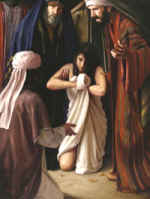
The scribes and the Pharisees bring before Jesus an adulterous woman and say to him, “Teacher, this woman was caught in the very act of committing adultery. Now in the law, Moses commanded us to stone such women. So what do you say?”

This scene raises some questions. For instance, how did Jesus’ enemies know where to find an adulteress when they needed one? It’s unlikely this affair was discovered just that morning. It must have been known from days, weeks, months, or even years before.

This prompts another question: if this affair had occurred much earlier, then why had the Jews not executed judgment on this woman before now. There seems to be two reasons for this. First of all, under Roman rule, the Jews had no authority to impose the death penalty on anyone. We will see this come into play in the Passion, where the Jewish leaders must convince Pilate that Jesus is an enemy of the state if they are going to do away with this “blasphemer.”

But there is another reason, too. Even though the Law of Moses had commanded death for certain sins, based upon what I’ve read the actual use of capital punishment for sins was very, very rare among the people of Israel, even before the Romans came along. And, as we can see in this scene, not even the scribes and the Pharisees are really serious about applying the law in strict and absolute terms. If they had been, they would have brought along the adulterous man for judgment too. Where is he? He was just as guilty as her, if not more (considering their culture.)

So the penalty of death was very rarely employed for punishing sinners, but then why were these severe punishments in the Old Covenant at all?  It seems that the point of those rarely applied laws was to teach an important lesson, a lesson repeated over and over again in countless ways throughout the Old Testament, a lesson for the Jews and a lesson for us today:

Sin is serious stuff, because sin leads to death.
Sin brings us death in our bodies and our souls.
Sin means death.

The scribes and the Pharisees round up a known adulteress and set their trap against Jesus (which is the only thing this is really about for them.) Jesus’ enemies will try pitting justice against Jesus’ mercy. They’re thinking to themselves, “Surely he’s not going to tell us to stone her, that’s not his way. He says he ‘has come not to destroy, but to seek and to save what is lost.’ So when he tells us not to stone her, then we’ve got him. He’ll be telling us to disobey the Law of Moses, and then we’ll have a charge to bring against him.”

“So Jesus… what do you say?” Jesus says nothing. He stoops down and writes with His finger on the ground the only thing we have record of Him writing in the entire Gospels. What did Jesus write? We don’t know. The Greek verb used indicates that Jesus was writing letters or words, and not drawing disinterested doodles or drawing a line between the accused and her accusers.

A common explanation is that Jesus’ finger was writing on the ground the names of sins, sins which those in the crowd had committed, sins which the finger of God had written of long before, on the stones of the commandments atop Mount Sinai. Perhaps Jesus wrote the words: “Sacrilege, Rebellion, Adultery, Theft, Deception, Coveting.”

The accusers continue harassing Jesus, but He rises again, and gives his well-known reply. The crowd of evil doers slowly scatters, and Jesus is left there alone with the woman. The threatening mob is gone, and you think that the woman would flee, but the woman does not run away. She knows she has sinned. She knows that she cannot run away from her sins or from God. She stays there before Jesus.

Jesus rises again and says to her, “Woman, where are they? Has no one condemned you?”
She replies, “No one, sir.”
Jesus says, “Neither do I condemn you. Go, and from now on do not sin any more.”

Jesus condemns the sin, but not the sinner. Jesus is merciful, but He is not indifferent to the prospect of her continuing in sin, nor is he indifferent to us continuing in our old sins. He does not say, “Go, and live as you will: presume on my deliverance: for however great your sins may be, it doesn’t really matter one way or the other.”

Jesus does not say this, for sin means death, and Jesus died to free us from sin and death. So let us come before Jesus to receive His pardon, but then let us go forth seriously and, from now on, sin no more.

Persons are Mysteries — Tuesday, 1st Week in Ordinary Time—Year II

January 12, 2010

Persons are always a mystery to each other. You could be lifelong friends with someone, and never exhaust their mystery. Husbands and wives can be married for fifty or sixty and still surprise each other.  Persons are always remain a mystery because our thoughts and minds, our motives and hearts, are hidden from each other. Realizing this, we should be very careful about the conclusions we arrive at about others.

For example, in the first reading, Hannah comes to the temple with a great longing in her heart. She wants a child and she asks for this from God at length, from her heart, with tears. 

Eli [the priest,] thinking her drunk, said to her, “How long will you make a drunken show of yourself? Sober up from your wine!”

She is pouring out her heart as a saint before him, but Eli thinks she is a drunk. (This is not one of the greatest moments in history for priestly pastoral ministry.) It’s wrong to get drunk, and it would be o.k. for Eli to tell her so if she were, but she’s not. Eli doesn’t understand  her. He doesn’t even understand what’s happening right in front of him. Oftentimes, we’re just like Him.  Another example of arriving at false conclusions in seen in the Gospel:

In their synagogue was a man with an unclean spirit; he cried out, “What have you to do with us, Jesus of Nazareth? Have you come to destroy us?

The demon doesn’t understand Jesus’ motives.  The demon looks at things in terms of power, control, and domination, not love. The demon thinks that no one can be better than himself. Thus, Jesus is a threat that must be knocked down.

It’s not our style to accuse and criticize people so directly.  We’re too timid for that. When someone commits a fault or offense, how likely are we to go to them face to face about it? How much more likely are we to complain to someone else about it out of their presence?

What’s wrong with speaking negatively about others?  For starters, what we think we know is often false, like we saw with Eli. And even if the report is true we judge uncharitably, like the demon.  Speaking negatively about others is also unhelpful.  Jesus says in the Gospel. “If your brother sins against you, go to him in private.” This can clear up many misunderstandings and result in a solution. Instead, we may talk to everyone in the world about our burden besides the one person we actually need to. Finally, speaking negatively about others, even in private, wounds unity.  Even if your criticisms never find their way back to the person which they are about, harm is still done.  The person you are speaking with will wonder to themselves, “Does this person talk about me behind my back to others? How small of a fault on my part would that take?”

At times you will be misunderstood and people will speak ill of you, especially if you are faithful in following Jesus Christ.  But as for your part, never speak a bad word about anyone, unless it is really necessary. Live in this way and people will respect & love you for it. People will notice, as they did with Jesus, and say, “This person does not speak like the others. They speak like Jesus Christ.”